Problems
Filters
1974 Paper 3 Q1
Prove the Binomial Theorem, that \begin{equation*} (1+x)^n = \sum_{r=0}^{n} \binom{n}{r} x^r \end{equation*} (where \(n\) is a positive integer). Let \(m, k\) be positive integers. By considering the powers of 2 occurring in the numerator and denominator, or otherwise, show that \(\binom{2^k m}{2^k}\) and \(m\) are either both even or both odd. Deduce that if the coefficients of \(x^r\) in \((1+x)^n\) are all odd, then \(n+1 = 2^k\) for some \(k\).
1974 Paper 3 Q2
Let \(u_1\) be an odd positive integer greater than 1. For \(n > 1\), \(u_n\) is defined by the relation \begin{equation*} u_n = u_{n-1}^2 - 2. \end{equation*} Show that, for \(n > 1\), 1 is the highest common factor of \(u_n\) and \(u_m\) for \(1 \leq m \leq n-1\). Show further that 1 is the highest common factor of \(u_n\) and \(u_m - 1\) for \(1 \leq m \leq n\).
1974 Paper 3 Q3
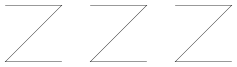
Discuss the symmetry group of the plane which preserves the following pattern, considered to extend to infinity in both directions (the 'ends' of the pattern). Define two particular symmetries \(T\) (a translation to the right by one unit) and \(R\) (a rotation through \(180^{\circ}\) about the mid-point of one of the Z's), and show that: (i) any symmetry which leaves fixed the two ends of the pattern is of the form \(T^r\) with \(r\) a positive or negative integer. (ii) \(R\) interchanges the two ends, and \(R^2\) is the identity. (iii) \(RTR = T^{-1}\). (iv) Any symmetry \(S\) which interchanges the two ends of the pattern is of the form \(T^r R\) for some \(r\). Show also that in case (iv) \(S\) has a single fixed point in the plane, and that \(S^2\) is the identity.
1974 Paper 3 Q4
\(P\) is a point, and \(l\) and \(m\) are lines, in 3-dimensional space. Show that if \(l, m\) and \(P\) are general enough, there is a unique line passing through \(P\) and meeting both \(l\) and \(m\). Suppose that, in terms of coordinates \((x, y, z)\), \(l\) is given by \(x = 1, y = 0\), and \(m\) by \(x = -1, z = 0\); prove that the line through the point \((0, \alpha, \alpha)\) which meets \(l\) and \(m\) is given by \begin{equation*} \alpha(x-1)+y = 0, \quad \alpha(x+1)-z = 0. \end{equation*} Deduce that, if \(n\) is a third line given by \(x = 0, y = z\), then the point \(P\) with coordinates \((x, y, z)\) lies on a line which meets \(l, m\) and \(n\) if and only if \(z(x-1)+y(x+1) = 0\).
1974 Paper 3 Q5
Two coplanar circles \(S\) and \(S'\) are exterior to one another and have different radii. A line is called special if it intersects \(S\) and \(S'\) in four points which are at the ends of four distinct diameters having the property that they are parallel in pairs. Determine all the distinct diameters through which pass at least three special lines. Determine also the points through which pass two, but not three, special lines.
1974 Paper 3 Q6
The cubic curve \(C\) in the \((x, y)\)-plane is defined by \(y^2 = x^3-x\). Sketch the curve. Let \(P\) be the point \((1, 0)\), and let \(Q\) be a point \((x_0, y_0)\), lying on \(C\) and distinct from \(P\). Show that the line \(PQ\) touches \(C\) at \(Q\) if and only if \(x_0^2 - 2x_0 - 1 = 0\). Let \(P'\) be the point \((1-\epsilon, 0)\), where \(\epsilon\) is small and positive. Sketch all the tangents from \(P'\) to \(C\).
1974 Paper 3 Q7
\(f(x)\) is a real function that satisfies, for all \(x, y\), \begin{equation*} f(x+y)+f(x-y) = 2f(x)f(y). \tag{*} \end{equation*} Prove that either \(f(0) = 0\), or \(f(0) = 1\) and \(f'(0) = 0\). Prove that in the former case \(f(x)\) is identically zero, and that in the latter case \begin{equation*} f'(x) = f''(0)f(x). \end{equation*} Hence find all solutions of (*). [You may assume that \(f\) is twice differentiable.]
1974 Paper 3 Q8
A disc \(D\) of radius \(b\), whose centre is initially at a point with rectangular cartesian coordinates \((1+b, 0)\), rolls without slipping round a disc with radius 1 and centre the origin; its point of contact at time \(t\) is \((\cos t, \sin t)\). A point \(P\) is embedded in the disc \(D\), and is initially at \((1+a+b, 0)\); at time \(t\), the coordinates of \(P\) are \((x(t), y(t))\). Determine \(x(t), y(t)\), and check your answers by considering the case \(a = 0\). In the case \(a > 0\), show that \(P\) will return to its initial position if and only if \(b\) is rational (i.e. \(b = p/q\), where \(p\) and \(q\) are integers and \(q \neq 0\)). Show that the area enclosed by the curve traced by \(P\) when \(a = b = 1\) is \(6\pi\).
1974 Paper 3 Q9
The probability that a family has exactly \(n\) children (\(n \geq 1\)) is \(\alpha p^n\), where \(\alpha > 0\) and \(0 < p < 1\). The probability that it has no children is therefore \(1-\alpha p(1-p)^{-1}\). The probability that a child is a boy is \(\frac{1}{2}\). Show that the probability that a family has exactly \(k\) boys is \(2\alpha p^k(2-p)^{k+1}\), if \(k \geq 1\). Given that a family includes at least one boy, find the probability that there are at least two boys in the family.
1974 Paper 3 Q10
The following test was designed to examine whether cards shuffled by a machine were in random order. Four red cards followed by six black cards were placed in the machine. After shuffling the first four cards were examined and the number of red cards among them was noted. This was repeated 1260 times and the results are tabled below.