Problems
Filters
1978 Paper 4 Q13
A particle projected from a point on a smooth inclined plane strikes the plane normally at the \(r\)th impact, and is at the point of projection at the \(n\)th impact; if the coefficient of restitution is \(e\), prove that \[e^n - 2e^r + 1 = 0.\]
Solution: We will repeatedly be using the following result about how long a particle under constant acceleration returns to it's initial point (component-wise). \begin{align*} && s &= ut - \frac12 at^2 \\ && t_{\text{return}} &= \frac{2u}{a} \\ \end{align*} Let the initial speed up the slope be \(u_x\) and perpendicular to the slope be \(u_y\). Let the acceleration down the slope be \(g_x\) and the acceleration perpendicular to the slope be \(g_y\). (We can calculated these in terms of the angle of the slope but there is no need to). So at the \(r^{\text{th}}\) bounce the "normal to the slope" bounces have taken \[ \frac{2u_y}{g_y}\left (1 + e + e^2 + \cdots + e^{r-1} \right) = \frac{2u_y}{g_y} \left ( \frac{1-e^r}{1-e} \right) \] We must also have that the "parallel to the slope" speed is \(0\) at this time since the particle strikes the plane normally, so: \[0 = u_x - g_x t = u_x -g_x \frac{2u_y}{g_y} \left ( \frac{1-e^r}{1-e} \right) \tag{*} \] Over the whole journey we must have the time taken is \(\frac{2u_y}{g_x} \left (\underbrace{1 + e + \cdots + e^{r-1}}_{\text{outward journey}} + \underbrace{e^r + \cdots + e^{n-1}}_{\text{return journey}} \right) = \frac{2u_y}{g_x}\frac{1-e^{n}}{1-e}\) and we must be exactly at the start, ie \(t = \frac{2u_x}{g_x}\) Therefore we must have: \begin{align*} && u_x &= u_y \frac{2g_x}{g_y}\frac{1-e^r}{1-e} \tag{*} \\ && \frac{2u_x}{g_x} & = \frac{2u_y}{g_x}\frac{1-e^{n}}{1-e} \tag{two ways of calculating total time taken} \\ \Rightarrow && 2\left ( \frac{1-e^r}{1-e} \right) &= \frac{1-e^n}{1-e} \\ \Rightarrow && 2-2e^r &= 1 - e^n \\ \Rightarrow && 0 &= e^n -2e^r+1 \end{align*}
1978 Paper 4 Q14
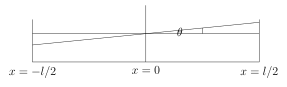
When the wind blows from the southwest, the water in Loch Ness piles up at the northeast end; if the wind then falls, the water sloshes to and fro between the ends of the Loch. Consider the following model of this phenomenon. The water surface is assumed to be plane and the Loch a rectangular container of length \(l\), breadth \(b\) and depth \(h\). As the water rises at one end, water must flow through the vertical plane through \(x = 0\), and it is assumed to do this at a speed \(v\) independent of depth and distance across the Loch.
1978 Paper 4 Q15
Define the scalar product \(\mathbf{a}\cdot\mathbf{b}\) and the vector product \(\mathbf{a} \wedge \mathbf{b}\) of two vectors. Prove that \[(\mathbf{a}+\mathbf{b}) \wedge \mathbf{c} = \mathbf{a} \wedge \mathbf{c} + \mathbf{b} \wedge \mathbf{c}.\] Given three non-coplanar vectors \(\mathbf{a}\), \(\mathbf{b}\), \(\mathbf{c}\) prove that an arbitrary vector \(\mathbf{x}\) may be written in the form \[\mathbf{x} = (\mathbf{x}\cdot\mathbf{a}^*)\mathbf{a} + (\mathbf{x}\cdot\mathbf{b}^*)\mathbf{b} + (\mathbf{x}\cdot\mathbf{c}^*)\mathbf{c},\] where \[\mathbf{a}^* = \frac{\mathbf{b} \wedge \mathbf{c}}{\mathbf{a}\cdot(\mathbf{b} \wedge \mathbf{c})}\] and \(\mathbf{b}^*\), \(\mathbf{c}^*\) are defined similarly. Show that \(\mathbf{a} = \mathbf{a}^*\), \(\mathbf{b} = \mathbf{b}^*\), \(\mathbf{c} = \mathbf{c}^*\) if and only if \(\mathbf{a}\), \(\mathbf{b}\), \(\mathbf{c}\) form an orthogonal triad of unit vectors.