Problems
Filters
1962 Paper 3 Q102
State the basic laws of Newtonian mechanics, explain their meaning, and give reasons for believing them.
1962 Paper 3 Q103
A particle is released from rest at a point on the surface of smooth sphere very near to the top. Find where it leaves the sphere. If the sphere is roughened in patches and the particle, released in the same way, eventually leaves the surface, prove that it does so at a lower point than in the previous case.
1962 Paper 3 Q104
A particle of mass \(M\) is projected with initial components of velocity along the \(x\)-, \(y\)- and \(z\)-axes equal to \(U\), 0 and \(W\) respectively, where the \(z\)-axis is vertically upward and \(W > 0\). A wind of speed \(V\) is blowing in the direction of the \(y\)-axis. In addition to its weight, the particle experiences a force equal in magnitude and direction to \(-kM\) times its velocity relative to the air. Prove that, at the highest point of its trajectory, the particle's speed is $$[(gU)^2 + (kVW)^2]^{1/2}/(g + kW).$$
1962 Paper 3 Q105
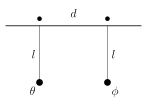
Two identical simple pendulums each of mass \(M\) and length \(l\), suspended from the same horizontal plane, are connected by a light straight spring (which is both inextensible and extensible) of natural length \(d\) and modulus of elasticity \(\lambda\), as shown in the figure. The system is released from rest with the pendulums coplanar and \(\theta\) and \(\phi\) small. Prove that the quantities \((\theta + \phi)\) and \((\theta - \phi)\) vary periodically with time, and find their approximate periods.
1962 Paper 3 Q106
A moving particle strikes another particle of equal mass which is free but initially at rest, and they rebound in such a way that their combined kinetic energy is the same before and after the collision. Prove that in general the angle, \(\theta\), between their paths after the collision is equal to 90°. If, on the other hand, kinetic energy is lost in the collision, show that \(\theta < 90^{\circ}\).
1962 Paper 3 Q107
The points of contact with the ground of the four wheels of a car are at the corners of a rectangle of length \(2d\), and the centre of mass of the car is always at a height \(h\) directly above the centre of the rectangle. If, when the car is travelling straight on level ground, the brakes are applied on the front wheels only causing them to lock, a deceleration \(f\) is produced. If instead the brakes are applied on the back wheels only causing them to lock, the deceleration is \(R_0\). The coefficient of friction between the tyres and the ground is \(\mu\), and the resistance offered by the free wheels in each case is negligible. The moments of inertia of rotating parts are to be neglected. If the back wheels do not leave the ground, find the ratio \(R_1/R_0\) and prove that its maximum value is 2. (Hint. It is correct to take moments about the centre of mass, even though it is a moving point.)
1962 Paper 3 Q108
Define the moment of inertia of a rigid body about a given axis. From your definition prove that, among all axes in a given direction, the one about which the moment of inertia is least passes through the centre of mass of the body. Determine the axes about which a uniform circular lamina has least moment of inertia.
1962 Paper 3 Q109
A horizontal turntable is free to rotate about a point \(O\). It has moment of inertia \(I\) and is initially at rest. A circular path of radius \(r\) passing through \(O\) is marked out on the turntable. A man of mass \(m\) starts from \(O\) and walks once round the path. Find, in the form of a definite integral, the angle through which the turntable has turned when the man gets back to \(O\), and show that it is approximately \(\frac{1}{2}ma^2/I\) if \(ma^2\) is small compared with \(I\).
1962 Paper 3 Q110
A particle, \(P\), moving in a plane is acted upon by a force of magnitude \(mk/r^2\) directed towards a fixed point \(O\), where \(m\) is the mass of the particle and \(r\) is the length of \(OP\). State the equations of motion of the particle in terms of polar coordinates \((r, \theta)\). Deduce from these equations that \(r^2\dot{\theta}\) is a constant, say \(H\), and that $$\frac{1}{2}r^2 + \frac{1}{2}H^2/r^2 - k/r = \text{constant}.$$ State the physical meaning of this equation, and interpret the individual terms in it.
1962 Paper 3 Q201
Weights \(w_i\) (\(i = 1, 2, \ldots, n\)) are hung from points of a light inextensible string which is suspended at its two ends from given fixed points. The lengths of the segments are given. Show how to obtain sufficient equations to determine the tension and inclination of each segment. Equal weights \(W\) are attached at equal horizontal intervals \(a\) to a light inextensible string which hangs between given points. Show that the points of attachment of the weights lie on a parabola of latus rectum \(2aW/H\), where \(H\) is the horizontal component of tension.