Problems
Filters
1975 Paper 3 Q12
An elliptical disc with semi-axes \(a, b\) can be thought of as a circular disc of radius \(b\) which has been stretched uniformly by a factor \(a/b\) in one direction and not stretched in the perpendicular direction. Use this concept (or any other method) to show that the radius of gyration of an elliptical disc about an axis through its centre perpendicular to its plane is \(\frac{1}{2}\sqrt{a^2+b^2}\). The disc is at rest on a flat table with its major axis vertical. Given an infinitesimal push, it rolls sideways without slipping. Find its angular velocity when the minor axis is vertical.
1975 Paper 3 Q13
Two stars \(B\) and \(X\) with masses \(m_B\) and \(m_X\) and separation \(d\) revolve in circles around their common centre of gravity, under the influence of Newtonian gravity (force of attraction \(= Gm_Bm_X/d^2\)). Find the velocity of each star and the period of revolution. An observer views the system from a very large distance at an angle \(\theta\) to the normal to the plane of their orbits. He can recognise \(B\) as a star of a type that has mass \(m_B\), and star \(X\), which produces X-rays must be either a neutron star or a black hole, whose mass is less than or more than 2 units respectively. He measures the line-of-sight component of \(B\)'s velocity, and finds it fits a curve \(V = K\sin \omega t\). Show that \[\frac{m_X^3}{(m_B+m_X)^2}\sin^3\theta = \frac{|K|^3}{\omega G}.\] His measurements give \(\frac{K^3}{\omega G} = 1/250\) units. If all values of \(\cos\theta\) are equally likely, find the probability that \(X\) is a black hole.
1975 Paper 3 Q14
A particle can slide smoothly in a uniform straight tube. The tube and the particle have equal masses. The tube can rotate freely in a horizontal plane about a fixed end. It is given an initial angular velocity, and the particle is displaced slightly along the tube from its fixed end. Show that the particle must eventually leave the other end, and does so at an angle of approximately \(\tan^{-1}\frac{1}{2}\) to the axis of the tube.
1975 Paper 3 Q15
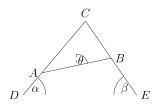
A heavy rod \(AB\) slides by means of smooth rings on the two fixed rods \(CD, CE\) which lie in a vertical plane and make acute angles \(\alpha, \beta\) respectively with the horizontal (see the diagram below). The centre of gravity of the rod \(AB\) is at a fraction \(\lambda\) of its length from \(B\). If the rod makes an angle \(\theta\) with the vertical, show that in equilibrium \[\cot\theta = \lambda\cot\beta-(1-\lambda)\cot\alpha.\] Show that the equilibrium is always stable when \(A\) and \(B\) lie below \(C\).
1975 Paper 3 Q16
A spacecraft has cylindrical symmetry. The unit vector through the centre of gravity along the axis of symmetry is \(\mathbf{l}\) and the spin vector of the spacecraft is \(\boldsymbol{\omega}\). The spacecraft is falling freely in space so that the equation of motion of its axis of symmetry is \[\frac{d\mathbf{l}}{dt} = \boldsymbol{\omega} \times \mathbf{l}.\] Show that \(\boldsymbol{\omega} = \mathbf{l} \times \frac{d\mathbf{l}}{dt} + (\boldsymbol{\omega} \cdot \mathbf{l})\mathbf{l}\). The angular momentum \(\mathbf{h}\) of the spacecraft may be written \[\mathbf{h} = A\mathbf{l} \times \frac{d\mathbf{l}}{dt} + C(\boldsymbol{\omega} \cdot \mathbf{l})\mathbf{l}, \quad \text{where \(A\) and \(C\) are constants.}\] The craft is struck by a meteor and the angular momentum after this impact is \(\Gamma\mathbf{k}\), where \(\Gamma\) is a constant and \(\mathbf{k}\) a constant unit vector. Show that \[\frac{\boldsymbol{\omega}}{\Gamma} = \frac{\mathbf{l} \times (\mathbf{k} \times \mathbf{l})}{A} + \frac{(\mathbf{k} \cdot \mathbf{l})\mathbf{l}}{C}\] and that \[\frac{d\mathbf{l}}{dt} = \frac{\Gamma}{A}\mathbf{k} \times \mathbf{l}.\] Deduce the subsequent motion of the spacecraft's axis. [You may assume that \(\mathbf{a} \times (\mathbf{b} \times \mathbf{c}) = (\mathbf{a} \cdot \mathbf{c})\mathbf{b} - (\mathbf{a} \cdot \mathbf{b})\mathbf{c}\).]
1975 Paper 4 Q1
By first calculating how many different non-degenerate triangles can be formed with a rod of length \(m > 3\) and two other rods selected from a set of \(m - 1\) rods of lengths 1, 2, \ldots, \(m, - 1\), or otherwise, prove that if 3 rods are chosen from 2n rods of lengths 1, 2, \ldots, 2n the chance that they can be used to construct a non-degenerate triangle is \[\frac{4n-5}{4(2n-1)}.\]
1975 Paper 4 Q2
Elements \(a\), \(b\), \(c\), \(\alpha\), \(\beta\), \(\gamma\) of a group are given, and \(a\), \(b\), \(c\) are all different. No four distinct elements \(x\), \(y\), \(z\), \(t\) from \(\{a, b, c, \alpha, \beta, \gamma\}\) satisfy \(x^{-1}y = z^{-1}t\). Prove that if \[1 \neq \alpha a^{-1} = \beta b^{-1} = \gamma c^{-1}\] then \(ab^{-1}\) has order 3 and \(c = ab^{-1}a = ba^{-1}b\). Give an example of a group in which the above situation obtains and show that it does.
1975 Paper 4 Q3
Let \(f(x, y, z) \equiv x^2 + y^2 + z^2 - xy - yz - zx\). Show that \[f(x, y, z) = (x + \omega y + \omega^2 z)(x + \omega^2 y + \omega z),\] where \(\omega\) is a complex cube root of 1. Prove that if \((y - z)^n + (z - x)^n + (x - y)^n\), (\(n \geq 2\)), has \(f(x, y, z)\) as a factor then 3 does not divide \(n\); and that if the expression has \(\{f(x, y, z)\}^2\) as a factor then \(n\) is of the form \(3m + 1\).
1975 Paper 4 Q4
A triangle is called chromatic if all its sides are the same colour. Each pair of \(n\) distinct points \(P_1\), \ldots, \(P_n\) in space is connected with either a red line or a black line. Prove that if \(n = 6\) there must be at least 2 chromatic triangles of the form \(P_iP_jP_k\). Deduce that if \(n = 7\) there are at least 3 such chromatic triangles.
1975 Paper 4 Q5
A solid cone is described by the following equations (in cylindrical polar coordinates \((r, \phi, z)\)): \begin{align} r &\leq -z\tan\alpha \quad (\alpha < \pi/2)\\ z &\leq 0\\ z &\geq mr\sin\phi-a \quad (m < \cot\alpha) \end{align} \(\alpha\), \(m\) and \(a\) are constants with \(a > 0\). Sketch the cone. The cone is placed on its side on a plane, with its vertex at a point \(O\). The cone is in contact with the plane along the line segment \(OP\), which is initially of length \(a\sec\alpha\). The cone now rolls on the plane, the vertex remaining at \(O\). Obtain the polar equation of the locus of the point \(P\) in terms of the distance \(R\) from \(O\) to \(P\), and the angle between the line \(OP\) and its initial direction. What conditions are required on \(\alpha\) to ensure that the curve is closed?