Problems
Filters
1976 Paper 2 Q12
A hollow cylinder of internal radius \(3a\) is fixed with its axis horizontal. There rests inside it in stable equilibrium a uniform solid cylinder of radius \(a\) and mass \(M\). The axes of the cylinders are parallel and no slipping can occur between them. A particle of mass \(m\), with \(m > M\), is now attached to the top of the inner cylinder. Show that this equilibrium position is no longer stable. If the equilibrium is slightly disturbed, show that the particle touches the outer cylinder in the subsequent motion only if \(m \geq 2M\).
1976 Paper 2 Q13
An aeroplane flies at a constant air speed \(v\) around the boundary of a circular airfield. When there is no wind it takes a time \(T\) to complete one circuit of the airfield. Show that when there is a steady wind blowing, whose speed \(u\) is small compared with \(v\), the increase in the time required for one circuit is approximately \(3Tu^2/4v^2\).
1976 Paper 2 Q14
A uniform cylinder of radius \(a\) and mass \(M\) rests on horizontal ground with its axis horizontal. A uniform rod of length \(2l\) and mass \(m\) rests against the cylinder and has one end attached to the ground by a smooth hinge. The rod makes an angle \(2\alpha\) with the horizontal such that \(a\cot\alpha < 2l\), and it lies in the vertical plane through the centre of the cylinder which is perpendicular to its axis. The coefficients of friction between the cylinder and the rod, and between the cylinder and the ground, both have value \(\mu\). Show that the system is in equilibrium provided that \(\mu > \tan\alpha\). A force \(P\) is now applied at the centre of the cylinder along a line parallel to the rod and directed away from the hinge. Find the smallest value of \(P\) for which the cylinder will move, on the assumption that slipping occurs first between the cylinder and the rod.
1976 Paper 2 Q15
A light elastic string of unstretched length \(3l\) passes over a small smooth horizontal peg. Particles \(A\) and \(B\) of masses \(m\) and \(3m\) respectively are attached to the ends of the string. Initially \(B\) is held fixed at a distance \(2l\) vertically below the peg, and the string hangs in equilibrium with \(A\) and \(B\) at the same level. Particle \(B\) is now released. Show that \(A\) moves upwards until it strikes the peg, and that the maximum length of the string during this motion is \(5l\).
1976 Paper 2 Q16
\(O\), \(P\), \(Q\), \(R\) are four non-coplanar points. \(A\), \(B\), \(C\), \(D\) are four coplanar points which lie respectively on the straight lines \(OP\), \(PQ\), \(QR\), \(RO\). Let \[\alpha = OA/AP, \beta = PB/BQ, \gamma = QC/CR, \delta = RD/DO.\] Using three-dimensional vectors with origin \(O\), express the position vectors of \(A\), \(B\), \(C\), \(D\) in terms of those of \(P\), \(Q\), \(R\) and the ratios \(\alpha\), \(\beta\), \(\gamma\), \(\delta\). Deduce that \[\alpha\beta\gamma\delta = 1.\]
1976 Paper 3 Q1
Let \(b\) and \(c\) be real numbers. The cubic equation \(x^3 + 3x^2 + bx + c = 0\) has three distinct real roots which are in geometric progression. Show that there are unique values of \(b\) and \(c\) such that the roots of this equation are integers, and find this equation and its roots.
Solution: Say the roots are \(k,l,m\), (in order of their geometric progression). Then we must have that \(km = l^2\) and \(k+l+m = -3\). \begin{align*} && km &= (3+k+m)^2 \\ \Rightarrow && km &= 9+k^2+m^2 + 6k+6m + 2km \\ \Rightarrow && 0 &= k^2+6k+m^2+6m+km+9 \\ \Rightarrow && 0 &= 2k^2+12k+2m^2+12m+2km+18 \\ &&&= (m+k)^2 + (k+6)^2+(m+6)^2-72+18 \\ \Rightarrow && 54 &= (m+k)^2 + (k+6)^2+(m+6)^2 \end{align*} \(54\) can be written as the sum of \(3\) squares as \(1^2+2^2+7^2, 2^2+5^2+5^2, 3^2+3^2+6^2\). Case 1: \(1^2+2^2+7^2\) Case 1a: \(7 = m+6 \Rightarrow m = 6\). Contradiction since \((k+6)^2\) is both \(1^2\) and \(2^2\) Case 1b: \(7 = m+k \Rightarrow \) one of \(m\) or \(k\) is bigger than \(0\), contradiction. So case 1 is impossible, Case 2: \(2^2+5^2+5^2\) Case 2a: \(5 = m+6 \Rightarrow m = -1\). If \((k-1)^2, (k+6)^2 = 2^2, 5^2\) clearly not possible. Case 2b: \(2 = m+6 \Rightarrow m = -4\), Then \((k+6)^2, (k-4)^2 = 2^2, 5^2\) also not possible. So case 2 is impossible. Case 3: \(3^2+3^2+6^2\) Case 3a: \(6 = m+6 \Rightarrow m = 0\) contradiction. Therefore we must have \(m = -3, n = -3\) and clearly \(-3,3,-3\) works, so our equation is: \((x+3)^2(x-3) = (x^2+6x+9)(x-3) = x^3+3x^2-9x-27\)
1976 Paper 3 Q2
Define a sequence of numbers \(x_0, x_1, \ldots\) by \[x_{n+1} = \frac{1}{2}\left(x_n + \frac{a}{x_n}\right) \quad (a \geq 0).\] Show that \[\sqrt{a} < x_n < x_{n-1} < \ldots < x_1,\] provided that \(x_0\) is positive and does not take one special value. Find the limit of the sequence \(x_0, x_1, x_2, \ldots\). Does \(x_n\) converge if \(a < 0\)?
1976 Paper 3 Q3
Show that the set of real-valued \(2 \times 2\) matrices with determinant \(\pm 1\) forms a group \(G\) under matrix multiplication. Show that the matrix \[\begin{pmatrix} \cos\theta & \sin\theta \\ -\sin\theta & \cos\theta \end{pmatrix}\] is a member of \(G\) and deduce that \(G\) contain subgroups of all finite orders. Are all finite subgroups of \(G\) cyclic?
1976 Paper 3 Q4
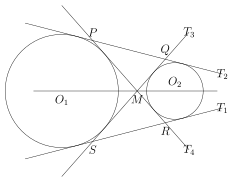
Let \(C_1, C_2\) be non-intersecting circles with centres \(O_1, O_2\) respectively and common tangents \(T_1, T_2, T_3, T_4\). \(T_3\) and \(T_4\) meet at \(M\) on the line of centre between \(O_1\) and \(O_2\). \(T_1\) meets \(T_3\) at \(Q\) and \(T_4\) at \(P\), and \(T_2\) meets \(T_3\) at \(S\) and \(T_4\) at \(R\) (see the diagram below). Let \(O_1 P\) and \(O_2 Q\) meet at \(N\) and let \(O_1 S\) and \(O_2 R\) meet at \(L\). Prove that \(L\), \(M\) and \(N\) are collinear.
1976 Paper 3 Q5
\(C\) is the mid-point of \(OD\) and the point \(Q\) lies on the semi-circle through \(D\), with centre \(O\), whose diameter is perpendicular to \(OD\). Points \(A\) and \(B\) lie in the plane of the semi-circle, are equidistant from \(O\) and also equidistant from \(Q\). The point \(R\) completes the rhombus \(QARB\). Find the locus of \(R\) as \(Q\) traverses the semi-circle, the distances \(OA\), \(OB\), \(QA\), \(QB\), \(AR\), \(BR\) remaining fixed.