Problems
Filters
1974 Paper 3 Q9
The probability that a family has exactly \(n\) children (\(n \geq 1\)) is \(\alpha p^n\), where \(\alpha > 0\) and \(0 < p < 1\). The probability that it has no children is therefore \(1-\alpha p(1-p)^{-1}\). The probability that a child is a boy is \(\frac{1}{2}\). Show that the probability that a family has exactly \(k\) boys is \(2\alpha p^k(2-p)^{k+1}\), if \(k \geq 1\). Given that a family includes at least one boy, find the probability that there are at least two boys in the family.
1974 Paper 3 Q10
The following test was designed to examine whether cards shuffled by a machine were in random order. Four red cards followed by six black cards were placed in the machine. After shuffling the first four cards were examined and the number of red cards among them was noted. This was repeated 1260 times and the results are tabled below.
1974 Paper 3 Q11
A bell of mass \(M\) is in the form of a hollow right circular cone of height \(h\) and semivertical angle \(\alpha\), and is made of thin uniform material. It is mounted on a light spindle passing through the vertex and perpendicular to the axis of the cone. Calculate its moment of inertia about the spindle.
1974 Paper 3 Q12
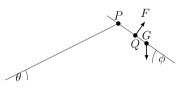
A kite of mass \(m\) possesses an axis of symmetry on which lie the mass centre \(G\) and the point of attachment, \(P\), of the light string by which it is held. The string, \(PG\), may be assumed to lie in a fixed vertical plane, in which a horizontal wind blows with speed \(v\). The string makes an angle \(\theta\), and the kite an angle \(\phi\), with the horizontal in the senses shown. It is known that the force exerted by the wind on the kite has a magnitude \(F\) passing through a fixed point \(Q\) on \(PG\) (\(PQ = a\), \(QG = b\)), normal to the kite, where \(F = Cv\sin\phi\), \(C\) being a constant. Show that the kite adopts an equilibrium position described by \begin{equation*} \tan\phi = \frac{mg}{Cv}\left(1+\frac{b}{a}\right). \end{equation*} The string has fixed length \(l\) and is attached to the ground, and the wind speed at height \(h\) is given by \(v = \beta h\). Neglecting the variation of wind speed over the kite, show that it flies at a height governed by \begin{equation*} \tan\theta = \frac{\lambda ab}{(a+b)^2}\sin\theta-\frac{1}{\lambda\sin\theta}, \end{equation*} where \(\lambda = C\beta l/mg\). Show graphically that, for sufficiently large \(\lambda\), this equation has two roots in \(0 < \theta < \frac{\pi}{2}\).
1974 Paper 3 Q13
A circular hoop of radius \(a\) rolls without slipping, in a vertical plane, with angular velocity \(\omega\) along a rough horizontal table in a direction perpendicular to the edge. Prove that when it reaches the edge the centre of the hoop will fall through a vertical distance \(a(g-a\omega^2)/2g\) before the hoop leaves the edge, provided that \(a\omega^2 < g\). What happens if \(a\omega^2 \geq g\)?
1974 Paper 3 Q14
A four-wheeled truck runs forward freely on level ground. The distance between the front and rear axles is \(D\), and the centre of gravity of the truck is at a distance \(\beta\) from the vertical plane through the front axle and at a height \(H\) above the ground. The moments of inertia of wheels and axles are negligible. Find the deceleration of the truck if the rear wheels become locked (the front wheels remaining free), and \(\mu\) is the coefficient of friction between the wheels and the ground. If the front rather than the rear wheels become locked show that the rear wheels remain on the ground provided that \(\mu < \beta/H\).
1974 Paper 3 Q15
Six wires are connected to form the edges of a tetrahedron \(ABCD\). The resistances of opposite edges are equal. The resistance of \(AB\) is \(R_1\), that of \(AC\) is \(R_2\) and that of \(AD\) is \(R_3\). Show that if a current enters the network at \(A\) and leaves at \(D\) the total resistance of the circuit is \begin{equation*} \frac{(R_1R_2 + 2R_1R_3 + R_2R_3)R_3}{2(R_1 + R_3)(R_2 + R_3)}. \end{equation*}
1974 Paper 3 Q16
Define the vector product of two vectors \(\mathbf{x}\) and \(\mathbf{y}\). Let \(\mathbf{u}\) be a vector of unit length in 3-dimensional space and let \(\mathbf{s}\) be a vector perpendicular to \(\mathbf{u}\); \(\mathbf{s}'\) is the vector obtained by rotating \(\mathbf{s}\) through an angle \(\theta\) about \(\mathbf{u}\). Show that, with a suitable sign convention for \(\theta\), \begin{equation*} \mathbf{s}' = \cos\theta\mathbf{s} + \sin\theta(\mathbf{u} \times \mathbf{s}). \end{equation*} Now let \(\mathbf{r}\) be any vector, and let \(\mathbf{r}'\) be the vector obtained by rotating \(\mathbf{r}\) through an angle \(\theta\) about \(\mathbf{u}\). Deduce a formula for \(\mathbf{r}'\) in terms of \(\mathbf{r}, \mathbf{u}\) and \(\theta\).
1974 Paper 4 Q1
The number of delegates attending a conference is \(m\), where \(m > 2\). A set of seating plans for arranging the delegates around a circular table has the property that in no two plans does any delegate have the same pair of neighbours. If \(p(m)\) is the maximum number of plans possible in such a set prove that \[[\frac{1}{2}m] \leq p(m) \leq \frac{1}{2}(m-1)(m-2),\] where \([\frac{1}{2}m]\) denotes the greatest integer \(k\) such that \(k \leq \frac{1}{2}m\). If \(m = 3n\), where \(n\) is an integer, \(n \geq 2\), show that \(p(m) \geq 2n\).
1974 Paper 4 Q2
Let \(G\) be the multiplicative group of all non-singular \(3 \times 3\) matrices with elements in the field of order 2 (i.e. integers written modulo 2). Under matrix multiplication \(G\) permutes the seven column vectors \(P_1, \ldots, P_7\) amongst themselves, where the elements of the \(P_i\) are also integers written modulo 2, \[P_1 = \begin{pmatrix} 1 \\ 0 \\ 0 \end{pmatrix}, P_2 = \begin{pmatrix} 0 \\ 1 \\ 0 \end{pmatrix}, P_3 = \begin{pmatrix} 0 \\ 0 \\ 1 \end{pmatrix},\] \(P_4 = P_1 + P_2\), \(P_5 = P_1 + P_3\), \(P_6 = P_2 + P_3\) and \(P_7 = P_1 + P_2 + P_3\). Let \(H = \{X \in G: XP_1 = P_1\}\). Show that \(H\) is a subgroup of \(G\). Determine the general form for an element of \(H\), and hence show that \(H\) has order 24. Let \(T_1\), \(T_2\), \(T_3\) and \(T_4\) be the following unordered triples: \begin{align*} T_1 &= \{P_2, P_3, P_6\},\\ T_2 &= \{P_3, P_5, P_7\},\\ T_3 &= \{P_6, P_4, P_7\},\\ T_4 &= \{P_4, P_5, P_6\}. \end{align*} By considering the action of \(H\) on \(T_1\), \(T_2\), \(T_3\), \(T_4\), or otherwise, show that \(H\) is isomorphic to the symmetric group on four symbols.