Problems
Filters
1968 Paper 3 Q12
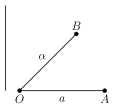
A form of seismograph for detecting horizontal vibrations consists of a thin rod \(OA\) of length \(a\) supported horizontally as shown in the figure. \(O\) is a smooth pivot, and \(AB\) a light inextensible wire. Calculate the period of oscillation for free oscillations of small amplitude. [You may if you wish assume the conservation of energy after the initial disturbance.]
1968 Paper 3 Q13
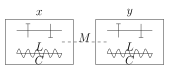
The figure represents a pair of electric circuits each containing a self-inductance \(L\) and a capacitance \(C\); the mutual inductance is \(M\), where \(|M| < L\). The currents \(x\), \(y\) satisfy the equations \begin{align} L \frac{d^2x}{dt^2} + M \frac{d^2y}{dt^2} + \frac{1}{C}x &= 0, \\ M \frac{d^2x}{dt^2} + L \frac{d^2y}{dt^2} + \frac{1}{C}y &= 0. \end{align} Show that these equations can be satisfied by $$x = a \cos(\omega t - \alpha), \quad y = b \cos(\omega t - \alpha)$$ for just two positive values, \(\omega_1\) and \(\omega_2\) say, of \(\omega\), the amplitudes \(a\) and \(b\) being appropriately related and the phase \(\alpha\) being arbitrary. Find \(\omega_1\) and \(\omega_2\) explicitly, and the ratio \(a:b\) for each of the two solutions.
1968 Paper 3 Q14
Without making detailed calculations give one reason in each case why the following statements about a sheet of metal in the form of a regular octagon are wrong:
- [(a)] the area is \(ka^4\), where \(k\) is a dimensionless constant and \(a\) is the distance between a pair of opposite vertices;
- [(b)] the moment of inertia about a line in the plane of the lamina through the centre \(O\) and inclined at an angle \(\alpha\) to a line joining a pair of opposite vertices is
- [(c)] the solid angle subtended by the lamina from a point on the perpendicular to the lamina at \(O\) and at distance \(b\) from \(O\) is (i) \(ka^3/(a+b)\), (ii) \(ka^2/b^2\), where in each case \(k\) is a dimensionless constant.
1968 Paper 3 Q15
The moment of momentum about a point \(O\) of a particle of mass \(m\) moving with velocity \(\mathbf{u}\) is defined as the vector product \(\mathbf{r} \times m\mathbf{u}\), where \(\mathbf{r}\) is the vector drawn from \(O\) to the particle. Prove that, if \(O\) is such that \(\mathbf{r}\) is parallel and the particle moves along a straight line with constant velocity, its moment of momentum about \(O\) is constant. A number of particles interact during a finite time interval. The mass of a typical particle is \(m_i\), its velocity before the interaction is \(\mathbf{u}_i\), and its velocity after the interaction is \(\mathbf{v}_i\). We postulate that $$\sum m_i \mathbf{u}_i = \sum m_i \mathbf{v}_i,$$ i.e. the total momentum is conserved in the interaction (postulate \(A\)). We postulate also that there is a fixed point about which the total moment of momentum of all the particles is zero before and after the interaction (postulate \(B\)). Show that \(A\) and \(B\) together imply that the total moment of momentum about an arbitrary fixed point is conserved in the interaction (principle \(C\)). Show also that \(C\) implies \(A\).
1968 Paper 4 Q1
\(A\) makes a statement which is overheard by \(B\), who reports on its truth to \(C\). \(A\) and \(C\) each independently tell the truth once in three times and lie twice. \(B\) says that \(A\) was lying. By considering the eight combinations of truth and falsehood, or otherwise, find the probability that \(A\) was in fact telling the truth.
1968 Paper 4 Q2
Six equal rods are joined together to form a regular tetrahedron. Two scorpions are placed at the midpoints of two opposite edges of this framework, and a beetle is placed at some point of this framework. The scorpions can move along the rods with maximum speed \(s\), and the beetle with maximum speed \(b\). Show that if \(b < 2s\) the scorpions can always catch the beetle; and explain in detail how they should manoeuvre to do so.
1968 Paper 4 Q3
Let \(N = p_1^{a_1}p_2^{a_2}\ldots p_n^{a_n}\) be the representation of \(N\) as a product of powers of distinct primes. How many proper factors has \(N\)? (A proper factor of \(N\) is an integer \(M\) which exactly divides \(N\) and which satisfies \(1 < M < N\).) Hence or otherwise find
- [(i)] the smallest positive integer with exactly 12 proper factors.
- [(ii)] the smallest positive integer with at least 12 proper factors.
1968 Paper 4 Q4
For any continuous function \(g(x)\) write \[Y(x) = \int_0^x g(t)\,dt.\] Prove the identity \[\int_0^{1\pi} (g^3 - Y^3)\,dx = \int_0^{1\pi} (g - Y\cot x)^2\,dx\] and deduce the inequality \[\int_0^{1\pi} Y^2\,dx \leq \int_0^{1\pi} g^2\,dx.\] For what functions \(g(x)\) are the two sides equal? [Problems of convergence may be ignored.]
1968 Paper 4 Q5
One of the ways of sorting a list of distinct numbers, initially in a random order, involves arranging them in a tree-like structure which satisfies the following rules. The tree consists of nodes, at each of which one of the numbers is placed, and branches each of which join two nodes. There is one special node, called the base, at the foot of the tree; any other node is at the top of just one branch. From any node there is at most one branch which grows upwards to the left, and at most one branch which grows upwards to the right. If a branch grows upwards to the left, all the numbers accessible from the top of the branch by proceeding upwards (including the number at the top of the branch itself) are less than the number at the bottom of the branch; and for a branch that grows upwards to the right they are all greater. (A typical tree is illustrated below.) [Tree diagram showing nodes with numbers: 13, 24 at top level; 22 below them; 34 below 22; 39 at bottom center; 44, 72, 57 on right side; 43, 75 connected to right structure; 45 connecting parts] Numbers are supplied one by one from a list. By means of a flow diagram, or otherwise, describe how to add a new number to an existing tree. (The operations available are to locate the base node, to move up or down an existing branch, to grow a new branch from the node which you are at, to compare the new number with the number placed at the node which you are at, and such other similarly simple operations as you may require.) Draw the tree which should be formed from the list 28, 79, 18, 45, 60, 63, 54, 33, 11, 55, 98, 27, 47, 20.
1968 Paper 4 Q6
Denote by \(g_1, g_2, \ldots, g_n\) the elements of a given finite multiplicative group \(G\), not necessarily commutative, and let \(\mathscr{S}\) be the set of all formal expressions \[a_1g_1 + a_2g_2 + \ldots + a_ng_n,\] where the \(g_i\) are the elements of \(G\) and the \(a_i\) are any real numbers. Addition and multiplication are defined on the set \(\mathscr{S}\) by the rules \[\{\sum a_ig_i\} + \{\sum b_ig_i\} = \sum (a_i + b_i)g_i\] and \[\{\sum a_ig_i\} \times \{ \sum b_jg_j\} = \sum \sum (a_ib_j)(g_ig_j)\] where in the second equation the dot denotes multiplication in \(G\). Prove that \[0 = 0g_1 + 0g_2 + \ldots + 0g_n\] has in \(\mathscr{S}\) the properties normally associated with the symbol zero. Writing \[s = 1g_1 + 1g_2 + \ldots + 1g_n\] prove that for any \(i, j\) \[s \times \{1g_i - 1g_j\} = 0.\] In the special case where \(G\) contains just two elements \(g_1\) and \(g_2\), of which \(g_1\) is the identity, find all expressions \(x\) in \(\mathscr{S}\) which satisfy \[x \times x = 1g_1 + 0g_2.\]