Problems
Filters
1922 Paper 3 Q505
\(A\) is a point on the ground, \(l\) feet distant from a vertical wall \(BC\), \(h\) feet high, so that \(AB\) is horizontal and equal to \(l\). It is required to throw a stone from \(A\) with a given velocity \(u\) feet per second to hit a stationary cat at \(C\). Neglecting air resistance, find an equation to give the two directions in which the stone can be thrown if the task is possible; and show that the least value of \(u\) that makes it possible is \[ \sqrt{g(h+\sqrt{h^2+l^2})}. \]
1922 Paper 3 Q506
Two masses \(m_1\) and \(m_2\) are connected by a light spring and placed on a smooth horizontal table. When \(m_2\) is held fixed, \(m_1\) makes \(n\) complete vibrations per second. Show that if \(m_1\) is held fixed, \(m_2\) will make \(n\sqrt{m_1/m_2}\) vibrations per second, and if both are free, they will make \(n\sqrt{(m_1+m_2)/m_2}\) vibrations per second, the vibrations in all cases being in the line of the spring.
1922 Paper 3 Q507
A motor car is running at a constant speed of 60 feet per second. It is found that the effective horse-power at the road wheels is 18. Find the resistance to motion. Assuming that the resistance varies as the square of the speed, and that the effective horse-power at the road wheels remains constant and equal to 18, prove that the distance required for the car to accelerate from 20 feet per second to 40 feet per second is \[ 750 \log_e \frac{26}{19} \text{ feet}. \] The car weighs 3300 lbs., and in both cases the road is level.
1922 Paper 3 Q508
If \[ y=\sin(\log x), \] prove that \[ x^2\frac{d^2y}{dx^2}+x\frac{dy}{dx}+y=0. \] The work that must be done to propel a ship of displacement \(D\) for a distance \(s\) in time \(t\) is proportional to \(s^2 D^{2/3}/t^2\). Find approximately the percentage increase of work necessary when the distance is increased 1\%, the time is diminished 1\%, and the displacement of the ship is diminished 2\%.
1922 Paper 3 Q509
A closed circular cylinder of height \(h\) is to be inscribed in a given sphere of radius \(R\). If the whole surface of the cylinder, including the base and lid, is to be a maximum, prove that \[ \frac{h^2}{R^2} = 2\left(1-\frac{1}{\sqrt{5}}\right). \]
1922 Paper 3 Q510
Find the asymptotes of the curve \[ y^2 = \frac{a^3x}{a^2-x^2} \] and find the radius of curvature at the origin. Sketch the curve.
1922 Paper 3 Q601
A smooth sphere is suspended from a fixed point by a string of length equal to its radius. To the same point a second string is attached which after passing over the sphere supports a weight equal to that of the sphere. Show that the first string then makes an angle \(\sin^{-1}(\frac{1}{4})\) with the vertical.
Solution:
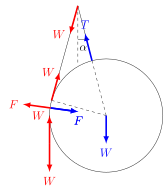
1922 Paper 3 Q602
Show that a force \(R\) is equivalent to forces \(X,Y,Z\) acting along the sides \(BC, CA, AB\) of any given triangle in its plane. If \(R\) acts at right angles to \(BC\) at its middle point inwards, show that \[ \frac{X}{b^2-c^2} = \frac{Y}{ab} = \frac{Z}{-ac} = \frac{R}{4\Delta}, \] where \(\Delta\) is the area of the triangle and \(a,b,c\) are the lengths of the sides.
1922 Paper 3 Q603
The distance between the axles of a railway truck is \(2a\) and the centre of gravity is half-way between them and at a distance \(h\) from the rails. With the lower wheels locked, the greatest incline upon which the truck can rest is \(\alpha\). Show that the coefficient of friction between the wheels and the rails is given by \(\mu = \frac{2a\tan\alpha}{a+h\tan\alpha}\).
1922 Paper 3 Q604
A rhombus is formed of rods each of weight \(W\) and length \(l\) with smooth joints. It rests symmetrically with its two upper sides in contact with two smooth pegs at the same level and at a distance apart \(2a\). A weight \(W'\) is hung at the lowest point. If the sides of the rhombus make an angle \(\theta\) with the vertical show that \(\sin^3\theta = \frac{a(4W+W')}{l(4W+2W')}\).