Problems
Filters
1978 Paper 4 Q7
Show that the curve defined by \[x = (t-1)e^{-t}, \quad y = tx, \quad -\infty < t < \infty,\] has a loop and find the area it encloses.
1978 Paper 4 Q8
The function \(f\) is defined by \[f(x) = \frac{1-\cos x}{x^2} \quad (x \neq 0),\] \[= \frac{1}{2} \quad (x = 0).\] Determine the maxima and minima of \(f\) in the range \(-2\pi < x < 2\pi\).
1978 Paper 4 Q9
The square wave function \(f_0(x)\) is defined by \[f_0(x) = 1 \quad \text{if} \quad 2n < x < 2n + 1\] \[= -1 \quad \text{if} \quad 2n + 1 < x < 2n + 2 \quad \text{(for } n = 0, 1, 2, \ldots\text{),}\] and functions \(f_j(x)\) are defined by \(f_j(x) = f_{j-1}(2x)\), for \(j = 1, 2, \ldots\) Evaluate \[\int_0^1 f_{j_1}(x)\ldots f_{j_r}(x)\,dx,\] where \(1 \leq j_1 < \ldots < j_r\), and \(k_1, \ldots, k_r\) are non-negative integers. Show that \[\int_0^1 \left(\sum_{i=1}^{n} a_i f_i(x)\right)^4 \,dx \leq 3\left(\int_0^1 \left(\sum_{i=1}^{n} a_i f_i(x)\right)^2 \,dx\right)^2,\] where \(a_1, \ldots, a_n\) are any real numbers.
1978 Paper 4 Q10
On the basis of an interview, the \(N\) candidates for admission to a college may be ranked in order of excellence. The candidates are interviewed in random order; that is, each possible ordering is equally likely.
- Given that the \(n\)th candidate interviewed is the best among the first \(n\) what is the probability that he is the best overall?
- Given that the \(n\)th candidate interviewed is the best among the first \(n\) what is the probability that he is the best or second-best overall?
- For \(n = 1, 2, \ldots, N\), let \(X_n\) denote the rank among the first \(n\) of the \(n\)th candidate interviewed. Prove that \(X_1, X_2, \ldots, X_N\) are independent random variables.
1978 Paper 4 Q11
A basket contains \(N\) eggs, a proportion \(P\) of which are rotten. It is decided to estimate \(P\) by \(R/n\), where \(R\) is the number of rotten eggs in a sample of \(n\) eggs chosen randomly from the basket. Prove that the mean of this estimate is \(P\) and its variance is \((N-n)P(1-P)/n(N-1)\).
1978 Paper 4 Q12
A lamina of mass \(m\) with centre of mass \(G\) moves in its own plane. The velocity of \(G\) has components \(u\) and \(v\) relative to some fixed external rectangular axes, and the lamina has angular velocity \(\Omega\). Find the position relative to \(G\) of the instantaneous centre of rest, \(I\). If \(L\) is the sum of the moments about \(I\) of the external forces, show that \[L = \frac{1}{2\Omega}\frac{d}{dt}[m(r^2 + k^2)\Omega^2],\] where \(r = GI\) and \(k\) is the radius of gyration about \(G\). Hence, or otherwise, show that, if the body starts from rest, the initial value of the angular acceleration is \[\dot{\Omega} = \frac{L}{mK^2},\] where \(K\) is the radius of gyration about \(I\).
1978 Paper 4 Q13
A particle projected from a point on a smooth inclined plane strikes the plane normally at the \(r\)th impact, and is at the point of projection at the \(n\)th impact; if the coefficient of restitution is \(e\), prove that \[e^n - 2e^r + 1 = 0.\]
Solution: We will repeatedly be using the following result about how long a particle under constant acceleration returns to it's initial point (component-wise). \begin{align*} && s &= ut - \frac12 at^2 \\ && t_{\text{return}} &= \frac{2u}{a} \\ \end{align*} Let the initial speed up the slope be \(u_x\) and perpendicular to the slope be \(u_y\). Let the acceleration down the slope be \(g_x\) and the acceleration perpendicular to the slope be \(g_y\). (We can calculated these in terms of the angle of the slope but there is no need to). So at the \(r^{\text{th}}\) bounce the "normal to the slope" bounces have taken \[ \frac{2u_y}{g_y}\left (1 + e + e^2 + \cdots + e^{r-1} \right) = \frac{2u_y}{g_y} \left ( \frac{1-e^r}{1-e} \right) \] We must also have that the "parallel to the slope" speed is \(0\) at this time since the particle strikes the plane normally, so: \[0 = u_x - g_x t = u_x -g_x \frac{2u_y}{g_y} \left ( \frac{1-e^r}{1-e} \right) \tag{*} \] Over the whole journey we must have the time taken is \(\frac{2u_y}{g_x} \left (\underbrace{1 + e + \cdots + e^{r-1}}_{\text{outward journey}} + \underbrace{e^r + \cdots + e^{n-1}}_{\text{return journey}} \right) = \frac{2u_y}{g_x}\frac{1-e^{n}}{1-e}\) and we must be exactly at the start, ie \(t = \frac{2u_x}{g_x}\) Therefore we must have: \begin{align*} && u_x &= u_y \frac{2g_x}{g_y}\frac{1-e^r}{1-e} \tag{*} \\ && \frac{2u_x}{g_x} & = \frac{2u_y}{g_x}\frac{1-e^{n}}{1-e} \tag{two ways of calculating total time taken} \\ \Rightarrow && 2\left ( \frac{1-e^r}{1-e} \right) &= \frac{1-e^n}{1-e} \\ \Rightarrow && 2-2e^r &= 1 - e^n \\ \Rightarrow && 0 &= e^n -2e^r+1 \end{align*}
1978 Paper 4 Q14
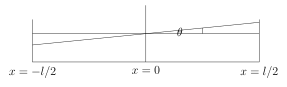
When the wind blows from the southwest, the water in Loch Ness piles up at the northeast end; if the wind then falls, the water sloshes to and fro between the ends of the Loch. Consider the following model of this phenomenon. The water surface is assumed to be plane and the Loch a rectangular container of length \(l\), breadth \(b\) and depth \(h\). As the water rises at one end, water must flow through the vertical plane through \(x = 0\), and it is assumed to do this at a speed \(v\) independent of depth and distance across the Loch.
1978 Paper 4 Q15
Define the scalar product \(\mathbf{a}\cdot\mathbf{b}\) and the vector product \(\mathbf{a} \wedge \mathbf{b}\) of two vectors. Prove that \[(\mathbf{a}+\mathbf{b}) \wedge \mathbf{c} = \mathbf{a} \wedge \mathbf{c} + \mathbf{b} \wedge \mathbf{c}.\] Given three non-coplanar vectors \(\mathbf{a}\), \(\mathbf{b}\), \(\mathbf{c}\) prove that an arbitrary vector \(\mathbf{x}\) may be written in the form \[\mathbf{x} = (\mathbf{x}\cdot\mathbf{a}^*)\mathbf{a} + (\mathbf{x}\cdot\mathbf{b}^*)\mathbf{b} + (\mathbf{x}\cdot\mathbf{c}^*)\mathbf{c},\] where \[\mathbf{a}^* = \frac{\mathbf{b} \wedge \mathbf{c}}{\mathbf{a}\cdot(\mathbf{b} \wedge \mathbf{c})}\] and \(\mathbf{b}^*\), \(\mathbf{c}^*\) are defined similarly. Show that \(\mathbf{a} = \mathbf{a}^*\), \(\mathbf{b} = \mathbf{b}^*\), \(\mathbf{c} = \mathbf{c}^*\) if and only if \(\mathbf{a}\), \(\mathbf{b}\), \(\mathbf{c}\) form an orthogonal triad of unit vectors.
1977 Paper 1 Q1
Given that, for all \(x\), \[\frac{ax^2+bx+c}{(x-\alpha)(x-\beta)(x-\gamma)} = \frac{A}{x-\alpha} + \frac{B}{x-\beta}+ \frac{C}{x-\gamma},\] find the condition that \(A+B+C = 0\). Hence, or otherwise, evaluate \[\sum_{n=1}^{N} \frac{3n+1}{n(n+1)(n+2)}.\]
Solution: Proof 1: Let \(f(x) = \frac{ax^2+bx+c}{(x-\alpha)(x-\beta)(x-\gamma)}\) then \(\lim_{x \to \infty} xf(x) = a\) but also \(A+B+C\), therefore \(A+B+C = a\). Therefore \(A+B+C = 0 \Leftrightarrow a = 0\) Proof 2: Multiply both sides by \((x-\alpha)(x-\beta)(x-\gamma)\) then the coefficient of \(x^2\) is \(a\) on the LHS and \(A+B+C\) on the RHS, therefore \(A+B+C = a\) \begin{align*} && \frac{3n+1}{n(n+1)(n+2)} &= \frac{1}{2n} + \frac{2}{n+1} - \frac{5}{2(n+2)} \\ \Rightarrow && \sum_{n=1}^N \frac{3n+1}{n(n+1)(n+2)} &= \sum_{n=1}^N\left ( \frac{1}{2n} + \frac{2}{n+1} - \frac{5}{2(n+2)}\right) \\ &&&= \quad \frac{1}{2 \cdot 1} + \frac{2}{2} - \frac{5}{2 \cdot 3} + \cdots \\ &&&\quad\,\,\, + \frac{1}{2 \cdot 2} + \frac{2}{3} - \frac{5}{2 \cdot 4} + \cdots \\ &&&\quad\,\,\, + \frac{1}{2 \cdot 3} + \frac{2}{4} - \frac{5}{2 \cdot 5} + \cdots \\ &&&\quad \quad \quad \cdots \\ &&&\quad\,\,\, + \frac{1}{2 \cdot (N-2)} + \frac{2}{N-1} - \frac{5}{2 \cdot N} + \cdots \\ &&&\quad\,\,\, + \frac{1}{2 \cdot (N-1)} + \frac{2}{N} - \frac{5}{2 \cdot (N+1)} + \cdots \\ &&&\quad\,\,\, + \frac{1}{2 \cdot N} + \frac{2}{N+1} - \frac{5}{2 \cdot (N+2)} + \cdots \\ &&&= \frac3{2} +\frac{2}{N+1} - \frac{5}{2(N+1)} - \frac{5}{2(N+2)} \\ &&&= \frac3{2} - \frac{1}{2(N+1)} - \frac{5}{2(N+2)} \end{align*}