Problems
Filters
1983 Paper 2 Q15
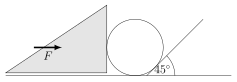
A cylinder of radius \(a\) and mass \(M\) rests on a horizontal floor touching as shown a vertical loading ramp at \(45^\circ\) to the horizontal. It is then pushed from the side with a force \(F\) by the vertical face of a piece of moving equipment. The coefficient of friction between the cylinder and the vertical face is \(\mu\) and the coefficient of friction between the cylinder and the ramp is \(\nu\). The value of \(F\) is such that the cylinder just rolls up the ramp. Show that \(F = Mg/[1 - \mu(1 + \sqrt{2})]\). Show further that \(\mu < \sqrt{2} - 1\) and \(\nu \geq \mu/(\sqrt{2} - \mu)\).
1983 Paper 2 Q16
A ship has an engine which exerts a constant force \(f\) per unit mass. The resistance of the water varies as the square of the speed. Verify that if \(x\) is the distance travelled in a time \(t\) starting from rest and \(V\) is the maximum possible speed of the ship, then \begin{equation*} x = \frac{V^2}{f}\ln\cosh\frac{ft}{V} \end{equation*} is a solution of the equation of motion. If the ship is travelling at full speed, find the distance travelled before the ship can come to a stop on reversing the engines.
1983 Paper 3 Q1
Let \(x = x(t)\), \(y = y(t)\) be parametric equations for a simple closed curve \(C\) in the \(x, y\) plane, described counter-clockwise as \(t\) increases from \(t_0\) to \(t_1\). Show that the area \(A\) enclosed by \(C\) is given by \begin{equation*} A = -\int_{t_0}^{t_1} y(t)\frac{dx(t)}{dt} dt. \end{equation*} Hence show that \(\displaystyle A = -\frac{1}{2}\int_{t_0}^{t_1}\left[y(t)\frac{dx(t)}{dt} - x(t)\frac{dy(t)}{dt}\right] dt\). Use this result to find the area enclosed by the hypocycloid \(x^{2/3} + y^{2/3} = a^{2/3}\).
1983 Paper 3 Q2
Find all positive integers that are equal to the sum of the squares of their digits.
1983 Paper 3 Q3
State an inequality between the arithmetic mean of \(k\) positive numbers and their geometric mean. The numbers \(a_1, a_2, \ldots, a_n\) are positive. Assume that \(1 \leq k \leq n\) and let \(S_k\) be the sum of the \(k\)th powers of the numbers, and let \(P_k\) be the sum of all products of \(k\) distinct numbers from \(a_1, a_2, \ldots, a_n\). Prove that \begin{equation*} (n-1)! S_k \geq k!(n-k)! P_k. \end{equation*}
1983 Paper 3 Q4
A magic square of order \(n \geq 3\) is an arrangement of the numbers 1 to \(n^2\) in a square so that the sum of the numbers in every row, in every column and in each long diagonal is the same. Prove that in a magic square of order \(n\), this common number is equal to \(\frac{1}{2}n(n^2+1)\). Show that in a magic square of order 3, 5 is in the centre, and 1 is not in a corner. Prove also that there are precisely two magic squares of order three in which 1 is in the middle of the top row.
1983 Paper 3 Q5
A sequence \(a_0, a_1, a_2, \ldots\) is defined by the following recurrence relation: \begin{equation*} a_n = a_0a_{n-1} + a_1a_{n-2} + \ldots + a_{n-1}a_0, \quad a_0 = 1 \end{equation*} Setting \(f(x) = \sum_{n=0}^{\infty}a_nx^n\), show that \(f(x)\) satisfies the equation \begin{equation*} xf(x)^2 - f(x) + 1 = 0. \end{equation*} Deduce that \(a_n = \frac{1}{n+1}\binom{2n}{n}\). [The convergence of series may be assumed.]
1983 Paper 3 Q6
- [(i)] Evaluate the limits
- [(ii)] By using the fact that \(u \ln u \to 0\) as \(u \to 0\), or otherwise, evaluate \begin{equation*} \lim_{x \to \pi/2}(\sin x)^{\tan x} \end{equation*}
1983 Paper 3 Q7
For \(r = 1, 2, \ldots, n\) show that \(\binom{n}{r} < \frac{n^r}{2^{r-1}}\). If \(R_n = (1 + 1/n)^n\) show that, provided \(n \geq 2\), \(2 < R_n < 3\). Show also that \(R_{n+1} > R_n\).
1983 Paper 3 Q8
Polynomials \(H_n(x)\) are defined by \begin{equation*} H_n(x) = (-1)^n e^{\frac{1}{2}x^2}\frac{d^n}{dx^n}(e^{-\frac{1}{2}x^2}). \end{equation*} Show that \(\sum_{n=0}^{\infty}\frac{1}{n!}H_n(x)y^n = \exp(xy - \frac{1}{2}y^2)\). Hence or otherwise show that \(\frac{dH_n}{dx}(x) = nH_{n-1}(x)\). [Taylor's theorem may be assumed. Questions of convergence need not be considered.]