Problems
Filters
1976 Paper 2 Q15
A light elastic string of unstretched length \(3l\) passes over a small smooth horizontal peg. Particles \(A\) and \(B\) of masses \(m\) and \(3m\) respectively are attached to the ends of the string. Initially \(B\) is held fixed at a distance \(2l\) vertically below the peg, and the string hangs in equilibrium with \(A\) and \(B\) at the same level. Particle \(B\) is now released. Show that \(A\) moves upwards until it strikes the peg, and that the maximum length of the string during this motion is \(5l\).
1976 Paper 2 Q16
\(O\), \(P\), \(Q\), \(R\) are four non-coplanar points. \(A\), \(B\), \(C\), \(D\) are four coplanar points which lie respectively on the straight lines \(OP\), \(PQ\), \(QR\), \(RO\). Let \[\alpha = OA/AP, \beta = PB/BQ, \gamma = QC/CR, \delta = RD/DO.\] Using three-dimensional vectors with origin \(O\), express the position vectors of \(A\), \(B\), \(C\), \(D\) in terms of those of \(P\), \(Q\), \(R\) and the ratios \(\alpha\), \(\beta\), \(\gamma\), \(\delta\). Deduce that \[\alpha\beta\gamma\delta = 1.\]
1976 Paper 3 Q1
Let \(b\) and \(c\) be real numbers. The cubic equation \(x^3 + 3x^2 + bx + c = 0\) has three distinct real roots which are in geometric progression. Show that there are unique values of \(b\) and \(c\) such that the roots of this equation are integers, and find this equation and its roots.
Solution: Say the roots are \(k,l,m\), (in order of their geometric progression). Then we must have that \(km = l^2\) and \(k+l+m = -3\). \begin{align*} && km &= (3+k+m)^2 \\ \Rightarrow && km &= 9+k^2+m^2 + 6k+6m + 2km \\ \Rightarrow && 0 &= k^2+6k+m^2+6m+km+9 \\ \Rightarrow && 0 &= 2k^2+12k+2m^2+12m+2km+18 \\ &&&= (m+k)^2 + (k+6)^2+(m+6)^2-72+18 \\ \Rightarrow && 54 &= (m+k)^2 + (k+6)^2+(m+6)^2 \end{align*} \(54\) can be written as the sum of \(3\) squares as \(1^2+2^2+7^2, 2^2+5^2+5^2, 3^2+3^2+6^2\). Case 1: \(1^2+2^2+7^2\) Case 1a: \(7 = m+6 \Rightarrow m = 6\). Contradiction since \((k+6)^2\) is both \(1^2\) and \(2^2\) Case 1b: \(7 = m+k \Rightarrow \) one of \(m\) or \(k\) is bigger than \(0\), contradiction. So case 1 is impossible, Case 2: \(2^2+5^2+5^2\) Case 2a: \(5 = m+6 \Rightarrow m = -1\). If \((k-1)^2, (k+6)^2 = 2^2, 5^2\) clearly not possible. Case 2b: \(2 = m+6 \Rightarrow m = -4\), Then \((k+6)^2, (k-4)^2 = 2^2, 5^2\) also not possible. So case 2 is impossible. Case 3: \(3^2+3^2+6^2\) Case 3a: \(6 = m+6 \Rightarrow m = 0\) contradiction. Therefore we must have \(m = -3, n = -3\) and clearly \(-3,3,-3\) works, so our equation is: \((x+3)^2(x-3) = (x^2+6x+9)(x-3) = x^3+3x^2-9x-27\)
1976 Paper 3 Q2
Define a sequence of numbers \(x_0, x_1, \ldots\) by \[x_{n+1} = \frac{1}{2}\left(x_n + \frac{a}{x_n}\right) \quad (a \geq 0).\] Show that \[\sqrt{a} < x_n < x_{n-1} < \ldots < x_1,\] provided that \(x_0\) is positive and does not take one special value. Find the limit of the sequence \(x_0, x_1, x_2, \ldots\). Does \(x_n\) converge if \(a < 0\)?
1976 Paper 3 Q3
Show that the set of real-valued \(2 \times 2\) matrices with determinant \(\pm 1\) forms a group \(G\) under matrix multiplication. Show that the matrix \[\begin{pmatrix} \cos\theta & \sin\theta \\ -\sin\theta & \cos\theta \end{pmatrix}\] is a member of \(G\) and deduce that \(G\) contain subgroups of all finite orders. Are all finite subgroups of \(G\) cyclic?
1976 Paper 3 Q4
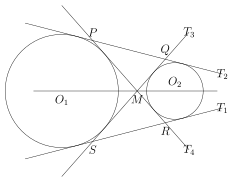
Let \(C_1, C_2\) be non-intersecting circles with centres \(O_1, O_2\) respectively and common tangents \(T_1, T_2, T_3, T_4\). \(T_3\) and \(T_4\) meet at \(M\) on the line of centre between \(O_1\) and \(O_2\). \(T_1\) meets \(T_3\) at \(Q\) and \(T_4\) at \(P\), and \(T_2\) meets \(T_3\) at \(S\) and \(T_4\) at \(R\) (see the diagram below). Let \(O_1 P\) and \(O_2 Q\) meet at \(N\) and let \(O_1 S\) and \(O_2 R\) meet at \(L\). Prove that \(L\), \(M\) and \(N\) are collinear.
1976 Paper 3 Q5
\(C\) is the mid-point of \(OD\) and the point \(Q\) lies on the semi-circle through \(D\), with centre \(O\), whose diameter is perpendicular to \(OD\). Points \(A\) and \(B\) lie in the plane of the semi-circle, are equidistant from \(O\) and also equidistant from \(Q\). The point \(R\) completes the rhombus \(QARB\). Find the locus of \(R\) as \(Q\) traverses the semi-circle, the distances \(OA\), \(OB\), \(QA\), \(QB\), \(AR\), \(BR\) remaining fixed.
1976 Paper 3 Q6
A commercial process is governed by the equation \(\ddot{x} + 3\dot{x} - 4x = 0\). At the first time \(T\) that \(|x(T)| = 100\) the process must be shut down at once. The total profit made on that run is then \(T\) thousand pounds. Unfortunately the initial values \(x(0)\), \(\dot{x}(0)\) cannot be controlled exactly and all that can be done is to ensure that \(|x(0)|, |\dot{x}(0)| \leq 1\). Estimate the minimum value of \(T\). A machine is available which would improve the accuracy with which \(x(0)\), \(\dot{x}(0)\) are controlled in such a way that \(|x(0)|, |\dot{x}(0)| \leq 1/10\) but this would cost an extra \(S\) thousand pounds per run. Would you advise the use of such a machine if \(S = 1\), if \(S = 4\) or if \(S = 10\) and why? (Clearly you have not got as much information as you might want in ideal circumstances but you do have enough information to come to a sensible decision.) [log\(_e\)10 = 2.30256.]
1976 Paper 3 Q7
A road is to be built from a town \(A\) with map coordinates \((x,y) = (-1, -1)\) to a town \(B\) at \((1, 1)\). The cost per unit length of a road in the region \(y \leq 0\) is \(K\) million pounds and that in the region \(y > 0\) is 1 million pounds. The road is to run in a straight line from \(A\) to a point \(C\) at \((u, 0)\) and then in a straight line from \(C\) to \(B\). The total cost will thus be \((K \times \text{length }AC + \text{length }CB)\) million pounds and \(C\) is chosen to minimize this total cost. Let \(\theta\) be the angle between \(AC\) and the negative real axis and \(\phi\) the angle between \(BC\) and the positive real axis. Describe how \(u\) varies with \(K\) (an explicit formula is not required) and give a simple explicit formula for \(\frac{\cos \theta}{\cos \phi}\) in terms of \(K\).
1976 Paper 3 Q8
Suppose \(f\) is a twice differentiable function with \(f''(x) < 0\) for all \(x > 0\). Show that if \(0 < a < b\) then \[f(\lambda a + (1-\lambda)b) \geq \lambda f(a) + (1-\lambda)f(b)\] for all \(1 \geq \lambda \geq 0\). By induction or otherwise deduce that if \(a_1, a_2, \ldots, a_n > 0\) then \[f\left(\frac{1}{n}\sum_{j=1}^n a_j\right) \geq \frac{1}{n}\sum_{j=1}^n f(a_j).\] Setting \(f(x) = \log_e x\) deduce that \[\frac{1}{n}\sum_{j=1}^n a_j \geq (a_1 a_2 \ldots a_n)^{1/n}.\] [Hint: Consider \(g(\lambda) = f(\lambda a + (1-\lambda)b) - \lambda f(a) - (1-\lambda)f(b)\) as a function of \(\lambda\).]