Problems
Filters
1958 Paper 4 Q209
Evaluate $$\int_0^1 \frac{dx}{(1 + x + x^2)^{3/2}} \quad \int_0^{2\pi} \frac{\sin^2 \theta}{a - b\cos \theta} d\theta \quad (a > b > 0).$$ By remarking that, when \(0 \leq x \leq 1\), we have \(0 \leq x^3 \leq x^2\), prove that $$0.35 < \int_0^1 \frac{dx}{(9 - 4x^3 + x^6)^{1/2}} < 0.37.$$
1958 Paper 4 Q210
The rectangular cartesian coordinates \(x\), \(y\) of a point \(P\) on a closed oval curve are given as functions of the arc \(s\) measured from a fixed point of the curve in such a direction that the inclination of the tangent to the \(x\)-axis increases with \(s\). Prove that if the coordinates of the point \(Q\) at a distance \(t\) from \(P\) along the outward drawn normal are $$X = x + t\sin \psi, \quad Y = y - t\cos \psi,$$ where \(\cos \psi = dx/ds\), \(\sin \psi = dy/ds\). Prove that, if \(t\) is a function of \(s\), $$X\frac{dY}{ds} - Y\frac{dX}{ds} = x\frac{dy}{ds} - y\frac{dx}{ds} + \{t(x\cos \psi + y\sin \psi)\} + 2t + \rho\kappa,$$ where \(\kappa = d\psi/ds\) is the curvature of the given curve at \(P\). Deduce that, if \(t = 1/\kappa\), the area enclosed by the curve described by \(Q\) is $$A + \frac{3}{2}\int \frac{ds}{\kappa},$$ where \(A\) is the area enclosed by the original curve and the integral is taken round it.
1958 Paper 4 Q301
The equations \begin{align} x^3 + 2x^2 + ax - 1 &= 0, \\ x^3 + 3x^2 + x + b &= 0 \end{align} have two common roots. Find all possible pairs of values of the constants \(a\), \(b\), and find the remaining roots in each case.
1958 Paper 4 Q302
By the use of complex numbers or otherwise, evaluate the sums \(\sum_{n=0}^{\infty} r^n \cos n\theta\) where \(0 < r < 1\). Hence write \[ \frac{(1 - r^2 \cos 2\theta) r \cos \theta - r^3 \sin \theta \sin 2\theta}{1 - 2r^2 \cos 2\theta + r^4} \] in the form \(\sum a_n r^n \cos n\theta\), where the \(a_n\) are constants to be determined.
1958 Paper 4 Q303
A drunkard sets out to walk home. In each successive unit of time he has a chance \(p > 0\) of walking one unit north, a chance \(q > 0\) of walking one unit south, and a chance \(1 - p - q > 0\) of going to sleep where he is—in which case the process stops. His home lies \(n\) units to the north of his starting-point, where \(n > 0\); once he gets home he stays there. Let \(c_n\) be his chance of getting there before he goes to sleep. By finding a recurrence relation for \(c_n\), or otherwise, show that \[ c_n = A\alpha^n + B\beta^n, \] where \(\alpha\) and \(\beta\) are the roots of \[ qx^2 - x + p = 0. \] Find the constants \(A\), \(B\).
1958 Paper 4 Q304
If \(n\), \(r\), \(s\) are non-negative integers, and \(k\) is a positive integer, show that \begin{align} |\sin nx| &\leq n |\sin x|, \\ \left|\frac{\sin rx \sin sy + \sin sx \sin ry}{2 \sin x \sin y}\right| &\leq rs, \\ \left|\frac{\cos kB \cos A - \cos kA \cos B}{\cos B - \cos A}\right| &\leq k^2 - 1. \end{align}
1958 Paper 4 Q305
A prison consists of a square courtyard of side 110 yd., with a square building of side 200 yd. centrally placed in it. The sides of the building are parallel to the walls of the courtyard. A guard stands on the wall at a distance \(x\) yards from the nearest corner. Find how much of the courtyard he can see, distinguishing the various cases where \(x \leq 220\). What is the largest area of courtyard he can see from any point on the wall? Of how many pieces does it consist?
1958 Paper 4 Q306
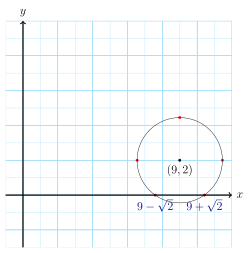
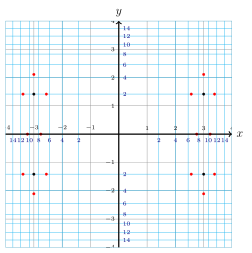
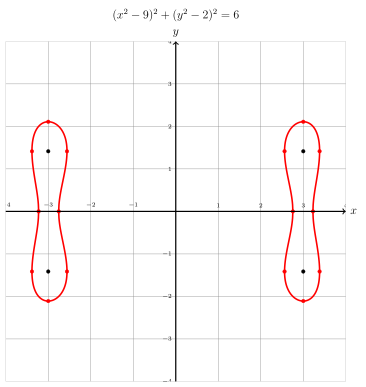
Sketch the curve \((x^2 - 9)^2 + (y^2 - 2)^2 = 6\).
Solution: It should be clear by now what transformation we are going to use: \(X = x^2, Y = y^2\), so first we will sketch \((X-9)^2+(Y-2)^2 = 6\)
1958 Paper 4 Q307
The points \(z_1\), \(z_2\), \(z_3\) form a triangle in the Argand diagram. Prove that it is equilateral if and only if \[ z_1^2 + z_2^2 + z_3^2 = z_2 z_3 + z_3 z_1 + z_1 z_2. \]
1958 Paper 4 Q308
Find \begin{align} \text{(i) } &\int_0^1 \tan^{-1}\left(\frac{2x+1}{2-x}\right) dx; \quad \text{(ii) } \int_0^1 \frac{dx}{(1+x^2)^2}; \quad \text{(iii) } \int_1^2 \sqrt{(2-x)(x-1)} dx. \end{align}