Problems
Filters
1922 Paper 3 Q601
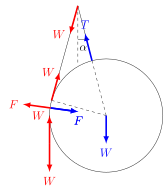
A smooth sphere is suspended from a fixed point by a string of length equal to its radius. To the same point a second string is attached which after passing over the sphere supports a weight equal to that of the sphere. Show that the first string then makes an angle \(\sin^{-1}(\frac{1}{4})\) with the vertical.
Solution:
1922 Paper 3 Q602
Show that a force \(R\) is equivalent to forces \(X,Y,Z\) acting along the sides \(BC, CA, AB\) of any given triangle in its plane. If \(R\) acts at right angles to \(BC\) at its middle point inwards, show that \[ \frac{X}{b^2-c^2} = \frac{Y}{ab} = \frac{Z}{-ac} = \frac{R}{4\Delta}, \] where \(\Delta\) is the area of the triangle and \(a,b,c\) are the lengths of the sides.
1922 Paper 3 Q603
The distance between the axles of a railway truck is \(2a\) and the centre of gravity is half-way between them and at a distance \(h\) from the rails. With the lower wheels locked, the greatest incline upon which the truck can rest is \(\alpha\). Show that the coefficient of friction between the wheels and the rails is given by \(\mu = \frac{2a\tan\alpha}{a+h\tan\alpha}\).
1922 Paper 3 Q604
A rhombus is formed of rods each of weight \(W\) and length \(l\) with smooth joints. It rests symmetrically with its two upper sides in contact with two smooth pegs at the same level and at a distance apart \(2a\). A weight \(W'\) is hung at the lowest point. If the sides of the rhombus make an angle \(\theta\) with the vertical show that \(\sin^3\theta = \frac{a(4W+W')}{l(4W+2W')}\).
1922 Paper 3 Q605
A particle is projected with velocity \(\sqrt{2ga}\) from a point at a height \(h\) above a level plain. Show that the tangent of the angle of elevation for maximum range on the plain is \(a/(a+h)\), and that the maximum range is \(2\sqrt{a(a+h)}\).
1922 Paper 3 Q606
A particle describes a distance \(x\) along a straight line in time \(t\), where \(t=ax^2+bx\), and \(a,b\) are positive numbers. Show the retardation is proportional to the cube of the velocity. If the initial velocity is 2000 feet per second, and is reduced to 1975 feet per second in 100 feet, show that the initial resistance is about 15.8 of the weight of the particle.
1922 Paper 3 Q607
A horse pulls a wagon of 10 tons from rest against a constant resistance of 50 lb. The pull exerted is at first 200lb., and decreases uniformly with the distance until it falls to 50lb. after a distance of 167 feet has been covered. Show that the resulting velocity of the wagon is very nearly 6 feet per second.
1922 Paper 3 Q608
Find the velocities of two elastic spheres after direct impact with given velocities. Two equal spheres \(A,B\) lie in a smooth horizontal circular groove at opposite ends of a diameter. \(A\) is projected along the groove and at the end of time \(t_0\) impinges on \(B\); show that the second impact will occur at a further time \(\frac{2t_0}{e}\), where \(e\) is the elastic coefficient.
1922 Paper 3 Q609
Define simple harmonic motion, and find the velocity in terms of the displacement. A particle is attached to one end of an elastic string whose other end is fixed at \(A\) and whose modulus is equal to the weight of the particle. The particle is let go from rest at \(A\). Show that the greatest extension of the string during the motion is \(1+\sqrt{3}\) times its natural length.
1922 Paper 3 Q610
A particle of mass \(m\) is attached to a point \(O\) by an inextensible string of length \(l\). Prove that it can describe a horizontal circle about a point vertically below \(O\) with uniform angular velocity \(\omega\), provided \(l\omega^2 < g\). Prove that if the string is elastic, this condition is replaced by \[ \frac{l_0\lambda\omega^2}{g} > \lambda - ml_0\omega^2 > 0, \] where \(\lambda\) is the modulus of elasticity and \(l_0\) the natural length of the string.