Problems
Filters
1958 Paper 4 Q303
A drunkard sets out to walk home. In each successive unit of time he has a chance \(p > 0\) of walking one unit north, a chance \(q > 0\) of walking one unit south, and a chance \(1 - p - q > 0\) of going to sleep where he is—in which case the process stops. His home lies \(n\) units to the north of his starting-point, where \(n > 0\); once he gets home he stays there. Let \(c_n\) be his chance of getting there before he goes to sleep. By finding a recurrence relation for \(c_n\), or otherwise, show that \[ c_n = A\alpha^n + B\beta^n, \] where \(\alpha\) and \(\beta\) are the roots of \[ qx^2 - x + p = 0. \] Find the constants \(A\), \(B\).
1958 Paper 4 Q304
If \(n\), \(r\), \(s\) are non-negative integers, and \(k\) is a positive integer, show that \begin{align} |\sin nx| &\leq n |\sin x|, \\ \left|\frac{\sin rx \sin sy + \sin sx \sin ry}{2 \sin x \sin y}\right| &\leq rs, \\ \left|\frac{\cos kB \cos A - \cos kA \cos B}{\cos B - \cos A}\right| &\leq k^2 - 1. \end{align}
1958 Paper 4 Q305
A prison consists of a square courtyard of side 110 yd., with a square building of side 200 yd. centrally placed in it. The sides of the building are parallel to the walls of the courtyard. A guard stands on the wall at a distance \(x\) yards from the nearest corner. Find how much of the courtyard he can see, distinguishing the various cases where \(x \leq 220\). What is the largest area of courtyard he can see from any point on the wall? Of how many pieces does it consist?
1958 Paper 4 Q306
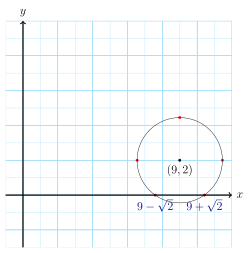
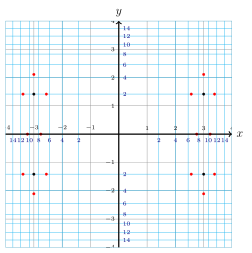
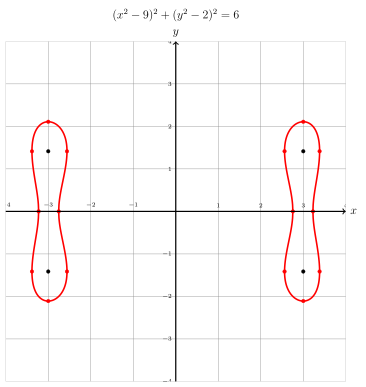
Sketch the curve \((x^2 - 9)^2 + (y^2 - 2)^2 = 6\).
Solution: It should be clear by now what transformation we are going to use: \(X = x^2, Y = y^2\), so first we will sketch \((X-9)^2+(Y-2)^2 = 6\)
1958 Paper 4 Q307
The points \(z_1\), \(z_2\), \(z_3\) form a triangle in the Argand diagram. Prove that it is equilateral if and only if \[ z_1^2 + z_2^2 + z_3^2 = z_2 z_3 + z_3 z_1 + z_1 z_2. \]
1958 Paper 4 Q308
Find \begin{align} \text{(i) } &\int_0^1 \tan^{-1}\left(\frac{2x+1}{2-x}\right) dx; \quad \text{(ii) } \int_0^1 \frac{dx}{(1+x^2)^2}; \quad \text{(iii) } \int_1^2 \sqrt{(2-x)(x-1)} dx. \end{align}
1958 Paper 4 Q309
A sequence of integers \(u_n\) is generated by the relation \(u_{n+1} = u_n + u_{n-1}\). Show that the sequence of remainders when the \(u_n\) are divided by a fixed integer \(k\) is periodic. Deduce that if \(u_0 = -1\) and \(u_1 = 1\) then some \(u_n\) is divisible by \(k\). By considering the case \(k = 5\), show that this last result is not true for all pairs of initial values \(u_0\) and \(u_1\).
1958 Paper 4 Q310
The function \(f\) is differentiable and satisfies the identity \[ f(x) + f(y) = f\left(\frac{xy}{x+y+1}\right) \] for \(x, y > 0\). Show that \(x(x+1)f'(x)\) is constant, and hence deduce the function \(f\).
1957 Paper 1 Q101
The roots of the equation \[ x^3+3qx+r=0 \] are \(\alpha, \beta, \gamma\). Express \(P^2\) as a polynomial in \(q\) and \(r\), where \(P=(\beta-\gamma)(\gamma-\alpha)(\alpha-\beta)\). Explain why \(P\) cannot be expressed in this form. From your expression for \(P^2\), or otherwise, obtain necessary and sufficient conditions for the given equation to have
- a repeated root,
- three distinct real roots,
- one real and two non-real roots,
Solution: Note that \(\alpha+\beta+\gamma = 0\) and let \(p_k = \alpha^k+\beta^k+\gamma^k\). \begin{align*} && P^2 &= \det \begin{pmatrix} 1 & \alpha & \alpha^2 \\ 1 & \beta & \beta^2 \\ 1 & \gamma & \gamma^2 \end{pmatrix}^2 \\ &&&= \det \begin{pmatrix} 1 & \alpha & \alpha^2 \\ 1 & \beta & \beta^2 \\ 1 & \gamma & \gamma^2 \end{pmatrix} \det \begin{pmatrix} 1 & \alpha & \alpha^2 \\ 1 & \beta & \beta^2 \\ 1 & \gamma & \gamma^2 \end{pmatrix}^T\\ &&&= \det \begin{pmatrix} 1 & \alpha & \alpha^2 \\ 1 & \beta & \beta^2 \\ 1 & \gamma & \gamma^2 \end{pmatrix} \det \begin{pmatrix} 1 &1 &1 \\ \alpha & \beta & \gamma \\ \alpha^2 & \beta^2 & \gamma^2 \end{pmatrix}\\ &&&= \det \begin{pmatrix} p_0 & p_1 &p_2 \\ p_1 & p_2 & p_3\\ p_2 & p_3 & p_4 \end{pmatrix}\\ \end{align*} Node that \(p_0 = 3, p_1 = 0, p_2 = p_1^2 - 6q = -6q\) and \(p_3 = -3qp_1 - 3r = -3r\) and \(p_4 = -3qp_2-rp_1 = 18q^2\) So \begin{align*} P^2 &= \det \begin{pmatrix}3 & 0 & -6q \\ 0 & -6q & -3r \\ -6q & -3r & 18q^2 \end{pmatrix} \\ &= 3 \left \lvert \begin{matrix} -6q & -3r \\ -3r & 18q^2 \end{matrix} \right \rvert - 0 + (-6q) \left \lvert \begin{matrix} 0& -6q \\ -6q & -3r \end{matrix} \right \rvert \\ &= 3(-6 \cdot 18 q^3-9r^2) +6^3 q^3 \\ &= 27(q^3(-12+8) -r^2) \\ &= 27(-4q^3-r^2)\\ &= -27(4q^3+r^2) \end{align*} \(P\) cannot be written as a combination of elementary symmetric polynomials since it isn't symmetric under the transposition \(\alpha \leftrightarrow \beta\).
- There is a repeated root then \(P^2 = 0\)
- If all roots are distinct and real, then \(P^2\) must be strictly positive.
- If one root is real, the others non-real then they are complex conjugate and in particular: \begin{align*} P &= (a+ib - (a-ib))(a-ib-\alpha)(\alpha - (a-ib)) \\ &= 2bi((a-\alpha)^2+b^2) \end{align*} Therefore \(P^2\) is (strictly) negative.
1957 Paper 1 Q102
By putting the expression \[ \frac{(x+1)(x+2)\dots(x+n)}{x(x-1)(x-2)\dots(x-n)} \] into partial fractions, or otherwise, prove that the system of \(n\) equations \[ \sum_{r=0}^n \frac{X_r}{r+s} = 0 \quad (s=1, 2, \dots, n) \] in the \(n+1\) unknowns \(X_0, X_1, \dots, X_n\) is satisfied by \[ X_r = \frac{(-1)^{n-r}(n+r)!}{(r!)^2(n-r)!} \quad (r=0, 1, \dots, n). \] Show also that, with these values, \[ \sum_{r=0}^n X_r = 1. \]