Problems
Filters
1958 Paper 3 Q105
Prove that, if \(G\) is the centre of gravity of a plane lamina of mass \(M\) and \(I_G\) is the moment of inertia of the lamina about the line through \(G\) perpendicular to its plane, then its moment of inertia about the parallel line through a point \(P\) in its plane is \(I_G + M \cdot GP^2\). The cross-section of a thin straight open-ended tube is a regular hexagon of side \(a\). It is laid with one face in contact with a rough horizontal plane and the plane is then tilted slowly. Find the angle at which the cylinder at the instant when the adjacent face strikes the plane.
1958 Paper 3 Q106
A thin uniform rod \(ABC\) is bent at right angles at \(B\) forming two straight portions \(AB\) and \(BC\), each of length \(l\). It is placed in a vertical plane over two small smooth pegs at the same level and distant \(4\sqrt{2}\) apart, the point \(B\) being uppermost. Show that in the symmetrical position, for displacement in its plane, $$10ga < 16V^2 < 16ga$$ and $$25V = 16V.$$ Show also that if \(l\) is between \(4\sqrt{2}a\) and \(4a\) there will be three positions of equilibrium, two of which will be stable.
1958 Paper 3 Q107
A plane lamina is moving in its own plane. Show that in general its motion at any instant can be represented as a rotation about a point (the instantaneous centre of rotation). A thin rod \(PQ\) of mass \(M\) and length \(l\) is constrained to move so that \(P\) and \(Q\) lie on two lines \(OA\) and \(OB\) respectively, where \(\angle AOB = 60^\circ\). At a certain instant the end \(P\) is moving with a velocity \(v\) and \(OP = OQ = l\). Calculate the kinetic energy of the rod.
1958 Paper 3 Q108
A trolley, of mass 10 lb., can move freely on a horizontal track. It has a horizontal platform on which rests a particle of mass 10 lb., the coefficient of friction between the particle and the platform being \(\frac{1}{2}\). The system being initially at rest, the trolley is set in motion by a horizontal force which increases from zero to 12 lb.-wt. in 2 sec. at a uniform rate. Draw a graph showing the acceleration of the trolley during this period and determine the velocity of the particle relative to the trolley at the end of the period. [Take \(g\) as 32 ft. per sec. per sec.]
1958 Paper 3 Q109
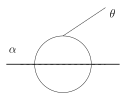
A uniform circular cylinder (Fig. 2) is placed with its axis horizontal on a rough plane inclined at an angle \(\alpha\) to the horizontal. It is held in that position by a light string which is attached at one end to a point on the middle section of the cylinder, passes round part of the circumference and is held at the other end so that it lies entirely in a vertical plane and the free part makes an angle \(\theta\) with the horizontal. The coefficient of friction between the cylinder and the plane is \(\mu\). Show that the tension in the string will be the minimum necessary to maintain equilibrium when \(\theta\) is equal to \(\alpha\) or \(\cos^{-1}\left(\frac{\sin(\alpha-\lambda)}{\sin \lambda}\right)\) according as tan \(\lambda\) is greater or less than \(\frac{1}{\mu}\) tan \(\alpha\).
1958 Paper 3 Q110
A particle of mass \(m\) is suspended from a fixed support by a light elastic string which extends by unit distance under a tension \(\kappa\). Motion of the particle in a vertical line is resisted by a frictional force which is given at any instant by \(cv\), where \(c\) is a constant and \(v\) is the velocity of the particle at that instant. The particle is displaced vertically from the position of equilibrium and released. Show that the subsequent motion will be oscillatory provided that \(c\) is less than \(2\sqrt{m\kappa}\). Show also that if this condition is satisfied, the distances of successive positions of rest from the equilibrium position will be in geometrical progression; and obtain an expression for their common ratio. It may be assumed that the string does not become slack.
1958 Paper 3 Q201
A pedestal is constructed of three uniform right circular cylinders placed with their axes vertical and in the same line. The weights of the cylinders are in the ratios 2:1:3, and their radii are in the ratios 12:11:9, where the cylinders are taken in order from the topmost downwards. If no mortar is used in the pedestal, find the greatest weight of a statue which may be placed safely anywhere on the top of the pedestal, in terms of the weight of the middle cylinder. If the three cylinders are cemented together, while the base is still not fixed to the ground, show that the greatest weight of a statue which may now be placed safely on the top of the pedestal is \(1 + k\) times its value when the cylinders were not cemented.
1958 Paper 3 Q202
A light rigid wire is bent into the shape of a rectangle \(ABCD\), with \(AB = a\), \(BC = b\). Particles of weights \(w\), \(5w\), \(w\), \(2w\) are attached to the vertices, \(A\), \(B\), \(C\), \(D\) respectively, and the wire is then suspended freely from \(A\). What is the inclination of \(AB\) to the vertical when the system composed of wire and particles is in equilibrium? A rough horizontal plane is held so as to touch the wire at \(C\), and another particle of weight \(w\) is attached to \(C\). If \(\mu\) is the coefficient of friction between the wire at \(C\) and the plane, what further force must be applied vertically upwards to the plane so that sliding will just commence at \(C\)?
1958 Paper 3 Q203
A hemispherical shell, with a rough inner surface, is held fixed with its rim horizontal. A uniform narrow ladder of weight \(W\) and length \(2l\) is placed with its ends \(A\), \(B\) touching the inner surface so as to lie in a vertical plane through the centre \(O\) of the hemisphere and be inclined at an angle \(\alpha\) to the horizontal. The coefficient of friction between the ladder and the inner surface of the shell is \(\tan \lambda\) at both \(A\) and \(B\). The angle \(BAO\) is \(\beta\). A man of weight \(W'\) stands on the lower end \(A\) of the ladder. What are the conditions to be imposed upon the ratio \(W'/W\), in terms of the angles \(\alpha\), \(\beta\) and \(\lambda\), so that the ladder will not slip? If these conditions are satisfied, how far may the man walk along the ladder before it will slip?
1958 Paper 3 Q204
A rope of length \(L\) and weight \(w\) per unit length hangs in a vertical plane over two small rough pegs, which are parallel in the same horizontal plane and a distance \(2a\) apart. Particles of weight \(W\) are attached at the ends of the rope so that equal amounts of rope hang vertically from the pegs. If \(wLe^{\mu \pi/2} W\) is very small and all powers of this quantity above the first are neglected, show that the inclination of the rope to the horizontal between the pegs takes the value \(awe^{\mu \pi/2}/W\) at the pegs, where \(\mu\) is the coefficient of friction between the rope and the pegs, this friction assumed limiting.