Problems
Filters
1968 Paper 3 Q11
Two spheres \(A\), \(B\) (not necessarily equal) are in direct collision, momentum being conserved. The velocities before the collision are \(u_A\), \(u_B\) and after the collision \(v_A\), \(v_B\), all velocities being measured in the direction from the centre of \(A\) to that of \(B\). Prove the equivalence of the following statements:
- [(i)] \(v_B - v_A = e(u_A - u_B)\),
- [(ii)] \(I_{\text{exp}} = eI_{\text{comp}}\),
- [(iii)] \(T_2 = e^2T_1\),
1968 Paper 3 Q12
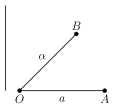
A form of seismograph for detecting horizontal vibrations consists of a thin rod \(OA\) of length \(a\) supported horizontally as shown in the figure. \(O\) is a smooth pivot, and \(AB\) a light inextensible wire. Calculate the period of oscillation for free oscillations of small amplitude. [You may if you wish assume the conservation of energy after the initial disturbance.]
1968 Paper 3 Q13
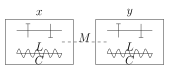
The figure represents a pair of electric circuits each containing a self-inductance \(L\) and a capacitance \(C\); the mutual inductance is \(M\), where \(|M| < L\). The currents \(x\), \(y\) satisfy the equations \begin{align} L \frac{d^2x}{dt^2} + M \frac{d^2y}{dt^2} + \frac{1}{C}x &= 0, \\ M \frac{d^2x}{dt^2} + L \frac{d^2y}{dt^2} + \frac{1}{C}y &= 0. \end{align} Show that these equations can be satisfied by $$x = a \cos(\omega t - \alpha), \quad y = b \cos(\omega t - \alpha)$$ for just two positive values, \(\omega_1\) and \(\omega_2\) say, of \(\omega\), the amplitudes \(a\) and \(b\) being appropriately related and the phase \(\alpha\) being arbitrary. Find \(\omega_1\) and \(\omega_2\) explicitly, and the ratio \(a:b\) for each of the two solutions.
1968 Paper 3 Q14
Without making detailed calculations give one reason in each case why the following statements about a sheet of metal in the form of a regular octagon are wrong:
- [(a)] the area is \(ka^4\), where \(k\) is a dimensionless constant and \(a\) is the distance between a pair of opposite vertices;
- [(b)] the moment of inertia about a line in the plane of the lamina through the centre \(O\) and inclined at an angle \(\alpha\) to a line joining a pair of opposite vertices is
- [(c)] the solid angle subtended by the lamina from a point on the perpendicular to the lamina at \(O\) and at distance \(b\) from \(O\) is (i) \(ka^3/(a+b)\), (ii) \(ka^2/b^2\), where in each case \(k\) is a dimensionless constant.
1968 Paper 3 Q15
The moment of momentum about a point \(O\) of a particle of mass \(m\) moving with velocity \(\mathbf{u}\) is defined as the vector product \(\mathbf{r} \times m\mathbf{u}\), where \(\mathbf{r}\) is the vector drawn from \(O\) to the particle. Prove that, if \(O\) is such that \(\mathbf{r}\) is parallel and the particle moves along a straight line with constant velocity, its moment of momentum about \(O\) is constant. A number of particles interact during a finite time interval. The mass of a typical particle is \(m_i\), its velocity before the interaction is \(\mathbf{u}_i\), and its velocity after the interaction is \(\mathbf{v}_i\). We postulate that $$\sum m_i \mathbf{u}_i = \sum m_i \mathbf{v}_i,$$ i.e. the total momentum is conserved in the interaction (postulate \(A\)). We postulate also that there is a fixed point about which the total moment of momentum of all the particles is zero before and after the interaction (postulate \(B\)). Show that \(A\) and \(B\) together imply that the total moment of momentum about an arbitrary fixed point is conserved in the interaction (principle \(C\)). Show also that \(C\) implies \(A\).