Problems
Filters
1983 Paper 2 Q11
The ``logistic'' difference equation is \begin{equation*} x_{n+1} = ax_n(1 - x_n), \end{equation*} where \(1 < a < 4\). Show that if either \(x_1 < 0\) or \(x_1 > 1\), then \(x_n \to -\infty\) as \(n \to \infty\), but if \(0 < x_1 < 1\), then \(0 < x_n < 1\) for all \(n\). Show further that if \(x_n\) tends to a finite limit \(x\) as \(n \to \infty\), then \(x = 0\) or \(x = 1 - 1/a\). By writing \(x_n = x + \epsilon_n\), and considering \(\epsilon_{n+1}/\epsilon_n\), or otherwise, show that sequences \(x_n\) with \(x_1\) sufficiently close to \(1 - 1/a\) get steadily closer to \(1 - 1/a\) provided \(a < 3\).
1983 Paper 2 Q12
Find the largest volume which can be attained by a circular cone inscribed in a sphere of radius \(R\).
1983 Paper 2 Q13
A bifilar pendulum consists of two point masses at the ends of a light horizontal rigid rod of length \(2L\). This rod is suspended symmetrically by two thin vertical threads of length \(l\), separation \(2d < 2L\). Show that the frequency of small oscillations in which the system rotates about a vertical axis through the centre of the rod is smaller than that when the whole system performs small oscillations perpendicular to its equilibrium plane. [Vertical displacements may be neglected.]
1983 Paper 2 Q14
A fine chain of mass \(\rho\) per unit length has length \(l\) and is suspended from one end so that it hangs vertically at rest with the lower end just touching a horizontal plane. The chain is released so that it falls freely and collapses inelastically onto the plane. Find as a function of time the force exerted on the plane.
1983 Paper 2 Q15
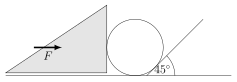
A cylinder of radius \(a\) and mass \(M\) rests on a horizontal floor touching as shown a vertical loading ramp at \(45^\circ\) to the horizontal. It is then pushed from the side with a force \(F\) by the vertical face of a piece of moving equipment. The coefficient of friction between the cylinder and the vertical face is \(\mu\) and the coefficient of friction between the cylinder and the ramp is \(\nu\). The value of \(F\) is such that the cylinder just rolls up the ramp. Show that \(F = Mg/[1 - \mu(1 + \sqrt{2})]\). Show further that \(\mu < \sqrt{2} - 1\) and \(\nu \geq \mu/(\sqrt{2} - \mu)\).
1983 Paper 2 Q16
A ship has an engine which exerts a constant force \(f\) per unit mass. The resistance of the water varies as the square of the speed. Verify that if \(x\) is the distance travelled in a time \(t\) starting from rest and \(V\) is the maximum possible speed of the ship, then \begin{equation*} x = \frac{V^2}{f}\ln\cosh\frac{ft}{V} \end{equation*} is a solution of the equation of motion. If the ship is travelling at full speed, find the distance travelled before the ship can come to a stop on reversing the engines.