Problems
Filters
1962 Paper 1 Q201
Prove that, if \(x\) is any positive integer, then \(x^5 - x\) is divisible by 30. Deduce, or prove otherwise, that, if \(a\) and \(b\) are any positive integers, then \[ ab(a+b)(a^2+ab+b^2) \] is divisible by 6.
1962 Paper 1 Q202
Given three real non-zero numbers \(a\), \(b\), \(h\), prove that the relations \begin{align} ax + hy &= \lambda x\\ hx + by &= \lambda y \end{align} can be satisfied by two distinct real values of \(\lambda\) and, for each of these values of \(\lambda\), a definite value of the ratio \(x/y\). By considering \(\lambda_1^2 + \lambda_2^2\), or otherwise, where \(\lambda_1\) and \(\lambda_2\) are the two values of \(\lambda\), prove that the numerical values of \(\lambda_1\) and \(\lambda_2\) cannot exceed \(\sqrt{(a^2 + b^2 + 2h^2)}\). Is it possible for \(\lambda_1\) or \(\lambda_2\) to have this extreme value?
1962 Paper 1 Q203
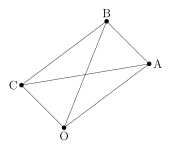
An `algebra of coplanar points' is constructed as follows: \(A\), \(B\), \(C\), \(\ldots\) are points in a plane which contains a fixed base point \(O\), and by the `sum' \(A + B\) of \(A\) and \(B\) is meant that point of the plane which is the fourth vertex of the parallelogram of which \(OA\), \(OB\) are adjacent sides. Prove the associative law \[ (A + B) + C = A + (B + C). \] Give a definition for a point to be called \(B - C\). Copy the adjoining diagram (strict accuracy is not essential). Mark the points \(B - C\), \(C - A\), \(A - B\) and prove that they are at the vertices of a triangle whose centroid is \(O\).
1962 Paper 1 Q204
An acute-angled triangle \(ABC\) is inscribed in a circle; another circle through \(B\) and \(C\) meets \(AC\) and \(AB\) in \(R\), where \(C\) lies between \(A\) and \(R\), and the line \(AP\) meets the circle \(ABC\) in \(X\). Prove, in any order, that \(QR\) meets \(BC\) in \(P\); \(X\), \(P\), \(Q\), \(C\) are three sets of concyclic points \(X\), \(Q\), \(R\), \(A\); \(X\), \(P\), \(Q\), \(C\) are concyclic points.
1962 Paper 1 Q205
Three points \(A\), \(B\), \(C\) form an acute-angled triangle in space. Establish the existence of two points at each of which the sides \(BC\), \(CA\), \(AB\) subtend right angles. Prove, further, that such points do not exist when one of the angles of the triangle \(ABC\) is obtuse.
1962 Paper 1 Q206
Prove that, if \(P\) is any point on the ellipse \[ \frac{x^2}{a^2} + \frac{y^2}{b^2} = 1 \quad (b^2 = a^2 - a^2e^2) \] with foci \(S(ae, 0)\), \(S'(-ae, 0)\), then \[ SP + S'P = 2a. \] The line through the origin parallel to \(\overrightarrow{SP}\) cuts the auxiliary circle \(x^2 + y^2 = a^2\) in \(R\). Prove that \(RP\) is perpendicular to \(RS\).
1962 Paper 1 Q207
The point \(P(ap^2, 2ap)\) lies on the parabola \(y^2 = 4ax\) and points \(M(0, a)\), \(N(0, -a)\) are fixed on the tangent at the vertex \(O\). The line \(PM\) meets the parabola again in \(Q(aq^2, 2aq)\) and \(PN\) meets it again in \(R(ar^2, 2ar)\). The line joining \(P\) to the pole, \(T\), of \(QR\) meets the parabola again in \(U(au^2, 2au)\). Express \(u\) in terms of \(p\). Verify that, if \(P\) is on the perpendicular bisector of \(OS\), where \(S\) is the focus \((a, 0)\), \(TP\) is parallel to the axis of the parabola.
1962 Paper 1 Q208
A variable circle through the foci \((\pm ae, 0)\) cuts the hyperbola \[ \frac{x^2}{a^2} - \frac{y^2}{b^2} = 1 \quad (b^2 = a^2e^2 - a^2) \] in points \(A\), \(B\), \(C\), \(D\), so named that \(AD\) and \(BC\) are parallel to the \(x\)-axis. The line \(AD\) cuts the \(y\)-axis in \(M\), and \(BC\) cuts it in \(N\). Prove that the circle on \(OM\) as diameter is equal in radius to that circle which is the inverse of the line \(BC\) with respect to the circle of centre the origin and radius \(b^2/\sqrt{(a^2 + b^2)}\).
1962 Paper 1 Q209
Points \(L(0, 1, \lambda)\), \(M(\mu, 0, 1)\), \(N(1, \nu, 0)\) are taken on the sides of the triangle \(XYZ\) in homogeneous coordinates, and lines \(y = \alpha z\), \(z = \beta x\), \(x = \gamma y\) are taken through the vertices, where \(\lambda\), \(\mu\), \(\nu\), \(\alpha\), \(\beta\), \(\gamma\) are non-zero constants. Prove that, if the points are collinear, then \(\lambda \mu \nu + 1 = 0\), and that, if the lines are concurrent, then \(\alpha \beta \gamma - 1 = 0\). The lines form the sides \(VW\), \(WU\), \(UV\) respectively of a triangle \(UVW\). Prove that, if the lines \(LU\), \(MV\), \(NW\) are concurrent, then \[ \begin{vmatrix} \beta \gamma - \lambda & \gamma \lambda & -\gamma \\ -\alpha & \gamma \alpha - \mu & \alpha \mu \\ \beta \nu & -\beta & \alpha \beta - \nu \end{vmatrix} = 0. \] By factorising the expansion of this determinant, or otherwise, show that, when the determinant is zero, the condition \(\alpha \beta \gamma + 1\) for the existence of a proper triangle is, as a consequence the condition \(\lambda \mu \nu \neq -1\), so that the points \(L\), \(M\), \(N\) are collinear.
1962 Paper 1 Q210
The conic \[ 2fyz + 2gzx + 2hxy = 0 \] circumscribes the triangle of reference \(XYZ\) in general homogeneous coordinates, and \(U(1, 1, 1)\) is a point not on the conic. The lines \(XU\), \(YU\), \(ZU\) meet the conic again in \(P\), \(Q\), \(R\). Prove that the sides of the triangle \(XYZ\) and the sides of the triangle \(PQR\) touch the conic whose tangential equation (equation in line coordinates) is \[ f(g + h)mn + g(h + f)nl + h(f + g)lm = 0. \]