Problems
Filters
1948 Paper 3 Q301
Coplanar forces of magnitudes \(kA_1A_2, kA_2A_3, \dots, kA_nA_1\) act at the middle points of, and perpendicular to, the sides of a polygon \(A_1A_2\dots A_n\); the polygon is convex and all forces act outwards. If the coordinates of each vertex \(A_r\) are \((x_r, y_r)\) referred to orthogonal Cartesian axes \(Ox, Oy\), find the moment about \(O\) of the force \(kA_rA_{r+1}\), and prove that the system of forces is in equilibrium. If the lines of action of all the forces are rotated in the same direction through an angle \(\alpha\), the points of application being unchanged, find the resultant of the new system.
1948 Paper 3 Q302
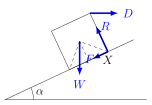
A uniform solid cube is at rest on a rough plane (coefficient of friction \(\mu\)) inclined at an angle \(\alpha\) to the horizontal, two of the edges of the cube being along lines of greatest slope of the plane. A slowly increasing horizontal force is then applied at the middle point of, and perpendicular to, the highest horizontal edge of the cube so that the cube tends to move up the plane. Find how equilibrium will be broken (i) if \(\mu=0.4\), and (ii) if \(\mu=0.25\); explain why the result in case (ii) does not depend on \(\alpha\).
Solution:
1948 Paper 3 Q303
A framework \(ABCD\) of four uniform rods each of length \(a\) and weight \(w\) smoothly jointed together hangs in equilibrium under gravity with \(AB\) held in a horizontal position, \(B\) and \(D\) being joined by a light string of length \(b\) (\(< \sqrt{2}a\)). By the principle of Virtual Work, or otherwise, find the tension in the string.
1948 Paper 3 Q304
A uniform chain of weight \(w\) per unit length hangs in equilibrium under gravity on a rough circular cylinder of radius \(a\) with a horizontal axis; the chain lies in a plane perpendicular to the axis, one end \(A\) is on the level of the axis, and the length of the chain exceeds \(\pi a\). If the chain is on the point of slipping and \(T\) is the tension at the point at an angular distance \(\theta\) (\(<\pi\)) from \(A\), establish the equation \[ \frac{d}{d\theta}(e^{-\mu\theta}T) = wae^{-\mu\theta}(\cos\theta+\mu\sin\theta), \] where \(\mu\) is the coefficient of friction, and find the length of the chain.
1948 Paper 3 Q305
A solid is made by drilling a cylindrical hole of radius \(a\) from a uniform solid sphere of radius \(b\); the axis of the cylindrical part of the surface of the solid passes through the centre of the spherical part. Find a formula for the radius of gyration of the solid about its axis of symmetry, and show that the formula is correct in the limiting cases \(a=0, a=b\).
1948 Paper 3 Q306
A sphere of mass \(m\) at rest on a horizontal table is struck by a second sphere of mass \(m\) which is moving on the table with velocity \(u\); the spheres are smooth and are of the same radius, and the coefficient of restitution between them is \(e\) (\(<1\)). Find the condition in which there is the maximum alteration in the direction of motion of the second sphere, and find the loss of kinetic energy in the impact in this case.
1948 Paper 3 Q307
Two particles are projected under gravity from a point \(O\) with the same initial velocity in the same vertical plane through \(O\) at angles of elevation \(\alpha, \beta\). If the trajectories meet at the point \((h, k)\) referred to horizontal and upward vertical axes at \(O\), prove that \[ k=h\tan(\frac{1}{2}\alpha+\frac{1}{2}\beta-\frac{1}{2}\pi). \] By considering the limiting case of this result as \(\beta\to\alpha\), or otherwise, prove that to attain maximum range along a given straight line through \(O\) with a given initial velocity the direction of projection must bisect the angle between the line and the vertical through \(O\).
1948 Paper 3 Q308
The driving force of a car is constant and the resisting forces vary as the square of its speed; the mass of the car is 1 ton, its maximum horse-power 42 and its maximum speed 75 miles per hour. Find the distance in which the car accelerates from 30 to 60 miles per hour.
1948 Paper 3 Q309
A bead can slide freely on a straight wire \(AB\) of length \(l\) which is rotated in a horizontal plane with constant angular velocity \(\omega\) about its end \(A\). Initially the bead is projected along the wire with velocity \(V\) from \(A\). When the bead leaves the wire, what is the angle between the line of the wire and the direction of motion of the bead?
1948 Paper 3 Q310
Two particles \(P_1, P_2\) of masses \(m_1, m_2\) are connected by a light elastic string of modulus \(\lambda\) and natural length \(l\) and lie at rest on a smooth horizontal table at a distance \(l\) apart. If an impulse \(I\) is applied to \(P_1\) in the direction \(P_2P_1\), prove that in the subsequent motion the greatest extension of the string is \[ I \sqrt{\frac{m_2 l}{m_1(m_1+m_2)\lambda}}, \] and find when it is first attained.