Problems
Filters
1983 Paper 1 Q1
Show that \begin{equation*} \cosh x - \cosh y = 2\sinh\left(\frac{x+y}{2}\right)\sinh\left(\frac{x-y}{2}\right) \end{equation*} Show that the inverse hyperbolic function \begin{equation*} y = \sinh^{-1} x \end{equation*} satisfies the differential equation \begin{equation*} (x^2 + 1)\frac{d^2y}{dx^2} + x\frac{dy}{dx} = 0. \end{equation*}
1983 Paper 1 Q2
Define the inverse \(A^{-1}\) and the transpose \(A^T\) of an invertible \(n \times n\) matrix \(A\). If \(B\) is also an invertible matrix show that \begin{equation*} (AB)^{-1} = B^{-1}A^{-1}, \quad (AB)^T = B^TA^T. \end{equation*} Hence show that if in addition \(A\) and \(B\) are symmetric and commute, then
- [(i)] \(A^{-1}\) is symmetric.
- [(ii)] \(A^{-1}\) and \(B^{-1}\) commute.
- [(iii)] \(A^{-1}B^{-1}\) is symmetric.
1983 Paper 1 Q3
- [(i)] Show that a necessary condition for the lines \begin{equation*} \mathbf{r} = \mathbf{a} + s\mathbf{m}, \quad \mathbf{r} = \mathbf{b} + t\mathbf{n} \end{equation*} to intersect is \([(\mathbf{a} - \mathbf{b}), \mathbf{m}, \mathbf{n}] = 0\), where \([\mathbf{x}, \mathbf{y}, \mathbf{z}]\) denotes the scalar triple product \(\mathbf{x}\cdot(\mathbf{y} \times \mathbf{z})\) of the vectors \(\mathbf{x}\), \(\mathbf{y}\), \(\mathbf{z}\). Is the condition \([(\mathbf{a} - \mathbf{b}), \mathbf{m}, \mathbf{n}] = 0\) sufficient for the two lines to intersect?
- [(ii)] Find the points of intersection of the line \(\mathbf{r} = \mathbf{a} + s\mathbf{m}\) with the plane \(\mathbf{r}\cdot\mathbf{n} = d\), discussing carefully the case \(\mathbf{m}\cdot\mathbf{n} = 0\).
1983 Paper 1 Q4
Let \(C\) be the set of matrices of the form \begin{equation*} \begin{pmatrix} a & b \\ -b & a \end{pmatrix} \end{equation*} where \(a\) and \(b\) are real numbers. Show that \(C\) is closed under addition and multiplication, and that for every matrix \(Z\) in \(C\) other than the zero matrix, there is a matrix \(Z'\) in \(C\) with \(ZZ' = I\) (\(I\) being the identity \(2\times2\) matrix). Find matrices \(X\) and \(Y\) in \(C\) such that \begin{equation*} X^2 + I = 0, \quad Y^2 + Y + I = 0. \end{equation*}
1983 Paper 1 Q5
- [(i)] Assume that the numbers \(b_1\), \(b_2\), \(b_3\) are not all zero. State a sufficient condition on the coefficients \(a_{ij}\) for the equations \begin{align*} a_{11}x + a_{12}y + a_{13}z &= b_1 \\ a_{21}x + a_{22}y + a_{23}z &= b_2 \\ a_{31}x + a_{32}y + a_{33}z &= b_3 \end{align*} to have a solution.
- [(ii)] For all values of \(c\), solve the equations \begin{align*} cx + 2y - z &= 1 \\ x + 2y + z &= 1 \\ 2x - 2y + 5z &= -1. \end{align*} By considering the case where \(c = 0\), determine whether the condition you have given in part (i) is necessary as well as sufficient.
1983 Paper 1 Q6
Let \(\displaystyle I_n = \int_0^{\pi/2} \sin^n\theta\, d\theta, \quad n\) an integer. Show that:
- [(i)] \(I_{2n-1} > I_{2n} > I_{2n+1}\), for all \(n \geq 1\).
- [(ii)] \(nI_n = (n-1)I_{n-2}\), \quad for all \(n \geq 2\).
- [(iii)] \(\displaystyle I_{2n} = \frac{(2n-1)(2n-3)\ldots 1}{2n\cdot(2n-2)\ldots 2}\frac{\pi}{2}\) for \(n \geq 1\). \(\displaystyle I_{2n+1}= \frac{2n\cdot(2n-2)\ldots 2}{(2n+1)(2n-1)\ldots 3}\) for \(n \geq 1\).
1983 Paper 1 Q7
Show that if \(z = x + iy\) defines a point in the \(x,y\) plane, then \begin{equation*} \left|\frac{z - z_1}{z - z_2}\right| = k \quad \text{(where \(k\) is a positive constant and \(z_1 \neq z_2\))} \end{equation*} gives the equation of a circle or straight line, depending on the value of \(k\). If \(z \to \frac{az + b}{cz + d}, ad - bc \neq 0\), \(a\), \(b\), \(c\), \(d\) complex, show that such circles or straight lines are mapped into circles or straight lines.
1983 Paper 1 Q8
If \(f(x)\) is a positive function of \(x\) whose derivative is positive and \(n \geq 2\) is an integer, justify the inequality \begin{equation*} \int_1^n f(x)\, dx < \sum_{r=2}^n f(r). \end{equation*} By considering the integral of \(\ln x\), show that \(e\left(\frac{n}{e}\right)^n < n!\)
1983 Paper 1 Q9
Let \(S_1\), \(S_2\) be two spheres such that the sum of the surface areas is fixed. When is the sum of the volumes a) a maximum b) a minimum? Suppose instead that the sum of the reciprocals of the areas is fixed. When (if ever) is the sum of the volumes a) a maximum b) a minimum?
1983 Paper 1 Q10
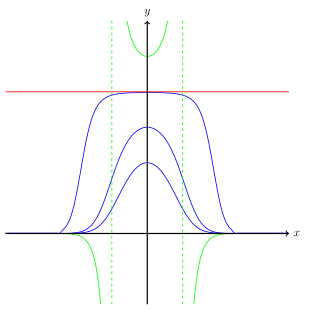
Find the solution of \(\frac{dy}{dx} = xy(y-2)\) such that \(y(0) = y_0\). Sketch the forms of solution that arise for \(y_0 > 0\).
Solution: \begin{align*} && \frac{\d y}{\d x} &= x y(y-2) \\ \Rightarrow && \int x \d x &=\int \frac{1}{y(y-2)} \d y \\ \Rightarrow && \frac{x^2}{2} &=\frac12 \int \left ( \frac{1}{y-2}-\frac{1}{y} \right)\d y \\ &&&= \frac12 (\ln |y - 2| - \ln |y|)+C \\ \Rightarrow && x^2 &= \ln |1-\frac{2}{y} | +C\\ y(0) = y_0: && 0 &= \ln | 1 - \frac{2}{y_0}| + C \\ \Rightarrow && C &= - \ln |1 - \frac{2}{y_0}| \\ \Rightarrow && x^2 &= \ln \frac{1-2/y}{1-2/y_0} \\ \Rightarrow && (1-2/y_0)e^{x^2} &=1-2/y \\ \Rightarrow && y &= \frac{2}{1-(1-2/y_0)e^{x^2}} \\ &&&= \frac{2y_0}{y_0-(y_0-2)e^{x^2}} \end{align*}