zNo longer examinable
Problems which are no longer examinable from mechanics
A uniform rod of mass \(m\) and length \(4a\) can rotate freely in a smooth horizontal plane about its midpoint. Initially the rod is at rest. A particle of mass \(m\) travelling in the plane with velocity \(u\) at right angles to the rod collides perfectly elastically with the rod at a distance \(a\) from the centre. Find the velocity of the particle and angular velocity of the rod after collision. Do the particle and the rod undergo a subsequent collision?
A uniform solid, with total mass \(M\), occupies the volume obtained by rotating about the \(x\)-axis the area lying between the two parabolas \(y^2 = 4ax\) \((0 < x < b)\) and \(y^2 = 8ax - 4ab\) \((\frac{1}{2}b < x < b)\). Find the position of its mass centre and calculate its moment of inertia about the \(x\)-axis.
A railway truck of total mass \(M\) has identical wheels of radius \(a\) whose combined moment of inertia, about the axles is \(J\). The axle bearings are frictionless, but the coefficient of limiting friction between the wheels and the rails is \(\mu\). The truck is on a horizontal track, and is pulled by a force \(P\). The vertical acceleration due to gravity is \(g\).
- [(i)] If the frictional force between the rails and wheels is \(F\), what inequality is satisfied by \(F\), \(\mu\), and \(M\)?
- [(ii)] If \(x\) measures the horizontal distance moved by the truck, and \(\theta\) measures the angle turned by the wheels, what is the relation between \(x\) and \(\theta\), assuming that no slipping occurs?
- [(iii)] Write down the equations that govern the motion of the truck and the wheels.
- [(iv)] Show that, for the wheels not to slip, \(P\) must be less than a certain value, which should be found.
A uniform rod \(AB\) of length \(l\) lies on a rough horizontal table. A string is attached to the rod at \(B\) and is pulled in a horizontal direction perpendicular to the rod. Show that, as the tension in the string is gradually increased, the rod begins to turn about a point whose distance from \(A\) is \(l(1 - 1/\sqrt{3})\), and find the value of the tension when that occurs, in terms of the weight of the rod and the coefficient of friction between the rod and the table.
A uniform circular cylinder of mass \(m\) and radius \(a\) moves under the action of a horizontal force \(P\) on a rough horizontal table. The force \(P\) is directed through the centre of mass of the cylinder. The table moves with acceleration \(f\) in the same direction as the force \(P\). Both \(P\) and \(f\) are perpendicular to the axis of the cylinder. The coefficient of friction between the cylinder and the table is \(\mu\). Initially the cylinder and the table are at rest, and there is no slipping in the subsequent motion. When the cylinder has moved a distance \(x\) perpendicular to its axis, it has rotated through an angle \(\theta\) about its axis. Show that \[\ddot{x} + a\ddot{\theta} = f\] and find \(\ddot{\theta}\). Show that \[\mu \geq \tfrac{1}{3}|mf - P|/mg\] where \(g\) is the acceleration due to gravity.
A uniform rod \(AB\), of length \(a\) and mass \(m\), is pivoted about \(A\). It is released from rest with \(B\) vertically above \(A\), and given a very slight displacement so that it falls under gravity. Find the horizontal and vertical components of the reaction at the pivot when the rod makes an angle \(\theta\) with the upwards vertical.
A plane lamina in the shape of a quadrant of the unit circle has a variable density proportional to \(r^{-1}\sin(\frac{1}{2}\pi r)\) where \(r\) is the distance from the centre of the circle. Calculate its moment of inertia about an axis through its centre of gravity perpendicular to the plane of the lamina.
A gramophone record of mass \(m\) and radius \(a\) is placed on a horizontal turntable of radius greater than \(a\). The pressure between the record and the turntable is uniformly distributed and the coefficient of friction is \(\mu\). Show that, if, starting from zero, the angular acceleration \(f\) of the turntable is gradually increased, slipping takes place as soon as \(f\) exceeds \(4\mu g/3a\). A second record, of mass \(m'\) and radius \(a\), is placed upon the first, the coefficient of friction between the records being \(\mu'\). If, starting from zero, the angular acceleration of the turntable is gradually increased, find where slipping first takes place, and for what value of \(f\). If \(\mu = 3\mu'\), if the angular acceleration of the turntable is twice that at which slipping first occurs, and if \(I\) is the moment of inertia of the turntable, calculate the torque required to turn the turntable.
Without making detailed calculations give one reason in each case why the following statements about a sheet of metal in the form of a regular octagon are wrong:
- [(a)] the area is \(ka^4\), where \(k\) is a dimensionless constant and \(a\) is the distance between a pair of opposite vertices;
- [(b)] the moment of inertia about a line in the plane of the lamina through the centre \(O\) and inclined at an angle \(\alpha\) to a line joining a pair of opposite vertices is
- [(c)] the solid angle subtended by the lamina from a point on the perpendicular to the lamina at \(O\) and at distance \(b\) from \(O\) is (i) \(ka^3/(a+b)\), (ii) \(ka^2/b^2\), where in each case \(k\) is a dimensionless constant.
A hollow circular cylinder of moment of inertia \(I\) about its axis is initially at rest. It is made to spin about its axis by a motor which applies a constant torque \(G\). The motion is opposed by a frictional torque \((G/\omega_0)\omega\), where \(\omega\) is the angular velocity of the cylinder. Find \(\omega\) as a function of time and show that it tends to a limiting value. When the cylinder is rotating at this limiting rate a particle (whose mass is so small that its effect on the motion of the cylinder is negligible) moves on the inner surface of the cylinder, in a plane perpendicular to the axis, with an initial angular velocity \(2\omega_0\) about the axis. The coefficient of friction is \(\mu\). How much time elapses before the particle rotates at the same rate as the cylinder? [The force of gravity may be neglected.]
A uniform circular disc of mass \(M\) and radius \(a\) is placed on a smooth horizontal table. Find from first principles the moment of inertia about a vertical axis through a point of the disc at a distance \(c\) from the centre. If the disc is set in motion by a tangential impulse applied at a point on the edge, determine the point about which the disc will start to rotate.
A solid spherical ball of radius \(a\) rolls on a level floor towards a step of height \(h\) \((h < a)\). Initially the angular velocity of the ball is \(\Omega\). Find the condition that the ball fails to mount the step, assuming that the collision is inelastic and that there is no slipping of the ball on the step. If the ball fails to mount the step, and the subsequent collision with the floor is inelastic, prove that the angular velocity with which the ball finally rolls away from the step is \(\omega\) where \begin{equation*} \frac{\omega}{\Omega} = \left(1 - \frac{5h}{7a}\right)^2. \end{equation*}
If the moment of inertia of a body of mass \(m\) about an axis which passes through the centre of mass is \(mk^2\), show that the moment of inertia about a parallel axis a distance \(l\) from the first is \(m(k^2+l^2)\). A thin uniform rod of mass \(m\) is attached to a smooth hinge at one end. The rod falls from rest in the horizontal position. If the maximum strain which the hinge can take in any direction is \(mg\), show that the hinge will snap when the rod makes an angle \(\sin^{-1} \left(\frac{2\sqrt{3}}{3}\right)\) with the vertical. Describe, without explicit calculation, the motion of the rod after the hinge has broken.
A uniform solid cylinder is projected up a rough plane with speed \(v\) in such a way that it has initially no rotation. The plane is inclined at an angle \(\alpha\) to the horizontal, and the coefficient of friction is \(\frac{1}{3}\tan\alpha\). Show that the frictional force acts down the plane for all times \(t\) less than \(t_1 = 2V\textrm{cosec}\alpha/3g\). Show also that at this time \(t_1\) a pure rolling motion cannot commence, and that at all later times the frictional force acts up the plane.
A bell of mass \(M\) is in the form of a hollow right circular cone of height \(h\) and semivertical angle \(\alpha\), and is made of thin uniform material. It is mounted on a light spindle passing through the vertex and perpendicular to the axis of the cone. Calculate its moment of inertia about the spindle.
A hollow spherical ball of mass \(M\) and radius \(r\) runs between two horizontal parallel bars a distance \(2d\) apart and at the same height. The coefficient of friction between the ball and the bars is \(\mu\). Initially the ball rolls without slipping along the bars with constant velocity \(v\), but it then collides with an obstacle in the form of a smooth, perfectly elastic, fixed vertical wall at right angles to the direction of motion of the ball. Describe carefully the subsequent motion of the ball. What is the total work done by the frictional forces? [The moment of inertia of the ball about its diameter is \(\frac{2}{3}Mr^2\).]
An elliptical disc with semi-axes \(a, b\) can be thought of as a circular disc of radius \(b\) which has been stretched uniformly by a factor \(a/b\) in one direction and not stretched in the perpendicular direction. Use this concept (or any other method) to show that the radius of gyration of an elliptical disc about an axis through its centre perpendicular to its plane is \(\frac{1}{2}\sqrt{a^2+b^2}\). The disc is at rest on a flat table with its major axis vertical. Given an infinitesimal push, it rolls sideways without slipping. Find its angular velocity when the minor axis is vertical.
Suppose that the coefficient of friction between two surfaces is directly proportional to the velocity difference between the surfaces (the 'slipping velocity'). Show that a body can slide down an inclined plane with a constant velocity which depends on the inclination of the plane. A cylinder of radius \(a\) and radius of gyration \(k\), with its axis horizontal, rolls (with slipping of the above character) down an inclined plane. If the cylinder starts from rest, determine the subsequent motion. Show that the frictional force tends to the force which would be necessary to keep the cylinder rolling without slipping, but that the slipping velocity at the point of contact does not tend to zero.
A particle of unit mass moves, in the absence of gravity, in the plane of a disc of unit radius and moment of inertia \(k^2\). The particle is attached by a light inextensible string of length \(l_0\) to a point on the rim of the disc. The particle's motion is such that the string is always taut, and wraps itself round the disc as the particle moves in a clockwise sense. (i) If the disc is fixed, show that the kinetic energy \(T\) of the system is \(\frac{1}{2}l^2\dot{\theta}^2\), and its angular momentum \(h\) is \(l^2\dot{\theta}\), where \(l\) is the length of the unwrapped portion of the string. Which, if either, of \(T\) and \(h\) is constant? (ii) If the disc is free to rotate about its axis, with angular velocity \(\dot{\phi}\) which is positive if the body rotates anticlockwise, show that \[h = l^2\dot{\theta}+(1+k^2+l^2)\dot{\phi},\] and find \(T\). Which, if either, of \(T\) and \(h\) is now constant? Show that \[h^2+l^2\dot{\theta}^2(1+k^2) = 2T(1+k^2+l^2).\]
A garden water sprinkler consists of a straight arm of length \(2l\) pivoted at its centre. The arm rotates in a horizontal plane at a steady angular velocity \(\Omega\), with a rusty pivot exerting a constant couple \(G\) on the arm. Water enters through the central pivot and leaves horizontally through small nozzles at the ends of the arm set at an angle \(\theta\) to the direction of the arm. In unit time a mass \(Q\) of water is discharged with a kinetic energy \(\frac{1}{2}QU^2\) relative to the ground. By considering the angular momentum imparted to the water in unit time, show that the angular velocity of the discharged water is \(G/l^2Q\) at the nozzles. Show further that \(\Omega\) is given by \begin{align*} \Omega l = \left[U^2 - \frac{G^2}{l^2Q^2}\right]^{\frac{1}{2}} \tan \theta - \frac{G}{lQ}. \end{align*} What is the total power which must be supplied to the sprinkler?
The body of a skater may be represented by a uniform cylinder of mass \(M\) and radius \(a\), with two uniform thin rods of mass \(m\) and length \(2b\), representing his arms, hinged on the circumference of the cylinder at opposite ends of a diameter. Starting from first principles, find the moment of inertia of his body about the axis of the cylinder when his arms are out-stretched and when they lie by his sides. The skater stands upright and spins with angular velocity \(\omega_1\) about a vertical axis with his arms out-stretched. Find his angular velocity \(\omega_2\) when he lowers his arms to his sides and show that the work he needs to do in this process is \[2mb \left[ \frac{\omega_1^2(a + \frac{2b}{3})(Ma^2 + 4m[\frac{1}{3}b^2 + (b+a)^2]))}{a^2(M+4m)} - g \right]\]
A church bell consists of a heavy symmetrical bell and a clapper, both of which can swing freely in a vertical plane about a point \(O\) on a horizontal beam at the apex of the bell. The radius of gyration of the bell (without clapper) about this beam is \(k\) and its centre of mass is at distance \(h\) from \(O\). The clapper may be regarded as a small heavy ball on a light rod of length \(l\). Initially the bell is held with its axis vertical and its mouth above the beam. The clapper rod rests against the side of the bell, making an angle \(\beta\) with the axis. The bell is then released. Show that the clapper rod will remain in contact with the side of the bell until the clapper rod makes an angle \(\alpha\) with the upwards vertical, where \[\cot \alpha = \cot \beta - \frac{k^2}{hl} \textrm{cosec} \beta\] [The radius of gyration, \(k\), is defined by \(I = Mk^2\), where \(I\) is the moment of inertia and \(M\) is the mass.]
An amusing trick is to press a finger down on a marble on a horizontal table top in such a way that the marble is projected along the table with an initial linear velocity \(v_0\) and an initial backward angular velocity \(\omega_0\) about a horizontal axis perpendicular to \(v_0\). The coefficient of sliding friction between the marble and the table is constant, and the radius of the marble is \(a\). For what value of \(v_0/a\omega_0\) does the marble:
- [(a)] slide to a complete stop?
- [(b)] slide to a stop and then return towards its initial position with a final constant linear speed \((3/7)v_0\)?
Particles of a system move in one plane under forces between the particles and external forces in the plane. Prove that the rate of change of angular momentum about their centroid is equal to the resultant moment of the external forces about the centroid. A compound pendulum of radius of gyration \(k\) about the centroid \(G\) hangs from a point \(P\) at distance \(h\) from \(G\). \(P\) is forced to move along a horizontal line in the plane of the pendulum, its displacement \(x\) being a known function of time \(t\), and the inclination of \(PG\) to the downward vertical being \(\theta\). Show that $$h\cos\theta \ddot{x} + (h^2 + k^2)\ddot{\theta} + hg\sin\theta = 0.$$ Find the value of \(\ddot{x}\) that is needed to make the pendulum maintain a constant inclination \(\alpha\). Show that if \(\ddot{x}\) has this value the period of small oscillations in inclination is \(\frac{2\pi}{n}\), where \(n^2 = (hg\sec\alpha)/(h^2 + k^2)\).
State the principles of conservation of linear momentum and conservation of angular momentum. Explain
- [(a)] how a child on a swing can increase the amplitude of successive swings by body movements,
- [(b)] how you would control your movements after emerging from a satellite in free orbit.
A heavy plane plate is dropped on to two identical parallel horizontal rough rollers whose axes are a distance \(a\) apart in the same horizontal plane. The rollers are rotating extremely rapidly and the coefficient of sliding friction \(\mu\) is constant. Discuss the motion of the plate according to the various senses of rotation of the rollers.
A weightless rod carries a particle of mass \(m\) at its upper end. It is balanced in unstable equilibrium on a rough horizontal table, and begins to fall sideways. Using conservation of energy, find the angular velocity (squared) and the angular acceleration as functions of the angle \(\theta\) through which it has fallen, assuming the lower end does not move. Use these to show that the vertical component of force, where the rod touches the table, is \[N = mg(3\cos^2\theta - 2\cos\theta),\] and find the horizontal component. Let the coefficient of friction between the rod and the table be \(\mu\). Show that the rod's lower end either leaves the surface of the table when \(\cos\theta = \frac{1}{3}\), or slips when \(\tan\theta = \mu\). What determines which happens?
A particle can slide smoothly in a uniform straight tube. The tube and the particle have equal masses. The tube can rotate freely in a horizontal plane about a fixed end. It is given an initial angular velocity, and the particle is displaced slightly along the tube from its fixed end. Show that the particle must eventually leave the other end, and does so at an angle of approximately \(\tan^{-1}\frac{1}{2}\) to the axis of the tube.
A uniform plank is held at rest with one end on a smooth horizontal floor and with the other end against a smooth vertical wall. The plank makes an angle of \(60^{\circ}\) with the vertical wall. If the plank is released from rest, show that the top end of the plank loses contact with the wall after it has slipped down the vertical wall through a distance equal to \(\frac{1}{6}\) of the length of the plank.
A particle \(A\) of mass \(m\) and a particle \(B\) of mass \(2m\) are connected by a light string of length \(a\) and slide on a smooth horizontal table. Initially both are at rest with the string taut, when another particle of mass \(m\) moving with velocity \(U\) perpendicular to \(AB\) embeds itself in \(A\). Show that \(A\) comes to rest again after a time \(\frac{2ma}{U}\). What is then the velocity of \(B\)?
A particle moves under a central attractive force \(f(r)\) per unit mass when its distance from the centre of force is \(r\). Find the form of \(f(r)\) if the particle describes the ellipse $$\frac{x^2}{a^2} + \frac{y^2}{b^2} = 1$$ and the centre of force is at the origin.
A massless hoop, of radius \(a\), stands vertically on a rough plane. A weight is attached to the rim of the hoop so that the radius to the weight makes an angle \(\theta_0\) (\(0 \leq \theta_0 < \pi\)) to the upward vertical. In the subsequent motion the hoop remains vertical and rolling occurs without slipping until the vertical reaction at the point of contact with the plane is zero. Show that this occurs when \(\theta = \theta_1\) where \(\frac{1}{2}\pi \leq \theta_1 < \pi\). At the moment when the vertical reaction is zero, the plane is removed. Show that the velocity of the weight when it reaches the former level of the plane is \[2\sqrt{2ag}\cos\left(\frac{\theta_1}{2}\right).\]
A long thin pencil is held vertically with one end resting on a rough horizontal plane whose coefficient of static friction is \(\mu\). The pencil is released and starts to topple forward making an angle \(\theta(t)\) to the vertical. Show that there is a critical value of \(\mu\), say \(\mu_1\), such that
- [(i)] if \(\mu < \mu_1\) the pencil base slips backwards before \(\cos\theta = 9/11\);
- [(ii)] if \(\mu > \mu_1\) the pencil base slips forwards at some value of \(\theta\) lying in the range \(\frac{2}{3} > \cos\theta > \frac{1}{3}\).
A ring of weight \(mg\) is free to move on a fixed smooth horizontal rod. A light inextensible string of length \(2l\) is attached to the ring at one end. Its other end is attached to a particle of weight \(mg\). The system is held with the particle just below the rod and with the string just taut and lying along the underside of the rod. The system is released from rest in this position. Express the velocities of the ring and the particle in terms of the angle \(\theta\) made by the string with the horizontal during motion of the system in which the string remains taut. For such motion, show that \begin{align*} l\dot{\theta}^2 = \frac{2g \sin \theta}{1 + \cos^2 \theta} \end{align*} and evaluate the tension in the string as a function of \(\theta\). Hence show that for \(0 < \theta < \pi\) the string never becomes slack. Show also that the particle follows an elliptic path.
Two planets circle around their common centre of gravity \(C\) under the influence of Newtonian gravity; the effect of their parent sun can be neglected. Obtain the total energy of their mutual motion, and the total angular momentum about \(C\), as functions of the planets' masses and separation. Miners from the initially less massive planet take ore from the other planet back to their home planet, at a slow, fairly steady, rate. Assuming the two orbits always remain circular, and that the planets are small compared with their separation, show that as the relative masses of the planets change so will their separation, and it will reach a minimum when the two masses are equal. As the planets start to separate at later times, an ecologist suggests that the journey could be kept short, and hence fuel saved, if equivalent masses of unwanted material were shipped back at the same rate, thus keeping the separation at its minimum. Do you agree that this would save fuel in the long run?
A uniform plane lamina has a polygonal boundary and rests on a smooth horizontal table. Forces act at the mid-points of the sides, each directly along the inward normal and represented in magnitude by the length of the side on which it acts. Show that the lamina is in equilibrium. The lamina is now turned through an angle \(\alpha\) (less than \(\pi\)) about its centroid, the forces retaining their magnitudes, points of application, and directions in space. If the lamina is now released from rest, show that it will turn about its centroid through an angle \(2\pi - 2\alpha\) before coming again to rest, and will return to its initial position at equal intervals of time.
A uniform pole of length \(2a\), standing vertically on rough ground, is slightly disturbed and begins to fall over. If it has not slipped by the time it makes an angle \(\theta\) with the vertical, show that $$\frac{d\theta}{dt} = \left(\frac{3g}{a}\right)^{1/2} \sin \frac{\theta}{2}.$$ Find the horizontal and vertical components of the force exerted by the ground on the pole, as a function of \(\cos\theta\), and prove that the pole will certainly have slipped before it can reach a certain angle \(\alpha\), however great the coefficient of friction may be.
A bead moves on a rough wire which is in the shape of the cycloid whose intrinsic equation is $$s = 4a \sin \psi.$$ The wire is in a vertical plane and its cusps point upwards, \(s\) is measured from the lowest point, and \(\psi\) is the angle between tangent and horizontal. Show that if the particle is released from rest at one of the cusps it just comes to rest again at the bottom of the wire if the coefficient of friction \(\mu\) satisfies the equation $$\mu^2 e^{4\pi} = 1.$$
Two particles \(A\) and \(B\), of equal mass, are joined by a light inextensible string. \(A\) moves on a rough horizontal table (coefficient of friction \(\mu\)) and the string passes through a small smooth hole \(O\), so that \(B\) hangs below the table. Show that, if \((r, \theta)\) are polar coordinates of the position of \(A\) relative to \(O\), $$\frac{d}{dt}(r^2\dot{\theta}) = -\mu gr^2\dot{\theta}/v,$$ $$2\ddot{r} - r\dot{\theta}^2 = -g(1 + \mu^2/v),$$ where \(v^2 = \dot{r}^2 + r^2\dot{\theta}^2\) and the dot denotes differentiation with respect to the time \(t\). Initially \(r = R\) and the velocity of \(A\) is at right angles to the string and of magnitude \(\sqrt{(gR)}\). If \(\mu\) is small an approximate solution to the equations of motion is $$r = R + \mu\rho(t),$$ $$r\theta = \sqrt{(gR)} + \mu h(t),$$ where the functions \(\rho(t)\) and \(h(t)\) are independent of \(\mu\). Show that $$h = -gt - \sqrt{(g/R)}\rho$$ and $$\ddot{\rho} + \frac{3g}{2R^2}\rho + g\sqrt{\frac{g}{R}}t = 0.$$
A uniform thin straight rod \(AB\), of mass \(M\) and length \(2l\), is initially at rest on a smooth horizontal table. If the end \(A\) is constrained to move from rest with constant acceleration \(f\) in a horizontal straight line at right angles to the rod, find the components of the force being exerted on the rod at \(A\) at the instant when the rod has turned an angle \(\theta\) from its initial direction. Discuss whether the rod will make complete revolutions.
Two equal light rods \(AB\), \(BC\) are freely jointed at \(B\) and lie on a smooth table. A heavy weight is attached at \(A\), and the point \(C\) is fixed. The rod \(BC\) is constrained to pass through a fixed point. Initially, \(A\) is at rest and \(ABC\) are in a straight line, and roughly describe the motion of \(A\).
Three equal heavy particles \(XYZ\) lie in a straight line on a smooth table. \(XY\) and \(YZ\) are joined by similar light springs, each of natural length \(L\). Initially, the particles are still, and the distance \(XY\) is \(L\), and the distance \(YZ\) is \(L - y_0\) (\(y_0 < L\)). Describe the subsequent motion—in particular, show that it is periodic.
A smooth wire \(AB\) of length \(a\) is originally in a vertical line, \(B\) being above \(A\). A stop is attached to the wire very near the end \(B\) and a heavy bead is threaded on to the wire just above the stop (so that the bead cannot move nearer to \(A\), but is free to leave the wire after moving a negligibly small distance away from the stop). The wire is then suddenly constrained to rotate with uniform angular velocity in a vertical plane about the end \(A\), which remains fixed. Find where the bead leaves the wire, and at what distance from \(A\) it meets the horizontal plane through \(A\).
A particle \(P\) of mass \(m\) moves in a hyperbolic orbit under the influence of a radial repulsion \(k/r^2\) from a fixed focus \(O\), where \(r = OP\). The particle starts at a great distance from \(O\) with a speed \(v\) along a line to which the perpendicular from \(O\) has length \(b\). If \(u\) is the speed of the particle when it is closest to \(O\), show from the equations of energy and angular momentum respectively that \[\left(\frac{u}{v}\right)^2 = 1 - \frac{2k\sin\alpha}{mv^2b(1+\cos\alpha)}, \quad \frac{u}{v} = \frac{\sin\alpha}{1+\cos\alpha},\] where \(\alpha\) is the acute angle between the initial direction of motion of the particle and the axis of symmetry of the orbit. Deduce that when the particle has receded a great distance from \(O\) its direction of motion has turned through the angle \[2\tan^{-1}\left(\frac{k}{mv^2b}\right).\]
A light spring \(ABCD\), of natural length \(3a\) and modulus \(\lambda\), lies on a smooth horizontal table to the surface of which its ends \(A\), \(D\) are fixed at points distant \(3a\) apart. Particles of mass \(m\) are rigidly attached to the points of trisection \(B\), \(C\) of the unstretched spring, and subsequently the particle at \(B\) is moved a distance \(\frac{1}{2}a\) towards that at \(C\), which is held stationary. The system is then released from rest. Determine the subsequent motion.
A particle \(P\) of unit mass moves on a smooth horizontal plane on which \(Ox\), \(Oy\) are fixed rectangular cartesian axes. \(P\) is attracted towards \(O\) with force \(n^2r\), where \(r\) is the distance \(OP\). The particle is projected from the point \(C\) \((c, 0)\) with velocity \(nb\), in the direction which makes an angle \(\alpha\) with \(Ox\). Show that \(P\) moves on the ellipse \(b^2(x\sin\alpha - y\cos\alpha)^2 + c^2y^2 = b^2c^2\sin^2\alpha.\) Using \(t = \tan\alpha\) as parameter, or otherwise, show that all points of the plane which can be reached by projection from \(C\) with speed \(nb\) lie within or on the ellipse \(b^2x^2 + (b^2 + c^2) y^2 = b^2(b^2 + c^2).\)
Two unequal masses, \(m_1\) and \(m_2\), are fixed to the ends of a light elastic spring of length \(k\). The spring is laid on a smooth horizontal table and compressed through a distance \(l\). Both ends are then released simultaneously. Investigate mathematically the subsequent motion of the system.
A uniform rod \(AB\) of length \(2a\) and mass \(m\) stands balanced vertically on a smooth horizontal table, \(A\) being the point of contact. A horizontal impulse \(I\) is applied at \(A\). Show that if \(I > \frac{1}{2}m\sqrt{(ag)}\) the rod leaves the table immediately, and in this case find that value of \(I\) for which the rod is horizontal at its first impact with the table.
A narrow straight tube of length \(2a\) has one end fixed and is made to rotate in a plane with constant angular velocity \(\omega\). A small bead is instantaneously at rest at \(t = 0\) at the mid-point of the tube, and the coefficient of friction in the tube is \(\frac{1}{3}\). If gravity can be neglected, show that the particle will reach the other end of the tube after time \((2/\omega) \log x\), where \(x\) is the larger positive root of the equation \(4x^2 - 10x^4 + 1 = 0\).
A smooth rigid wire in the form of a parabola is held fixed in a vertical plane with its vertex downwards. A bead moves under gravity on the wire. Prove that at the square of the normal reaction of the bead on the wire is inversely proportional to the cube of the height of the point above the directrix of the parabola.
A rain-drop falls through air containing stationary infinitesimal water droplets. The volume-concentration of droplets is \(c\) (that is, they occupy a fraction \(c\) of the unit of space). The rain-drop maintains its spherical shape during the motion, and coalesces with all the droplets in its path. Show that, at time \(t\), its velocity \(v\) and radius \(r\) satisfy the equations \begin{equation*} \frac{dr}{dt} = \frac{cv}{4}, \quad \frac{d^2}{dt^2}r^4 = cgr^3. \end{equation*} The drop starts from rest as an infinitesimal droplet. Assuming that its acceleration is uniform, show that it is \(g/7\).
A spaceship gathers interstellar gas as it travels at a rate \(\alpha V\) where \(V\) is its velocity. Its motors burn the gas and expel it at the same rate at which they acquire it, with velocity \(V_0\) relative to the ship. The ship, of mass \(M\), experiences a constant force \(Mg\) directly opposing its motion. Show that if the ship is initially travelling at a speed \(\frac{1}{2}V_0\) and \(\alpha = 2Mg/V_0^2\), then it will come to rest after a time \(\pi V_0/4g\). Find the distance travelled in this time.
A particle moves in a straight line under a force \(F\), its mass increasing by picking up matter whose previous velocity was \(u\). If the mass and velocity of the particle at time \(t\) are \(m\) and \(v\), respectively, show that \[\frac{d}{dt}(mv) - \frac{dm}{dt}u = F.\] A particle whose mass at time \(t\) is \(m_0(1 + at)\) is projected vertically upwards under gravity at time \(t = 0\) with velocity \(V\), the added mass being picked up from rest. Show that it rises to a height \[\frac{g+2aV}{4a^2}\log\left(1+\frac{2aV}{g}\right) - \frac{V}{2a}.\]
A spherical raindrop has mass \(m\), radius \(r\) and downward speed \(v\) as it falls through a cloud of water vapour, which is moving upwards at speed \(U\). The raindrop grows by the condensation of water vapour on its surface, so that the increase of mass per unit time is proportional to the surface area. The raindrop starts from rest with radius \(r_0\) at time \(t = 0\).
- Prove that the equation of motion of the raindrop is \[\frac{d(mv)}{dt} = mg-U\frac{dm}{dt}.\]
- Show that the radius of the drop grows linearly with time.
- Find the speed of the drop as a function of time by integrating the equations in (i) and (ii).
- Show that the acceleration of the drop tends to a constant value as \(t \to \infty\), and find this value.
A rocket is travelling horizontally. Its initial mass is \(M\) and it expels a mass \(m\) of gas per unit time horizontally with a velocity \(a\) relative to the rocket, where \(m\) and \(a\) are constants. If the rocket experiences a resistive force which is a constant multiple \(k\) of its velocity \(v\), show that if \(v = 0\) when \(t = 0\) $$\left(\frac{M-mt}{M}\right)^k = \left(\frac{ma-kv}{ma}\right)^m.$$ Find a similar relation for the case where the resistive force is proportional to the square of the velocity of the rocket.
A two-stage rocket carries a payload of mass \(m\). Each stage has mass \(M\) including fuel of mass \(\lambda M\), where \(0 < \lambda < 1\). When the fuel is ignited, it burns at a constant rate \(k\), and exhaust gases are ejected at constant speed \(w\) relative to the rocket. Justify carefully the following equation of motion, which ignores gravity, during the burning of the first stage: \begin{equation*} (2M + m - kt)\frac{dv}{dt} = wk, \end{equation*} where \(v\) is the speed of the rocket. If the first stage drops off when it is burnt out, and the second stage then ignites, find the velocity of the rocket when both stages are fully burnt. Find also the corresponding velocity for a single stage rocket, with the same properties \(k, w\), which has mass \(2M\) (including fuel of mass \(2\lambda M\)) and carries a payload of mass \(m\).
A rocket is programmed to burn its propellant fuel and eject it at a variable rate but at a constant velocity \(u\) relative to the rocket. Its initial mass is \(M_0\) and its mass at time \(T\) after all its fuel has been burned is \(M_0(1-e)\), where \(e\) is a constant, \(e < 1\). The rocket is launched from rest in a vertical direction under the influence of a constant gravitational acceleration \(-g\). Show that the velocity \(w\) of the rocket at time \(T\) is given by \begin{align*} w = -gT - u\log_e(1-e) \end{align*} independently of all details of the fuel burning program other than the fact that the burning takes time \(T\). In the special case where the mass of the rocket at time \(t\) is \(M_0(1-pt)\) for \(0 \leq t \leq T\), \(p\) being constant, show that the rocket rises to a height \(H\) given by \begin{align*} H = -\frac{1}{2}gT^2 - \frac{u}{p}[pT\log_e(1-pT) - pT - \log_e(1-pT)] \end{align*} at time \(T\). Show that \(H\) is certainly positive if \(up > g\).
A spherical water droplet moves in an atmosphere saturated with water vapour. The vapour condenses onto the sphere, increasing the mass at a rate \(\lambda\rho A\), where \(A\) is the surface area of the sphere, \(\rho\) is the density of the water and \(\lambda\) is a constant. Show that the radius of the sphere increases linearly with time. The sphere falls freely and vertically under gravity. Assuming that the vapour particles are at rest before coming into contact with the sphere, show that the sphere will fall with an acceleration which at large times approaches \(\frac{1}{3}g\), where \(g\) is the acceleration due to gravity.
A rocket is launched vertically from rest against a constant gravitational acceleration \(g\). The fuel is burnt at a uniform rate in a time \(T\) and is ejected at a constant speed \(u\) relative to the rocket. Initially \(\frac{3}{4}\) of the total mass is fuel. Show that the maximum upward velocity achieved by the rocket is \[2u\ln 2 - gT\] provided \[T < 3u/4g.\] What is the significance of this condition? Show also that if \(T < 3u/4g\), the maximum height attained is \[2(u\ln 2)^2/g - \left(\frac{8}{3}\ln 2 - 1\right)uT.\]
An octopus propels itself horizontally from rest by jet propulsion: while at rest it sucks a volume \(V\) of water into an internal cavity. It then propels itself by squirting this water out at a constant rate of \(Q\) units of volume per unit time, through a nozzle of cross- sectional area \(A\). Let the mass of the octopus plus the water contained in the cavity at time \(t\) after an ejection begins, be \(m(t)\), let its speed be \(u(t)\) and let the drag force exerted on the octopus by the surrounding water be \(D(t)\). Show that, during ejection, \begin{align} m\frac{du}{dt} = \frac{\rho Q^2}{A} - D \end{align} where \(\rho\) is the density of water. Given that \(D = ku^2\) (\(k\) constant), show that the speed attained by the octopus at the end of ejection is \begin{align} u_1 = Q\left(\frac{\rho}{kA}\right)^{\frac{1}{2}}\frac{\alpha-1}{\alpha+1} \end{align} where \begin{align} \alpha = \left(1+\frac{\rho V}{m_0}\right)^{2\frac{k}{(\rho A)^{\frac{1}{2}}}} \end{align} and \(m_0\) is the value of \(m\) before intake of the volume \(v\). State a condition to be satisfied by \(\alpha\) for the drag to be negligible during water ejection. Find the time after the end of ejection at which \(u = u_1/10\).
A rocket burns fuel at a rate equal to \(k\) times its instantaneous mass, the fuel being ejected at a fixed velocity \(u\) relative to the rocket. It is fired vertically upwards from the surface of the Earth. The gravitational force exerted by the Earth on the rocket varies as the inverse square of the distance, \(r\), of the rocket from the centre of the Earth. Show that it is necessary to have \(ku > g\), where \(g\) is the acceleration due to gravity at the Earth's surface, and that the time taken to reach a distance \(R\) from the centre of the Earth is \[\int_a^R \left\{\frac{1}{2(kur-ag)(r-a)}\right\}^{1/2}\,dr\] where \(a\) is the radius of the Earth. If \(ku\) is very much greater than \(g\), show that, on reaching \(r = R\), the rocket is lighter than it would be in the absence of the Earth's gravity by a factor \(e^{-\lambda}\) where \(\lambda^2 = ag^2/2ku^3\) and \(R = a(\sec\phi)^2\).
A cloud of stationary droplets has mean density \(k\rho\). A raindrop falls through the cloud under the influence of gravity and those droplets of the cloud that adhere to it. The raindrop remains spherical and of constant density. Find the speed \(v\) of the raindrop when its mass is \(m\), if it starts from rest with mass \(m_0\).
A rocket containing a mass \(m\) gm. of propellant has a total initial mass of \((M + m)\) gm. The propellant issues from the rocket at a rate \(k\) gm. per sec. with a velocity \(V\) cm./sec. relative to the rocket. The rocket is fired vertically, and gravity may be assumed to be constant. What will be (i) the height of the rocket when the fuel is exhausted; (ii) the maximum vertical velocity of the rocket?
A rocket of initial total mass \(M_0\) (including fuel \( < M_0\)) moves vertically under gravity in a resisting medium. The resisting force, per unit mass, is a function \(f(V)\) of the velocity \(V\) which vanishes when \(V = 0\). The fuel is ejected from the rocket with a constant velocity \(U\) relative to the rocket and the rate of burning at any time is proportional to the total mass of rocket and fuel remaining \((dM/dt = -\lambda M)\). Show that the rocket cannot begin to descend until after the fuel is exhausted. If \(f(V) = kV\), where \(k\) is a constant, find the height reached at the moment of fuel exhaustion.
A rocket without fuel has mass \(M\), and initially carries fuel of mass \(m\). When it is fired the mass of the fuel is ejected at a constant rate \(k\) with a speed \(u\) relative to the rocket. If the rocket is propelled vertically upwards, and forces other than gravity are neglected, find both its speed and the distance it has travelled by the time all the fuel is ejected.
A railway engine with its tender contains a quantity of fuel that is being consumed at a constant rate of \(m\) units of mass per unit time in doing a constant amount of work equal to \(P\) per unit time, while the combustion involves the intake of surrounding air at the constant rate of \(s\) units of mass per unit time. The engine is running on a level track, and the resistance is \(kv\), where \(v\) is the speed and \(k\) is a constant. If the total mass is initially \(M_0\) and the speed is initially \(v_0\), show that at time \(t\) \[\frac{P - (k + s)v^2}{P - (k + s)v_0^2} = \left(1 - \frac{mt}{M_0}\right)^{\frac{2(k+s)}{m}}.\]
A rocket, whose initial mass is \((M + m)\), contains a mass \(m\) of propellant fuel. This is ejected at a constant velocity \(V\) relative to the rocket at a rate of \(\mu\) per sec. What are the conditions that the rocket (a) rises immediately; (b) rises at all? Assuming that it rises immediately show that its maximum upward velocity is $$V \log \left( 1 + \frac{m}{M} \right) - gm/\mu.$$ What is the maximum height attained? [Variation of gravity with height may be neglected.]
A rocket in rectilinear motion is propelled by ejecting all the products of combustion of the fuel from the tail at a constant rate and at a constant velocity relative to the rocket. Show that, for a given initial total mass \(M\), the final kinetic energy of the rocket is greatest when the initial mass of fuel is \((1-e^{-2})M\).
A machine gun of mass \(M\) stands on a horizontal plane and contains a shot of mass \(M'\). The shot is fired horizontally at the rate of mass \(m\) per unit time with velocity \(v\) relative to the gun. If the coefficient of friction between the gun and the plane is \(\mu\), and sliding begins at once, show that the velocity of the gun after all the shot is fired is \begin{align} u\log\left(1 + \frac{M'}{M}\right) - \frac{\mu gM'}{m}. \end{align}
A rocket burns fuel at a rate equal to \(k\) times its instantaneous mass, the fuel being ejected with a fixed velocity \(P\) relative to the rocket. It is initially at rest on the surface of the Earth and is fired vertically upwards. The gravitational acceleration caused by the Earth may be taken to be \(ga^2/r^2\), where \(a\) is the radius of the Earth and \(r\) the distance of the rocket from the centre of the Earth. Show that, if \(kP > g\), the relation between the mass \(m\) and position \(r\) of the rocket is given by $$\log m = \log m_0 - \int_a^r \frac{k^2x}{2(x-a)(kPx-ag)} dx,$$ where \(m_0\) is the initial mass of the rocket.
The stars of a globular cluster may be taken to move independently under the influence of smooth mean gravitational field of the whole cluster. A star moves on a straight-line `orbit' through the centre of the cluster under the influence of an attractive force \(F = -\psi'(r)\) per unit mass towards the centre. Here \(\psi(r)\) is a known function of distance \(r\) from the centre of the cluster. Find as an integral the time that it takes for a star that starts at rest at \(r = R_0\) to reach \(r = R < R_0\) for the first time. $$\psi = \frac{GM}{b+(r^2+b^2)^{1/2}}$$ If where \(GM\) and \(b\) are constants, use the variable \(\chi(r) = \{(r/b)^2 + 1\}^{1/2}\) to show that the period of the motion is $$P = \left(\frac{8b^2(1+\chi_0)}{GM}\right)^{1/2} \int_1^{\chi_0} \frac{\chi d\chi}{[(1-\chi_0)(\chi-1)]^{1/2}},$$ where \(\chi_0 = \chi(R_0)\).
A spherical star of initial mass \(M_0\) and radius \(a\) moving with velocity \(v_0\) enters a cloud which is at rest. The cloud has density \(\rho\) and thickness \(b\) in the direction of the star's motion. All the particles of the cloud struck by the star are absorbed by it without changing its radius. What is the velocity of the star when it leaves the cloud and how long does it take to cross it? (It may be assumed that \(a\) is small compared with \(b\).)
A rocket continuously ejects matter backwards with velocity \(c\) relative to itself. Show that if gravity is neglected the velocity \(v\) and total mass \(m\) of the rocket are related by the equation \[ m\frac{dv}{dt} + c\frac{dm}{dt} = 0. \] Deduce that whatever the rate of burning of the rocket, \(v\) and \(m\) are related by the formula \[ v=c\log(M/m), \] where \(M\) is a constant. Assuming that \(m\) decreases at a constant rate \(k\), show that the distance the rocket travels from rest before the mass has fallen from the initial value \(m_0\) to \(m_1\) is \[ c(m_1/k)\{m_0/m_1 - 1 - \log(m_0/m_1)\}. \]
A raindrop is of mass \(m_0\) and at rest at time \(t=0\). It then falls through a cloud which is at rest, and, while it is falling, water condenses on the drop so that its mass increases at a constant rate \(c\). When the mass of the drop is \(m\) and its velocity \(v\) the frictional resistance to its motion is \(mkv\) where \(k\) is a constant. Obtain a differential equation governing the variation of \(v\) with the time \(t\), and hence express \(v\) explicitly in terms of \(t\) and the given constants.
A rocket is propelled vertically upwards by the backward ejection of matter at a uniform rate and with constant speed \(V\) relative to the rocket. The total mass of propelling matter available is \(m\) and it is completely ejected at a time \(\tau\) after launching, when the mass remaining to the rocket is \(km\). Show that, when the time \(t\) is less than \(\tau\), the velocity of the rocket varies according to the equation
\[ \frac{dv}{dt} = -g + \frac{V}{(k+1)\tau - t}. \]
If \(g\tau(k+1)
Let \(u\) be a function of \(x\) and \(y\). If \(x\) and \(y\) are related by \(u(x,y) = \text{constant}\), prove that $$\frac{dy}{dx} = -\frac{\partial u / \partial x}{\partial u / \partial y}.$$ Deduce that the partial differential equation $$2yu \frac{\partial u}{\partial x} + \frac{\partial u}{\partial y} = 0$$ has solutions given by $$u = f(x - y^2 u),$$ where \(f\) is an arbitrary function. Find the solution such that \(u = x\) when \(y = 0\).
A string is wound around the perimeter of a fixed disc of radius \(a\); one end is then unwound, the string remaining taut throughout, the portion remaining in contact with the disc not slipping and the motion being in the plane of the disc. Show that the equation of the curve described by the end of the string is given, with respect to suitably chosen axes, and a parameter \(t\), by \(x = a(\cos t + t\sin t)\), \(y = a(\sin t - t\cos t)\). Express this relationship in terms of intrinsic coordinates \(s\) and \(\psi\), and hence find the radius of curvature at the point with the parameter \(t\). Find also the area swept out by the string as its end moves from \(t = t_1\) to \(t = t_2\).
Show that \(\iiint dxdydz = 4\pi abc/3\) where the integral is over the space enclosed by the surface \[\frac{x^2}{a^2} + \frac{y^2}{b^2} + \frac{z^2}{c^2} = 1 \quad (a,b,c>0).\] Use this result to calculate \(\iiiint dxdydzdt\) over the space enclosed by the surface \[\frac{x^2}{a^2} + \frac{y^2}{b^2} + \frac{z^2}{c^2} + \frac{t^2}{d^2} = 1 \quad (a,b,c,d>0).\]
A vector \(\mathbf{k}\) is of unit length but its direction varies as a function of time. Show that \begin{align*} \mathbf{k}\cdot\dot{\mathbf{k}} &= 0\\ \mathbf{k}\cdot\frac{d}{dt}(\mathbf{k}\wedge\dot{\mathbf{k}}) &= 0, \end{align*} where \(\dot{\mathbf{k}} = d\mathbf{k}/dt\). If \(\mathbf{k}\) also satisfies the equation of motion \begin{equation} \frac{d}{dt}(C_0\mathbf{k}+A\mathbf{k}\wedge\dot{\mathbf{k}}) = G\mathbf{l}\wedge\mathbf{k} \tag{*} \end{equation} where \(A\), \(C\), \(G\) and \(\mathbf{l}\) are constants, and \(|\mathbf{l}| = 1\), show that \(\omega = \text{constant}\). Show also that (*) has a solution where \begin{align*} \dot{\mathbf{k}} &= \Omega\mathbf{l}\wedge\mathbf{k}\\ \mathbf{l}\cdot\mathbf{k} &= \cos\alpha, \end{align*} \(\Omega\), \(\alpha\) being constants related by \begin{equation*} \Omega^2A\cos\alpha-C\omega\Omega+G = 0. \end{equation*}
A point moves in the plane and its position in polar co-ordinates \((r(t), \theta(t))\) is given by \[\frac{d^2r}{dt^2} - r\left(\frac{d\theta}{dt}\right)^2 = -f(r),\] \[r^2\frac{d\theta}{dt} = h,\] where \(h\) is a constant and \(f\) a given function. Show that if \(u = 1/r\), these equations can be written in the form \[\frac{d^2u}{d\theta^2} + u = \frac{1}{h^2u^2}f\left(\frac{1}{u}\right). \tag{*}\] Solve \((*)\) in the cases (i) \(f(r) = 1/r^2\), (ii) \(f(r) = 1/r^3\).
A comet of mass \(M\) moves under the gravitational attraction \(\mu M/r^2\) of the Sun. Derive from the equations of motion that the total energy, \(\frac{1}{2}M(\dot{r}^2 + r^2\dot{\theta}^2) - \mu M/r\), and the angular momentum about the Sun, \(Mr^2\dot{\theta}\), are constant. If the total energy is zero and the angular momentum has the value \(Mh\), find the differential equation of the orbit in the form $$F\left(\frac{dr}{d\theta}, r\right) = 0$$ and verify that it has solutions $$1/r = 1 + \cos(\theta - \alpha),$$ where \(l = h^2/\mu\) and \(\alpha\) is an arbitrary constant. Calculate the time taken for \(\theta\) to increase from \(\alpha - \frac{1}{2}\pi\) to \(\alpha + \frac{1}{2}\pi\).
A particle of mass \(m\) at \(\mathbf{r}\) is rotating about the origin \(O\) with angular velocity \(\boldsymbol{\omega}\). It is constrained to lie on a smooth sphere with centre at \(O\) and is acted upon by an external force \(\mathbf{F}\). Starting from the vector equation of linear motion, prove that \begin{equation*} \frac{d\mathbf{h}}{dt} = \mathbf{G}, \end{equation*} where \(\mathbf{h} = m[\mathbf{r} \times (\boldsymbol{\omega} \times \mathbf{r})]\) and \(\mathbf{G}\) is the moment about \(O\) of the force \(\mathbf{F}\). Hence show that if \(\mathbf{G}\) is perpendicular to \(\mathbf{h}\) then \(|\mathbf{h}|\) is constant. Show also that the kinetic energy \(T\) of the particle may be expressed in the form \(T = \frac{1}{2}\boldsymbol{\omega} \cdot \mathbf{h}\).
A particle of unit mass moves under the action of a force which is given in polar coordinates \((r, \theta)\) by \begin{equation*} -\frac{4q\cos\theta}{r^3}\hat{\mathbf{r}} - \frac{2q\sin\theta}{r^3}\hat{\boldsymbol{\theta}}, \end{equation*} where \(\hat{\mathbf{r}}, \hat{\boldsymbol{\theta}}\) are unit vectors defined in the usual way. The \(r\)-axis is taken to be \(\theta = 0\), and \(q\) is a positive constant. The particle is projected from \(r = a, \theta = 0\), perpendicularly to the \(r\)-axis, with velocity \((8q/a^2)^{\frac{1}{2}}\). Show that in the subsequent motion, \begin{equation*} \left(\frac{dr}{d\theta}\right)^2 = \frac{(r^2-a^2)r^2}{a^2(1+\cos\theta)}. \end{equation*} By using the substitution \(r = a\sec\lambda\), or otherwise, find and sketch the path of the particle.
A spacecraft has cylindrical symmetry. The unit vector through the centre of gravity along the axis of symmetry is \(\mathbf{l}\) and the spin vector of the spacecraft is \(\boldsymbol{\omega}\). The spacecraft is falling freely in space so that the equation of motion of its axis of symmetry is \[\frac{d\mathbf{l}}{dt} = \boldsymbol{\omega} \times \mathbf{l}.\] Show that \(\boldsymbol{\omega} = \mathbf{l} \times \frac{d\mathbf{l}}{dt} + (\boldsymbol{\omega} \cdot \mathbf{l})\mathbf{l}\). The angular momentum \(\mathbf{h}\) of the spacecraft may be written \[\mathbf{h} = A\mathbf{l} \times \frac{d\mathbf{l}}{dt} + C(\boldsymbol{\omega} \cdot \mathbf{l})\mathbf{l}, \quad \text{where \(A\) and \(C\) are constants.}\] The craft is struck by a meteor and the angular momentum after this impact is \(\Gamma\mathbf{k}\), where \(\Gamma\) is a constant and \(\mathbf{k}\) a constant unit vector. Show that \[\frac{\boldsymbol{\omega}}{\Gamma} = \frac{\mathbf{l} \times (\mathbf{k} \times \mathbf{l})}{A} + \frac{(\mathbf{k} \cdot \mathbf{l})\mathbf{l}}{C}\] and that \[\frac{d\mathbf{l}}{dt} = \frac{\Gamma}{A}\mathbf{k} \times \mathbf{l}.\] Deduce the subsequent motion of the spacecraft's axis. [You may assume that \(\mathbf{a} \times (\mathbf{b} \times \mathbf{c}) = (\mathbf{a} \cdot \mathbf{c})\mathbf{b} - (\mathbf{a} \cdot \mathbf{b})\mathbf{c}\).]
A planet moves about the sun under the influence of a radial force \(F(r)\), \(r\) being the distance from the sun to the planet. Show that the differential equation of the orbit can be written in the form \[\frac{d^2u}{d\theta^2} + u = \frac{f(u)}{h^2u^2},\] where \(u = r^{-1}\), \(f(u) = F(r)\), \((r, \theta)\) are polar coordinates of the planet in the plane of the orbit, and \(h\) is a constant. According to special relativity, \(F(r)\) takes the form \[F(r) = -\frac{GM}{r^2}\left(\frac{E}{m_0c^2}+\frac{GM}{rc^2}\right),\] where \(M\) is the sun's mass, \(m_0\) the planet's mass, and \(G\), \(E\) and \(c\) are constants. In the approximation \(GM \ll hc\), find the equation of the orbit and describe the motion.
The real 6-dimensional vector space V consists of all homogeneous quadratics \begin{align*} p(x, y, z) \equiv ax^2 + by^2 + cz^2 + 2dyz + 2ezx + 2fxy \end{align*} in \(x, y\) and \(z\), under the usual definitions of addition and multiplication by scalars. Find the dimension of, and write down a basis for,
- [(i)] the subspace consisting of all \(p\) with \(\partial^2p/\partial x^2 + \partial^2p/\partial y^2 + \partial^2p/\partial z^2 \equiv 0\)
- [(ii)] the subspace consisting of all \(p\) with \(\partial p/\partial x + \partial p/\partial y + \partial p/\partial z \equiv 0\).
Find the greatest value of \(2^{\frac{1}{2}}(p+q)^{\frac{1}{2}}(1-s)^{\frac{1}{2}}+(s-p)^{\frac{1}{2}}(s-q)^{\frac{1}{2}}\) in the three-dimensional region \(p, q, s \geq 0, p+q \leq s \leq \frac{1}{2}\).
Let \(\mathbf{r}\) denote the position vector of a particle relative to a point \(O\) on the earth's surface. In a certain approximation the effects of the earth's rotation are described by the equation \[\ddot{\mathbf{r}}+2\mathbf{\omega} \wedge \dot{\mathbf{r}} = \mathbf{g},\] where \(\mathbf{g}\) is the acceleration due to gravity, pointing vertically downwards, and \(\mathbf{\omega}\) is another constant vector (pointing in the direction of the earth's axis of rotation and equal in magnitude to its angular velocity). If the particle is projected from \(O\), with velocity \(\mathbf{v}\), at time \(t = 0\), show that \[\dot{\mathbf{r}}+2\mathbf{\omega} \wedge \mathbf{r} = \mathbf{g}t+\mathbf{v}.\] Deduce that \[\mathbf{r} = \frac{1}{2}\mathbf{g}t^2 + \mathbf{v}t - \frac{1}{3}\mathbf{\omega} \wedge \mathbf{g}t^3 - \mathbf{\omega} \wedge \mathbf{v}t^2\] if terms of order \(\omega^2\) may be neglected. The flight ends when the particle hits the horizontal plane through \(O\). Continuing to neglect terms of order \(\omega^2\) show that the time of flight is \[2g^{-2}\mathbf{g}.\mathbf{v}(1 + 2g^{-2}\mathbf{\omega}.(\mathbf{v} \wedge \mathbf{g})).\]
The moment of relative momentum of a particle \(P\), of mass \(m\), about an arbitrary point \(O'\) is defined as \(m\mathbf{r'} \wedge \dot{\mathbf{r'}}\), where \(\mathbf{r'} = \overrightarrow{O'P}\) and the dot denotes differentiation with respect to time. A collection of particles has centre of gravity \(G\), total mass \(M\), and moment of momentum \(\mathbf{h}\) about the origin \(O\) of a fixed coordinate system. Show that the moment of relative momentum about an arbitrary point \(O'\) is \(\mathbf{h'}\), given by \[\mathbf{h'} = \mathbf{h} - M\mathbf{s} \wedge \dot{\mathbf{f}} - M(\mathbf{f}-\mathbf{s}) \wedge \dot{\mathbf{s}},\] where \(\mathbf{f} = \overrightarrow{OG}\) and \(\mathbf{s} = \overrightarrow{OO'}\). Show also that, if \(\mathbf{L'}\) is the moment of the external forces about \(O'\), then \[\dot{\mathbf{h'}} = \mathbf{L'} - M(\mathbf{f}-\mathbf{s}) \wedge \ddot{\mathbf{s}}.\]
Each day a factory produces \(x_1\) tons of product \(A\), \(x_2\) tons of product \(B\), \(x_3\) tons of product \(C\) and \(x_4\) tons of waste \(D\). The nature of the process is such that \[x_1 + x_2 + x_3 = \lambda_1,\] \[x_4 - \log_e x_2 = \lambda_2,\] and \(x_1, x_2, x_3, x_4 \geq 0\). For what range of values of the constants \(\lambda_1\) and \(\lambda_2\) is it possible to find \(x_1, x_2, x_3\) and \(x_4\) satisfying the conditions above? The daily profit of the factory is \(2 \tan^{-1} x_1 + x_2\) (in thousands of pounds). Show how to choose \(x_1, x_2, x_3\) and \(x_4\) to maximise this profit.
Relative to an observer \(O\), a point \(A\) of a rigid body has velocity \(\mathbf{u}\). Another point \(P\) of the body, at position \(\mathbf{r}\) relative to \(A\), will have relative to \(O\) a velocity \begin{align*} \mathbf{u} + \boldsymbol{\omega} \times \mathbf{r}, \end{align*} where \(\boldsymbol{\omega}\) is the angular velocity of the body, which is independent of the position of \(A\) or \(P\). (i) If \(\boldsymbol{\omega}\) is non-zero, a line \(L\) may be defined to be the set of points whose position vectors \(\mathbf{x}\) relative to \(A\) satisfy \begin{align*} \mathbf{x} = \frac{\boldsymbol{\omega} \times \mathbf{u}}{|\boldsymbol{\omega}|^2} + \lambda\boldsymbol{\omega}, \end{align*} where \(\lambda\) is an arbitrary real parameter. If \(B\) lies on \(L\) and \(\mathbf{s}\) is the position vector of \(P\) relative to \(B\), show that the velocity of \(P\) relative to \(O\) may be written \begin{align*} \mathbf{V} + \boldsymbol{\omega} \times \mathbf{s}, \end{align*} where \(\mathbf{V}\) is parallel to \(\boldsymbol{\omega}\), and show that the magnitude of \(\mathbf{V}\) is \((\boldsymbol{\omega} \cdot \mathbf{u})/|\boldsymbol{\omega}|\). (Such a motion is called a screw motion with axis \(L\).) (ii) Another screw motion, defined by \(L'\), \(\mathbf{V}'\), and \(\boldsymbol{\omega}'\), is superimposed, where \(\boldsymbol{\omega} + \boldsymbol{\omega}' \neq \mathbf{0}\). Verify that the resulting motion is also a screw motion, defined by \(L''\), \(\mathbf{V}''\) and \(\boldsymbol{\omega}''\), where \begin{align*} \boldsymbol{\omega}'' &= \boldsymbol{\omega} + \boldsymbol{\omega}',\\ \mathbf{V}'' &= \frac{\boldsymbol{\omega}'}{|\boldsymbol{\omega}''|^2}\{\boldsymbol{\omega}'' \cdot (\mathbf{V} + \mathbf{V}') + (\mathbf{x} - \mathbf{x}') \cdot (\boldsymbol{\omega} \times \boldsymbol{\omega}')\}, \end{align*} and \(\mathbf{x}\), \(\mathbf{x}'\) are any two points on \(L\), \(L'\) respectively.
Express in partial fractions $$\frac{(x+1)(x+2)\ldots(x+n+1)-(n+1)!}{x(x+1)(x+2)\ldots(x+n)}.$$ Hence, or otherwise, prove that $$\frac{C_1}{1} - \frac{C_2}{2} + \frac{C_3}{3} - \ldots + (-1)^{n-1} \frac{C_n}{n} = 1 + \frac{1}{2} + \frac{1}{3} + \ldots + \frac{1}{n},$$ where \(C_r = n!/r!(n-r)!\).
Let \(f(x) = (x-a)(x-b)(x-c)(x-d)\) where \(a\), \(b\), \(c\), \(d\) are distinct. Resolve \(e^x f(x)\) into partial fractions, for \(n = 0\), \(1\), \(2\), \(3\). Let $$K_n = \sum \frac{a^n}{(a-b)(a-c)(a-d)},$$ the sum of four cyclic terms. Prove that \(K_n = 0\) for \(n = 0\), \(1\), \(2\), and find \(K_3\).
\(f(x)\) is a polynomial of degree \(n\), whose zeros \(z_1\), \(z_2\), ..., \(z_n\) are all different. Obtain the expansion in partial fractions $$\frac{f(x)}{g(x)} = \sum_{r=1}^{n} \frac{f(z_r)}{(x-z_r)g'(z_r)}.$$ \(g(x)\) is a polynomial of degree less than \(n\). Explain how to deal with the case where \(f(x)\) has degree \(n\) or greater. Express $$\frac{(x+1)(x+2)...(x+n)}{(x-1)(x-2)...(x-n)}$$ in partial fractions, and show that $$\sum_{r=1}^{n} \frac{(-1)^{r+1}(n+r)!}{(r!)^2(n-r)!} = 1-(-1)^n.$$
- [(i)] The variables \(x\) and \(y\) are connected by the equation \(f(x, y) = 0\). Calculate \(dy/dx\) and \(d^2y/dx^2\) in terms of the partial derivatives of \(f\) with respect to \(x\) and \(y\).
- [(ii)] The equation \(\phi(x, y, z) = 0\) can be regarded as defining \(x\) as a function of \(y\) and \(z\), or \(y\) as a function of \(x\) and \(z\), or \(z\) as a function of \(x\) and \(y\). Prove that $$\left(\frac{\partial x}{\partial y}\right)_z \cdot \left(\frac{\partial y}{\partial z}\right)_x \cdot \left(\frac{\partial z}{\partial x}\right)_y = -1,$$ where \((\partial x/\partial y)_z\) for instance means the partial derivative of \(x\) with respect to \(y\), keeping \(z\) constant.
The rectangular cartesian coordinates \(x\), \(y\) of a point \(P\) on a closed oval curve are given as functions of the arc \(s\) measured from a fixed point of the curve in such a direction that the inclination of the tangent to the \(x\)-axis increases with \(s\). Prove that if the coordinates of the point \(Q\) at a distance \(t\) from \(P\) along the outward drawn normal are $$X = x + t\sin \psi, \quad Y = y - t\cos \psi,$$ where \(\cos \psi = dx/ds\), \(\sin \psi = dy/ds\). Prove that, if \(t\) is a function of \(s\), $$X\frac{dY}{ds} - Y\frac{dX}{ds} = x\frac{dy}{ds} - y\frac{dx}{ds} + \{t(x\cos \psi + y\sin \psi)\} + 2t + \rho\kappa,$$ where \(\kappa = d\psi/ds\) is the curvature of the given curve at \(P\). Deduce that, if \(t = 1/\kappa\), the area enclosed by the curve described by \(Q\) is $$A + \frac{3}{2}\int \frac{ds}{\kappa},$$ where \(A\) is the area enclosed by the original curve and the integral is taken round it.
A function \(f(r, \theta)\) is transformed into \(g(u, s)\) by means of the relations \(r \cos \theta = 1/u\), \(\tan \theta = s\). Prove that
- [(i)] \(r \frac{\partial f}{\partial r} = -u \frac{\partial g}{\partial u}\)
- [(ii)] \(\frac{\partial f}{\partial \theta} = us \frac{\partial g}{\partial u} + (1 + s^2) \frac{\partial g}{\partial s}\)
If \(\theta(t)\) and \(\phi(t)\) are differentiable functions of an independent variable \(t\), and \(F(t) = f(\theta(t), \phi(t))\), where \(f\) has continuous first-order partial derivatives, prove that $$\frac{dF}{dt} = \frac{\partial f}{\partial \theta} \frac{d\theta}{dt} + \frac{\partial f}{\partial \phi} \frac{d\phi}{dt}.$$ The variables \(x\), \(y\), \(z\), \(t\) are such that any two can be regarded as independent, and the other two can then be expressed as functions of them. The partial differential coefficients of \(x\) regarded as a function of \(y\) and \(z\), are continuous and are denoted by \((\partial x/\partial y)_z\) and \((\partial x/\partial z)_y\) and others likewise. Prove that $$\left(\frac{\partial x}{\partial y}\right)_z = \left(\frac{\partial x}{\partial t}\right)_z \left(\frac{\partial t}{\partial y}\right)_z = \left(\frac{\partial x}{\partial y}\right)_t + \left(\frac{\partial x}{\partial t}\right)_y \left(\frac{\partial t}{\partial y}\right)_z.$$ A chord of length \(l\) subtends an angle \(\theta(0 < \theta < \pi)\) at the centre of a circle of radius \(r\); the area of the smaller of the segments into which the circle is dissected by the chord is \(A\). Express \((\partial A/\partial r)_l\) and \((\partial A/\partial l)_r\) as functions of \(r\) and \(\theta\).
Show that, if \(u = r + x\), \(v = r - x\), where \(r = (x^2 + y^2)^{1/2}\), and \(f(x,y) = g(u,v)\), then \(r\left(\frac{\partial^2 f}{\partial x^2} + \frac{\partial^2 f}{\partial y^2}\right) = 2u \frac{\partial^2 g}{\partial u^2} + 2v \frac{\partial^2 g}{\partial v^2} + \frac{\partial g}{\partial u} + \frac{\partial g}{\partial v}.\)
The functions \(u = u(x, y)\) and \(v = v(x, y)\) satisfy the equations $$\frac{\partial u}{\partial x} = \frac{\partial v}{\partial y}, \quad \frac{\partial u}{\partial y} = -\frac{\partial v}{\partial x},$$ identically. By means of the substitution \(x = X + Y\), \(y = X - Y\), or otherwise, prove that \(u + v\) is a function of \(x + y\), and \(u - v\) is a function of \(x - y\). What can be said about \(f(x, y)\) if it satisfies the equation $$\frac{\partial^2 f}{\partial x^2} = \frac{\partial^2 f}{\partial y^2}$$ identically? Illustrate your conclusion in the cases
- [(i)] \(f(x, y) = \sin x \cos y\), (ii) \(f(x, y) = xy\).
The gravitational attraction between two pointlike bodies of masses \(m_1\) and \(m_2\) is \(\frac{Gm_1m_2}{r^2}\), where \(G\) is a constant and \(r\) is the distance between the bodies. The bodies are initially at rest a distance \(a\) apart. Because \(m_2 \gg m_1\), the body of mass \(m_2\) can be taken to remain at rest in the subsequent motion. Show that the bodies will collide after a time \(\frac{\pi a^{3/2}}{2(2Gm_2)^{1/2}}\). [You may find that \[\int_{0}^{1}\left(\frac{1}{x} - 1\right)^{-1} dx = \frac{\pi}{2}\] is useful.] By considering the motion of the earth round the sun as circular, show that if the earth were suddenly stopped in its orbit around the sun it would take about 65 days to reach the sun under the gravitational attraction between the earth and the sun.
State the laws of conservation of linear momentum and energy for the motion and collision of perfectly elastic smooth spherical particles referred to a fixed frame of reference \(F\) in the absence of external forces. A second frame of reference \(F'\) moves with velocity \(\mathbf{v}+\mathbf{a}t\) relative to \(F\) where \(\mathbf{v}\) and \(\mathbf{a}\) are constant vectors and \(t\) is time. Prove that the conservation laws holding in \(F\) hold also in \(F'\) if and only if \(\mathbf{a} = \mathbf{0}\). What alternative equations of motion hold in \(F'\) if \(\mathbf{a} \neq \mathbf{0}\)?
A hollow cylinder of internal radius \(3a\) is fixed with its axis horizontal. There rests inside it in stable equilibrium a uniform solid cylinder of radius \(a\) and mass \(M\). The axes of the cylinders are parallel and no slipping can occur between them. A particle of mass \(m\), with \(m > M\), is now attached to the top of the inner cylinder. Show that this equilibrium position is no longer stable. If the equilibrium is slightly disturbed, show that the particle touches the outer cylinder in the subsequent motion only if \(m \geq 2M\).
A bead of mass \(m\) slides down a rough wire in the shape of a circle. The wire is fixed with its plane vertical and the coefficient of friction between the bead and the wire is \(\mu\). Show that the reaction \(R\) between the bead and the wire satisfies \[\frac{dR}{d\theta} - 2\mu R + 3mg\sin\theta = 0,\] where \(\theta\) is the angle the radius to the bead makes with the downward vertical. Show that this equation is satisfied by \[R = A\cos\theta + B\sin\theta + Ce^{2\mu\theta},\] where \(C\) is arbitrary and \(A\) and \(B\) are to be determined. If the bead is released from rest at the same level as the centre of the circle and comes to rest at its lowest point show that \[(1 - 2\mu^2)e^{\mu\pi} = 3\mu.\]
A uniform spherical dust cloud of mass \(M\) expands or contracts in such a way as to remain both uniform and spherical. The gravitational force on a particle of mass \(m\) at a distance \(r\) from the origin is radial and given by \[F = -\frac{4\pi}{3}G\rho mr,\] \(\rho\) being the density of the cloud and \(G\) the gravitational constant. By considering a particle on the surface of the cloud at distance \(R\) from the centre of the cloud, or otherwise, show that \[\frac{1}{2}\dot{R}^2 - \frac{GM}{R} = -\frac{GM}{R_M},\] \(R_M\) being a constant. Verify that for \(R_M > 0\) this equation has a solution of the form \begin{align*} R &= a\sin^2\chi\\ t &= b(\chi-\sin\chi\cos\chi), \end{align*} where \(a\) and \(b\) are constants. Evaluate \(a\) and \(b\) in terms of \(G\), \(M\) and \(R_M\). Show that this solution describes a cloud that expands from infinite density at \(t = 0\) and which collapses back to infinite density at time \[t_\infty = \pi\sqrt{\frac{R_M^3}{2GM}}.\]
A uniform fine chain of length \(l\) is suspended with its lower end just touching a horizontal table. The chain is allowed to fall freely. If the mass of the chain is \(M\), find the force on the table when a length \(x\) has reached it. [You may assume that the part of the chain on the table does not interfere with the subsequent motion.]
An artificial satellite moves in the earth's upper atmosphere. If air resistance were ignored the orbit would be exactly circular. Write down an expression for the total energy of the satellite. The effect of air resistance can be represented by a force whose magnitude is extremely small and depends only on the velocity, and whose direction directly opposes the motion of the satellite. Show that its effect is to cause the satellite to spiral inwards, the speed increasing at the same rate that would occur in rectilinear motion (i.e. with no gravitational force) with the sign of the resistance reversed.
A fine chain of mass \(\rho\) per unit length has length \(l\) and is suspended from one end so that it hangs vertically at rest with the lower end just touching a horizontal plane. The chain is released so that it falls freely and collapses inelastically onto the plane. Find as a function of time the force exerted on the plane.
Assuming that Oxford and Cambridge are 65 miles apart, and are at the same height above sea level, show that if a straight tunnel were bored between them, a train would traverse it (in one direction) under gravity alone in about 42 minutes, and find the maximum speed attained. Would your results be substantially modified if the tunnel were bored between Land's End and John O'Groats (about 600 miles apart)?
An earth satellite experiences a gravitational acceleration \(-\gamma r/r^3\), where \(\mathbf{r}\) is its position vector relative to the centre of the earth. Find the period of a satellite moving in a circular orbit of radius \(r_0\). A space vehicle ejected from this satellite acquires initially an additional radial velocity \(v_0\). Obtain the maximum distance from the earth reached by this vehicle. What is the least value of \(v_0\) for which the space vehicle escapes to outer space?
A ship enters a lock. When the gates have been closed the ballast tanks in the ship, which contain water, are pumped out into the lock. Discuss with the aid of Archimedes' principle the resulting rise or fall of the surface of the water in the lock. [It follows from Archimedes' principle that, if a body floats at rest in a liquid, the weight of the 'displaced' liquid (i.e. the liquid that would fill the submerged volume of the body) is equal to the weight of the body.]
Two stars \(B\) and \(X\) with masses \(m_B\) and \(m_X\) and separation \(d\) revolve in circles around their common centre of gravity, under the influence of Newtonian gravity (force of attraction \(= Gm_Bm_X/d^2\)). Find the velocity of each star and the period of revolution. An observer views the system from a very large distance at an angle \(\theta\) to the normal to the plane of their orbits. He can recognise \(B\) as a star of a type that has mass \(m_B\), and star \(X\), which produces X-rays must be either a neutron star or a black hole, whose mass is less than or more than 2 units respectively. He measures the line-of-sight component of \(B\)'s velocity, and finds it fits a curve \(V = K\sin \omega t\). Show that \[\frac{m_X^3}{(m_B+m_X)^2}\sin^3\theta = \frac{|K|^3}{\omega G}.\] His measurements give \(\frac{K^3}{\omega G} = 1/250\) units. If all values of \(\cos\theta\) are equally likely, find the probability that \(X\) is a black hole.
A square-wheeled bicycle is ridden at constant horizontal speed \(V\). The sides of one wheel are always parallel to the sides of the other, and the wheels do not slip on the ground. If the wheels remain in contact with the ground show that \[V^2 < ag/16,\] where \(a\) is the circumference of each wheel.
A particle of mass \(m\) moves in a planar orbit under a central force of magnitude \(mf(r)\) directed towards the origin of plane polar coordinates \(r, \theta\). Show that (a) the radius vector to the particle sweeps out area at a constant rate \(\frac{1}{2}h\), where \(mh\) is the angular momentum about the origin; (b) if \(u = 1/r\), the equation of the orbit may be put in the form \[\frac{d^2u}{d\theta^2} + u = \frac{f(1/u)}{h^2u^2}.\] If the orbit of the particle is an ellipse \(l = r(1 + e \cos\theta)\), show that the semi-major axis, \(a\), of the ellipse equals \(l/(1-e^2)\). Find the force and show that the period of time is \(2\pi a^{\frac{3}{2}}l^{\frac{1}{2}}/h\). [The area of the ellipse is \(\pi ab\) where \(b = a (1-e^2)^{\frac{1}{2}}\).]
The Earth is to be treated as a uniform sphere of density \(\rho\) and radius \(R\), with no atmosphere. Gravitational acceleration is given by \(GM(r)/r^2\), where \(r\) is the distance from the Earth's centre and \(M(r)\) is the mass within the sphere of radius \(r\). (i) A satellite orbits the Earth in a circular orbit just above the surface. Find the time taken for an orbit, in terms of \(G, \rho\) and any other relevant quantities. (ii) A tunnel is drilled diametrically through the Earth's centre, from one side to the other. If a particle is released from rest at one end, find the time it takes to fall the length of the tunnel. (iii) A particle falls to the Earth's surface starting from rest at distance \(2R\) from the centre. Find the time taken to reach the Earth.
Two astronomical bodies may be regarded as particles of masses \(M_1\) and \(M_2\), and attract each other according to the inverse square law. Prove that a possible solution of their equations of motion is one in which they move steadily on circles centred on their mass-centre, and give the relation between the radii and the period of rotation. Explain qualitatively why there are two tides per day rather than one.
The earth may be assumed to be a homogeneous sphere and then the gravitational acceleration within it may be shown to be directed towards and to vary directly as the distance from the centre. A straight tunnel connects two points on the surface of the earth which subtend an angle \((\pi - 2\alpha)\) at the centre. A small particle is placed at one end of the tunnel. The limiting coefficient of static friction between the particle and the tunnel is \(\mu_s\), and the coefficient of dynamic friction is \(\mu_d\), where \[\mu_d < \mu_s < 1.\] Describe the subsequent motion of the particle and show that, if the particle moves initially and does not reach the half-way point in the tunnel, then \[\frac{1}{2}\cot\alpha < \mu_d < \mu_s < \cot\alpha.\]
A curve, made of smooth wire, passing through a point \(O\) and lying in a vertical plane is to be constructed in such a manner that a smooth bead projected along the wire from \(O\) at speed \(V\) comes to rest in a time \(T(V)\), where \(T\) is a given function of \(V\). Show how an equation for the curve can be found in general, given that the solution to Abel's integral equation for \(g\), \[\int_0^x\frac{g(y)dy}{(x-y)^{\frac{1}{2}}} = f(x)\] where \(f\) is a known function, is \[g(x) = \frac{1}{\pi} \frac{d}{dx} \int_0^x \frac{f(y)dy}{(x-y)^{\frac{1}{2}}}.\] Hence show that, if \(T(V) = \text{constant}\), the curve, a tautochrone, is an inverted cycloid.
A particle moves in the \((r, \theta)\) plane under the influence of a force field \[f_r = -\mu/r^2, f_{\theta} = 0.\] Show that there exist possible motions with \(r = a\), \(\dot{\theta} = \omega\) provided \(a\), \(\omega\) are constants satisfying a certain relation. Nearly circular motion in the same field can be described by \[r = a+\delta(t)\] \[\dot{\theta} = \omega+\epsilon(t).\] By expanding the equations of motion about \(r = a\) and \(\dot{\theta} = \omega\), neglecting squares and products of \(\delta\), \(\epsilon\) and their derivatives \(\dot{\delta}\), \(\dot{\epsilon}\) show that \[\ddot{\delta}+\omega^2\delta = 0.\] Given that \(|\delta|/a\), \(|\dot{\delta}|/a\omega\) and \(|\epsilon|/\omega\) are all less than some small number \(k\) at \(t = 0\), show that \(|\delta| < 12ka\) in the subsequent motion.
Particles in a certain system can only have certain given energies \(E_1\), \(E_2\) or \(E_3\). If \(n_i\) particles have energy \(E_i\) (\(i = 1, 2, 3\)) write down conditions that
- [(i)] the total number of particles is \(N\)
- [(ii)] the total energy is \(U\).
A person drags a mass over a level, rough floor by pulling on a rope of length \(l\). Friction is so great that the inertia of the mass may be neglected. Show that the time-dependent position \((x, y)\) of the mass is related to the time-dependent but given position \((x_0, y_0)\) of the person by \[\frac{dy}{dx} = \frac{y_0-y}{x_0-x}.\] Hence show that if the person's locus is specified as \(y_0 = f(x_0)\), the mass's locus is determined by \[l\frac{dy}{ds}+y = f\left(l\frac{dx}{ds}+x\right),\] where \(s\) is the arc-length along the mass's locus. (i) If the person walks along the line \(y_0 = 0\), show that the mass moves along the curve \[x = l \textrm{sech}^{-1}(y/l)-\sqrt{l^2-y^2}+\text{const}.\] (ii) If the person walks along the circle \(x_0^2+y_0^2 = a^2\), \(a > l\), show that the mass ultimately moves along the circle \(x^2+y^2 = a^2-l^2\).
When the wind blows from the southwest, the water in Loch Ness piles up at the northeast end; if the wind then falls, the water sloshes to and fro between the ends of the Loch. Consider the following model of this phenomenon. The water surface is assumed to be plane and the Loch a rectangular container of length \(l\), breadth \(b\) and depth \(h\). As the water rises at one end, water must flow through the vertical plane through \(x = 0\), and it is assumed to do this at a speed \(v\) independent of depth and distance across the Loch.
Three particles of unit mass lie always on a straight line; they can however pass through each other without hindrance. Each attracts each other according to an inverse cube law of force, e.g. the force on the first due to the second is \((x_2 - x_1)^{-3}\) in some units, being the distance along the line. Show that the quantity \begin{align*} 2E = \dot{x}_1^2 + \dot{x}_2^2 + \dot{x}_3^2 - (x_1-x_2)^{-2} - (x_2-x_3)^{-2} - (x_3-x_1)^{-2} \end{align*} is constant in the motion. Show also that \begin{align*} \frac{d^2}{dt^2}(x_1^2 + x_2^2 + x_3^2) = 4E. \end{align*} Hence show that, if the particles start from rest at finite distances apart, they will reach their common centre of gravity simultaneously after a finite time.
A satellite is planned to have a circular orbit at speed \(v\) and distance \(d\) from the centre of the earth \(O\). It is in fact released at distance \(d(1+\alpha)\), speed \(v(1+\beta)\), and at an angle \(\gamma\) radians to the horizontal, where \(\alpha\), \(\beta\), \(\gamma\) are small inaccuracies. Prove, either by using the differential equation of the orbit or otherwise, that at the lowest point of its orbit the distance of the satellite from \(O\) is, to first order, \(d\{1+2\alpha+2\beta-\sqrt{(1+2\beta)^2+\gamma^2}\}.\) (The differential equation of the orbit referred to polar coordinates \((r, \theta)\) about \(O\) is \(\frac{d^2u}{d\theta^2} + u = \frac{\mu}{h^2}, \text{ where } u = \frac{1}{r}, h \text{ is the angular momentum per unit mass about } O, \text{ and } \mu r^2 \text{ is the force of attraction per unit mass towards } O.)\) Assuming that \(\alpha\), \(\beta\), \(\gamma\) are in absolute value less than \(\frac{1}{10}\), that the earth is 4000 miles in radius, and the atmosphere 200 miles thick, find the minimum height above the earth's surface at which the satellite should be planned to be released in order to be sure of missing the atmosphere. Additional questions on probability and statistics
A heavy particle is attached at one end of a long string. The string is wound round a rough circular cylinder of radius \(a\) whose axis is horizontal, and the weight hangs freely at a height \(c\) below the axis of the cylinder. The particle is given a horizontal velocity \(u\), in the direction away from and perpendicular to the vertical plane through the axis of the cylinder. If \(a/c\) is small, and if \(n\) is an integer such that \(0 \leq 2n \leq \frac{u^2 - 5gc}{3\pi ga} < 2n + 1,\) show that the string first slackens after rotating through an angle of approximately \((2n + 1)\pi\).
A point moves on the (fixed) set of points in the plane having integer coordinates \((m, n)\) with \(m \geq n\). The point starts at the origin \((0, 0)\) and at each step can move either one unit in the \(x\)-direction or one unit in the \(y\)-direction (provided this is possible); thus from \((m, n)\) it goes either to \((m + 1, n)\) or to \((m, n + 1)\) if \(m > n\), while it necessarily goes to \((m+1,n)\) if \(m = n\). Let \(h_p\) denote the number of distinct paths from \((0, 0)\) to \((p,p)\) for \(p \geq 0\) (so that \(h_0 = 1\)), and let \(k_p\) denote the number of distinct paths from \((0, 0)\) to \((p,p)\) for \(p > 0\) that do not include any of the points \((m, m)\) for \(0 \leq m \leq p - 1\). Show that \(h_p = \sum_{q=1}^{p} k_q h_{p-q}\) and that \(k_p = h_{p-1}\) for \(p \geq 1\). Writing \(H(x) = \sum_{p=0}^{\infty} h_p x^p\) and \(K(x) = \sum_{p=1}^{\infty} k_p x^p\), obtain an expression for \(H(x)\) as a function of \(x\), and hence show that \(h_p = \frac{1}{p+1}\binom{2p}{p}\).
Let \(N(k,l)\) be the number of sets of integers \(a_1, \ldots, a_k\) such that $$1 \leq a_{j+1} \leq 2a_j \quad (1 \leq j < k)$$ and $$a_1 = 1, \quad a_k = l.$$ Prove that $$N(k, 2s+2) - N(k, 2s) = N(k-1, s).$$ For \(k \geq 2\), \(0 \leq v < 2^{k-2}\), show that $$N(k, 2^{k-1} - 2v) = N(k, 2^{k-1} - 2v - 1) = c(v)$$ is independent of \(k\), and that $$\sum_{v=0}^{\infty} c(v)t^v = (1-t)^{-1}\prod_{r=0}^{\infty}(1-t^{2^r})^{-1}.$$
Given that \(u_0=1\), \(u_1=\frac{3}{2}\), and that \[ 2u_n - 3u_{n-1} + u_{n-2} = 0 \quad (n\ge2), \] find \(u_n\) in terms of \(n\). Prove that, if \(-1 < x < 1\), \[ \sum_{n=0}^\infty u_n x^n = \frac{2}{(1-x)(2-x)}, \] \[ \sum_{n=0}^\infty u_n u_{n+1} x^n = \frac{12}{(1-x)(2-x)(4-x)}. \]
A man has a balance with two pans \(P\) and \(Q\), and a supply of weights of \(1, 2, \dots, k\) pounds, the weights of any one kind being unlimited in number and indistinguishable from each other. The symbols \(a(n), b(n), c(n)\) denote, respectively, the number of ways in which an article \(A\) of \(n\) pounds can be weighed by the following methods:
- [(a)] \(A\) is placed in \(P\), and weights in \(Q\), but not more than one weight of any one kind;
- [(b)] as in (a), but without restriction on the number of weights of any one kind;
- [(c)] \(A\) is placed in \(P\), and weights in one or both of \(P\) and \(Q\), but not more than one of any one kind altogether.
Let \(N(n)\) denote, for any given integer \(n\) (positive, zero, or negative) the number of solutions of the equation \[ x+2y+3z=n \] in non-negative integers \(x, y, z\) (so that \(N(n)=0\) for \(n<0\), \(N(0)=1\), \(N(1)=1\), \(N(2)=2\), etc.). By considering the coefficient of \(t^n\) in the expansion of \[ \frac{1-t^6}{(1-t)(1-t^2)(1-t^3)} \] in ascending powers of \(t\), or otherwise, prove that \[ N(n) - N(n-6) = n \quad (n>0), \] and write down the corresponding formula for \(n=0\). Defining the integers \(q, r\) by \[ n = 6q+r \quad (0 \le r < 6), \] obtain an expression (or expressions) for \(N(n)\) (\(n \ge 0\)) in terms of \(n\) and \(r\). Show that, for every \(n \ge 0\), \(N(n)\) is the integer nearest to \(\frac{1}{12}(n+3)^2\).
Prove that \[ \int_0^\pi \left( f(\theta) - \sum_{r=1}^n a_r \sin r\theta \right)^2 d\theta \ge \int_0^\pi \{f(\theta)\}^2 d\theta - \frac{\pi}{2}\sum_{r=1}^n a_r^2, \] for all values of \(a_1, \dots, a_n\), where \[ a_r = \frac{2}{\pi} \int_0^\pi f(\theta) \sin r\theta d\theta. \] By taking \(f(\theta)=1\), prove that, for any value of \(m\), \(\sum_{r=1}^m \frac{1}{(2r-1)^2} \le \frac{\pi^2}{8}\).
The expansion of \((1-2xy+y^2)^{-\frac{1}{2}}\) as a power series in \(y\) defines a sequence \(\{P_n(x)\}\) of polynomials in \(x\) through the identity \[ \frac{1}{\sqrt{(1-2xy+y^2)}} = \sum_{n=0}^\infty P_n(x) y^n. \] By differentiating the identity with respect to \(y\), show that \[ (n+1)P_{n+1}(x) - (2n+1)xP_n(x) + nP_{n-1}(x) = 0; \] and by differentiating the identity with respect to \(x\), show that \[ P'_{n+1}(x) - xP'_n(x) = (n+1)P_n(x). \] Show also that \[ (1-x^2)P''_n(x) - 2xP'_n(x) + n(n+1)P_n(x) = 0. \] [It may be assumed that term by term differentiation of the series is permissible.]
The generating plant of an electric power station has an efficiency of 16\% at full load, viz. 600 kilowatts. The coal consumption at ``no load'' is one quarter of that at full load, and the consumption varies with load according to a straight line law; the output of the station for 24 hours is approximately divided as follows:
In driving piles into harbour mud the resistance varies directly as the distance already penetrated. A pile weighing 5 tons sinks through a distance \(a\) under its own weight. When the pile hammer, weighing 1 ton, suddenly descends from a height of 10 feet, the pile and hammer sink 3 inches further. Shew that \(a = 2\frac{2}{49}\) inches; and find the loss of energy at the impact.
Illustrate the use of the principle of virtual work by solving the following problem. A smooth cone of semi-vertical angle \(\beta\) is fixed with its axis vertical and its vertex upwards. A uniform inextensible string of length \(2\pi a\) and weight \(W\) is placed over the cone and rests in equilibrium in a horizontal circle. Show that the tension in the string is \(\dfrac{W}{2\pi\tan\beta}\) and that the reaction between the string and the cone is \(\dfrac{W}{2\pi a \sin\beta}\) per unit length of the string.
A rough plane is inclined at an angle \(\alpha\) to the horizontal. One end of a light rod is pivoted to a point of the plane, and to the other end of the rod is fastened a mass \(M\) which rests on the plane; the coefficient of friction between \(M\) and the plane is \(\mu\), and the friction between the rod and the plane is negligible. If the rod makes an acute angle \(\beta\) with a line of greatest slope of the plane (both directions being measured up the plane), show that the least horizontal force, acting parallel to the plane, that must be applied to \(M\) in order to prevent slipping is \[ Mg (\sin \alpha \tan \beta - \mu \cos \alpha \sec \beta). \] Find also the thrust in the rod.
If \(a_n+a_{n-1}+a_{n-2}=0\), for \(n > 2\), shew that \[ a_1\cos\theta + a_2\cos 2\theta + \dots + a_n\cos n\theta = \frac{a_1+(a_1+a_2)\cos\theta - a_{n-1}\cos n\theta + a_n\cos(n+1)\theta}{1+2\cos\theta}. \]
State the principles of the conservation of energy and of angular momentum. A light string passing through a smooth ring at \(O\) on a smooth horizontal table has particles each of mass \(m\) attached to its ends \(A\) and \(B\). Initially the particles lie on the table with the portions of string \(OA, OB\) straight and \(OA=OB\). An impulse \(P\) is applied to the particle \(A\) in a direction making \(60^\circ\) with \(OA\). Prove that when \(B\) reaches \(O\) its velocity is \(P\sqrt{22}/8m\).
A particle rests in equilibrium on the outer surface of a rough uniform cylindrical shell of radius \(a\), which is free to turn about its axis, which is horizontal. The particle and the shell have equal masses, and the coefficient of friction is \(\mu\). The equilibrium is disturbed by giving the cylinder a small angular velocity. Show that, if the particle slips, it does so when the cylinder has turned through an angle \(\theta\) given by \(4\mu\cos\theta - \sin\theta = 2\mu\). \par Investigate whether the particle can leave the surface before slipping occurs.
A rough rigid wire rotates in a horizontal plane with constant angular velocity \(\omega\) about a vertical axis through a point \(O\) of itself. A bead, which can slide on the wire, is released from relative rest at a distance \(a\) from \(O\). Shew that at any time subsequently, the distance \(r\) of the bead from \(O\) satisfies the equation \[ \frac{d^2r}{dt^2} + 2\mu\omega \frac{dr}{dt} = \omega^2 r, \] \(\mu\) being the coefficient of friction. Prove that after a time \(t\), the velocity of the bead is \[ a\omega e^{-\mu\omega t} \left\{\cosh(n\omega t) + \frac{\mu}{n}\sinh(n\omega t)\right\}^{\frac{1}{2}}, \] (Note: The expression from the scan seems different from the OCR. Let's re-read the scan) It appears to be \(a\omega e^{-\mu\omega t} \{\cosh 2n\omega t + \frac{\mu}{n} \sinh 2n\omega t \}^{\frac{1}{2}}\). I will use this.
A mass of 160 lb. is attached to one end of a light rope, the other end of which is made fast at a point \(A\). The rope is elastic, obeying Hooke's law, and its breaking tension is 2000 lb. wt. If the rope does not break when the mass is dropped freely from \(A\), prove that the elongation of the rope under its breaking tension must exceed 19 per cent.
If \(\frac{A}{PQ}\) be a rational proper fraction whose denominator contains two integral factors \(P, Q\) having no common factor, then \(\frac{A}{PQ}\) can be expressed as the sum of two proper fractions \(\frac{P'}{P}+\frac{Q'}{Q}\). Find the coefficient of \(x^{2n}\) in the expansion in ascending powers of \(x\) of \[ \frac{1+x+x^2}{1-x-x^2+x^3}. \]
The boundary of a gravitating solid of density \(\rho\) is given by \(r=a[1+\epsilon P_n(\cos\theta)]\) \(\epsilon\) being small. Show that the potential at an external point is approximately \[ -\frac{4\pi a^3\rho}{3}\left[\frac{1}{r}+\frac{3a^n\epsilon P_n(\cos\theta)}{(2n+1)r^{n+1}}\right]. \] If the solid is completely covered by liquid of density \(\sigma\) and of total volume \(\frac{4\pi}{3}(b^3-a^3)\), find the equation of the free surface of the liquid.
A uniform rod \(AB\), of mass \(m\) and length \(a\), is free to turn about a fixed point \(A\). The end \(B\) is connected by an elastic string, of natural length \(l_0\) and modulus \(\lambda\), to a point \(C\) distant \(d\) from \(A\) and vertically above it. Show that the steady motions, in which the rod rotates with angular velocity \(\omega\) about a vertical axis and makes a fixed angle \(\alpha\) with the vertical, are stable. Show that to any given value of \(\alpha\) there is in general one and only one value of \(\omega\), but that if \[ \lambda = \frac{mgl_0(a^2+d^2)^{3/2}}{2d(a^2+d^2)^{3/2}-l_0^3} \] the steady motion \(\alpha=\pi/2\) is possible with any value of \(\omega\); and show that in this case the period of a small oscillation about the steady state is \[ 2\pi\left[\omega^2 + \frac{3\lambda d^2}{m(a^2+d^2)^2}\right]^{-1/2}. \]
A solid sphere of radius \(a\) and density \(\sigma\) is surrounded by liquid of density \(\rho_1\) enclosed within a massless concentric shell of inner radius \(b\) and outer radius \(c\); the space outside extending to infinity is occupied by liquid of density \(\rho_2\). The sphere is set in motion with velocity \(U\). Shew that at any point on either the inner or outer surface of the shell, which is at angular distance \(\theta\) from the direction of \(U\), the initial impulsive pressure is \[ \frac{3}{4}a^3b^3cU\cos\theta\rho_1\rho_2/\{p_1b^3(2b^3+a^3)+p_2c^3(b^3-a^3)\}; \] and that the impulse to be applied to the sphere is \[ \frac{4\pi}{3}a^3U\left\{\sigma+\frac{1}{2}\rho_1\frac{2\rho_1 b^3(b^3-a^3)+\rho_2 c^3(b^3+2a^3)}{\rho_1 b^3(2b^3+a^3)+\rho_2 c^3(b^3-a^3)}\right\}. \]
\(f(x)\) is a real function that satisfies, for all \(x, y\), \begin{equation*} f(x+y)+f(x-y) = 2f(x)f(y). \tag{*} \end{equation*} Prove that either \(f(0) = 0\), or \(f(0) = 1\) and \(f'(0) = 0\). Prove that in the former case \(f(x)\) is identically zero, and that in the latter case \begin{equation*} f'(x) = f''(0)f(x). \end{equation*} Hence find all solutions of (*). [You may assume that \(f\) is twice differentiable.]
The measurement of a certain physical quantity \(Q\) involves the use of the unit of length. Let \(q\) denote the measure of \(Q\) when the unit of length is taken to be \(\mathbf{u}\), and \(\tilde{q}\) when it is taken to be \(\mathbf{\tilde{u}}\). Assume that, if \(\mathbf{u} = \lambda \mathbf{\tilde{u}}\), then $$\tilde{q} = f(\lambda, q).$$ Now suppose that the sum \(Q_1 + Q_2\) has a meaning independent of the choice of the unit of length. Then we must have $$q_1 + q_2 = q_3 \Rightarrow \tilde{q}_1 + \tilde{q}_2 = \tilde{q}_3.$$ Therefore $$f(\lambda, q_1) + f(\lambda, q_2) = f(\lambda, q_1 + q_2)$$ for all \(q_1, q_2\) and all positive \(\lambda\). Prove that \(f(\lambda, q)\) must be of the form \(\phi(\lambda)q\). By considering two successive changes of unit show that $$\phi(\lambda \lambda') = \phi(\lambda)\phi(\lambda')$$ and deduce the form of the function \(\phi(\lambda)\). (Assume that all the functions considered are differentiable.)
The function \(f\) is differentiable and satisfies the identity \[ f(x) + f(y) = f\left(\frac{xy}{x+y+1}\right) \] for \(x, y > 0\). Show that \(x(x+1)f'(x)\) is constant, and hence deduce the function \(f\).
Given that \(f(x)\) is continuous and differentiable for \(x \neq 0\), that \(f(-1) = 1\), and that \begin{align} (f(x))^2 + (f(y))^2 = f(x^2 + y^2) \quad \text{for all real } x, y, \end{align} show that \(f(x) = |x|\).
Two functions \(P(x)\) and \(Q(x)\) have the following properties: $$P(0) = 1, \quad P'(x) = Q(x),$$ $$Q(0) = 0, \quad Q'(x) = P(x).$$ Deduce the following properties: \begin{align} P(x)^2 - Q^2(x) &= 1, \quad P(x)P(x+a) - Q(x)Q(x+a) = P(a), \\ P(x)Q(x+a) - Q(x)P(x+a) &= Q(a), \\ (P(x) + Q(x))(P(y) + Q(y)) &= P(x+y) + Q(x+y), \\ P(-x) &= P(x), \quad Q(-x) = -Q(x). \end{align}
It is given that, for all \(x, y\), \[ f(x)f(y) = f(x+y), \] where \(f(x)\) is differentiable and \(f(0)\ne 0\). Write down the results of differentiating the above identity partially with respect to \(x\) and \(y\), and deduce that \[ f(x) = e^{ax}, \] where \(a\) is a constant.
Two functions of \(x\), \(f(x)\) and \(\phi(x)\), have the following properties for all real values of \(x\): \(f(-x)=f(x)\), \(f'(x)=\phi(x)\), \(\phi'(x)=f(x)\). Deduce that \(\phi(-x)=-\phi(x)\) for all real values of \(x\). If it is further given that \(f(x+y)=f(x)f(y)+\phi(x)\phi(y)\) for all real values of \(x\) and \(y\), and that \(f(0)=1, \phi(0)=0\), deduce that \(\phi(x+y)=\phi(x)f(y)+\phi(y)f(x)\) for all real values of \(x\) and \(y\). Find the differential equation satisfied by \(f(x)\) and \(\phi(x)\), and obtain explicit forms for them.
The functions \(\phi(t)\) and \(\psi(t)\) possess derivatives \(\phi'(t)\) and \(\psi'(t)\) for all real values of \(t\), and \(\psi(0)=1\). If the relation \[ \phi(x^2+y^2) = \psi(x)\psi(y) \] holds for all pairs of values of the variables \(x\) and \(y\), determine the forms of the functions \(\phi(t)\) and \(\psi(t)\).
The function \(f(x)\) is differentiable and satisfies the functional equation \[ f(x)+f(y) = f\left(\frac{x+y}{1-xy}\right) \text{ for } xy < 1, \] and \(f'(0)=1\). Without assuming any properties of the trigonometric functions, shew that:
- [(i)] \(f(0)=0\),
- [(ii)] \(f(-x)=-f(x)\),
- [(iii)] \(f'(x) = \frac{1}{1+x^2}\),
- [(iv)] \(f(x)+f(\frac{1}{x})\) is constant, if \(x>0\),
- [(v)] \(f(x)\) tends to a limit as \(x \to \infty\).
The function \(f(x)\) is defined and takes real finite values for all real finite \(x\). It satisfies the functional equation \(f(x+y)=f(x)f(y)\) and is not identically zero. Show that \(f(x)\) is positive for every \(x\) and that \(f(0)=1\). If there exists a fixed positive constant \(K\) such that \(f(x) < K\) for all \(x\), show that \(f(x)\) cannot exceed unity for any \(x\), and hence prove that \(f(x)=1\) for every \(x\).
Solve the equations: \begin{align*} (y-c)(z-b) &= a^2, \\ (z-a)(x-c) &= b^2, \\ (x-b)(y-a) &= c^2. \end{align*}
Find all the solutions of the simultaneous equations \[ \sin x = \sin 2y, \quad \sin y = \sin 2z, \quad \sin z = \sin 2x, \] each angle being restricted to be positive and less than \(\pi\).
Define an involution of pairs of points on a straight line, and prove that it is determined by two pairs. Shew that a system of conics through four points cut an arbitrary straight line in an involution. Prove that two conics of the system can be found to touch the line, and construct the points of contact, when real.
If \(\phi(x)\) be a function such that \(\phi(x)+\phi(y) = \phi\left(\frac{x+y}{1-xy}\right)\) for all values of \(x, y\) such that \(xy \neq 1\), shew that \[ (1+x^2)\phi'(x) = \phi'(0). \] If \(\phi'(0)=1\) and \(x>0\), shew that
- \(0 < 1 - \phi'(x) < x^2\),
- \(0 < x - \phi(x) < \frac{x^3}{3}\),
- \(x - \frac{x^3}{3} + \frac{x^5}{5} - \dots - \frac{x^{4n-1}}{4n-1} < \phi(x) < x - \frac{x^3}{3} + \dots - \frac{x^{4n-1}}{4n-1} + \frac{x^{4n+1}}{4n+1}\).
Eliminate \(x, y, x', y'\) from the following equations: \[ \frac{x}{a} + \frac{y}{b} = 1, \quad \frac{x'}{a'} + \frac{y'}{b'} = 1, \quad x^2+y^2=c^2, \quad x'^2+y'^2=c'^2, \quad xy' - x'y=0. \]
An ammeter has a coil and needle which rotate on a pivot. The moving system has moment of inertia \(M\), and when the deflection is \(\theta\), a spring supplies a restoring couple \(-A\theta\). When a current \(I\) flows the coil experiences a deflecting couple \(kI\). There is also a resisting couple \(-\mu\dot{\theta}\) due to friction and eddy currents whenever the coil is moving. Here \(M\), \(k\), \(\lambda\) and \(\mu\) are all constants. Show that the current and deflection are related by $$M\ddot{\theta} + \mu\dot{\theta} + A\theta = kI.$$ Find the complementary function for this equation, distinguishing between the cases where \(\mu^2\) is greater than, less than, and equal to \(4MA\). Explain how to solve the problem in which \(\theta\), \(\dot{\theta}\) and \(I\) are initially zero, and a steady current \(I\) is switched on at a time \(t = 0\). Why is the choice \(\mu^2 = 4MA\) the most convenient in practice?
The figure represents a pair of electric circuits each containing a self-inductance \(L\) and a capacitance \(C\); the mutual inductance is \(M\), where \(|M| < L\). The currents \(x\), \(y\) satisfy the equations \begin{align} L \frac{d^2x}{dt^2} + M \frac{d^2y}{dt^2} + \frac{1}{C}x &= 0, \\ M \frac{d^2x}{dt^2} + L \frac{d^2y}{dt^2} + \frac{1}{C}y &= 0. \end{align} Show that these equations can be satisfied by $$x = a \cos(\omega t - \alpha), \quad y = b \cos(\omega t - \alpha)$$ for just two positive values, \(\omega_1\) and \(\omega_2\) say, of \(\omega\), the amplitudes \(a\) and \(b\) being appropriately related and the phase \(\alpha\) being arbitrary. Find \(\omega_1\) and \(\omega_2\) explicitly, and the ratio \(a:b\) for each of the two solutions.
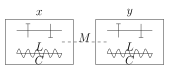
Explain briefly the use of the method of complex impedances for solving problems in a.c. electrical networks. What is the relation of the method to that of partial fractions, integral and complementary function in the solution of ordinary differential equations? Find the conditions under which the bridge circuit shown below is in balance (i.e. no current flows through the meter), if the generator has angular frequency \(\omega\).
Six wires are connected to form the edges of a tetrahedron \(ABCD\). The resistances of opposite edges are equal. The resistance of \(AB\) is \(R_1\), that of \(AC\) is \(R_2\) and that of \(AD\) is \(R_3\). Show that if a current enters the network at \(A\) and leaves at \(D\) the total resistance of the circuit is \begin{equation*} \frac{(R_1R_2 + 2R_1R_3 + R_2R_3)R_3}{2(R_1 + R_3)(R_2 + R_3)}. \end{equation*}
When an e.m.f. \(E(t)\) is applied to an inductor of constant inductance \(L\) and resistance \(R\), the current \(I\) is governed by the equation $$L \frac{dI}{dt} + RI = E.$$ Given that \(I = 0\) at time \(t_0\), find \(I(t)\) in the following cases: (i) \(E(t) = \begin{cases} 0 & \text{for } t < t_0 \\ E_0 \sin \omega t & \text{for } t > t_0 \end{cases}\) (\(E_0\) constant); (ii) \(E(t) = \begin{cases} 0 & \text{for } t < t_0 \\ E_0 \sin \omega t & \text{for } t_0 < t < t_1 \\ 0 & \text{for } t > t_1 \end{cases}\)
A battery \(B\) of voltage \(V\) is connected through a switch \(S\) with a circuit containing a capacity \(C\) and two equal resistances \(R\). The capacitor is initially uncharged, the switch is then closed and is opened again when the charge on \(C\) has reached \(\frac{3}{5}CV\). Show that after an equal time has elapsed the charge will have fallen to \(\frac{9}{25}CV\).
A dynamo, of E.M.F. 105 volts and internal resistance 0.025 ohm, is in parallel with a storage battery of E.M.F. 100 volts and internal resistance 0.06 ohm. They are feeding an external circuit of resistance 1.75 ohm: find whether the battery is charging or discharging, and calculate the current through the dynamo and the P.D. at the terminals of the external circuit.
A steady P.D. of 5 volts is applied to a coil of copper wire which has a resistance of 100 ohms at 0\(^\circ\)C., and is such that it can radiate \(\frac{1}{100}\) watt per degree Centigrade rise of temperature above the atmospheric temperature (15\(^\circ\)C.). Find the final steady temperature, if the temperature coefficient of copper be 0.004 per degree Centigrade.
A pair of conductors are laid side by side, and each one forms a closed curve. Each is of length 3000 yards and has a resistance of 0.05 ohm per 1000 yards. At one point the conductors are kept at a difference of pressure of 200 volts, and current is taken off between them at distances reckoned from one side of this point as follows: 200 amperes at 500 yards, 200 at 1500 yards, and 100 at 2000 yards. Find the current in each section of the ring and the difference of pressure at each of the points at which the current is taken off.
A dynamo giving a terminal P.D. of 140 volts is used to charge a battery of 55 cells in series, each giving a back \textsc{e.m.f.} of 2\(\cdot\)2 volts and having a resistance of 0\(\cdot\)002 ohm. If the charging current required be 30 amperes, find the extra resistance which must be put in the circuit, and make out a balance sheet, showing on the one side the total output of the dynamo, and on the other side the separate items in the power account.
An electric train weighing 150 tons is running down a gradient of 1 in 100 at a speed of 15 feet per sec. and with an acceleration of 0.5 feet per sec. per sec. The frictional resistance to motion may be taken as 30 lbs. wt. per ton of the train. At the instant under consideration the supply point, at which the voltage between the two current rails is kept constant at 500 volts, is 2000 yards distant. If each current rail has a resistance of 0.025 ohm per 1000 yards and the motors of the train have an efficiency of 80\%, find the current taken from the rails and the voltage between them at the train.
Distinguish between ``Potential difference'' and ``Electromotive force.'' A cell of E.M.F. 2 volts and internal resistance 1 ohm sends current through an external resistance of 10 ohms, whilst a voltmeter of 40 ohms resistance is put across the terminals of the cell. Find the reading of the voltmeter.
Find the magnetic force at the centre of a circular coil containing 20 turns of radius 10 cm. when a current of 5 amperes is flowing. (A C.G.S. unit of current is 10 amperes.)
An insulated spherical conductor \(C\) formed of two hemispherical shells in contact (of outer and inner radii \(b,c\)) is surrounded by a concentric hollow spherical conductor \(C_1\) of internal radius \(a\), and encloses a concentric spherical conductor \(C_2\) of radius \(d\). The potential of \(C_1\) is thrice that of \(C\), while \(C_2\) is at zero potential. Find the condition that the two hemispheres of \(C\) may just be held together electrically.
A sphere of S.I.C. \(K\) is introduced into a uniform field of electric force. Obtain expressions for the electric potential at points inside and outside the sphere; and shew that the greatest discontinuity in the direction of a line of force at the surface of the sphere is \[ \frac{\pi}{2} - 2(\text{arc cot}\sqrt{K}). \]
A magnetic molecule is placed along the axis of a circular conductor of radius \(a\) at a point where any radius of the circle subtends an angle \(\alpha\). The magnetic moment of the molecule is periodic and equal to \(\mu\cos pt\). Shew that the periodic current in the conductor is \[ \frac{2\pi\mu p\sin^3\alpha}{a} \frac{pL\cos pt - R\sin pt}{p^2L^2+R^2}. \] Find the mechanical force on the conductor at any time, and prove that its mean value is \[ \frac{6\pi^2\cos\alpha\sin^4\alpha}{a^3} \frac{\mu^2 p^2 L}{p^2L^2+R^2}; \] where \(L,R\) are the coefficient of self-induction and resistance of the conductor.
Find the electrical image of an external point charge in an uninsulated conducting sphere. Two conducting spheres have radii \(a\) and \(b\) each of which is small in comparison with \(c\) the distance between their centres. Show that the coefficients of potential \(p_{11}, p_{12}, p_{22}\) are given by the approximate equations \[ p_{11} = \frac{1}{a}, \quad p_{12} = \frac{1}{c}, \quad p_{22}=\frac{1}{b}, \] wherein the fourth and higher powers of the ratio of the larger radius to \(c\) are neglected.
The figure represents a circuit in which a periodic E.M.F. \(V\cos pt\) is induced across \(EF\), and which contains between \(A\) and \(B\) a coil of resistance \(R\) and self-inductance \(L\). The resistance of the remainder of the circuit is \(r\). The points \(A\) and \(B\) are also connected by leads of total resistance \(r'\) to the plates of a condenser of capacity \(C\). Find the current in the main circuit.
Obtain the conditions which must be satisfied by the electric intensity and the electric displacement at the interface between two dielectrics. What modifications are necessary if there is a surface charge located at the interface? The distance between the plates \(A_1, A_2\) of a parallel plate condenser is \(a_1+a_2\), and the space between them is entirely filled with two slabs of dielectric \(S_1\) and \(S_2\), of thicknesses \(a_1\) and \(a_2\), whose sides are parallel to the faces. The dielectric constants are \(K_1\) and \(K_2\). The slabs are slightly conducting, and have specific resistances \(r_1\) and \(r_2\). At the instant \(t=0\), the plate \(A_1\) (in contact with \(S_1\)) is connected to the positive pole of a battery of electromotive force \(V\), and the plate \(A_2\) is simultaneously connected to the negative pole. Prove that a charge accumulates at the interface between \(S_1\) and \(S_2\), and that at time \(t\) the surface density at the interface is \[ \frac{V}{4\pi}\frac{K_2r_2-K_1r_1}{a_1r_1+a_2r_2}(1-e^{-\alpha t}), \] where \[ \alpha = \frac{4\pi(a_1r_1+a_2r_2)}{r_1r_2(a_1K_2+a_2K_1)}. \] (The internal resistance of the battery and connecting wires and the effects of electro-magnetic induction are to be neglected.)
The plates of a condenser of capacity \(C\) are connected by a wire of self-induction \(N\), and the system is placed in the neighbourhood of a circuit of self-induction \(L\) containing an alternating E.M.F. \(E\cos pt\). The coefficient of mutual induction is \(M\). Write down the differential equations for determining the currents \(i_1, i_2\) in the primary and condenser circuits, and deduce that the rate at which the applied E.M.F. does work exceeds the sum of the rate of expenditure of energy in heating the wires and the rate of accumulation of energy in the condenser by the amount \[ \frac{d}{dt}(\frac{1}{2}Li_1^2+Mi_1i_2+\frac{1}{2}Ni_2^2). \] Show that the phase of the current in the condenser circuit lags behind that in the primary circuit by an amount \[ \tan^{-1}\frac{pRC}{1-p^2NC}, \] where \(R\) is the resistance in the condenser circuit.
A particle of unit mass falls from a position of unstable equilibrium at the top of a rough sphere of radius \(a\). Show that the equations of motion may be written \(a\omega\frac{d\omega}{d\theta} = g\sin\theta - \mu R\), \(R = g\cos\theta - a\omega^2\), where \(\theta\) is the inclination to the upward vertical of the line from the particle to the centre of the sphere, \(\omega = \dot{\theta}\), and \(R\) is the reaction of the sphere on the particle. Show that if \(\mu = 0\), the particle leaves the sphere at \(\theta = \alpha\), where \(\cos\alpha = \frac{2}{3}\). Now suppose \(\mu\) is positive but small. Solve the first equation approximately by giving \(R(\theta)\) the value it has in the solution for \(\mu = 0\). Hence obtain an improved formula for \(R(\theta)\), and by regarding the required value of \(\theta\) as \(\alpha\) plus a small correction, show that the particle leaves the sphere where \(\theta = \alpha + \mu\left(2-\frac{4\alpha}{3\sin\alpha}\right)\) approximately. [Use the facts that, if \(x\) is small, \(\sin x\) and \(\cos x\) can be approximated by \(x\) and \(1\), respectively.]
The ends of a uniform rod of length \(2b\) are constrained to lie on a smooth wire in the form of a parabola, which is fixed with its axis vertical and vertex downwards. The length of the latus rectum of the parabola is \(4a\). Prove that, when the rod is inclined at an angle \(\theta\) to the horizontal, the height of its centre of gravity above the vertex of the parabola is \[\frac{1}{4a}(b^2\cos^2\theta + 4a^2\tan^2\theta).\] Hence, or otherwise, find the positions of equilibrium and discuss their stability.
Three unequal rods \(A_0 A_1\), \(A_1 A_2\) and \(A_2 A_3\) are smoothly jointed at \(A_1\) and \(A_2\). The ends \(A_0\) and \(A_3\) can slide along a smooth horizontal rail. Find the position of stable equilibrium. Investigate the equilibrium of a similar system consisting of a chain of \(n\) rods \(A_0 A_1, \ldots, A_{n-1} A_n\), and show that there is precisely one stable configuration.
A heavy, uniform circular cylinder of radius \(r\) lies on a rough horizontal plane with its axis horizontal. A heavy, uniform rod \(AB\) of length \(l\) lies in the vertical plane which bisects the axis of the cylinder at right angles. Its end \(A\) rests on the plane and point \(C\), distinct from \(B\), is in contact with the cylinder. The coefficient of friction is the same value, \(\mu\), at each of the three points of contact between the rod, cylinder and plane. The rod makes an angle \(\alpha\) with the horizontal, and the friction is limiting at Show, by a geometrical method or otherwise, that for fixed values of \(r\), \(l\) and \(\alpha\), there exists a value of \(\mu\) such that this situation is a possible equilibrium state of the system provided \[r\cot(\frac{1}{2}\alpha) \leq l\cos\alpha \leq 2r\cot(\frac{1}{2}\alpha).\]
A rectangular sheet of adhesive material is placed with its adhesive side uppermost on a plane which is inclined to the horizontal at an angle \(\alpha\). Two opposite edges of the sheet (of length \(b\)) are horizontal. The coefficient of friction between the sheet and the plane is sufficient to prevent slipping. The material has uniform mass per unit area \(m\), and its thickness is negligible. A uniform solid cylinder of mass \(M\), radius \(a\) and length \(b\) is placed along the top edge of the material and released from rest. The material then adheres to the cylinder as it rolls downwards. Show that when the cylinder has rolled through an angle \(\theta\), and an area \(ab\theta\) of material has been lifted from the plane, the potential energy of the system has decreased by an amount \[Mga\theta\sin\alpha - mga^2b[(\theta - \sin\theta)\cos\alpha + (1 - \frac{1}{2}\theta^2 - \cos\theta)\sin\alpha].\] By examining the approximate form of this expression when \(\theta\) is small, find an approximation to a value of \(\theta\) for which equilibrium is possible when \(M\tan\alpha\) is small compared with \(mab\).
A light strut of length \(a\) is freely pivoted at one end \(A\), and the other end \(B\) carries a light small pulley. A light rope passes over the pulley; one end is fixed at a height \(h\) vertically above \(A\), and the other end carries a weight. Discuss the positions of equilibrium and their stability.
Describe briefly the laws of friction as applied to simple problems in mechanics. A particle of mass \(m_1\) is attached to another of mass \(m_2\) by a smooth, light, rigid rod. The system is placed on a rough inclined plane carrying a smooth pin which passes through the hole in the centre of the rod. Show that equilibrium is possible with the rod at any angle in the plane if $$\mu > \frac{|m_1 - m_2|}{m_1 + m_2} \tan \alpha,$$ where \(\mu\) is the coefficient of friction between the particles and the plane, and \(\alpha\) is the inclination of the plane to the horizontal. Write down the equation of motion for the case when the rod is made to rotate in the inclined plane by the application of a couple \(G\).
A uniform rod of length \(2a\) is smoothly hinged at one end to a fixed point \(A\) of a horizontal axis in such a way that it must lie in the plane through \(A\) perpendicular to the axis. The rod is kept in rotation with constant angular velocity \(\omega\) about the vertical through \(A\). Show that, if \(\omega\) is sufficiently large, there is a position of relative equilibrium in which the rod makes an angle \(\alpha\) with the vertical, given by \(\cos\alpha = 3g/(4\omega^2)\). Show also that the equilibrium is stable, and that the period of small oscillations about the equilibrium position is \(2\pi/(\omega\sin\alpha)\). Derive corresponding results for the case in which the rod is non-uniform.
A uniform solid hemisphere is balanced in equilibrium with its curved surface in contact with a sufficiently rough inclined plane. Find the greatest possible value of the inclination of the plane to the horizontal, and less inclination there may be two positions of equilibrium, one stable and one unstable. Show also that the coefficient of friction has to be greater than \(3/\sqrt{(55)}\) for the plane to be sufficiently rough.
A particle moves in a circle of radius \(a\) about a centre of force which exerts an attraction of magnitude \(\mu r^n\), \(r\) being the distance from the centre. By considering first-order equations for the time variation of the quantity \(\epsilon\), where \(r = a(1 + \epsilon)\) and \(\epsilon\) is considered small, discuss the stability of this motion when it is disturbed
- [(a)] by a small transverse impulse,
- [(b)] by a small radial impulse.
A rigid hoop, of radius \(a\), is made of thin smooth wire, and is fixed with its plane vertical. A small bead, of weight \(w\), is free to slide on the hoop and is joined to one end of a light elastic string, of modulus of elasticity \(\lambda\). The other end of the string is fastened to the highest point of the wire, and the unstretched length \(l\) of the string is less than \(2a\). Show that asymmetrical positions of equilibrium exist if \(2lw/\lambda < 2a - l\). If these asymmetrical positions exist, show that the equilibrium is stable.
Two small smooth pegs are situated at a distance \(2h\) apart at the same level. A light string, which hangs symmetrically across the pegs, carries a mass \(m\) at each end and a mass \(M\) (\( < 2m\)) at the middle point. If the masses move vertically and the string remains taut and below the level of the pegs, write down the kinetic energy and the potential energy in terms of the angle \(\theta\) that the inclined portions of the string make with the vertical. By writing \(\theta = \alpha + \psi\), where \(\alpha\) is the equilibrium value of \(\theta\) and \(\psi\) and its derivatives with respect to the time are assumed to remain small, deduce from the energy equation that the period of small vertical oscillations of the system is the same as that of small oscillations of a simple pendulum of length \(h\cos\alpha\cot\alpha(\cos\alpha + \cot\alpha)\).
A rigid plank of length \(l\), breadth \(b\) and thickness \(h\) is laid across a rough log of radius \(r\) to act as a seesaw. Find the relationship between \(r\) and \(h\) for the plank to rest stably on the log if it is initially placed symmetrically across it. Could you have solved this problem by any other methods? If so, describe them briefly.
A fixed hollow sphere of radius \(a\) has a small hole bored through its highest point, resting on the inside of the sphere; there is no friction. Find, for any value of \(b/a\), how many positions of equilibrium there are with the rod in a given vertical plane and which of them are stable.
A uniform solid consists of a hemisphere of radius \(a\) to the base of which is fixed, symmetrically, a circular cylinder of radius \(a\) and length \(\frac{1}{4}a\). The solid rests in equilibrium with its axis vertical, on a rough sphere of radius \(b\). Show that, if the cylindrical part of the solid is uppermost, the equilibrium is stable if, and only if, \[b > \frac{4}{5}a.\]
A uniform heavy rod \(AB\) of length \(2l\) can turn freely about a fixed point \(A\), and \(C\) is a fixed point at height \(2a\) vertically above \(A\). A small heavy ring of weight equal to that of the rod can slide smoothly along the rod, and is attached to \(C\) by a light inelastic string of length \(a\). Given that \(a < 2l\), prove that the configuration in which the rod is vertical is one of stable equilibrium if \(a > l\).
A uniform rectangular rough plank of weight \(W\) and thickness \(2b\) rests in equilibrium across the top of a fixed horizontal circular cylinder of radius \(a\). The length of the plank is perpendicular to the axis of the cylinder. Find an expression for the increase in potential energy if the plank is turned without slipping through an angle \(\theta\), and deduce that the horizontal position is stable provided that \(a > b\). Discuss the case \(a = b\).
A smooth wire has the shape of a parabola whose latus rectum is of length \(l_0\) and whose axis is vertical and vertex upwards. Two beads \(A\) and \(B\), whose masses are \(m_1\) and \(m_2\), where \(0 < m_1 < m_2\), slide on the wire, and are joined by a light inelastic string of length \(l\), where \(l > 2a\), which passes through a small smooth ring at the focus of the parabola. Prove that the only positions of equilibrium for which the two beads are not on the same side of the vertex are those in which at least one of the beads is at the vertex of the parabola, and determine which positions are stable and which are unstable. How is the problem altered if \(m_1 = m_2\)?
A bead of mass \(m\) is free to move on a smooth circular wire of radius \(r\) which is fixed in a vertical plane. A light, perfectly elastic string of natural length \(r\) has one end attached to the bead and the other fixed to the highest point \(P\) of the wire. The tension in the string when the bead is at the lowest point \(Q\) of the wire is \(T_0\). Show that there are positions of equilibrium other than \(P\) and \(Q\) if and only if \(T_0 > 2mg\), and that in this case equilibrium at \(Q\) is unstable. In the particular case \(T_0 = 4mg\) the bead is slightly disturbed from rest at \(Q\). Show that in the subsequent motion the string becomes slack, and find the reaction of the wire on the bead at the instant when this occurs.
A plane framework consists of five uniform heavy rods \(AB\), \(BC\), \(CD\), \(DA\), \(AO\), smoothly hinged at \(A\), \(B\), \(C\) and \(D\), and two light elastic strings \(BO\) and \(DO\); \(O\) lies outside the rhombus \(ABCD\). Each rod is of length \(l\) and weight \(W\), and each string has natural length \(l\) and modulus \(6W\). The framework is suspended freely from \(O\). Show that there is a position of equilibrium in addition to that in which the rods are all vertical, and examine the stability of these two positions of equilibrium. Find the reaction at \(C\) between the rods \(BC\) and \(CD\) when the framework hangs in the equilibrium position in which the rods are not all vertical.
A uniform thin rod of length \(2a\) and weight \(W\) is freely hinged at one end to a fixed support. The other end is joined by a light elastic string of modulus \(\lambda\) and unstretched length \(l\) \((l < 4a)\) to a fixed hook located vertically above and at distance \(2a\) from the hinge. Find the range of values of \(\lambda\) for which there exists a position of equilibrium with the rod inclined to the vertical. Show also that if such a position of equilibrium exists then it is stable.
A stiff rod \(AB\) of length \(a\) pivots about a fixed point \(A\) and is attached by an elastic string, of unstretched length \(a\) and modulus \(E\), to a fixed point \(C\) at a distance \(a\) from \(A\). A force parallel to and in the direction of \(CA\), of magnitude equal to \(E/8a\) times the length \(BC\), is applied to the rod at \(B\), the rod being constrained to lie in a fixed plane through \(AC\). Show that there exists a position of equilibrium where the rod is not parallel to the string. Show also that this position is stable.
A uniform rod of length \(l_0\) and mass \(m\) is hinged at one end to the point \(A\) and is free to rotate in a vertical plane through the point \(B\) which is at a distance \(l_0\) horizontally from \(A\). The other end of the rod is attached to the point \(B\) by an elastic string of unstretched length \(l_0\). The tension in the string when stretched to a length \(l(l > l_0)\) is given by \(mg R(l-l_0)/l_0\). Derive an equation in terms of \(\theta\), the angle between the rod and the line \(AB\), for the positions of equilibrium of the system with the rod lying below \(AB\), and obtain a criterion for their stability. If \(f'(\omega) > 0\) for all \(\omega > 0\), show that only one such position exists, and discuss its stability.
A uniform heavy rod of length \(2b\) has its ends attached to small light rings which slide on a smooth rigid wire in the shape of a parabola of latus rectum \(4a\) held fixed in a vertical plane with its vertex uppermost. Prove that the horizontal position of the rod is one of stable equilibrium if \(b > 2a\). Show further that in this case there are two oblique positions of equilibrium, one on either side.
A bead of mass \(m\), which is free to move on a smooth wire in the form of an ellipse held fixed in a vertical plane with its major axis vertical, is attached to one end of a light elastic string of modulus \(\lambda\) whose other end is attached to the uppermost focus of the ellipse, so that when the particle is at the top end of the major axis of the ellipse the string is just taut. Find the possible positions of equilibrium, and show that there is an oblique position if $$\frac{\lambda}{mg} > \frac{1-e}{2e^2},$$ where \(e\) is the eccentricity of the ellipse.
\(Z\) denotes the set of all integers, positive, negative, and zero. An equivalence relation \(R\) on \(Z\) is said to be a congruence relation if there exists an integer \(d \geq 0\) such that \(xRy\) if and only if \(x - y\) is an integral multiple of \(d\). Show that an equivalence relation \(S\) on \(Z\) which is such that \((x - y)S(z - w)\) whenever \(xSz\) and \(ySw\) is a congruence relation. Find an equivalence relation \(T\) on \(Z\) which is not a congruence relation but is such that \((xy)T(zw)\) whenever \(xTz\) and \(yTw\).
Let \(N\) denote the non-negative integers. A subset \(S \subseteq N\) is called convex if \(x \in S\), \(y \in N\), \(x < y < z\), implies that \(y \in S\). Let \(*\) be a composition on \(N\) defined by \(x * y = \max(x, y)\). Prove that if an equivalence relation \(R\) on \(N\) has convex equivalence classes then \((x * y) R (x' * y')\) whenever \(x R x'\) and \(y R y'\). Is the converse true?
Prove that, if \(x\) and \(y\) are real numbers, and \(\max(x, y)\) denotes the greater of \(x\) and \(y\) when \(x \neq y\), and their common value when \(x = y\), then \[\max(x, y) = \frac{1}{2}(x + y) + \frac{1}{2}|x - y|.\] Explain what is meant by saying that a real-valued function \(f\), defined on an interval of the real line, is continuous at a point of the interval. Suppose that \(f\) and \(g\) are defined in the same interval \(I\), and that \(h(x) = \max[f(x), g(x)]\) for all \(x\) in \(I\); prove that, if \(f\) and \(g\) are both continuous at a point \(x_0\) in \(I\), then \(h\) is also continuous at \(x_0\). Give an example to show that if \(f\) and \(g\) are both differentiable at \(x_0\), then \(h\) is not necessarily differentiable at \(x_0\); and another example to show that \(h\) can be differentiable at \(x_0\).
A certain statistical procedure to be applied to the numbers \(x_1, x_2, \ldots, x_n\) requires the calculation of the median of the numbers \(x_r\). Construct a flow diagram for the solution of this problem, where \(n\) is odd and is included in the data, and \(x_1, x_2, \ldots, x_n\) are available in that order. Carry out all the steps and obtain the solution when \(n = 5\) and the numbers \(x_1, \ldots, x_5\) are \(5, 1, 2, 4, 3\) respectively.
Write a program in any standard language (or draw a flow diagram for such a program) which will print out a list of candidates in order of merit, together with their marks on each paper and their overall mark. You may assume that candidates are identified by code numbers and not by names.
One of the ways of sorting a list of distinct numbers, initially in a random order, involves arranging them in a tree-like structure which satisfies the following rules. The tree consists of nodes, at each of which one of the numbers is placed, and branches each of which join two nodes. There is one special node, called the base, at the foot of the tree; any other node is at the top of just one branch. From any node there is at most one branch which grows upwards to the left, and at most one branch which grows upwards to the right. If a branch grows upwards to the left, all the numbers accessible from the top of the branch by proceeding upwards (including the number at the top of the branch itself) are less than the number at the bottom of the branch; and for a branch that grows upwards to the right they are all greater. (A typical tree is illustrated below.) [Tree diagram showing nodes with numbers: 13, 24 at top level; 22 below them; 34 below 22; 39 at bottom center; 44, 72, 57 on right side; 43, 75 connected to right structure; 45 connecting parts] Numbers are supplied one by one from a list. By means of a flow diagram, or otherwise, describe how to add a new number to an existing tree. (The operations available are to locate the base node, to move up or down an existing branch, to grow a new branch from the node which you are at, to compare the new number with the number placed at the node which you are at, and such other similarly simple operations as you may require.) Draw the tree which should be formed from the list 28, 79, 18, 45, 60, 63, 54, 33, 11, 55, 98, 27, 47, 20.
The famous Four Colour Theorem (still unproved) asserts that the regions of any geographical map in the plane may be coloured using only four colours in such a way that regions which touch along an edge are distinctly coloured. In the case when there is a path composed of edges which includes every vertex just once, show that it is possible to colour the map in such a way that two colours are used for the portion enclosed by the path, and two for the remainder. [You may suppose that the regions of the map are straight-edged polygons, whose edges and vertices are called the edges and vertices of the map.]
Suppose a profit-maximising firm produces a perishable and homogeneous good from which the net revenue per unit sold becomes negative if output exceeds a certain level. If a sales tax of \(t\) pence is imposed on each unit, will the firm produce more or less? Justify your answer.
It is desired to write a computer program that will print out all the prime numbers 2, 3, 5, ... less than some specified \(N\), in their natural order. Give a flow diagram, with any additional explanation you wish to include, for such a program. [More credit will be given for more efficient schemes.]
A convex polyhedron \(S\) is such that each vertex is the intersection of \(k\) faces with \(p_1, p_2, \ldots, p_k\) sides, the numbers \(p_1, p_2, \ldots, p_k\) being the same for all vertices of \(S\). If \(V\) is the total number of vertices of \(S\), prove that $$\sum_{r=1}^{k} \left(\frac{1}{2} - \frac{1}{p_r}\right) = 1 - \frac{2}{V}.$$ Show that (i) if \(k = 3\), and \(p_2 \neq p_3\), then \(p_1\) is even; (ii) if \(k = 4\), \(p_1 = p_3 > 3\), \(p_4 > 3\) then \(p_2 = p_4\). Hence or otherwise determine all possible values of \(p_1, p_2, \ldots, p_k\) for \(k = 4\) and indicate the number of vertices and faces of each kind of the corresponding polyhedron. [It is not necessary to show that polyhedra corresponding to these values of \(p_1, p_2\) exist.]
The function \(f(x)\) is such that \(f'(t) \geq f'(u)\) whenever \(t \leq u\). By applying the Mean Value Theorem to the function \(f\) over suitable intervals, or otherwise, show that $$f(\lambda x + \mu y) \geq \lambda f(x) + \mu f(y)$$ whenever \(\lambda \geq 0\), \(\mu \geq 0\), \(\lambda + \mu = 1\). By taking a suitable function \(f\) (or otherwise) show that if \(x\), \(y\) are positive and \(\lambda\), \(\mu\) are as above, we have $$\lambda x + \mu y \geq x^{\lambda} y^{\mu}.$$
The function \(f(x)\) is said to be maximal in the closed interval \([a, b]\) at \(c\) if (i) \(a \leq c \leq b\) and (iii) \(f(x) \leq f(c)\) whenever \(a \leq x \leq b\). If \(f(x)\) is maximal in \((a, b)\) at \(c\), where \(a < c < b\), and \(f'(c)\) exists, show that \(f'(c) = 0\). You may assume the theorem that a function continuous in a closed interval is maximal in that interval at at least one point. Suppose that \(f(x)\) is continuous in \([a, b]\) and that \(f(x) < g(x)\) for all \(x\) such that \(a < x < b\). Show that, if \(a < y < b\) then \(f(x) \leq f(x)\) and deduce that \(f(x)\) is maximal in \([a, b]\) at \(b\) and nowhere else.
Each of the following rules defines a map (or transformation) from the set \(Z\) of all integers (positive, negative, or zero) into the same set \(Z\):
- [(a)] \(x \rightarrow \cos\pi x\);
- [(b)] \(x \rightarrow 3x - 1\).
James. \(\pi\) is the most important constant in mathematics. John. No, \(e\) is. Continue the discussion.
Four given tangents to a circle \(C_1\) are such that through four of their mutual intersections a circle \(C_2\) can be drawn cutting \(C_1\) in real points. Prove that \(C_2\) passes through the centre of \(C_1\). Prove further, that if any four tangents to \(C_1\) are such that three of their mutual intersections lie on \(C_2\), a fourth intersection will also lie on \(C_2\).
A slide rule consists of a fixed scale and a sliding scale, each 10 in. long. On each scale the numbers from 1 to 10 are marked in such a way that the distance between the marks 1 and \(x\) is proportional to \(\log x\). In order to multiply together two numbers \(x, y\) between 1 and 10 whose product is less than 10, the mark 1 on the slide is brought into coincidence with the mark \(x\) on the fixed scale. The mark \(z\) on the fixed scale which then coincides with the mark \(y\) on the slide gives the product \(xy\). If marks \(\frac{1}{100}\) in. apart are liable to be judged coincident, find to two significant figures the percentage error to which the reading \(z\) is liable. If an increase of temperature causes the fixed scale to increase in length by one part in 2000, and the slide, owing to a difference in construction, to increase by one part in 1000, what is the percentage error in \(z\), assuming that coincidences of marks are judged accurately?
An endless light inextensible string of length \(l+2\pi a\), where \(8a>l>6a\), passes round three smooth circular cylinders each of radius \(a\) and weight \(W\). Two of the cylinders rest on a smooth horizontal plane with their axes parallel and the third rests above and between them. Find the tension in the string. If \(l\) is adjustable, show that the least value the tension can have is \(W/2\sqrt{3}\).
A boiler is fitted with a feed-water heater in the flue, which reduces the temperature of the flue-gases from \(350^\circ\) C. to \(200^\circ\) C., whilst the temperature of the feed-water is raised from \(40^\circ\) C. to \(84^\circ\) C. If the consumption of water and coal per hour be 1350 lbs. and 125 lbs. respectively, find the weight of air used per pound of coal, taking the specific heat of the flue-gases to be 0.24.
A wire framework consists of 10 equal wires, each of resistance 1 ohm, placed so that they form three squares side by side. Find the resistance of the framework between diagonally opposite corners.
A railway motor-car, weighing 30 tons, is driven by a petrol engine direct coupled to a dynamo, which supplies motors geared to the driving axles. If the total tractive resistance be equivalent to 20 lbs. per ton, and if the maximum speed on the level be 36 miles an hour, find (1) the efficiency of the motors and gearing, (2) the efficiency of the engine and dynamo: given that the maximum current is 360 amperes at 165 volts, and that for this output the engine consumes 55 lbs. of petrol an hour, the fuel having a calorific value of 11,000 thermal units per pound. One thermal unit is equivalent to 1400 ft. lbs.
Prove the relation in isotropic material between Young's modulus \(E\), the modulus of rigidity \(C\) and Poisson's ratio \(\frac{1}{m}\), \(E = 2C\left(1 + \frac{1}{m}\right)\). A bar is subject to a normal stress \(p\), uniform over the cross-section. Show that the strain in a line in the bar making an angle \(\theta\) with the direction of the stress \(p\) is \[\frac{p}{E}\left(1 - \frac{2}{m}\sin^2\theta\right).\]
Prove the formulae
- [(i)] \(4\Delta R = abc\),
- [(ii)] \(16QR^2 = (\alpha\beta + \gamma\delta)(\alpha\gamma + \delta\beta)(\alpha\delta + \beta\gamma)\),
A line is determined by the parametric equations \(x = a_0t + a_1\), \(y = b_0t + b_1\). The parameters \(t\) and \(t'\) of corresponding points of two ranges on this line are connected by the relation \[ att' + b(t+t') + c = 0. \] Show that there is a symmetrical \((1, 1)\) correspondence between points of the two ranges, and that there are two points of the first range which correspond to themselves in the second. Show further that these self-corresponding points harmonically separate every corresponding pair of points. Such a correspondence is called an involution. Show that any pencil of conics through four points cuts any line in pairs of points in involution, and hence show that to any such pencil belong two parabolas and that the directions of the asymptotes of each conic of the pencil are harmonically separated by the directions of the axes of these parabolas.
If \(s_1=0, s_2=0, s_3=0, s_4=0\) are the equations (each in the standard form \(x^2+y^2+2gx+2fy+c=0\)) of four circles (of radii \(r_1, r_2, r_3, r_4\) respectively) every two of which cut orthogonally, shew that the two circles \begin{align*} \lambda_1 s_1 + \dots + \lambda_4 s_4 &= 0, \\ \mu_1 s_1 + \dots + \mu_4 s_4 &= 0 \end{align*} will cut orthogonally if \[ \lambda_1\mu_1 r_1^2 + \dots + \lambda_4\mu_4 r_4^2 = 0. \]
A uniform chain suspended from two points on the same level, hangs partly in air of negligible density and partly in liquid of which the density is half the (constant) density of the material of the chain. One-third of the length of the chain is immersed in the liquid, and the distance between the points where the chain leaves the surface of the liquid is half the distance between the supports; find the ratio of the depth of the liquid surface below the supports to the sag of the chain.
A random sample \(X_1 ... X_n\) is taken from the normal distribution with mean \(\mu\) and variance \(\sigma^2\). Find the mean and variance of \(\overline{X}\), the sample mean, and find the expected value of \(\sum_{i=1}^{n} (X_i-\overline{X})^2\). For what value of \(k\) will \(k \sum_{i=1}^{n} (X_i-\overline{X})^2\) be an unbiased estimator of \(\sigma^2\), i.e. have expected value \(\sigma^2\)? In an experiment to determine the growth rate of human infants, nine randomly selected infants are fed with an approved diet for two weeks, and their weight gains \(X_1,..., X_9\) during that period are recorded in pounds. It is observed that \(\overline{X} = 1.2\) and \(\sum_{i=1}^{9}(X_i-\overline{X})^2 = 0.72\). Use the tables of the \(t\)-distribution to find a 95\% confidence interval for the mean weight gain. Medical science dictates that the approved growth rate is an ounce a day. Do these babies conform to the approved rate?
A battery of 5 ohms resistance is connected to a 20 ohm galvanometer and gives a deflection of 40 divisions. What will be the deflection when a 4 ohm shunt is put across the galvanometer terminals?
Describe briefly with sketches three common types of voltmeter. State the peculiar advantages and disadvantages of each type. Place the three types in your estimated order of sensitiveness as measured by the scale deflection obtained with a given expenditure of power, and explain the fundamental reasons for expecting this order.
A milkman buys eggs at 10 for 3s. and sells them at \(4\frac{1}{2}\)d. each; what is his profit per cent.?
The sides of a triangle \(ABC\) are each divided in the same ratio \(\frac{1}{\lambda}\) at the points \(L, M, N\), so that \[ \frac{AN}{NB} = \frac{BL}{LC} = \frac{CM}{MA} = \lambda. \] Forces of magnitude \(\mu BC, \mu CA, \mu AB\) act through \(L, M, N\) respectively, outwards and perpendicular to the sides. Shew that the resultant of the forces is a couple, and that if the sides of the triangle are divided in the ratio \(\frac{1}{\lambda}\) the resultant so obtained is an equal but opposite couple. Find the magnitude of the couple.
\(I\) is the centre of the inscribed circle of a triangle \(ABC\) and \(D, E, F\) are the feet of the perpendiculars from \(I\) on the sides \(BC, CA, AB\) respectively. The radii of the circles inscribed in the quadrilaterals \(AEIF, BFID\) and \(CDIE\) are \(\rho_1, \rho_2, \rho_3\) respectively and \(r\) is the radius of the circle inscribed in the triangle. Prove that \[ (r-2\rho_1)(r-2\rho_2)(r-2\rho_3) = r^3-4r\rho_1\rho_2\rho_3. \]
A man sells a farm of 74 acres 3 roods 10 poles at £21. 6s. 8d. per acre and invests the proceeds in 2\(\frac{1}{2}\)\% Consols at 76. Find what income he secures by this investment.
A cylinder of compressed carbon dioxide contains 2.1 lbs. of gas at pressure 120 lbs./sq. in. and temperature 15° C. The cylinder may only be subjected to an internal pressure of 350 lbs./sq. in. and the temperature is liable to rise to 30° C. What further weight of CO\(_2\) would it be safe to add to the contents of the cylinder?
Discuss from a thermodynamical point of view the connection between the osmotic pressure of a salt solution and the lowering of the vapour pressure of the solvent due to the presence of the salt.
\(S\) is the set of real numbers. Operations, denoted by \(\oplus\) and \(\otimes\), are defined on \(S\) by \begin{align} a \oplus b &= a + b + 1,\\ a \otimes b &= ab + a + b, \end{align} where the operations of addition and multiplication on the right are the usual ones. Show that if \(\oplus\) and \(\otimes\) are taken to define an addition and multiplication on \(S\), then \(S\) is a field. Which element of \(S\) has no multiplicative inverse in this field, and what is the multiplicative inverse of a general element \(x\) of \(S\)?
Let \(x_1, x_2, x_3\) be independent vectors in a vector space. Say whether each of the following statements is true, and justify your answers.
- [(i)] The set \(\{x_1, x_2, x_3, y\}\) is linearly independent provided that every subset of three vectors is independent.
- [(ii)] The vectors \(x_1+y, x_2+y, x_3+y\) are independent provided that they are all non-zero.
- [(iii)] If \(y_1, y_2, y_3\) are independent, then so are \(x_1 + y_1, x_2 + y_2, x_3 + y_3\).
- [(iv)] The vectors \(x_2 + x_3, x_3 + x_1, x_1 + x_2\) are independent.
Denote by \(g_1, g_2, \ldots, g_n\) the elements of a given finite multiplicative group \(G\), not necessarily commutative, and let \(\mathscr{S}\) be the set of all formal expressions \[a_1g_1 + a_2g_2 + \ldots + a_ng_n,\] where the \(g_i\) are the elements of \(G\) and the \(a_i\) are any real numbers. Addition and multiplication are defined on the set \(\mathscr{S}\) by the rules \[\{\sum a_ig_i\} + \{\sum b_ig_i\} = \sum (a_i + b_i)g_i\] and \[\{\sum a_ig_i\} \times \{ \sum b_jg_j\} = \sum \sum (a_ib_j)(g_ig_j)\] where in the second equation the dot denotes multiplication in \(G\). Prove that \[0 = 0g_1 + 0g_2 + \ldots + 0g_n\] has in \(\mathscr{S}\) the properties normally associated with the symbol zero. Writing \[s = 1g_1 + 1g_2 + \ldots + 1g_n\] prove that for any \(i, j\) \[s \times \{1g_i - 1g_j\} = 0.\] In the special case where \(G\) contains just two elements \(g_1\) and \(g_2\), of which \(g_1\) is the identity, find all expressions \(x\) in \(\mathscr{S}\) which satisfy \[x \times x = 1g_1 + 0g_2.\]
\(R\) is a ring with identity. A relation \(\sim\) is defined on \(R\) by \(x \sim y\) if and only if there is an element \(z\) having an inverse in \(R\) such that \(x = zy\). Prove that \(\sim\) is an equivalence relation. Let \(R\) be the ring of all \(3 \times 3\)-matrices of the form $$Z = \begin{pmatrix} a & b & c \\ c & a & b \\ b & c & a \end{pmatrix},$$ where \(a, b, c\) are integers. Prove that $$\det Z = \frac{1}{3}(a+b+c)[(b-c)^2 + (c-a)^2 + (a-b)^2],$$ and hence find the invertible elements of \(R\). Determine the number of elements in the various equivalence classes of \(R\) under \(\sim\).
A vector space is said to be finite-dimensional if there exists a finite number of vectors \(x_1, x_2, \ldots, x_n\) such that each vector in the space can be written as a linear combination $$c_1 x_1 + c_2 x_2 + \ldots + c_n x_n$$ with \(c_1, c_2, \ldots, c_n\) scalars. The vector space \(V_1\) consists of all sequences $$x = (\xi_1, \xi_2, \ldots)$$ of real numbers which have only a finite number of terms \(\xi_i\) non-zero. Addition and scalar multiplication are defined by $$(\xi_1, \xi_2, \ldots) + (\eta_1, \eta_2, \ldots) = (\xi_1 + \eta_1, \xi_2 + \eta_2, \ldots),$$ $$c(\xi_1, \xi_2, \ldots) = (c\xi_1, c\xi_2, \ldots).$$ \(V_2\) consists of all real sequences, the definitions of addition and scalar multiplication being the same. Prove that neither \(V_1\) nor \(V_2\) is finite-dimensional.
If a (commutative) ring has multiplicative identity 1, the element \(x\) is said to have order \(n\) if \(n\) is the least positive integer for which \(x^n = 1\). Show, by considering the elements \(-1\) and \(1 + u + u^4\), that, if a ring has an element \(u\) of order 5, then it has either an element of order 2, or one of order 3. [Note: It is possible to have \(1 + 1 = 0\) in a ring.]
Let \(R\) be a ring in which \(x + x \neq 0\) whenever \(x \neq 0\) (\(x\) in \(R\)). Show that (i) provided \(R \neq \{0\}\), there is at least one element \(x\) in \(R\) with \(x^4 \neq x\); (ii) if \(x^2 = 0\) for every \(x\) in \(R\), then every product of three or more elements of \(R\) is zero. [Warning: \(R\) is not necessarily commutative.]
If \(u = x + y\), \(v = xy\), and \(x^n + y^n = 1\), find the degree in \(v\) of the algebraic relation between \(u\) and \(v\). If \(n = 5\), prove that $$5(x + y)(1 - x)(1 - y)(1 - x - y + x^2 + xy + y^2) = (x + y - 1)^5.$$
Prove that, if \(P, Q\) are two polynomials in a variable \(x\) with no common factor, it is possible to find two other polynomials \(A, B\) such that \(AP + BQ = 1\) identically. Prove further that if \(A_1, B_1\) are a pair of polynomials satisfying this identity, every solution is of the form \(A = A_1 + CQ, B = B_1 - CP\), where \(C\) is a polynomial, and deduce that \(A, B\) can be so chosen that the degree of \(A\) is less than that of \(Q\), and the degree of \(B\) less than that of \(P\). State and prove the corresponding theorems relating to positive or negative integers \(p, q\) which are prime to one another.
Explain the method of proving propositions by projection, stating what classes of properties are projective and illustrating by examples.
Two opponents play a series of games in each of which they have an equal chance of winning. The loser of each game pays the winner one unit of capital. The first player begins with \(k\) units of capital and the second player has all \(\alpha\) units of capital. Let \(p_k\) be the probability that the first player wins the series. Write down a relation between \(p_{k-1}, p_k\) and \(p_{k+1}\); and hence show that \(p_k = k/\alpha\).
In Utopia there are three types of weather and on any particular day the weather belongs to just one of these: 1, sunny; 2, rainy; 3, cloudy but dry. It has been observed that if the weather on a certain day is of type \(i\) then that on the following day is of type \(j\) with probability \(p_{ij}\), where \(p_{ij}\) is the entry in the \(i\)th row and \(j\)th column of the array below:
- [(i)] prove that \(b_j = \sum_{i=1}^{3} a_i p_{ij}\);
- [(ii)] show that there is an \(\mathbf{a}\) such that \(\mathbf{b} = \mathbf{a}\) (i.e. there is a steady state in which the statistical properties of the weather do not change with time);
- [(iii)] given that the steady state obtains, find the probabilities \(q_{ij}\) such that, if the weather on a particular day is of type \(i\), then that on the preceding day is of type \(j\).
In tennis, players serve in alternate games and a set is won when one player has won six games, except that whenever a score of five games all is reached play continues until one player has a lead of two games. A player is leading by four games to two. His chance of winning a game when he serves is \(\frac{3}{4}\) and his chance of winning when his opponent serves is \(\frac{1}{4}\). What is the probability that he will win the set?
Three players \(A\), \(B\) and \(C\) each throw three fair dice in turn until one of them wins by making a score of 15 or more on the three dice. Show that the players' respective probabilities of winning are in the ratio $$(54)^2 : 54 \times 49 : (49)^2.$$
A sequence of integers \(n_1\), \(n_2\), \(n_3\), \(\ldots\) is obtained as follows. If \(1 < n_r < 3\) then \(n_{r+1} = n_r - 1\) or \(n_r + 1\), with probability \(\frac{1}{2}\) each; if \(n_r = 9\) then \(n_{r+1} = 8\) (with probability 1) and if \(n_r = 0\) then the sequence terminates at this point. Given that \(n_1 = 9\), calculate (i) the probability that \(n_r\) is never equal to \(0\) for \(r \geq 2\), and (ii) the expected length of the sequence. [For (i), let \(p_k\) be the probability that if \(n_r = k\) for some \(r \geq 2\) then \(n_s = 9\) for \(s \geq r\). Show that \(2p_k = p_{k-1} + p_{k+1}\) for \(1 \leq k \leq 8\), and use the obvious values of \(p_0\) and \(p_9\) to obtain the required probability. A similar method may be used for (ii).]
In a game between two players both players have an equal chance of winning each point. The game continues until one player has scored \(N\) points. Find the probability \(p_r\) that the winning player has a lead of exactly \(r\) points when the game is completed. Deduce that $$(2N - r - 1)p_{r+1} = 2(N - r)p_r \quad (r = 1, 2, \ldots, N),$$ and hence find the expected value of the lead at the end of the game.
A fair coin is tossed successively until either two heads occur in a row or three tails occur in a row. What is the probability that the sequence ends with two heads?
Show SolutionA drunkard sets out to walk home. In each successive unit of time he has a chance \(p > 0\) of walking one unit north, a chance \(q > 0\) of walking one unit south, and a chance \(1 - p - q > 0\) of going to sleep where he is—in which case the process stops. His home lies \(n\) units to the north of his starting-point, where \(n > 0\); once he gets home he stays there. Let \(c_n\) be his chance of getting there before he goes to sleep. By finding a recurrence relation for \(c_n\), or otherwise, show that \[ c_n = A\alpha^n + B\beta^n, \] where \(\alpha\) and \(\beta\) are the roots of \[ qx^2 - x + p = 0. \] Find the constants \(A\), \(B\).
At tennis the player serving has a probability \(\frac{3}{4}\) of winning any particular point, and his opponent has a probability \(\frac{1}{4}\). What is the probability that the player serving will win the game? [A game is finished as soon as one player has won at least four points and is at least two points ahead of his opponent.]
In the gambling game of toss-penny, after each toss either \(A\) gives \(B\) one penny, these two outcomes being equally likely, and the game continues until either \(A\) or \(B\) is exhausted of pennies. If \(P(m, n)\) is the probability that \(A\) will win, given that \(A\) has \(m\) pennies and \(B\) \(n\) pennies at the start, show (by considering the position after the first toss) that $$P(m, n) = \frac{1}{2}P(m-1, n+1) + \frac{1}{2}P(m+1, n-1).$$ Hence find the value of \(P(m, n)\).
Two men, \(A\) and \(B\), play a gambling game by tossing together four apparently similar unbiassed coins. If three or four heads are uppermost \(B\) wins, if three or four tails \(A\) wins, and if two of each neither wins. \(A\) and \(B\) start each with \(N\) counters, and after each single game the winner receives a counter from the loser; the first to collect all \(2N\) counters wins the complete game. \(B\), unperceived by \(A\), has arranged that one of the coins is ``double headed'', the other three coins being normal. Show that as a result of this stratagem \(B\)'s chance of winning any single game is four times that of \(A\). Prove further that if when \(A\) has \(r\) counters his chances of winning the complete game is \(U_r\), then \(U_{r+2}-5U_{r+1}+4U_r=0\) for \(0< r< 2N-2\). Hence, or otherwise, deduce that at the start \(A\)'s chance of winning the complete game is \(1/(4^N+1)\). \subsubsection*{SECTION B}
Find the equation of the perpendicular bisector of the line joining the points \((x_1, y_1)\), \((x_2, y_2)\). A fixed circle has centre \(C\) and radius \(2a\). \(A\) is a fixed point inside the circle and \(P\) is a variable point on the circumference. Prove that the perpendicular bisector of \(AP\) touches the foci are at \(C\) and \(A\), and whose major axis is of length \(2a\).
Let \(z_1\), \(z_2\), \(z_3\), \(z_4\) be real numbers, and suppose that \(z_1^2 + z_2^2 + z_3^2 + z_4^2 = 0\) for \(i = 1, 2, 3\). Show that the notation for the four numbers can be chosen in such a way that \(z_1 + z_2 + z_3 + z_4 = 0\).
Show that if \(y = \sum_{r=0}^{\infty} e^{rx}\), then \begin{equation*} (-1)^m\frac{d^m y}{dx^m} + e^x \sum_{k=0}^{m} \binom{m}{k} \frac{d^k y}{dx^k} = (n+1)^m e^{(n+1)x} \end{equation*} for all \(m > 0\). Deduce that if \(s_k = \sum_{r=0}^{\infty} r^k\), then \begin{equation*} \sum_{k=0}^{m-1} \binom{m}{k} s_k = (n+1)^m \quad (m > 0). \end{equation*} Prove that \(s_2 = \frac{1}{6}n(n+1)^2\).
tangent to the parabola.
(i) If \(k = 9^9\), use the information given in four-figure tables to prove that \(9^k\) is a number of more than 368,000,000 figures. (ii) Prove that, if \(m\), \(n\), \(p\) are positive integers such that $$(m^n)^p = m^{(n,p)},$$ then the only possibilities are that either \(m = 1\) or \(p = 1\) or \(n = p = 2\).
The edges \(a\), \(b\), \(c\), \(d\), \(p\), \(q\), \(r\), \(s\), \(t\), \(y\), \(z\), \(l\) of a cube are named as in the diagram, and \(f\), \(g\), \(r\), \(s\) are 'horizontal'; \(x\), \(y\), \(z\), \(l\) are 'vertical'. The cube is cut by a plane, the sections a, \(b\), \(c\), \(d\) (produced where necessary) meeting the plane at \(A\), \(B\), \(C\), \(D\), \(Z\), \(T\). Draw a clear annotated diagram of the section, showing the twelve points of intersection, and indicate which sets of more than two of them lie, and indicate which of those lines are parallel.
Prove that the series $$\frac{1}{1} + \frac{1}{4} + \frac{1}{9} + \frac{1}{16} + \ldots$$ is divergent. Prove also the series $$\frac{1}{1} + \frac{1}{4} + \ldots + \frac{1}{81} + \frac{1}{100} + \ldots + \frac{1}{8^2} + \frac{1}{100} + \ldots,$$ derived from the first series by the omission of all terms whose denominators contain the digit 9, is convergent.
Let \(f(x, y, a, b, c) = 0\) be the equation of a circle having its centre at \((a, b)\) and radius \(c\). Regarding this equation as defining \(y\) as a function of \(x\), find the values for arbitrary values of \(a\), \(b\), and \(c\) obtained by the second-order condition satisfied by such functions. Give the equation satisfied by \(x\) regarded as a function of \(y\), \(a\), \(b\) and \(c\) under the same conditions.
A uniform cylinder of mass \(m\) and radius \(a\) is hung from a fixed point by a very long light string fastened to a point on it. The cylinder is released from rest with the string wound half a turn round it, as in the left-hand diagram, and descends with its axis remaining horizontal and parallel to its original position. What points in the cylinder have zero velocity when it has reached the position shown in the second diagram? Find the angular velocity and the tension in the string when the axis reaches its lowest point.
Find a relation connecting \(\alpha\) and \(\beta\) such that the equations \[x_0 = \beta(x_1 + x_2 + \ldots + x_n) + c_0\] \[x_j = \alpha x_{j-1} + c_j \quad (j = 1, 2, \ldots, n)\] have no solution for the unknowns \(x_0, x_1, \ldots, x_n\) unless the \(c_j\) satisfy a certain linear relation. Show further that, if the \(c_j\) satisfy this relation, and \(x_j = \xi_j\) is a solution, then so is \(\xi_j + kx^j\), whatever the value of \(k\).
Sketch the curve \(3y^2x^2 - 7y^2 + 1 = 0.\) Show that the line \(y = mx\) meets the curve in three distinct points if, and only if, \(|m| > 2\sqrt{3-4\sqrt{5}+7-4}.\)
If \(f\), \(g\) are real-valued functions of a real variable, let \(f*g\) denote the function whose value at \(x\) is \(f(g(x))\). (i) Show that there is exactly one function \(u\) such that, for every \(f\), \[ f*u = u*f = f. \] (ii) Find the form of the most general function \(v\) such that, for every \(f\), \[ v*f = v. \] (iii) Show that a function \(w\) satisfies the condition \[ w*f + f \] if and only if, the equation \(w(t) = t\) has no solutions. Give an example of such a function \(w\).
Let \(x\) be a real number such that \(0 < x < 1\). Find all the maxima and minima of the function \[ f(x) = xx - \cos x. \] Show how to determine the number of distinct positive roots of the equation \(\cos x = xx\). Show that this number is even if, and only if, \[ \frac{x\sin^{-1}x + \sqrt{(1-x^2)}}{2\pi x} \] is an integer (the value of \(\sin^{-1}x\) being chosen between \(0\) and \(\frac{1}{2}\pi\)).
A prison consists of a square courtyard of side 110 yd., with a square building of side 200 yd. centrally placed in it. The sides of the building are parallel to the walls of the courtyard. A guard stands on the wall at a distance \(x\) yards from the nearest corner. Find how much of the courtyard he can see, distinguishing the various cases where \(x \leq 220\). What is the largest area of courtyard he can see from any point on the wall? Of how many pieces does it consist?
By taking \(xy, x + y\) as new variables, or otherwise, find how many values of \(x\) and \(y\) are for which the equations \begin{align} x^2 + y^2 &= 1 + x^2, \quad x^2 + y^3 = 1 + x^3 \end{align} have less than six distinct solutions.
If \(a_i(x)\), \(b_i(x)\), \(c_i(x)\) \((i = 1, 2, 3)\), are differentiable functions of \(x\), prove that \begin{align} \frac{d}{dx} \begin{vmatrix} a_1(x) & a_2(x) & a_3(x) \\ b_1(x) & b_2(x) & b_3(x) \\ c_1(x) & c_2(x) & c_3(x) \end{vmatrix} = \begin{vmatrix} a_1'(x) & a_2'(x) & a_3'(x) \\ b_1(x) & b_2(x) & b_3(x) \\ c_1(x) & c_2(x) & c_3(x) \end{vmatrix} \\ + \begin{vmatrix} a_1(x) & a_2(x) & a_3(x) \\ b_1'(x) & b_2'(x) & b_3'(x) \\ c_1(x) & c_2(x) & c_3(x) \end{vmatrix} + \begin{vmatrix} a_1(x) & a_2(x) & a_3(x) \\ b_1(x) & b_2(x) & b_3(x) \\ c_1'(x) & c_2'(x) & c_3'(x) \end{vmatrix} \end{align} Each of the functions \(u_1(x)\), \(u_2(x)\), \(u_3(x)\) is a solution, valid for all values of \(x\), of the differential equation \(y'' - xy' - \beta y + \gamma y = 0\), where \(\alpha\), \(\beta\), \(\gamma\) are constants. Find a first-order differential equation satisfied by the function \begin{align} f(x) = \begin{vmatrix} u_1 & u_2 & u_3 \\ u_1' & u_2' & u_3' \\ u_1'' & u_2'' & u_3'' \end{vmatrix} \end{align} and deduce that \(f(x)\) either vanishes identically or is non-zero for all values of \(x\).
The sequence \(x_0, x_1, x_2, \ldots\) satisfies the relation $$2n^2 x_{n+1} = x_n (3n^2 - x_n^2),$$ where \(n = 0, 1, 2, \ldots\) Show that, if \(0 < x_0 < a\), then (i) \(0 < x_n < a\); (ii) \(x_n < x_{n+1}\); (iii) \(\lim_{n \to \infty} x_n\). Show also that, for \(n \geq 1\), $$a - x_n < \frac{2a}{3} \left[\frac{3(a-x_0)}{2a}\right]^{2^n}.$$
It is given that the equation $$x^2(1-x) \frac{d^2y}{dx^2} + Py = 0,$$ where \(P\), \(Q\) are functions of \(x\), is satisfied by \(y = x^2\) and \(y = x^3\). Find \(P\), \(Q\). With these values of \(P\), \(Q\), what condition must be satisfied by the numerical coefficients \(A\), \(B\) if the equation is satisfied by $$y = Ax^2 + Bx^3$$ for all values of \(x\)?
A string \(ABCD\), whose elasticity can be neglected, is stretched at tension \(T\) the fixed points \(A\) and \(D\) on a smooth horizontal table. Equal masses \(m\) are attached along the string, with small velocity \(v\). Assuming that the tension in the string off at right angles, and \(C\), Hence find the subsequent displacements of \(B\) and \(C\) as functions of time.
Nine distinct points, not all collinear, are such that the line joining any two of them passes through a third. Prove that
- [(a)] no four of the points are collinear;
- [(b)] the points define exactly twelve lines, each passing through three of the points;
- [(c)] through each of the nine points there pass exactly four of the twelve lines.
Show that, if \(x > 0\), \(y > 0\), and \(x + y\),
- [(i)] \(xx^r(x-y) > x^r - y^r > ry^{r-1}(x-y)\), \((r > 1)\)
- [(ii)] \(rx^{r-1}(x-y) < x^r - y^r < ry^{r-1}(x-y)\), \((0 < r < 1)\).
A uniform rod of length \(l\) lies horizontally on a rough plane inclined to the horizontal at an angle \(\alpha\). The coefficient of friction \(\mu\) is greater than \(\tan \alpha\). A gradually increasing force is applied upwards along the line of greatest slope at one end of the rod. Show that when the rod begins to move, the length of rod which moves upwards is less than \(l/\sqrt{2}\).
A set of \(m + 1\) white mice is taken at random, where \(m\) and \(n\) are positive integers. Show that at least one of the following two situations must occur: either there is a set of \(n + 1\) white mice or \((1 \leq j \leq n + 1)\) such that \(w_j\) is a parent of \(w_{j+1}\) \((1 \leq j \leq n)\) or there is a set of \(m + 1\) white mice no one of which is a parent of any other.
By use of the identity \(\cos n\theta + \cos(n-2)\theta - 2\cos\theta\cos(n-1)\theta\), or otherwise, prove that \begin{align} \cos n\theta = \sum_{k=0}^{m} a_{n,k} \cos^{n-2k}\theta, \end{align} where \(m\) is the largest integer \(k\) such that \(2k \leq n\), and the coefficients \(a_{n,k}\) are integers satisfying \begin{align} a_{n,0} = 2a_{n-1,0}, \quad a_{n,k} = 2a_{n-1,k} - a_{n-2,k-1} \quad (1 \leq k \leq \frac{1}{2}n). \end{align} Deduce that \(a_{n,0} = 2^{n-1}\), \(a_{n,1} = -2^{n-3}n\) and \begin{align} \sum_{0 \leq r \leq n} \cos(r + \frac{1}{2})\frac{\pi}{n} \cos(s + \frac{1}{2})\frac{\pi}{n} = -\frac{1}{4}n. \end{align}
The rhesus factor in blood is determined by two genes, one inherited from each parent, each to be either of the parent's two genes. There are two sorts of genes \(R\) and \(r\), and \(r\) is recessive, \(RR\) and \(Rr\) are positive. If the proportion of genes \(R\) and \(r\) in the population is \(55:9\), calculate the proportion of genes \(R\) and \(r\) positive to negative in the population is stable and they have 4 children. What are the odds that at least 2 of their children are positive? [You may assume that the proportion of positive to negative in the population is stable and that a man takes no account of rhesus factors in choosing a wife.]
\(T\) is a point on a parabola of which \(S\) is the focus. A circle through \(S\) and \(T\) cuts the tangent to the parabola at \(T\) again in \(U\). Prove that the tangent to the circle at \(U\) is also a tangent to the parabola.
A regular polygon \(\Pi\) of \(n\) sides is given. A variable regular polygon of \(n\) sides is inscribed in \(\Pi\), having one vertex on each side of \(\Pi\). Prove that the sides of the variable polygon envelop parabolas. When \(n = 4\), identify the foci and latera recta of the parabolas.
The circle \(A\) is contained inside the circle \(B\). Let \(L\), \(L'\) be the limit points of the coaxal system of circles containing \(A\), \(B\); suppose that \(L\) lies outside \(B\). Let \(\alpha\), \(\beta\) be the angles between \(LL'\) and the tangents from \(L\) to \(A\), \(B\) respectively. Prove that there is a sequence of circles \(C_1\), \(C_2\), \(\ldots\), \(C_n\), each \(C_i\) touching \(A\), \(B\) and \(C_{i-1}\) and \(C_1\) touching \(C_n\), provided that $$\frac{\sin\alpha}{\sin\beta} = \frac{1-\sin(\pi/n)}{1+\sin(\pi/n)}.$$
\(A\) is a fixed point, \(C\) a circle passing through two given fixed points. Prove that in general the polar of \(A\) with respect to \(C\) passes through a fixed point. Are there any exceptional cases? Consider the similar problem when \(C\) passes through one fixed point and touches a fixed line.
Write a short essay on that aspect of the theory of conics which you find most interesting.
\(ABC\) is a given triangle and \(l\) a given line in its plane. A variable conic is drawn touching \(AB\), \(AC\) at \(B\), \(C\) respectively and meeting \(l\) at \(M\), \(N\). Prove that the tangents at \(M\), \(N\) meet on a certain fixed straight line. Two other lines are obtained similarly after cyclic permutation of the letters \(A\), \(B\), \(C\). Prove that the three lines so obtained are concurrent.
The polar of the point \(D(1, 1, 1)\) with respect to the conic whose equation (in homogeneous coordinates with triangle of reference \(XYZ\)) is $$fyz + gzx + hxy = 0$$ meets the conic in \(P_1\), \(P_2\), and the lines \(XP_1\), \(XP_2\) meet \(YZ\) in \(L_1\), \(L_2\). Points \(M_1\), \(M_2\) on \(ZX\) and \(N_1\), \(N_2\) on \(XY\) are defined similarly. Prove that the six points \(L_1\), \(L_2\), \(M_1\), \(M_2\), \(N_1\), \(N_2\) all lie on the conic $$gh(y + h)x^2 + hf(h + f)y^2 + fg(f + g)z^2 + 2fgh(yz + zx + xy) = 0.$$
The circle whose centre is the point \(P(ap^2, 2ap)\) of the parabola \(y^2 = 4ax\) and which touches the \(x\)-axis meets the \(y\)-axis in points \(M\), \(N\). Prove that, for \(M\), \(N\) to be real and distinct, \(|p| < 2\). The tangents to the circle at \(M\), \(N\) meet in \(U\). Prove that \(PU\) is constant for all positions of \(P\), and that as \(P\) varies the polar of \(U\) with respect to the parabola touches a congruent parabola.
Show how to obtain the equation of a conic through the vertices \(X\), \(Y\), \(Z\) of the triangle of reference for general homogeneous coordinates in the form \[yz + zx + xy = 0.\] The tangent at \(X\) is met by \(YZ\) in \(P\); by the tangent at \(Y\) in \(V\); and by the tangent at \(Z\) in \(W\). The tangents at \(Y\), \(Z\) meet in \(R\), and \(YW\) meets \(ZV\) in \(Q\). Prove that the conic through \(Y\), \(Z\), \(Q\), \(R\) which touches \(XY\) at \(Y\) and \(XZ\) at \(Z\) touches at \(Q\) and \(R\) the conic through \(V\), \(W\), \(Q\), \(R\) which touches \(PQ\) at \(Q\) and \(PR\) at \(R\).
Establish the existence of the nine-point circle of a triangle, and prove that its centre is the mid-point of the join of the circumcentre and the orthocentre. The feet of the perpendiculars from the vertices of a triangle \(ABC\) on to the opposite sides are \(P, Q, R\) respectively; prove that the corresponding sides of the triangles \(ABC, PQR\) meet in points lying on the radical axis of the circumcircle and nine-point circle of the triangle \(ABC\).
(i) Given four distinct points \(A, B, C, D\) on a line \(l\), prove that there is a projectivity (a one-one algebraic correspondence) which sends the points \(A, B, C, D\) respectively into \(B, A, D, C\). (ii) A projectivity on \(l\) sends a point \(P\) into a different point \(Q\), and also sends \(Q\) into \(P\); prove that the projectivity is involutory, i.e. if any point \(R\) goes into \(S\), then \(S\) goes into \(R\). (iii) Any two points \(S, S'\) are taken on a line which meets \(l\) in \(M\); \(A, A'\) and \(B, B'\) are two pairs of points on \(l\): \(SA, S'A'\) meet in \(V\) and \(SB, S'B'\) in \(W\); \(VW\) meets \(l\) in \(N\). Prove that the projectivity which sends \(M\) into itself, \(A\) into \(A'\) and \(B\) into \(B'\) also sends \(N\) into itself; and that \(A, B'; B, A', M, N\) are pairs of an involution.
Find the coordinates of the point of intersection of the tangents to the conic whose equation in general homogeneous coordinates is \[ax^2 + by^2 + cz^2 = 0,\] at the points in which it is met by the line \[lx + my + nz = 0.\] Prove that, if the tangents to a conic at the points \(P, Q\) meet in \(R\), and the tangents at \(P', Q'\) meet in \(R'\), then the six points \(P, Q, R, P', Q', R'\) lie on a conic. If \(RR'\) meets \(PQ\) in \(L\), \(P'Q'\) in \(L'\), and the conic in \(M, M'\), prove that \(L, L'; M, M'; R, R'\) are pairs of an involution.
The altitudes \(AP\), \(BQ\), \(CR\) of an acute-angled triangle \(ABC\) meet in the orthocentre \(H\) and \(U\) is an arbitrary point in the plane. The inverse of \(U\) with respect to the circle of centre \(A\) and radius \(\sqrt{(AH \cdot AP)}\) is \(V\); the inverse of \(V\) with respect to the circle of centre \(B\) and radius \(\sqrt{(BH \cdot BQ)}\) is \(W\); the inverse of \(W\) with respect to the circle of centre \(C\) and radius \(\sqrt{(CH \cdot CR)}\) is \(X\). Prove that \(UX\) passes through \(H\) and that \(HU \cdot HX = HA \cdot HP\).
Four points \(X\), \(Y\), \(Z\), \(U\) lie on a given conic; \(UX\), \(UY\), \(UZ\) meet \(YZ\), \(ZX\), \(XY\) respectively in \(P\), \(Q\), \(R\). Prove that a conic can be drawn to touch \(YZ\) at \(P\), \(ZX\) at \(Q\), and that, if \(X\), \(Y\), \(Z\) are kept fixed, the polar of \(U\) with respect to this conic passes through a point which is fixed for all positions of \(U\) on the given conic.
Points \(L(0, 1, \lambda)\), \(M(\mu, 0, 1)\), \(N(1, \nu, 0)\) are taken on the sides of the triangle \(XYZ\) in homogeneous coordinates, and lines \(y = \alpha z\), \(z = \beta x\), \(x = \gamma y\) are taken through the vertices, where \(\lambda\), \(\mu\), \(\nu\), \(\alpha\), \(\beta\), \(\gamma\) are non-zero constants. Prove that, if the points are collinear, then \(\lambda \mu \nu + 1 = 0\), and that, if the lines are concurrent, then \(\alpha \beta \gamma - 1 = 0\). The lines form the sides \(VW\), \(WU\), \(UV\) respectively of a triangle \(UVW\). Prove that, if the lines \(LU\), \(MV\), \(NW\) are concurrent, then \[ \begin{vmatrix} \beta \gamma - \lambda & \gamma \lambda & -\gamma \\ -\alpha & \gamma \alpha - \mu & \alpha \mu \\ \beta \nu & -\beta & \alpha \beta - \nu \end{vmatrix} = 0. \] By factorising the expansion of this determinant, or otherwise, show that, when the determinant is zero, the condition \(\alpha \beta \gamma + 1\) for the existence of a proper triangle is, as a consequence the condition \(\lambda \mu \nu \neq -1\), so that the points \(L\), \(M\), \(N\) are collinear.
The conic \[ 2fyz + 2gzx + 2hxy = 0 \] circumscribes the triangle of reference \(XYZ\) in general homogeneous coordinates, and \(U(1, 1, 1)\) is a point not on the conic. The lines \(XU\), \(YU\), \(ZU\) meet the conic again in \(P\), \(Q\), \(R\). Prove that the sides of the triangle \(XYZ\) and the sides of the triangle \(PQR\) touch the conic whose tangential equation (equation in line coordinates) is \[ f(g + h)mn + g(h + f)nl + h(f + g)lm = 0. \]
The homogeneous coordinates of a point \(U\) with respect to a triangle of reference \(P(\alpha, \beta, \gamma)\) are \((1, 1, 1)\). The lines \(XU\), \(YU\), \(ZU\) meet \(YZ\), \(ZX\), \(XY\) respectively in \(L\), \(M\), \(N\), and \(YXLLP\), \(ZLMUP\) meet the sides \(YZ\), \(ZX\), \(XY\) respectively in points all of which lie on a conic with respect to which the triangle \(XYZ\) is self-polar.
Find in terms of their eccentric angles a necessary and sufficient condition for four points of an ellipse to be concyclic. Four points \(H\), \(P\), \(Q\), \(R\) on an ellipse are concyclic. The circle which touches the ellipse at \(P\) and passes through \(H\) meets the ellipse again in \(P'\). The points \(Q'\) and \(R'\) are similarly defined. Prove that \(H\), \(P'\), \(Q'\), \(R'\) are concyclic.
Show that a conic can be represented parametrically, in homogeneous coordinates, by the form \(x:y:z = \theta^2:\theta:1\), by a suitable choice of coordinate system. In the form \(x:y:z = \theta^2:\theta:1\), \(P\) is a fixed point in the plane of a conic \(S\), not lying on \(S\), and \(P\), \(Q\) are points on \(S\) such that \(OP\) and \(OQ\) are conjugate with respect to \(S\). Find the envelope of \(PQ\).
\(A\), \(B\), \(C\), \(D\) are four points on a conic. The tangents at \(A\), \(B\), \(C\), \(D\) meet \(BC'\), \(CD'\), \(DA'\), \(AB\) in \(A_2\), \(B_2\), \(C_2\), \(D_2\). Prove that
- \(A\), \(C\) and \(AC\) meet on the tangent at \(B\);
- \(C_1\), \(D_2\), \(AB\), \(CD\) are concurrent.
- The conic through \(A_1\), \(A_2\), \(B_1\), \(B_2\), \(C_1\) contains \(C_2\) and \(D_2\). Deduce that \(D_1\) also lies on this conic.
\(PP'\) is a focal chord of a parabola. Prove that the circle on \(PP'\) as diameter touches the directrix. If the normals to the parabola at \(P\), \(P'\) meet the curve again in \(Q\), \(Q'\) prove that \(PP'\) and \(QQ'\) are parallel.
Two parallel tangents of an ellipse, whose points of contact are \(P\) and \(P'\), are met by a third tangent in \(Q\) and \(Q'\). Prove that \(PQ \cdot P'Q'\) is equal to the square on the semidiameter conjugate to \(PP'\).
Prove that the locus of points from which the two tangents to the conic $$ax^2 + 2hxy + by^2 + 2gx + 2fy + c = 0$$ are perpendicular is the circle (the director circle of the conic) $$(ab - h^2)(x^2 + y^2) - 2(hf - bg)x - 2(gh - af)y + (bc + ca - f^2 - g^2) = 0.$$ If \(P\) is a point of a conic, \(Q\) the centre of curvature of the conic at \(P\), and \(R\) the image of \(Q\) in \(P\), prove that \(P\) and \(R\) are conjugate with respect to the director circle.
Two points \(P\), \(Q\) invert into the points \(P'\), \(Q'\) with respect to a circle with centre \(O\) and radius \(k\). Prove that $$\frac{P'Q'}{PQ} = \frac{k^2}{OP \cdot OQ}.$$ \(A\), \(B\), \(C\), \(D\) are any four points in a plane. Prove that $$AB \cdot CD + AD \cdot BC \geq AC \cdot BD,$$ equality occurring only when \(A\), \(B\), \(C\), \(D\) lie, in the order \(ABCD\), on a circle or straight line.
Prove that the common chords of a central conic and a circle taken in pairs are equally inclined to the principal axes of the conic. The common chord of the ellipse $$\frac{x^2}{a^2} + \frac{y^2}{b^2} = 1$$ and the circle of curvature at a point \(P\) passes through the point \((\xi, \eta)\). Prove that there are four such points \(P\) and that they lie on the circle $$2(x^2 + y^2) - (a^2 - b^2)(\xi x/a^2 - \eta y/b^2) - a^2 - b^2 = 0.$$
Three points \(A\), \(B\), \(C\) are given in general position in a plane. A circle of the coaxal system with \(A\), \(B\) as limiting points meets a circle of the coaxal system with \(A\), \(C\) as limiting points in \(U\), \(V\). Prove that the line \(UV\) passes through the circumcentre of the triangle \(ABC\).
Three concurrent lines \(DA\), \(DB\), \(DC\) in space are such that each is perpendicular to the other two. Identify the common chord of the three spheres with diameters \(BC'\), \(CA\), \(AB\).
Define the cross-ratio of four points \(P\), \(Q\), \(R\), \(S\) on a line \(l\), and prove from your definition that, if \(P'\), \(Q'\), \(R'\), \(S'\) are four points on another line \(l'\) such that \(PP'\), \(QQ'\), \(RR'\), \(SS'\) meet through \(Y\) and such that the cross-ratios \((PQRS)\), \((P'Q'R'S')\) are equal, then \(SS'\) also passes through \(Y\). \(A\), \(B\), \(C\), \(D\) are four points in general position in a plane; \((BC\), \(AD)\), \((CA\), \(BD)\), \((AB\), \(CD)\) meet in points \(X\), \(Y\), \(Z\) respectively. An arbitrary line through \(Y\) meets \(AD\) in \(U\) and \(BC\) in \(V\); \(ZU\) meets \(AD\) in \(M\) and \(ZV\) meets \(BC\) in \(N\). Prove that the line \(MN\) passes through \(X\). Deduce a theorem for a parallelogram \(ABCD\), and prove it independently.
\(U\), \(V\), \(P\), \(Q\) are four points in order on a straight line, and circles are drawn on \(U\Gamma'\) and \(PQ\) as diameters. A direct common tangent touches the circle \(PQ\) at \(A\) and the circle \(UV\) at \(B\). Prove that the lines \(AP\), \(AQ\), \(BU\), \(BV\) lie along the sides of a rectangle \(AXBY\) whose centre is on the radical axis of the two circles and whose circumcircle passes through the limiting points \(L\), \(M\) of the coaxal system determined by them. Prove that the four points of intersection \((LX, MY)\), \((LY, MX)\), \((LA, MB)\), \((LB, MA)\) are at the vertices of a rectangle whose sides are parallel to those of \(AXBY\).
Two triangles \(ABC\), \(A'B'C'\) in general position in a plane are so related that \(AA'\), \(BB'\), \(CC'\) are in perspective from a point \(O\). The sides \(BC\), \(B'C'\) meet in \(L\); \(CA\), \(C'A'\) meet in \(M\); \(AB\), \(A'B'\) meet in \(N\). Prove that \(L\), \(M\), \(N\) are collinear. The line \(LMN\) meets \(AA'\) in \(U\), \(BB'\) in \(V\), \(CC'\) in \(W\). Prove that the pairs \(L\), \(U\); \(M\), \(V\); \(N\), \(W\) are in involution. In a particular case, \(L\), \(U\) coincide and \(M\), \(V\) coincide. Examine whether your proofs of the preceding results remain valid. If you decide that they are not, point out the deficiency, but you are not asked to formulate a fresh proof.
\(ABCD\) is a plane quadrangle, \(AB\) meets \(CD\) in \(E\), \(AC\) meets \(BD\) in \(F\) and \(AD\) meets \(BC\) in \(G\); \(FG\) meets \(AB\), \(CD\) in \(P\), \(P'\), \(GE\) meets \(AC\), \(BD\) in \(Q\), \(Q'\) and \(EF\) meets \(AD\), \(BC\) in \(R\), \(R'\). Prove that \(P\), \(P'\); \(Q\), \(Q'\); \(R\), \(R'\) are pairs of opposite vertices of a complete quadrilateral. What is the dual of this result?
A triangle \(PQR\) is such that its vertices lie on the sides \(BC\), \(CA\), \(AB\), respectively, of a fixed triangle. Its sides \(PR\) and \(PQ\) pass through two fixed points \(M\), \(N\) on a fixed line through \(A\). Prove that \(QR\) passes through a fixed point \(L\), and identify this point precisely. State the dual theorem.
In a homography \(T\) on a straight line \(l\), to points \(A\), \(B\) there correspond respectively \(A'\), \(B'\), and \(M\) is a self-corresponding point. If \(M\) are any two points on a straight line through \(M\), \(BA\), \(B'A'\) meet in \(A'\) and \(BB\), \(B'B'\) meet in \(B'\). If \(A'B'\) meets \(l\) in a point \(N\) distinct from \(M\), prove that \(N\) is also a self-corresponding point of \(T\), and deduce that the cross-ratio \((M \text{ } NPP')\), where \(P'\) corresponds to \(P\), is constant for all positions of \(P\) on \(l\). What can be said about \(T\) if \(A'B'\) passes through \(M\)?
Prove that the inverse of a circle with respect to a coplanar circle is either a circle or a straight line. Show that the inverse of a system of coaxal circles is in general a similar system, and justify the inverses of the line of centres and the radical axis.
Show that there exists a unique circle, \emph{the polar circle}, with respect to which a given triangle is self-polar. Determine its centre and radius, and state the conditions in which it is a real or imaginary circle. Prove that this polar circle is coaxial with the circumcircle and nine-points circle of the triangle.
Obtain necessary and sufficient conditions that two circles in different planes shall be sections of the same sphere. One of two coplanar circles is rotated about their radical axis and brought into a different plane, the other circle meanwhile remaining fixed. Show that in the changed position the circles are sections of a common sphere.
The lines joining a point \(P\) to the vertices of a triangle \(ABC\) meet the opposite sides at the points \(D\), \(E\), \(F\). The lines \(EF\), \(FD\), \(DE\) meet \(BC\), \(CA\), \(AB\) in \(L\), \(M\), \(N\) respectively. Prove that \(L\), \(M\), \(N\) are collinear. \(LMN\) is called the polar of \(P\) with respect to the triangle \(ABC\). If \(Q\) lies on the polar of \(P\), does \(P\) necessarily lie on the polar of \(Q\)? Justify your answer.
\(A\), \(B\), \(C\) are three distinct points on the complex projective line. Let \(A'\) be the harmonic conjugate of \(A\) with respect to \(B\) and \(C\), and let \(B'\) and \(C'\) be similarly defined. Prove that \(A\) and \(A'\), \(B\) and \(B'\), \(C\) and \(C'\) are pairs in involution. Let \(D\), \(E\) be the double points of this involution. Prove that it is impossible to choose coordinates so that \(A\), \(B\), \(C\), \(D\), \(E\) all have real coordinates.
In a euclidean plane a point \(P'\) is said to be the reflection of a point \(P\) in a point \(A\) if \(A\) is the mid-point of \(PP'\); \(P'\) is the reflection of \(P\) in a line \(l\) if the line \(l\) bisects \(PP'\) at right angles. The operation of reflection in a point or a line will be denoted by the same symbol as the point or line itself. A symbol such as \(\ln B/l\) denotes the operation of successive reflection in \(l\), then in \(B\), then in \(A\) etc., taken in this order. If \(A\) is any operation of this type, \(R\) is denoted by \(R^{-1}\) and so on. The identity operation, in which every point of the plane is left unaltered, is denoted by \(I\). Show that every point of the plane is left unaltered if and only if \(R = I\) and only if
- \(R = I\) is a necessary and sufficient condition for the lines \(a\), \(b\), \(c\) to be concurrent (or parallel), and give the geometrical meanings of the equations (i) \((abc)^2 = I\), (ii) \(aoBo = I\), (iii) \(AaB = I\), (iv) \(aoBa = I\).
\(O\), \(P\), \(P'\) are three distinct collinear points; \(Q\) is another point on the line \(OPP'\). Give a geometrical construction for the point \(Q'\) such that \((P, P'), (Q, Q')\) are pairs of corresponding points in a homography on the line whose self-corresponding points coincide at \(O\). If \(Q\) is at \(P'\), and the corresponding position of \(Q'\) is \(P''\), prove that \(O\) and \(P'\) harmonically separate \(P\) and \(P''\).
\(ABC\) is a triangle and \(O\) a general point in the plane \(ABC\); \(AO\), \(BO\), \(CO\) meet \(BC\), \(CA\), \(AB\) respectively in \(D\), \(E\), \(F\). A line \(l\) meets \(BC\), \(CA\), \(AB\) in \(L\), \(M\), \(N\). \(P\) is the mate of \(D\) in the involution in which \(B\), \(C\) are corresponding points and \(L\) is a double point; \(Q\) and \(R\) are defined similarly on \(CA\) and \(AB\). Prove that \(AP\), \(BQ\), \(CR\) meet in a point \(S\). Find the locus of \(S\) if \(O\) varies on a general line in the plane, \(l\) remaining fixed.
Prove that the inverse of a circle is either a circle or a straight line. Prove also that the angle at which two curves cut is unaltered by inversion. Given a coaxial system of circles intersecting in two real points, prove that there is at least one circle of the system orthogonal to a given circle, and discuss the conditions that there should be more than one such circle of the system. Prove also that there are either none, one, or two real circles of the system which touch a given circle, and discuss the conditions for each case.
A common tangent to two non-intersecting circles \(C_1, C_2\) touches them at \(P_1, P_2\) respectively. \(L\) is one of the limiting points of the coaxal system determined by \(C_1, C_2\). \(P_1L\) meets \(C_1\) again at \(Q_1\) and \(P_2L\) meets \(C_2\) again at \(Q_2\). By inversion with respect to \(L\), or otherwise, prove that \(Q_1Q_2\) is a common tangent to \(C_1, C_2\).
Prove that the number of (real) circles of a given coaxal system that touch a given line in the plane of the circles is two, one, or none; distinguish the various cases. A line \(l\) is touched at \(P, P'\) by two circles of the given coaxal system, and at \(Q, Q'\) by two circles of the orthogonal system. Show that the point pairs \(P, P'\) and \(Q, Q'\) separate one another harmonically.
Three circles \(S_1, S_2, S_3\) are in general position in a plane, and their centres are \(O_1, O_2, O_3\), respectively. The radical axis of \(S_i\) and \(S_j\) is \(p_{ij}\). Prove that \(p_{23}, p_{31}, p_{12}\) meet in a point \(R\). Prove that, if \(p_{23}\) passes through \(O_1\) and \(p_{31}\) passes through \(O_2\), then \(p_{12}\) passes through \(O_3\). Prove also that, in this case, the mid-points of \(O_2O_3, O_3O_1, O_1O_2, O_1R, O_2R, O_3R\) all lie on one circle.
Three circles touch one another (internally or externally), and the three points of contact are distinct. Show by inversion, or otherwise, that in general there are exactly two circles which touch each of the given three, and that these two do not intersect. What is the exceptional case?
The tangents from a point P to two non-intersecting coplanar circles are equal. Prove that the locus of P is a straight line (the radical axis of the two circles). The incircle of a triangle ABC touches the sides BC, CA, AB at D, E, F respectively, and the escribed circle opposite A touches them at P, Q, R respectively. The middle points of EQ, FR are Y, Z. Prove that the straight line YZ bisects BC.
State and prove the theorem of Menelaus for a transversal \(LMN\) of a triangle \(ABC\). \(ABCD\) is a given parallelogram; points \(Q, V\) are taken on \(AD, BC\) respectively so that \(QV\) is parallel to \(AB\), and points \(R, W\) are taken on \(AB, CD\) respectively so that \(RW\) is parallel to \(AD\). Prove that \(QR\) meets \(VW\) on the diagonal \(BD\).
By inversion, or otherwise, prove that, if \(A, B, C, D\) are four coplanar points, then the sum of any two of the products \(BC \cdot AD\), \(CA \cdot BD\), \(AB \cdot CD\) is greater than the third, unless the four points are concyclic. \(ABC\) is a triangle of which no one of the angles is greater than 120\(^\circ\). \(D\) is the vertex of the equilateral triangle described on \(BC\) on the side remote from \(A\); \(AD\) meets the circumcircle of \(BCD\) in \(O\). Prove that the sum of the distances \(PA, PB, PC\) of a point \(P\) of the plane from the vertices \(A, B, C\) is least when \(P\) is at \(O\). If the angle \(A\) is greater than 120\(^\circ\), what is the point which gives the least sum of distances from \(A, B, C\)?
Defining an involution on a straight line as a symmetrical bilinear relation \[ axx'+b(x+x')+c=0 \] between the distances \(x, x'\), from a fixed origin on the line, of two points \(P, P'\), establish the existence of a centre \(O\) on the line such that \(OP \cdot OP' = \text{const}\). A variable line through a fixed point \(K\) meets a given circle in points \(P, P'\). The joins of \(P, P'\) to a fixed point \(A\) on the circle meet a fixed chord through \(K\) in \(Q, Q'\). Prove that the points \(Q, Q'\) are pairs of an involution on the line. The line through \(A\) parallel to \(KQQ'\) meets the circle again in \(Y\), and \(KY\) meets the circle again in \(Z\). Prove that the four points \(A, Z, Q, Q'\) are concyclic.
Write a short essay on complex numbers, starting from the beginning and erecting a series of definitions and theorems sufficient to justify the manipulation of complex numbers in accordance with all the laws of elementary algebra.
Complex Numbers.
The Exponential and Logarithmic Functions of a real variable.
Starting from the existence of real numbers, and Dedekind's theorem concerning sections of real numbers, state, without proof, the chain of theorems leading to the proposition that any continuous function is integrable. Establish the principal properties of integrals. Show that if \(f(x)=0\) for irrational values of \(x\), and \(f(x)=1/q\) when \(x\) is a rational \(p/q\), where \(p/q\) is in its lowest terms, then \(f(x)\) has in any finite interval a Riemann integral, whose value is zero.
Curvature.
Green's Theorem and its applications to Electrostatics.
The potentials, charges, and energy of a system of conductors.
Lines and tubes of electrostatic force, and equipotential surfaces.
The parabolic motion of a particle under gravity.
The conservation of momentum and energy; illustrate your account by considering the direct impact of spheres.
The refraction of light, with applications to prisms and simple lenses.
Homographic correspondence in Plane Geometry, with applications.
Ruled surfaces, both developable and otherwise.
Determinants.
The employment of the Calculus of Residues
- [(a)] in the expansion of functions,
- [(b)] in the theory of equations,
- [(c)] in the general theory of elliptic functions.
Infinite integrals.
The separation and approximate calculation of the real roots of algebraic equations.
Discuss the general equation of the second degree in three dimensions, obtaining the necessary conditions for the various types of quadrics and degenerate quadrics.
Moving axes as applied to the geometry of curves and surfaces.
The uniform convergence of series.
The theory of Riemann integration.
Doubly periodic functions.
Frobenius' method for the solution of differential equations. Illustrate your account by discussing fully Bessel's equation \[ x^2y''+xy'+(x^2-n^2)y=0. \]
Give a general account of the theorems connecting the Volume, Surface and Line integrals of mathematical physics, showing for example how they are applied in Electromagnetic and Hydrodynamical theory.
Write a short account of the principal energy exchanges which occur during the production of a steady current by a voltaic cell or accumulator, during the charging of the latter, and during electrolytic decomposition of (say) water. Prove the following general theorems on steady currents in linear conductors.
- [(i)] If \(F=\Sigma C^2R\), the summation being taken over all conductors in a network, and if no accumulation of charge is going on at any point, then the currents must actually be distributed so that \(F-\Sigma EC_s\) is a minimum, \(E_s, C_s, R_s\) being the E.M.F., current and resistance of the \(s\)th conductor.
- [(ii)] If a unit current is led into the network at A and out at B, the potential difference between C and D is the same as the potential difference between A and B when the unit current is led in at C and out at D. There is no cell producing an E.M.F. in any conductor.
- [(iii)] If a unit E.M.F. exists in the conductor AB, the current produced in the conductor CD is equal to the current produced in the conductor AB by a unit E.M.F. in CD.
One of Sir Walter Scott's novels.
The Turkish Empire.
A league of Nations.
Is the study of Physical Science an essential part of a general education?
The application of Chemistry to the arts.
Greek views of a future life.
Athleticism in Greece.
The place of ceremonial in Roman life.
War and Literature.
State control of the means of production.
The case for phonetic orthography.
The future of Aerial Navigation.
Roman Britain.
"A Liberal Education."
Opera.
Small Holdings.
The English Public School.
Sir Walter Scott.
The relations between Employers and Employed.
The responsibilities of a First-rate Power.
The Battle of Jutland.
``A perpetual peace is a dream, and not even a beautiful dream.'' \hfill (COUNT VON MOLTKE.) ``Civilization must destroy war, or war will destroy civilization.'' \hfill (PROFESSOR LAWRENCE.) Discuss these contrasted opinions.
The influence of mechanical inventions on life and character.
``All art which proposes amusement as its end, or which is sought for that end, must be of an inferior and is probably of a harmful class.'' \hfill (JOHN RUSKIN.) Explain and criticize this opinion.