LFM Pure
Year 12 course on pure mathematics
\(P\) and \(Q\) are the intersections of the line \(lx + my + n = 0\) with the parabola \(y^2 = 4ax\). The circle on \(PQ\) as diameter meets the parabola again in \(R\) and \(S\). Find the equation of \(RS\).
A room has a square horizontal ceiling of side \(a\), and vertical walls of height \(h\). A spider is located at distance \(h\) below the ceiling at the intersection of two walls, moving along the walls and ceiling it moves to a point on the intersection of the other two walls, also at distance \(h\) below the ceiling. Find the length of its shortest path for all possible values of \(h/a\).
A hole of circular cross-section is drilled through a spherical ball of radius \(a\), so that the axis of the hole goes through the centre of the sphere. The diameter of the hole is such that its length is \(b(<2a)\). What is the volume and total surface area of that part of the sphere that remains?
Show that if \(S=0\) and \(S'=0\) represent the cartesian equations of two circles, then \(S+kS'=0\) also represents a circle, and explain its relationship to the first two circles. If the tangents from two given points to a variable circle are of given lengths, prove that the variable circle always passes through two fixed points, and state the positions of these two points.
Find the relation between \(p\) and \(\alpha\) in order that the straight line \[ x\cos\alpha+y\sin\alpha=p \] should cut the circles \[ (x-a)^2+y^2=b^2, \quad (x+a)^2+y^2=c^2, \] in chords of equal length. Prove that the envelope of the lines satisfying this condition is a parabola, and find its equation.
A point \(P\) moves on the quadrant of the circle \(x^2+y^2=1\) for which \(x\ge0, y\ge0\). The circle with centre \(P\) and radius \(\sqrt{5}\) intersects the positive \(x\) axis at \(A\) and the positive \(y\) axis at \(B\). Find the position of \(P\) for which \(AB\) attains its greatest length and give the value of this length.
If the tangents at the points \(P, Q\) of a parabola meet at \(T\), prove that the circle \(TPQ\) passes through the reflexion of \(T\) in the focus \(S\). If \(P, Q, R\) are the feet of the normals from a point \(N\) to a parabola, prove that the circumcircle of the triangle formed by the tangents to the parabola at \(P, Q, R\) has \(S\) and \(N'\) at the ends of a diameter, where \(N'\) is the reflexion of \(N\) in the focus \(S\).
The equation \[ ax^2+2hxy+by^2+2gx+2fy+c=0, \] referred to rectangular cartesian axes with their origin at \(O\), represents two straight lines meeting in \(A\). The circle on \(OA\) as diameter meets the diagonal other than \(OA\) of the parallelogram, which has the two given lines as sides and \(O\) as a vertex, in the points \(P, Q\). Obtain the equation of the line-pair \(OP, OQ\) in the form \[ (Gg-Ff)(x^2-y^2)+2(Gf+Fg)xy=0, \] where \(F=gh-af, G=hf-bg\).
Two triangles \(ABC, A'B'C'\) are related so that, with respect to a given conic \(S\), the polar of \(A\) is \(B'C'\), the polar of \(B\) is \(C'A'\) and the polar of \(C\) is \(A'B'\). Prove that \(AA', BB', CC'\) meet in a point \(T\), and that the three points determined by the intersections of the pairs of lines \((AB, A'B')\), \((BC, B'C')\), and \((CA, C'A')\) lie on a straight line which is the polar of \(T\).
A variable circle passes through a fixed point \(A\) and cuts at right angles a given circle whose centre is \(O\). Prove that the locus of the centre of the first circle is a straight line perpendicular to \(OA\).
Find the coordinates of the centres of circles which pass through the point \((1, 1)\) and touch the axis of \(x\) and the straight line \(3x + 4y = 5\).
A chord of a circle cuts two fixed parallel chords so that the rectangles contained by the segments of the latter chords are equal. Show that its middle point lies on a straight line.
(i) \(AOA', BOB'\) are two chords of a conic, and \(P, Q\) are two points on a line through \(O\). Shew that, if \(AP\) and \(BQ\) meet on the conic, \(B'P\) and \(A'Q\) will do the same. (ii) \(A, B, C\) are three points on a given conic and \(O\) is a point on a given line. \(AO, BO, CO\) meet the conic again in \(A', B', C'\), and \(BC, CA, AB\) meet the line in \(A'', B'', C''\) respectively. Shew that the lines \(A'A'', B'B'', C'C''\) meet in a point that lies on the conic, and that, if any conic is drawn through \(A, B, C, O\), its two remaining intersections with the line and the conic are collinear with this point.
Prove that the circumcentre \(O\), the centroid \(G\), and the orthocentre \(H\), of a triangle \(ABC\) are collinear, and that \(OH=3OG\). A triangle \(ABC\) is inscribed in a fixed circle with centre \(O\), and varies so that \(A\) is fixed and \(BC\) passes through a fixed point \(P\). Prove that the locus of the orthocentre of \(ABC\) is a circle whose radius is equal to \(OP\).
Given two circles (the centre of each of which lies inside the other), show how to draw a rhombus \(ABCD\) with two opposite angular points \(A, C\) on one circle, and \(B, D\) on the other circle. Prove that all such rhombuses have equal sides.
Consider some of the chief results and formulae of analytical geometry in rectangular cartesian coordinates (concerning for example parallel, perpendicular or concurrent lines; the centres, foci, tangents, normals, conjugate lines and points of conics; lengths, areas, and their centres of gravity etc.) and, by drawing up two short lists, distinguish those where the results hold without modification for oblique cartesian coordinates from those where the results do not so hold. What geometrical process can be applied to the former class without destroying their properties and not to the latter? Illustrate the main differences between the two classes.
Find the equation of the circle which passes through the origin, has its centre on the line \(x+y=0\), and cuts the circle \[ x^2+y^2-4x+2y+4=0 \] at right angles.
Prove that the middle points of a system of parallel chords of the curve \[ ax^2+2hxy+by^2=1 \] lie on a straight line through the origin. \par Show that the chord of this curve which has \((X, Y)\) for its middle point is \[ axX + h(xY+yX)+byY = aX^2+2hXY+bY^2. \]
An equilateral triangle has its centre at the origin and one of its sides is \(x+y=1\), find the equations of the other sides. Prove that \(x^3+3x^2y-3xy^2-y^3=0\) represents the perpendiculars from the vertices of the triangle on the opposite sides.
Two opposite sides of a quadrilateral inscribable in a circle lie respectively along the coordinate axes \(Ox, Oy\). If the diagonals of the quadrilateral intersect in a given point, shew that the locus of the centres of the circles is a straight line.
\(O\) is the middle point of a straight line \(AB\) of length \(2a\). \(P\) moves so that \(AP.BP = c^2\). Shew that the radius of curvature at \(P\) of the locus is \[ 2c^2r^3/(3r^4 + a^4 - c^4), \] where \(r=OP\).
Show how to perform any three of the following constructions, using a ruler only. Justify your constructions.
- [(i)] Given three collinear points \(A, B, C\), find the harmonic conjugate of \(C\) with respect to \(A\) and \(B\).
- [(ii)] Given four points \(A, B, C, D\) on a line \(l\) and three points \(A', B', C'\) on a line \(l'\) in the same plane, find \(D'\) on \(l'\) such that the ranges \((ABCD)\), \((A'B'C'D')\) have the same cross-ratio.
- [(iii)] Given five collinear points \(A, A', B, B', C\), find \(C'\) such that the pairs \((A, A')\), \((B, B')\), \((C, C')\) are in involution.
- [(iv)] Given two lines \(l, l'\), which meet at an inaccessible point, and a point \(P\), construct the line joining \(P\) to the point of intersection of \(l, l'\).
Prove that the locus of the centre of a circle, which touches two given circles in a plane, consists of two hyperbolas, two ellipses or an ellipse and a hyperbola according as one given circle is external to, internal to or cuts the other.
Given two intersecting straight lines and a point in a plane, shew how to draw the straight line, the intercept on which between the given lines is bisected at the point, and also the two lines for which the intercepts are trisected.
(i) Prove that one diagonal of the parallelogram formed by the lines \[ ax+by+c=0, \quad ax+by+c'=0, \quad px+qy+r=0, \quad px+qy+r'=0 \] has for its equation \[ (r-r')(ax+by+c) = (c-c')(px+qy+r). \] (ii) Prove that the reflexion of the line \(a'x+b'y+c'=0\) in the line \(ax+by+c=0\) has for its equation \[ 2(aa'+bb')(ax+by+c) - (a^2+b^2)(a'x+b'y+c')=0. \]
If \(a, b, c\) are three constants, all different, show that the system of equations \begin{align*} x+y+z &= 3(a+b+c), \\ ax+by+cz &= (a+b+c)^2, \\ xyz &= ayz+bzx+cxy \end{align*} has in general only one set of unequal solutions, and find that set.
If the equations \[ \frac{x}{y+z}=a, \quad \frac{y}{z+x}=b, \quad \frac{z}{x+y}=c, \] have a solution \(x, y, z\), find the relation that must be satisfied by \(a, b, c\). If \(bc, ca\) and \(ab\) are all unequal to 1, show that \[ \frac{x^2}{a(1-bc)} = \frac{y^2}{b(1-ca)} = \frac{z^2}{c(1-ab)}. \]
If \(a, b, c\) are three constants, all different, show that the equations \begin{align*} x+y+z &= 3(a+b+c), \\ ax+by+cz &= (a+b+c)^2, \\ xyz &= ayz+bzx+cxy, \end{align*} have in general only one solution in which \(x, y, z\) are unequal, and find this solution.
Simplify:
- [*(1)] \(\frac{ab(a+b)+a^3+b^3}{ab(a-b)-a^3+b^3}\).
- [(2)] \((2a^2 - 2ab\sqrt{3}+3b^2)(2a^2+2ab\sqrt{3}+3b^2)\).
- [(1)] \(\frac{b-c}{x+a}+\frac{c+a}{x} = \frac{a+b}{x-c}\).
- [(2)] \(4x^2 - 12x = 71\).
Solve the equations \[ \frac{x}{y} + \frac{y}{z} + \frac{z}{x} = 1\frac{2}{3}, \quad \frac{y}{x} + \frac{z}{y} + \frac{x}{z} = -3\frac{2}{3}, \quad xyz = 72. \]
\(x_1, x_2, y_1, y_2, z_1, z_2\) are given. Shew that the numbers \begin{align*} X &= \lambda x_1 + \mu x_2 \\ Y &= \lambda y_1 + \mu y_2 \\ Z &= \lambda z_1 + \mu z_2 \end{align*} satisfy for all values of \(\lambda, \mu\) a relation of the form \[ aX+bY+cZ = 0, \] where all of \(a, b, c\) are not zero. State and prove the converse proposition.
Solve the equations:
- [(i)] \(\sqrt{x^2+12y} + \sqrt{y^2+12x} = 33, \quad x+y=23\);
- [(ii)] \(x^2+2yz=-11, \quad y^2+2zx=-2, \quad z^2+2xy=13\).
Solve the equations:
- [(i)] \(\frac{x^3}{3} + \frac{y^3}{5} = 9, \quad \frac{x^2y}{5} + \frac{y^2x}{3} = 8\);
- [(ii)] \(3(x+yz) = 4(y+zx) = 5(z+xy), \quad 8x-9y=1\).
Solve the equations
- [(i)] \(x(y+z) = y(z+x) = z(x+y) = a^2\),
- [(ii)] \(x+y+z=2, \quad x^2+y^2+z^2=26, \quad x^3+y^3+z^3=38\).
Solve the equation \((x+b+c)(x+c+a)(x+a+b)+abc=0\). Eliminate \(x, y\) from \(x+y=a, x^3+y^3=b^3, x^5+y^5=c^5\).
If the equations \begin{align*} axy+bx+cy+d&=0, \\ ayz+by+cz+d&=0, \\ azw+bz+cw+d&=0, \\ awx+bw+cx+d&=0, \end{align*} are satisfied by values of \(x, y, z, w\) which are all different, show that \[ b^2+c^2=2ad. \]
Solve the equations:
- [(i)] \((x-3)^{\frac{1}{2}} + (x-6)^{\frac{1}{2}} + (x-11)^{\frac{1}{2}} = 0\);
- [(ii)] \(x^2-40y=129\), \(2y^2-x=15\).
Solve the equations:
- [(i)] \(x+y=(1+xy)\sin\alpha, \quad x-y=(1-xy)\sin\beta\).
- [(ii)] \(\frac{ax+by+cz}{x} = \frac{bx+cy+az}{y} = \frac{cx+ay+bz}{z}\).
Solve the system of equations: \begin{align*} yz+by+cz &= a^2-bc, \\ zx+cz+ax &= b^2-ca, \\ xy+ax+by &= c^2-ab. \end{align*}
Solve the equations \[ x^2+y^2-3x+1=0, \quad 3y^2-xy+2x-2y-3=0. \]
Show that if \(n\) straight lines are drawn in a plane in such a way that no two are parallel and no three meet in a point, then the plane is divided into \(\frac{1}{2}(n^2+n+2)\) regions. How many of these regions stretch to infinity?
- Imagine that you are writing down integers in increasing order, starting from 1, until you have written 1000 digits, at which point you stop (even possibly in the middle of a number). How many times have you used the digit 7?
- In how many zeros does the number 365! terminate, when written in base 10?
The distant island of Amphibia is populated by speaking frogs and toads. They spend much of their time in little groups, making statements to themselves. Toads always tell the truth and frogs always lie. In each of the following four scenes from Amphibian life decide which characters mentioned are frogs and which are toads, explaining your reasoning carefully:
- \(A\): `Both myself and \(B\) are frogs.'
- \(C\): `At least one of \(D\) and myself is a frog.'
- \(E\): `Both \(G\) and \(H\) are toads.' \\ \(G\): `That is true.' \\ \(H\): `No, that is not true.'
- \(I\) and \(J\) talking about \(I\), \(J\) and \(K\): \\ \(I\): `All of us are frogs.' \\ \(J\): `Exactly one of us is a toad.'
Let \(N = p_1^{a_1} \cdots p_r^{a_r}\), where \(p_1, \ldots, p_r\) are distinct primes and \(a_1, \ldots, a_r\) are positive integers. Find an expression for the number of divisors of \(N\) (including 1 and \(N\)) and show that the sum of these divisors is \begin{align} \prod_{i=1}^{r} \frac{(p_i^{a_i+1}-1)}{(p_i-1)}. \end{align}
Given two sets \(A\) and \(B\), we define the symmetric difference \[A\triangle B = (A \cap B^c) \cup (A^c \cap B)\] (where for any set \(C\), \(C^c\) denotes its complement) Show that (i) \(A\triangle \emptyset = \emptyset\triangle A = A\) (where \(\emptyset\) is the empty set), (ii) \(A\triangle A = \emptyset\), (iii) the operator \(\triangle\) is associative (i.e. \(A\triangle(B\triangle C) = (A\triangle B)\triangle C\) for any three sets \(A, B, C\)), (iv) \(x \in A_1\triangle A_2\triangle \ldots \triangle A_n\) (\(n \geq 2\)) if and only if \(x \in A_j\) for an odd number of \(j\)'s.
An harmonious population with ample space and food is liable to grow at a rate proportional to its size. However, disunity induces mortal combat, so that in practice the ratio \(x_n\) of the number in any generation to a fixed number \(k\) satisfies \[x_{n+1} = \alpha x_n(1 - x_n)\] where \(\alpha\) is a positive constant. It is known that under certain circumstances the solution to this equation is of the form \begin{align*} x_n = x_{n+2} = x_{n+4} = \ldots = p,\\ x_{n+1} = x_{n+3} = x_{n+5} = \ldots = q. \end{align*} Show that aside from the trivial solution \(p = q = 0\), the relation \[\alpha^2(1-p)(1-q) = 1\] can then be satisfied, together with either \(p = q\) or \[\alpha(p+q-1) = 1.\] Hence, or otherwise, establish the ranges of \(\alpha\) for which (a) the population can oscillate with a period of 2 generations and (b) a non-zero steady state exists.
- [(i)] Prove that \(n^5 - n\) is divisible by 30 for every integer \(n\).
- [(ii)] Suppose that \(m_1\) is a positive integer divisible by 11. Prove that the integer \(m_2\) obtained by reversing the digits of \(m_1\) is also divisible by 11.
A magic square of order \(n \geq 3\) is an arrangement of the numbers 1 to \(n^2\) in a square so that the sum of the numbers in every row, in every column and in each long diagonal is the same. Prove that in a magic square of order \(n\), this common number is equal to \(\frac{1}{2}n(n^2+1)\). Show that in a magic square of order 3, 5 is in the centre, and 1 is not in a corner. Prove also that there are precisely two magic squares of order three in which 1 is in the middle of the top row.
An even integer \(2n\) is said to be \(k\)-powerful if the set \(\{1, 2, \ldots, 2n\}\) can be partitioned into two disjoint sets \(\{a_1, a_2, \ldots, a_n\}\), \(\{b_1, b_2, \ldots, b_n\}\) such that \[\sum_{r=1}^{n} a_r^j = \sum_{r=1}^{n} b_r^j \quad \text{(for all \(j = 1, 2, \ldots, k\)).}\] Show that
- \(2n\) is 1-powerful if and only if \(n\) is even;
- if \(2n\) is \(k\)-powerful, then \(4n\) is \((k+1)\)-powerful.
\(p, n\) are positive integers with \(p\) a prime (\(\geq 2\)). Prove that the highest power of \(p\) that divides \(n!\) is exactly $$\left\lfloor\frac{n}{p}\right\rfloor + \left\lfloor\frac{n}{p^2}\right\rfloor + \left\lfloor\frac{n}{p^3}\right\rfloor + \ldots,$$ where \(\lfloor x \rfloor\) denotes the greatest integer not greater than \(x\). Find the highest power of 12 that divides \(120!\)
Let \(N\) be the set of positive integers and \(f\) a function from \(N\) to \(N\). Define, for \(k \in N\) and \(n \geq 0\), \(f^n(k) = k\), \(f^{n+1}(k) = f(f^n(k))\). If \(k\) and \(l\) are such that there are \(n \geq 0\) and \(m \geq 0\) with \(f^n(k) = f^m(l)\), let \(d(k, l)\) be the least possible value of \(n + m\) for such a pair; otherwise set \(d(k, l) = +\infty\).
- Show that, with the usual conventions regarding \(+\infty\), \[d(k, l) \leq d(k, j) + d(j, l)\] for all \(k, l, j \in N\).
- Show that if \(d(k, l) < +\infty\), \[d(k, l) - 1 \leq d(f(k), l) \leq d(k, l) + 1.\] Let \(K_k\) be the set of all \(l\) with \(d(k, l) < +\infty\).
- Show that if \(j \in K_k\) then \(K_j = K_k\).
- Show that if \(f(k) = k\) then \(K_k\) is the union of two disjoint sets \(A\) and \(B\) such that if \(l \in A\) then \(f(l) \in B\), and if \(l \in B\) then \(f(l) = k\) or \(f(l) \in A\).
In a class of students, feelings are running high. Those who are not friends are enemies. Every two students have precisely one friend in common. (a) Prove that if two students are enemies then they each have the same number of friends. (b) Prove that: either some student has no enemies, or any two students \(S\), \(S'\) can be 'linked by a hostile chain', that is, there are students \(S_1, S_2, \ldots, S_R\) so that each pair \((S, S_1)\), \((S_1, S_2)\), \(\ldots\), \((S_{R-1}, S_R)\), \((S_R, S')\) consists of enemies. (c) Deduce that if every student has some enemies then each student has the same number of friends.
A set \(S\) of positive integers is called sparse if the equation \(x - y = z - t\) has no solutions with \(x\), \(y\), \(z\), \(t\) in \(S\) apart from those for which \(x = y\) or \(x = z\). Show that the set 1, 2, 4, \ldots of powers of 2 is sparse. Let \(\{u_1, \ldots, u_n\}\) be a sparse set of positive integers, with \(n \geq 2\), and let \(v\) be the smallest positive integer such that \(\{u_1, \ldots, u_n, v\}\) is sparse. Prove that \(v \leq \frac{1}{2}n^3 + 1\). Show that for each integer \(N > 0\) there is a sparse set of positive integers less than or equal to \(N\) containing \([(2N)^{1/3}]\) members. [Here \([X]\) denotes the greatest integer less than or equal to \(X\).]
Prove that by the end of a party, attended by \(n \geq 2\) people, there are two people who have made the same number of new acquaintances. Now suppose that of all the pairs of people, precisely one pair have made the same number of new acquaintances. Show that there are at most two possibilities for this number. (It is not necessary to calculate the possibilities explicitly in terms of \(n\).)
Show that, if \(n > 1\), \(1 + \frac{1}{2} + \frac{1}{3} + \ldots + \frac{1}{n}\) is not an integer. [Hint. Take \(m\), the largest integer such that \(2^m \leq n\) and split the sum as $$1 + \frac{1}{2} + \ldots + \frac{1}{2^m} + \frac{1}{3} + \frac{1}{5} + \frac{1}{6} + \ldots]$$
(i) Prove that, if \(a\), \(b\), \(c\) are in arithmetical progression, so are $$b^2 + bc + c^2, \quad c^2 + ca + a^2, \quad a^2 + ab + b^2.$$ Investigate whether the converse is true. (ii) Either find integers \(x\), \(y\) satisfying $$x^2 - 7y^2 = 10,$$ or prove that no such integers exist.
Prove that, if \(x\) is any positive integer, then \(x^5 - x\) is divisible by 30. Deduce, or prove otherwise, that, if \(a\) and \(b\) are any positive integers, then \[ ab(a+b)(a^2+ab+b^2) \] is divisible by 6.
If \(n\) is a positive integer and \(p\) a prime number, \(\alpha_p(n)\) denotes the greatest integer \(k\) such that \(p^k\) divides \(n\). If \(n\) is written in the form \(n = \sum_{r=0}^N a_r p^r \quad (0 \leq a_r \leq p-1),\) show that \(\alpha_p(n!) = \frac{n - \sum_{r=0}^N a_r}{p-1}.\)
A set of points \(S\) in the plane is called \emph{convex} if, for every pair of points \(P\), \(Q\) in \(S\), the line segment \(PQ\) lies in \(S\). Prove that the set of points whose coordinates \((x, y)\) satisfy $$y^2 \leq x \leq 1 - y^2$$ is convex. Give an example of a set which is not convex.
When \(x\) is a real number, the notation \([x]\) (the 'integral part' of \(x\)) is used to denote the greatest integer that does not exceed \(x\). Prove the following three statements:
- [(i)] \([x - y] = [x] - [y] - \epsilon\),
- [(ii)] \([x] + [x + y] + [y] \leq [2x] + [2y]\);
- [(iii)] if \(n\) is a positive integer, then \[[x] + \left[x + \frac{1}{n}\right] + \left[x + \frac{2}{n}\right] + \cdots + \left[x + \frac{n-1}{n}\right] = [nx].\]
Let \(a_1, \ldots, a_n\) be \(n\) real numbers such that \(0 > a_i \geq -1\) for each \(i\). Prove that $$(1+a_1)\ldots(1+a_n) > 1+a_1+\ldots+a_n$$ if \(s > 1\).
Show that if an integer of the form \(4n + 3\) is expressed as a product of integers, then one at least of these integers is also of the form \(4n + 3\). Show that each pair of integers \(x_i\), \(x_j\) \((i \neq j)\) chosen from the sequence \(x_1\), \(x_2\), \(\ldots\), defined by \[x_1 = 1, \quad x_{n+1} = 4x_1x_2\ldots x_n + 3 \quad (n \geq 1)\] are coprime (that is, have highest common factor 1). Deduce that there are an infinity of prime numbers of the form \(4n + 3\).
In a certain examination the possible marks were integers from 0 to 100; for each such integer there was at least one candidate who obtained that mark. In a second examination, taken by the same candidates, and with the same possible marks, it was found that for each pair of candidates the mark obtained by one was greater than that obtained by the other only if the same had been true in the first examination. Prove that at least one candidate obtained the same mark in both examinations. If a third examination is taken, and the second sentence of the above paragraph remains true when 'third' and 'second' are substituted for 'second' and 'first' respectively, is it necessarily true—
- [(a)] that some candidate obtained the same mark in the second and third examinations;
- [(b)] that some candidate obtained the same mark in the first and third;
- [(c)] that some candidate obtained the same mark in all three examinations?
The sum \(s(m,n)\) is defined by \[ s(m,n) = \sum_{r=1}^n \frac{1}{r}, \] where \(n \geq m \geq 2\). Show that \(s(m,n)\) is never an integer, by proving the following two propositions or otherwise.
- If there is no integer \(t\) such that \(n \geq 2^t > m\), then \(s(m,n) < 1\).
- If there are integers \(t\) such that \(n \geq 2^t > m\), and if \(u\) is the greatest such, then \[ s(m,n) = \frac{p}{q \cdot 2^u} \] where \(p\) and \(q\) are odd numbers.
Show that with \(n\) rods of lengths \(1, 2, 3, \ldots, n\) it is possible to form exactly \(\frac{1}{24}n(n-2)(2n-5)\) triangles if \(n\) is even, and find the corresponding number if \(n\) is odd.
Prove that the geometric mean of \(n\) positive numbers cannot exceed their arithmetic mean. Deduce that if \(x, y, z\) are positive numbers such that \(x + y + z = 1\), and \(a, b, c\) are positive integers, then $$x^a y^b z^c \leq a^a b^b c^c / (a + b + c)^{a+b+c}.$$
- Show that \(8(p^4 + q^4) > (p + q)^4\).
- If \(a > b > c\) and \(c > 0\) show that \(\left(\frac{a+c}{a-c}\right)^a < \left(\frac{b+c}{b-c}\right)^b.\)
- Let \(a, b, c\) be real numbers with \(a > 0\). Prove that \(ax^2 + 2bx + c \geq 0\) for all \(x\) if and only if \(ac \geq b^2\).
- Let \(n\) be a positive integer and let \(a_1, a_2, \ldots, a_n\) and \(b_1, b_2, \ldots, b_n\) be real numbers. By considering \(\sum_{i=1}^n (a_i x - b_i)^2\), prove that $$\left(\sum_{i=1}^n a_i^2\right) \left(\sum_{i=1}^n b_i^2\right) \geq \left(\sum_{i=1}^n a_i b_i\right)^2.$$
- Now let \(c_1, c_2, \ldots, c_n\) be non-negative real numbers. Prove that $$\left(\sum_{i=1}^n c_i\right)^2 \geq \sum_{i=1}^n c_i^2 \geq \frac{1}{n}\left(\sum_{i=1}^n c_i\right)^2.$$
State an inequality between the arithmetic mean of \(k\) positive numbers and their geometric mean. The numbers \(a_1, a_2, \ldots, a_n\) are positive. Assume that \(1 \leq k \leq n\) and let \(S_k\) be the sum of the \(k\)th powers of the numbers, and let \(P_k\) be the sum of all products of \(k\) distinct numbers from \(a_1, a_2, \ldots, a_n\). Prove that \begin{equation*} (n-1)! S_k \geq k!(n-k)! P_k. \end{equation*}
If \(a_1, \ldots, a_n\) and \(b_1, \ldots, b_n\) are real numbers prove, by considering the minimum value as \(x\) varies of \(\sum_{r=1}^n (xa_r + b_r)^2\), or otherwise, that $$\left(\sum_{r=1}^n a_r^2\right)\left(\sum_{r=1}^n b_r^2\right) > \left(\sum_{r=1}^n a_r b_r\right)^2.$$ Hence prove by analytical geometry that, if \(ABC\) is a triangle, \(AB + BC > AC\). Two circles, \(C_1\) and \(C_2\), touch at \(T\). A variable circle \(C\) goes through \(T\) and cuts \(C_1\) and \(C_2\) again orthogonally in \(X\) and \(Y\). Prove that in general \(XY\) passes through a fixed point. Also discuss the exceptional case.
(i) Prove that \[\left(\sum_{i=1}^n a_ib_i\right)^2 \leq \sum_{i=1}^n a_i^2 \sum_{i=1}^n b_i^2,\] determining when equality arises. (ii) If \(g\) is the geometrical mean of \(n\) positive numbers \(a_1, \ldots, a_n\), prove that \[(1+a_1)(1+a_2)\ldots(1+a_n) > (1+g)^n,\] unless \(a_1 = a_2 = \ldots = a_n\).
The positive numbers \(p\) and \(q\) are such that \(\frac{1}{p} + \frac{1}{q} = 1\). Prove that $$ab = \frac{a^p}{p} + \frac{b^q}{q}$$ and \(a\) and \(b\) are positive numbers. Prove that $$ab = \frac{a^p}{p} + \frac{b^q}{q}.$$ Prove also that if \(a^p \neq b^q\), then $$ab < \frac{a^p}{p} + \frac{b^q}{q}.$$ (Notice that the relation \(a^p = b^q\) can also be written in the form \(b = a^{p-1}\), and in the form \(a = b^{q-1}\).) If \(a_1, a_2, \ldots, a_n\) and \(b_1, b_2, \ldots, b_n\) are two sets of positive numbers such that \(\sum a_i^p = \sum b_i^q = 1\), where the symbol \(\sum\) implies summation from \(r = 1\) to \(r = n\), prove that \(\sum a_i b_i \leq 1\). Hence prove that if \(a_1, a_2, \ldots, a_n\) and \(b_1, b_2, \ldots, b_n\) are any two sets of positive numbers, then $$\sum a_i b_i \leq (\sum a_i^p)^{1/p} (\sum b_i^q)^{1/q}.$$
Prove that, if \(a, b\) are real, \[ ab \le \left(\frac{a+b}{2}\right)^2, \] and deduce that, if \(a, b, c, d\) are positive, \[ abcd < \left(\frac{a+b+c+d}{4}\right)^4, \] with equality only when the numbers are all equal. By giving \(d\) a suitable value in terms of \(a, b, c\), or otherwise, prove that, if \(a, b, c\) are positive, \[ abc \le \left(\frac{a+b+c}{3}\right)^3. \]
The numbers \(a_1, a_2, \dots, a_n\) are positive and not all equal, and their arithmetic and geometric means are \(A\) and \(G\), respectively. Prove that \(A>G\). Prove that, if \(x>0\), the geometric mean of the numbers \(x+a_r\) (\(r=1,2,\dots,n\)) is greater than \(x+G\).
If \(a_1, a_2, \dots, a_n\) are all positive, and \(s_r = a_1^r + a_2^r + \dots + a_n^r\), prove that \(ns_3 \ge s_1s_2\).
Prove the following inequalities:
- \(3(x^3+y^3+z^3) > (x+y+z)(x^2+y^2+z^2)\), where \(x, y, z\) are all positive.
- \((1+x)^{1-x}(1-x)^{1+x} < 1 < (1+x)^{1+x}(1-x)^{1-x}\), where \(0 < x < 1\).
If \(a,b,c,x,y,z\) are all real numbers, and \[ a+b \ge c, \quad b+c \ge a, \quad c+a \ge b, \] show that the expression \[ a^2(x-y)(x-z) + b^2(y-x)(y-z) + c^2(z-x)(z-y) \] can never be negative.
The sides of a triangle are \(a, b, c\) and the corresponding angles \(A, B, C\). Prove that
- \(a \cos\frac{3A}{2} \sec\frac{A}{2} + b \cos\frac{3B}{2} \sec\frac{B}{2} + c \cos\frac{3C}{2} \sec\frac{C}{2} \le 0\);
- \(\frac{1}{2} < \frac{\sin B\sin C + \sin C\sin A + \sin A\sin B}{\sin^2 A + \sin^2 B + \sin^2 C} \le 1\).
Prove that the geometric mean of a finite set of positive numbers is not greater than their arithmetic mean. When does equality occur? Find the volume of the greatest box whose sides of length \(x, y\) and \(z\) satisfy \[ 36x^2+9y^2+4z^2=36. \]
The numbers \(a_1, b_1, a_2, b_2, \dots\) and the numbers \(c_1, c_2, c_3, \dots\) are all positive and \[ 0 < h < \frac{a_1}{b_1} < \frac{a_2}{b_2} < \dots < \frac{a_n}{b_n} < \dots < H. \] Show that \[ h < \left( \frac{a_1^m c_1 + a_2^m c_2 + \dots + a_n^m c_n}{b_1^m c_1 + b_2^m c_2 + \dots + b_n^m c_n} \right)^{\frac{1}{m}} < H \quad (m=1, 2, 3, \dots). \] Show also that \[ h < \left( \frac{\frac{1}{b_1^m c_1} + \frac{1}{b_2^m c_2} + \dots + \frac{1}{b_n^m c_n}}{\frac{1}{a_1^m c_1} + \frac{1}{a_2^m c_2} + \dots + \frac{1}{a_n^m c_n}} \right)^{\frac{1}{m}} < H \quad (m=1, 2, 3, \dots). \]
Prove that the geometric mean of a finite set of positive numbers cannot exceed the arithmetic mean, and deduce that it cannot be less than the harmonic mean. In what circumstances does equality occur? By considering the set of numbers \(a_r=(n+r)(n+r+1)\), where \(n\) is fixed and \(r\) takes the values \(1, 2, \dots, n\), prove that \[ (n+1)^{n+1}(2n+1)^{n-1} < \left(\frac{(2n)!}{n!}\right)^2 < \left(\frac{7n}{6}\right)^{2n}(n+1)^{n+1}(2n+1)^{n-1}. \]
If \(x_1, \dots, x_n; y_1, \dots, y_n\) are real numbers, prove that \[ (x_1^2 + \dots + x_n^2)(y_1^2 + \dots + y_n^2) \ge (x_1y_1 + \dots + x_ny_n)^2, \] and state under what conditions the equality sign holds. If \[ C_r = \frac{n!}{r!(n-r)!}, \] prove that \[ \sqrt{C_1} + \sqrt{C_2} + \dots + \sqrt{C_n} \le \sqrt{\{n(2^n-1)\}}. \]
If \(a_1, a_2, \dots, a_n\) are all positive, prove that \[ \frac{a_1+a_2+\dots+a_n}{n} \ge (a_1a_2\dots a_n)^{1/n}. \] If \(x, y, z, w\) are positive and \(x+y+z+w=1\), prove that \[ x^3yzw \le \frac{1}{1728}, \] and find for which values of \(x, y, z, w\) equality is obtained.
Prove that, if \(a_1, \dots, a_n\) are positive, \[ \frac{1}{n}(a_1+\dots+a_n) \ge (a_1a_2\dots a_n)^{\frac{1}{n}}. \] Deduce, using the binomial theorem, that \[ (n+1)! \le 2^n\{(1!)(2!)\dots(n!)\}^{\frac{2}{n+1}}. \]
If \(x_1, \dots, x_n\) are real numbers, prove that \[ n(x_1^2+\dots+x_n^2) \ge (x_1+\dots+x_n)^2 \] and determine when equality occurs. Prove that \[ \sum_{r=1}^n \frac{1}{r^2+r} \le \frac{n}{(n+1)}. \]
Show that the arithmetic mean \(A=(a_1+\dots+a_n)/n\) of \(n\) positive numbers \(a_1, \dots, a_n\) is never less than the geometric mean \(G=(a_1 a_2 \dots a_n)^{1/n}\). If, further, \(a_i \ge 1\) for \(1 \le i \le n\) show that \[ G \ge (nA-n+1)^{1/n}. \]
Prove that the geometric mean of a number of positive quantities can never exceed their arithmetic mean. Prove that if \(a_1, a_2, \dots, a_n\) are essentially positive but not all equal then \(\sum_{r \ne s} a_r/a_s > n(n-1)\).
Prove that the arithmetic mean of a set of positive numbers cannot be less than their geometric mean. If \(x,y\) are positive numbers and \(m,n\) are positive integers prove that \[ \frac{x^m y^n}{(x+y)^{m+n}} \le \frac{m^m n^n}{(m+n)^{m+n}}. \]
If \(pu+qv+rw=1\), where \(p, q, r, u, v, w\) are all positive quantities, prove that \[ \frac{p}{u} + \frac{q}{v} + \frac{r}{w} \ge (p+q+r)^2. \] Prove further that if \(p, q, r\) are integers, \[ u^{-p}+v^{-q}+w^{-r} \ge 3(p+q+r)^{\frac{p+q+r}{3}}. \] (It may be assumed that the arithmetic mean of a number of positive quantities is never less than the geometric mean.)
Show that if \(p>q>0\) and \(x\) is positive then \[ \frac{1}{p}(x^p-1) > \frac{1}{q}(x^q-1). \] Hence, or otherwise, show that for \(s>0\) and \(n\) a positive integer \[ \frac{1}{p}\left( \frac{x^p}{(p+s)^n} - \frac{1}{s^n} \right) > \frac{1}{q}\left( \frac{x^q}{(q+s)^n} - \frac{1}{s^n} \right). \]
- Show that the product of three consecutive positive integers is divisible by 60 if the middle one is a square, and by 240 if the middle one is an odd square.
- Show that if \(n\) is a non-negative integer, \(4^{3n} + 5^{2n+2}\) cannot be a prime.
Prove that \(\sum_{r=1}^n r(r+1)(r+2)\ldots(r+s-1) = n(n+1)\ldots(n+s)/(s+1).\) Evaluate \(\sum_{r=1}^n r^4\).
(i) Guess an expression for \[\left(1-\frac{1}{4}\right)\left(1-\frac{1}{9}\right) \cdots \left(1-\frac{1}{n^2}\right),\] valid for \(n \geq 2\), and prove your guess by mathematical induction. (ii) Show that \[\sum_{r=0}^{k} (-1)^r \binom{n}{r} = (-1)^k \binom{n-1}{k},\] for all \(k = 0, 1, \ldots, n-1\), where \(\binom{n}{r}\) is the usual binomial coefficient.
- Consider the sequence \(\{a_n\}\) of positive real numbers defined by \(a_1 = 1\), \(a_{n+1} = a_n + 2\). Prove by induction or otherwise that \(a_n < 2\) and \(a_{n+1} > a_n\) for all \(n \geq 1\).
- Prove by induction that 19 divides \(2 \cdot 5^{2n+1} + 2^n \cdot 3^{n+2}\) for all integers \(n \geq 0\).
Two sequences \((x_0, x_1, x_2, \ldots)\) and \((y_0, y_1, y_2, \ldots)\) of positive integers are defined inductively by taking \(x_0 = 2\), \(y_0 = 1\), and counting rational and irrational parts in the equations \[x_n + y_n\sqrt{3} = (x_{n-1} + y_{n-1}\sqrt{3})^2 \quad (n = 1, 2, 3, \ldots).\] Prove that \[x_n^2 - 3y_n^2 = 1 \quad (n = 1, 2, 3, \ldots),\] and that when \(n \to \infty\), the sequences \(x_n/y_n\) and \(3y_n/x_n\) tend to the limits \(\sqrt{3}\) from above and below respectively. By carrying this process far enough, obtain two rational numbers enclosing \(\sqrt{3}\) and differing from one another by less than \(5 \times 10^{-9}\).
Show, by induction or otherwise, that, if \(n\) consecutive integers have arithmetic mean \(m\), then the sum of their cubes is \[mn\{m^2 + \frac{1}{4}(n^2-1)\}\] Find an expression in terms of \(m\) and \(n\) for the sum of their squares. Let \(s_1\) be the sum of \(n\) consecutive integers, \(s_2\) the sum of their squares and \(s_3\) the sum of their cubes. Prove that \[9s_2^2 \geq 8 s_1 s_3\]
Let \(f_N(a) = \underset{R}{\textrm{Max}}(x_1 x_2 \ldots x_N)\), where \(a \geq 0\), and \(R\) is the region of values determined by \begin{equation*} x_1 + x_2 + \ldots + x_N = a \end{equation*} and \(x_i \geq 0\) for all \(i\). Show that \begin{equation*} f_N(a) = \underset{0 \leq z \leq a}{\textrm{Max}} \{zf_{N-1}(a-z)\} \end{equation*} \((N > 1)\), with \(f_1(a) = a\). Hence show that \begin{equation*} f_N(a) = \frac{a^N}{N^N}. \end{equation*}
Suppose \(f\) is a twice differentiable function with \(f''(x) < 0\) for all \(x > 0\). Show that if \(0 < a < b\) then \[f(\lambda a + (1-\lambda)b) \geq \lambda f(a) + (1-\lambda)f(b)\] for all \(1 \geq \lambda \geq 0\). By induction or otherwise deduce that if \(a_1, a_2, \ldots, a_n > 0\) then \[f\left(\frac{1}{n}\sum_{j=1}^n a_j\right) \geq \frac{1}{n}\sum_{j=1}^n f(a_j).\] Setting \(f(x) = \log_e x\) deduce that \[\frac{1}{n}\sum_{j=1}^n a_j \geq (a_1 a_2 \ldots a_n)^{1/n}.\] [Hint: Consider \(g(\lambda) = f(\lambda a + (1-\lambda)b) - \lambda f(a) - (1-\lambda)f(b)\) as a function of \(\lambda\).]
The sequence \(a_0\), \(a_1\), \(a_2\), \(\ldots\) is defined by $$a_0 = a_1 = 1; \quad a_n = a_{n-1} + a_{n-2} \quad (n \geq 2).$$ Prove that, for all \(n \geq 1\), $$a_{2+1}^2 - a_{2-1}^2 = a_{2s-1} \quad \text{and} \quad a_s^2 + a_{s-1}^2 = a_{2s}.$$
- [(i)] Prove, by induction or otherwise, that \(3^{2n+1} + 2^{n+2}\) is divisible by 7 for any positive integer \(n\).
- [(ii)] Let $$u(m, n) = \{(n+1)!\}^2 + (n-1)!^{3m} + \{(n+1)! - (n-1)!\}^{2m},$$ where \(m\) and \(n\) are positive integers. Show that, for each pair of values of \(m\) and \(n\), \(u(m, n)\) is an integer. Show also (by finding a relation between \(u(m, n)\), \(u(m+1, n)\) and \(u(m+2, n)\), or otherwise) that \(u(m, n)\) is divisible by \(2^{m+1}\).
Discover a general formula of which \begin{align} 1^3 + 3^3 + 5^3 &= 9 \times 17,\\ 1^3 + 3^3 + 5^3 + 7^3 &= 16 \times 31, \end{align} are particular cases. Prove the formula.
A finite sequence of real numbers \(u_0\), \(u_1\), \(\ldots\), \(u_n\) satisfies $$(u_{k+1} - 2u_k)^2 = 1 \quad (0 \leq k < n).$$ Show that \(u_n - 2^nu_0 + 2^n\) is a positive integer. What values may this integer take?
If, for \(n = 1, 2, 3, \ldots\), the polynomial $$\frac{1}{n!}x(x-1)(x-2)\cdots(x-n+1)$$ is denoted by \(P_n(x)\), show that $$P_{n+1}(x+1) - P_{n+1}(x) = P_n(x) \quad (n = 1, 2, 3, \ldots).$$ Hence, or otherwise, prove that each of the polynomials \(P_n(x)\) takes integral values for all integral values of \(x\).
Given that \(a_r, b_r\) and \(c_r\) are all real and positive numbers for \(r=1, 2, \dots, n\), and that \[ a_r^2 = b_r^2+c_r^2, \quad r=1, 2, \dots, n, \] \[ A_n = \sum_{r=1}^n a_r, \quad B_n = \sum_{r=1}^n b_r, \quad C_n = \sum_{r=1}^n c_r, \] prove by induction, or otherwise, that for \(n \ge 1\), \[ A_n^2 \ge B_n^2 + C_n^2. \]
If \[ p_r = \frac{1 \cdot 4 \cdot 7 \dots (3r-2)}{3 \cdot 6 \cdot 9 \dots (3r)} \quad (r=1, 2, \dots), \] show that \[ 2(p_{2n+1} + p_1 p_{2n} + \dots + p_n p_{n+1}) = \frac{2 \cdot 5 \cdot 8 \dots (6n+2)}{3 \cdot 6 \cdot 9 \dots (6n+3)} \quad (n=0, 1, 2, \dots). \]
Show, by induction or otherwise, that \[ \tan(\theta_1+\theta_2+\dots+\theta_n) = \frac{\sum\tan\theta_1 - \sum\tan\theta_1\tan\theta_2\tan\theta_3+\dots}{1-\sum\tan\theta_1\tan\theta_2+\dots}. \] Three angles \(\theta_1, \theta_2, \theta_3\), none of which is zero or a multiple of \(\pi\), satisfy the relations \[ \tan(\theta_1+\theta_2+\theta_3) = \tan\theta_1+\tan\theta_2+\tan\theta_3 = -\tan\theta_1\tan\theta_2\tan\theta_3. \] Show that one of tan \(\theta_1\), tan \(\theta_2\), tan \(\theta_3\) must be equal to 1, another must be equal to -1, while the third is arbitrary.
(i) Prove that the sum of the cubes of the first \(n\) integers is equal to the square of the sum of the integers. (ii) Prove that if \(n\) is a positive integer, \[ \frac{a}{b} + \frac{a(a+x)}{b(b+x)} + \dots + \frac{a(a+x)\dots(a+\overline{n-1}x)}{b(b+x)\dots(b+\overline{n-1}x)} = \frac{a}{a-b} \left[ \frac{(a+x)(a+2x)\dots(a+nx)}{b(b+x)\dots(b+nx)} - 1 \right]. \]
Prove that if \(n\) is a positive integer:
- \(\frac{1}{(2n!)^2} - \frac{1}{(1!(2n-1)!)^2} + \frac{1}{(2!(2n-2)!)^2} - \dots + \frac{(-1)^r}{(r!(2n-r)!)^2} + \dots + \frac{1}{(2n!)^2} = \frac{(-1)^n}{2n!(n!)^2}\).
- \(\frac{1}{(2n)!^2} + \frac{1}{(1!(2n-1)!)^2} + \dots + \frac{1}{(r!(2n-r)!)^2} + \dots + \frac{1}{(2n!)^2} = \frac{4n!}{(2n!)^2(2n!)^4}\). % The OCR for (b) seems very corrupted. (2n!)^4 is unlikely. I will re-examine. % Image: (2n!)^2 (2n!)^4 -> I see (2n!)^2 on the left. On the right, it is (2n!)^2. Let me re-read the right part. 4n! / ( (2n!)^2 ). The last term looks like (2n!)^2 not 4. % Okay, the term is (2n!)! which is double factorial. No, it is (2n!)2. So (2n!)^2. % The expression is likely related to sum of squares of binomial coefficients. sum (nCr)^2 = 2nCn. Here it is sum (2nCr)^2. No closed form. % The question might be wrong. OCR says (2n!)^2(2n!)^4. I will write this down but it is very suspect. % Looking again, it's `(2n!)^2 (2n!)^4`. The last bit is clearly `(2n!)^4`. % Let's check the very first term, `(2n!)^2`. No, `(2n)!^2`. It is `1/( (2n)! )^2`. % The question is likely corrupted. I will write what is in the OCR. % Re-OCR: `1/(2n!)² + 1/(1!(2n-1)!)² + ... + 1/((2n)!)² (2n!)^4`. The sum seems fine, but the result `4n!/((2n!)^2 (2n!)^4)` is odd. % I'll write what the prompt OCR shows. `... (2n!)^2 (2n!)^4`. This cannot be right. The sum on the left is a number. The right is an expression in n. % Ok, the OCR provided for the prompt is `(2n!)^2(2n!)^4` for the last term. Let's look at the image again. The sum is fine. The last term in the sum is `1/(2n! (2n-0)!)^2 = 1/((2n)!)^2`. % The right side `4n! / (2n!)^2 (2n!)^4` -> no, this is not what I see. % I see `4n!` on top. Denominator is `(2n!)^2`. Then there is `(2n!)^4`. This is impossible. % Let me try to interpret the fuzzy image. `(2n!)^2` is repeated. % The formula is likely `\sum_{r=0}^{2n} \binom{2n}{r}^{-2}`. Let me check if there's a known identity. No. % I will transcribe what the prompt OCR says, acknowledging it's likely incorrect. % OCR for prompt says `... + 1/(2n!)^2(2n!)^4`. This is the final term? No, that's the result. % Okay, the sum part ends with `+...`. The result is `4n! / ((2n!)^2(2n!)^4)`. % I am going to have to guess. The last term of the sum is `1/((2n)!(2n-2n)!)² = 1/((2n)!)²`. The result `4n!/((2n!)^2)` is plausible. The `(2n!)^4` must be a blotch. % I will transcribe `4n! / (2n!)^2`.
Prove that \[ 1^2 + 2^2 + 3^2 + \dots + n^2 = \frac{1}{6}n(n+1)(2n+1), \] and evaluate \[ 1^3 + 3^3 - 5^3 + 7^3 - 9^3 + \dots - 37^3 + 39^3. \]
Shew (by induction or otherwise) that if \(n\) and \(k\) are positive integers, then \[ f_{n,k} = x^n - k (x+y)^n + \frac{k(k-1)}{1.2}(x+2y)^n - \frac{k(k-1)(k-2)}{1.2.3}(x+3y)^n + \dots \] contains no term in \(x\) of degree higher than \(n-k\); and deduce that \[ f_{n,n} = (-1)^n n! y^n. \]
By induction or otherwise prove that \[ \frac{1}{n+1} - \frac{m}{n+2} + \frac{mC_2}{n+3} - \frac{mC_3}{n+4} \dots + \frac{(-1)^m}{m+n+1} = \frac{m!n!}{(m+n+1)!}, \] where \(m\) and \(n\) are positive integers.
Explain the principle of proof by 'mathematical induction'; and prove in this way that \[ 1-\frac{1}{2}+\frac{1}{3}-\dots-\frac{1}{n} = 2\left(\frac{1}{n+2} + \frac{1}{n+4} + \dots + \frac{1}{2n}\right) \] if \(n\) is even.
Find the sum of the cubes of the first \(n\) natural numbers. Find the sum to \(2n+1\) terms of the series \(1^3-2^3+3^3-4^3+\dots\).
Prove that the geometric mean of \(n\) positive numbers does not exceed their arithmetic mean. Shew that if \(a, b\) are positive, and \(p, q\) are positive rational numbers satisfying \(\dfrac{1}{p}+\dfrac{1}{q}=1\), then \[ ab \le \frac{a^p}{p} + \frac{b^q}{q}. \]
Prove that
- If \(n\) is an integer greater than 2, then \[ \left(\frac{n+1}{2}\right)^n > n! > n^{n/2}, \] \[ n! \left(2-\frac{1}{n}\right)\left(2-\frac{3}{n}\right)\dots\left(2-\frac{2n-1}{n}\right) > 1; \]
- If \(p > m > 0\), then \[ \frac{p+m}{p-m} \ge \frac{x^2-2mx+p^2}{x^2+2mx+p^2} \ge \frac{p-m}{p+m} \] for all real \(x\).
Sine and cosine rule, graphs of trig functions, solving trig equations
Show that, if \(p = \cos A + \cos B\) and \(q = \sin A + \sin B\), then \(\sin(A + B) = \frac{2pq}{p^2+q^2}\) and \(\cos(A + B) = \frac{p^2-q^2}{p^2+q^2}\). Hence, or otherwise, find the general solution of the equation \(\frac{\sin\theta-\cos\theta}{\sin\theta+\cos\theta} = \frac{\sqrt{2}-2\sin\theta}{\sqrt{2}+2\cos\theta}\).
\(C\) is a circle of radius \(r\). Determine the length \(l\) of the side of a regular \(n\)-sided polygon inscribed in \(C\). Suppose that \(P_1\) and \(P_2\) are two \(n\)-sided polygons inscribed in \(C\), and that the lengths of the sides of \(P_1\) are the same as the lengths of the sides of \(P_2\), perhaps in a different order. Deduce that \(P_1\) and \(P_2\) have the same area. Show that, if \(P_1\) is not regular, then a polygon \(P_3\) with \(n\) sides can be inscribed in \(C\) in such a way that \(P_3\) has greater area than \(P_1\), and \(P_3\) has more edges of length \(l\) than \(P_1\) has. Hence prove that of all \(n\)-sided polygons which can be inscribed in \(C\), a regular polygon has the largest area.
The sides of a triangle are \(p\), \(q\), \(r\); the angles opposite them are (in circular measure) \(P\), \(Q\), \(R\). Prove that $$\frac{\pi}{3} \leq \frac{pP + qQ + rR}{p + q + r} \leq \frac{\pi}{2}.$$ When, if at all, can equality occur?
A spaceship is constructed by attaching the plane circular face of a hemisphere of radius \(a\), to the plane circular face at one end of a right circular cylinder of radius \(a\) and length \(b\). The angle between the axis of symmetry of the spaceship and the direction of the sun is \(\theta\). Show that the amount of solar heating is a maximum when \(\tan^2\theta = 16b^2/\pi^2a^2\), and find the value of \(\theta\) for which the amount of solar heating is a minimum. (You may assume that the amount of solar heating is proportional to the area of the shadow cast by the spaceship on a fixed plane.)
Show that, if \(n\) is a positive integer, the equation $$2x = (2n+1)\pi(1-\cos x),$$ (where \(\cos x\) denotes the cosine of an angle of \(x\) radians) has just \((2n+3)\) real roots.
Prove that \(\displaystyle\frac{\cot 3x}{\cot x}\) never lies between 3 and \(\frac{1}{3}\).
The sine of an acute angle is equal to \(\cdot 9998\), accurately; with the aid of the four-figure tables find the angle to the nearest tenth of a minute.
Express the area of a triangle (1) symmetrically in terms of \(R\) the circumradius and the angles, (2) in terms of \(R\) and \(a, b\), two of the sides.
Find the value of \(\sin\left(\cos^{-1}\frac{63}{65} + 2\tan^{-1}\frac{1}{5}\right)\). Given \[ \tan\alpha = a\tan\beta, \quad \sin\frac{\alpha+\beta}{2} = b\cos\frac{\alpha-\beta}{2}, \] find \(\sin\alpha\) in terms of \(a\) and \(b\).
Find the only value of \(x\) which satisfies the equation \[ 3\tan^{-1}x + \tan^{-1}3x = \frac{1}{4}\pi, \] where \(\tan^{-1}x\) and \(\tan^{-1}3x\) each lie between \(0\) and \(\frac{1}{2}\pi\).
If \(A+B+C=\pi\), prove that
- [(i)] \(1-\cos^2A-\cos^2B-\cos^2C-2\cos A\cos B\cos C=0\).
- [(ii)] \(\frac{\sec A+\sec B+\sec C-1}{\cos A+\cos B+\cos C+1} = \frac{2\sin\frac{A}{2}\sin\frac{B}{2}\sin\frac{C}{2}}{\cos A\cos B\cos C}\).
Prove that \(\tan^{-1}a + \tan^{-1}b = \tan^{-1}\left(\frac{a+b}{1-ab}\right)\). Solve the equation \(\cot^{-1}x - \cot^{-1}(x+2) = \frac{\pi}{12}\).
Prove that \[ \tan 20^\circ \tan 30^\circ \tan 40^\circ = \tan 10^\circ. \] If \(A+B+C=90^\circ\), prove that \[ \frac{\tan A}{\tan C} = \frac{1-\cos 2A+\cos 2B+\cos 2C}{1+\cos 2A+\cos 2B-\cos 2C}. \]
Find a real value of \(x\) making $$f(x) = -3|x|^4 + 8|x|^3 + 6|x|^2 - 24|x| - 201$$ as large as possible. A proof that any other real value of \(x\) gives a smaller value of \(f(x)\) should be included.
Define the product of two real \(2 \times 2\) matrices. Show that this multiplication is associative. A matrix \(A\) is said to commute with a matrix \(B\) if \(AB = BA\). Show that if \(A\) is a \(2 \times 2\) real matrix which commutes with every real \(2 \times 2\) matrix, then \(A = \begin{pmatrix} \lambda & 0 \\ 0 & \lambda \end{pmatrix}\), for some real number \(\lambda\).
A matrix \(B\) satisfies \(B^2 = B\) and is known to be of the following form: \[B = \begin{pmatrix} a & 0 & a \\ -b & b & -a \\ -b & 0 & -b \end{pmatrix},\] where \(a\) and \(b\) are non-zero real numbers. Find the matrix \(B\). Find a non-zero column matrix \(Z\) such that \(BZ = 0\), and determine the condition for a column matrix \(X = \begin{pmatrix} x \\ y \\ z \end{pmatrix}\) to satisfy \(BX = X\). Hence, by defining its columns suitably, find an invertible matrix \(P\) such that \[BP = P\begin{pmatrix} 1 & 0 & 0 \\ 0 & 1 & 0 \\ 0 & 0 & 0 \end{pmatrix}.\]
Let \(A\) be any \(2 \times 2\) matrix with integer entries. The trace of \(A\) is defined to be the sum of the diagonal elements of \(A\) \[e.g. \text{trace} \begin{pmatrix} 1 & 7\\ 4 & 6 \end{pmatrix} = 1 + 6 = 7.\] Show that the function \(f(A) = \text{trace } A\) satisfies the following rules: (i) \(f(A+B) = f(A)+f(B)\). (ii) \(f(\lambda A) = \lambda f(A)\) for any integer \(\lambda\). (iii) \(f(AB) = f(BA)\). (iv) If \(I\) is the \(2 \times 2\) identity matrix, then \(f(I) = 2\). Suppose \(f\) is any other function which also satisfies (i) to (iv). Let \(E_{ij}\) be the matrix with 1 in the \((ij)\) position and 0 elsewhere. Use rules (ii) and (iii) to prove that \[f(E_{12}) = f(E_{21}) = 0 \text{ and } f(E_{11}) = f(E_{22}).\] Hence use (i), (ii) and (iv) to deduce that \(f(A) = \text{trace } A\) for all \(2 \times 2\) integer matrices \(A\).
The numbers \(a, b, c, d\) have the property that there exist \(x_1, x_2\), not both zero, such that \begin{align} ax_1 + bx_2 &= 0,\\ cx_1 + dx_2 &= 0. \end{align} Show that there exist numbers \(y_1, y_2\), not both zero, such that \begin{align} ay_1 + cy_2 &= 0,\\ by_1 + dy_2 &= 0. \end{align} [If you use any result about determinants, you should prove it.]
Define the inverse \(A^{-1}\) and the transpose \(A^T\) of an invertible \(n \times n\) matrix \(A\). If \(B\) is also an invertible matrix show that \begin{equation*} (AB)^{-1} = B^{-1}A^{-1}, \quad (AB)^T = B^TA^T. \end{equation*} Hence show that if in addition \(A\) and \(B\) are symmetric and commute, then
- [(i)] \(A^{-1}\) is symmetric.
- [(ii)] \(A^{-1}\) and \(B^{-1}\) commute.
- [(iii)] \(A^{-1}B^{-1}\) is symmetric.
Let \(C\) be the set of matrices of the form \begin{equation*} \begin{pmatrix} a & b \\ -b & a \end{pmatrix} \end{equation*} where \(a\) and \(b\) are real numbers. Show that \(C\) is closed under addition and multiplication, and that for every matrix \(Z\) in \(C\) other than the zero matrix, there is a matrix \(Z'\) in \(C\) with \(ZZ' = I\) (\(I\) being the identity \(2\times2\) matrix). Find matrices \(X\) and \(Y\) in \(C\) such that \begin{equation*} X^2 + I = 0, \quad Y^2 + Y + I = 0. \end{equation*}
Let \(A\), \(B\) be real \(2 \times 2\) matrices. Show that only one of the following assertions is always true by proving it and supplying counterexamples to the others:
- [(a)] If \(AB = 0\) then \(BA = 0\);
- [(b)] \((A-B)(A+B) = A^2-B^2\);
- [(c)] If \(BA = 0\) and \(B \neq 0\) then there is some \(2 \times 2\) matrix \(X \neq 0\) which satisfies the equation \(AX = 0\);
- [(d)] There are at most two \(2 \times 2\) matrices satisfying the equation \(X^2+AX+B = 0\).
The elements of the \(n \times n\) matrix \(A = (a_{ij})\) are all equal to either 1 or \(-1\). Prove or disprove the following assertions concerning the determinant \(\delta\) of \(A\):
- \(\delta = 0\) only if there are two rows of \(A\) which are multiples of one another.
- \(\delta\) is divisible by \(2^{n-1}\).
- \(\delta\) can only take the values \(0, \pm 2^{n-1}\).
Two real differentiable functions \(u(x)\), \(v(x)\) are said to be linearly dependent in \(-1 \leq x \leq 1\) if there exist real constants \(\lambda\), \(\mu\), not both zero, such that \(\lambda u(x) + \mu v(x) = 0\) for all \(x\) in the range. Show that, if \(u(x)\), \(v(x)\) are linearly dependent, then each of the determinants \[D_1(x) = \begin{vmatrix} u(x) & v(x) \\ \frac{du}{dx} & \frac{dv}{dx} \end{vmatrix},\] \[D_2 = \begin{vmatrix} \int_{-1}^1 \{u(x)\}^2dx & \int_{-1}^1 u(x)v(x)dx \\ \int_{-1}^1 u(x)v(x)dx & \int_{-1}^1 \{v(x)\}^2dx \end{vmatrix}\] is zero. Prove that the converse `\(D_1(x) = 0\) for all \(x\) implies that \(u(x)\), \(v(x)\) are linearly dependent in \(-1 \leq x \leq 1\)' is false, by exhibiting an example of two functions \(u(x)\), \(v(x)\), differentiable at each point of the range, yet with one of them vanishing identically in the part \(-1 \leq x \leq 0\) of the range and the other vanishing identically in the part \(0 \leq x \leq 1\) of the range. Prove that the converse `\(D_2 = 0\) implies that \(u(x)\), \(v(x)\) are linearly dependent' is however true, by considering \[\int_{-1}^1 \{u(x)-\theta v(x)\}^2dx\] as a quadratic expression in \(\theta\).
Show that the operation of matrix multiplication on the set \(M_2\) of real \(2 \times 2\) matrices is associative but not commutative. Let \(I = \begin{pmatrix} 1 & 0 \\ 0 & 1 \end{pmatrix}\), \(O = \begin{pmatrix} 0 & 0 \\ 0 & 0 \end{pmatrix}\) and let \(A\), \(B\) be members of \(M_2\). Prove that
- [(i)] if \(AB = O\) then \((BA)^2 = O\), but that \(BA\) need not be equal to \(O\);
- [(ii)] if \(I-AB\) is invertible, then \(I-BA\) is also invertible.
Define the determinant of a \(2 \times 2\) matrix \(C\) with complex entries, and show that \(C\) is invertible (i.e. has an inverse) if and only if its determinant is non-zero. Suppose \(C = A + iB\) is an invertible complex matrix, where \(A\) and \(B\) are real matrices. Prove that there exists a real number \(\lambda\) such that \(A + \lambda B\) is invertible, but show by an example that neither \(A\) nor \(B\) need be invertible. Two \(2 \times 2\) matrices \(P\) and \(Q\) are said to be conjugate if there exists an invertible matrix \(C\) such that \(Q = CPC^{-1}\). If \(P\) and \(Q\) are conjugate and have real entries, show that the matrix \(C\) may also be chosen to have real entries.
The trace of a square matrix is defined to be the sum of its diagonal elements. If \(A\) and \(B\) are both two by two matrices, show that \[\text{trace}(AB) = \text{trace}(BA)\] If the elements of the two by two matrix \(A\) are functions of \(t\), \(\frac{dA}{dt}\) denotes the matrix whose elements are the derivatives of the corresponding elements of \(A\). If \(\Delta\) equals the determinant of the matrix \(A\), which may be assumed to be non-zero, show that \[\frac{1}{\Delta}\frac{d\Delta}{dt} = \text{trace}\left(A^{-1}\frac{dA}{dt}\right),\] where \(A^{-1}\) is the matrix inverse of \(A\). If, additionally, \(A\) satisfies the differential equation \[\frac{dA}{dt} = AB - BA,\] where the elements of \(B\) depend on \(t\), show that both \(\Delta\) and trace \((A^2)\) are independent of \(t\).
If \(a\), \(b\), \(c\) and \(d\) are all positive, prove that there is a positive value of \(t\) such that the equations $$ax + by = tx,$$ $$cx + dy = ty$$ have solutions other than \(x = y = 0\), and that there are solutions corresponding to this value of \(t\) in which both \(x\) and \(y\) are positive.
Given three real non-zero numbers \(a\), \(b\), \(h\), prove that the relations \begin{align} ax + hy &= \lambda x\\ hx + by &= \lambda y \end{align} can be satisfied by two distinct real values of \(\lambda\) and, for each of these values of \(\lambda\), a definite value of the ratio \(x/y\). By considering \(\lambda_1^2 + \lambda_2^2\), or otherwise, where \(\lambda_1\) and \(\lambda_2\) are the two values of \(\lambda\), prove that the numerical values of \(\lambda_1\) and \(\lambda_2\) cannot exceed \(\sqrt{(a^2 + b^2 + 2h^2)}\). Is it possible for \(\lambda_1\) or \(\lambda_2\) to have this extreme value?
The nine numbers \(a_{ij}\) (\(i,j=1, 2, 3\)) satisfy the equations \[ a_{i1} a_{j1} + a_{i2} a_{j2} + a_{i3} a_{j3} = \delta_{ij} \quad (i, j = 1, 2, 3), \] where \(\delta_{ij}=0\) if \(i \neq j\) but \(\delta_{ii}=1\) if \(i=j\). Show that they also satisfy the equations \[ a_{1i} a_{1j} + a_{2i} a_{2j} + a_{3i} a_{3j} = \delta_{ij} \quad (i, j=1, 2, 3). \] Prove also that \(a_{22} a_{33} - a_{23} a_{32} = \pm a_{11}\).
Two lines \(ABC\dots\), \(A'B'C'\dots\) meet in a point \(O\). Shew that forces acting along \(AA'\), \(BB'\), \(CC'\), \dots, of magnitudes \(\lambda OA \cdot OA'\), \(\mu OB \cdot OB'\), \(\nu OC \cdot OC'\), \dots respectively, are in equilibrium, if \(\sum \lambda OA = 0\), \(\sum \lambda OA' = 0\), \(\sum \lambda OA \cdot OA' = 0\).
Prove that, if \[ax^2 + by^2 + cz^2 + 2fyz + 2gzx + 2hxy\] is the product of two factors linear in \(x, y\) and \(z\), then \[ \begin{vmatrix} a & h & g \\ h & b & f \\ g & f & c \end{vmatrix} = 0. \] Prove that, if \(A, B\) and \(C\) are the angles of a triangle, \[ \begin{vmatrix} \sin 2A & \sin C & \sin B \\ \sin C & \sin 2B & \sin A \\ \sin B & \sin A & \sin 2C \end{vmatrix} = 0. \]
\(A_1, A_2, \dots, A_n\) are \(n\) points whose coordinates are \((x_1, y_1), (x_2, y_2), \dots, (x_n, y_n)\). \(A_1A_2\) is bisected at \(B_1\), \(B_1A_3\) is divided at \(B_2\) so that \(2B_1B_2 = B_2A_3\), \(B_2A_4\) is divided at \(B_3\) so that \(3B_2B_3 = B_3A_4\), and so on. Find the coordinates of \(B_{n-1}\).
Let \(A(\theta)\) and \(B(\theta)\) denote the matrices $$\begin{pmatrix} \cos\theta & \sin\theta \\ \sin\theta & -\cos\theta \end{pmatrix}, \quad \begin{pmatrix} \cos\theta & -\sin\theta \\ \sin\theta & \cos\theta \end{pmatrix}$$ respectively.
- [(i)] If \(\begin{pmatrix} X' \\ Y' \end{pmatrix} = A(\theta) \begin{pmatrix} X \\ Y \end{pmatrix}\), show that the point \((X', Y')\) is the mirror image of \((X, Y)\) in the line \(y = x\tan\frac{1}{2}\theta\).
- [(ii)] Prove that \(A(\theta_1) A(\theta_2) = B(\phi)\), where \(\phi\) is some angle (to be determined), and hence, or otherwise, explain the relation between the points \((X', Y')\) and \((X, Y)\) when \(\begin{pmatrix} X' \\ Y' \end{pmatrix} = B(\theta) \begin{pmatrix} X \\ Y \end{pmatrix}\).
- [(iii)] Prove that \(A(\theta_1) A(\theta_2) A(\theta_3) = A(\theta_4) A(\theta_5) A(\theta_1)\), and interpret this result geometrically.
Show that $\begin{vmatrix} 1+x_1 & x_2 & x_3 & \cdots & x_n \\ x_1 & 1+x_2 & x_3 & \cdots & x_n \\ \vdots & \vdots & \vdots & \ddots & \vdots \\ x_1 & x_2 & x_3 & \cdots & 1+x_n \end{vmatrix} = 1 + x_1 + x_2 + \cdots + x_n$ Hence or otherwise evaluate the \(n\)-rowed determinant $\begin{vmatrix} 0 & 1 & 1 & \cdots & 1 \\ 1 & 0 & 1 & \cdots & 1 \\ 1 & 1 & 0 & \cdots & 1 \\ \vdots & \vdots & \vdots & \ddots & \vdots \\ 1 & 1 & 1 & \cdots & 0 \end{vmatrix}$
The rectangular Cartesian coordinates of \(P'\) are \((x', y')\) and a mapping \(\alpha\) of the plane into itself sends \(P\) to \(P' = (x', y')\), where \[\begin{pmatrix} x' \\ y' \end{pmatrix} = A \begin{pmatrix} x \\ y \end{pmatrix},\] \(A\) being a \(2 \times 2\) matrix. The \(2 \times 2\) matrix \(B\) yields a mapping \(\beta\) in the same way. Show how the mapping determined by the matrix \(AB\) is related to \(\alpha\) and \(\beta\). Hence or otherwise show that, if \(l, m\) are two distinct fixed lines through the origin, and if \(P'\) is the projection of \(P\) onto \(l\) parallel to \(m\) (i.e. \(P'\) is on \(l\) and \(PP'\) is parallel to \(m\)), then \(A^2 = A\). It may be assumed without proof that this mapping is of the type (3). Now let \(B\) be any \(2 \times 2\) matrix which is neither the zero matrix nor the identity matrix, and which satisfies \(B^2 = B\). Show that \(B\) must take one or other of the forms \[\text{(i)} \begin{pmatrix} a & \lambda a \\ c & \lambda c \end{pmatrix} \text{ with } a+\lambda c = 1, \quad \text{(ii)} \begin{pmatrix} 0 & b \\ 0 & 1 \end{pmatrix}.\] Deduce that the mapping \(\beta\) is a projection onto one line parallel to another.
The following four functions are defined for all real \(x\): (i) \(\log(2e^x)\); (ii) \(e^x\); (iii) \(|x|\); (iv) \((x^2 + 1)^{\frac{1}{2}}\). Show that the first function can be represented as a polynomial in \(x\). Prove that the other three functions cannot be so represented.
Two lines in a plane meet in \(P\). Prove that successive reflexion in the two lines is equivalent to a rotation about \(P\). \(P_1\) and \(P_2\) are two distinct points of a plane. By considering the effect on the points \(P_1\) and \(P_2\), or otherwise, prove that a rotation of the plane about \(P_1\) followed by an equal and opposite rotation about the original position of \(P_2\) is equivalent to a translation. The four points \(A\), \(B\), \(C\), \(D\) lie on a circle of radius \(r\). Prove that successive reflexion in \(AB\), \(BC\), \(CD\), \(DA\) is equivalent to a translation through a distance \(AC \cdot BD/r\).
Find, in terms of \(h\), \(k\), \(\sin 2\theta\) and \(\cos 2\theta\), the co-ordinates of the mirror-image of the point \((h, k)\) in the line \(x \cos \theta - y \sin \theta = 0\). \(M_1(P)\) and \(M_2(P)\) are respectively the mirror-images of \(P\) in two lines \(l_1\) and \(l_2\) which intersect at an angle \(\alpha\). Prove that \(M_1\{M_2(M_1(P))\}\) is the same as \(M_2\{M_1(P)\}\) for all positions of \(P\) if and only if \(\alpha = \frac{1}{3}\pi\).
The lines \(AB\) and \(A'B'\) are equal in length and lie in a plane. Show that \(A'B'\) can always be brought into coincidence with \(AB\) by either a rotation about a point in the plane or a translation. Show also that \(A'B'\) can be brought into coincidence with \(AB\) by a reflection in a suitably chosen line followed by translation parallel to the line. Prove that successive reflections of a plane figure in two non-parallel lines in the plane are equivalent to a rotation and that an odd number of reflections is equivalent to a single reflection followed by a translation.
The points in a plane are displaced so that the point \((x,y)\) referred to rectangular coordinates takes the position \((X,Y)\), where \(X=px+qy, Y=rx+sy\). Show that a unit square in any position becomes a parallelogram of area \(ps \sim qr\), and that the parallelogram has the sum of the squares of the lengths of its sides constant. What is the least possible angle between the sides of the parallelogram?
The line \(AB\) is equal in length to \(A'B'\) and in the same plane: shew that \(AB\) can always be moved to coincidence with \(A'B'\) by a rotation about a point in the plane except in the case when, \(AA'\) being equal, parallel and in the same sense as \(BB'\), translation is alone necessary. Shew also that a line can be chosen in the plane so that the image of \(AB\) by reflexion in the line can be moved by translation parallel to the line to coincide with \(A'B'\). Shew that two successive reflexions of a plane figure in lines in the plane are equivalent to a rotation and that any odd number of reflexions is equivalent to a single reflexion and translation.
Find the two values of \(\lambda\) for which the matrix equation \(\begin{pmatrix} 3 & 2 \\ 1 & 4 \end{pmatrix} \begin{pmatrix} x \\ y \end{pmatrix} = \lambda \begin{pmatrix} x \\ y \end{pmatrix}\) has non-trivial solutions for \(x\) and \(y\). For each of these values, find a corresponding solution for \(x\) and \(y\). If \(A = \begin{pmatrix} 3 & 2 \\ 1 & 4 \end{pmatrix}, \quad M = \begin{pmatrix} x_1 & x_2 \\ y_1 & y_2 \end{pmatrix}\) where \((x_1, y_1)\) and \((x_2, y_2)\) are the two solutions just obtained, find a diagonal matrix \(D\) such that \(AM = MD\)
A square matrix \(B\) has an inverse \(B^{-1}\); \(B\) satisfies \[BX = \lambda X\] for some scalar \(\lambda\) and non-zero column vector \(X\). Show that the inverse of \(B\) satisfies \[B^{-1}X = \lambda^{-1}X.\] For \(B = \begin{pmatrix} 3 & 1 \\ 1 & 3 \end{pmatrix}\) show there are exactly two values \(\lambda_1\), \(\lambda_2\) such that (*) has a solution for \(X\), and find corresponding normalized vectors \(X_1\), \(X_2\) (a column vector \(\begin{pmatrix} x \\ y \end{pmatrix}\) is normalized if \(x^2 + y^2 = 1\)). Show that \(\lambda_1 X_1 X_1^T + \lambda_2 X_2 X_2^T = B\), where \(X_i^T\) is the row vector transpose of \(X_i\), \(i = 1, 2\). Assuming a similar representation for \(B^{-1}\), determine \(B^{-1}\).
The three numbers \(X, Y\) and \(Z\) are related to the three numbers \(x, y\) and \(z\) by the two equations \[ \frac{X}{x+3y-z} = \frac{Y}{3x+4y-2z} = \frac{Z}{-x-2y+2z}. \] Find one set of constants \(\alpha, \beta, \gamma\) and \(\lambda\) so that each of these three ratios is equal to \[ \lambda \left(\frac{\alpha X + \beta Y + \gamma Z}{\alpha x + \beta y + \gamma z}\right) \] for all \(x, y\) and \(z\).
If \(\lambda_1, \lambda_2\) are the roots of the equation in \(\lambda\), \[ \begin{vmatrix} a-\lambda, & b \\ c, & d-\lambda \end{vmatrix} = 0, \] verify that \(\alpha_1=b/(\lambda_1-a), \alpha_2=b/(\lambda_2-a)\) are the roots of the equation in \(x\), \[ cx^2+(d-a)x-b = 0. \] Shew that the equation \(y = (ax+b)/(cx+d)\) can be written in the form \[ \frac{y-\alpha_1}{y-\alpha_2} = \frac{\lambda_2}{\lambda_1} \left(\frac{x-\alpha_1}{x-\alpha_2}\right), \] except when \(\lambda_2 = \lambda_1\); and that in this exceptional case \[ \frac{1}{y-\alpha_1} = \frac{1}{x-\alpha_1} + \frac{c}{\lambda_1}. \]
The set of numbers \(x_1, x_2, \dots, x_n\) are transformed into the set of numbers \(\xi_1, \xi_2, \dots, \xi_n\) by means of the equations \begin{align*} \xi_1 &= a_{11}x_1 + a_{12}x_2 + \dots + a_{1n}x_n, \\ &\vdots \\ \xi_n &= a_{n1}x_1 + a_{n2}x_2 + \dots + a_{nn}x_n; \end{align*} the set of numbers \(y_1, y_2, \dots, y_n\) are transformed into the set of numbers \(\eta_1, \eta_2, \dots, \eta_n\) in the same way, and the set of numbers \(\pounds_1, \pounds_2, \dots, \pounds_n\) are similarly transformed into the set of numbers \(X_1, X_2, \dots, X_n\). Shew that, if all the coefficients \(a_{ij}\) are real, and if \(a_{ij}=a_{ji}\), then
- \(y_1\xi_1+y_2\xi_2+\dots+y_n\xi_n = x_1\eta_1+x_2\eta_2+\dots+x_n\eta_n\),
- \(X_1X_1+x_2X_2+\dots+x_nX_n \geq 0\).
Show that the equation \[ \{a(x^2-c)-b(y^2-c)\}^2 + 4\{axy+h(y^2-c)\}\{bxy+h(x^2-c)\}=0 \] represents four lines forming the sides of a rhombus.
Reciprocal trig, addition formulae, double angle formula, product to sum, sum to product formulae, harmonic formulae, inverse functions
Let $$p(x) = 8x^4 - 8x^2 + 1.$$ Given that \(\cos 4\theta = p(\cos \theta)\), sketch the graph of \(y = p(x)\) as \(x\) ranges from \(-1\) to \(+1\). Now suppose that $$f(x) = 8x^4 + a_3x^3 + a_2x^2 + a_1x + a_0$$ is a polynomial such that \(-1 \leq f(x) \leq 1\) whenever \(-1 \leq x \leq 1\). What conclusion do you draw from a consideration of the number of roots of \(f(x) - p(x)\)? Show that, whatever the values of the real numbers \(b_0, b_1, b_2\) and \(b_3\), there exists an \(x\) such that \(0 \leq x \leq 4\) and such that $$|x^4 + b_3x^3 + b_2x^2 + b_1x + b_0| \geq 2.$$
(i) Sketch, in the same diagram, the graphs of \[y = \tan x, \quad y = \tan^{-1} x,\] where \(\tan^{-1} x\) denotes the principal value. Show that the equation \[\tan x = \tan^{-1} x\] has just one root between \((n - \frac{1}{2})\pi\) and \((n + \frac{1}{2})\pi\) for \(n \geq 1\); how many such roots are there when \(n = 0\)? Give an estimate for the root when \(n\) is large. (ii) The continuous curve \(y = f(x)\) is such that \[f'(x) > 0, \quad = 0, \quad < 0\] according as \[f(x) > 0, \quad = 0, \quad < 0 \quad \text{respectively}.\] By considering the function \(\{f(x)\}^2\), or otherwise, show that if \(f(x_0) = 0\), then \(f(x) = 0\) for all \(x < x_0\). Is there any corresponding result if (4) is replaced by \[f'(x) < 0, \quad = 0, \quad > 0\] according as \[f(x) > 0, \quad = 0, \quad < 0 \quad \text{respectively}?\]
An assembly hall has a semi-circular dais of radius \(a\), set with its bounding diameter against a straight wall which extends a distance greater than \(a\pi\) on either side of the dais. There is an electric power point in the wall, where it meets one end of the curved side of the dais; the power point is at floor level (here and elsewhere in this question, the word 'floor' means the floor of the hall and not that of the dais). A standard lamp with a flex of length \(a\pi\) is plugged into the power point; the lamp and its flex are to be on the floor, and there are no obstructions nearby except the dais and the wall. Consider the case in which the flex is at full stretch and the straight part of it has length \(a\theta\) \((0 < \theta < \pi)\). Find, to first order in \(\delta\theta\), the distance through which the lamp has to be moved in order to increase \(\theta\) by a small amount \(\delta\theta\); find also the approximate area swept out by the flex in this operation. Hence determine the total area of the region on which the lamp can be placed, and the length of the boundary of this region.
Show that \[\cos 3\theta = 4\cos^3\theta - 3\cos\theta\] (thus expressing \(\cos 3\theta\) as a cubic in \(\cos\theta\)). Show that if we can express \(\cos m\theta\) and \(\sin\theta\sin(m-1)\theta\) as polynomials of degree at most \(m\) in \(\cos\theta\) for all \(m\) with \(1 \leq m \leq n\), then we can express \(\cos(n+1)\theta\) and \(\sin\theta\sin n\theta\) as polynomials of degree at most \(n+1\) in \(\cos\theta\). Deduce that \[\cos n\theta = \sum_{r=0}^{n} a_{nr}(\cos\theta)^r\] for suitable real numbers \(a_{n0}, a_{n1}, \ldots, a_{nn}\). If we write \[T_n(x) = \sum_{r=0}^{n} a_{nr}x^r,\] show, using the fact that \(T_n(x) = \cos(n\cos^{-1}x)\) for \(|x| \leq 1\), or otherwise, that \begin{align} \text{(i)} \quad & |T_n(x)| \leq 1 \text{ for } |x| \leq 1,\\ \text{yet (ii)} \quad & |T_n'(1)| = n^2. \end{align} [Hint for (ii): If \(f\) is continuous then, automatically, \(f(1) = \lim_{x \to 1}f(x)\).]
Show that, for \(0 < \lambda < 1\), the least positive root of the equation $$\sin x = \lambda x \qquad (1)$$ is a decreasing function of \(\lambda\). How many real positive roots of (1) are there when $$\lambda = \frac{2}{(4n+1)\pi},$$ with \(n\) an integer?
Prove the formulae \begin{align*} \sin\frac{y}{2} \sum_{m=0}^{N} \sin my &= \sin\frac{(N+1)y}{2}\sin\frac{Ny}{2},\\ \sin\frac{y}{2} \sum_{m=0}^{N} \cos my &= \sin\frac{(N+1)y}{2}\cos\frac{Ny}{2}. \end{align*} A numerical integration formula is \begin{equation*} \int_{0}^{2\pi} f(x)dx \simeq \frac{2\pi}{M}\sum_{m=0}^{M-1} f(x_m), \quad \text{where } x_m = \frac{2\pi m}{M}. \end{equation*} For what values of \(M\) will all functions of the form \begin{equation*} f(x) = \sum_{r=0}^{R} a_r\cos rx + \sum_{s=0}^{S} b_s\sin sx \end{equation*} be integrated exactly by this formula? (Here \(R\) and \(S\) are fixed integers, but \(a_r\) and \(b_s\) have any values.)
Show that \[2\sin\frac{1}{2}x \sum_{n=1}^{N} \cos nx = \sin(N + \frac{1}{2})x - \sin\frac{1}{2}x.\] Let \[S_N(x) = \sum_{n=1}^{N} \frac{\sin nx}{n}.\] Find the values of \(x\) at the turning points of \(S_N(x)\) in the interval \(0 < x < \pi\), and show that \(S_N(x) \geq S_{N-1}(x)\) at each of them. Using induction, or otherwise, show that \(S_N(x) > 0\) for all \(x\) such that \(0 < x < \pi\).
Prove that the orthocentre of the triangle formed by the points \((a\cos\alpha, a\sin\alpha)\), \((a\cos\beta, a\sin\beta)\), \((a\cos\gamma, a\sin\gamma)\) is the point \((a(\cos\alpha + \cos\beta + \cos\gamma), a(\sin\alpha + \sin\beta + \sin\gamma))\). Show that the centre of the nine-point circle of a triangle lies within the triangle if and only if the difference between the greatest and least angles of the triangle is less than a right angle.
\(ABC\) is the triangle formed by the tangents to the circle \(x^2 + y^2 = r^2\) at the points \((r\cos\theta, r\sin\theta)\), for \(\theta = \alpha\), \(\beta\), \(\gamma\). (It is to be assumed that the triangle is a proper one.) Prove that the coordinates of the centroid of the triangle are $$\left( \frac{r}{12D} \sum \cos\alpha[3 + \cos(\beta - \gamma)], \quad \frac{r}{12D} \sum \sin\alpha[3 + \cos(\beta - \gamma)] \right),$$ where \(D = \cos\frac{1}{2}(\beta - \gamma) \cos\frac{1}{2}(\gamma - \alpha) \cos\frac{1}{2}(\alpha - \beta)\). Verify that the point $$\left( \frac{r}{4D} \sum \cos\alpha[1 + \cos(\beta - \gamma)], \quad \frac{r}{4D} \sum \sin\alpha[1 + \cos(\beta - \gamma)] \right)$$ is the orthocentre of the triangle. Prove that the centre of a circle touching the three sides of a triangle lies on the line joining the orthocentre and centroid if, and only if, the triangle is isosceles.
A flagstaff leaning due north at an angle \(\alpha\) to the vertical subtends angles \(\phi_1\) and \(\phi_2\) respectively, from two points \(P_1\) and \(P_2\) on a horizontal road leading north-west from its base. Prove that the length of the flagstaff is $$\frac{\pm \sqrt{2b} \sin \phi_1 \sin \phi_2}{\sin(\phi_1 - \phi_2)(2 - \sin^2 \alpha)^{1/2}},$$ where \(b\) is the distance \(P_1P_2\).
Obtain the general solutions of the trigonometrical equations:
- [(i)] \(\sin^{-1}(2x) - \sin^{-1}(\sqrt{3}x) = \sin^{-1} x\);
- [(ii)] \(\sin(\pi \cos x) = \cos(\pi \sin x)\).
Find all the real roots of the two following equations in \(x\): \[\cos(x\sin x) = \frac{1}{2};\] \[\cos 2x + 2\cos a\cos x - 2\cos 2a = 1.\]
A man observes that the summit of a nearby hill is in a direction \(x\) radians east of north, and at an inclination \(\theta\) above the horizontal. He then walks due north, down a slope of uniform inclination \(\tan^{-1}k\) below the horizontal, a distance \(x\) yards (measured along the slope), and finds that the direction and inclination of the summit are now (respectively) \(\beta\) east of north, \(\phi\) above the horizontal. Show that \[ k\sin(\beta-\alpha) = \sin\alpha\tan\phi - \sin\beta\tan\theta. \] Calculate the height of the summit above the man's initial position.
(i) Evaluate the sum \[ \sum_{r=1}^{n} \sin^3 rx. \] (ii) By using an algebraic relation between \(\tan x\) and \(\tan 2x\), or otherwise, evaluate the sum \[ \sum_{r=0}^{n} 2^r\tan\left(\frac{y}{2^r}\right)\tan^3\left(\frac{y}{2^{r+1}}\right). \] Show that \[ \sum_{r=0}^{\infty} 2^r\tan\left(\frac{y}{2^r}\right)\tan^3\left(\frac{y}{2^{r+1}}\right) = \tan y - y. \]
(i) \(A, B, C, D\) are the angles of a plane quadrilateral. Show that $$4\sin(A+B)\sin(B+D)\sin(D+A) = \sin 2A + \sin 2B + \sin 2C + \sin 2D.$$ (ii) If $$\arccos a + \arccos b = \frac{1}{4}\pi,$$ show that $$a^2 - 2\sqrt{2}ab + b^2 = \frac{1}{2}.$$
If \(n\), \(r\), \(s\) are non-negative integers, and \(k\) is a positive integer, show that \begin{align} |\sin nx| &\leq n |\sin x|, \\ \left|\frac{\sin rx \sin sy + \sin sx \sin ry}{2 \sin x \sin y}\right| &\leq rs, \\ \left|\frac{\cos kB \cos A - \cos kA \cos B}{\cos B - \cos A}\right| &\leq k^2 - 1. \end{align}
Solve the following equations:
- [(i)] \(x^2(y^2 - 1) + xy + 1 = 0\),\\ \(y^2 + yz + z^2 = 3\),\\ \(x^2(z^2 - 1) + xz + 1 = 0\).
- [(ii)] \(\sin 3x = \cos 4x\).
Show that $$x^{2n} - 2x^n \cos n\theta + 1 = \prod_{r=0}^{n-1} \left[ x^2 - 2x \cos \left( \theta + \frac{2\pi r}{n} \right) + 1 \right].$$ By taking a particular value of \(x\), or otherwise, show that $$\sin n\phi = 2^{n-1} \prod_{r=0}^{n-1} \sin \left( \phi + \frac{r\pi}{n} \right).$$ Hence or otherwise show that $$\prod_{r=1}^{r=n-1} \sin \frac{r\pi}{n} = \frac{n}{2^{n-1}}.$$
If \(A + B + C = \frac{\pi}{2}\), prove that \begin{align} (\sin A + \cos A)(\sin B + \cos B)(\sin C + \cos C) = 2(\sin A \sin B \sin C + \cos A \cos B \cos C) \end{align}
Show that for each integer \(n \geq 1\) there is a polynomial \(T_n(x)\) of degree \(n\) such that $$T_n(\cos t) = \cos nt$$ for all real \(t\). Show furthermore that, for each such integer \(n\), \(|T_n(x)| \leq 1\) if \(-1 \leq x \leq 1\) but \(|T_n(x)| > 1\) for all real \(x\) outside this range.
A piece of paper has the shape of a triangle \(ABC\), where \(\angle BCA = \frac{1}{5}\pi\), \(\angle CAB = \frac{2}{5}\pi\), \(AB = c\). It is folded so that \(C\) coincides with a point of \(AB\), and the crease meets \(CA\) at \(Y\). Show that the minimum area of the triangle \(XYC\) is $$\frac{c^2 \sin^2 x \cos^2 x}{4 \sin \frac{3}{5}(\pi - x) \sin^2 \frac{1}{5}(\pi + 2x)}.$$
Let $$f(x) = k\cos x - \cos 2x,$$ where \(k\) is a constant, \(k > 0\). By considering the sign of \(f'(x)\), or otherwise, find the greatest and least values taken by \(f(x)\) for \(0 \leq x \leq \frac{1}{2}\pi\), distinguishing the various cases that arise according to the value of \(k\). Sketch the graph of \(y = f(x)\) for \(0 \leq x \leq \frac{1}{2}\pi\) in each case.
Solve completely the equation \[ \sin 3x = \cos 4x. \] Hence, or otherwise, find all the roots of \[ 8y^4+4y^3-8y^2-3y+1=0. \]
Prove that, in general, \[ \frac{\sin x}{\sin(x-a)\sin(x-b)} \] can be expressed in the form \[ \frac{A}{\sin(x-a)} + \frac{B}{\sin(x-b)}, \] when \(A\) and \(B\) are trigonometrical functions (to be found) independent of \(x\). Extend your result to \[ \frac{\sin^2 x}{\sin(x-a)\sin(x-b)\sin(x-c)}. \]
Three equal circular arcs, each of radius \(a\) and angle \(\beta (<2\pi/3)\), are joined together to form a plane convex figure with three vertices. The angle \(\beta\) is such that, as the figure rolls along a fixed line, its topmost point at any moment lies on a fixed parallel line. Sketch the figure, and describe the path of one of its vertices as it rolls.
The triangle \(ABC\) is inscribed in a circle \(K\) of radius \(R\), and its angles are all acute. If small changes \(\delta a\), \(\delta b\), \(\delta c\) are made in the sides \(a\), \(b\), \(c\) of the triangle in such a way that it remains inscribed in \(K\), prove that \[\frac{\delta a}{\cos A} + \frac{\delta b}{\cos B} + \frac{\delta c}{\cos C} = 0\] approximately. Discuss what happens when \(C\) is a right angle. Show also that, if \(S\) is the area of the triangle, then the small change \(\delta S\) in \(S\) under the same conditions is given approximately by the equation \[\frac{\delta S}{S} = \frac{\delta a}{a} + \frac{\delta b}{b} + \frac{\delta c}{c}.\] [The formula \(a = 2R\sin A\) may be assumed.]
A ship is steaming due east at a constant speed. The ship sends out an SOS call which is received by an aeroplane. The navigator of the aeroplane correctly determines the bearing of the ship as \(\alpha\) radians east of north, and calculates that, allowing for the motion of the ship, if they fly on a bearing \(\beta\) radians east of north at speed \(v\), they should reach the ship after flying a distance \(l\). The pilot accepts this course, but due to errors in his instruments he actually flies on a bearing \((\beta + \phi)\) radians east of north at speed \(v(1 + \epsilon)\), where \(\phi\) and \(\epsilon\) are small. Show that, to first order in \(\phi\) and \(\epsilon\), their closest distance of approach to the ship is $$l[\epsilon \sin(\beta - \alpha) + \phi \cos(\beta - \alpha)].$$
The area of a triangle is to be determined by the measurement of its sides. If the maximum small percentage error in the measurement of the sides is \(e\), prove that if the triangle is acute angled, the maximum percentage error in the calculated value of the area is approximately \(2e\) per cent. Explain briefly how the percentage error could be calculated when the triangle is obtuse.
Prove that \(\cot \theta - 2 \cot 2\theta = \tan \theta\). Hence or otherwise prove that: \[\frac{1}{2} \tan \frac{\theta}{2} + \frac{1}{2^2} \tan \frac{\theta}{2^2} + \ldots + \frac{1}{2^n} \tan \frac{\theta}{2^n} = \frac{1}{2^n} \cot \frac{\theta}{2^n} - \cot \theta.\] Deduce the result \[\frac{1}{\theta} = \cot \theta + \sum_{r=1}^{\infty} \frac{1}{2^r} \tan \frac{\theta}{2^r}.\]
Show that the increment in the radius \(R\) of the circumcircle of a triangle \(ABC\) due to small increments in the sides \(a\), \(b\), \(c\) is given by $$\delta R = \Sigma \frac{\delta a}{a} \cot B \cot C.$$ \(R\) is calculated from measurements of \(a\), \(b\), \(c\), and each measurement is liable to a small relative error \(\epsilon\) (so that, for example, \(\delta a\) can lie anywhere between \(\pm \epsilon a\)). Show that, when \(A\), \(B\), \(C\) are all acute, the calculated value of \(R\) is likewise liable to a relative error \(\epsilon\). How must this result be modified when \(A\) is obtuse?
The sides \(a\), \(b\), \(c\) of a triangle are measured with a possible small percentage error \(\epsilon\) and the area is calculated. Prove that the possible percentage error in the area is approximately \(2\epsilon\) or \(2\cot B \cot C\) according as the triangle is acute-angled or obtuse-angled at \(A\).
Define exactly what is meant by the derivative \(dy/dx\) of a function \(y = f(x)\). Obtain from first principles the derivatives of
- [(i)] \(y = \sqrt{x}\),
- [(ii)] \(y = (1+x)^2\cos 2x\).
An inaccessible vertical tower \(CD\) of height \(h\) is observed from two points \(A\) and \(B\) which lie on a horizontal straight line \(ABC\) through the base \(C\). The distance \(AB\) is \(a\) and the elevation of \(D\) is \(\alpha\) from \(A\) and \(\beta\) from \(B\). Find an expression for the distance \(BC\) in terms of \(a\), \(\alpha\) and \(\beta\). If small errors \(\pm \epsilon\) may be made in observing each of \(\alpha\) and \(\beta\), show that the greatest proportional error in \(BC\) is \[ \frac{\epsilon\sin(\beta+\alpha)}{\sin\alpha\cos\beta\tan(\beta-\alpha)}. \]
Prove that \[ 2^{-n}\sin\theta\operatorname{cosec}(\theta/2^n) = \cos(\theta/2)\cos(\theta/2^2)\dots\cos(\theta/2^n), \] \(n\) being an integer. Obtain the limit of the right-hand side when \(n\) is increased indefinitely, and hence establish the infinite product relation for \(\pi\) \[ \frac{2}{\pi} = \frac{\sqrt{2}}{2} \cdot \frac{\sqrt{2+\sqrt{2}}}{2} \cdot \frac{\sqrt{2+\sqrt{2+\sqrt{2}}}}{2} \dots. \]
Prove that the increment in the angle \(A\) of a triangle due to small increments in the sides is given by the equation \[ bc \sin A\, \delta A = -a(\cos C\,\delta b + \cos B\,\delta c - \delta a). \] The measurement of any side is liable to a small error of \(\pm\mu\) per cent. Prove that, if \(B\) and \(C\) are acute, the calculated value of \(A\) is liable to an error of about \[ \pm 1.15 \frac{\mu a^2}{bc \sin A} \text{ degrees}. \] Find an expression for the possible error in \(A\) if \(B\) is obtuse.
Prove that, if \(0 < x < 1\), then \[ \pi < \frac{\sin\pi x}{x(1-x)} < 4. \] Sketch the graph of the function in this range of \(x\).
In a triangle \(ABC\) the side \(a\) and the angles \(B, C\) (measured in radians) are taken as independent variables. Show that \[ \frac{\partial b}{\partial B} = \frac{c}{\sin A}, \] and interpret this result geometrically. \newline If the angles \(B\) and \(C\) undergo small variations \(\delta B\) and \(\delta C\) (positive or negative) while the vertices \(B\) and \(C\) remain fixed in position, prove that the vertex \(A\) is displaced through a distance \(\delta s\) given approximately by \[ (\sin A \, \delta s)^2 = c^2 \delta B^2 + b^2 \delta C^2 + 2bc \cos A \, \delta B \delta C. \] The position of \(A\) is estimated by taking bearings from \(B\) and \(C\). The position and length of the base line \(BC\) may be taken to be accurately known, but the measurement of each of the angles \(B\) and \(C\) is liable to a small error \(\epsilon\) in either direction. Show that, if \(B+C \le \frac{1}{2}\pi\), the maximum distance between the true and the estimated positions of \(A\) due to these errors is \[ \frac{\epsilon a}{\sin(B+C)} \] to the first order in \(\epsilon\). How must this result be modified if \(B+C > \frac{1}{2}\pi\)?
Shew that the error in taking \(\frac{3\sin\theta}{2+\cos\theta}\) for \(\theta\) is less than two-thirds per cent. when \(\theta\) is less than a radian.
Shew that the area of a segment of a circle of radius \(r\) cut off by a chord of length \(2c\), where \(c/r\) is small, is approximately \[ \frac{2}{3}\frac{c^3}{r} + \frac{1}{5}\frac{c^5}{r^3}. \]
Prove that \(\frac{\sin\theta}{\theta}\) diminishes steadily from 1 to \(\frac{2}{\pi}\) as \(\theta\) increases from 0 to \(\frac{\pi}{2}\). If \(\tan(\phi-\theta)=(1+\lambda)\tan\phi\), where \(\lambda\) is very small, prove that one value of \(\tan\phi\) is \((1-\frac{1}{2}\lambda)\tan\frac{1}{2}\theta\), approximately.
Give without proof expressions for \(\sin\theta, \cos\theta\) in terms of \(t \left(=\tan\frac{\theta}{2}\right)\). If \(\theta\) is an acute angle, shew that \[ \frac{\tan\theta}{\theta} > \frac{\sin\theta}{\theta}. \] Hence, or otherwise, prove that the equation \[ \frac{1}{\sin\theta} - \frac{1}{\theta} = k \] is satisfied by one and only one acute angle \(\theta\) if \(0 < k < 1 - \frac{2}{\pi}\), and by no acute angle \(\theta\) if \(k\) lies outside these limits.
Prove that the length of the line joining the orthocentre of a triangle \(ABC\) to the middle point of the side \(BC\) is \[ \frac{a}{2}\left\{\frac{1-4\cos A \cos B \cos C}{\sin^2 A}\right\}^{\frac{1}{2}}. \] Prove that, if the side \(a\) of a triangle \(ABC\) is increased by a small quantity \(x\) while the other two sides remain constant, the radius of the circumscribing circle will be increased by approximately \[ \frac{1}{2}x \operatorname{cosec} A \cot B \cot C. \]
Product rule, quotient rule, chain rule, differentiating trig, exponentials, logarithm,
Explain the relation between the greatest and least values taken by a function in an interval, the maxima and minima of the function, and the points where the first derivative of the function is zero. Illustrate by considering the functions (i) \(\exp[-(x^2-1)^2]\), \quad (ii) \(\exp[-|x^2-1|]\), in the interval \(-2 \leq x \leq 2\). Draw a rough sketch of each function. [exp \(y\) means \(e^y\).]
Show that \[ (-1)^n e^{z^2} \frac{d^n e^{-z^2}}{dz^n} \] is a polynomial of degree \(n\) in \(z\). Call this polynomial \(H_n(z)\), and show, in any order, that
- [(i)] \(\frac{d}{dz} H_n(z) = 2nH_{n-1}(z)\);
- [(ii)] \(H_{n+1}(z) - 2zH_n(z) + 2nH_{n-1}(z) = 0\);
- [(iii)] \(\frac{d^2H_n(z)}{dz^2} - 2z\frac{dH_n(z)}{dz} + 2nH_n(z) = 0\).
Prove that the only positive integers \(x\) and \(y\) satisfying the conditions \(x < y\) and \(x^y = y^x\) are \(x = 2\), \(y = 4\).
If \[ f(\theta) = \sum_{r=1}^n a_r \sin (2r-1)\theta, \] where \(a_1 > a_2 > \dots > a_n > 0\), show by considering \(f(\theta)\sin\theta\), or otherwise, that \[ f(\theta) > 0 \quad (0 < \theta < \pi). \]
State and prove Leibniz' theorem concerning the \(n\)th derivative of a product \(u(x)v(x)\). If \(y=y_n(x)=x^n e^{-x}\), show that \(xy'=(n-x)y\) and deduce that \[ xy^{(n+2)}+(x+1)y^{(n+1)}+(n+1)y^{(n)}=0. \] If \[ L_n(x) = e^x \frac{d^n}{dx^n}(x^n e^{-x}) \] show that \(L_n(x)\) is a polynomial of degree \(n\), and prove that it satisfies the differential equation \[ xL_n''(x)+(1-x)L_n'(x)+nL_n(x)=0. \] Prove also that \[ L_{n+2}(x)+(x-2n-3)L_{n+1}(x)+(n+1)^2 L_n(x)=0. \]
If the angles \(\theta_1, \theta_2, \dots, \theta_n\) all lie between \(0\) and \(\frac{1}{2}\pi\), and \(\theta_1+\theta_2+\dots+\theta_n=\alpha\), where \(\alpha\) is fixed, show that \[ \sin\theta_1+\sin\theta_2+\dots+\sin\theta_n \] attains its maximum value when all the angles \(\theta_r\) are equal. State and prove the corresponding result for \[ \tan\theta_1+\tan\theta_2+\dots+\tan\theta_n. \]
Show that the stationary values of the function \[ (a-\cos t)^2 + t^2 + (b-\sin t)^2 \] are given by an equation of the form \(A \sin(t-\alpha)+t=0\), where \(A\) and \(\alpha\) are to be found. Show that if \(a^2+b^2 < 1\) there is only one stationary value; but that if \(a^2+b^2 > 1\) it is possible to choose the ratio \(a:b\) so that there is more than one stationary value.
The area \(\Delta\) of a triangle is expressed as a function of its sides \(a,b,c\). Show that \[ \Delta d\Delta = \frac{1}{8}\{(b^2+c^2-a^2)ada + (c^2+a^2-b^2)bdb + (a^2+b^2-c^2)cdc\}. \] The sides of a triangle are measured, the limits of error in these measurements being \(\pm\mu\) per cent., \(\mu\) being small. The area of the triangle is calculated from these data. Show that, if the triangle is acute-angled, the limits of error in the calculated area are approximately \(\pm 2\mu\) per cent. Is the result still true if the triangle is obtuse-angled? Give reasons for your answer.
Differentiate the following expressions:
- \(\cos\log x\);
- \((2+\cos x)\sin x\);
- \(\int_1^{1+x^2} \frac{\sin t}{t} dt\).
Explain how a knowledge of the solutions of the equation \(f'(x)=0\) may give information about the roots of \(f(x)=0\), where \(f'(x)\) is the derivative of \(f(x)\). Show that the equation \[ 1-x+\frac{x^2}{2}-\frac{x^3}{3}+\dots+(-1)^n\frac{x^n}{n}=0 \] has one and only one real root if \(n\) is odd and no real root if \(n\) is even.
The curve \(y=ax+bx^3\) passes through the points \((-0.2, 0.0167)\) and \((0.25, 0.026)\). Prove that the tangent at the origin makes an angle of approximately 34 seconds with the \(x\)-axis. Find the radius of curvature at the origin correct to six significant figures.
Find any maxima, minima and points of inflexion on the curve \[ y = \frac{|x-1|}{x^2+1}. \]
Find the maxima, minima and points of inflexion of the curve \(y = \sqrt{x} \cos \log \sqrt{x}\), where \(x > 0\).
If \(y = e^{\frac{1}{2}x^2+bx^2}\) and \(c_n = \left(\frac{d^n y}{dx^n}\right)_{x=0}\), show that \(c_{n+1} = c_n + nc_{n-1}\). Prove also that \(c_n\) is an integer and \((n+1)(c_n-1)\) is always divisible by 3.
Prove that the \(n\)th derivative of \[ \frac{1}{x^2+b^2} \quad (b \ne 0)\] is \[ \frac{(-)^n n!}{b^{n+2}} \sin (n+1)\theta \sin^{n+1}\theta, \] where \(\theta=\tan^{-1}(b/x)\). Find the \(n\)th derivative of \(\tan^{-1}\frac{x+a}{b}\).
Prove Leibniz' theorem for the \(n\)th differential coefficient of the product of two functions. By using this theorem, or otherwise, prove that if \(n\) is a positive integer the polynomial \[ \frac{d^n}{dx^n}(x^2-1)^n \] is a solution of the differential equation \[ (1-x^2)\frac{d^2y}{dx^2} - 2x\frac{dy}{dx} + n(n+1)y=0. \]
Show that the function \[ \frac{x^3+x^2+1}{x^2-1} \] of the real variable \(x\) has only two critical values one of which is at \(x=0\) and the other at a certain value of \(x\) lying between 2 and 3. Establish which of these is a maximum and which a minimum value.
Prove that for an algebraic equation \(f(x)=0\), there can at most be only one real root in a range of values of \(x\) not containing any real root of the derived equation \(f'(x)=0\). Consider the equation \(3x^5-25x^3+60x+k=0\) for different real values of \(k\), and prove that it cannot have more than three real roots, and that it will have more than one real root only if \(16 \le |k| \le 38\).
Establish Leibniz' theorem for the \(n\)th derivative of the product of two functions. If \(f=(px+q)/(x^2+2bx+c)\), prove that \[ (x^2+2bx+c)f_{n+2} + 2(n+2)(x+b)f_{n+1} + (n+1)(n+2)f_n = 0. \]
If \[ X_n = e^{-x^2} \frac{d^n}{dx^n}(e^{x^2}), \quad (n=0, 1, 2, 3\dots) \] establish the relations
- \(X_n - 2xX_{n-1} - 2(n-1)X_{n-2} = 0\),
- \(X_n' = 2nX_{n-1}\),
- \(X_n'' + 2xX_n' - 2nX_n = 0\),
If \[ L_n(x) = e^x \frac{d^n}{dx^n}(x^n e^{-x}) \] show that:
- [(i)] \(L_{n+1}(x) - (2n+1-x)L_n(x) + n^2 L_{n-1}(x)=0\);
- [(ii)] \(\frac{dL_n(x)}{dx} - n\frac{dL_{n-1}(x)}{dx} + nL_{n-1}(x)=0\);
- [(iii)] \(x\frac{dL_n(x)}{dx} - nL_n(x) + n^2 L_{n-1}(x)=0\);
- [(iv)] \(x\frac{d^2L_n(x)}{dx^2} + (1-x)\frac{dL_n(x)}{dx} + nL_n(x)=0\).
A man can walk at the rate of 100 yd. a minute, which is \(n\) times faster than he can swim. He stands at one corner of a rectangular pond 80 yd. long and 60 yd. wide. To get to the opposite corner he may walk round the edge, swim straight across or walk part of the way along the longer side and then swim the rest. If he is to make the trip in the least time, how should he proceed and how long does he take if (i) \(n=\frac{5}{3}\), (ii) \(n=\frac{4}{3}\), (iii) \(n=\frac{5}{4}\)?
(i) Show that \[ |(x+y)e^{-2(x^2-xy+y^2)}| \le e^{-1/2} \] for all real \(x, y\). When is the sign of equality required? (ii) If \(0< x< pr, 0< y< pr, 0< xy< p^2\), show that \[ x+y < \left(r+\frac{1}{r}\right)p. \]
If \(f(x)\) is a polynomial in \(x\) of degree 2, and \[ F_n(x) = \frac{d^n}{dx^n} [\{f(x)\}^n], \] show that \[ F'_{n+1}(x) = f(x)F''_n(x) + (n+2)f'(x)F'_n(x) + \frac{1}{2}(n+1)(n+2)f''(x)F_n(x). \] Hence or otherwise obtain the relation \[ f(x)F''_n(x) + f'(x)F'_n(x) - \frac{1}{2}n(n+1)f''(x)F_n(x) = 0. \]
If \(f(x)\) is a polynomial and \(f'(x)\) its derivative, state, without proof, what you can deduce about the roots of the equation \(f(x)=0\) from a knowledge of the roots of the equation \(f'(x)=0\). \newline Prove that the equation \[ 1-x+\frac{x^2}{2} - \frac{x^3}{3} + \dots + (-1)^n \frac{x^n}{n} = 0 \] has one real root if \(n\) is odd, and no real root if \(n\) is even. \newline Hence or otherwise find the number of real roots of \[ 1 - \frac{x}{1 \cdot 2} + \frac{x^2}{2 \cdot 3} - \dots + (-1)^n \frac{x^n}{n(n+1)} = 0. \]
Show that if \(e(x)\) is a differentiable function with \(e'(x) = e(x)\) and \(e(0) = 1\) then, if \(a\) is any fixed real number, \[\frac{d}{dx}[e(a-x)e(x)] = 0.\] Deduce that \(e(x)e(y) = e(x+y)\) for all \(x\) and \(y\). Let \(c(x)\), \(s(x)\) be differentiable functions such that \(c'(x) = -s(x)\), \(s'(x) = c(x)\), \(s(0) = 0\) and \(c(0) = 1\). Show that \(c(x+y) = c(x)c(y) - s(x)s(y)\).
A chemist wishes to conduct an experiment in which a process takes place for a fixed interval of time \(t_0\) in a pressurised vessel. Initially the pressure in the vessel is \(p_0\). Theoretical considerations show that there are positive parameters \(A\) and \(\alpha\) (with \(\alpha = 1\) or 2) such that the pressure \(p\) satisfies \[\frac{dp}{dt} \leq Ap^\alpha.\] The chemist asks you how strong his vessel should be. Advise him.
Suppose that the functions \(f(x)\) and \(g(x)\) can each be differentiated \(n\) times. Prove that one can write \[\frac{d^n}{dx^n}\{g[f(x)]\} = g'[f(x)]u_1(x) + g''[f(x)]u_2(x) + \cdots + g^{(n)}[f(x)]u_n(x),\] where the functions \(u_k(x)\) depend on \(f(x)\), and on \(n\), but not on \(g(x)\). Show that \(u_k(x)\) is the coefficient of \(s^k\) in the expansion of \[e^{-sf(x)} \frac{d^n}{dx^n} [e^{sf(x)}]\] as a power series in \(s\). Hence, or otherwise, prove that \[u_k(x) = \frac{1}{k!} \sum_{r=0}^k (-1)^{k-r} \binom{k}{r} [f'(x)]^{k-r} \frac{d^n}{dx^n} [f(x)]^r,\] where \(\binom{k}{r}\) denotes the coefficient of \(t^r\) in the binomial expansion of \((1+t)^k\).
Prove Leibniz's theorem on the differentiation of the product of two functions. By considering $$\frac{d^{2n}}{dx^{2n}}(1 - x^2)^{2n} \quad \text{for } x = 1,$$ or otherwise, prove that $$\sum_{k=0}^{s} (-1)^k \binom{2n}{k} \binom{4n - 2k}{2n} = 2^{2n}.$$ [If \(s\), \(t\) are non-negative integers and \(s \leq t\), then $$\binom{t}{s} = \frac{t!}{s!(t-s)!},$$ where \(0!\) is taken to be 1.]
Suppose that the function \(f(x)\) has derivatives of all orders. Show by induction that \[ \frac{d^n}{dx^n}\{f(\frac{1}{2}x^2)\} = \sum_{r=0}^{[\frac{1}{2}n]} a(n,r)x^{n-2r}f^{(n-r)}(\frac{1}{2}x^2), \] where \([\frac{1}{2}n]\) denotes the greatest integer not exceeding \(\frac{1}{2}n\), and the constants \(a(n,r)\) satisfy \begin{align} a(n,0) &= 1 \quad (n = 0, 1, 2, \ldots),\\ a(2r,r) &= a(2r-1,r-1) \quad (r = 1, 2, \ldots),\\ a(n+1,r) &= a(n,r) + (n-2r+2)a(n,r-1) \quad (n = 2r, 2r+1, \ldots; r = 1, 2, \ldots). \end{align}
If \(y_m(x)\) is defined as a function of \(x\) by the equation $$y_m(x) = (-1)^m e^{x^2} \frac{d^m}{dx^m} e^{-x^2},$$ show that \(y_m\) is a polynomial in \(x\) and that $$y_{n+1}(x) = -\frac{d}{dx} y_n(x) + 2xy_n(x).$$ Deduce, by induction on \(n\) or otherwise, that $$\frac{d^2}{dx^2} y_n(x) - 2x \frac{d}{dx} y_n(x) + 2ny_n(x) = 0.$$
Explain the principle of mathematical induction, and use it to prove that the \(n\)th derivative of the function \(\frac{1}{x^2 + 1}\) is \((-1)^{n+1} n! \cos^{n+1}\theta \sin(n+1)(\theta - \frac{1}{2}\pi),\) where \(-\frac{1}{2}\pi < \theta < \frac{1}{2}\pi\) and \(\tan \theta = x\).
Establish Leibnitz' theorem for the \(n\)th derivative of a product of two functions. If \[f(x) = \frac{px + q}{ax^2 + 2bx + c},\] and \(f_n\) denotes the \(n\)th derivative of \(f(x)\), prove that \[(ax^2 + 2bx + c) f_{n+2} + 2(ax + b)(n + 2) f_{n+1} + a(n + 1)(n + 2) f_n = 0.\]
The functions \(f_n(x)\) are defined thus: \begin{align} f_0(x) = 1, \quad f_n(x) = (-\frac{1}{2})^n e^{-x} \frac{d^n}{dx^n}(e^{-x}) \quad (n \geq 1). \end{align} Show that \(f_n(x) = xf_{n-1}(x) - \frac{1}{2}f'_{n-1}(x)\) if \(n \geq 1\), and deduce that \(f_n(x)\) is a polynomial of degree \(n\), with leading coefficient 1. By considering the signs of \(f'_n\) and \(f_n\) at the zeros of \(f_{n-1}\), or otherwise, prove that the equation \(f_n(x) = 0\) has \(n\) distinct real roots, which are separated by the \(n-1\) distinct real roots of \(f_{n-1}(x) = 0\).
The functions \(u(x)\) and \(v(x)\) satisfy the equations \begin{align} u'' + u &= 0, & u(0) &= 0, & u'(0) &= 1,\\ v'' + v &= 0, & v(0) &= 1, & v'(0) &= 0. \end{align} Show, without using the trigonometrical or exponential functions, that $$u' = v, \quad v' = -u, \quad u^2 + v^2 = 1,$$ $$u(a+b) = u(a) v(b) + v(a) u(b).$$
If \(y=\sin^{-1}x\), show that \(y''(1-x^2)=xy'\). By Leibniz' Theorem or otherwise, find \(y^{(n)}\) at \(x=0\) and hence expand \(\sin^{-1}x\) as a power series in \(x\).
Given that \(a\) and \(b\) are positive constants and \(x\) is a real variable, prove that \[f(x) = a \cot x + b \csc x\] takes all real values provided \(a > b\), but takes all real values except for a certain range if \(a < b\). Prove that the curve \(y=f(x)\) has real points of inflexion at \(x=\cos^{-1}\frac{\sqrt{a^2-b^2}-a}{b}\) when \(a > b\), but none when \( a < b\). What happens when \(a=b\)? Sketch graphs of \(y=f(x)\) for the three cases.
Prove that, if \(f(x) = e^{ax} \sin bx\), then \[ f'(x) = r e^{ax} \sin (bx + \phi), \] and specify the values of \(r, \phi\) in terms of \(a\) and \(b\). Prove that \(f(x)\) has a sequence of maximum values which form a geometric progression whose common ratio is \(e^{2\pi a/b}\).
Having given \begin{align*} ax + by &= 1, \\ a'x + b'y &= 1, \\ ab &= a'b', \\ a + b + a' + b' &= c, \end{align*} and shew that in general \[ x + y = cxy. \]
If in a triangle \(ABC\) the side \(a\) is increased by a small quantity \(x\) while the other two sides are unaltered, shew that the radius of the circumscribing circle will be increased by \[ \frac{1}{2}x \operatorname{cosec} A \cot B \cot C. \]
Show that for two values of \(\lambda\) the equations \begin{align*} (2+\lambda)x + 4y + 3z &= 6, \\ 2x + (9+\lambda)y + 6z &= 12, \\ 3x + 12y + (10+\lambda)z &= A \end{align*} have no solution unless \(A\) has a definite value (not necessarily the same for the two values of \(\lambda\)). For each of these values of \(\lambda\) find the value of \(A\) for which the equations have a solution, and obtain the general solution in each case.
Prove that \[ \frac{d}{dx}\left(\frac{u}{v}\right) = \frac{v\frac{du}{dx}-u\frac{dv}{dx}}{v^2}. \] Find \[ \frac{d^2(\sin^{-1}x)}{dx^2}, \quad \frac{d^3(\cos^2x\sin x)}{dx^3}. \]
Find the \(n\)th differential coefficients of \(x^n e^{ax}\) and \(e^{ax}\sin x\), and shew that the \(n\)th differential coefficient of \(\displaystyle\frac{x}{x^2+1}\) is \[ (-1)^n n! \frac{\cos\left((n+1)\cot^{-1}x\right)}{(x^2+1)^{\frac{n+1}{2}}}. \]
Find from the definition the derivative of \(\sin^{-1}x\). \par Prove that for the value \(x=0\), \(\frac{d^n}{dx^n}(\sin^{-1}x)=(1,3,5,\dots n-2)^2\) or 0 according as \(n\) is odd or even.
Prove that \[ \left(\frac{d}{dx}-\tan x\right)^n u_n = n! u_0, \] where \[ u_n = x^n \sec x. \]
Find \(\frac{dy}{dx}\) in the following cases:
- \(y = \tan^{-1}x + \tan^{-1}\frac{1-x}{1+x}\),
- \(y = x^{\sqrt{x}}\).
Prove that the length of the subnormal of the curve \[ y=f(x) \text{ is } y\frac{dy}{dx}. \] In the catenary \[ y=c\cosh\frac{x}{c}; \] prove that the subtangent is \(c\coth\frac{x}{c}\), the subnormal is \(\frac{1}{2}c\sinh\frac{2x}{c}\), and the normal is \(\frac{y^2}{c}\).
Prove from first principles that, if \(f(x)\) is continuous in \(a \le x \le b\) and differentiable in \(a
Show that \(y = \sin x \tan x - 2 \log \sec x\) increases steadily as \(x\) increases from \(0\) to \(\frac{1}{2}\pi\). Show also that \(y\) has no inflexion in this range. Sketch the curve \(y(x)\) in \[0 \leq x < \frac{1}{2}\pi.\]
By means of the calculus or otherwise, prove that if \(p > q > 0\) and \(x > 0\), then \[q(x^p - 1) > p(x^q - 1).\] Hence or otherwise prove that, under the same conditions, \[\frac{1}{p}\left(\frac{x^p}{(p+1)^p} - 1\right) > \frac{1}{q}\left(\frac{x^q}{(q+1)^q} - 1\right)\] for every positive integer \(n\).
It is given that $$f_n(x) = \sin x + \frac{1}{2}\sin 2x + \frac{1}{3}\sin 3x + \ldots + \left(\frac{1}{n}\right)\sin nx$$ For each integer \(n = 1, 2, 3, \ldots\) If \(x_0\) is any minimum of \(f_n(x)\) in the range \(0 < x < \pi\), prove that \(\sin x_0 < 0\), and hence that \(\sin x_0\) and \(\sin(n + \frac{1}{2})x_0 = \sin \frac{1}{2}x_0\). Deduce, by using mathematical induction on \(n\), that \(f_n(x)\) can never take negative or zero values in the range \(0 < x < \pi\), for any \(n \geq 1\).
Prove that, if \(0 < x < 1\), \[\pi < \frac{\sin\pi x}{x(1-x)} \leq 4.\]
Show that \(e^{-t^2/2} \geq \cos t\) for \(0 \leq t \leq \frac{1}{4}\pi\).
The function \(\log^+ (x)\) is defined by \[\log^+ (x) = \begin{cases} \log_e (x) & (x \geq 1) \\ 0 & (x < 1) \end{cases}\] Positive numbers \(\lambda_1 > \lambda_2 > ... > \lambda_n\) and \(\mu_1 > \mu_2 > ... > \mu_n\) satisfy \[\lambda_1 \lambda_2 ... \lambda_j \geq \mu_1 \mu_2 ... \mu_j \quad \text{for} \quad 1 \leq j \leq n.\] Show that \[g(x) = \sum_{j=1}^{n} \log^+ (\lambda_j x) \geq h(x) = \sum_{j=1}^{n} \log^+ (\mu_j x),\] for all \(x\). By considering \[\int_0^{\infty} \frac{g(x)}{x^{s+1}} dx \quad \text{and} \quad \int_0^{\infty} \frac{h(x)}{x^{s+1}} dx,\] show that \[\lambda_1^s + ... + \lambda_n^s \geq \mu_1^s + ... + \mu_n^s, \quad \text{for} \quad s > 0.\]
Prove that the positive number \(a\) has the property that there exists at least one positive number that is equal to its own logarithm to the base \(a\) if and only if \(a \leq e^{1/e}\).
Let $$f_m(x) = \frac{x}{2} \left[ \sin x - \frac{\sin 2x}{2} + \frac{\sin 3x}{3} - \ldots + (-1)^{m+1} \frac{\sin mx}{m} \right].$$ By considering \(df_m(x)/dx\), or otherwise, show that $$(-1)^m f_m(x) > 0$$ for \(0 < x < \pi/(2m+1)\). Show also that $$(-1)^m f_m\left(\frac{\pi}{m+\frac{1}{3}}\right) < 0.$$
Find the ranges of values of \(x\) for which the function \((\log x)/x\) (i) increases, (ii) decreases, as \(x\) increases. Hence determine the largest possible value of the positive constant \(k\) such that the inequalities \(0 < x < y < k\) imply that \(x^y < y^x\).
The polynomial \(P(x)\) is defined, for a given positive integer \(n\), by \[ P(x) = \frac{d^n y}{dx^n}, \] where \(y=(x^2-1)^n\). Find the values of \(P(0)\), \(P(1)\), \(P(-1)\). Prove that \[ (x^2-1)P''(x) + 2xP'(x) - n(n+1)P(x) = 0. \]
\(\alpha\) is a real number and \[ \frac{\alpha x - x^3}{1+x^2} \] is increasing for all real \(x\). Show that \[ \alpha \ge \frac{9}{8}. \]
Find for what ranges of \(x\) the function \(\dfrac{\log x}{x}\) increases as \(x\) increases, and decreases as \(x\) increases. Hence show that if \(n\) is a given positive number and \(x\) is a positive real variable, the equation \(x=n^x\) has two roots, one root, or no root according to the value of \(n\), and state the critical values of \(n\) concerned.
Define \(\log_e x\) for \(x>0\). Prove that for \(x>1\): \[ x^2-x > x\log_e x > x-1 \quad \text{and} \quad x^2-1 > 2x\log_e x > 4(x-1)-2\log_e x. \]
Prove that, if \(a\) is real, the equation \[ e^x = x + a \] has two real roots if \(a\) is greater than 1 and no real roots if \(a\) is less than 1. Prove that the equation has no root of the form \(iv\), where \(v\) is real and not zero, and that, if \(u + iv\) is a complex root, \(u\) is positive.
- [(i)] Prove that, for positive values of \(x\), \[ \log(1+x) < \frac{x(2+x)}{2(1+x)}. \]
- [(ii)] Find whether \(e^{-x^2}\sec^2 x\) has a maximum or a minimum value for \(x=0\).
Prove by differentiation, or otherwise, that \[ xy \le e^{x-1} + y \log y \] for all real \(x\) and all positive \(y\). When does the sign of equality hold?
Shew that
\[
f(x) = \frac{1-x}{\sqrt{x}} + \log x
\]
has a differential coefficient which is negative for all values of \(x\) between 0 and 1. Hence shew that, if \(0
The area of a triangle \(ABC\) is calculated from the measured values \(a, b\) of the sides \(BC, CA\) and the measured value \(90^\circ\) of the angle \(C\). It is found that the calculated area is too large by a small error \(z\), and that the true lengths of the sides are \(a-x, b-y\), where \(x\) and \(y\) are small. Shew that the error in the angle \(C\) is approximately \(\frac{180}{\pi} \left( \frac{2z-ay-bx}{\frac{1}{2}ab} \right)\) degrees.
Differentiate \(\sin^{-1} \{2x \sqrt{(1-x^2)}\}\), \(a^{x \log a}\). If \(x\) is large, show that the differential coefficient of \((1+\frac{1}{x})^x\) is approximately \(e/2x^2\).
Prove that \[ (3 \cos \phi - \sec \phi)^2 \geq 12 \] for all real values of \(\phi\). \par Use this result to show that \[ \frac{\sin\theta - \cos\theta}{3 \cos \theta + 3 \cos \phi - \sec \phi} \] lies between \(1 - \sqrt{(5/3)}\) and \(1 + \sqrt{(5/3)}\) for all real values of \(\theta\) and \(\phi\).
Show that the equation \[ \frac{d^n}{dx^n}\left(\frac{1}{x^2+1}\right) = 0 \] has just \(n\) roots (all real), and determine them.
Prove that, if \(f\) is a homogeneous polynomial in \(x\) and \(y\), of degree \(n\), then
- [(1)] \(xf_x+y f_y=nf\),
- [(2)] \(x f_{xx} + y f_{xy} = (n-1)f_x\),
- [(3)] $\begin{vmatrix} f_{xx} & f_{xy} & f_x \\ f_{xy} & f_{yy} & f_y \\ f_x & f_y & 0 \end{vmatrix} + \frac{nf}{n-1}(f_{xx}f_{yy}-f_{xy}^2)=0,$
Shew, by use of the methods of the differential calculus, or otherwise, that \[ \frac{1}{2} < \frac{e^x}{e^x-1} - \frac{1}{x} < 1 \] for all positive values of \(x\).
Prove that if \(x + y + z = a\), where \(a\) is a given positive number, the function \[ u = x^2 + y^2 + z^2 - 2yz - 2zx - 2xy \] has the minimum value \(-\frac{1}{2}a^2\) and no maximum. Prove also that if \(x, y, z\) are further restricted to be not negative, the maximum value of \(u\) is \(a^2\).
Find the equation of the tangent from the origin to the curve \[ y=e^{\lambda x} \quad (\lambda > 0). \] Deduce, or prove otherwise, that the equation \(x=e^{\lambda x}\) has 0, 1, or 2 real roots according as \(e\lambda > 1, e\lambda=1, e\lambda < 1\).
Sketch the graph of the function \(f(x) = -x\textrm{cosec} x\) in the range \(0 < x < 2\pi\). Prove that there is a unique value \(\bar{x}\) of \(x\) which minimises \(f(x)\) in the range \(\pi < x < 2\pi\), and show that the corresponding minimum value of \(f\) is \(\sqrt{(1+\bar{x}^2)}\).
A straight river of width \(d\) flows with uniform speed \(u\). A man, who can swim with constant speed \(v\) (\(v > u\)) and run with constant speed \(w\), starts from a point \(P\) on one bank of the river. He wishes to reach the point \(Q\) on the other bank directly opposite to \(P\). Show that, if he swims across in a straight line, he will take a time \(T_0 = d(v^2-u^2)^{-\frac{1}{2}}\). Find the total time \(T(t)\) that he would take if he first runs upstream for a time \(t > 0\) and then swims to \(Q\) in a straight line. Hence show, by considering \(dT/dt\) or otherwise, that if \(uw > v^2-u^2\) then \(T(t) < T_0\) for sufficiently small values of \(t\).
A single stream of cars, each of width \(a\) and exactly in line, is passing along a straight road of breadth \(b\) with speed \(V\). The distance between the rear of each car and the front of the one behind it is \(c\). Show that, if a pedestrian is to cross the road in safety in a straight line making an angle \(\theta\) with the direction of the traffic, then his speed must be not less than \[\frac{Va}{c\sin\theta+a\cos\theta}.\] Show also that if he crosses the road in a straight line with the least possible uniform speed, he does so in time \[\frac{b}{V}\left(\frac{c}{a}+\frac{a}{c}\right).\]
The banks of a straight river are given by \(x = 0\) and \(x = a\) in a horizontal rectangular coordinate system \((x, y)\). The water flows in the positive \(y\)-direction with a speed \(3ux(a-x)/a^2\) which depends on the distance \(x\) from the bank. An otter which swims at a steady speed \(u\) starts from the coordinate origin and swims at a constant angle \(\theta\) to the current. Evaluate \(dy/dx\) for its motion and hence find \(y\) as a function of \(x\). If it arrives at the far bank at the point \((a, 0)\) directly opposite its starting point, show that \(\theta = \frac{2\pi}{3}\). For this case find also the values of \(x\) for which \(|y|\) is maximum.
A road is to be built from a town \(A\) with map coordinates \((x,y) = (-1, -1)\) to a town \(B\) at \((1, 1)\). The cost per unit length of a road in the region \(y \leq 0\) is \(K\) million pounds and that in the region \(y > 0\) is 1 million pounds. The road is to run in a straight line from \(A\) to a point \(C\) at \((u, 0)\) and then in a straight line from \(C\) to \(B\). The total cost will thus be \((K \times \text{length }AC + \text{length }CB)\) million pounds and \(C\) is chosen to minimize this total cost. Let \(\theta\) be the angle between \(AC\) and the negative real axis and \(\phi\) the angle between \(BC\) and the positive real axis. Describe how \(u\) varies with \(K\) (an explicit formula is not required) and give a simple explicit formula for \(\frac{\cos \theta}{\cos \phi}\) in terms of \(K\).
Find the local maxima of \(e^{ax}\sin x\) in \([0, 4\pi]\). Let \(m(a)\) be the maximum value of \(e^{ax}\sin x\) in \([0, 4\pi]\). Show that for \(a > 0\) there is a unique point \(g(a)\) in \([0, 4\pi]\) such that \[m(a) = e^{ag(a)}\sin g(a),\] and show that \(2\pi < g(a) < 3\pi\). Establish a similiar result for \(a < 0\). Deduce that there is no continuous function \(g(a)\) defined for all \(a\), satisfying \((*)\). Determine \(m(a)\) and show that it is continuous.
The function \(f(x)\) is defined by $$f(x) = \begin{cases} -\pi - x & \text{if } -\pi \leq x < -\frac{1}{2}\pi, \\ x & \text{if } -\frac{1}{2}\pi \leq x < \frac{1}{2}\pi, \\ \pi - x & \text{if } \frac{1}{2}\pi \leq x \leq \pi. \end{cases}$$ Show that the value of \(A\) that makes the maximum of \(|f(x) - A\sin x|\) for \(-\pi \leq x \leq \pi\) as small as possible is a root of the equation $$A + (A^2 - 1)^{\frac{1}{2}} - \cos^{-1}(A^{-1}) = \frac{1}{4}\pi.$$
Planners have to route a motorway from a point 20 miles due east of the centre of a town to a point 20 miles due west. Construction costs amount to £1m per mile, and the cost of compulsory acquisition is given in £m per mile by a function \(f(r)\) of the distance \(r\) from the centre. It is decided to build the motorway as two straight east-west sections, together with a semicircular ring road concentric with the town. Calculate the total cost of the motorway as a function of the radius of the ring road, and obtain an equation from which the values of the radius for which the cost is stationary may be found. Describe the cheapest planned route (i) if \(f(r) = k \cdot |20-r|\), and (ii) if \(f(r) = k \cdot |10-r|\), where \(k\) is a constant.
The function \(f\) is defined by \[f(x) = \frac{1-\cos x}{x^2} \quad (x \neq 0),\] \[= \frac{1}{2} \quad (x = 0).\] Determine the maxima and minima of \(f\) in the range \(-2\pi < x < 2\pi\).
Let \(a\) and \(c\) be given real numbers such that \(0 < a < c\); find the least value of \(x\) for which \[a \sec \theta + x \cos \sec \theta \geq c\] for all \(\theta\) between \(0\) and \(\frac{1}{2}\pi\).
Find the minimum distance between the origin and the branch of the curve $$y = \frac{x}{x+c} \quad (c \neq 0)$$ that does not pass through the origin. Does your result remain true when \(c = 0\)?
Find the maximum and minimum values of \(\cos\theta + \cos(z - \theta)\), where \(z\) is fixed and \(\theta\) is variable. Hence, or otherwise, show that, if \(A\), \(B\), \(C\) are the angles of any triangle, then $$\cos A + 2(\cos B + \cos C) \leq 2.$$
\(f(x)\) is continuous and has a derivative for \(a \le x \le b\); give the conditions that the largest value of \(f(x)\) in this interval occurs at a point where \(\frac{df(x)}{dx}=0\). What modifications must be made if, at a finite number of places in the interval, \(\frac{df(x)}{dx}\) does not exist? Find the largest and smallest values for \(-1 \le x \le 1\) of
- [(i)] \(x^2(3x-4)\);
- [(ii)] \((13-14x^2)^{\frac{2}{3}}\).
Determine the values of \(x\) giving stationary values of \(\phi(x) = \int_x^{2x} f(t)dt\), in the cases (i) \(f(t)=e^t\), (ii) \(f(t)=\frac{\sin t}{t}\). Distinguish in each case between maxima and minima.
The length of the equal sides of an isosceles triangle is given. Prove that, when the radius of the inscribed circle is a maximum, the angle between the equal sides has a value between \(76^\circ\) and \(76^\circ 30'\).
Find the shape of the circular cylinder, open at one end, which contains a maximum volume for a given superficial area.
Find the function \(f(x) = ax + b\) for which \(f(1) = 1\), and for which \[ \int_0^1 [f(x)]^2 dx \] has its minimum value. Shew that \(f(x)\) vanishes when \(x=1-1/\sqrt{2}\).
Shew that 80 and 81 are respectively the minimum and maximum values of \(2x^3 - 21x^2+72x\).
Prove that a function \(f(x)\) has a minimum for \(x=a\), if \(f'(a)=0\) and \(f''(a)>0\). A thin closed rectangular box is to have one edge \(n\) times the length of another edge, and the volume is to be \(V\). Prove that the least surface \(S\) is given by \(nS^3=54(n+1)^2V^2\).
Give an account of the application of the differential calculus to the investigation of the maxima and minima of a function of a single variable, explaining how to distinguish between maxima and minima. Investigate completely the maxima and minima of the distance of a variable point \(P\) on an ellipse from a fixed point \(Q\) on the major axis.
Criticize the following arguments:
- If \(y=(2x^2+3)/(x^2+4)\), then \(dy/dx=0\) if \(x=0\) or \(\pm 1\), and so the only maximum and minimum values are given by \(x=0\), \(y=\frac{3}{4}\) (minimum) and \(x=\pm 1\), \(y=1\) (maxima). Hence \(y\) lies between \(\frac{3}{4}\) and \(1\) for all values of \(x\).
- If \(y^2=x^3-3x+1\), then \(dy/dx=0\) if \(x=\pm 1\). Also \(d^2y/dx^2\) does not vanish for these values of \(x\). Hence \(x=1\) and \(x=-1\) give points on the curve at which the tangents are parallel to the line \(y=0\).
- \(\int_{-1}^3 \frac{dx}{1-x} = \left[-\log(1-x)\right]_{-1}^3 = \dots = -\log 2\).
Prove that the radius of curvature at any point of a curve \(y=f(x)\) is \[ \frac{\left\{1+\left(\frac{dy}{dx}\right)^2\right\}^{\frac{3}{2}}}{\frac{d^2y}{dx^2}}. \] Shew that, if in a curve \(x^2=a^2(\sec\phi+\tan\phi)\), where \(\phi\) is the angle which the tangent makes with the axis of \(x\), then the radius of curvature is \(\frac{1}{2}a\sec^2\phi\).
In a given sphere of radius \(a\) a right circular cylinder is inscribed. Prove that the whole surface of the cylinder (including the ends) is a maximum when its height is \[ a\sqrt{2-\frac{2}{\sqrt{5}}}. \]
Define a "maximum" of a function of \(x\). \(y\) is determined by the equations: \begin{align*} y &= \cos x - \log\left(\frac{\cos x}{\cos 1}\right) + 1 - \cos 1 \quad \text{for } 0 \le x < 1, \\ y &= \frac{1}{4}\left(x+\frac{3}{x}\right) \quad \text{for } x \ge 1. \end{align*} Find the greatest value of \(y\) for values of \(x\) in the interval \((0, 3)\) and shew that this occurs for two values of \(x\). Is \(y\) a maximum at the points in question?
Prove that the values of \(x\) which make \(f(x)\) a maximum or a minimum must be such as to satisfy \(f'(x)=0\). Give an example in which a root of \(f'(x)=0\) does not give a maximum or minimum value of \(f(x)\). Through a fixed point \(O\) within an ellipse chords \(POP', QOQ'\) are drawn at right angles to each other. Determine when the product \(OP \cdot OP' \cdot OQ \cdot OQ'\) is a maximum or a minimum.
Let \(S_1\), \(S_2\) be two spheres such that the sum of the surface areas is fixed. When is the sum of the volumes a) a maximum b) a minimum? Suppose instead that the sum of the reciprocals of the areas is fixed. When (if ever) is the sum of the volumes a) a maximum b) a minimum?
A solid right circular cone of semi-vertical angle \(\alpha\) has its apex and the circumference of its base lying in the surface of a sphere of radius \(R\). Show that if \(\alpha\) is varied for fixed \(R\), the total surface area of the cone is a maximum for $$\sin\alpha = (1+\sqrt{17})/8.$$
A square \(ABCD\) is made of stiff cardboard, and has sides of length \(2a\). Points \(P\), \(Q\), \(R\), \(S\) are taken inside the square, each at a distance \(xa\) from the centre; they are so placed that when the triangles \(APB\), \(BQC\), \(CRD\), \(DSA\) are cut away a single piece of cardboard remains, which can be folded about \(PQ\), \(QR\), \(RS\), \(SP\) so as to form the surface of a pyramid with \(A\), \(B\), \(C\), \(D\) coinciding at its apex. Show that the volume of the pyramid cannot exceed \begin{equation*} \frac{32\sqrt{2}}{75\sqrt{3}}a^3. \end{equation*}
Prove that the rectangle of greatest perimeter which can be inscribed in a given circle is a square. This result changes if, instead of maximizing the sum of lengths of sides of the rectangle, we seek to maximize the sum of \(n\)th powers of the lengths of those sides, for an integer \(n > 1\). What happens? Justify your answer.
Find the largest volume which can be attained by a circular cone inscribed in a sphere of radius \(R\).
In a manufacturing process it is required to determine the shape of a truncated circular cone, of given height \(h\) and base radius \(a\), whose surface area (excluding the flat top and bottom) is least. The shape can be changed only by varying the radius \(c\) of the top, and the value of \(c\) may be taken as zero if necessary. Find the optimal value of \(c\) in the two cases (i) \(h^2 = 3a^2/8\); (ii) \(h^2 = 15a^2/32\), and sketch the relationship between \(c\) and surface area in each case.
A rectangle lies wholly in the region \[0 < x < a,\] \[0 \leq y \leq \frac{\beta}{x^\gamma} \quad (\alpha, \beta, \gamma > 0),\] and has two of its sides along the coordinate axes. Determine the rectangle of this type which has greatest area, paying attention to the relative values of \(a\), \(\beta\) and \(\gamma\).
The sides \(AB\), \(BC\), \(CD\), \(DA\) of a deformable but plane quadrilateral are of fixed lengths \(a\), \(b\), \(c\), \(d\) respectively. Show that its area is greatest when the shape is such that \(A\), \(B\), \(C\), \(D\) are concyclic.
In a sphere of radius \(a\) is inscribed a right circular cylinder. Show that if its maximum height is \(2a/\sqrt{3}\). Find the height of the cylinder if its whole surface area, including the end faces, is a maximum.
A water-cistern has the form of a right circular cylinder of radius \(a\) and height \(h\). It is open at the top and is made of uniform thin metal. Find the ratio of \(a\) to \(h\) if the volume of the cistern is to be a maximum for a given amount of metal. What would be the value of the ratio if the cistern were closed at both ends?
If \(0< \theta < \alpha < \phi < 2\pi\) and \(\alpha+\beta=\theta+\phi<2\pi\), show that \[ \sin\alpha + \sin\beta > \sin\theta + \sin\phi. \] Prove that among the \(n\)-sided polygons inscribed in a given circle, the regular ones (those whose sides are all equal) enclose the greatest area.
The inside of a box, with lid closed, has the form of a cube of edge \(2a\). A circular ring of radius \(b\), made of wire of negligible thickness, is to be placed in the box and the lid closed. How would you suggest placing the ring so as to allow \(b/a\) to be as large as possible, and what is the largest value of \(b/a\) with the suggested arrangement?
Prove that if the sides of a plane quadrilateral are of given lengths \(a, b, c, d\), then the area enclosed is greatest when the quadrilateral is cyclic, and its value is then given by \(\sqrt{(s-a)(s-b)(s-c)(s-d)}\), where \(2s=a+b+c+d\).
A circular field of unit radius is divided in two by a straight fence. In the smaller segment a circular enclosure as large as possible is fenced off. Show that the total area of the two remaining pieces of the segment can at most be \(\psi-\sin\psi\), where \(\psi=2\tan^{-1}(4/\pi)\).
An isosceles triangle is circumscribed about a circle of given radius \(R\). Express the perimeter of the triangle as a function of its altitude, and find the altitude when the perimeter is a minimum. Suppose that the above figure is revolved about the altitude of the triangle, thus generating a right circular cone circumscribed about a sphere of radius \(R\). Find the altitude of the cone when the area of its curved surface is a minimum, and show that the minimum area is \(\pi(3+2\sqrt{2})R^2\).
A beaker of thick glass is in the form of a circular cylinder, one end, the base, being closed. The walls of the beaker and the base are of uniform thickness \(t\). If the volume of glass used in making the beaker is fixed, find the ratio of the height of the beaker to the radius of the base which makes the internal volume of the beaker a maximum.
\(ABCD\) is a convex quadrilateral, with \(AB=a, BC=b, CD=c, DA=d\) and the sum of the interior angles at \(A\) and \(C\) equal to \(2\alpha\). Express the area of \(ABCD\) as a function of \(a,b,c,d\) and \(\alpha\) and prove that if \(a,b,c,d\), are given, the area is a maximum when \(ABCD\) is cyclic.
A cylindrical hole of radius \(r\) is bored through a solid sphere of radius \(a\), the axis of the hole being along a diameter of the sphere. Find the volume and total surface area of the remaining portion of the sphere, and show that, for fixed \(a\), its surface area is maximum when \(r=a/2\).
A square of side \(2x\) is drawn with its centre coincident with the centre of a circle of radius \(y\). The region of the plane comprising all points lying inside either the square or the circle but not inside both is denoted by \(R\). Obtain an expression for the area of \(R\) in terms of \(x\) and \(y\), distinguishing the cases (i) \(y \le x\), (ii) \(x \le y \le \sqrt{2}x\), (iii) \(y \ge \sqrt{2}x\). Show that, if the square is fixed, the concentric circle for which the area of \(R\) is minimum is that with exactly half its perimeter inside the square; and that, if the circle is fixed, the concentric square for which the area of \(R\) is minimum is that with exactly half its perimeter inside the circle.
A man standing on the edge of a circular pond wishes to reach the diametrically opposite point by running or swimming or a combination of both. Assuming that he can run \(k\) times as fast as he can swim, find what is his quickest method, for any given \(k>1\).
Prove that a solid right circular cone of given total surface area has the greatest volume when the slant height is three times the radius of the base.
A wedge of given total surface area \(S\) has the form of a right cylindrical figure whose base is the sector of a circle with given sectorial angle \(\alpha\). Show that the volume of the wedge does not exceed \(\dfrac{\sqrt{\alpha}\,S\,\sqrt{S}}{3\sqrt{3}(2+\alpha)}\). If only the total surface area \(S\) is given, show that the volume cannot exceed \(\dfrac{S\sqrt{S}}{6\sqrt{6}}\).
A right circular cone has unit volume. Show that its total surface area, including the base, cannot be less than \(2(9\pi)^{\frac{1}{3}}\). If such a cone has unit total surface area, what would be its maximum volume?
A tank in the form of a rectangular parallelepiped but open at the top is to be made of uniform thin sheet metal to contain a given volume of water. Find what ratios the depth must bear to the length and breadth in order that the amount of metal used shall be least. If instead a given amount of metal were to be used to construct a tank of the same form and of greatest cubic capacity, what would be the appropriate proportions?
A pyramid consists of a square base and four equal triangular faces meeting at its vertex. If the total surface area is kept fixed, show that the volume of the pyramid is greatest when each of the angles at its vertex is \(36^\circ 52'\).
By considering the integral \(\int_1^x \frac{dt}{t}\) or otherwise, prove that \(0 < \log x < x\) for all \(x > 1\). Hence show that for fixed \(k > 0\), \(\frac{\log x}{x^k}\) tends towards 0 as \(x\) tends towards infinity. (You may find it helpful to use the substitution \(y = x^n\) in the first inequality.) Deduce that \(x^k \log x\) tends towards 0 as \(x\) tends towards 0 through positive values. Use this theory to investigate the behaviour of the function \(y = x^x\) (\(x > 0\)) when \(x\) is near to 0. Sketch the graph of \(y = x^x\) for values of \(x > 0\).
Evaluate the following.
- [(i)] \(\displaystyle \int_{-\pi}^{\pi} |\sin x + \cos x| dx,\)
- [(ii)] \(\displaystyle \int_{-\pi}^{\pi} x^5 \cos x \, dx.\)
Evaluate the integrals \[\int_0^\infty e^{-t}\cos xt \,dt \quad \text{and} \quad \int_0^\infty e^{-t}\sin xt\,dt.\] Hence or otherwise evaluate \[\int_0^\infty \int_0^\infty e^{-(s+t)}\cos x(s+t)\,ds\,dt.\]
Evaluate the indefinite integral \[\int \frac{d\theta}{a + \cos\theta},\] where \(a > 1\), using the substitution \(t = \tan\frac{1}{2}\theta\) or otherwise. What is the value of \[\int_0^{2\pi}\frac{d\theta}{a+\cos\theta}?\] What happens to the latter integral as \(a \to 1\) from above?
Integrate the expression $$\frac{x^3}{(x^2 + 1)^3}$$
- by using the substitution \(y = x^2 + 1\), and
- by using the substitution \(\tan \theta = x\).
- Evaluate the indefinite integrals
- Show that $$\int_{-\pi/4}^0 \frac{dx}{\cos x - \sin x} = \frac{1}{\sqrt{2}} \ln(\sqrt{2} + 1).$$
(i) Using integration by parts, or otherwise, show that \begin{align} \int_{0}^{\pi/2} \cos 2x \ln (\textrm{cosec} x) \, dx = \frac{\pi}{4}. \end{align} (ii) Evaluate the integral \begin{align} \int_{0}^{\pi/2} \sin 2x \ln (\textrm{cosec} x) \, dx. \end{align} [You may assume that \(u \ln u \to 0\) as \(u \to 0\).]
\(z = f(r)\) is a function which decreases steadily from \(h\) to \(0\) as \(r\) increases from \(0\) to \(a\). The inverse function is \(r = g(z)\). Show that $$\int_0^h [g(z)]^2 dz = 2 \int_0^a rf(r) dr$$ (i) by changing the variable in the first integral and integrating by parts; and (ii) by evaluating the volume of the solid of revolution bounded by \(z = f(r)\) and the disc \(z = 0\), \(r < a\) in two different ways. \([r = \sqrt{x^2 + y^2}; x, y, z\) are Cartesian coordinates.]
The function \(I(x)\) is defined for \(x > 0\) by $$I(x) = \int_1^x \frac{dt}{t}.$$ Show that \(I(xy) = I(x) + I(y)\). Show, by making the change of variables \(u = (1-\theta)t + \theta\), that if \(0 < \theta < 1\) and \(x > 1\), then $$(1-\theta)I(x) < I(\theta + (1-\theta)x).$$ Deduce that if \(0 < \theta < 1\) and \(0 < a \leq b\) then $$\theta I(a) + (1-\theta)I(b) \leq I(\theta a + (1-\theta)b).$$ What information does this inequality give about the shape of the graph of the function \(I(x)\)?
By considering \(\int_0^1 [1 + (\alpha-1)x]^n dx\), or otherwise, show that \[\int_0^1 x^k(1-x)^{n-k} dx = \frac{k!(n-k)!}{(n+1)!}.\] Deduce the value of \[\int_0^{\pi/2} \sin^{2n+1}\theta \cos^{2n+1}\theta d\theta.\]
(i) A groove of semicircular section, of radius \(b\), is cut round a right circular cylinder of radius \(a\), where \(a > b\); find the surface area of the groove. (ii) Suppose that the region \(R\) of area \(A\) in the first quadrant of the \((x, y)\)-plane generates a solid of revolution of volume \(U\) when it is revolved about the \(x\)-axis, and a solid of revolution of volume \(V\) when it is revolved about the \(y\)-axis. Find the volume generated by \(R\) when it is revolved about the straight line whose equation is \[x\cos\alpha + y\sin\alpha = p,\] assuming that this line does not meet \(R\). Explain why the sign of the expression obtained for the volume appears to be negative for certain positions of the line, and describe the positions for which this happens.
For positive \(Q\), evaluate the integrals $$I(Q) = \int_0^{\pi/2} \frac{\sin^3 \theta \, d\theta}{1 + Q^2 \cos^2 \theta}, \quad J(Q) = \int_0^{\pi/2} \frac{\cos^2 \theta \sin \theta \, d\theta}{1 + Q^2 \cos^2 \theta},$$ and show that \(I(Q) > J(Q)\) when \(Q\) is sufficiently large.
Evaluate:
- [(i)] \(\int_0^{\infty}e^{-ax}\sin^2bx\,dx\) (\(a > 0\))
- [(ii)] \(\int_a^b\{(x-a)(b-x)\}^{-\frac{1}{2}}\,dx\)
- [(iii)] \(\int_0^1 \log x\,dx\).
Evaluate \(\int_1^x (\log_e t)^2\,dt\), for \(x > 0\). Let \(J_n = \log_e(1+\frac{1}{n})\), where \(n\) is a positive integer. By considering an upper bound for \(\int_1^{1+1/n} (\log_e t)^2\,dt\), or otherwise, show that \[J_n^2 - 2(1+\frac{1}{n})J_n + \frac{2}{n} \leq 0.\]
- [(i)] Evaluate \(\displaystyle \int_0^1 \sin^{-1}x\, dx\).
- [(ii)] For \(y = 4\tan^{-1}(e^x)\), evaluate the integral \begin{equation*} \int_{-\infty}^{\infty}\left[\frac{1}{2}\left(\frac{dy}{dx}\right)^2 + (1 - \cos y)\right]dx. \end{equation*} [Take \(-\pi/2 < \tan^{-1}x < \pi/2\).]
Evaluate the indefinite integral \begin{equation*} \int \frac{px + q}{rx^2 + 2sx + t} dx \end{equation*} where \(p, q, r, s, t\) are real constants.
A circular arc subtends an angle \(2\alpha(< \pi)\) at the centre of a circle of radius \(R\). A surface is generated by rotating the arc about the line through its end points. Prove that the area of this surface is \(4\pi R^2(\sin\alpha-\alpha\cos\alpha)\).
Show that \(e^{x}/x \to \infty\) as \(x \to \infty\). Sketch the graph of the function \begin{align*} f(x) = x \log_e(x) \quad (x > 0). \end{align*} Solve the equation \begin{align*} \int_0^x f(t) dt = 0. \end{align*}
(a) Evaluate \[\int_0^{\infty} \frac{1}{(1+t^2)^2} dt.\] (b) Show that \[\int_a^b \left\{\left(1-\frac{a}{x}\right)\left(\frac{b}{x}-1\right)\right\}^{1/2} dx = \pi\left\{\frac{a+b}{2} - (ab)^{1/2}\right\}\] where \(0 < a < b\). [The substitution \(t^2 = (x-a)/(b-x)\) is suggested.]
An aircraft flies due east from a point \(A\) at speed \(v\). A homing missile, starting at the same time from a point \(B\) at distance \(a\) due south of \(A\), flies at speed \(2v\) always in the direction of the aircraft. Neglecting the curvature of the earth, show that \(\psi\), the angle made by the instantaneous direction of flight of the missile with a line pointing north, obeys the equation $$\frac{d}{dt}\left(\log\frac{d\psi}{dt}\right) = \frac{2(1-\sin\psi)d\psi}{\cos\psi \cdot dt}.$$ Using \(\phi = \frac{1}{4}\pi - \psi\) and \(\int\textrm{cosec}\phi d\phi = -\log(\textrm{cosec}\phi + \cot\phi)\) or otherwise, show that the time taken for the missile to reach the aircraft is \(2a/3v\).
Evaluate $$\int_0^\infty x \sin nx \, e^{-ax} dx \quad \text{and} \quad \int_0^\infty x^n \sin x \, e^{-x} dx,$$ where \(n\) is a positive integer.
Prove that \((\sin x)/x\) is a decreasing function of \(x\) for \(0 < x < \frac{1}{2}\pi\). Assuming that \(F(x) \geq 0\) when \(a \leq x \leq b\) implies that \(\int_a^b F(x)dx \geq 0,\) prove that, if \(m \leq f(x) \leq M\) when \(a \leq x \leq b\), \(m(b-a) \leq \int_a^b f(x)dx \leq M(b-a),\) and deduce that \(I = \int_0^{\pi/3} \frac{\sin x}{x} dx\) lies between \(0.866\) and \(1.048\). Prove further that, if also \(\phi(x) > 0\) when \(a \leq x \leq b\), \(m \int_a^b \phi(x)dx \leq \int_a^b f(x)\phi(x)dx \leq M \int_a^b \phi(x)dx,\) and by making the substitution \(x = 2y\) prove that \(I\) lies between \(0.955\) and \(1\).
Two circles of radius \(a\) intersect in \(A\), \(B\), the length of the common chord \(AB\) being equal to \(a\). The figure formed by the interiors of the two circles is rotated about the line through \(B\) perpendicular to \(AB\). Determine the volume of the solid of revolution so formed.
Evaluate $$\int_0^1 \frac{dx}{(1 + x + x^2)^{3/2}} \quad \int_0^{2\pi} \frac{\sin^2 \theta}{a - b\cos \theta} d\theta \quad (a > b > 0).$$ By remarking that, when \(0 \leq x \leq 1\), we have \(0 \leq x^3 \leq x^2\), prove that $$0.35 < \int_0^1 \frac{dx}{(9 - 4x^3 + x^6)^{1/2}} < 0.37.$$
Find \[\int \frac{dx}{x^4 + x^3}; \quad \int \frac{dx}{3 \sin x + \sin^2 x}.\] Evaluate \[\int_0^{2a} \frac{x dx}{\sqrt{(2ax - x^2)}}.\]
(i) Evaluate \[\int_{1/a}^{a} \frac{x^2}{1+x^2} dx,\] where \(a > 1\). (ii) Find a substitution that transforms \[\int_{1/a}^{a} \frac{1}{1+x^2} dx \text{ to } \int_{1/a}^{a} \frac{x}{1+x^2} dx.\] By considering the sum of these two integrals in the case \(a = 2\), or otherwise, evaluate \[\int_{\frac{1}{2}}^{2} \frac{1}{1+x^2} dx.\] Would you expect \[\int_{1/a}^{\beta} \frac{1}{1+x^2} dx \text{ and } \int_{1/a}^{\beta} \frac{x}{1+x^2} dx\] to be equal when \(\beta > a > 1\)? Justify your answer.
Let \(I\) be the integral \begin{align} I = \int_{0}^{\pi/2} \ln (\sin x) \, dx. \end{align} Show, by means of changes of variable, that \begin{align} I &= \int_{0}^{\pi/2} \ln (\cos y) \, dy = \int_{\pi/2}^{\pi} \ln (\sin z) \, dz \end{align} By considering \(\int_{0}^{\pi/2} \ln (\sin 2x) \, dx\), or otherwise, prove that \begin{align} I = -\frac{\pi}{2} \ln 2 \end{align} [You may assume that all these integrals converge.]
(i) Prove \[\int_0^a \frac{x^2 dx}{x^2 + (x-a)^2} = \int_0^a \frac{(x-a)^2 dx}{x^2 + (x-a)^2} = \frac{1}{2}a.\] (ii) Evaluate \[\int x^3 \tan^{-1} x dx.\] (iii) Given \(a > b > 0\), evaluate \[\int_0^\pi \frac{\cos x dx}{a^2 + b^2 - 2ab \cos x}.\]
Show that $$\int_0^{\frac{1}{4}\pi} f(\cos\theta)d\theta = \int_0^{\frac{1}{4}\pi} f(\sin\theta)d\theta,$$ and hence that $$\int_0^{\frac{1}{4}\pi} \ln\sin x dx = -\frac{1}{8}\pi\ln 2.$$ $$[\ln x = \log_e x.]$$
Interpret geometrically the statement that, if \(f(x) \geq 0\) when \(a \leq x \leq b\), then \[\int_a^b f(x) dx \geq 0.\] Express \[\int_{2n\pi}^{(2n+2)\pi} \frac{\sin x}{x+\pi} dx\] in terms of an integral over the interval \(2n\pi \leq x \leq (2n+1)\pi\), where \(n\) is a positive integer. Deduce, or prove otherwise, that \[\int_0^T \frac{\sin x}{x+\pi} dx \geq 0 \quad \text{for all } T > 0.\] Given that \(g(x) > 0\) for all \(x \geq 0\), suggest a further condition on \(g(x)\) which ensures that \[\int_0^T g(x) \sin x \, dx \geq 0 \quad \text{for all } T > 0.\]
(i) Sketch the graph of \([e^x]\) for \(x \geq 0\); here \([y]\) means the integer part of \(y\). Evaluate \begin{align*} I = \int_0^{\log_e (n+1)} [e^x]dx \end{align*} and show that \(e^I = (n+1)^n/n!\). (ii) If \(f(x) = xg(\sin x)\), show that \begin{align*} f(x) + f(\pi-x) = \pi g(\sin x), \end{align*} and hence (or otherwise) that \begin{align*} \int_0^{\pi} \frac{x\sin x}{2-\sin^2 x}dx = \frac{\pi}{2}\int_{-1}^{1}\frac{du}{u^2+1} = \frac{\pi^2}{4}. \end{align*}
- [(i)] Prove that \[\int_0^a f(x) dx = \int_0^a f(a-x) dx.\] Hence, or otherwise, evaluate the integral \[\int_0^\pi \frac{x \sin x}{1 + \cos^2 x} dx.\]
- [(ii)] Prove that \[\frac{1}{2} < \int_0^1 \frac{dx}{\sqrt{(4-x^2+x^3)}} < \frac{\pi}{6}.\]
(i) Evaluate \(\int_0^{\infty} e^{-\alpha x} \cos \beta x \cos \gamma x \, dx, \quad \text{where } \alpha > 0.\) (ii) Prove that \(\int_0^{\pi} xf(\sin x) \, dx = \pi \int_0^{\pi/2} f(\sin x) \, dx,\) and hence evaluate \(\int_0^{\pi} \frac{x \sin x \, dx}{2 - \sin^2 x}.\) (iii) Prove that, for \(x > 0\), \(\int_0^x [t] \, dt = (x - \frac{1}{2})[x] - \frac{1}{2}[x]^2,\) where \([t]\) is the greatest integer \(\leq t\).
Show that $$\int_0^{\pi/2} \log(1 + p \tan^2 x) dx = \pi \log(1 + p^t),$$ where \(p\) is any positive real number.
Prove that \[ \int_0^\pi xf(\sin x) dx = \frac{\pi}{2} \int_0^\pi f(\sin x) dx. \] Evaluate the integral \[ \int_0^a \frac{x\sin x}{1+\cos^2 x} dx \] for \(a=\pi\) and \(a=2\pi\).
If \[ I = \int_0^\pi \frac{x \cos^2 x \sin x}{\sqrt{(1+3 \cos^2 x)}}\,dx, \] show that \[ I = \frac{\pi}{2} \int_0^\pi \frac{\cos^2 x \sin x}{\sqrt{(1+3\cos^2 x)}}\,dx, \] and hence evaluate \(I\).
Prove that \[ \int_1^a \frac{f(x)}{x} dx = \int_{1/a}^1 \frac{f(1/x)}{x} dx \] where \(a>0\). Evaluate the integral \[ \int_{1/a}^a \frac{(\log x)^2 dx}{x(1+x^n)}. \]
Evaluate the integral \[ I = \int_{-a}^{a} \frac{1-k\cos\theta}{1-2k\cos\theta+k^2} d\theta, \] where \(0 < k < 1, 0 < a < \pi\). Prove that
- [(i)] when \(k\) is fixed and \(a \to 0, I \to 0\);
- [(ii)] when \(a\) is fixed and \(k \to 1, I \to \pi + a\).
Shew that the area, contained by the straight lines \(\theta = 0\), \(\theta = \frac{\pi}{3}\) and the part of the curve \(r = a \cos\frac{\theta}{2}\) for which \(\theta\) lies between 0 and \(\frac{\pi}{3}\), is \(\frac{a^2}{4}\left(\frac{\pi}{3} + \frac{\sqrt{3}}{2}\right)\).
Evaluate \[ \int \frac{x^2+x+1}{x^2(x+1)^2} dx, \quad \int a^x \sin bx \, dx, \quad \int_0^\pi x \sin^2 x \, dx. \]
Evaluate \[ \int_{-\pi}^{\pi} \cos m\theta \cos n\theta \,d\theta \] for all non-negative integral values of \(m\) and \(n\). If the function \[ f(\theta) = \sum_{r=0}^n a_r \cos r\theta, \] where \(n\) is a positive integer and the \(a_r\) are real constants, has the property that \(f(\theta) \ge 0\) for all real \(\theta\), prove by considering the integrals \[ \int_{-\pi}^{\pi} (1 \pm \cos\theta)f(\theta)\,d\theta, \] or otherwise, that \(-2a_0 \le a_1 \le 2a_0\).
Evaluate the integrals \[ \int \log x\,dx, \quad \int \frac{x^3\,dx}{\sqrt{x-1}}, \quad \int_0^{\frac{1}{2}\pi} \sin^2x\cos^2x\,dx. \]
Two equal parabolas of latus rectum \(4a\) have a common focus. Shew, by integration or otherwise, that if \(\alpha\) is the inclination of their axes, the area common to both is \(\dfrac{16}{3}a^2\text{cosec}^3\dfrac{\alpha}{2}\).
Shew, by means of the transformation \((1-\cos\theta\cos x)(1+\cos\theta\cos y) = \sin^2\theta\), or otherwise, that \[\int_0^\pi \frac{dx}{1-\cos\theta\cos x} = \frac{\pi}{2\sin\theta}, \quad \int_0^\pi \frac{dx}{(1-\cos\theta\cos x)^2} = \frac{\pi+2\cos\theta}{2\sin^3\theta}.\]
(i) Find \(\int \frac{1-\tan x}{1+\tan x}dx\). (ii) Prove that, if \(a>b>0\), \[ \int_0^\pi \frac{\sin^2 x dx}{a^2 - 2ab\cos x + b^2} = \frac{\pi}{2a^2}. \] What is the value of the integral, if \(b>a>0\)?
Perform the integrations \[ \int \frac{\sin 2x \, dx}{(a+b\cos x)^2}, \quad \int_0^{\frac{\pi}{2}} \sin^3x \cos^5x \, dx, \quad \int \frac{dx}{\sqrt{11x-5-2x^2}}. \]
Prove that
- [(i)] \(\displaystyle\int_1^2 \frac{dx}{9x^2-4} = \frac{1}{6}\log_e\frac{5}{4}\);
- [(ii)] \(\displaystyle\int_3^5 \frac{dx}{\sqrt{7+6x-x^2}} = \frac{\pi}{6}\);
- [(iii)] \(\displaystyle\int_0^{\frac{\pi}{2}} \sin^3 x \cos^3 x dx = \frac{1}{12}\).
If \[ \phi(c-x) = \phi(x), \] show that \[ \int_0^c x^3\phi(x)dx = \frac{3c}{2}\int_0^c x^2\phi(x)dx - \frac{c^3}{4}\int_0^c \phi(x)dx. \]
The integral $$I = \int_{x-h}^{x+h} f(u) du$$ is to be approximated by an expression of the form \(J = af(x-h) + bf(x) + cf(x+h)\), where \(a\), \(b\) and \(c\) may depend on \(h\) but are independent of the function \(f\) and of \(x\). Show that \(a\), \(b\) and \(c\) may be chosen in such a way that \(I = J\) whenever \(f\) is a polynomial of sufficiently low degree \(n\), and find the largest \(n\) for which this is true. Find values of \(a\), \(b\), \(c\) such that \(I = J\) whenever \(f(u) = p + q \sin u + r \cos u\).
Let \(f_n(x) = (x^2-1)^n\) and let \(\phi_n(x) = \frac{d^n}{dx^n} \{f_n(x)\}\). Use Leibniz' theorem on the differentiation of products to show that \begin{equation*} \frac{d^r}{dx^r} \{f_n(x)\} \end{equation*} vanishes at \(x = 1\) and \(x = -1\) for all values of \(r < n\). Hence show that \(\int_{-1}^{1} x^k\phi_n(x)dx = 0\) for all \(k < n\), and deduce that if \(m \neq n\) then \begin{equation*} \int_{-1}^{1} \phi_m(x)\phi_n(x)dx = 0. \end{equation*}
The real polynomial \(f(x)\) has degree 5. Prove that \begin{align*} \int_{-y}^{+y} f(x) dx = \frac{1}{2}y\{f(\lambda y) + f(\mu y) + f(-\lambda y) + f(-\mu y)\} \end{align*} for positive constants \(\lambda\) and \(\mu\) (independent of \(y\) and \(f\)) whose squares are the roots of a certain quadratic equation to be determined.
Show that there is a unique pair of real numbers \(a\), \(b\) with the property that \[\int_{-1}^{+1} P(x) dx = P(a) + P(b)\] for all polynomials \(P(x)\) of degree at most three.
The function \(L_n(x)\) is defined by $$L_n(x) = e^x \frac{d^n}{dx^n}(x^n e^{-x}),$$ where \(n\) is a positive integer or zero. Show that \(L_n(x)\) is a polynomial of degree \(n\), that the coefficient of \(x^n\) is \((-1)^n\) and that \(L_n(0) = n!\). By substituting for \(L_n(x)\), but not for \(L_m(x)\), and integrating by parts, or otherwise, show that $$\int_0^{\infty} L_m(x)L_n(x)e^{-x}dx = \begin{cases} 0 & (n > m \geq 0), \\ (n!)^2 & (m = n). \end{cases}$$
Write \(f_n(x)\) for the polynomial \(d^n/dx^n (x^2-1)^n\). Prove that if \(k < n\) $$\int_{-1}^{1} x^k f_n(x) dx = 0.$$ Deduce that, if \(g_n(x) = d/dx\{(x^2-1)f_n'(x)\}\) and \(k < n\), $$\int_{-1}^{1} x^k g_n(x) dx = 0.$$ Hence show that, if \(\lambda\) is the constant such that the coefficient of \(x^n\) in \(h_n(x) = g_n(x) - \lambda f_n(x)\) vanishes, \(h_n(x)\) is identically zero.
\(I(p,q)\) is defined as \[ \int_0^1 x^p(1-x)^q dx, \] where \(p\) and \(q\) are real and non-negative. Show that \[ I(p,q)=I(q,p). \] Obtain a reduction formula for the integral and state any limitations on the values of \(p\) and \(q\) necessary. Prove that if \(p\) and \(q\) are positive integers \[ I(p,q) = p!q!/(p+q+1)! \]
The polynomial \(f_n(x)\) is defined as \(\dfrac{d^n}{dx^n}(x^2-1)^n\). Prove that all the roots of the equation \(f_n(x)=0\) are real and distinct and lie between \(\pm 1\). Prove also that \(\int_{-1}^1 f_n(x)f_m(x)dx=0\) if \(m \neq n\), and find its value when \(m=n\).
If \[ L_n(x) = e^x \frac{d^n}{dx^n} (x^n e^{-x}), \] show that
- [(i)] \(xL_n''(x) + (1-x)L_n'(x) + nL_n(x)=0\),
- [(ii)] \(\int_0^\infty e^{-x} x^k L_n(x) \, dx = 0\)
Prove by induction or otherwise that \[ \int_0^\pi \{\sin n\theta / \sin\theta\} \, d\theta = 0 \text{ or } \pi \] according as \(n\) is an even or odd positive integer.
Prove that, if \[ f_n(x) = \frac{1}{2^n.n!} \frac{d^n}{dx^n} \{ (x^2-1)^n \}, \] then \[ f_n(1) = 1, \quad f_n(-1) = (-1)^n. \] Prove also, by integration by parts or otherwise, that, if \(\phi(x)\) is a polynomial of degree less than \(n\), \[ \int_{-1}^1 \phi(x) f_n(x) dx = 0, \] and that \[ \int_{-1}^1 f_n(x) f_m(x) dx = 0, \text{ or } 2/(2n+1), \] according as \(m \neq n\), or \(m=n\).
Give a discussion of the method of ``proportional parts'' as applied to interpolation in mathematical tables; and by considering the function \[ F(x) = f(x) - f(a) - \frac{x-a}{b-a}\{f(b)-f(a)\} - C(x-a)(x-b), \text{ or otherwise,} \] shew that the error in the value of \(f(c)\) as calculated from the tabular values given for \(x=a, x=b\), is equal to \[ \frac{1}{2}(b-c)(c-a)f''(\gamma) \] in excess of the true value, where \(c\) and \(\gamma\) lie between \(a\) and \(b\). Hence or otherwise determine whether the method can be applied safely to the four figure tables supplied, in the following cases:
- [(i)] to find \(\log 1.45\) from \(\log 1.40\) and \(\log 1.50\),
- [(ii)] to find \(\cot 1^\circ 45'\) from \(\cot 1^\circ 40'\) and \(\cot 1^\circ 50'\).
Give examples to illustrate the utility of the method of reciprocation in geometry.
If \[ P_n(x) = \frac{1}{2^n n!} \frac{d^n}{dx^n}(x^2-1)^n, \] prove that \[ \int_{-1}^1 P_m(x)P_n(x) \, dx = 0 \text{ if } m \ne n \] \[ = \frac{2}{2n+1} \text{ if } m=n. \]
Find the rationalized form of \(x^{1/r}+y^{1/r}+z^{1/r}=0\) in the cases \(r=3\) and \(4\).
Polynomials \(f_0(x), f_1(x), f_2(x), \dots\) are defined by the relation \[ f_n(x) = \frac{d^n}{dx^n}(x^2-1)^n. \] Prove that \[ \int_{-1}^{+1} f_n(x) f_m(x) dx = 0 \] if \(m \neq n\), and that \[ \int_{-1}^{+1} \{f_n(x)\}^2 dx = \frac{2(n!)^2 2^{2n+1}}{2n+1}. \] Shew that if \(\phi(x)\) is any polynomial of degree \(m\), \[ \phi(x) = \sum_{n=0}^m a_n f_n(x), \] where \[ a_n = \frac{2n+1}{(n!)^2 2^{2n+1}} \int_{-1}^{+1} \phi(x) f_n(x) dx. \]
If \(p_n/q_n\) be the \(n\)th convergent to \(\sqrt{a^2+1}\) when expressed as a continued fraction, prove that \begin{align*} 2p_n &= q_{n-1}+q_{n+1} \\ \text{and} \quad 2(a^2+1)q_n &= p_{n-1}+p_{n+1}. \end{align*}
If \(y_r(x)\) satisfies the equation \[ \frac{d}{dx}\left((1-x^2)\frac{dy}{dx}\right) + r(r+1)y=0, \] shew that if \(m \ne n\) then \[ \int_{-1}^{+1} y_m(x)y_n(x)dx=0. \]
Prove the formula for the radius of curvature \(\rho=r\dfrac{dr}{dp}\). At any point of a rectangular hyperbola prove that \(3\rho\dfrac{d^2 p}{ds^2} - 2\left(\dfrac{dp}{ds}\right)^2\) is constant.
Evaluate the integrals:
\[ \int_0^\infty \frac{x^{p-1}}{1+x+x^2}\,dx \quad (0
Defining the Legendre Polynomial of degree \(n\) (positive integral) by the equation \[ P_n(x) = \frac{1}{2^n n!} \frac{d^n}{dx^n}(x^2-1)^n, \] show that
- [(a)] \(P_n(1)=1, \quad P_n(-1)=(-1)^n\).
- [(b)] \((1-x^2)P_n''(x)-2xP_n'(x)+n(n+1)P_n(x)=0\).
- [(c)] \(\int_{-1}^{+1} P_n(x)P_m(x)dx=0\) if \(m \neq n\), \(= \frac{2}{2n+1}\) if \(m=n\).
Define the Weierstrassian Elliptic Function \(\wp(u)\) as the sum of a double series and verify that it is doubly periodic. Prove that, if \(u+v+w=0\), then \[ \begin{vmatrix} 1 & \wp(u) & \wp'(u) \\ 1 & \wp(v) & \wp'(v) \\ 1 & \wp(w) & \wp'(w) \end{vmatrix} = 0. \]
Prove that \[ \frac{3^3}{1.2} + \frac{5^3}{1.2.3} + \frac{7^3}{1.2.3.4} + \dots = 21e. \]
Show how the number and approximate position of the real roots of an algebraic equation may be determined by means of the properties of a series of Sturm's functions. Show that the Legendre polynomials \(P_0(x), P_1(x), \dots, P_n(x)\) have the characteristic property of a series of Sturm's functions and state what information regarding the zeros of \(P_n(x)\) can be obtained from this fact.
Prove that, if \(2\omega\) is a period of \(\wp u\), then \[ \frac{\wp'(u+\omega)}{\wp'u} = -\left\{ \frac{\wp(u/2)-\wp\omega}{\wp u-\wp\omega} \right\}^2, \] and verify the formula by making \(u\to\omega\).
The function \(f(x)\) has first and second derivatives for all values of \(x\) and satisfies the equation \[xf''(x) + f'(x) + xf(x) = 0,\] together with the condition \(f(a) = 0\) for some \(a > 0\). By considering the derivates with respect to \(x\) of \((xf(x)f'(x))\) and \((x^2f'(x)^2)\), or otherwise, show that \[\int_{0}^{a} xf(x)^2 dx = \int_{0}^{a} xf'(x)^2 dx = \frac{1}{2}a^2[f'(a)]^2.\]
Verify that \begin{equation*} \frac{1}{2}\{f(n)+f(n+1)\} - \int_{n}^{n+1} f(x)dx = \frac{1}{2}\int_{0}^{1} t(1-t)f''(t+n)dt. \end{equation*} Using the inequality \begin{equation*} 0 \leq t(1-t) \leq \frac{1}{4} \quad \text{if } 0 \leq t \leq 1, \end{equation*} show that \begin{equation*} \frac{1}{2}\{\log n + \log(n+1)\} = \int_{n}^{n+1}\log x dx - r_n \quad (n > 0), \end{equation*} where \begin{equation*} 0 \leq r_n \leq \frac{1}{8}\left(\frac{1}{n} - \frac{1}{n+1}\right). \end{equation*} Deduce that, for all positive integers \(N\), \begin{equation*} \log N! = \left(N+\frac{1}{2}\right)\log N - N + 1 - R_N, \end{equation*} where \begin{equation*} 0 \leq R_N \leq \frac{1}{8}\left(1-\frac{1}{N}\right). \end{equation*}
Find the straight line which gives the best fit to \(x \cos x\) for \(-\frac{\pi}{2} \leq x \leq \frac{\pi}{2}\); i.e., find constants \(a\), \(b\) such that \[\int_{-\frac{\pi}{2}}^{\frac{\pi}{2}} (x\cos x - ax - b)^2 dx\] is as small as possible.
By evaluating the integral, sketch \begin{equation*} f(x) = \int_0^{\pi} \frac{\sin\theta\, d\theta}{(1 - 2x\cos\theta + x^2)^{1/2}} \end{equation*}
A function \(f(x)\) is defined, for \(x > 0\), by \[f(x) = \int_{-1}^1 \frac{dt}{\sqrt{(1-2xt+x^2)}}.\] Prove that, if \(0 \leq x \leq 1\), then \(f(x) = 2\). What is the value of \(f(x)\) if \(x > 1\)? Has \(f(x)\) a derivative at \(x = 1\)?
Show SolutionEvaluate $$\int_0^\infty \int_0^\infty e^{-x} \frac{\sin cx}{x} dx dc,$$ and hence evaluate $$\int_0^\infty \frac{\sin x}{x} dx.$$
Find the derivative of \(\tan^{-1} [(b^2 - x^2)^{1/2} / (x^2 - a^2)^{1/2}]\) and hence evaluate \[\int_a^b \frac{x\,dx}{(b^2-x^2)^{1/2}(x^2-a^2)^{1/2}}\] An unknown function \(f(x)\) is related to a known continuous function \(g(z)\) by \[g(z) = \int_0^z \frac{f(\eta)d\eta}{(z^2-\eta^2)^{1/2}}\] Show that the function \(f(x)\) may be found from \[f(x) = \frac{2}{\pi}\frac{d}{dx}\int_0^x \frac{g(z)z\,dz}{(x^2-z^2)^{1/2}}\]
Let $$f(y) = \int_{-1}^{1} \frac{dx}{2\sqrt{(1-2xy+y^2)}},$$ where the positive value of the square root is taken. Prove that \(f(y) = 1\) if \(|y| \leq 1\). Find the value of \(f(y)\) when \(|y| > 1\). Hence or otherwise prove that if \(|y| < 1\), then $$\int_{y}^{1} \frac{(x-y)dx}{(1-2xy+y^2)^{3/2}} = \int_{-y}^{1} \frac{(x+y)dx}{(1+2xy+y^2)^{3/2}}.$$
Criticize the following arguments: (i) \(\int \frac{d\theta}{5+4\cos\theta} = \int \frac{\sec^2 \frac{1}{2}\theta d\theta}{9+\tan^2 \frac{1}{2}\theta} = \frac{2}{3}\tan^{-1}(\frac{1}{3}\tan \frac{1}{2}\theta)\), \(\therefore \int_0^{2\pi} \frac{d\theta}{5+4\cos\theta} = \frac{2}{3}(\tan^{-1} 0 - \tan^{-1} 0) = 0\). (ii) The differential equation \(y'' + 2y'y = 0\) is satisfied by the functions \(y = 1/x\) and \(y = \cot x\); its general solution is therefore \(A \cot x + B/x\). Another solution is \(y = \tanh x\), therefore \(\tanh x\) is equal to a linear combination of \(\cot x\) and \(1/x\). Solve the differential equation completely.
Show that the function $$f(x) = \int_x^{2x} \frac{\sin t}{t} dt$$ is bounded for \(x > 0\), and find the points \(x\) at which it attains its greatest and least values in this range. (A function \(f(x)\) is said to be bounded over a certain range if a real number \(C\) can be found such that \(|f(x)| \leq C\) for all \(x\) in that range.)
Obtain indefinite integrals of the functions
- [(i)] \(\frac{x^2}{1-x}\),
- [(ii)] \(\frac{\tan^3 x}{1 - \tan x}\),
- [(i)] \((-2, 0)\), \((0, 2)\);
- [(ii)] \((0, \frac{1}{4}\pi)\), \((\frac{1}{4}\pi, \frac{1}{3}\pi)\), \((\frac{2}{3}\pi, \pi)\).
Find
- [(i)] \(\int_0^1 \cos^{-1}\sqrt{1-x^2} dx\),
- [(ii)] \(\int_0^1 \frac{dx}{1+x^2+x^4}\),
- [(iii)] \(\int \frac{dx}{(x^2+1)^{\frac{1}{2}}+(x^2-1)^{\frac{1}{2}}}\).
Defining an infinite integral by the equation \(\int_0^\infty f(x)dx = \lim_{X\to\infty} \int_0^X f(x)dx\), show how to integrate an infinite integral by parts. By integration by parts, show that \[ \frac{4}{3} \int_0^\infty \frac{\sin^3 x}{x^3} dx = \int_0^\infty \frac{\sin^2 x}{x^2} dx = \int_0^\infty \frac{\sin x}{x} dx. \] (It may be assumed that these integrals exist.)
Prove Simpson's formula \(\frac{1}{3}h (y_0 + 4y_1 + y_2)\) for the area bounded by a curve of the type \(y = A + Bx + Cx^2\), two ordinates of heights \(y_0, y_2\) and the axis \(y=0\), where \(y_1\) is the height of the mid-ordinate and \(h\) is the interval between successive ordinates. To approximate to the area under a curve for which \(y_0=0\) and the tangent at this point of intersection with \(y=0\) is perpendicular to \(y=0\), it is sometimes convenient to fit a curve of the type \(y^2 = x^2(a+bx)\) to the points \((0,0)\), \((h, y_1)\), \((2h, y_2)\). Show that the corresponding formula for the area is \(\frac{2}{15}h (4\sqrt{2} y_1 + y_2)\). Illustrate these rules by finding approximately the area of a quadrant of a circle of radius \(a\). The area is to be divided into strips of breadth \(\frac{1}{4}a\) by lines parallel to a bounding radius; for the two longer strips use Simpson's rule.
Evaluate the integrals \[ \int_0^1 \frac{\sin^{-1}x}{(1+x)^2} \, dx, \quad \int_0^{\pi/2} \frac{dx}{2\cos^2x + 2\cos x \sin x + \sin^2 x}, \quad \int_{-\infty}^{\infty} \frac{dx}{(e^x-a+1)(1+e^{-x})}. \]
Find \[ \int \frac{(x-1)dx}{x\sqrt{1+x^2}}, \quad \int xe^x\sin x dx. \] Prove that \[ \int_0^\frac{\pi}{2} \log(2\sin x)dx = \int_0^\frac{\pi}{2} \log(2\cos x)dx = \int_\frac{\pi}{2}^\pi \log(2\sin x)dx, \] and that each equals 0.
Evaluate \(\int_1^\infty \frac{dx}{(1+x)\sqrt[3]{x}}, \quad \int_0^{2\pi} |1+2\cos x| \, dx, \quad \int_2^5 \frac{x\,dx}{\sqrt{\{(5-x)(x-2)\}}}\).
State, without proof, the conditions that the expression \(A\lambda^2 + 2H\lambda + B\) should be positive for all real values of \(\lambda\). If \(f(t)\) and \(g(t)\) are real continuous functions, show, by expressing \(\int_a^b [\lambda f(t)+g(t)]^2 dt\) in the form \(A\lambda^2 + 2H\lambda + B\), that \[ \left[ \int_a^b f(t)g(t)\,dt \right]^2 \le \int_a^b [f(t)]^2\,dt \cdot \int_a^b [g(t)]^2\,dt. \] State under what conditions the equality holds. Prove that, if \(x > 0\), then \[ e^x - 1 < \int_0^x \sqrt{(e^{2t} + e^{-t})}\,dt < \sqrt{\{\tfrac{1}{2}(e^x-1)(e^{2x}-\tfrac{1}{2})\}}. \]
Find \[ \int_0^\infty \frac{x\,dx}{x^5 + x^2 + x + 1}, \quad \int \frac{dx}{(x^3 - 1)^{\frac{1}{3}}}, \quad \int x^3 \sin x^2 \,dx. \]
A function \(f(x)\) is defined, for \(x \ge 0\), by \[ f(x) = \int_{-1}^1 \frac{dt}{\sqrt{\{1 - 2xt + x^2\}}}, \] where the positive value of the square root is to be taken. Prove that, if \(0 \le x \le 1\), \(f(x)=2\). What is the value of \(f(x)\) if \(x > 1\)? Has the function \(f(x)\) a differential coefficient for \(x=1\)?
Prove that:
- [(i)] \(2\pi^3 3^{-\frac{1}{2}} > \int_0^{\pi/3} \sin^{\frac{1}{2}}x \, dx > 2^{\frac{1}{2}} \pi 3^{-1}\),
- [(ii)] \(2\pi > 12 \int_0^{\pi/4} \tan^{\frac{1}{2}} x \, dx > \pi^{\frac{3}{2}}\).
(i) Prove that \[ \int_0^\infty \frac{dx}{1+x^3} = \int_0^\infty \frac{x dx}{1+x^3} = \frac{2\pi}{3\sqrt{3}}. \] (ii) By means of the substitution \((1+e\cos\phi)(1-e\cos\psi)=1-e^2\), or otherwise, show that, if \(e<1\), \[ (1-e^2)^{-n-\frac{1}{2}}\int_0^\pi (1+e\cos\phi)^{-n}d\phi = \int_0^\pi (1-e\cos\psi)^{n-1}d\psi. \] Hence evaluate \[ \int_0^\pi \frac{\sin^2\theta d\theta}{1+e\cos\theta}. \]
If \(y^2 = p(x-\alpha)^2+q(x-\beta)^2\), \(X=r(x-\alpha)^2+s(x-\beta)^2\), where \(\alpha, \beta\) are unequal, prove that the substitution \(\xi = (x-\alpha)/(x-\beta)\) reduces the integral \(\int \frac{dx}{X^{n+1}y}\) to the form \[ k \int \frac{(1-\xi)^{2n+1}}{(r\xi^2+s)^{n+1}\eta} d\xi, \] where \(\eta^2 = p\xi^2+q\), and \(k\) is a constant (to be determined). Prove that this last integral can be expressed as the sum of integrals of the types \[ \text{(i)} \int\frac{d\xi}{(r\xi^2+s)^{m+1}\eta} \quad \text{and} \quad \text{(ii)} \int\frac{d\eta}{(r\eta^2)^{m+1}}, \] and that (i) can be found when \(m=0\) by the substitution \(u = \eta/\xi\).
Shew how to integrate \[ \frac{1}{(x-x_0)\sqrt{(ax^2+2bx+c)}}, \] and prove that the integral will be algebraical if and only if \(ax_0^2+2bx_0+c=0\).
A sphere is divided by two parallel planes into three portions of equal volume; find to three places of decimals the ratio of the thickness of the middle portion to the diameter of the sphere.
The graph of \(y = f(x)\) for \(x \geq 0\) is a continuous smooth curve passing through the origin and lying in the first quadrant. It is such that, to each value of \(y\) there corresponds exactly one value of \(x\). Solving for \(x\), we obtain the equation \(x = g(y)\). Let \(F(X) = \int_0^X f(x)dx\), \(G(Y) = \int_0^Y g(y)dy\). Give a geometric argument to show that \(F(a) + G(b) \geq ab\) for any positive \(a, b\). When is equality obtained? Prove that \(u\log u - u + e^v - uv \geq 0\) if \(u \geq 1\) and \(v \geq 0\).
Show that \[\int_{n-1}^{n} \log x dx \leq \log n \leq \int_{n}^{n+1} \log x dx \text{ for all integers } n \geq 2.\] Deduce that \[\int_{1}^{n} \log x dx \leq \log n! \leq \int_{2}^{n+1} \log x dx.\] Hence, or otherwise, show that \(e \leq n! (e/n)^n \leq \frac{1}{4}en(1 + 1/n)^{n+1}\).
If \(f(x)\) is a positive function of \(x\) whose derivative is positive and \(n \geq 2\) is an integer, justify the inequality \begin{equation*} \int_1^n f(x)\, dx < \sum_{r=2}^n f(r). \end{equation*} By considering the integral of \(\ln x\), show that \(e\left(\frac{n}{e}\right)^n < n!\)
Prove that, if \(g(x) > 0\), then $$\int_a^b f(x)g(x) \, dx \leq \max_{a \leq x \leq b} \{f(x)\} \int_a^b g(x) \, dx$$ and hence that $$\left| \int_a^b f(x)g(x) \, dx \right| \leq \max_{a \leq x \leq b} \{|f(x)|\} \int_a^b g(x) \, dx.$$ Give an example of functions \(f(x)\) and \(g(x)\) for which $$\left| \int_a^b f(x)g(x) \, dx \right| > \max_{a \leq x \leq b} \{|f(x)|\} \int_a^b g(x) \, dx.$$ The function \(h(x)\) vanishes at \(x = 0\), and possesses a first derivative. Show that $$\int_0^a h(x) \, dx = \int_0^a (a-x)h'(x) \, dx,$$ and deduce that $$\left| \int_0^a h(x) \, dx \right| \leq \frac{1}{2}a^2 M,$$ where $$M = \max_{0 \leq x \leq a} \{|h'(x)|\}.$$
Using the inequality \(\int_a^b [f(x) + \lambda g(x)]^2 dx \geq 0\) for all \(\lambda\), where \(b > a\), show that \[\left(\int_a^b f(x)g(x) dx\right)^2 \leq \left(\int_a^b [f(x)]^2 dx\right)\left(\int_a^b [g(x)]^2 dx\right).\] Show that \(\frac{\pi}{4} < \int_0^{\pi/4} (\cos \theta)^{-1/2} d\theta < \{\frac{\pi}{4} \ln(1+\sqrt{2})\}^{1/2}\)
For any continuous function \(g(x)\) write \[Y(x) = \int_0^x g(t)\,dt.\] Prove the identity \[\int_0^{1\pi} (g^3 - Y^3)\,dx = \int_0^{1\pi} (g - Y\cot x)^2\,dx\] and deduce the inequality \[\int_0^{1\pi} Y^2\,dx \leq \int_0^{1\pi} g^2\,dx.\] For what functions \(g(x)\) are the two sides equal? [Problems of convergence may be ignored.]
If \(A\), \(B\), \(C\) are numbers such that \(A t^2 + 2Bt + C \geq 0\) for all real \(t\), show that \(B^2 \leq AC\). By considering \((f(x) + g(x))^2\), show that $$\left(\int_a^b f(x)g(x)dx\right)^2 \leq \int_a^b (f(x))^2 dx \int_a^b (g(x))^2 dx$$ for any continuous functions defined on the interval \([a, b]\). Obtain the inequality $$\int_0^{\pi/2} \sin^4 x \, dx \leq \frac{1}{8}\sqrt{\pi}.$$
Let \(f\) be a continuous function on \([0, \infty)\) which is increasing (that is, if \(x \leq y\) then \(f(x) \leq f(y)\)). For \(s \geq 0\) define \(F(s) = \int_0^s f(x)dx\). Show that for \(s \geq 0, t \geq 0, 0 < \lambda \leq 1\), \[F(\lambda s + (1 - \lambda)t) \leq \lambda F(s) + (1 - \lambda)F(t).\] Suppose \(g\) is a continuous increasing function on \([0, \infty)\) such that \(g(f(x)) = x\) and \(f(g(y)) = y\), and hence \(f(0) = g(0) = 0\). For \(t \geq 0\), define \(G(t) = \int_0^t g(y)dy\). Demonstrate by means of a diagram that for \(s \geq 0\) and \(t \geq 0\), \[F(s) + G(t) \geq st.\] Show that, for non-negative \(a\) and \(b\), \[a^{\frac{1}{3}}b^{\frac{2}{3}} \leq \frac{1}{3}a + \frac{2}{3}b \leq \log(e^a + 2e^b) - \log3.\]
By considering $$\int_a^b \{f(x) + \lambda g(x)\}^2 dx$$ show that $$\left\{\int_a^b fg dx\right\}^2 \leq \int_a^b f^2 dx \cdot \int_a^b g^2 dx.$$ By applying this inequality to the integrals $$\int_0^1 (x^{\frac{1}{2}})(x^2-1) dx \quad \text{and} \quad \int_0^1 (x^{\frac{1}{2}})(x^{\frac{1}{2}} e^{-x}) dx,$$ show that $$\int_0^1 x^{\frac{1}{2}} e^x dx$$ lies between 1.11 and 1.13. \([e = 2.71828; e^2 = 7.38906; \sqrt{e} = 1.64872.]\)
Prove (using tables if you wish) that $$1 < \int_0^{1\pi} \sqrt{\sin x} \, dx < \sqrt{1 \cdot 25}.$$
\(P\) and \(Q\) are the points on the curve \(y=f(x)\) corresponding to \(x=a, x=b\) where \(b>a\). The function \(f(x)\) is increasing and the curve between \(P\) and \(Q\) lies above the chord \(PQ\). Prove that \[ (b-a)f(b) > \int_a^b f(x)dx > \frac{1}{2}(b-a)(f(a)+f(b)). \] By splitting the range of integration of \(\int_1^n \log x dx\) into suitable parts, prove that \[ n^{n+1/2}e^{-n+1} \ge n! \ge n^n e^{-n+1}. \]
Prove, by considering \(\int_a^b (f(x)+\lambda g(x))^2 dx\) for all real \(\lambda\), that \[ \left( \int_a^b f(x)g(x) \,dx \right)^2 \le \left( \int_a^b (f(x))^2 \,dx \right) \left( \int_a^b (g(x))^2 \,dx \right). \] (It may be assumed that, if \(\phi(x) \ge 0\) when \(a \le x \le b\), then \(\int_a^b \phi(x) \,dx \ge 0\).) Prove that \[ \int_0^{\pi/2} \sin^{n+1}\theta \,d\theta \le \frac{1}{2^n n!} \sqrt{\frac{(2n)!}{2}\pi}. \]
Prove that conics through four fixed points cut any fixed straight line in pairs of points in involution. Identify the double points of the involution. Show that for any given point P there is another point Q which is the conjugate of P with respect to every conic of the pencil. Illustrate this theorem by the special case of a set of coaxal circles.
The equations of conics S, S' are \[ ax^2+2hxy+by^2=1, \quad a'x^2+2h'xy+b'y^2=1. \] Prove that the asymptotes of S are conjugate diameters of S' if and only if \[ ab' + a'b - 2hh' = 0. \] If this condition is not satisfied, show that the envelope of a chord of S whose extremities lie on conjugate diameters of S' is a conic which is similar and similarly situated to S'. What is the envelope when the condition is satisfied?
\(A, B\) are fixed points distant \(2c\) apart. Find the polar equation of the locus of points \(P\) in a plane through \(AB\) such that \(PA.PB = c^2\). Prove that the points \(P\) of space such that \(PA.PB = c^2\) lie on a surface whose area is \(4\pi c^2 (2-\sqrt{2})\).
Shew that the anharmonic ratio of the range intercepted on a variable tangent to a conic by four fixed tangents is constant. Shew that the theorem `four tangents to a conic, such that the intersection of one pair lies on the line joining the points of contact of the other pair, intercept a harmonic range on a variable tangent to a conic' may, by projection and the consideration of an appropriate special tangent, be reduced to the form `if A, B, C are three points on a circle, and B is equidistant from A and C, then the tangents at A and C cut the tangent at B in points equidistant from B': and hence prove the theorem.
Prove that the locus of a point, such that the tangents from it to a given conic \(S\) are harmonic conjugates of the tangents from it to a second given conic \(S'\), is a conic (the harmonic locus); and that the envelope of a straight line, such that its intersections with \(S\) are harmonic conjugates of its intersections with \(S'\), is also a conic (the harmonic envelope). Prove further that, if \(S\) and \(S'\) have contact of the third order (four-point contact), the harmonic locus and the harmonic envelope coincide.
Interpret the equation \[ S + \lambda t^2 = 0, \] where \(S=0\) and \(t=0\) are the equations of a conic and one of its tangents, \(\lambda\) being a parameter. Two chords \(AB\) and \(CD\) of a conic \(S\) meet in the point \(O\), and one of the tangents \(OP\) from \(O\) to \(S\) touches \(S\) at \(P\). Another conic \(S'\) is drawn through \(A, B, C, D\) to touch at \(P'\) the harmonic conjugate \(OP'\) of \(OP\) with respect to the line pair \(AB\) and \(CD\). Prove that there exists a conic \(S''\) having four point contact with \(S\) at \(P\) and four point contact with \(S'\) at \(P'\).
Describe briefly the process of reciprocation with respect to (a) a general conic, (b) a circle. A conic has a given focus \(S\), passes through a given point \(P\), and touches a given line \(l\). Shew that its directrix envelopes a conic which passes through \(S\).
Find the length and direction of the major axis of the ellipse \[ 24x^2 + 8xy + 18y^2 = 1. \] Prove that this ellipse lies entirely inside the ellipse \[ 23x^2 + y^2 = 1. \] % Question 10 is cut off in the image
\(x_1, x_2, \dots, x_n\); \(a_1, a_2, \dots, a_n\) are two systems of positive numbers with the same sum. Shew that, the \(a\)'s being individually fixed and the \(x\)'s variable, \[ \frac{x_1^p}{a_1^{p-1}} + \frac{x_2^p}{a_2^{p-1}} + \dots + \frac{x_n^p}{a_n^{p-1}}, \] where \(p\) (not necessarily integral) is greater than 1, is least when \[ x_1 = a_1, \quad x_2 = a_2, \quad \dots, \quad x_n = a_n, \] so that \[ \frac{x_1^p}{a_1^{p-1}} + \frac{x_2^p}{a_2^{p-1}} + \dots + \frac{x_n^p}{a_n^{p-1}} \ge a_1 + a_2 + \dots + a_n. \] Deduce that, if \(a_1, a_2, \dots, a_n\) are any positive numbers whatsoever, then \[ \frac{a_1^p}{a_1^{p-1}} + \frac{a_2^p}{a_2^{p-1}} + \dots + \frac{a_n^p}{a_n^{p-1}} \ge \frac{(a_1+a_2+\dots+a_n)^p}{(a_1+a_2+\dots+a_n)^{p-1}}. \] By taking \(a_n = A_n B_n\), shew that with a suitable choice of \(a_n\) the above gives \[ \Sigma A_n B_n \le (\Sigma A_n^p)^{\frac{1}{p}} (\Sigma B_n^q)^{\frac{1}{q}}, \] where \(q\) is determined by the relation \[ \frac{1}{p} + \frac{1}{q} = 1. \]
Two conics \(S_1, S_2\) cut in \(A, B, C, D\). \(P_1, P_2\) denote the respective poles of \(AB\) and \(CD\) with respect to \(S_1\). \(l_1, l_2\) are two lines through \(P_1, P_2\) respectively. If the pairs of points in which \(l_1\) cuts \(S_1, S_2\) are harmonically conjugate, prove that \(l_2\) is cut harmonically by \(S_1, S_2\). Prove also that \(P_1\) is the pole of \(CD\) with respect to \(S_2\).
Prove that a plane section of a circular cone is a conic section as defined by focus and directrix. Prove that through any point within the cone two sections can be drawn of which the point is a focus; show also that one of these sections is an ellipse and the other an ellipse, parabola or hyperbola according as the point is within, on or without another circular cone with the same vertex and axis.
Prove that the line \(lx+my+n=0\) touches the conic \(Ax^2+2Hxy+By^2=1\), provided \(Am^2 - 2Hlm + Bl^2 = (AB-H^2)n^2\). Prove that the two conics, \[ \frac{x^2}{a^2} + \frac{y^2}{b^2} = 1 \quad \text{and} \quad -\frac{x^2}{a^2} - \frac{y^2}{b^2} + 2\mu\frac{xy}{ab} = (1+\mu^2)\frac{a^2+b^2}{a^2-b^2}, \] are such that any common tangent terminated by the points of contact subtends a right angle at the common centre.
Prove that two conics have four common points and four common tangents, and deduce that the relation between \(r\) and \(p\) for any conic, where \(r\) is the distance of a point on the conic from a chosen origin and \(p\) the perpendicular from the origin on the tangent, is of the fourth degree in \(r\) and in \(p\). In the case of the parabola \(y^2-4ax=0\) with the new origin at \(x=a+h, y=0\), prove that the \(p\) and \(r\) equation is \((aR-hP)^2=P^3 R\), where \(R=r^2-4ah, P=p^2-4ah\).
Show that there is an infinite number of rectangles circumscribing a given ellipse and that their vertices lie on a circle. Hence find the circumscribing rectangle of greatest area.
Find all the stationary values of the function \(y(x)\) defined by \begin{equation*} \frac{ay + b}{cy + d} = \sin^2x + 2\cos x + 1 \end{equation*} where \(ad \neq bc\), \(a \neq 3c\) and \(a \neq -c\). Assume that \(a/c > 3\) or \(a/c < -1\) and show that \(y(x)\) is then a bounded function for all \(x\).
If \(ax^2 + 2hxy + by^2 + 2gx + 2fy + c = 0\), prove that $$y_3 = \frac{d^2y}{dx^2} = \frac{k}{(hx + by + f)^3},$$ where \(k\) is a constant. Prove also that $$\frac{d}{dx}\left(\frac{1}{y_3}\frac{d^2}{dx^2}(y_3^{-1})\right) = 0,$$ and express this result rationally in terms of derivatives of \(y\) with respect to \(x\).
By considering the points where the curve \[ x^3+y^3=3axy \] is met by the line \(y=px\), or otherwise, express the co-ordinates of a general point \(P\) of the curve as rational functions of a parameter \(p\). Obtain a necessary and sufficient condition, in terms of the parameters \(p_1, p_2, p_3\), for three points \(P_1, P_2, P_3\) on the curve to be collinear. A straight line meets the curve in three points \(P, Q, R\) (real or imaginary), and the tangents at \(P, Q, R\) meet the curve again in \(U, V, W\), respectively. Prove that \(U, V, W\) are collinear. Prove also that a given set of three collinear points \(U, V, W\) on the curve can be derived in this way from any one of four lines, which may be denoted by \(PQR, PQ'R', P'QR', P'Q'R\), where \(P, P', Q, Q', R, R'\) are suitable points on the curve.
Sketch the curve whose equation in Cartesian coordinates is \[ y^4+axy^2+a^2x^2=a^4, \] where \(a\) is a positive constant. Show that the curve may be inscribed in a certain rectangle, of area \(2\{(\frac{5}{4})^{\frac{1}{2}}+(\frac{5}{4})^{\frac{3}{4}}\}a^2\), which touches the curve at five points.
If \(y^2 = ax^2+2bx+c\), prove that \[ y^3 \frac{d^2y}{dx^2} = ac-b^2. \] Prove that, if \(n\) is a positive integer, \[ y^{2n+1} \frac{d^{2n}}{dx^{2n}}(y^{2n-1}) = 1^2 \cdot 3^2 \cdot 5^2 \dots (2n-1)^2 (ac-b^2)^n. \]
Evaluate \(\frac{d^2y}{dx^2}\) for the curve \((1+x^2)y=1+x^3\). Hence show that the curve has three points of inflexion, and that these are the intersections of the curve with the line \[ 3x-4y+3=0. \] Give a rough sketch of the curve.
The relation between the variables being \(f(x,y)=0\), find \(\dfrac{d^2y}{dx^2}\) in terms of the partial differential coefficients of \(f(x,y)\) with respect to \(x\) and \(y\).
Investigate the equation of the tangent at any point of the curve \(f(x,y)=0\). Write down the equation of the normal at the point of the curve \(ay^2=x^3\) where \(x=\frac{1}{2}a\), and prove that it touches the curve.
Find the equation of a curve which passes through the origin and is such that the area included between the curve, any ordinate and the \(x\)-axis is \(k\) times the cube of that ordinate. For a given value of \(k\), is there more than one such curve?
Solve the equations:
- [(i)] \(\frac{dy}{dx} = \frac{1-x-y}{1+x+y}\),
- [(ii)] \(\left(\frac{dy}{dx}\right)^2 + (x+y)\frac{dy}{dx} + xy = 0\).
- \(\,\) \begin{align*} z = x+y: && \frac{\d z}{\d x} - 1 &= \frac{1-z}{1+z} \\ \Rightarrow && \frac{\d z}{\d x} &= \frac{2}{1+z} \\ \Rightarrow && \frac14 (1+z)^2 &= x + C \\ \Rightarrow && \frac14 (1+x+y)^2 &= x + C \end{align*} (ie a rotated parabola)
- \(\,\) \begin{align*} && 0 &= \left ( \frac{\d y}{\d x} + x \right) \left ( \frac{\d y}{\d x} + y \right) \\ \Rightarrow && y &= - \frac{x^2}{2}+c \\ && y &= Ae^{-x} \end{align*} These solution curves can only "switch" on the line \(y=x\) (since otherwise they have different derivatives.
- [(i)] Solve the equation \[ \frac{dy}{dx} = \frac{2y}{y-x-y^3}. \]
- [(ii)] It is observed that, if the temperature of a cooling body at time \(t\) is \(\theta(t)\), then \[ \frac{\theta(t)-\theta(t+\tau)}{\theta(t+\tau)-\theta(t+2\tau)} \] depends upon \(\tau\) only. Obtain a differential equation for the function \(\theta(t)\), and hence, or otherwise, show that \(\theta(t)\) is of the form \(A+Be^{-kt}\), where \(A, B\) and \(k\) are constants.
If \[ y=\sin(\log x), \] prove that \[ x^2\frac{d^2y}{dx^2}+x\frac{dy}{dx}+y=0. \] The work that must be done to propel a ship of displacement \(D\) for a distance \(s\) in time \(t\) is proportional to \(s^2 D^{2/3}/t^2\). Find approximately the percentage increase of work necessary when the distance is increased 1\%, the time is diminished 1\%, and the displacement of the ship is diminished 2\%.
Prove that if \(y^3+3ax^2+x^3=0\), then \[ \frac{d^2y}{dx^2} + \frac{2a^2x^2}{y^5} = 0. \] Shew that the curve given by the above equation is everywhere concave to the axis of \(x\), and that there is a point of inflexion where \(x=-3a\).
If \[ y = ax\cos\left(\frac{n}{x}+b\right), \] prove that \[ x^4 \frac{d^2 y}{dx^2} + n^2 y=0. \] Prove that \(x^{1/x}\) is a maximum when \(x=e\).
(i) Find, for every real non-negative integer \(k\), all the solutions of the differential equation \[\left(\frac{dy}{dx}\right)^2 = x^{2k}\] that pass through the origin. (ii) Solve, for every real non-negative integer \(k\), the equation \[\frac{1}{y}\frac{dy}{dx} = x^{-1}(\log x)^k\] with the condition \(y = 1\) at \(x = e\).
Find a solution to the differential equation \[\frac{dy}{dt} = 2(2y^{\frac{1}{2}} - y^2)^{\frac{1}{2}}\] for which \(y = 1\) when \(t = 0\).
Show that $$\frac{dv}{du} - \frac{nv}{u} = u^n \frac{d}{du}(vu^{-n}).$$ By considering \(x\) as a function of \(y\), or otherwise, find and sketch the solution of the differential equation $$\frac{dy}{dx} = \frac{y}{3x - 2y},$$ which passes through the point \(x = 0\), \(y = 1\).
Find the solution of \(\frac{dy}{dx} = xy(y-2)\) such that \(y(0) = y_0\). Sketch the forms of solution that arise for \(y_0 > 0\).
Show Solution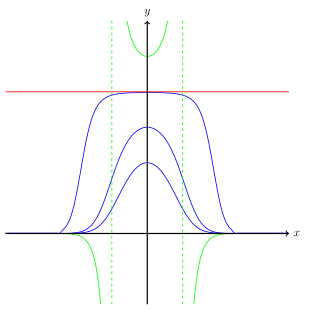
(i) Find a first-order differential equation satisfied by each member of the family \(F\) of curves \[y = c\exp(x^2) \quad (-\infty < c < \infty).\] Write down the differential equation satisfied by any curve which is orthogonal to every member of \(F\) and hence find the set of orthogonal trajectories to \(F\). (ii) Verify that \(y = x^2/4a\) is a solution of the differential equation \[y = x\frac{dy}{dx} - a\left(\frac{dy}{dx}\right)^2.\] Explain why each tangent to the curve \(y = x^2/4a\) is also a solution of the differential equation.
The function \(f(z)\) possesses a derivative \(f'(z)\) for all real values of \(z\), and is such that $$f(x + y) = f(x)f(y)$$ for all real values of the independent variables \(x\) and \(y\). By differentiating the relation with respect to \(x\) and \(y\) in turn, show that $$\frac{f'(x)}{f(x)} = \frac{f'(y)}{f(y)},$$ and hence determine the form of \(f\). Determine similarly the form of the function \(g\) that satisfies $$g(x+y) = \frac{g(x) + g(y)}{1 + g(x)g(y)}.$$
The Cartesian coordinates of a particle \(P\) at time \(t\) are \((x(t), y(t))\), where \[x = u(1+t), \quad (u > 0),\] \[\frac{dy}{dx} = \frac{y}{x} + \frac{x}{(x^2+y^2)^{\frac{1}{2}}}.\] Initially the particle is on the \(x\) axis; if \(O\) is the origin \((0, 0)\), prove that the slope of \(OP\) increases with time, and show that \(4y = 3x\) after a time \[t = \sqrt{2}\exp(15/32) - 1.\]
A boiling fluid, which is initially a mixture of equal amounts of fluids \(A\) and \(B\), evaporates at a constant rate, and evaporates completely in ten seconds. At any time, the ratio of the rate of evaporation of fluid \(A\) to the rate of evaporation of fluid \(B\) is twice the ratio of the amount of fluid \(A\) to the amount of fluid \(B\). How long elapses before the two fluids are evaporating at exactly the same rate?
A container in the form of a right circular cone with semi-vertical angle \(\alpha\) is held with its axis vertical and vertex downwards. Water is supplied to the container at a constant volume-rate \(Q\), and it escapes through a leak at the vertex at a rate \(ky\), where \(y\) is the depth of water in the cone, and \(k\) is a constant. Show that $$\pi \tan^2 \alpha \, y^2 \frac{dy}{dt} = Q - ky,$$ and find how long it takes for the water level to rise from zero to \(Q/2k\).
A shopkeeper has to meet a continuous demand of \(r\) units per unit of time from his customers. At intervals of \(T\) units of time, he buys a quantity of \(Q\) units from a wholesaler, where \(Q \geq rT\). The cost of placing the order is \(a\) pounds and its cost per unit is \(b\) pounds. If he runs out of stock at any unit time, his customers go elsewhere (at no cost to him per unit of time); but as soon as his shop is set again (through loss of customers, or other business) for the period during which the capital tied up against these losses he makes a net profit on this line of business if \(p^2 > 2ab/r\), where \(p\) is the amount of money per unit sold. Show that he can make a maximum profit per unit time of \(X\) which will maximise his profit per unit time.
The atmosphere at a height \(z\) above ground level is in equilibrium with density \(\rho(z)\). Neglecting the curvature of the earth, show that the pressure \(p(z)\) is given by \begin{equation*} \frac{dp}{dz} = -\rho g, \end{equation*} where \(g(z)\) is the acceleration due to gravity at a height \(z\). If the earth is now assumed to be spherical, it can be shown that the above still holds and that \(g\) is inversely proportional to the square of the distance from the centre of the earth. Assuming also that \(p\), \(\rho\), \(T\) are connected by the relations \begin{equation*} p = k\rho^\gamma, \quad p = R\rho T, \end{equation*} where \(T(z)\) is the temperature of the atmosphere at a height \(z\) and where \(k\), \(R\) are constants with \(\gamma > 1\), show that \begin{equation*} T = T_0\left(1 - \frac{(\gamma-1)a\rho_0g_0z}{(\gamma R\rho_0a+z)}\right), \end{equation*} where \(a\) is the radius of the earth and \(p_0\), \(\rho_0\), \(T_0\), \(g_0\) denote the values of \(p\), \(\rho\), \(T\), \(g\) at \(z = 0\).
In a certain chemical reaction 1 mole of a product \(P\) is produced per mole of reactant \(R\). The rate of production of \(P\) in moles per litre per second is \(k\) times the product of the concentrations of \(P\) and \(R\), these concentrations being measured in moles per litre. Initially there is 1 mole of \(P\) present for every 100 moles of \(R\). Assuming that the system is closed and has constant volume, i.e., that the sum of the concentrations of \(P\) and \(R\) is some constant \(\alpha\), calculate, in terms of \(\alpha\) and \(k\), the time that elapses before there are 100 moles of \(P\) present for every mole of \(R\).
A paraboloidal bucket is formed by rotating the curve \(ay = x^2\) (\(0 \leq y \leq a\)) about the \(y\)-axis which is vertical. Water runs out of the bucket, initially full, through a small hole at \(y = 0\). The volume of water issuing per unit time is proportional to \(h^\alpha\), where \(h\) is the depth of the water remaining in the bucket at time \(t\), and \(\alpha\) is a constant (\(0 < \alpha < 2\)). At time \(t_1\) the bucket is half-empty (in terms of volume); it becomes totally empty at time \(t_2\). Find \(t_1/t_2\), showing that it depends on \(\alpha\) only.
The following is a simple theory for the decompression of divers: When the diver is at a depth \(b\), the pressure \(A\) of gas in his lungs is \((1+b/10)\), and the pressure \(P\) of gas dissolved in his body tissues is governed by the equation \(\frac{dP}{dt} = k(A-P)\), where \(k\) is a positive constant. The risk of 'bends' is proportional to \(P/A\) and ceptable if \(P/A < 2\). The diver is at a depth \(D\), with \(P = A = (1+D/10)\), and wishes to ascend to the surface at a constant speed \(s\). Show that the risk is acceptable provided \[s(1 - e^{-kD/s}) < 10k.\]
The barrel of a gun may be considered as a tube of length \(L\), closed at one end, and of uniform circular cross section of area \(A\). The rear surface of the bullet is at a distance \(x\) from the closed end, and \(x = x_0\) when the gun is fired. The pressure in the gun is \(P\), and \(P = P_0\) immediately after firing. Subsequently \(P\) obeys the equation \[PV^{\gamma} = \text{constant},\] where \(V = Ax\) is the volume of propellant gas, and \(\gamma\) is a constant \(\geq 1\). The equation of motion of the bullet is \[m\frac{d^2x}{dt^2} = AP.\] Find the velocity of the bullet when it leaves the barrel, for all values of \(\gamma \geq 1\).
A family of plane curves has the property that if the tangent to \(f(x,y)\) of any one of the curves intersects the \(x\)-axis in \(N\), then the distance \(ON\) is equal to \(ky^2\), where \(O\) is the origin and \(k\) is a positive constant. Find the equation of the particular curve of the family that passes through the point \((0,1)\) and sketch it.
A certain hill has the following property. If a man stands anywhere on it and looks directly uphill, the horizontal distance from where he is to the furthest point of the hill that he can see depends only on his height and not on where he is on the hill. What is the shape of the hill? [It may be assumed that the hill is a surface of revolution.]
A curve lying above the \(x\)-axis is such that the portion of its tangent between the point of contact and the \(x\)-axis is of constant length \(c\). Give a rough sketch of the curve and show that the area between the curve and the \(x\)-axis is \(\frac{1}{2}\pi c^2\).
The arc intercepted on a rectangular hyperbola by a latus rectum is revolved about an asymptote. If \(2a\) is the length of the latus rectum, prove that the area of the surface of revolution generated is \(\pi a^2 (\sqrt{6}+\sinh^{-1}\sqrt{2})\).
A coil of copper wire, whose resistance is 50 ohms at 0° C., is immersed in water in a closed vessel: it is observed that when the temperature of the whole is 20° C. the rate of fall of temperature by radiation and conduction is 0.3° C. per minute. A constant P.D. is now applied to the coil and it is observed that when the temperature rises to 20° C. it is rising at the rate of 4.2° C. per minute: find the final steady temperature reached. The temperature coefficient of increase of resistance for copper is \(\cdot 004\) per degree C.; the atmospheric temperature is 15° C. throughout.
If the tractive force per ton of an electric train at speed \(v\) is \[ \frac{a(b-v)}{c+v} \text{ tons weight}, \] where \(a, b\) and \(c\) are constants, find the speed \(V\) at which the horse-power exerted is a maximum. Find also the gradient up which, if friction and wind resistance are neglected, the maximum speed attainable is \(V\). \item[(i)] If \[ x^m y^n = (x+y)^{m+n}, \] prove that \[ \frac{dy}{dx} = \frac{y}{x}. \] \item[(ii)] Sketch roughly the shape of the curve \[ y^2 = x(x-1)(2-x), \] and prove that part of it is an oval of breadth 1, and depth \(\sqrt{\frac{4}{27}}\). Note: The scanned document depth value is hard to read. It's likely `sqrt(4/27)` or `sqrt(64/27)`. Using the value that seems more correct.
Prove that a necessary condition for the radius of curvature to be equal to the perpendicular from the origin on to the tangent for every point of a curve, is that the intrinsic equation is of the form \(s = \frac{1}{2}(a\psi^2+2b\psi+c)\). Show that with this form of intrinsic equation given, an origin can be found to satisfy the former property. Prove that in this case, the centre of curvature lies on a fixed circle of radius \(a\).
Develop the Lagrange-Charpit method of solving a partial differential equation and illustrate by considering \[ p^2+q^2-2px-2qy+1=0. \]
Find a differential equation which represents the path of a ray through a medium whose refractive index, \(\mu\), is a function of \(r\), the distance from a fixed centre. In the case when \(\mu = Cr^{-m}\), and \(C\) is a constant, show that the deviation of any ray in a portion of the path which subtends an angle \(\theta\) at the centre, is \(m\theta\).
Give an account of Lagrange's method of solving the linear partial differential equation \[ Pp+Qq=R, \] explaining the geometrical interpretation of the method. Solve the equation \[ yp-xq=c \quad (c>0). \] Describe the general nature of the surfaces represented by this equation.
Long waves are travelling along a straight shallow canal of uniform section. Show that \(\eta\), the elevation of the free surface above the equilibrium level at a distance \(x\) along the canal, satisfies the equation \[ \frac{\partial^2\eta}{\partial t^2} = \frac{gA}{b}\frac{\partial^2\eta}{\partial x^2}, \] \(A\) being the area of the section of the canal, and \(b\) its breadth. Find the corresponding differential equation if \(A\) and \(b\) are functions of \(x\).
If \(U\) and \(p\) denote the energy per unit mass and the pressure of a substance, supposed expressed as functions of the temperature \(T\) and the specific volume \(v\), establish the relation \[ \frac{\partial U}{\partial v} = T\frac{\partial p}{\partial T}-p. \] A substance is such that \[ U=av+C_vT, \] where \(a\) and \(C_v\) are constants. Show that it has an equation of state of the form \[ (p+a)f(v)=T. \] Show further that the specific heat at constant pressure \(C_p\) is independent of \(T\), and that if it is also independent of \(v\) then \[ f(v) = \frac{v+k}{C_p-C_v}, \] where \(k\) is a constant.
A community is made up of \(R\) independent, continuously-varying populations, of which the \(r\)th has population \(N_r\) and constant growth-rate \(k_r\) (i.e. \(dN_r/dt = k_r N_r\)). If \(k\) is the growth-rate of the total population of the community, \(N\), show that \begin{align} \text{(a)} \sum_{r=1}^{R} k(k_r - k)N_r = 0 \\ \text{(b)} \frac{dk}{dt} = \frac{1}{N}\sum_{r=1}^{R} k_r^2 N_r - k^2 \\ \text{(c)} \frac{dk}{dt} \geq 0 \end{align}
Two identical snowploughs plough the same stretch of road in the same direction. The first starts at \(t = 0\) when the depth of snow is \(d\) metres, and the second starts from the same point \(\tau\) seconds later. Snow falls at a constant rate of \(k\) metres/second. It may be assumed that each snowplough moves at a speed equal to \(b/z\) metres/second, where \(z\) is the depth of snow it is ploughing, and that it clears all the snow. Show that:
- [(i)] the time taken for the first snowplough to travel \(x\) metres is \[(e^{kx/b}-1)d/k \text{ seconds};\]
- [(ii)] at time \(t > \tau\), the second snowplough has moved \(y\) metres, where \(t\) satisfies \[b \frac{dt}{dy} = kt - d (e^{ky/b} - 1);\]
- [(iii)] the snowploughs collide when they have moved a distance \(b\tau/d\) metres.
Farmer Jones' meadow may be regarded as the square \(0 \leq x \leq 1, 0 \leq y \leq 1\). At time \(t = 0\), Jones enters at \((1,0)\) and walks at constant velocity \((0, c)\). At the same moment his dog, Spot, enters at \((0,0)\) and runs at unit speed, directed always towards the instantaneous position of Jones. Show that Spot's path satisfies \[(1-x)\frac{dp}{dx} = c(1 + p^2)^{\frac12}\] where \(p = \frac{dy}{dx}\). Hence show that Spot does not overtake Jones inside the meadow if \(c > (5^{1/2} - 1)/2\).
A mouse \(M\) is running at a constant speed \((U, 0)\) along the line \(y = 0\). At \(t = 0\), the mouse is at position \((a, 0)\), where \(a > 0\), and a cat \(C\) is at \((0, b)\). The cat starts running at constant speed \(V\) in a direction which is always towards the mouse. If \(O\) is the origin and \(\psi\) the acute angle \(OMC\), show that \[\frac{d}{dt}(\cot \psi) = \frac{U}{y},\] where \((x, y)\) is the position of \(C\) at any time \(t\). If \(b \ll a\), show that the path of \(C\) is given approximately, for \(t > 0\), by an equation of form \[x = Ay^{1-\lambda} + B,\] where \(A\) and \(B\) are constants to be found and \(\lambda = U/V\), provided \(\lambda > 1\). Find the approximate equation of the path when \(\lambda = 1\).
Suppose \(x\) is a continuous function with continuous derivative satisfying \[\dot{x}(t) + x(t) = 0 \quad \text{for } |x(t)| \leq 1,\] \[\dot{x}(t) + 4x(t) = 0 \quad \text{for } 1 < |x(t)|,\] \[x(0) = 0, \quad \dot{x}(0) = v.\] Giving an account of your reasoning but without necessarily resorting to detailed calculation, show that \(x\) is periodic for all choices of \(v\). Give a rough sketch of how the period varies with \(v\), indicating the main features of your sketch and explaining why they occur (again exact numerical detail is not required). How would your various conclusions be altered (if at all) for the general initial conditions \(x(0) = u\), \(\dot{x}(0) = v\)?
The functions \(x(t)\), \(y(t)\) satisfy the differential equations \[\frac{dx}{dt} = y - x,\] \[\frac{dy}{dt} = \begin{cases} y(1-x) & 0 < x < 1 \\ 0 & \text{otherwise} \end{cases}\] By considering the path \(\{x(t), y(t)\}\) traced out in the \((x, y)\) plane as \(t\) varies, show that the path starting at \((1, a)\), with \(0 < a < 1\), passes through (i) a point \((b, b)\), where \(0 < b < 1\), (ii) a point \((c, 1)\), where \(0 < c < 1\), and (iii) a point \((1, f(a))\), where \(f(a) > 1\). Show that \(f'(a) < 0\). By considering paths which cross the line \(y = 2x\), or otherwise, show that \(f(a) < 2\). Show that as \(t \to \infty\), \((x(t), y(t)) \to (f(a), f(a))\). [Hint: Do not attempt to solve the equations analytically in the region \(0 < x < 1\).]
A river has parallel banks distance \(2h\) ft. apart. The velocity of the stream vanishes at the banks and increases linearly to a maximum value \(u_0\) ft./sec. at the centre. A swimmer who swims at \(v_0\) ft./sec. in still water crosses the river. How long does it take him if he crosses as quickly as possible, and how far downstream from his starting point does he finish? Show that, if \(v_0 > u_0\) and he swims in such a way that he is always moving towards the point immediately opposite his starting position, his travel time is $$\frac{2h}{u_0} \sin^{-1} \frac{u_0}{v_0} \text{ seconds.}$$
A fixed plane p meets a fixed sphere in a small circle Y and a variable plane p' meets the sphere in a circle Y'; prove that, if the circles Y, Y' cut each other orthogonally, the plane p' passes through a fixed point P. Prove also that, if the plane p passes through a fixed line, the corresponding points P lie on another fixed line.
Prove that a circle through the vertex of a parabola cuts the curve again in three points at which the normals to the parabola are concurrent. \par Taking the co-ordinates of this point of concurrence as \((h,k)\) with the equation of the parabola as \(y^2=4ax\), find the co-ordinates of the centre of the circle.
Eliminate \(\theta, \phi\) from the equations \begin{align*} x\cos\frac{\theta-\phi}{2} &= a\cos\theta\cos\frac{\theta+\phi}{2}, \\ y\cos\frac{\theta-\phi}{2} &= b\cos\phi\sin\frac{\theta+\phi}{2}, \\ a^2\cos^2\theta - b^2\cos^2\phi &= c^2. \end{align*}
Prove that as a point P describes, from end to end, a generator of a ruled but non-developable surface, the tangent plane at P rotates through a total angle \(\pi\).
The function \(F(x,y)\) is continuous in \((x,y)\) in a neighbourhood of a certain point \((a,b)\) and \[ F(a,b)=0. \] Investigate conditions under which the equation \[ F(x,y)=0 \] determines, in some neighbourhood of \(a\), a function \(y=\phi(x)\) which reduces to \(b\) when \(x=a\). Find also conditions for \(\phi(x)\) to be
- [(1)] single-valued,
- [(2)] continuous,
- [(3)] differentiable,
Show that \((y-c)^2+\frac{1}{2}(x-c)^3=0\) is a family of solutions of \[ y+\frac{1}{2}p^3-(x+p^2)=0, \quad \text{where } p=\frac{dy}{dx}. \] Find the envelope of the family, and show that \(y=x\) is a cusp locus.
Deduce from the ordinary equations of motion of an incompressible fluid those of impulsive motion.
At a certain instant a jet of liquid of density \(\rho\) occupies the space specified by \(0
Solve the differential equations:
- [(a)] \(y\dfrac{d^2 y}{dx^2} + (3y-2)\left(\dfrac{dy}{dx}\right)^2 - 2y^2=0\),
- [(b)] \(2(y+z)dx+(x+3y+2z)dy+(x+y)dz=0\),
- [(c)] \(4z = \left(\dfrac{\partial z}{\partial x}\right)^2 + \left(\dfrac{\partial z}{\partial y}\right)^2\).
What conditions must the positive integer \(n\) and the constants \(a\) and \(b\) satisfy in order that the \(n+1\) equations \begin{gather*} x_k - x_{k-1} + x_{k-2}=0, \quad (k=2,3,\dots,n) \\ x_0=a, \quad x_n=b \end{gather*} for the unknowns \(x_0, \dots, x_n\) shall have (i) a solution, (ii) one and only one solution?
Show that, if \(n>2\) and \(\theta\) is not an integral multiple of \(\displaystyle\frac{\pi}{n-1}\), a unique set of \(n\) numbers \(a_1, a_2, \dots, a_n\) can be found to satisfy the equations \[ a_1=a, \quad a_n=b, \] \[ a_{r+1} - 2a_r\cos\theta+a_{r-1}=0 \quad (1< r < n), \] and express \(a_r\) as a real function of \(a,b\) and \(\theta\). Investigate the exceptional cases, where \(\theta = \displaystyle\frac{k\pi}{n-1}\) (\(k\) an integer).
Prove that, if \(a, b, c\) are the sides of a triangle of area \(\Delta\), \[ \begin{vmatrix} (b-c)^2 & b^2 & c^2 & 1 \\ a^2 & (c-a)^2 & c^2 & 1 \\ a^2 & b^2 & (a-b)^2 & 1 \\ 1 & 1 & 1 & 0 \end{vmatrix} = -16\Delta^2. \]
Solve the equations \begin{align*} \frac{1}{x}+\frac{1}{y}+\frac{1}{z} &= 1, \\ \frac{y+z}{x} + \frac{z+x}{y} + \frac{x+y}{z} &= 8, \\ \frac{yz}{x} + \frac{zx}{y} + \frac{xy}{z} &= 14, \end{align*} assuming that none of \(x, y, z\) is zero.
If \(a, b\) and \(h(>0)\) are real constants, prove that the roots \(x_1, x_2 (x_1>x_2)\) of the equation \[ (a-x)(b-x)=h^2 \] lie outside the range between \(a\) and \(b\). \newline If \(\phi(x)\) denotes the polynomial \[ \begin{vmatrix} a-x & h & g \\ h & b-x & f \\ g & f & c-x \end{vmatrix} \] show that \begin{align*} \phi(x_1) &= (g\sqrt{x_1-b}+f\sqrt{x_1-a})^2, \\ \phi(x_2) &= -(g\sqrt{b-x_2}-f\sqrt{a-x_2})^2. \end{align*} Deduce that if \(g, f\) and \(c\) are real the equation \(\phi(x)=0\) has three real unequal roots.
Prove that, if an equation of the second degree (with real coefficients) \[ S=ax^2+2hxy+by^2+2gx+2fy+c=0 \] represents two straight lines, then the value of the determinant \[ \Delta = \begin{vmatrix} a & h & g \\ h & b & f \\ g & f & c \end{vmatrix} \] is zero. Prove conversely that, if \(\Delta=0\), then the equation \(S=0\) does represent two straight lines (possibly ``coincident''). Prove that the point common to the two lines, assumed distinct and not parallel, can be expressed in any of the equivalent alternative forms \((A/G, H/G), (H/F, B/F), (G/C, F/C)\), where \[ A=bc-f^2, \quad F=gh-af, \quad \text{etc.} \] Deduce, or find otherwise, conditions for the lines to ``coincide.'' Prove that, if the lines are real, distinct and not parallel, then \(A, B, C\) are non-positive and at least one of them is negative. Determine conversely whether these conditions (or a lesser number selected from them) ensure that the equation \(S=0\) represents two distinct real lines when \(\Delta\) is zero.
Shew that if the elements of the determinant \(\Delta\) are functions of \(x\), \(d\Delta/dx\) is the sum of the determinants formed by differentiating the separate rows of \(\Delta\). If \(\Delta(x)\) is formed from the \(n\) functions \(f_1(x), f_2(x), \dots, f_n(x)\) as follows: \[ \begin{vmatrix} f_1(x), & f_2(x), & \dots, & f_n(x) \\ f_1'(x), & f_2'(x), & \dots, & f_n'(x) \\ \vdots & \vdots & \ddots & \vdots \\ f_1^{(n-1)}(x), & f_2^{(n-1)}(x), & \dots, & f_n^{(n-1)}(x) \end{vmatrix} \] find \(d\Delta/dx\). If \(D(x)\) is formed in the same way from the \(n\) functions \[ \phi(x)f_1(x), \phi(x)f_2(x), \dots, \phi(x)f_n(x), \] shew that \(D(x) = \{\phi(x)\}^n \Delta(x)\). By considering the case \(\phi(x) = 1/f_1(x)\) prove by induction that if \(\Delta(x) = 0\) for all values of \(x\), there are constants \(c_1, c_2, \dots, c_n\), not all zero, such that \(c_1f_1(x)+c_2f_2(x)+\dots+c_n f_n(x) = 0\).
For what values of \(a\), \(b\) and \(c\) are the following equations consistent? \begin{align} x + y + z &= 1, \\ ax + by + cz &= 0, \\ a^2x + b^2y + c^2z &= 0. \end{align} Solve them completely when they are consistent.
Whenever possible, solve the following simultaneous equations (in which \(\lambda\) is a real number). \begin{align*} \lambda x + y &= 1\\ x + (\lambda - 1)y &= 2\\ x + y + (\lambda - 2)z &= \lambda \end{align*} For what values of \(\lambda\) are there no solutions?
- [(i)] Assume that the numbers \(b_1\), \(b_2\), \(b_3\) are not all zero. State a sufficient condition on the coefficients \(a_{ij}\) for the equations \begin{align*} a_{11}x + a_{12}y + a_{13}z &= b_1 \\ a_{21}x + a_{22}y + a_{23}z &= b_2 \\ a_{31}x + a_{32}y + a_{33}z &= b_3 \end{align*} to have a solution.
- [(ii)] For all values of \(c\), solve the equations \begin{align*} cx + 2y - z &= 1 \\ x + 2y + z &= 1 \\ 2x - 2y + 5z &= -1. \end{align*} By considering the case where \(c = 0\), determine whether the condition you have given in part (i) is necessary as well as sufficient.
Solve the following equations completely: \begin{align} 2x + 5y + z &= a,\\ x + 3y + az &= 1,\\ 3x + 8y + bz &= c. \end{align} In particular, for what values of \(a\), \(b\), \(c\) have these equations
- [(i)] no solutions,
- [(ii)] more than one solution?
Find all the solutions of the equations \begin{align} Bx + 7y + 8z &= A \\ 4x - 2y - 3z + 9 &= 0 \\ x + y + z &= 11 \end{align} for all possible values of the constants \(A\) and \(B\).
Discuss the solution of the system of linear equations \begin{align} x + y + z + t &= 4,\\ x + 2y + 3z + 4t &= 10,\\ x + 4y + az + bt &= c, \end{align} with due regard to the special cases which may arise for particular values of \(a\), \(b\) and \(c\).
Prove that, if the simultaneous equations \begin{align} 3x + ky + 2z &= \lambda x,\\ kx + 3y + 2z &= \lambda y,\\ 2x + 2y + z &= \lambda z \end{align} have a solution in which \(x\), \(y\), \(z\) are not all zero, then \[(1-\lambda) k^2 - 8k + (\lambda + 1)(\lambda - 3)(\lambda - 5) = 0.\] When this condition is satisfied, find formulae for the most general solutions in the two cases (i) \(\lambda = 1\), (ii) \(\lambda = 3\).
Find the general solution of the system of equations \begin{align} x + y - az &= b, \\ 3x - 2y - z &= 1, \\ 4x - 3y - z &= 2, \end{align} in each of the three cases: (i) \(a = 1\), \(b = 9\); (ii) \(a = 2\), \(b = -3\); (iii) \(a = 2\), \(b = 0\).
Prove that, if \(a \neq 1\) or 2, then the equations \begin{align} ax + y + z &= 1,\\ x + ay + z &= b,\\ 3x + 3y + 2z &= c \end{align} have a solution whatever the values of \(b\) and \(c\). Find particular values of \(b\) and \(c\) such that the equations have a solution whatever value is given to \(a\).
Find the most general solution of the system of equations \begin{align} 3x + 2y + z &= 7,\\ x + y + az &= 3,\\ (2a + 1)x + 4y + 5z &= 11, \end{align} where \(a\) is a given real number. Examine carefully any exceptional cases.
Solve the simultaneous equations \begin{align} x + y + z &= 6, \\ (y + z)(z + x)(x + y) &= 60, \\ \begin{vmatrix} x & y & z \\ y & z & x \\ z & x & y \end{vmatrix} &= -18. \end{align}
Find all the values of \(x\), \(y\) and \(z\) which satisfy the equations \begin{align} -y + z &= u,\\ x - z &= v,\\ -x + y &= w, \end{align} where \begin{align} v - 2w &= a,\\ -u + 3w &= b,\\ 2u - 3v &= c. \end{align}
In the system of equations \begin{align*} -ny+mz &= a, \\ nx - lz &= b, \\ -mx+ly &= c, \\ lx+my+nz &= p, \end{align*} \(l, m, n, a, b, c, p\) are given real numbers, and \(l,m,n\) are not all zero. Prove that a necessary and sufficient condition for the equations to have a solution is that \[ la+mb+nc=0; \] and solve the equations when this condition is satisfied.
In the system of equations \begin{align*} ax+by+cz &= 0, \\ cx+ay+bz &= 0, \\ bx+cy+az &= 0, \end{align*} the numbers \(a,b,c\) are real and not all equal. Prove the following facts:
- [(i)] If \(a+b+c \ne 0\), the system has no solution other than \(x=y=z=0\).
- [(ii)] If \(a+b+c=0\), the system has other solutions, but every solution satisfies \(x=y=z\).
Show that the simultaneous equations \begin{align*} ax+y+z&=p, \\ x+ay+z&=q, \\ x+y+az&=r \end{align*} have an unique solution if \(a\) has neither of the values 1 or \(-2\). Show also that, if \(a = -2\), there is no solution unless \(p, q\) and \(r\) satisfy a certain condition, and that there are then an infinite number of solutions. Discuss the solution of the equations when \(a=1\). Find the most general solution (if any) in the following cases: (i) \(a=3, p=q=r=1\), (ii) \(a=-2, p=q=r=1\), (iii) \(a=-2, p=1, q=-1, r=0\), (iv) \(a=1, p=q=r=0\).
Show that, if \(\lambda=3\), it is possible to choose constants \(\alpha, \beta, \gamma\), not all zero, such that \[ \alpha (11x-6y+2z) + \beta (-6x+10y-4z) + \gamma (2x-4y+6z) \] is identically equal to \[ \lambda (\alpha x + \beta y + \gamma z). \] Obtain the ratios of \(\alpha, \beta\) and \(\gamma\). Find all other values of \(\lambda\) for which it is possible to find constants \(\alpha, \beta\) and \(\gamma\), not all zero, with the above property.
Solve for \(x, y, z\) the three simultaneous equations \[ \begin{cases} ax+3y+2z=b, \\ 5x+4y+3z=1, \\ x+2y+z=b^2, \end{cases} \] explaining in particular the different cases obtained for \(a=3\) with varying values of \(b\).
The nine numbers \(l_i, m_i, n_i\) (\(i=1,2,3\)) satisfy the six relations \begin{align*} l_i l_j + m_i m_j + n_i n_j &= 0, \quad i \ne j, \\ l_i^2 + m_i^2 + n_i^2 &= 1. \end{align*} If \[ \Delta = \begin{vmatrix} l_1 & m_1 & n_1 \\ l_2 & m_2 & n_2 \\ l_3 & m_3 & n_3 \end{vmatrix}, \] show that \(\Delta l_1 = m_2 n_3 - m_3 n_2\) and that \(\Delta^2 l_1^2 = l_2^2 - l_3^2\). Hence, or otherwise, show that \(\Delta^2=1\). Establish the equivalence of the two sets of equations \[ \left\{ \begin{aligned} X &= l_1 x + m_1 y + n_1 z \\ Y &= l_2 x + m_2 y + n_2 z \\ Z &= l_3 x + m_3 y + n_3 z \end{aligned} \right. \quad \text{and} \quad \left\{ \begin{aligned} x &= l_1 X + l_2 Y + l_3 Z \\ y &= m_1 X + m_2 Y + m_3 Z \\ z &= n_1 X + n_2 Y + n_3 Z. \end{aligned} \right. \]
Solve completely the system of equations \begin{align*} (b+c)x+a(y+z) &= a, \\ (c+a)y+b(z+x) &= b, \\ (a+b)z+c(x+y) &= c, \end{align*} (i) when \(abc \neq 0\), and (ii) when \(a=0\), but \(b \neq 0\).
Investigate for what values of \(\lambda, \mu\) the simultaneous equations \begin{align*} x + y + z &= 6, \\ x + 2y + 3z &= 10, \\ x + 2y + \lambda z &= \mu \end{align*} have (i) no solution, (ii) a unique solution, (iii) an infinite number of solutions. In case (iii) give the general solution.
Solve the equations: \[ \left\{ \begin{array}{l} x+y+z = 1 \\ ax+by+cz=d \\ a^2x+b^2y+c^2z=e, \end{array} \right. \] where \(a, b, c\) are unequal. If \(a=b\), determine sufficient conditions in terms of \(a, b, c, d\) and \(e\), for the existence of a solution. Show that in this case a possible combination of values is \(e=d^2\), and \(d=a\) or \(d=c\).
Classify the values of \(a, b\) such that the three equations \begin{align*} 5x + ay - 5z &= 3, \\ 4x + 4y - 7z &= b, \\ -3x + y + 4z &= -2, \end{align*} shall have (i) a unique solution, (ii) no solution, (iii) an infinite number of solutions.
Discuss as systematically as you can the theory of the solutions of three linear equations of the type \(ax+by+cz=d\), paying special attention to the cases that are commonly regarded as exceptional.
Discuss the solution of the equations \[ ax+by+cz=d, \quad a'x+b'y+c'z=d', \quad a''x+b''y+c''z=d''. \] Distinguish carefully with numerical examples the cases in which there are an infinity of solutions, one, or none; and obtain conditions, in terms of the coefficients, sufficient to discriminate between the different cases. Interpret the results geometrically in terms of planes in space.
Determine all sets of solutions \((x, y, z)\) of the equations \begin{align*} x + y + z &= a+b+c, \\ a^2x + b^2y + c^2z &= a^3+b^3+c^3, \\ a^3x + b^3y + c^3z &= a^4+b^4+c^4, \end{align*} where \(a, b, c\) are unequal, distinguishing the cases in which \(bc+ca+ab\) is different from or equal to zero.
Evaluate the \(n \times n\) determinant \[\begin{vmatrix} -2 & 1 & 0 & 0 & \ldots & 0 \\ 1 & -2 & 1 & 0 & \ldots & 0 \\ 0 & 1 & -2 & 1 & \ldots & 0 \\ 0 & 0 & 1 & -2 & \ldots & 0 \\ . & . & . & . & . & . \\ . & . & . & . & . & . \\ . & . & . & . & . & . \\ 0 & 0 & 0 & 0 & \ldots & -2 \end{vmatrix}\]
Evaluate the determinant \[A = \begin{vmatrix} 1 & z & z^2 & 0 \\ 0 & 1 & z & z^2 \\ z^2 & 0 & 1 & z \\ z & z^2 & 0 & 1 \end{vmatrix}.\] Plot in the Argand diagram the points satisfying \(A = 0\).
Prove that $$\begin{vmatrix} (a-x)^2 & (a-y)^2 & (a-z)^2 & (a-w)^2 \\ (b-x)^2 & (b-y)^2 & (b-z)^2 & (b-w)^2 \\ (c-x)^2 & (c-y)^2 & (c-z)^2 & (c-w)^2 \\ (d-x)^2 & (d-y)^2 & (d-z)^2 & (d-w)^2 \end{vmatrix} = 0.$$
If \(n\) is a positive integer, show that $$\begin{vmatrix} 1 & 1 & 1 \\ a & b & c \\ a^{n+2} & b^{n+2} & c^{n+2} \end{vmatrix}$$ has the value \((b-c)(c-a)(a-b)S\), where $$S = \sum a^r b^s c^t$$ summed over all values \(r\), \(s\), \(t\) satisfying \(r+s+t=n\). Prove a similar result for $$\begin{vmatrix} 1 & 1 & 1 & 1 \\ a & b & c & d \\ a^2 & b^2 & c^2 & d^2 \\ a^{n+3} & b^{n+3} & c^{n+3} & d^{n+3} \end{vmatrix}$$ and generalise the result.
Factorize the determinant $$\begin{vmatrix} a & b & c \\ c & a & b \\ b & c & a \end{vmatrix}.$$ Given that \(a\), \(b\), \(c\) are real and not all equal and that \(a+b+c \neq 0\), solve \begin{align} ax + by + cz &= 1,\\ cx + ay + bz &= 0,\\ bx + cy + az &= 0. \end{align} What happens when \(a+b+c = 0\)?
The determinant \(D_n\), with \(n\) rows and columns, has elements as follows: $$d_{r,r} = a, \quad d_{r,r+1} = +1, \quad d_{r+1,r} = -1 \quad \text{(all } r\text{),}$$ other elements zero. Find a recurrence relation connecting \(D_n\), \(D_{n-1}\) and \(D_{n-2}\). Hence show that, for even \(n\), \(D_n\) has the value \(\cosh(n+1)\theta/\cosh\theta\), where \(\theta = \sinh^{-1}\frac{1}{2}a\). Determine the value of \(D_n\) for odd \(n\).
Stating without proof any properties of determinants used, express as a product of two linear terms and one quadratic term the determinant: \[\begin{vmatrix} x+a & b & c & d \\ b & x+c & d & a \\ c & d & x+a & b \\ d & a & b & x+c \end{vmatrix}.\]
(i) Evaluate the determinant $$\begin{vmatrix} a^3 & 3a^2 & 3a & 1 \\ a^2 & a^2+2a & 2a+1 & 1 \\ a & 2a+1 & a+2 & 1 \\ 1 & 3 & 3 & 1 \end{vmatrix}.$$ (ii) Show that if $$\begin{vmatrix} a & a^3 & a^4-1 \\ b & b^3 & b^4-1 \\ c & c^3 & c^4-1 \end{vmatrix} = 0,$$ and \(a\), \(b\), \(c\) are all different, then $$bc + ca + ab = \frac{1}{bc} + \frac{1}{ca} + \frac{1}{ab}.$$
If \[ D_N = \begin{vmatrix} 1 & a & a^N \\ 1 & b & b^N \\ 1 & c & c^N \end{vmatrix} \quad (N=0, 1, 2, \dots), \] prove that \[ D_N = D_2 P_{N-2}, \] where \(P_n\) is the coefficient of \(t^n\) in \[ (1+at+\dots+a^Nt^N)(1+bt+\dots+b^Nt^N)(1+ct+\dots+c^Nt^N) \] for any \(N \ge n\). Write out \(P_n\) explicitly, as a polynomial in \(a, b, c\), in the cases \(n=0, 1, 2, 3\).
If \(\Delta_n\) denotes the determinant \[ \begin{vmatrix} \lambda & 1 & 0 & 0 & \cdots \\ 1 & \lambda & 1 & 0 & \cdots \\ 0 & 1 & \lambda & 1 & \cdots \\ 0 & 0 & 1 & \lambda & \cdots \\ \vdots & \vdots & \vdots & \vdots & \ddots \end{vmatrix} \] with \(n\) rows and columns (where elements \(a_{rr}\) in the main diagonal all have the value \(\lambda\), elements \(a_{r,r+1}\) and \(a_{r+1,r}\) all have the value 1, and the rest vanish) prove that \[ \Delta_n = \lambda \Delta_{n-1} - \Delta_{n-2}. \] Deduce that, if \(\lambda=2\cos\theta\), the value of the determinant \(\Delta_n\) is \(\sin(n+1)\theta \operatorname{cosec}\theta\).
By factorizing the determinant, or otherwise, show that \[ \begin{vmatrix} x & y & z & u \\ u & x & y & z \\ z & u & x & y \\ y & z & u & x \end{vmatrix} = (x^2+z^2-2yu)^2 - (u^2+y^2-2zx)^2. \] Express \[ \{(x^2+z^2 - 2yu)^2 - (u^2 + y^2 - 2zx)^2\} \{(X^2 + Z^2 - 2YU)^2 - (U^2 + Y^2 - 2ZX)^2\} \] in the form \((A^2+C^2-2BD)^2 - (D^2+B^2-2CA)^2\), giving explicit expressions for \(A, B, C, D\) in terms of \(x, y, z, u\) and \(X, Y, Z, U\).
State, without proof, how the existence of a solution of the set of four equations \[ a_r x+b_r y+c_r z+d_r w=0, \quad (r=1, 2, 3, 4), \] for which not all of \(x, y, z, w\) are zero is related to the value of the determinant of the sixteen coefficients \(a_r, b_r, c_r, d_r\). Prove that, if \(p, q, r, s\) are all different from \(-1\) and if \[ \begin{vmatrix} -1 & q & r & s \\ p & -1 & r & s \\ p & q & -1 & s \\ p & q & r & -1 \end{vmatrix} = 0, \] then \[ \frac{p}{p+1} + \frac{q}{q+1} + \frac{r}{r+1} + \frac{s}{s+1} = 1. \]
Prove the identity \[ \begin{vmatrix} x_1 & y_1 & a & b \\ \lambda_1 x_2 & x_2 & y_2 & c \\ \lambda_1 \lambda_2 x_3 & \lambda_2 x_3 & x_3 & y_3 \\ \lambda_1 \lambda_2 \lambda_3 x_4 & \lambda_2 \lambda_3 x_4 & \lambda_3 x_4 & x_4 \end{vmatrix} = (x_1 - \lambda_1 y_1)(x_2 - \lambda_2 y_2)(x_3 - \lambda_3 y_3)x_4. \] Hence, or otherwise, prove that \[ \begin{vmatrix} a_1b_1 & a_1b_2 & a_1b_3 & a_1b_4 \\ a_1b_2 & a_2b_2 & a_2b_3 & a_2b_4 \\ a_1b_3 & a_2b_3 & a_3b_3 & a_3b_4 \\ a_1b_4 & a_2b_4 & a_3b_4 & a_4b_4 \end{vmatrix} = a_1 b_4 (a_2b_1 - a_1b_2)(a_3b_2-a_2b_3)(a_4b_3-a_3b_4), \] and evaluate \[ \begin{vmatrix} 1 & 1 & 1 & 1 \\ b_1 & a_1 & a_1 & a_1 \\ b_1 & b_2 & a_2 & a_2 \\ b_1 & b_2 & b_3 & a_3 \end{vmatrix}. \]
If \(\bar{a}, \bar{b}, \bar{c}\) are the complex conjugates of \(a, b, c\), respectively, and if \(p, q, r\) are real, show that the equation \[ \begin{vmatrix} a-z & p & \bar{b} \\ c & q-z & b \\ \bar{c} & r & \bar{a}-z \end{vmatrix} = 0 \] has either three real roots or one real root and a pair of conjugate complex roots. It is given that \(q\) is a root when \(a=i, b=c=p=r=1\). Find \(q\) and solve the equation completely.
Evaluate the determinant \[ \begin{vmatrix} \frac{1}{x_1+y_1} & \frac{1}{x_2+y_1} & \frac{1}{x_3+y_1} \\ \frac{1}{x_1+y_2} & \frac{1}{x_2+y_2} & \frac{1}{x_3+y_2} \\ \frac{1}{x_1+y_3} & \frac{1}{x_2+y_3} & \frac{1}{x_3+y_3} \end{vmatrix} \] where \(x_1, x_2, x_3, y_1, y_2, y_3\) are any numbers such that \(x_i+y_j\) is non-zero for all \(i,j\). Hence give the numerical value when \(x_1=y_1=1\), \(x_2=y_2=2\), \(x_3=y_3=3\).
Explain briefly the rule for multiplying two determinants together. Show that \[ \begin{vmatrix} b^2+c^2+1 & c^2+1 & b^2+1 & b+c \\ c^2+1 & c^2+a^2+1 & a^2+1 & c+a \\ b^2+1 & a^2+1 & a^2+b^2+1 & a+b \\ b+c & c+a & a+b & 3 \end{vmatrix} \] is the square of a certain determinant, and hence obtain its value.
Show that the determinant \[ D(a,b,x) = \begin{vmatrix} r_1+x & a+x & a+x & \dots & a+x \\ b+x & r_2+x & a+x & \dots & a+x \\ b+x & b+x & r_3+x & \dots & a+x \\ \vdots & \vdots & \vdots & \ddots & \vdots \\ b+x & b+x & b+x & \dots & r_n+x \end{vmatrix} \] is linear in \(x\). Deduce that \[ D(a,b,0) = \frac{bf(a)-af(b)}{b-a}(a+b), \] \[ D(a,a,0) = f(a) - af'(a), \] where \(f(x) = (r_1-x)(r_2-x)\dots(r_n-x)\).
(i) Prove that \[ \begin{vmatrix} a_1+x & a_1 & \dots & a_1 \\ a_2 & a_2+x & \dots & a_2 \\ \vdots & \vdots & \ddots & \vdots \\ a_n & a_n & \dots & a_n+x \end{vmatrix} = x^{n-1}(x+a_1+a_2+\dots+a_n). \] (ii) Prove that \[ \begin{vmatrix} a_1 & b_1 & c_1 & d_1 \\ a_2 & b_2 & c_2 & d_2 \\ a_3 & b_3 & c_3 & d_3 \\ a_4 & b_4 & c_4 & d_4 \end{vmatrix} = \begin{vmatrix} d_4 & d_3 & d_2 & d_1 \\ c_4 & c_3 & c_2 & c_1 \\ b_4 & b_3 & b_2 & b_1 \\ a_4 & a_3 & a_2 & a_1 \end{vmatrix}. \] If \(a, b, c, d\) are real numbers, and \(p, q, r, s, t, u\) are complex numbers with respective conjugate complexes \(\bar{p}, \bar{q}, \bar{r}, \bar{s}, \bar{t}, \bar{u}\), show that all the coefficients of the polynomial in \(x\) \[ \begin{vmatrix} r-x & q & p & a \\ t & s-x & \bar{p} & b \\ u & c & \bar{s}-x & \bar{q} \\ d & \bar{u} & \bar{t} & \bar{r}-x \end{vmatrix} \] are real.
Factorize the determinants \[ \begin{vmatrix} x & y & x & y \\ y & x & y & x \\ -x & y & x & y \\ y & -x & y & x \end{vmatrix} \quad \text{and} \quad \begin{vmatrix} 1 & x & x^4 \\ 1 & x-y & (x-y)^4 \\ 1 & y & y^4 \end{vmatrix}. \]
Define a determinant (of any order), and from your definition prove that the value of a determinant is unaltered if to the elements of any column are added any multiple of the corresponding elements of another column. If \(x_1, x_2, x_3\) are the roots of the equation \(x^3 = px + q\), show that \[ \begin{vmatrix} x_1^4 & x_1^3 & 1 \\ x_2^4 & x_2^3 & 1 \\ x_3^4 & x_3^3 & 1 \end{vmatrix} = p^2 \begin{vmatrix} x_1^2 & x_1 & 1 \\ x_2^2 & x_2 & 1 \\ x_3^2 & x_3 & 1 \end{vmatrix}. \] Show also that \[ \begin{vmatrix} x_1^6 & x_1^5 & x_1 \\ x_2^6 & x_2^5 & x_2 \\ x_3^6 & x_3^5 & x_3 \end{vmatrix} = q(q^2 - p^3) \begin{vmatrix} x_1^2 & x_1 & 1 \\ x_2^2 & x_2 & 1 \\ x_3^2 & x_3 & 1 \end{vmatrix}. \]
Find the value of the \(n\)-rowed determinant of the form \[ \begin{vmatrix} 1 & 1 & 0 & 0 & 0 & 0 \\ 1 & 1 & 1 & 0 & 0 & 0 \\ 0 & 1 & 1 & 1 & 0 & 0 \\ 0 & 0 & 1 & 1 & 1 & 0 \\ 0 & 0 & 0 & 1 & 1 & 1 \\ 0 & 0 & 0 & 0 & 1 & 1 \end{vmatrix} \] whose element in the \(i\)th row and \(j\)th column is 1 if \(i\) and \(j\) differ by 0 or 1, and 0 otherwise.
Prove that the value of the determinant \[ \begin{vmatrix} t_1+x & a+x & a+x & a+x \\ b+x & t_2+x & a+x & a+x \\ b+x & b+x & t_3+x & a+x \\ b+x & b+x & b+x & t_4+x \end{vmatrix} \] is \(A + Bx\), where \(A\) and \(B\) are independent of \(x\). Show further that if \[ f(t) = (t_1-t)(t_2-t)(t_3-t)(t_4-t) \] then \(A = \dfrac{af(b)-bf(a)}{a-b}\) and \(B = \dfrac{f(b)-f(a)}{a-b}\).
\(D_n\) is the \((n \times n)\) determinant \[ \begin{vmatrix} \operatorname{cosec} 2\alpha & \tan\alpha & 0 & \dots & 0 & 0 \\ \cot\alpha & \operatorname{cosec} 2\alpha & \tan\alpha & \dots & 0 & 0 \\ 0 & \cot\alpha & \operatorname{cosec} 2\alpha & \dots & 0 & 0 \\ \dots & \dots & \dots & \dots & \dots & \dots \\ 0 & 0 & 0 & \dots & \operatorname{cosec} 2\alpha & \tan\alpha \\ 0 & 0 & 0 & \dots & \cot\alpha & \operatorname{cosec} 2\alpha \end{vmatrix} \] where \(0 < \alpha < \pi/2\). Find a relation connecting \(D_n, D_{n-1}\) and \(D_{n-2}\), and hence evaluate \(D_n\).
Give (without proof) a rule for multiplying two determinants of \(n\) rows and columns. By multiplying the determinants \[ \begin{vmatrix} x_1^2 + y_1^2 & -2x_1 & -2y_1 & 1 & 0 \\ x_2^2 + y_2^2 & -2x_2 & -2y_2 & 1 & 0 \\ x_3^2 + y_3^2 & -2x_3 & -2y_3 & 1 & 0 \\ x_4^2 + y_4^2 & -2x_4 & -2y_4 & 1 & 0 \\ 1 & 0 & 0 & 0 & 0 \end{vmatrix}, \quad \begin{vmatrix} 1 & 1 & 1 & 1 & 0 \\ x_1 & x_2 & x_3 & x_4 & 0 \\ y_1 & y_2 & y_3 & y_4 & 0 \\ x_1^2+y_1^2 & x_2^2+y_2^2 & x_3^2+y_3^2 & x_4^2+y_4^2 & 1 \\ 0 & 0 & 0 & 0 & 0 \end{vmatrix} \] or otherwise, find an identical relation connecting the squares of the distances between four points in a plane, and shew that it can be reduced to the form \[ \begin{vmatrix} 2 (14)^2 & (14)^2 + (24)^2 - (12)^2 & (14)^2 + (34)^2 - (13)^2 \\ (14)^2 + (24)^2 - (12)^2 & 2 (24)^2 & (24)^2 + (34)^2 - (23)^2 \\ (14)^2 + (34)^2 - (13)^2 & (24)^2 + (34)^2 - (23)^2 & 2 (34)^2 \end{vmatrix} = 0, \] where (12) denotes the distance between the points 1, 2, etc.
Let \[ \Delta = \begin{vmatrix} x^2-y^2-z^2-t^2 & -2xy & 2xz & -2xt \\ 2xy & x^2-y^2-z^2-t^2 & 2xt & 2xz \\ -2xz & 2xt & x^2-y^2-z^2-t^2 & -2xy \\ 2xt & -2xz & 2xy & x^2-y^2-z^2-t^2 \end{vmatrix}. \] By expressing \(\Delta\) as the square of another determinant \(D\), and forming the square of \(D\) in a different way, or otherwise, prove that \(\Delta = (x^2+y^2+z^2+t^2)^4\).
Two planes \begin{align} x - 3y + 2z &= 2, \\ 2x - y - z &= 9, \end{align} meet in the line \(l\). Find the equations of (i) the plane through the origin which contains \(l\), (ii) the plane through the origin which is perpendicular to \(l\). Find also the coordinates of the reflection of the origin in \(l\).
The number \(a_{11} + a_{22} + a_{33}\) is called the trace of the matrix $$\mathbf{A} = \begin{pmatrix} a_{11} & a_{12} & a_{13} \\ a_{21} & a_{22} & a_{23} \\ a_{31} & a_{32} & a_{33} \end{pmatrix}.$$ If \(\mathbf{A}\) and \(\mathbf{B}\) are two \(3 \times 3\) matrices, show that the traces of the matrices \(\mathbf{AB}\) and \(\mathbf{BA}\) are equal. If the matrix \(\mathbf{AB}\) represents a rotation through an angle \(\phi\) about the directed axis \(U\) and \(\mathbf{A}\) represents a rotation interchanging the axes \(U\) and \(V\), explain why \(\mathbf{BA}\) represents a rotation through the angle \(\phi\) about \(V\). Given that the matrix $$\mathbf{M} = \begin{pmatrix} \cos\phi & \sin\phi & 0 \\ -\sin\phi & \cos\phi & 0 \\ 0 & 0 & 1 \end{pmatrix}$$ represents a rotation through the angle \(\phi\) about the \(z\)-axis, and that the matrix \(\mathbf{C}\) represents a rotation about some axis, find a formula for the angle of rotation in terms of the trace of \(\mathbf{C}\).
Let \(E^{(ij)}\) be the \(3 \times 3\) real matrix with 1 in the \((i,j)\)th position and zeros everywhere else. Let \(F^{(ij)}(\lambda) = I + \lambda E^{(ij)}\) where \(I\) is the identity \(3 \times 3\) matrix. Show that for an arbitrary \(3 \times 3\) matrix \(A\), \(F^{(ij)}(\lambda)A\) (for \(i \neq j\)) is the matrix obtained from \(A\) by replacing the \(i\)th row \(A^{(i)}\) by \(A^{(i)} + \lambda A^{(j)}\) where \(A^{(j)}\) is the \(j\)th row of \(A\). Let \(A = \begin{pmatrix} 1 & -1 & 1 \\ 3 & 1 & 4 \\ 0 & 3 & 1 \end{pmatrix}\). Find a matrix \(Q\), which is the product of several \(F^{(ij)}(\lambda)\) for suitable \(i\), \(j\) and \(\lambda\), such that \(QA\) is of the form \(\begin{pmatrix} a & b & c \\ 0 & d & e \\ 0 & 0 & f \end{pmatrix}\). Hence solve the equation \[A \begin{pmatrix} x \\ y \\ z \end{pmatrix} = \begin{pmatrix} 0 \\ 2 \\ 1 \end{pmatrix}.\]
Show that the triangles in the complex plane with vertices \(z_1, z_2, z_3\) and \(z_1', z_2', z_3'\) respectively are similar if $$\begin{vmatrix} z_1 & z_1' & 1 \\ z_2 & z_2' & 1 \\ z_3 & z_3' & 1 \end{vmatrix} = 0.$$ Discuss whether the converse of this result is true.
Prove that, for any four points \(A, B, C, D\) in a plane, \[\begin{vmatrix} 0 & 2AB^2 & AB^2+AC^2-BC^2 & AB^2+AD^2-BD^2 \\ 2AC^2 & 0 & 2BC^2 & AC^2+AD^2-CD^2 \\ AC^2+AB^2-CB^2 & 2AB^2 & 0 & 2CD^2 \\ AD^2+AB^2-DB^2 & AD^2+AC^2-DC^2 & 2CD^2 & 0 \end{vmatrix} = 0\]
Three `ordered triplets' \[\mathbf{a} = (1, 1, 1), \quad \mathbf{b} = (1, 2, 3), \quad \mathbf{c} = (1, 3, 6)\] are given, each consisting of three numbers in an assigned order. [Thus the triplets \((3, 5, 7)\), \((3, 7, 5)\) are different.] By a `combination' \[\lambda\mathbf{a} + \mu\mathbf{b} + \nu\mathbf{c}\] is meant the triplet \[(\lambda + \mu + \nu, \lambda + 2\mu + 3\nu, \lambda + 3\mu + 6\nu).\] Prove that values \(\lambda\), \(\mu\), \(\nu\) can be found so that the combination is the given triplet \[\mathbf{x} = (p, q, r)\] and find \(\lambda\), \(\mu\), \(\nu\) in terms of \(p\), \(q\), \(r\). Express \(\mathbf{a}\) as a combination of \(\mathbf{b}\), \(\mathbf{c}\), \(\mathbf{x}\) in the form \(\alpha\mathbf{b} + \beta\mathbf{c} + \gamma\mathbf{x}\), or, in detail, \[(\alpha + \beta + \gamma p, 2\alpha + 3\beta + \gamma q, 3\alpha + 6\beta + \gamma r),\] stating any condition that may be necessary for this form of expression to be possible.
\(A\), \(B\) and \(C\) are the three angles of a triangle. Show that $$\begin{vmatrix} \sin A & \sin B & \sin C \\ \cos A & \cos B & \cos C \\ \sin^3 A & \sin^3 B & \sin^3 C \end{vmatrix} = 0.$$
The coordinates of any point on a curve are given by \(x = \phi(t)\), \(y = \psi(t)\), where \(t\) is a parameter; prove that the equation of the tangent is $$\begin{vmatrix} x & \phi(t) & \phi'(t) \\ y & \psi(t) & \psi'(t) \\ 1 & f(t) & f'(t) \end{vmatrix} = 0.$$ Prove that the condition that the tangents at the points of the curve $$x = at/(t^2 + bt^2 + ct + d), \quad y = a/(t^2 + bt^2 + ct + d),$$ whose parameters are \(t_1\), \(t_2\), \(t_3\) may be concurrent is $$3(t_2 t_3 + t_3 t_1 + t_1 t_2) + 2b(t_1 + t_2 + t_3) + b^2 = 0.$$
By the 'first octant' of 3-dimensional space with a given co-ordinate system we mean the set of points \((x, y, z)\) with $$x \geq 0, \quad y \geq 0, \quad z \geq 0.$$ A line \(\lambda\) passes through the origin and contains no other point of the first octant. Show that there is a plane \(\pi\) which passes through \(\lambda\) and contains no point of the first octant except the origin.
Show that the condition that the equation \[ ax^2+2hxy+by^2+2gx+2fy+c=0 \] should represent two straight lines is \[ \Delta = \begin{vmatrix} a & h & g \\ h & b & f \\ g & f & c \end{vmatrix} = 0. \] Show further that necessary conditions that these lines should be real are \(h^2 \ge ab\); \(f^2 \ge bc\); \(g^2 \ge ca\). If \(\Delta=0\), prove that the point of intersection of the lines is \[ (hf-bg)/(ab-h^2); \quad (gh-af)/(ab-h^2). \]
Two triangles \(ABC, A'B'C'\) in a plane are such that \(AA', BB', CC'\) are concurrent in a point \(O\). \(BC, B'C'\) meet in \(L\); \(CA, C'A'\) in \(M\), and \(AB, A'B'\) in \(N\). Prove that \(L, M, N\) are collinear. Shew further that there exists a unique conic \(S\) with respect to which the triangles reciprocate into each other, and that the polar of \(O\) with respect to \(S\) is the line \(LMN\).
Through any point \(P\) lines are drawn parallel to the internal bisectors of the angles of a triangle \(ABC\) to meet the opposite sides in \(D, E, F\). Prove that if \(D, E, F\) are collinear \(P\) lies on the conic \[ (b+c)\beta\gamma + (a+c)\alpha\gamma + (a+b)\alpha\beta = 0, \] where the coordinates are trilinear and \(ABC\) is the triangle of reference. Prove that the centre of the conic is the centre of the inscribed circle of the triangle whose vertices are the mid-points of the sides of \(ABC\).
Prove that the two straight lines \(x^2(\tan^2\theta+\cos^2\theta)-2xy\tan\theta+y^2\sin^2\theta=0\) form with the line \(x=c\) a triangle of area \(c^2\).
Obtain the condition that the equation \[ ax^2+2hxy+by^2+2gx+2fy+c=0 \] shall represent some pair of straight lines \(l_1, l_2\). If also the equation \(a_1x^2+2h_1xy+b_1y^2+2g_1x+2f_1y+c_1=0\) represents a pair of straight lines \(l_2, l_3\) (so that \(l_2\) is a line common to the two pairs), shew that \begin{align*} (a_1c-ac_1)^2 &= 4(g_1c-gc_1)(a_1g-ag_1), \\ \text{and} \quad (b_1c-bc_1)^2 &= 4(f_1c-fc_1)(b_1f-bf_1). \end{align*} Shew further that the coordinates of the point of intersection of \(l_1\) and \(l_3\) are \[ \left( \frac{(bc_1-cb_1)(ca_1-ac_1)}{2(ab_1-ba_1)(cg_1-gc_1)}, \frac{(bc_1-cb_1)(ca_1-ac_1)}{2(ab_1-ba_1)(fc_1-cf_1)} \right). \]
If \begin{align*} x^2 - yz + (a-\lambda)x &= 0, \\ y^2 - zx + (b-\lambda)y &= 0, \\ z^2 - xy + (c-\lambda)z &= 0, \end{align*} and \[ x^2y^2+y^2z^2+z^2x^2 = xyz(x+y+z), \] prove that \[ 3\lambda = a+b+c, \] and that \[ a^2+b^2+c^2 = bc+ca+ab. \]