UFM Additional Further Pure
Year 13 course on additional further pure
If \(k\) and \(l\) are positive numbers, and the sequence \((a_n)\) satisfies the recurrence relation \[ a_{n+1} = k a_n + l a_{n-1}, \] prove that \[ \lim_{n\to\infty} \frac{a_n}{\alpha^n} = \frac{a_2 - \beta a_1}{\alpha(\alpha-\beta)}, \] where \(\alpha\) is the positive root and \(\beta\) the negative root of the equation \[ x^2 - kx - l = 0. \]
Find the sum to \(N\) terms of the series whose \(n\)th term is \[ \frac{1}{1+2+3+\dots+n}. \] Find the sum to infinity of the series whose \(n\)th term is \[ \frac{1+x+x^2+\dots+x^{n-1}}{1+2+3+\dots+n}, \] where \(x\) is numerically less than 1.
If \(u_0=1, u_1=2\) and \[ u_{n+2} = 2(u_{n+1}-u_n) \quad (n=0, 1, 2, \dots), \] show that \(u_{4k}=(-4)^k\) and find \(u_{4k+1}, u_{4k+2}\) and \(u_{4k+3}\). Prove that \[ \sum_{n=1}^{4k} u_n^2 = \frac{2}{3}(16^k-1). \]
A recurring series whose \(n\)th term is \(u_n\) has the scale of relation: \[ u_{n+3}-6u_{n+2}+11u_{n+1}-6u_n=0. \] Show that \(u_n\) is of the general form \[ 3^n A + 2^n B + C, \] where \(A, B, C\) are independent of \(n\). Find the value of the \(n\)th term if \(u_1=1, u_2=6, u_3=14\).
Sum the series, \(n\) being a positive integer:
- [(i)] \(\dfrac{1}{(2n)!^2} + \dfrac{1}{(2n-2)!(2n+2)!} + \dfrac{1}{(2n-4)!(2n+4)!} + \dots + \dfrac{1}{2!(4n-2)!} + \dfrac{1}{(4n)!}\),
- [(ii)] \(1 + x\cos\theta + x^2\cos 2\theta + \dots + x^n\cos n\theta\).
Shew that the square of any even number \(2n\) is equal to the sum of \(n\) terms of a series of integers in Arithmetical Progression; and that the square of any odd number \(2n+1\) exceeds by unity the sum of \(n\) terms of another such progression.
(i) If \(x\) is positive and not equal to 1 and \(p\) is rational and not equal to 0 or 1, prove that \(x^p-1\) is less than or greater than \(p(x-1)\) according as \(p\) is between 0 and 1 or is outside these limits. \par (ii) If \(a_1, a_2, \dots, a_n\) are positive, show that \[ \frac{a_1+a_2+\dots+a_n}{n} \ge (a_1 a_2 \dots a_n)^{1/n}. \] Prove that, if \(x,y,z\) are positive and \(x+y+z=1\), the greatest value of \(x^2 y^7 z^6\) is \(2^{10}/3^{15}\).
Prove, by means of the identity \(\frac{p}{1-px} - \frac{q}{1-qx} = \frac{p-q}{(1-px)(1-qx)}\), or otherwise, that, if \(n\) be an even integer, \begin{align*} (-1)^{\frac{1}{2}n} \frac{p^{n+1}-q^{n+1}}{p-q} = (pq)^{\frac{1}{2}n} &- \frac{(n+1)^2-1^2}{2.4}(pq)^{\frac{1}{2}n-1}(p+q)^2 + \dots \\ & + (-1)^r \frac{\{(n+1)^2-1^2\}\{(n+1)^2-3^2\}\dots\{(n+1)^2-(2r-1)^2\}}{2.4.6\dots4r} (pq)^{\frac{1}{2}n-r}(p+q)^{2r} + \dots. \end{align*}
Prove that \[ \sin(\alpha+\beta)+\sin(\alpha+2\beta)+\dots+\sin(\alpha+n\beta) = \frac{\sin(\alpha+\frac{n+1}{2}\beta)\sin\frac{n\beta}{2}}{\sin\frac{\beta}{2}} \] and deduce the sum of \[ \sin\theta - \sin2\theta + \sin3\theta - \dots - \sin 2r\theta. \] Shew also that \[ \cos^2x + \cos^22x + \dots + \cos^2nx = \frac{2n-1}{4} + \frac{\sin(2n+1)x}{4\sin x}. \]
(i) Sum to \(n\) terms the series \[ \frac{1}{1.3.5} + \frac{2}{3.5.7} + \frac{3}{5.7.9} + \dots. \] (ii) Prove that \[ \frac{2^3}{2!} + \frac{3^3}{3!} + \frac{4^3}{4!} + \dots \text{ to infinity} = 5e-1. \]
Find the sum of the squares and cubes of the first \(n\) odd integers. Shew that the sum of the products two at a time of the first \(n\) odd integers is \[ \tfrac{1}{3}n(n-1)(3n^2-n-1). \]
Express \(\tan n\theta\) in terms of \(\tan\theta\) when \(n\) is a positive integer. Prove that \[ \sum_{r=1}^{r=10} \operatorname{cosec}^2 \frac{r\pi}{11} = 40. \]
Along a straight line are placed \(n\) points. The distance between the first two points is one inch; and the distance between the \(r\)th and \((r+1)\)th points exceeds one inch by \(\frac{1}{p}\)th of the distance between the \((r-1)\)th and \(r\)th points, for all values of \(r\) from 2 to \((n-1)\). Find the distance between the first and last points. Shew that, if \(n\) is large, the distance approximates to \(\frac{pn}{p-1} - \frac{p}{(p-1)^2}\) inches; and shew that, if \(n=p=10\), the distance is exactly 9.87654321 inches.
Find the sum of the cubes of the first \(n\) integers, and show that if \(m\) is the arithmetic mean of any \(n\) consecutive integers, the sum of their cubes is \[ mn\{m^2+\tfrac{1}{4}(n^2-1)\}. \] Prove that if \(s_1, s_2, s_3\) are the sums of the first, second and third powers of any consecutive integers \(9s_2^2 > 8s_1s_3\).
Prove that the geometric mean between two quantities is also the geometric mean between their arithmetic and harmonic means. Sum the series \[ a+(a+b)r+(a+2b)r^2+(a+3b)r^3+\dots+(a+\overline{n-1}b)r^{n-1}. \]
The sequences \(x_1, x_2, x_3, \ldots\) and \(y_1, y_2, y_3, \ldots\) are connected by the simultaneous equations \begin{align} x_{n+1} - x_n + y_n &= 0\\ x_n + y_{n+1} - y_n &= 1 \end{align} \((n \geq 1)\). It is given that \(x_1 = y_1 = 1\); find \(x_n\) and \(y_n\) for all \(n > 1\).
The sequence of real numbers \(x_n\) satisfies \[x_{n+1} = x_n + x_{n-1}, \quad x_0 = a, \quad x_1 = b, \quad a \neq 0, \quad b \neq 0.\] Find a solution of the form \(x_n = A\lambda^n + B\mu^n\), and hence prove that as \(n \to \infty\) the ratio of successive terms in the sequence tends to a certain number (to be found), unless the ratio \(a:b\) takes a certain value. What happens then?
The females of a particular species of beetle live for at most three years and sexually mature in their second and third years. One eighth of the first-year females survive to their second year, and one half of the second year females survive to a third year. The beetles all mate once a year at the same time. In her second year female who mates with a fertile male produces, on average, 6 female offspring and in her third year she produces 8. Let the populations of first, second- and third-year females in a given year (say year \(n\)) be \(X_n\), \(Y_n\), \(Z_n\) respectively. If all the males are fertile, show that \begin{align} X_{n+1} = 6Y_n + 8Z_n \end{align} and write down the corresponding equations for \(Y_{n+1}\) and \(Z_{n+1}\). Show that these equations have a solution \(X_n = A\lambda^n\), where \(A\) and \(\lambda\) are constants, and \(\lambda\) is a real root of the equation \begin{align} \lambda^3 - \frac{3}{4}\lambda - \frac{1}{2} = 0 \end{align} Deduce that the population can grow indefinitely. Show that the female population can remain constant if one-fifth of the sexually active males are infertile.
The figure represents a suspension bridge. The links forming each chain are pin-jointed; their weight may be neglected. The vertical rods carrying the roadway are equally spaced and equally tensioned. If they are numbered sequentially from one end of the bridge, and the length of the \(n\)th rod is \(y_n\), show that $$y_{n+1} - 2y_n + y_{n-1} = 2k,$$ where \(k\) is a constant. Verify that \(y_n = kn^2\) is one solution of this equation, and find the general solution. Deduce that the ends of the links of each chain lie on a parabola.
Solve the recurrence relation \[u_{n+2}-2\alpha u_{n+1}+(\alpha^2+\lambda^2)u_n = 0, \quad u_0 = 0, \quad u_1 = 1,\] in the following two cases.
- When \(\lambda = 0\).
- When \(\lambda > 0\).
Obtain conditions on the positive integer \(n\) and the constants \(a\), \(b\) in order that the \(n+1\) equations for \(x_0\), \(\ldots\), \(x_n\) $$x_k - x_{k-1} + x_{k-2} = 0 \quad (k = 2, 3, \ldots, n), \quad x_0 = a, \quad x_n = b,$$ shall have (i) exactly one solution, (ii) no solution, (iii) more than one solution.
Solve the simultaneous recurrence relations \begin{align} x_{n+1} &= x_n + y_n,\\ y_{n+1} &= 4x_n - 2y_n, \end{align} with \(x_0 = 5\), \(y_0 = 0\).
The horizontal carriageway of a suspension bridge is suspended from a chain of \(2n+1\) light links by \(2n\) light vertical rods at a constant distance \(a\) apart (so that the links carry in length). The ends of the chain are fixed at points at the same level at a distance \(2na\) apart. If the tension in the \(k\)th link (\(k = 0, 1, 2, \ldots, n-1, n\)) is \(T_k\) and the lengths of the rods attached to its ends are \(y_k\) and \(y_{k+1}\), show that \(y_{k+2} - 2y_{k+1} + y_k = \frac{aW}{T_0},\) and find \(y_k\) and \(T_k\) in terms of \(y_0\) and \(T_0\).
Discuss the recurring series which is such that each term above the second is equal to the sum of the previous term and twice the term previous to that. Write down the scale of relation and determine the general term if the values of the first two terms are given. Examine the case when \(u_0 = 1\) and \(u_1 = 2\).
Show that, if \(n\) is a positive integer or zero, then \[ (1+\sqrt{2})^n = u_n+v_n\sqrt{2}, \quad (1-\sqrt{2})^n=u_n-v_n\sqrt{2}, \] where \(u_n\) and \(v_n\) are integers. A sequence \(\{x_n\}\) satisfies the recurrence relation \[ x_{n+2} = 2x_{n+1}+x_n \quad (n=0,1,2,\dots). \] Express \(x_n\) in terms of \(u_n, v_n, x_0, x_1\). Prove that, if \(x_0=x_1=1\), then \(x_n\) is, for \(n \ge 1\), the integer nearest to \(\frac{1}{2}(1+\sqrt{2})^n\).
The sequence \(u_0, u_1, \dots, u_n, \dots\) is defined by \(u_0=2, u_1=1\), and the recurrence relation \(u_{n+2}=u_{n+1}+u_n\). Show that \(u_n=A\alpha^n+B\beta^n\), where \(A, B, \alpha, \beta\) are independent of \(n\), and find \(A, B, \alpha, \beta\). Prove that
- [(i)] \(\displaystyle\lim_{n\to\infty} \frac{u_{n+1}}{u_n} = \frac{1+\sqrt{5}}{2}\);
- [(ii)] \(\displaystyle\left(\frac{1+\sqrt{5}}{2}\right)^{100}\) differs from an integer by less than \(10^{-20}\).
Let \(u_0, u_1, \alpha, \beta\) be any real numbers and let \(u_2, u_3, u_4, \dots\) be given by the relation \[ u_n+\alpha u_{n-1} + \beta u_{n-2} = 0 \quad (n \ge 2). \] Put \(U_n = u_0+u_1+\dots+u_n\). Given that \(\alpha+\beta \neq -1\) show that there is a number \(\theta\) depending only on \(u_0, u_1, \alpha, \beta\) such that \(v_n = U_n-\theta\) satisfies the same relation \[ v_n+\alpha v_{n-1} + \beta v_{n-2} = 0 \quad (n \ge 2). \] Find \(U_n\) explicitly in terms of \(u_0\) and \(u_1\) when \(\alpha=-3, \beta=2\).
If a sequence of quantities \(x_0, x_1, x_2, \dots\) satisfy the recurrence relation \[ x_{n+2} - 2x_{n+1} + 2x_n = 0 \] and \(x_0=1, x_1=2\), show that \(x_{4n}=(-4)^n\), and find \(x_{4n-1}, x_{4n-2}\) and \(x_{4n-3}\). Prove also that \[ \sum_{r=1}^{4n} x_r^2 = \frac{8}{5}(2^{4n}-1). \]
In a recurring series of terms \(u_0, u_1, u_2, \dots u_n, \dots\) the recurrence relation \[ u_{n+2} - 2u_{n+1}\cosh\theta + u_n = 0 \] is satisfied for \(n \ge 0\). Prove that \(u_r, u_{n+r}, u_{2n+r}\) will satisfy the relation \[ u_{2n+r} - 2u_{n+r}\cosh n\theta + u_r = 0 \] where \(r \ge 0\). Show further that if \(u_{r_0}=0\), then \(u_n\) is proportional to \(\sinh(n-r_0)\theta\).
A sequence of numbers \(u_0, u_1, u_2, \dots, u_n, \dots\) satisfies the recurrence relation \[ u_{n+1}-2u_n+2u_{n-1}=0 \quad (n=1,2,3,\dots) \] and \(u_0=1, u_1=2\). Show that \(u_{4p}=(-4)^p\), and find expressions for \(u_{4p+1}, u_{4p+2},\) and \(u_{4p+3}\). Show further that \[ 5\sum_1^{4p} u_n^2 = 2^{4p+3}-8. \]
Show that every sequence of numbers \(s_n\) (\(n=0, 1, 2, \dots\)) which satisfies the recurrence relation \[ s_{n+2} - (\alpha+\beta)s_{n+1} + \alpha\beta s_n = 0 \quad (\alpha \ne \beta) \] is of the form \(a\alpha^n + b\beta^n\), where \(a\) and \(b\) are arbitrary constants independent of \(n\). Find \(u_n, v_n\) if \begin{align*} u_{n+2} - 8u_{n+1} - 9v_n &= 0 \\ v_{n+2} - 8v_{n+1} - 9u_n &= 0 \end{align*} (\(n=0, 1, 2, \dots\)), and \(u_0=v_0=0, u_1 = -5+\sqrt{7}, v_1 = -5-\sqrt{7}\).
Define the greatest common factor of two integers \(m, n\) and describe a method of determining it. The integers \(u_0, u_1, \dots, u_n, \dots\) are defined by \[ u_0=0, \quad u_1=1, \quad u_{r+1}=u_r+u_{r-1} \quad (r \ge 1). \] Prove that, if \(r, s\) are positive integers \[ u_{r+s} = u_r u_{s+1} + u_s u_{r-1} \] and that, if \(s < r\), \[ u_{r-s} = (-1)^s (u_r u_{s+1} - u_s u_{r+1}). \] Deduce that the greatest common factor of \(u_{207}\) and \(u_{345}\) is \(u_{69}\).
The sequence \(u_0, u_1, u_2, \dots\) is defined by \(u_0=0\), \(u_1=1\), \(u_n=u_{n-1}+u_{n-2}\) (\(n=2, 3, \dots\)). Obtain a general formula for \(u_n\), and shew that \(u_n\) is the integer nearest to \[ \frac{1}{\sqrt{5}}\left(\frac{\sqrt{5}+1}{2}\right)^n. \]
If \(p_r/q_r\) is the \(r\)th convergent of the continued fraction \[ a_1 + \frac{1}{a_2 +} \frac{1}{a_3 +} \dots + \frac{1}{a_n}, \] prove that \(p_n/p_{n-1}\) is equal to \[ a_n + \frac{1}{a_{n-1} +} \frac{1}{a_{n-2} +} \dots + \frac{1}{a_1}, \] and express \(q_n/q_{n-1}\) as a continued fraction. Prove that \[ a_1 + \frac{1}{a_2 +} \frac{1}{a_3 +} \dots + \frac{1}{a_{n-1} +} \frac{1}{2a_n +} \frac{1}{a_{n-1} +} \dots + \frac{1}{a_1} \] is equal to the harmonic mean of the convergents \(p_{n-1}/q_{n-1}\) and \(p_n/q_n\), and express the arithmetic mean of the convergents as a continued fraction.
Prove that, if \(x\) denote any convergent of the continued fraction \[ \frac{1}{a+} \frac{1}{b+} \frac{1}{a+} \frac{1}{b+} \dots, \] then the next convergent is \(a+a/bx\).
A sequence of terms \(u_0, u_1, u_2, \dots u_n, \dots\) is such that any three consecutive terms are connected by the relation \[ 6u_{n+1}-5u_n+u_{n-1}=0. \] If \(u_0=1, u_1=\frac{1}{2}\), find an expression for \(u_n\), and shew that the infinite series \(u_0+u_1+u_2+\dots\) converges to the sum unity.
If \(u_0, u_1, u_2, \dots\) are numbers connected by the recurrence formula \[ u_n-4u_{n-1}+5u_{n-2}-2u_{n-3}=0, \] find an expression for \(u_n\), given \(u_0=0, u_1=2, u_2=5\).
In the series \(u_0+u_1+u_2+\dots+u_r+\dots+u_n\) successive terms are connected by the relation \(u_r+pu_{r-1}+qu_{r-2}=0\), where \(p\) and \(q\) are independent of \(r\). Explain how to find a general expression for \(u_r\). Prove that the series whose general term is \((u_r u_{r+2}-u_{r+1}^2)x^r\) is a geometrical progression.
A series of pairs of quantities \(p_1, q_1; p_2, q_2; \dots\) are formed according to the law \[ p_n = p_{n-1}+q_{n-1}, \quad q_n=p_{n-1}. \] Find the limiting value of \(p_n/q_n\) as \(n \to \infty\).
Prove the rule for finding successive convergents of the continued fraction \[ \frac{1}{a_1+} \frac{1}{a_2+} \frac{1}{a_3+} \dots. \] In the recurring continued fraction \[ \frac{1}{1+} \frac{1}{2+} \frac{1}{3+} \frac{1}{1+} \frac{1}{2+} \frac{1}{3+} \dots, \] prove that \(3p_{3n}=2q_{3n}+q_{3n-3}\).
Let \[a_n = \frac{1}{2\sqrt{2}}\{(1+\sqrt{2})^n - (1-\sqrt{2})^n\}.\] Establish a linear relationship between \(a_n\), \(a_{n+1}\) and \(a_{n+2}\), and deduce that \(a_n\) is an integer for all positive integers \(n\). Show also that the greatest integer less than or equal to \((1+\sqrt{2})^n/\sqrt{2}\) is always even.
The sequence \(u_0, u_1, u_2, \ldots\) is defined by \(u_0 = 1\), \(u_1 = 1\), and \(u_{n+1} = u_n + u_{n-1}\) for \(n \geq 1\). Prove that \begin{equation*} u_{n+2}^2 + u_{n-1}^2 = 2(u_{n+1}^2 + u_n^2). \end{equation*} Using this result and induction, or otherwise, show that \begin{equation*} u_{2n} = u_n^2 + u_{n-1}^2 \quad \text{and} \end{equation*} \begin{equation*} u_{2n+1} = u_{n+1}^2 - u_{n-1}^2 \end{equation*}
A set of functions \(y_n (n = 0, 1, 2, ...)\) is defined for \(|x| \leq 1\) by \[y_n(x) = \cos(n \cos^{-1} x).\]
- Show that \(y_{n+1} - 2xy_n + y_{n-1} = 0\).
- Show that \(y_n\) is a polynomial in \(x\) of degree \(n\).
- Show that \(\displaystyle \sum_{n=0}^{\infty} t^n y_n(x) = \frac{1-tx}{1-2tx+t^2}\) for \(|t| < 1\).
- Obtain \(y_n(x)\) for \(0 \leq n \leq 4\).
Suppose that \(u_n\) satisfies the recurrence relation \[u_{n+2} = \alpha u_{n+1} + \beta u_n,\] and \(v_n\) satisfies the relation \[v_{n+2} = (\alpha^2 + 2\beta)v_{n+1} - \beta^2 v_n \quad (n \geq 0)\] with \(v_0 = u_0\), \(v_1 = u_2\). Show that \(v_n = u_{2n}\) for all positive integers \(n\). Hence or otherwise show that, if \(v_0 = v_1 = 1\) and \(v_{n+2} = 3v_{n+1} - v_n\), then \(v_n = 2^n \quad (n\geq 2)\).
For each positive integer \(n\), let \(u_n\) be the number of finite sequences \(a_1, a_2, \ldots, a_r\) satisfying the following conditions:
- [(i)] \(r \geq 1\);
- [(ii)] \(a_i = 1\) or \(2\) \quad \((i = 1, 2, \ldots, r)\);
- [(iii)] \(a_1 + a_2 + \ldots + a_r = n\).
Find necessary and sufficient conditions on the coefficients of the recurrence relations \[u_{n+2} = au_{n+1} + bu_n,\] \[v_{n+2} = cv_{n+1} + dv_n\] to ensure that, if \(u_0, u_1, v_0, v_1\) are arbitrary subject to \(v_0 = u_0\) and \(v_1 = u_2 = au_1 + bu_0\) then, for all \(n\), \[u_{2n} = v_n.\] Let \(v_n\) be defined by \(v_0 = 1, v_1 = 1, v_{n+2} = kv_{n+1} - v_n\). Show that, if \(k \geq 3\), then \[v_n \geq (\sqrt{k-2}+1)^{n-1}.\]
By considering the solution of the recurrence relation $$U_{n+2} - 6U_{n+1} + 4U_n = 0 \quad \text{with} \quad U_0 = 2, U_1 = 6,$$ or otherwise, prove that the whole number next greater than \((3+\sqrt{5})^n\) is, for \(n \geq 1\), divisible by \(2^n\). Is it possible for this number to be divisible by \(2^{n+1}\) for all \(n \geq N\) (for some integer \(N\))?
If, for each real number \(x\), \(\{x\}\) denotes the distance of \(x\) from the nearest integer (so that, for example, \(\{\pi\} = \pi - 3\) and \(\{2\frac{3}{4}\} = \frac{1}{4}\)), show that, if \(n\) is any integer \(\geq 1\), $$\{(\sqrt{2} + 1)^n\} = (\sqrt{2} - 1)^n$$
Show how to find the sum of the sines of \(n\) angles in arithmetical progression. \par Simplify the expression \[ \sum_{r=1}^{n} \sin (r-\tfrac{1}{2})\alpha \cos (r-\tfrac{3}{4})\theta, \] and show that (i) if \(\alpha = \pi\) the expression is never negative in the range \(0 \le \theta \le \pi\), and (ii) if \(\alpha = \pi/n~(n>1)\) the expression changes sign just once in \(0 \le \theta < \pi\).
Prove that, if \(n\) be a positive integer, \[ n^n \ge 1 \cdot 3 \cdot 5 \dots (2n-1) \ge (2n-1)^{n/2}, \] and that \[ \left(1+\frac{1}{2}\right)\left(1+\frac{1}{4}\right)\dots\left(1+\frac{1}{2n}\right) < \sqrt{2n+1}. \]
Prove that, if \(u_n = (\alpha+\beta)u_{n-1} - \alpha\beta u_{n-2}\) and \(u_2=\alpha\beta u_1\), then \[ \frac{u_n}{u_1} = \frac{\alpha\beta}{\beta-\alpha} \{\alpha^{n-2} - \alpha^{-1}\beta^{n-1} - \beta^{n-2} + \beta^{-1}\alpha^{n-1} \}. \]
If \(\frac{p_{n-1}}{q_{n-1}}\) and \(\frac{p_n}{q_n}\) are the \((n-1)\)th and \(n\)th convergents of the continued fraction \[ \frac{1}{a_1+} \frac{1}{a_2+} \frac{1}{a_3+} \dots, \] prove that \[ p_n q_{n-1} - p_{n-1}q_n = (-1)^n. \] Prove also that if \(w_n \left(=\frac{p_n}{q_n}\right)\) is the \(n\)th convergent, \[ \frac{(w_{n+1}-w_n)(w_{n-1}-w_{n-2})}{(w_{n+1}-w_{n-1})(w_n-w_{n-2})} + \frac{1}{a_n a_{n+1}} = 0. \]
If \(p_n\) is the numerator of the \(n\)th convergent of \(a_1+\frac{1}{a_2+}\frac{1}{a_3+}\dots\), shew that \(p_n=a_np_{n-1}+p_{n-2}\). \par Prove that \[ p_nq_{n-4}-q_np_{n-4} = (-1)^{n-1}(a_na_{n-1}a_{n-2}+a_n+a_{n-2}). \]
Prove the law of formation of a convergent of the continued fraction \[ a_1 + \frac{1}{a_2+} \frac{1}{a_3+} \dots \] from the two convergents next preceding it. If \(p_n/q_n\) is the \(n\)th convergent of \(\frac{1}{2+} \frac{1}{3+} \frac{1}{4+} \dots\), prove that \(2p_{2n}=3q_{2n-1}\); also find \(p_9\).
A sequence of numbers \(x_0, x_1, \ldots\) is defined by \begin{align*} x_0 &= 0,\\ x_{n+1} &= x_n + \frac{1}{2k}(x^{2k} - x_n^{2k}), \end{align*} where \(-1 \leq x \leq 1\) and \(k\) is a positive integer. Show that \begin{align*} x_0 \leq x_1 \leq \ldots \leq x_n \leq x_{n+1} \leq \ldots \leq |x| \end{align*} and find the limit of the sequence \(x_0, x_1, x_2, \ldots\).
A process for obtaining a new sequence \(v_0, v_1, \ldots\) from a given sequence \(u_0, u_1, \ldots\) is defined as follows: Write down the sequence \(u_0, u_1, \ldots\) and below it write the sequence of first differences \(u_1 - u_0, u_2 - u_1, \ldots\); below that write the sequence of second differences, and so on. The sequence \(v_0, v_1, \ldots\) is then read off down the left-hand vertical column. So, for example, starting with \(1, 1, 2, 6, 24, \ldots\) we get: \begin{align*} 1 \quad 1 \quad 2 \quad 6 \quad 24 \quad \ldots \\ 0 \quad 1 \quad 4 \quad 18 \quad \ldots \\ 1 \quad 3 \quad 14 \quad \ldots \\ 2 \quad 11 \quad \ldots \\ 9 \quad \ldots \end{align*} and the new sequence is \(1, 0, 1, 2, 9, \ldots\) If \(u_n\) is defined by the recurrence relation $$u_{n+1} = (n+1)u_n, \quad u_0 = 1,$$ prove that \(v_n\) is defined by the recurrence relation $$v_{n+1} = (n+1)v_n + (-1)^{n+1}, \quad v_0 = 1,$$ and that \(v_n/u_n \to e^{-1}\) as \(n \to \infty\).
Solve the linear recurrence relation $$u_n = (n-1)(u_{n-1} + u_{n-2}),$$ given that \(u_1 = 0\) and \(u_2 = 1\), by writing \(u_n = v_n \cdot n!\), or otherwise. Show that as \(n \to \infty\), \(u_n/n! \to 1/e\).
If \(x_0\) and \(x_1\) are two given positive real numbers and \(x_2, x_3, \ldots\) are determined successively by the formula $$x_n = \sqrt{(x_{n-1} \cdot x_{n-2})} \quad (n = 2, 3, \ldots),$$ show that \(x_n \rightarrow x_0^{1/3} x_1^{2/3}\) as \(n \rightarrow \infty\).
If \(u_0, u_1\) are given, and \[ (n+2)u_{n+2} - (n+3)u_{n+1} + u_n = 0 \quad (n \ge 0), \] find the recurrence relation satisfied by \(u_{n+1}-u_n\) and hence the value of \(u_n\). Show that \[ \lim_{n\to\infty} u_n = u_1(e-1) - u_0(e-2), \] where \[ e = 1 + \frac{1}{1!} + \frac{1}{2!} + \dots + \frac{1}{n!} + \dots. \]
An infinite series of positive finite real quantities \(C_1, C_2, \dots, C_n, \dots\) is such that, except for the first term, each term is the same fixed positive multiple \(\lambda\) of the harmonic mean of the two adjacent terms. Prove that \(\lambda\) cannot be less than unity. Show that in the special case when \(C_2=\lambda C_1\) the general term is given by \[ C_n = C_1 \operatorname{sech}\,(n-1)\theta, \] where \(\lambda = \cosh\theta\).
If, as \(n\) tends to infinity, \(a(n)\) and \(b(n)\) tend to finite limits \(a\) and \(b\), respectively, prove that \(a(n)+b(n)\) and \(a(n)b(n)\) tend to \(a+b\) and \(ab\), respectively. If \[ f(n,m) = \frac{n+k}{n} \cdot \frac{n+1+k}{n+1} \cdot \frac{n+2+k}{n+2} \dots \frac{n+m+k}{n+m}, \] where \(k\) is a fixed positive integer, investigate the limits
- \(\lim_{n \to \infty} f(n,m)\) \quad (\(m\) fixed);
- \(\lim_{n \to \infty} f(n,n)\).
Prove that, if \(nu_n = u_{n-2} + u_{n-3} + \dots + u_2 + u_1\) for all integral values of \(n\) greater than 2, and \(u_1 = 1\), \(u_2 = \frac{1}{2}\), then \[ u_n = \frac{1}{2!} - \frac{1}{3!} + \dots + (-1)^n/n! . \]
Explain what is meant by the statement \[ \phi(n) \to a \text{ as } n \to \infty, \] where \(n\) is a positive integer. Prove that, if \(\phi(n) \to a\) and \(\psi(n) \to b\) as \(n \to \infty\), then \[ \phi(n)\psi(n) \to ab. \] Determine the behaviour, as \(n \to \infty\), of two of the following:
- \(n^r x^n\), where \(r\) is an integer, positive, negative or zero;
- \(\sqrt[n]{x}\), where \(x\) is positive;
- \(\sqrt[n]{n}\).
Shew that the \(n\)th convergent to the continued fraction \[ \frac{1}{1+} \frac{1}{2+} \frac{1}{1+} \frac{1}{2+\dots} \text{ is } 2 \frac{(1+\sqrt{3})^n - (1-\sqrt{3})^n}{(1+\sqrt{3})^{n+1} - (1-\sqrt{3})^{n+1}}. \]
\((n+1)\) bricks of the same size are piled one above another in a vertical plane so that they rest, each one overlapping the one below by as much as possible. Prove that, if \(2a\) is the length of a brick, the lowest but one overlaps the lowest by a length \(a/n\). Shew also that, if each brick overlaps the one next below by a length \(a/n\), the greatest number of bricks that may be piled up is \((2n-1)\).
Find a pair of integers \(\alpha\) and \(\beta\) for which \(2^{5n+\alpha} + 4^{3n+\beta}\) is divisible by 29 for all non-negative integers \(n\).
For a positive integer \(N\) we write \(N = a_n a_{n-1} \ldots a_1 a_0\), where \(0 \leq a_i \leq 9\) for \(i = 0, \ldots, n\), to mean \(N = 10^n a_n + 10^{n-1} a_{n-1} + \ldots + 10 a_1 + a_0\). Show that any integer less than 1000, say \(N = a_2 a_1 a_0\), is divisible by 7 if and only if \(a_0 + 3a_1 + 2a_2\) is divisible by 7. Hence, or otherwise, show that an arbitrary integer \(N\) is divisible by 7 if and only if \(S\) is divisible by 7, where \[S = (a_0-a_3+a_6- \ldots) + 3(a_1-a_4+a_7- \ldots) + 2(a_2-a_5+a_8- \ldots).\]
Let \(a\) and \(b\) be integers, \(p\) a prime. Use the binomial theorem to show that \((a+b)^p \equiv (a^p+b^p) \pmod{p}\). Show (by induction or otherwise) that \(a^p \equiv a \pmod{p}\). Find all integer solutions of \(x^{p^2}-x^p-x+c \equiv 0 \pmod{p}\), where \(c\) is an integer.
Show that a number is divisible by 3 if and only if the sum of its digits is divisible by 3. All possible numbers between 1,000 and 10,000 are formed from the digits 0, 1, 2, 3, 5 and 7, no digit being repeated in any one number. What proportion of these numbers is divisible by 3 and what proportion by 6?
Prove that if \(p\) is a positive prime number and if \(k = 1, \ldots, p - 1\), then the binomial coefficient \(\binom{p}{k}\) is divisible by \(p\). Deduce, by induction or otherwise, that \(n^p - n\) is divisible by \(p\), for all positive integers \(n\) and prime numbers \(p\).
Show that every odd square leaves remainder 1 when divided by 8, and that every even square leaves remainder 0 or 4. Deduce that a number of the form \(8n + 7\), where \(n\) is a positive integer, cannot be expressed as a sum of three squares.
Prove that, if \(a\) and \(b\) are integers, then \(6a + 5b\) is divisible by 13 if and only if \(3a - 4b\) is. Determine all positive integers \(k\) such that if \(a\) and \(b\) are integers then \(6a + 5b\) is divisible by \(k\) if and only if \(3a - 4b\) is.
Let \(n\) be an integer and let \(p\) be a prime. Prove that the exponent of \(p\) in the prime factorization of \(n!\) is given by \(\frac{n-s}{p-1}\), where \(s\) is the sum of the digits of \(n\) when written to the base \(p\). How many zeros are at the end of 1000!, when written to the base 60? [You are reminded that every integer \(n\) can be written as \(n = p_1^{a_1} \cdot \ldots \cdot p_k^{a_k}\), where \(p_1 < p_2 < \ldots < p_k\) are primes and \(a_1, \ldots, a_k\) are integers. The exponent of \(p\) in the prime factorization of \(n\) is \(a_i\) if \(p = p_i\) for some \(i\), \(1 \leq i \leq k\); otherwise it is zero.]
Show that given an arithmetic progression \(a_n\) of integers, if one of the members is the cube of an integer then so are infinitely many others. Show also that if \(a_n = 7n + 5\) then no \(a_n\) is the cube of an integer.
Let \(n\) be an odd number such that some power of 2 leaves remainder 1 on division by \(n\). Show, by considering the sequence of remainders of \(1, 2, 2^2, \ldots\) on division by \(n\), that there is a number \(m < n\) such that \(2^k - 1\) is divisible by \(n\) if and only if \(k\) is divisible by \(m\). If \(2^n - 1\) is divisible by \(n\), show that \(2^m - 1\) is divisible by \(m\). Deduce that for no number \(n\) greater than 1 is \(2^n - 1\) divisible by \(n\).
Let \(n, p, q\) be integers with \(p, q\) prime, such that \(q\) divides \(n^p - 1\) but not \(n - 1\). Let the relation \(\sim\) on the set \(\{1, 2, \ldots, q - 1\}\) be defined by writing \(x \sim y\) if \(q\) divides \(y - n^x\) for some \(r\). Prove that
- [(i)] \(\sim\) is an equivalence relation,
- [(ii)] each equivalence class has \(p\) elements,
- [(iii)] \(p\) divides \(q - 1\).
Let \(q\) be an integer. If \(q > 1\) show that every positive real number \(x\) has an expansion to the base \(q\), that is \[x = \sum_{r=0}^{N} a_r q^r + \sum_{s=1}^{\infty} b_s q^{-s}\] where \(N\) is finite, and for each \(r\) and \(s\), \(a_r\) and \(b_s\) are integers satisfying \(0 \leq a_r < |q|\) and \(0 \leq b_s < |q|\). Is this result still true if \(q = -2\)?
Let \(N = \{1, 2, 3, \ldots\}\) and let \(F\) be the set of all real-valued functions \(f\) on \(N\) such that \(f(1) = 1\). For members \(f\), \(g\) of \(F\), define the function \(f * g\) on \(N\) by \[(f * g)(n) = \sum_{d|n} f(d) g(n/d)\] for all \(n\) of \(N\), where the summation is over all divisors \(d\) of \(n\) (including 1 and \(n\)). Prove that \((F, *)\) is an abelian (i.e. commutative) group, with identity element \(e\) given by \[e(n) = \begin{cases} 1 & (n = 1),\\ 0 & (n > 1). \end{cases}\] [N.B. You may assume, without proof, that each element of \(F\) has an inverse.] Let \(s\), \(\mu\) be the elements of \(F\) given by \[s(n) = 1 \quad \text{(all \(n\) of \(N\))},\] \[\mu(n) = \begin{cases} 1 & (n = 1),\\ (-1)^k & \text{(if \(n = p_1 \ldots p_k\), a product of \(k\) distinct primes)},\\ 0 & \text{(otherwise)}. \end{cases}\] Prove that \(s*\mu = e\) and deduce that, if \(g\) belongs to \(F\) and if \(f(n) = \sum_{d|n} g(d)\) (all \(n\) of \(N\)), then \(g(n) = \sum_{d|n} \mu(d)f(n/d)\) (all \(n\) of \(N\)), where the summation is taken over all divisors \(d\) of \(n\) in both cases.
Let \(p\) be a prime number. Show that if \(0 < r < p\) then the binomial coefficient \(\binom{p}{r}\) is divisible by \(p\). Let \(U(n, r)\) denote the remainder when \(\binom{n}{r}\) is divided by \(p\). Show that for \(0 < r < n\) we have \[U(n,r) = U(n-1,r-1)+U(n-1,r)-x,\] where \(x\) is either 0 or \(p\). Hence or otherwise prove that if \(m \geq 1\) and \(k \geq 1\), then \[U(p^km, r) = 0 \quad \text{if \(r\) is not a multiple of \(p^k\)},\] and \[U(p^km, p^ks) = U(m, s).\] [Hint: consider the case \(k = 1\) first.]
An integer-valued function \(f\) defined on the set of positive integers is said to be multiplicative if \(f(1) = 1\) and \(f(pq) = f(p) \cdot f(q)\) whenever \(p\) and \(q\) are coprime. Prove that if \(f\) and \(g\) are multiplicative functions, then so is the function \(f * g\) defined by \[f*g(n) = \sum_{d|n}f(d) \cdot g(n/d),\] where the sum is over all positive divisors \(d\) of \(n\) (including 1 and \(n\)). Let \(c(n) = 1\) for all \(n\), and let \(\varphi(n)\) denote the number of numbers in the set \(\{1, 2, \ldots, n\}\) which are coprime to \(n\) (where we adopt the convention that 1 is coprime to itself). By considering the set of all rational numbers \(m/n\) with \(1 \leq m \leq n\), prove that \[\varphi*c(n) = n\] for all \(n \geq 1\). Hence or otherwise prove that \(\varphi\) is a multiplicative function. [Hint: suppose not, and consider the least \(n\) such that \(\varphi(n) \neq \tilde{\varphi}(n)\), where \(\tilde{\varphi}\) is the unique multiplicative function agreeing with \(\varphi\) at prime powers.] Find an expression for \(\varphi(p^r)\), where \(p\) is a prime and \(r \geq 1\), and hence show that \[\varphi(n) = n \cdot \prod_{p|n} \left(1-\frac{1}{p}\right),\] where the product is over all distinct prime divisors of \(n\).
Let \(N\), \(r\) be positive integers with greatest common divisor 1, and for each integer \(m \geq 0\) let \(f(m)\) be the remainder on dividing \(r^m\) by \(N\). Show that (i) there exist distinct \(m_1\), \(m_2 > 0\) such that \(f(m_1) = f(m_2)\), (ii) there exists \(m > 0\) such that \(f(m) = 1\). Show that if \(n\) is any integer which is not divisible by 2 or 5, then there is an integer \(k\) such that \(nk\) has all digits 1 when written in base 10.
Let \(b_0\), \(b_1\), \(b_2\), \(b_3\) be integers. Show that \(b_0n^4 + b_1n^3 + b_2n^2 + b_3n\) is divisible by 24 for all integers \(n > 0\) if and only if all of the following conditions are satisfied: (i) \(2b_0 + b_1\) is divisible by 4; (ii) \(b_0 + b_2\) is divisible by 12; (iii) \(b_0 + b_1 + b_2 + b_3\) is divisible by 24.
Let \(p\) be a prime greater than 3. Assume the theorem that if \(0 < n < p\) then there are integers \(a\), \(b\) such that \(1 = an + bp\). Prove that if \(1 < n < p-1\) then \(a \neq n\). Hence or otherwise prove that \((p-2)! - 1\) is divisible by \(p\).
A sequence of integers \(u_n\) is generated by the relation \(u_{n+1} = u_n + u_{n-1}\). Show that the sequence of remainders when the \(u_n\) are divided by a fixed integer \(k\) is periodic. Deduce that if \(u_0 = -1\) and \(u_1 = 1\) then some \(u_n\) is divisible by \(k\). By considering the case \(k = 5\), show that this last result is not true for all pairs of initial values \(u_0\) and \(u_1\).
Let \(a_1, a_2, \ldots, a_k, \ldots\) be a sequence of real numbers which is periodic modulo a positive integer \(k\), that is \[a_{n+k} = a_n \quad (n = 1, 2, \ldots).\] Show that there is a positive integer \(N\) such that \[a_{N+1} + a_{N+2} + \ldots + a_{N+n} > nA\] for every positive integer \(n\), where \(A\) is defined by \[kA = a_1 + a_2 + \ldots + a_k.\]
(i) Show that every number of the form \(n^5-n\), where \(n\) is an integer, is divisible by 30, and that, if \(n\) is odd, it is divisible by 240. (ii) Show that, if an odd number has an even digit in the tens' place, all its integral powers have an even digit in the tens' place.
Prove that if \(a, b\), and \(c\) are positive integers the chance that \(a^2 + b^2 + c^2\) is divisible by 7 is one-seventh.
Prove that, if \(a\) and \(b\) are positive integers which have no common factor, integers \(A\) and \(B\), positive or negative, can be found such that \(Aa + Bb = 1\). If the positive integers \(a_1, a_2, \dots, a_n\) have the greatest common divisor \(g\), prove that integers \(A_1, A_2, \dots, A_n\), positive, negative, or zero, can be found, such that \[ g = A_1a_1 + A_2a_2 + \dots + A_na_n. \]
The prime factors of a number \(N\) are known, viz. \[ N = P_1^{a_1} P_2^{a_2} P_3^{a_3} \dots P_r^{a_r}, \] where \(P_1, P_2, P_3 \dots P_r\) are different prime numbers. Counting \(N\) itself and unity as divisors of \(N\), shew that the number of divisors of \(N\) is \[ (1+a_1)(1+a_2)(1+a_3)\dots(1+a_r), \] and find a formula for the sum of these divisors. Find also the number of ways in which \(N\) can be resolved into two factors prime to one another, and a formula for the sum of such factors. \par Prove that 60 is the smallest number which has 12 divisors; and generally that the smallest number which has \(k\) divisors is one of the numbers of the form \[ 2^{a_1} 3^{a_2} 5^{a_3} 7^{a_4} 11^{a_5} \dots, \] where \(a_1, a_2, a_3, \dots\) are numbers such that \(a_1 \ge a_2 \ge a_3 \ge a_4 \dots\), and \[ (1+a_1)(1+a_2)(1+a_3)\dots = k. \]
Explain how to find the highest common factor of two positive integers \(a\) and \(b\). Shew that if \(a\) and \(b\) have no common factor, the indeterminate equation \[ ax - by = 1 \] has an infinity of integral solutions; and that the general solution is \((x_0+mb, y_0+ma)\), where \((x_0, y_0)\) is a particular solution and \(m\) an arbitrary integer; and that there is one and only one solution \((x,y)\) such that \(ay+bx\) is numerically not greater than \(\frac{1}{2}(a^2+b^2)\).
- [(i)] Show that a necessary condition for the lines \begin{equation*} \mathbf{r} = \mathbf{a} + s\mathbf{m}, \quad \mathbf{r} = \mathbf{b} + t\mathbf{n} \end{equation*} to intersect is \([(\mathbf{a} - \mathbf{b}), \mathbf{m}, \mathbf{n}] = 0\), where \([\mathbf{x}, \mathbf{y}, \mathbf{z}]\) denotes the scalar triple product \(\mathbf{x}\cdot(\mathbf{y} \times \mathbf{z})\) of the vectors \(\mathbf{x}\), \(\mathbf{y}\), \(\mathbf{z}\). Is the condition \([(\mathbf{a} - \mathbf{b}), \mathbf{m}, \mathbf{n}] = 0\) sufficient for the two lines to intersect?
- [(ii)] Find the points of intersection of the line \(\mathbf{r} = \mathbf{a} + s\mathbf{m}\) with the plane \(\mathbf{r}\cdot\mathbf{n} = d\), discussing carefully the case \(\mathbf{m}\cdot\mathbf{n} = 0\).
Define the curvature \(\kappa\) at a point of a curve having a smoothly-turning tangent. Show that, if the rectangular Cartesian coordinates \((x,y)\) of the general point of the curve are given as functions of a parameter \(\theta\), then \[\kappa = \frac{x'y'' - y'x''}{[(x')^2 + (y')^2]^{3/2}},\] where dashes denote differentiations with respect to \(\theta\). Find the curvature at the general point of the curve \begin{align} x &= a \cos \theta + a\theta \sin \theta,\\ y &= a \sin \theta - a\theta \cos \theta. \end{align} Verify your result by showing that the normal at any point of the curve touches a circle \(x^2 + y^2 = a^2\). Deduce a mechanical method of drawing the curve, and sketch that part corresponding to values of \(\theta\) in the range \([0, 2\pi]\).
A curve is given parametrically by \begin{align*} x &= a(\cos\theta + \log\tan\tfrac{1}{2}\theta)\\ y &= a\sin\theta, \end{align*} where \(0 < \theta < \frac{1}{2}\pi\) and \(a\) is constant. The points with parameters \(\theta, \frac{1}{2}\pi\) are denoted by \(P, A\) respectively; the tangent at \(P\) meets the \(x\)-axis at \(Q\). Prove that \(PQ = a\). Let \(C\) be the centre of curvature at \(P\) and let \(s\) be the arc length from \(A\) to \(P\). By considering \(ds/d\theta\), or otherwise, show that \(CQ\) is parallel to the \(y\)-axis.
A curve in the Cartesian plane goes through the origin, touching the \(x\)-axis there; at any point the product of its radius of curvature \(R\) and its arc-length \(s\) (measured from \(O\)) is a constant, \(a^2\). Obtain the intrinsic equation of the curve and deduce that it may be parametrized thus: \[\begin{cases} dx = a(2\psi)^{-\frac{1}{2}}\cos\psi d\psi,\\ dy = a(2\psi)^{-\frac{1}{2}}\sin\psi d\psi. \end{cases}\] Draw a rough sketch of the curve. [You may assume if you wish that \[\int_0^\infty \frac{\cos\psi}{\sqrt{\psi}}d\psi = \int_0^\infty \frac{\sin\psi}{\sqrt{\psi}}d\psi = \sqrt{\frac{\pi}{2}}.\]]
Find the surface area of each of the two spheroids that are obtained by rotating the ellipse \[\frac{x^2}{a^2}+\frac{y^2}{b^2} = 1, \quad (b < a),\] about its major and minor axes. Express the areas in terms of \(a\) and the eccentricity \(e\) of the ellipse. In each case verify that the limit of the area, as \(e \to 0\), is \(4\pi a^2\).
Let \(C\) be the arc of the parabola \(y = \frac{1}{2}x^2\) between \(x = 0\) and \(x = a\). Calculate the length of \(C\) and the area swept out when \(C\) is rotated about the \(x\)-axis.
\(P\) is a variable point on a plane curve \(\Gamma\), and \(R\) is the centre of curvature of \(\Gamma\) at \(P\). Let \(\Delta\) be the locus of \(Q\), where \(Q\) is the mid-point of \(PR\). Show that if \(\phi\) is the angle between the tangent to \(\Gamma\) at \(P\) and the tangent to \(\Delta\) at \(Q\) then \begin{equation*} \tan\phi = \frac{d\rho}{ds}, \end{equation*} where \(\rho = PR\) and \(s\) is the arc length of \(\Gamma\). Prove that if \(\Gamma\) is defined by the equation \(\rho^2 + s^2 = a^2\), then \(\Delta\) is a straight line.
The points \(O\), \(A\), \(B\), \(C\) are not coplanar, and the position vectors of \(A\), \(B\), \(C\) with respect to \(O\) as origin are \(\mathbf{a}\), \(\mathbf{b}\), \(\mathbf{c}\) respectively. If \(\mathbf{p}\) is any vector, show that \begin{equation*} [\mathbf{a}, \mathbf{b}, \mathbf{c}]\mathbf{p} = (\mathbf{a} \cdot \mathbf{p})\mathbf{b} \times \mathbf{c} + (\mathbf{b} \cdot \mathbf{p})\mathbf{c} \times \mathbf{a} + (\mathbf{c} \cdot \mathbf{p})\mathbf{a} \times \mathbf{b}. \end{equation*} \(X\), \(Y\), \(Z\) are such that \(X\) is the centre of the sphere through \(O\), \(A\), \(B\), \(C\); \(Y\) is the centre of a sphere which touches the lines \(OA\), \(OB\), \(OC\); and \(Z\) is the second common point of the spheres through \(O\) with centres \(A\), \(B\) and \(C\). Show that the position vectors of \(X\), \(Y\), \(Z\) are of the form \(\mathbf{x}\), \(\lambda\mathbf{y}\), \(\mu\mathbf{z}\) respectively, where \begin{align*} 2[\mathbf{a}, \mathbf{b}, \mathbf{c}]\mathbf{x} &= |\mathbf{a}|^2 \mathbf{b} \times \mathbf{c} + |\mathbf{b}|^2 \mathbf{c} \times \mathbf{a} + |\mathbf{c}|^2 \mathbf{a} \times \mathbf{b}\\ \mathbf{y} &= |\mathbf{a}| \mathbf{b} \times \mathbf{c} + |\mathbf{b}| \mathbf{c} \times \mathbf{a} + |\mathbf{c}| \mathbf{a} \times \mathbf{b}\\ \mathbf{z} &= \mathbf{b} \times \mathbf{c} + \mathbf{c} \times \mathbf{a} + \mathbf{a} \times \mathbf{b} \end{align*} and \begin{equation*} \mu = \frac{2[\mathbf{a}, \mathbf{b}, \mathbf{c}]}{|\mathbf{z}|^2}. \end{equation*}
Define the vector product of two vectors \(\mathbf{x}\) and \(\mathbf{y}\). Let \(\mathbf{u}\) be a vector of unit length in 3-dimensional space and let \(\mathbf{s}\) be a vector perpendicular to \(\mathbf{u}\); \(\mathbf{s}'\) is the vector obtained by rotating \(\mathbf{s}\) through an angle \(\theta\) about \(\mathbf{u}\). Show that, with a suitable sign convention for \(\theta\), \begin{equation*} \mathbf{s}' = \cos\theta\mathbf{s} + \sin\theta(\mathbf{u} \times \mathbf{s}). \end{equation*} Now let \(\mathbf{r}\) be any vector, and let \(\mathbf{r}'\) be the vector obtained by rotating \(\mathbf{r}\) through an angle \(\theta\) about \(\mathbf{u}\). Deduce a formula for \(\mathbf{r}'\) in terms of \(\mathbf{r}, \mathbf{u}\) and \(\theta\).
Prove that a curve in the plane has constant curvature \(c \neq 0\) if and only if it is a circle (or portion thereof).
Show that \(|{\bf a} \wedge {\bf b}|^2 = a^2b^2 - ({\bf a} \cdot {\bf b})^2\). If \({\bf a} \wedge {\bf b} \neq 0\), and if \[\alpha{\bf a} + \beta{\bf b} + \gamma{\bf a} \wedge {\bf b} = \alpha'{\bf a} + \beta'{\bf b} + \gamma'{\bf a} \wedge {\bf b},\] show that \(\alpha = \alpha'\), \(\beta = \beta'\), \(\gamma = \gamma'\). For some \(\lambda\), and for some non-zero \({\bf x}\), \[({\bf a}\cdot{\bf x}){\bf a}+({\bf b}\cdot{\bf x}){\bf b} = \lambda{\bf x}.\] By looking for solutions of the form \({\bf x} = \alpha{\bf a} + \beta{\bf b} + \gamma{\bf a} \wedge {\bf b}\), or otherwise, show that either \(\lambda = 0\) or \[\lambda^2-(a^2+b^2)\lambda + |{\bf a} \wedge {\bf b}|^2 = 0.\]
Two particles of equal mass collide. Before the impact, their velocities are \(\mathbf{v}_1\) and \(\mathbf{v}_2\) and afterwards they are \(\mathbf{v}_1'\) and \(\mathbf{v}_2'\). Momentum and energy are conserved. Show that
- the relative velocity of the particles has the same magnitude before and after the impact;
- if one particle is initially at rest, the directions of motion after impact are perpendicular to one another.
For a curve defined parametrically by functions \(x(t)\), \(y(t)\), the radius of curvature is given by \begin{align*} \rho = \frac{(\dot{x}^2+\dot{y}^2)^{\frac{3}{2}}}{(\dot{x}\ddot{y}-\ddot{x}\dot{y})}. \end{align*} An ellipse is given by \begin{align*} x = a\cos t, \text{ } y = b\sin t. \end{align*} Find the parametric equations of the centre of curvature of the ellipse, and sketch its locus. Describe the shape carefully near the points corresponding to \(t = 0\), \(\pi/2\), \(\pi\), \(3\pi/2\).
A tetrahedron has vertices at the origin, and at points \(\mathbf{a}\), \(\mathbf{b}\), \(\mathbf{c}\). The inscribed sphere lies inside the tetrahedron and touches all four faces. Show that this sphere has radius \[\frac{|[\mathbf{a}, \mathbf{b}, \mathbf{c}]|}{|\mathbf{a} \times \mathbf{b}| + |\mathbf{b} \times \mathbf{c}| + |\mathbf{c} \times \mathbf{a}| + |(\mathbf{a} \times \mathbf{b}) + (\mathbf{b} \times \mathbf{c}) + (\mathbf{c} \times \mathbf{a})|}\] where \([\mathbf{a}, \mathbf{b}, \mathbf{c}]\) denotes the scalar triple product of \(\mathbf{a}\), \(\mathbf{b}\), \(\mathbf{c}\).
A particle at position \(\mathbf{r}(t)\) is subject to a force \(\mathbf{E} + \dot{\mathbf{r}} \times \mathbf{H}\) per unit mass, where \(\mathbf{E}\) and \(\mathbf{H}\) are constant unit vectors and \(\mathbf{E} \times \mathbf{H} \neq \mathbf{0}\). If \[\mathbf{r} = \alpha\mathbf{E} + \beta\mathbf{H} + \gamma\mathbf{E} \times \mathbf{H},\] derive the differential equations that must be satisfied by \(\alpha(t)\), \(\beta(t)\) and \(\gamma(t)\). The particle starts from the origin at time \(t = 0\) with \(\dot{\alpha} = \dot{\beta} = \dot{\gamma} = 1\). Show that the subsequent motion is given by \begin{align*} \alpha &= \sin t\\ \beta &= (1 + \mu)t + \frac{1}{2}\mu t^2 - \mu\sin t\\ \gamma &= 1 + t - \cos t \end{align*} where \[\mu = \mathbf{E}.\mathbf{H}.\]
In three-dimensional Euclidean space, \(\mathbf{u}\) is a fixed vector of unit length, and \(\mathbf{r}\) is a given vector. Using the notation of scalar and vector products, show how to write the sum of a part parallel to \(\mathbf{u}\) and a part perpendicular to \(\mathbf{u}\). Hence, or otherwise, show that if the plane containing \(\mathbf{r}\) and \(\mathbf{u}\) is rotated through an angle \(\phi\) measured in the clockwise sense relative to the direction of \(\mathbf{u}\), and \(\mathbf{r}\) is thereby transported to a new position \(\mathbf{r}'\), then \[\mathbf{r}' = \mathbf{r}\cos\phi + \mathbf{u}(\mathbf{r} \cdot \mathbf{u})(1 - \cos\phi) + (\mathbf{u} \times \mathbf{r})\sin\phi.\]
\(C\) is a closed, differentiable curve which is convex (i.e. any chord cuts it only twice). Points \(P\) and \(P'\) move round \(C\) in an anti-clockwise sense in such a way that the chord \(PP'\) has fixed length \(2a\); see Fig. 1. Show that the following properties are equivalent, in the sense that if \(C\) has any one of them it has all of them:
- [(i)] \(PP'\) cuts off a 'segment' \(S\) of constant area;
- [(ii)] the tangents to \(C\) at \(P\) and \(P'\) make equal angles with \(PP'\);
- [(iii)] \(PP'\) touches its envelope at its mid-point \(M\).
Let \(S\) be the surface of a sphere of unit radius. The intersection of \(S\) with a plane through its centre is called a great circle. Let \(\Delta\) be a curvilinear triangle on \(S\) whose edges are arcs of great circles \(C_1, C_2, C_3\). By considering the areas of all the regions into which \(C_1, C_2, C_3\) divide \(S\), or otherwise, show that the sum of the angles of \(\Delta\) is \(\pi +\) area of \(\Delta\). A convex polyhedron with triangular faces has \(v\) vertices, \(e\) edges and \(f\) faces. Show that \(e = \frac{3f}{2}\) and \(v-e+f = 2\).
An operator \(T_a\) on a vector \(\mathbf{b}\) is defined by \[T_a\mathbf{b} = \mathbf{a} \wedge \mathbf{b}.\] Show that \(T_a^3\mathbf{b} = -a^2T_a\mathbf{b}\). If \(S_a\) is defined by \[S_a\mathbf{b} = (1+T_a/1!+T_a^2/2!+...)\mathbf{b},\] show that \[S_a\mathbf{b} = \frac{1}{a^2}[(\mathbf{a}\cdot\mathbf{b})\mathbf{a}+\mathbf{a}\wedge\mathbf{b}\sin a-\mathbf{a}\wedge(\mathbf{a}\wedge\mathbf{b})\cos a],\] and that \(|S_a\mathbf{b}|^2 = b^2\).
Show that \((\mathbf{l} \wedge \mathbf{m}).\mathbf{n} = (\mathbf{n} \wedge \mathbf{l}).\mathbf{m} = (\mathbf{m} \wedge \mathbf{n}).\mathbf{l}\). Hence, or otherwise, show that \[|\mathbf{l} \wedge \mathbf{m}|^2 = |\mathbf{l}|^2|\mathbf{m}|^2-(\mathbf{l}.\mathbf{m})^2.\] If the point \(P\) has position vector \(\mathbf{r}\) given by \[\mathbf{r} = \mathbf{a} + s\mathbf{u}\] show that \(P\) lies on a line if \(s\) is allowed to vary, and explain the geometrical significance of \(\mathbf{a}\) and \(\mathbf{u}\). Suppose two lines are given by equations \[\mathbf{r}_i = \mathbf{a}_i+s_i\mathbf{u}_i, \quad i = 1, 2.\] By considering \(|(\mathbf{r}_1-\mathbf{r}_2) \wedge (\mathbf{u}_1 \wedge \mathbf{u}_2)|^2\), determine necessary and sufficient conditions for the lines to meet, and if they do not meet, find the shortest distance between them in the two cases \(\mathbf{u}_1 \wedge \mathbf{u}_2 = \mathbf{0}\) and \(\mathbf{u}_1 \wedge \mathbf{u}_2 \neq \mathbf{0}\).
Define the scalar product \(\mathbf{a}\cdot\mathbf{b}\) and the vector product \(\mathbf{a} \wedge \mathbf{b}\) of two vectors. Prove that \[(\mathbf{a}+\mathbf{b}) \wedge \mathbf{c} = \mathbf{a} \wedge \mathbf{c} + \mathbf{b} \wedge \mathbf{c}.\] Given three non-coplanar vectors \(\mathbf{a}\), \(\mathbf{b}\), \(\mathbf{c}\) prove that an arbitrary vector \(\mathbf{x}\) may be written in the form \[\mathbf{x} = (\mathbf{x}\cdot\mathbf{a}^*)\mathbf{a} + (\mathbf{x}\cdot\mathbf{b}^*)\mathbf{b} + (\mathbf{x}\cdot\mathbf{c}^*)\mathbf{c},\] where \[\mathbf{a}^* = \frac{\mathbf{b} \wedge \mathbf{c}}{\mathbf{a}\cdot(\mathbf{b} \wedge \mathbf{c})}\] and \(\mathbf{b}^*\), \(\mathbf{c}^*\) are defined similarly. Show that \(\mathbf{a} = \mathbf{a}^*\), \(\mathbf{b} = \mathbf{b}^*\), \(\mathbf{c} = \mathbf{c}^*\) if and only if \(\mathbf{a}\), \(\mathbf{b}\), \(\mathbf{c}\) form an orthogonal triad of unit vectors.
The equation of the tangent plane to the real ellipsoid \[\frac{x^2}{a^2} + \frac{y^2}{b^2} + \frac{z^2}{c^2} = 1\] at the point \((x_1, y_1, z_1)\) is \[\frac{xx_1}{a^2} + \frac{yy_1}{b^2} + \frac{zz_1}{c^2} = 1.\] Prove that the common tangent planes to the three ellipsoids \[\frac{x^2}{a^2} + \frac{y^2}{b^2} + \frac{z^2}{c^2} = 1,\] \[\frac{x^2}{b^2} + \frac{y^2}{c^2} + \frac{z^2}{a^2} = 1,\] \[\frac{x^2}{c^2} + \frac{y^2}{a^2} + \frac{z^2}{b^2} = 1\] touch a sphere of radius \(\{(a^2 + b^2 + c^2)/3\}^{\frac{1}{2}}\), and that the points of contact of these planes with the ellipsoids lie on a sphere of radius \((a^4 + b^4 + c^4)^{\frac{1}{2}}(a^2 + b^2 + c^2)^{-\frac{1}{2}}\).
Show that for three vectors \(\mathbf{a}\), \(\mathbf{b}\) and \(\mathbf{c}\) \[(\mathbf{a} \wedge \mathbf{b})\cdot(\mathbf{a} \wedge \mathbf{c}) = (\mathbf{a}\cdot\mathbf{a})(\mathbf{b}\cdot\mathbf{c})-(\mathbf{a}\cdot\mathbf{b})(\mathbf{a}\cdot\mathbf{c})\] and \[(\mathbf{a} \wedge \mathbf{b}) \wedge (\mathbf{a} \wedge \mathbf{c}) = \mathbf{a}(\mathbf{a}\cdot\mathbf{b} \wedge \mathbf{c}).\] [You may assume \[\mathbf{x} \wedge \mathbf{y}\cdot\mathbf{z} = \mathbf{x} \cdot \mathbf{y} \wedge \mathbf{z}\] and \[(\mathbf{x} \wedge \mathbf{y}) \wedge \mathbf{z} = \mathbf{y}(\mathbf{x}\cdot\mathbf{z}) - \mathbf{x}(\mathbf{y}\cdot\mathbf{z}).\] Three points \(A\), \(B\) and \(C\) lie on a sphere with centre \(O\). Let \(\hat{A}\), \(\hat{B}\) and \(\hat{C}\) be the angles \(BOC\), \(COA\) and \(AOB\), and let \(\alpha\), \(\beta\) and \(\gamma\) be the angles between the pairs of planes \(AOB\) \& \(AOC\), \(BOC\) \& \(BOA\) and \(COA\) \& \(COB\). Deduce the spherical triangle cosine and sine formulae \[\cos \hat{A} = \cos \hat{B} \cos \hat{C} + \sin \hat{B} \sin \hat{C} \cos \alpha\] and \[\frac{\sin \alpha}{\sin \hat{A}} = \frac{\sin \beta}{\sin \hat{B}} = \frac{\sin \gamma}{\sin \hat{C}}.\]
A particle of mass \(m\) and charge \(e\) moves in a constant uniform magnetic field \(\mathbf{B}\), so that the force on the particle is \(e\mathbf{v} \times \mathbf{B}\) when the particle's velocity is \(\mathbf{v}\). Show that: (i) the speed of the particle, \(v = |\mathbf{v}|\), is constant; (ii) if at a certain time the particle's velocity is perpendicular to \(\mathbf{B}\) then it remains so; (iii) a circular orbit with speed \(v\) is possible, and find its radius. Describe the orbit of the particle for general initial conditions.
(i) Prove that \[\frac{d}{dt}\left(\frac{\mathbf{u}}{|\mathbf{u}|}\right) = \frac{1}{|\mathbf{u}|^3}\left(\mathbf{u} \times \frac{d\mathbf{u}}{dt}\right) \times \mathbf{u},\] where \(\mathbf{u}\) is any function of \(t\). (ii) A particle \(P\) of unit mass is acted on by a force of magnitude \(\mu/|r|^2\) directed towards a fixed point \(O\), where \(\mu\) is a constant and \(\mathbf{r} = \overrightarrow{OP}\). Its equation of motion is \[\frac{d\mathbf{v}}{dt} = -\frac{\mu}{|r|^3}\mathbf{r},\] where \(\mathbf{v} = d\mathbf{r}/dt\). By taking an appropriate product with this equation and integrating, prove that \(\mathbf{r} \times \mathbf{v}\) is a constant vector \(\mathbf{h}\) and deduce that, if \(\mathbf{h}\) is non-zero, the motion of \(P\) is confined to the plane through \(O\) perpendicular to \(\mathbf{h}\). Show that \[\mu\frac{d}{dt}\left(\frac{\mathbf{r}}{|r|}\right) = \frac{d\mathbf{v}}{dt} \times \mathbf{h}\] and hence by integration show also that \[\mu(\mathbf{a} \cdot \mathbf{r} + |r|) = |\mathbf{h}|^2\] for some constant vector \(\mathbf{a}\). Relate the magnitude and direction of \(\mathbf{a}\) to the geometry of the orbit of the particle.
No problems in this section yet.
- State, giving adequate reasons, whether the following sets, with the given operations, are groups.
- The integers 1, 2, 3 and 4, under ordinary multiplication, reduced modulo 5.
- Rationals of the form \(p/q\), where \(p\) and \(q\) are integers with \(q > 0\) and \(q\) prime to 3, under addition.
- Real \(2 \times 2\) matrices, under matrix multiplication.
- Does the set of 3-dimensional real vectors form a ring under vector addition and vector multiplication? Justify your answer.
Let \(G\) be the set of all rational numbers which have an even numerator and an odd denominator, together with 0. Let the binary operation \(\circ\) on \(G\) be defined by \(x \circ y = x + y + xy\) (\(x\), \(y\) in \(G\)). Show that \((G, \circ)\) is a commutative group. Which, if either, of the following are subgroups: (i) the set of all non-negative numbers in \(G\), (ii) the set of all those elements of \(G\) which, in lowest terms, have numerator divisible by 3?
Let \(a\) be a non-zero real number and define a binary operation on the set of real numbers by \begin{equation*} x * y = x + y + axy. \end{equation*} Show that the operation \(*\) is associative. Prove that \(x * y = -1/a\) if and only if \(x = -1/a\) or \(y = -1/a\) Let \(G\) be the set of all real numbers except \(-1/a\). Show that \((G, *)\) is a group.
Let \(S\) be the set of all real numbers of the form \(\pm (a^2 + b^2)^{\frac{1}{2}}\), where \(a\) and \(b\) are rational. (i) Show that the non-zero elements of \(S\) form a group under multiplication. (ii) Show that there are elements of \(S\) which are not rational, and that \(S\) is not closed under addition.
Let \(X\) be a non-empty set with an associative binary operation \(*\). Suppose that \begin{align*} (a) &~\text{there is an } e \in X \text{ such that } e*x = x \text{ for all } x \in X,\\ (b) &~\text{for each } x \in X \text{ there is a } y \in X \text{ such that } x*y = e. \end{align*}
- Show that \(\{x*e : x \in X\}\) is a group under \(*\).
- By considering two-element sets \(X\) or otherwise, show that \(\{x : x \in X\}\) need not be a group under \(*\).
A finite set \(S\) of elements \(x\), \(y\), \(z\), ... (all different) has the following properties:
- [(i)] an operation of multiplication is defined in \(S\); for each pair of elements \(x\), \(y\) in \(S\) the product \(xy\) is defined and is an element of \(S\);
- [(ii)] multiplication is associative (i.e. \(x(yz) = (xy)z\) for all \(x\), \(y\), \(z\) in \(S\)) and commutative (\(xy = yx\) for all \(x\), \(y\) in \(S\));
- [(iii)] if \(xz = yz\) for some \(z\) in \(S\) then \(x = y\).
A \emph{semi-group} is a set of elements \(a, b, c, \ldots\) endowed with an operation, multiplication, denoted by juxtaposition (thus `\(a\) times \(b\)' is written \(ab\)) such that the product of any pair of elements is in the set and multiplication is associative, that is \((ab)c = a(bc)\), but not necessarily commutative (\(ab\) is not necessarily equal to \(ba\)). It is given that a certain semi-group possesses a right identity \(i\) (that is, \(ai = a\) for all elements \(a\)), and that every element \(a\) has a right inverse (that is, there exists an element \(a'\) such that \(aa' = i\)). By considering \(aa'a\) where \(aa' = i\), \(a'a = i\), or otherwise, prove (in either order):
- that \(i\) is also a left identity (that is, \(ia = a\) for all \(a\));
- that the right inverse \(a'\) (as defined above) is also a left inverse (that is, \(a'a = i\)).
Let \(A\) be a finite set having a commutative and associative binary operation * such that \(b = c\) whenever \(a * b = a * c\) for some \(a\). Show that \((A,*)\) is a group. Let \(p\) be a prime. For an integer \(n\), let \([n]\) be the equivalence class of \(n\) under the relation '\(x \sim y\) if and only if \(p\) divides \(x - y\)'. Let \[M = \{[n]; \quad 1 \leq n < p\},\] and define \[[r] * [s] = [rs].\] Prove that \((M,*)\) is a group. Deduce that \(p\) divides \((n^p - n)\) for all integers \(n\). [You may assume that the order of an element of a finite group divides the order of the group.]
If \(S\) is a finite set of non-negative integers, we define \(\text{mex } S\) to be the least non-negative integer not in the set \(S\). (In particular if \(S\) is empty, we define \(\text{mex } S = 0\).) A binary operation \(*\) is defined inductively on the set \(N\) of non-negative integers by \[a * b = \text{mex}(\{a' * b: 0 \leq a' < a\} \cup \{a * b': 0 \leq b' < b\}).\] Assuming the result that \(*\) is associative, show by induction that \(N\) forms an abelian (i.e. commutative) group under \(*\), with identity element 0, in which every element is its own inverse. Show also that the set \(\{0, 1, 2, \ldots, a-1\}\) is a subgroup of \(N\) under \(*\) if and only if \(a\) is a power of 2, and that in this case \(a * b = a + b\) for all \(b < a\).
An `arithmetic' has five numbers 0, 2, 4, 6, 8. They are subjected to `digital addition' and `digital multiplication', which are ordinary addition and multiplication save that only the units digit is retained for the result. (Thus \(6 + 8 = 4\), \(2 \times 8 = 6\).) Establish the existence among them of a `unit' \(e\), that is, a number such that \(a \times e = a\) for all five numbers. Prove also that, if \(b \neq 0\), then \(b^4 = e\), for that value of \(e\). Suggest a formal definition for a process of `digital subtraction' and solve the equation $$x^2 - 4x + 8 = 0.$$
Four elements \(a\), \(b\), \(c\), \(d\) are subject to a `multiplication table'
Objects \(\ldots, \langle -2 \rangle, \langle -1 \rangle, \langle 0 \rangle, \langle 1 \rangle, \langle 2 \rangle, \ldots\) are given. Two objects \(\langle p \rangle\) and \(\langle q \rangle\) are equal if \(p-q\) is a multiple of 4. Prove that
- [(i)] \(\langle p \rangle = \langle q \rangle\) and \(\langle q \rangle = \langle r \rangle\) imply that \(\langle q \rangle = \langle p \rangle\) and \(\langle p \rangle = \langle r \rangle\);
- [(ii)] each \(\langle p \rangle\) is equal to a member of the set \(S\) consisting of \(\langle 0 \rangle, \langle 1 \rangle, \langle 2 \rangle\) and \(\langle 3 \rangle\).
- [(iii)] \(\langle p \rangle \bullet \langle q \rangle \bullet \langle r \rangle = \langle p \rangle \bullet (\langle q \rangle \bullet \langle r \rangle)\);
- [(iv)] there is a member \(E\) of \(S\) such that, for every \(p\), $$\langle p \rangle \bullet E = E \bullet \langle p \rangle = \langle p \rangle;$$
- [(v)] every member \(\langle p \rangle\) of \(S\) has an inverse \(\langle p \rangle^{-1}\), also a member of \(S\), such that $$\langle p \rangle \bullet \langle p \rangle^{-1} = \langle p \rangle^{-1} \bullet \langle p \rangle = E.$$
An element \(x\) of a finite multiplicative group \(G\), with identity \(e\), is said to have finite order if \(x^n = e\) for some positive integer \(n\). The order of \(x\) is the least such integer. Show that every element of \(G\) has finite order. If \(x\) and \(y\) are elements of \(G\), show that \(x\) and \(y^{-1}xy\) have the same order. If \(G\) has only one element \(z\) of order 2, show that \(z\) commutes with every element \(w\) of \(G\), that is, that \(zw = wz\).
In a group with identity \(e\), an element \(g\) is said to have order \(n\) if \(n\) is the least positive integer such that \(g^n = e\).
- Prove that a group in which every element other than the identity has order 2 is Abelian (i.e. the group operation is commutative).
- Show that no group can have precisely two elements of order 2.
- Suppose every element satisfies \(x^2 = e\) (since \(e^2 = e\) and every other element has order \(2\)) and in particular \(x^{-1} = x\). Now \begin{align*} && e &= (xy)^2 \tag{order 2} \\ && e &= xyxy \tag{expand} \\ \Rightarrow && x &= yxy \tag{multiply on the left by \(x\)} \\ \Rightarrow && xy &= yx \tag{multiply on the right by \(y\)} \\ \end{align*} Therefore the group is commutative.
- Suppose \(x\), \(y\) are the only two elements of order \(2\). Then consider \(yxy\): \begin{align*} && (yxy)^2 &= yxyyxy \\ &&&= yxxy \\ &&&= yy \\ &&&= e \end{align*} Therefore either \(yxy = e\) or \(yxy = x\) or \(yxy = y\). Case 1: \(yxy = e\), then multiplying on the left and right by \(y\) we find \(x = e\), contradiction. Case 2: \(yxy = y\), so \(xy = e\) so \(x = y\), contradiction. Case 3: \(yxy = x\) so \(yx = xy\). Then consider the element \(xy\). \((xy)^2 = xyxy = xxyy = e\) so \(xy\) has order at most \(2\). Therefore \(xy\) is \(e\) or \(x\) or \(y\), all of which quickly lead to contradictions
Let \(g\) be an element of a group \(G\), and let \(\langle g \rangle\) denote the set of elements \(g^i\) for all integers \(i\) (positive, negative or zero); let \(e\) be the identity element of \(G\). Prove the following results.
- [(i)] \(\langle g \rangle\) is a subgroup of \(G\).
- [(ii)] If \(g\) has order \(N\) (that is, if \(g^N = e\) but \(g^i \neq e\) for \(1 \leq i < N\)), then \(g^n = e\) if, and only if, \(N\) is a factor of \(n\).
- [(iii)] If \(g\) has order \(N\), where \(N\) is prime, and if \(g^r \neq e\), then \(\langle g^r \rangle = \langle g \rangle\).
Let \(p\) be a prime number, and let \(C\) denote the set of all complex \(p'\)th-power roots of unity (that is, the set of all \(\exp(2\pi in/p^r)\) with \(n\) and \(r\) positive integers). Show that \(C\) is a commutative group with respect to multiplication of complex numbers. Identify all the subgroups of \(C\). [It may be helpful to use the fact that, for integers \(m\) and \(n\), with no common factors other than \(\pm 1\), there are (not necessarily positive) integers \(a\) and \(b\) such that \(am + bn = 1\).]
(i) Show that every group all of whose non-identity elements have order 2 is commutative. (ii) Let \(G\) be the set of \(3 \times 3\) matrices of the form \(\begin{pmatrix} 1 & x & y \\ 0 & 1 & z \\ 0 & 0 & 1 \end{pmatrix}\) with entries integers modulo 3. Show that, with respect to matrix multiplication, \(G\) is a non-commutative group all of whose non-identity elements have order 3. [The order of an element \(x\) of a group is the least integer \(n \geq 1\) such that \(x^n\) is the identity element. You may assume that \((AB)C = A(BC)\) for \(3 \times 3\) matrices \(A, B\) and \(C\).]
Let \(G\) be a finite group of order \(n\) with identity element \(e\). For every integer \(m\) dividing \(n\) the subset \(G_m\) of \(G\) is defined by \[G_m = \{g \in G; g^m = e\}.\] Show that if \(G\) is Abelian then \(G_m\) is a subgroup of \(G\). What is the order of \(G_m\) when \(G\) is cyclic? If \(G\) is the group of rotations and reflections of an equilateral triangle, show that \(G_2\) is not a subgroup. Explain this.
Let \(G\) be a group and let \(g \in G\). Let \[C(g) = \{x \in G : xg = gx\}.\] Show that \(C(g)\) is a subgroup of \(G\). Now let \(G\) be the group of symmetries of the square \(ABCD\). Let \(a\) be the rotation through \(\pi /2\) about an axis through the centre and perpendicular to the square. Let \(b\) be the rotation through \(\pi\) about an axis through the mid-points of \(AB\) and \(CD\). Show that every element of \(G\) can be written in one of the forms \(a^i\) or \(ba^i\) for \(i = 0, 1, 2, 3\). Determine those elements whose square is the identity. Show further that \(C(a^2) = G\) and that \(C(b) \neq G\).
Let \(G\) be a group. The centre of \(G\) is defined by \(Z = \{ x \in G: xg = gx \text{ for all } g \in G\}\). Show that \(Z\) is a subgroup of \(G\), and that \(Z\) is an abelian (i.e. commutative) group. Show that when \(G\) is the group of order 6 consisting of the rotations and reflections preserving an equilateral triangle, \(Z\) consists of the identity alone, but when \(G\) is the group of order 8 consisting of the rotations and reflections preserving a square, then \(Z\) has more than one element.
\(G\) is a group; operations \(\wedge\) and \(\vee\) are introduced for subgroups \(H\), \(K\), \(L\), \(\ldots\) of \(G\) as follows. \(H \wedge K\) is defined to be the set of all elements of \(G\) that are in both \(H\) and \(K\), and \(H \vee K\) is the set of all products formed from elements of \(H\) and \(K\) (taking any number of factors, in any order). Prove that \(H \wedge K\) and \(H \vee K\) are subgroups of \(G\), that \(H \wedge K\) is the largest subgroup of \(G\) contained in both \(H\) and \(K\), and that \(H \vee K\) is the smallest subgroup of \(G\) that contains both \(H\) and \(K\). Prove that \((H \wedge K) \vee (H \wedge L)\) is a subgroup of \(H \wedge (K \vee L)\); by considering the group consisting of the eight elements \(\pm 1\), \(\pm i\), \(\pm j\), \(\pm k\), whose multiplication table is given below (or otherwise), show that in general \((H \wedge K) \vee (H \wedge L)\) is not the whole of \(H \wedge (K \vee L)\).
Let \(G\) be a group with identity element \(e\). Prove that the number of solutions of the equation \(x^2 = e\) in \(G\) is either 1, \(\infty\) or even. [Suppose \(a \neq e\) is one solution and consider the solutions satisfying \(ax = xa\).]
Show that the group of all rotations of a cube onto itself is isomorphic to the group of all permutations of four letters \(a, b, c, d\), by considering the effect of rotations on the four main diagonals \(AA', BB', CC', DD'\) of any rotation (see the Figure). By considering the effects of rotations of the cube on the three axes \(EE', FF', GG'\) show also that with each permutation \(\pi\) of \(a, b, c, d\) we can associate a permutation \(\pi'\) of the three letters \(e, f, g\) in such a way that \((\pi_1 \pi_2)' = \pi_1' \pi_2'\) and that every possible permutation of \(e, f, g\) appears among the permutations \(\pi'\).
Give a multiplication table for the group of symmetries of a square, expressing each entry in the form \(a^m b^n\) where \(a\) is a rotation through a right angle and \(b\) is a reflexion in one of the diagonals. [MISSING DIAGRAM] Let \(C_1\), \(C_2\), \(C_3\) be squares whose vertices are numbered as in the diagram. By considering the symmetry group of each of the squares as a group of permutations of the symbols \(\{1, 2, 3, 4\}\), show that \(\Sigma_4\), the group of all permutations of four symbols, has (at least) three subgroups of order 8.
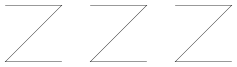
Discuss the symmetry group of the plane which preserves the following pattern, considered to extend to infinity in both directions (the 'ends' of the pattern). Define two particular symmetries \(T\) (a translation to the right by one unit) and \(R\) (a rotation through \(180^{\circ}\) about the mid-point of one of the Z's), and show that: (i) any symmetry which leaves fixed the two ends of the pattern is of the form \(T^r\) with \(r\) a positive or negative integer. (ii) \(R\) interchanges the two ends, and \(R^2\) is the identity. (iii) \(RTR = T^{-1}\). (iv) Any symmetry \(S\) which interchanges the two ends of the pattern is of the form \(T^r R\) for some \(r\). Show also that in case (iv) \(S\) has a single fixed point in the plane, and that \(S^2\) is the identity.
Lady Bracknell is holding a dinner party. She has arranged the six diners around a circular table, with Algernon next to Cecily. It is the custom at Bracknell Hall for those dining to change places several times during the meal, in order to vary the conversation. Let \(G\) be the set of those rearrangements of the six diners after which Algernon and Cecily are still sitting next to each other. (Two rearrangements are to be considered the same if one can be obtained from the other merely by rotating the diners around the table.) Show that \(G\) forms a group, under the operation of performing one rearrangement after another. How many elements does \(G\) have? Now suppose that, in the initial arrangement, Cecily is seated on Algernon's right. Let \(H\) be the set of those elements of \(G\) after which Cecily is still on Algernon's right. Show that whenever \(g\) is an element of \(G\) and \(h\) an element of \(H\), \(ghg^{-1}\) is an element of \(H\).
Let \(G\) be a group of permutations of a finite set \(X\). Define the stabiliser \(H(\alpha)\) of \(\alpha \in X\) by \[H(\alpha) \equiv \{g:g \in G, g\alpha = \alpha\}.\] The orbit of an element \(\alpha \in X\), \(O(\alpha)\), is the set of elements \(y\) in \(X\) such that \(g\alpha = y\) for some permutation \(g \in G\). Prove the following statements:
- [(i)] For any \(\alpha \in X\), \(H(\alpha)\) is a subgroup of \(G\).
- [(ii)] If \(\alpha, \beta \in X\), \(O(\alpha)\) and \(O(\beta)\) either coincide, or they are disjoint.
- [(iii)] \(|O(\alpha)| \cdot |H(\alpha)| = |G|\), where \(|A|\) denotes the number of elements of a set \(A\).
Let \(G\) be the multiplicative group of all non-singular \(3 \times 3\) matrices with elements in the field of order 2 (i.e. integers written modulo 2). Under matrix multiplication \(G\) permutes the seven column vectors \(P_1, \ldots, P_7\) amongst themselves, where the elements of the \(P_i\) are also integers written modulo 2, \[P_1 = \begin{pmatrix} 1 \\ 0 \\ 0 \end{pmatrix}, P_2 = \begin{pmatrix} 0 \\ 1 \\ 0 \end{pmatrix}, P_3 = \begin{pmatrix} 0 \\ 0 \\ 1 \end{pmatrix},\] \(P_4 = P_1 + P_2\), \(P_5 = P_1 + P_3\), \(P_6 = P_2 + P_3\) and \(P_7 = P_1 + P_2 + P_3\). Let \(H = \{X \in G: XP_1 = P_1\}\). Show that \(H\) is a subgroup of \(G\). Determine the general form for an element of \(H\), and hence show that \(H\) has order 24. Let \(T_1\), \(T_2\), \(T_3\) and \(T_4\) be the following unordered triples: \begin{align*} T_1 &= \{P_2, P_3, P_6\},\\ T_2 &= \{P_3, P_5, P_7\},\\ T_3 &= \{P_6, P_4, P_7\},\\ T_4 &= \{P_4, P_5, P_6\}. \end{align*} By considering the action of \(H\) on \(T_1\), \(T_2\), \(T_3\), \(T_4\), or otherwise, show that \(H\) is isomorphic to the symmetric group on four symbols.
\(\,\)
Two transformations in the complex plane are defined by \(Tz = -\frac{1}{z}\), \(Sz = z-1\). Explain the geometrical significance of these transformations. Show that \begin{align*} TST &= STS^{-1}, \\ STSTST &= TSTSTS = I, \end{align*} where \(Iz=z\) is the identical transformation and \(S^{-1}z=z+1\) is the inverse of the transformation \(S\). \(\Delta\) is the region defined by \[ -\frac{1}{2} < x < \frac{1}{2}, \quad y>0, \quad x^2+y^2>1. \] Give a diagram showing the regions into which \(\Delta\) is transformed by the transformations \(TS, ST\).
A point with rectangular Cartesian coordinates \((x_1, x_2)\) in the Euclidean plane is represented by the \(1 \times 2\) matrix or row-vector \(\mathbf{x} = (x_1 \; x_2)\). Interpret the \(1 \times 1\) matrix \(\mathbf{x}\mathbf{x}'\), where \(\mathbf{x}'\) is the transpose of \(\mathbf{x}\). \(T(\mathbf{a}, \mathbf{d})\) denotes the transformation of the plane which sends the point \(\mathbf{x}\) into the point \(\mathbf{x}\mathbf{a} + \mathbf{d}\), where \(\mathbf{a}\) is a non-singular \(2 \times 2\) matrix and \(\mathbf{d}\) is a row-vector. Prove that the set of all such transformations forms a group \(G\). What is (i) the identity element of \(G\), (ii) the inverse of \(T(\mathbf{a}, \mathbf{d})\)? Find a necessary and sufficient condition that the distance between any two points should be equal to the distance between their transforms by \(T(\mathbf{a}, \mathbf{d})\), and prove that such distance-preserving transformations form a subgroup of \(G\).
Show that the set of complex valued \(2 \times 2\) matrices of the form $\begin{pmatrix} z & w\\ -\overline{w} & \overline{z} \end{pmatrix}$ satisfying \(|z|^2+ |w|^2 = 1\) forms a group \(G\) under matrix multiplication. Determine the subsets \(G_2\) consisting of all elements of \(G\) whose square is the identity matrix, and \(G_4\) consisting of all elements of \(G\) whose fourth power is the identity matrix. Do they form subgroups of \(G\)?
Prove that the set of matrices of the type $\begin{pmatrix} 1 & 0 & 0 \\ x & 1 & 0 \\ y & z & 1 \end{pmatrix}$ with \(x, y, z\) real numbers, forms a group \(G\) under matrix multiplication. [You may assume that matrix multiplication is associative.] Does the subset consisting of those matrices where \(x, y, z\) are restricted to be integers form a subgroup of \(G\)? Is there an element \(a\) in \(G\), with \(a\) not equal to the identity matrix, such that \(ab = ba\) for all \(b\) belonging to \(G\)? Justify your answers.
Let \(G\) be the set of all \(2 \times 2\) real matrices of the form \[\begin{pmatrix} 1 & 0 \\ a & h \end{pmatrix}\] with \(h \neq 0\). Let \(A\) and \(H\) respectively be the set of all real matrices of the form \(\begin{pmatrix} 1 & 0 \\ a & 1 \end{pmatrix}\) and the set of all real matrices of the form \(\begin{pmatrix} 1 & 0 \\ 0 & h \end{pmatrix}\) with \(h \neq 0\). Show that \(G\) is a group with respect to matrix multiplication, and that \(A\) and \(H\) are subgroups of \(G\). [You may assume that matrix multiplication is associative.]
- [(i)] Show that every element of \(G\) may be written as a product of an element of \(A\) and an element of \(H\).
- [(ii)] Prove that if \(X \in A\) and \(Y \in G\) then \(Y^{-1}XY \in A\). Prove also that if \(X_1, X_2 \in A\) and neither \(X_1\) nor \(X_2\) is the identity matrix, then there exists a matrix \(Z \in H\) such that \(Z^{-1}X_1Z = X_2\).
Show that the set of real-valued \(2 \times 2\) matrices with determinant \(\pm 1\) forms a group \(G\) under matrix multiplication. Show that the matrix \[\begin{pmatrix} \cos\theta & \sin\theta \\ -\sin\theta & \cos\theta \end{pmatrix}\] is a member of \(G\) and deduce that \(G\) contain subgroups of all finite orders. Are all finite subgroups of \(G\) cyclic?
Let \(G\) be the set of all \(n \times n\) matrices such that each row and each column has one 1 and \((n-1)\) zeros. Assuming that matrix multiplication is associative, prove that \(G\) forms a group under multiplication and that it has \(n!\) elements.
Show that the square of any odd integer is congruent to 1 modulo 8. Let \(R\) be the ring of integers taken modulo 8 and let \(G\) be the group of all \(2 \times 2\) matrices \[\begin{pmatrix} u & x \\ y & v \end{pmatrix}\] with entries in \(R\) such that \(u\) and \(v\) are both odd, \(x\) and \(y\) are both even and \(uv - xy = 1\). Determine the number of elements in \(G\) and the number of elements of order 2 in \(G\). [You need not verify that \(G\) is a group.]
A relation \(R\) between elements \(a\), \(b\), \(\ldots\) of a group \(G\) is defined by the rule ``\(aRb\) if and only if there exists \(g \in G\) such that \(b = gag^{-1}\)''. Show that \(R\) is an equivalence relation. For a fixed element \(a \in G\), a second relation \(S\) between elements \(g\), \(h\), \(\ldots\) of \(G\) is defined by the rule ``\(gSh\) if and only if \(gh^{-1}a = agh^{-1}\)''. Show that \(S\) is also an equivalence relation, and that there is a (1--1) correspondence between the set of equivalence classes under \(R\) and the set of elements in the equivalence class of \(a\) under \(R\).
Two elements \(\alpha\), \(\beta\) of a finite group \(G\) are called conjugate if there exists \(\gamma \in G\) such that \(\alpha = \gamma\beta\gamma^{-1}\) Show that conjugacy defines an equivalence relation. The elements \(a\), \(b\) have associative multiplication with unit \(e\) and satisfy \(a^3 = b^2 = (ab)^2 = e\) The set of six elements \(e\), \(a\), \(a^2\), \(b\), \(ab\), \(a^2b\) are distinct. Show that they form a group and separate them into equivalence classes under conjugacy.
For elements \(a\), \(b\) of a multiplicative group \(G\), the element \(a^{-1}b^{-1}ab\) is written \([a, b]\). Show that if \(a\), \(b\) and \(c\) are in \(G\), then \([a, bc] = [a, c]c^{-1}[a, b]c\). Hence, or otherwise, show that if \([a, b]b = b[a, b]\) then \([a, b^n] = [a, b]^n\) for \(n = 1, 2, 3, ...\). If also \([a, b]a = a[a, b]\), prove, by considering \([a, b]^{-1}\), or otherwise, that \([a^n, b] = [a, b]^n\) for \(n = 1, 2, 3, ...\).
Let \(G\) be the group of symmetries of the equilateral triangle \(ABC\). Express all the symmetries of the triangle under reflection and rotation by the permutations which they induce on the letters \(A\), \(B\), \(C\). Let \(R\) in \(G\) correspond to a rotation of the triangle by \(\frac{2\pi}{3}\), and \(M\) in \(G\) to a reflection of the triangle about an altitude. Show that all elements of \(G\) may be expressed as \(R^i\) or \(R^i M\) for \(i = 0, 1, 2\). Given a subgroup \(H\) of \(G\) and an element \(g\) of \(G\), we define \(gH\) to be the set \(\{gh : h \in H\}\); similarly \(Hg = \{hg : h \in H\}\). \(H\) is then said to be a normal subgroup if \(gH = Hg\) for all \(g\) in \(G\). Show that the subgroup \(\{E, R, R^2\}\), where \(E\) is the identity permutation of \(G\), is normal. Find a subgroup of \(G\) which is not normal, and justify your answer.
Consider the \(2 \times 2\) complex matrices $$A = \begin{pmatrix} i & 0 \\ 0 & -i \end{pmatrix} \quad \text{and} \quad B = \begin{pmatrix} 0 & 1 \\ -1 & 0 \end{pmatrix}.$$ List all the matrices which may be obtained from \(A\) and \(B\) by matrix multiplication, and show that they form a non-commutative group \(G\) of order 8. [You may assume the associativity of matrix multiplication.] By considering the elements in \(G\) whose square is the identity, or otherwise, determine whether \(G\) is isomorphic to the group of symmetries of a square.
Suppose \(H_1\), \(H_2\), \(H_3\) are subgroups of a group \(G\), such that \(H_i \neq G\) \((i = 1, 2, 3)\). Of the following two statements, show that (i) is always false, and find an example where (ii) is false:
- [(i)] Every element of \(G\) is in \(H_1\) or \(H_2\).
- [(ii)] Every element of \(G\) is in \(H_1\), \(H_2\) or \(H_3\).
Which of the following assertions hold for each positive integer \(n\)? Justify your answer with proofs or counter-examples as appropriate.
- [(i)] If \(G\) is a group, the equation \(x^n = e\) has at least one solution in \(G\). [\(e\) denotes the identity element of \(G\).]
- [(ii)] If \(G\) is a group, the equation \(x^n = e\) has at most \(n\) solutions in \(G\).
- [(iii)] There exists a group with exactly \(n\) elements.
- [(iv)] There exist infinitely many groups with exactly \(n\) elements, no two of which are isomorphic.
Elements \(a\), \(b\), \(c\), \(\alpha\), \(\beta\), \(\gamma\) of a group are given, and \(a\), \(b\), \(c\) are all different. No four distinct elements \(x\), \(y\), \(z\), \(t\) from \(\{a, b, c, \alpha, \beta, \gamma\}\) satisfy \(x^{-1}y = z^{-1}t\). Prove that if \[1 \neq \alpha a^{-1} = \beta b^{-1} = \gamma c^{-1}\] then \(ab^{-1}\) has order 3 and \(c = ab^{-1}a = ba^{-1}b\). Give an example of a group in which the above situation obtains and show that it does.
What is the order of the smallest non-commutative group? Prove that there is, up to isomorphism, only one such group of that order. Carefully justify your answers.
If \(y_n = \int_0^X \frac{dx}{(x^3+1)^{n+1}}\), prove that \[ 3n y_n - (3n-1) y_{n-1} = \frac{X}{(X^3+1)^n}. \] Show that \(\int_0^\infty \frac{dx}{x^3+1} = \frac{2\pi}{3\sqrt{3}}\) and hence deduce the value of \(\int_0^\infty \frac{dx}{(x^3+1)^{n+1}}\) for positive integer values of \(n\).
Obtain a reduction formula for \[ u_n = \int_0^{\pi/2} \sin^n x \, dx. \] Prove that, for any positive integer \(n\), \[ n u_n u_{n-1} = \tfrac{1}{2}\pi, \] \[ 0 < u_n < u_{n-1}. \] Hence, or otherwise, prove that \[ n u_n^2 \to \tfrac{1}{2}\pi \quad \text{as} \quad n \to \infty. \]
If \(Q=ax^2+2bx+c\), and \[ I_n = \int \frac{dx}{Q^{n+1}}, \] show by differentiating \((Ax+B)/Q^n\) (where \(A, B\) are adjustable constants), or otherwise, that \[ 2n(ac-b^2)I_n = \frac{ax+b}{Q^n} + (2n-1)aI_{n-1}. \] Obtain a similar formula of reduction for \[ J_n = \int \frac{x\,dx}{Q^{n+1}}. \] Evaluate \[ \int_0^1 \frac{dx}{(x^2-x+1)^3}. \]
If \[ I_n = \int_\alpha^\beta \frac{x^n \,dx}{\sqrt{\{(\beta-x)(x-\alpha)\}}}, \] where \(\beta > \alpha, n \ge 0\), show that \begin{align*} 2I_1 &= (\alpha+\beta)I_0, \\ 2nI_n &= (2n-1)(\alpha+\beta)I_{n-1} - 2(n-1)\alpha\beta I_{n-2}, \quad (n \ge 2). \end{align*} Evaluate \[ \int_{-1}^2 \frac{x^3 \,dx}{\sqrt{\{2+x-x^2\}}}. \]
Prove the formula \[ \frac{1}{(x^2+1)^n} = \frac{1}{2n-2}\frac{d}{dx}\left(\frac{x}{(x^2+1)^{n-1}}\right) + \frac{2n-3}{2n-2}\frac{1}{(x^2+1)^{n-1}} \] for \(n \ge 2\), and hence obtain a recurrence relation for the indefinite integral \[ I_n = \int \frac{dt}{(1+t^2)^n}. \] Evaluate \[ \int_0^1 \frac{dt}{(1+t^2)^3}. \]
If \(n\) is a positive integer and \[ S_n = \int_0^{\pi/2} \sin^n\theta\,d\theta, \] find \(S_{2n+2}/S_{2n}\) and hence evaluate \(S_n\). Prove the inequalities \[ S_{2n} > S_{2n+1} > S_{2n+2}, \] and hence show that \[ \frac{2^2 \cdot 4^2 \dots (2n)^2(2n+2)}{1^2 \cdot 3^2 \dots (2n+1)^2} > \frac{\pi}{2} > \frac{2^2 \cdot 4^2 \dots (2n)^2}{1^2 \cdot 3^2 \dots (2n-1)^2(2n+1)}. \]
Obtain a reduction formula connecting the integrals \[ \int \frac{x^m \, dx}{(1+x^2)^n} \quad \text{and} \quad \int \frac{x^{m-2} \, dx}{(1+x^2)^{n-1}}. \] Prove that the value of the integral \[ \int_0^\infty \frac{x^{2k} \, dx}{(1+x^2)^{k+1}} \] decreases as the positive integer \(k\) increases. Determine the smallest (integer) value of \(k\) which makes the value of the integral less than 0.4.
If \(F(m, n) = \int_1^\infty (x-1)^m x^{-n} dx\), where \(m\) and \(n\) are positive integers satisfying \(n > m+2\), find relations between \(F(m, n-1)\) and \(F(m,n)\), and between \(F(m-1, n)\) and \(F(m, n)\). Hence find the value of \(F(m, n)\).
Obtain a recurrence relation between integrals of the type \[ I_n = \int x^n e^{ax} \cosh bx \, dx. \]
Prove that if \[ I_{p,q} = \int_0^{\pi/2} \sin^p\theta \cos^q\theta \,d\theta, \] where \(p>1, q>1\), then \[ (p+q)I_{p,q} = (p-1)I_{p-2,q}, \] and find the corresponding reduction formula involving \(I_{p,q-2}\). If the function \(\Gamma(n)\) is defined to have the following properties \[ \Gamma(n+1)=n\Gamma(n), \quad \Gamma(1)=1, \quad \text{and} \quad \Gamma(\tfrac{1}{2})=\sqrt{\pi}, \] verify that for all positive integral values of \(p\) and \(q\) greater than unity \[ I_{p,q} = \Gamma\left(\frac{p+1}{2}\right)\Gamma\left(\frac{q+1}{2}\right) / 2\Gamma\left(\frac{p+q+2}{2}\right). \]
If \[ I(p,q) = \int_0^{\log(1+\sqrt{2})} \sinh^p x \cosh^q x \, dx, \] where \(p>1\), prove that \[ (p+q)I(p,q) = 2^{\frac{q-1}{2}} + (q-1)I(p,q-2) = 2^{\frac{q+1}{2}} - (p-1)I(p-2,q). \]
If for \(q>1\), \(I(p,q)\) denote \(\int_0^\pi e^{px}\sin^q x \,dx\), derive the reduction formula \[ (p^2+q^2)I(p,q) = q(q-1)I(p, q-2). \] Hence show that for a positive even integral value of \(q\), \[ I(p,q) = q!(e^{p\pi}-1)/p \cdot (p^2+4)(p^2+16)\dots(p^2+q^2). \] Find the corresponding result when \(q\) is an odd integer greater than unity.
If \(y = \log_e \{x + \sqrt{(1 + x^2)}\}\), prove that \[ (1 + x^2) \frac{d^2y}{dx^2} + x \frac{dy}{dx} = 0. \] Prove, by induction or otherwise, that \[ (1+x^2) \frac{d^ny}{dx^n} + (2n - 3) x \frac{d^{n-1}y}{dx^{n-1}} + (n-2)^2 \frac{d^{n-2}y}{dx^{n-2}} = 0. \] Hence obtain the series expansion of \(y\) in ascending powers of \(x\).
If \[ I_{p,q} = \int_0^\pi \sin^p x \cos^q x \, dx \] shew that \[ (p+q)I_{p,q} = \begin{cases} (q-1)I_{p,q-2} & (q \ge 2) \\ (p-1)I_{p-2,q} & (p \ge 2) \end{cases}, \] and evaluate \(I_{\alpha-1,5}\) where \(\alpha\) is any positive real number.
Find a reduction formula for \[ I_n = \int \frac{dx}{(5+4\cos x)^n} \] in terms of \(I_{n-1}\) and \(I_{n-2}\) (\(n \ge 2\)), and use it to show that \[ \int_0^{2\pi/3} \frac{dx}{(5+4\cos x)^2} = \frac{1}{81}(5\pi-6\sqrt{3}). \]
Obtain a relation between \(I_{n-1}\) and \(I_{n+1}\) (\(n>0\)), where \[ I_n = \int_0^x \frac{t^n}{1+t^2} dt. \] Prove that, for any fixed \(x\) in the range \(-1 < x \le 1\), \(I_n \to 0\) as \(n \to \infty\). Deduce an expansion of (i) \(\tan^{-1} x\), (ii) \(\log (1+x^2)\), in ascending powers of \(x\), valid for \(-1 \le x \le 1\).
If \(I_n = \int_0^\infty x^n e^{-ax}\cos bx \, dx\), \(J_n = \int_0^\infty x^n e^{-ax}\sin bx \, dx\), where \(n\) is a positive integer and \(a\) and \(b\) are positive, prove that: \begin{align*} I_n(a^2+b^2) &= n(aI_{n-1}-bJ_{n-1}), \\ J_n(a^2+b^2) &= n(bI_{n-1}+aJ_{n-1}). \end{align*} Show that \begin{align*} (a^2+b^2)^{\frac{n+1}{2}} I_n &= n! \cos(n+1)\alpha, \\ (a^2+b^2)^{\frac{n+1}{2}} J_n &= n! \sin(n+1)\alpha, \end{align*} where \(\tan\alpha = \frac{b}{a}\) and \(0 < \alpha < \frac{\pi}{2}\).
If \(m\) and \(n\) are positive integers greater than unity, prove that \[ I_{m,n} = \int_0^{\pi/2} \cos^m x \cos nx dx = \frac{m}{m-n}I_{m-1, n-1} = \frac{m}{m+n}I_{m-1, n-1}. \] Hence show, if \(p\) and \(q\) are positive integers, that \[ \int_0^{\pi/2} \cos^{p+q} x \cos(p-q)x dx = \pi(p+q)!/2^{p+q+1}p!q!. \]
Prove that, if \[ u_n = \int_{-a}^a (a^2-x^2)^n \cos bx \,dx, \] \[ b^2 u_{n+2} - 2(n+2)(2n+3)u_{n+1} + 4(n+1)(n+2)a^2 u_n = 0, \] where \(n\) may be assumed to be positive.
Give an account of methods by which the \(n\)th differential coefficient of certain functions can be found, giving illustrations. Prove that the method of partial fractions enables us to find the \(n\)th differential coefficient of any rational algebraic fraction. Find the \(n\)th differential coefficients of \[ \text{(i) } e^{ax}\cos bx, \quad \text{(ii) } (2+x)^2/(1-x^3). \] Prove that, if \(\sin^{-1}y = a+b\sin^{-1}x\), the values when \(x=0\) of the successive differential coefficients of \(y\) satisfy \[ \frac{d^{n+2}y}{dx^{n+2}} = (n^2-b^2)\frac{d^ny}{dx^n}. \]
Perform the following integrations: \[ \int \frac{e^{\sin^{-1} x}}{\sqrt{1-x^2}} dx, \quad \int \sqrt{\frac{e^x+a}{e^x-a}} dx, \quad \int \cosh mx \sin nx dx. \]
Obtain an equation connecting the integrals \[ \int \frac{x^m dx}{(1+x^2)^n} \quad \text{and} \quad \int \frac{x^{m-2}dx}{(1+x^2)^{n-1}}. \] Prove that the value of the integral \[ \int_0^\infty \frac{x^{2k}dx}{(1+x^2)^{k+1}} \] decreases as the positive integer \(k\) increases, and find the smallest value of \(k\) which makes the value of the integral less than \(0 \cdot 4\).
(i) Evaluate \[ \int_1^e \left(\log \frac{e}{x}\right)^2 dx, \quad \int_0^\pi \frac{dx}{a+b\cos x}, \quad (a>|b|). \] (ii) If \[ I_n = \int_0^\pi \frac{\sin^2 nx}{\sin^2 x} dx, \] where \(n\) is a positive integer, shew that \(I_n - I_{n-1} = I_{n-1} - I_{n-2}\), and hence evaluate \(I_n\).
Determine \(A, B, C\) and \(D\) such that \[ \frac{x^2}{(x^2+1)^4} = \frac{d}{dx} \frac{Ax^5+Bx^3+Cx}{(x^2+1)^3} + \frac{D}{x^2+1}, \] and shew that \[ \int_0^1 \frac{x^2}{(x^2+1)^4}dx = \frac{1}{48} + \frac{\pi}{64}. \]
The function \(f_n(x)\) is defined to be \[ \frac{d^n}{dx^n}\{(x^2-1)^n\}. \] Shew by integration by parts, or otherwise, that \[ \int_{-1}^1 x^m f_n(x) dx = 0, \] if \(m\) is an integer less than \(n\), and is equal to \[ \frac{2^{2n+1}(n!)^3}{(2n+1)!} \] if \(m=n\). Shew that, if \(\phi(x)\) is a polynomial of degree less than \(n\), \[ \int_{-1}^1 \phi(x) f_n(x) dx = 0, \] and by using this last result, or otherwise, prove that \(f_n(x)\) has exactly \(n\) zeros in the range \(-1 \le x \le 1\).
Let \begin{equation*} L_n = \int_{0}^{\pi} \sin^n \theta\, d\theta. \end{equation*} Show that \(L_{2m-1} > L_{2m} > L_{2m+1}\). Establish a recurrence relation between \(L_{n+2}\) and \(L_n\), and by solving this (for a value \(p_m\) and for \(n\) odd) show that \begin{equation*} \frac{2m+1}{2m}p_m > \frac{\pi}{2} > p_m, \end{equation*} where \begin{equation*} p_m = \frac{(2m)^2(2m-2)^2\ldots 2^2}{(2m+1)(2m-1)^2\ldots 3^2\cdot 1^2}. \end{equation*}
If $$I_n = \int_0^{\pi/2} \cos^n \theta \, d\theta,$$ find a recurrence relation for \(I_n\) and deduce that $$I_n I_{n-1} = \frac{\pi}{2n}$$ for all integers \(n > 1\).
Let \(\displaystyle I_n = \int_0^{\pi/2} \sin^n\theta\, d\theta, \quad n\) an integer. Show that:
- [(i)] \(I_{2n-1} > I_{2n} > I_{2n+1}\), for all \(n \geq 1\).
- [(ii)] \(nI_n = (n-1)I_{n-2}\), \quad for all \(n \geq 2\).
- [(iii)] \(\displaystyle I_{2n} = \frac{(2n-1)(2n-3)\ldots 1}{2n\cdot(2n-2)\ldots 2}\frac{\pi}{2}\) for \(n \geq 1\). \(\displaystyle I_{2n+1}= \frac{2n\cdot(2n-2)\ldots 2}{(2n+1)(2n-1)\ldots 3}\) for \(n \geq 1\).
The region \(A_n\) of the \((x,y)\)-plane is bounded by the portions of the curves \(y = 0\) and \(y = \sin^n x\) given by \(0 \leq x \leq \pi\), where \(n\) is a positive integer. Show that, if \(n > 2\), the area \(a_n\) of \(A_n\) satisfies \[na_n = (n-1)a_{n-2},\] and hence find \(a_n\) for all \(n \geq 1\). Deduce that \(a_{2n}/a_{2n+1} \to 1\) as \(n \to \infty\), and hence show that \[\frac{2}{2n+1} \frac{2^{4n}(n!)^4}{[(2n)!]^2} \to \pi \quad \text{as} \quad n \to \infty.\]
Evaluate the integral $$I_n = \int_0^{\pi/2} \sin^n x \, dx$$ by using a reduction formula. By comparing the integrals \(I_{2n}\), \(I_{2n+1}\) and \(I_{2n+2}\), or otherwise, show that $$\frac{4}{3} \cdot \frac{16}{15} \cdots \frac{4n^2}{4n^2 - 1} \to \frac{\pi}{2} \quad \text{as} \quad n \to \infty.$$
Let $$S_r = \int_0^{\pi/2} \sin^r\theta \, d\theta \quad (r \geq 0),$$ $$P_r = rS_rS_{r-1} \quad (r \geq 1),$$ where \(r\) is not necessarily an integer. Prove that
- [(i)] \(P_r = P_{r+1}\) (\(r \geq 1\));
- [(ii)] \(P_1 = \frac{1}{2}\pi\);
- [(iii)] \(P_r/r\) decreases as \(r\) increases (\(r \geq 1\)).
- [(iv)] \(\frac{r\pi}{k+1} < P_r < \frac{r\pi}{k}\) (\(1 \leq k \leq r < k+1\); \(k\) an integer);
- [(v)] \(P_r = \frac{1}{2}\pi\) for all \(r \geq 1\);
If $$I_m = \int_0^{1\pi} \sin^m x dx,$$ evaluate \(I_m\) for all positive integers \(m\). Prove that \(I_{2n-2} < I_{2n-1} < I_{2n}\), and deduce that $$\frac{2.4.6...2n}{1.3.5...(2n-1)} \cdot \frac{1}{\sqrt{n}}$$ tends to the limit \(\sqrt{\pi}\) as \(n\) tends to infinity.
Evaluate \(\int_0^\pi \sin^m x dx\) in the cases where \(m\) is an odd or an even positive integer. Show that \(M/n > \pi > M/(n+\frac{1}{4})\), where \(n\) is a positive integer and \[ M = \left\{ \frac{2^{2n}(n!)^2}{(2n)!} \right\}^2. \]
Find a reduction formula for \(\int_0^{\pi/4} \tan^n x \,dx\). Prove that \(\lim_{n \to \infty} \int_0^{\pi/4} \tan^n x \,dx\) exists and is equal to zero.
If \[ I_{m,n} = \int \frac{\sec^m x}{\tan^n x} dx, \] where \(m\) and \(n\) are positive integers and \(n > 1\), prove that \[ (n-1) I_{m,n} = (m-2) I_{m-2, n-2} - \frac{\sec^{m-2} x}{\tan^{n-1} x}. \] Hence evaluate \[ \int_{\frac{\pi}{4}}^{\frac{\pi}{3}} \frac{\sec^5 x}{\tan^4 x} dx. \]
(i) If \(I_n\) denote \(\int_0^{2\pi} \frac{\cos(n-1)x - \cos nx}{1-\cos x} dx\), show that \(I_n\) is independent of \(n\), where \(n\) is a positive integer. Hence evaluate \(I_n\) and prove that \[ \int_0^{2\pi} \left( \frac{\sin nx}{\sin x} \right)^2 dn = 2n\pi. \] (ii) Evaluate \(\int_0^\infty \frac{dx}{(1+x^2)^n}\), where \(n\) is a positive integer.
Evaluate \(\displaystyle\int \frac{xdx}{\sqrt{(5+2x+x^2)}}\), \(\displaystyle\int_0^1 x^2 \tan^{-1} x dx\), \(\displaystyle\int_0^{\frac{1}{2}\pi} \sin^6 x dx\).
Shew that if \[ I_n = \int_0^\infty \frac{dx}{(1+x^2)^n}, \] where \(n\) is a positive integer, then \[ I_{n+1} = \frac{n-\frac{1}{2}}{n} I_n; \] and hence find a general formula for \(I_n\).
If \(n\) is a positive integer, and \[ I_n = \int_0^\infty \frac{dx}{(1+x^2)^n}, \] find a reduction formula for \(I_n\) in terms of \(I_{n-1}\) and elementary functions. Prove that \[ \int_{-\infty}^\infty \frac{dx}{(1+x^2)^{n+1}} = \frac{1 \cdot 3 \dots (2n-1)}{2 \cdot 4 \dots 2n}\pi. \]
Establish a reduction formula for the integral \[ \int_0^\infty \frac{dx}{(1+x^2)^n},\] and hence evaluate \[ \int_0^\infty \frac{dx}{(1+x^2)^n}\] for any positive integral \(n\).
Find formulae of reduction for \[ \int \frac{x^n dx}{\sqrt{(ax^2 + 2bx + c)}}, \quad \int_0^\infty \frac{dx}{(x^2 + a^2)^n}, \] and evaluate the latter integral when \(n = 3\) and when \(n=5/2\).
Prove that, if \(u_n = \int_0^\pi \frac{dx}{(a+b\cos x+c\sin x)^n}\), then for integral values of \(n\) \[ (n-1)(a^2-b^2-c^2)u_n - (2n-3)au_{n-1} + (n-2)u_{n-2} + c\left\{\frac{1}{(a-b)^{n-1}} + \frac{1}{(a+b)^{n-1}}\right\} = 0. \] Obtain the values of \(u_1\) and \(u_2\) when \(a^2>b^2+c^2\), \(a\) being supposed positive.
If \[ I_m = \int_0^{\pi/2} \cos^m x \,dx, \] evaluate \(I_{2n}\) and \(I_{2n+1}\) for all non-negative integers \(n\). Prove that \(I_{2n+2} < I_{2n+1} < I_{2n}\), and deduce that \[ \frac{2.4.6.\dots.2n}{1.3.5.\dots.(2n-1)}\frac{1}{\sqrt{n}} \] tends to the limit \(\sqrt{\pi}\) as \(n\) tends to infinity.
Prove the rule for forming the convergents to the continued fraction \[ a_1 + \frac{1}{a_2 +} \frac{1}{a_3 +} \dots, \] and prove that these convergents are fractions in their lowest terms. \par Prove that, if \(p/q\) is the fraction in its lowest terms, which is equal to \[ a_1 + \frac{1}{a_2 +} \frac{1}{a_3 +} \dots + \frac{1}{a_n +} \frac{1}{a_{n-1} +} \dots + \frac{1}{a_2 +} \frac{1}{a_1}, \] then \((q^2+1)/p\) is an integer when \(a_1, a_2, \dots a_n\) are all integers.
Integrate \[ \int \frac{dx}{\sin^3 x}, \quad \int \frac{dx}{1+e\cos x} \quad (e<1). \] Find a reduction formula for \(\int (x^2+a^2)^n dx\), and evaluate \(\int_0^1 (x^2+4)^{\frac{5}{2}} dx\).
Shew that if \(m\) and \(n\) are integers \[ \int_0^{\frac{\pi}{2}} \sin^n\theta \cos^m\theta d\theta \] is decreased when either \(m\) or \(n\) is increased. Hence shew that \[ \frac{(n!)^2 2^{2n}}{(2n+1)(2n-1)^2 \dots 3^2} < \frac{\pi}{2} < \frac{(n+1)(n!)^2 2^{2n+1}}{(2n+1)^2 \dots 3^2}. \]
Shew that \[ \int_0^{\frac{\pi}{4}} \sec^3 x dx = \frac{1}{2}\sqrt{2} + \frac{1}{2}\log(1+\sqrt{2}). \] Evaluate \[ \int_0^1 \frac{dx}{(1+x)^2(2x+1)}. \]
Integrate \[ (1+x^2)^{\frac{3}{2}}, \quad \frac{1-\tan x}{1+\tan x}. \] Prove that, if \(n\) is a positive integer, \[ \int_{-\infty}^{\infty} \frac{dx}{(1+x^2)^{n+1}} = \frac{1 \cdot 3 \dots (2n-1)}{2 \cdot 4 \dots 2n} \pi. \]
Prove that \[ \int_0^\pi \frac{\sin n\theta}{\sin\theta} d\theta = 0 \text{ or } \pi, \text{ according as } n \text{ is an even or odd positive integer.} \] Evaluate \(\displaystyle\int_0^\pi \frac{\sin^2 n\theta}{\sin^2\theta} d\theta\), where \(n\) is a positive integer.
Shew that if \[ I_m = \int_0^\infty e^{-x}\sin^m x dx \] and \(m\ge 2\), then \[ (1+m^2)I_m = m(m-1)I_{m-2}; \] and hence evaluate \(I_4\).
Let \(I(m, n) = \int_{0}^{\frac{1}{2}\pi} \cos^m x \sin^n x\, dx\). Using integration by parts, or otherwise, show that \begin{equation*} I(m, n) = \frac{n-1}{m+n}I(m, n-2) \end{equation*} if \(m \geq 0\), \(n \geq 2\). Let \begin{equation*} C = \int_{0}^{\frac{1}{2}\pi} \frac{\cos^2 x}{\cos x + \sin x}\, dx, \quad S = \int_{0}^{\frac{1}{2}\pi} \frac{\sin^2 x}{\cos x + \sin x}\, dx. \end{equation*} By considering \(C+S\), or otherwise, show that \begin{equation*} C = \frac{1}{32}(7\pi - 8). \end{equation*}
- [(i)] Let \(\displaystyle I_n = \int_0^{\infty} x^n e^{-x^2}dx\). Obtain formulae for \(I_n\) in terms of \(I_0\) or \(I_1\), according to whether \(n\) is even or odd, and evaluate \(I_1\).
- [(ii)] Evaluate \[\int_1^{\infty} \frac{dx}{x[1+(\log x)^2]}.\]
The function \(B(x, y)\) is defined by the equation, \[B(x, y) = \int_0^1 t^{x-1} (1-t)^{y-1} dt,\] for positive \(x\) and \(y\). Show that
- [(i)] \(B(x, y) = B(y, x)\),
- [(ii)] \(B(x, y) = B(x+1, y) + B(x, y+1)\),
- [(iii)] \(xB(x, y+1) = yB(x+1, y)\).
Show that the integral \[I_n = \int_{-\infty}^{+\infty} x^{2n}e^{-x^2}dx\] (where \(n\) is a positive integer) obeys the recurrence relation \[I_{n+1} = (n + \tfrac{1}{2})I_n\] By expanding \(\cos ax\) as a power series in \(x\), or otherwise, show that \[\int_{-\infty}^{+\infty} e^{-x^2}\cos ax \, dx = \pi^{1/2}e^{-a^2/4}.\] [You may assume that you may integrate the infinite series term by term.]
If \(I(a, b)\) is defined, for all pairs of positive real numbers \(a\), \(b\), by \[I(a, b) = \int_0^{\infty} \frac{x^{a-1}}{(1+x)^{a+b}} dx,\] show, by substituting for \(x\) or otherwise, that \(I(a, b) = I(b, a)\). Prove also that \[I(a+1, b) = \frac{a}{a+b} I(a, b) \text{ and } I(a, b+1) = \frac{b}{a+b} I(a, b).\]
Find:
- [(i)] \(\int \frac{1}{1 + x^2 + x^4} dx\);
- [(ii)] \(\int \left(\frac{1}{x^5}\right)^{1/4} dx\).
Obtain a recurrence relation connecting \(F(p)\) and \(F(p+1)\), where \(F(p) = \int_0^1 x^p (1-x)^{-1/4} dx,\) Hence, or otherwise, evaluate \(F(2)\) and \(F(\frac{3}{2})\).
If \[ I_{m,n} = \int_0^1 t^n (1-t)^m \, dt \quad (m > -1, n > -1) \] show that \[ (m+1)I_{m,n+1} = (n+1)I_{m+1,n}. \] Explain why the restrictions on the values of \(m\) and \(n\) are necessary. If \(n\) is a positive integer, show that
- [(i)] \(\displaystyle I_{m,n} = \frac{n!}{(m+1)(m+2)\dots(m+n+1)}\),
- [(ii)] \(\displaystyle I_{m,n-\frac{1}{2}} = I_{m,n} + \sum_{r=1}^{k-1} \frac{1 \cdot 3 \cdot 5 \dots (2r-1)}{2^r r!} I_{m+r,n} + R_k\) where \(0 < R_k < \frac{1 \cdot 3 \cdot 5 \dots (2k-1)}{2^k k!} I_{m+k,n-1}\);
- [(iii)] \(\displaystyle \operatorname*{Lt}_{n\to\infty} n\left(\frac{I_{m,n-\frac{1}{2}}}{I_{m,n}} - 1\right) = \frac{1}{2}(m+1)\).
Prove that, if \(F(x)\) is a polynomial of degree \(r\), \(n\) an integer greater than \(r\), and \(c>b>a\), then \[ \int_a^b \frac{F(x)\,dx}{(x-c)^{n+1}} = -\frac{1}{n!} \frac{d^n}{dc^n} \left\{ F(c) \log \frac{c-a}{c-b} \right\}. \]
If \(B(p,q) = \int_0^1 x^{p-1} (1-x)^{q-1} dx\) for \(p>0, q>0\), prove that \begin{align*} B(p,q) &= B(p+1,q) + B(p,q+1), \\ B(p,q) &= B(q,p). \end{align*} Prove that, if \(p\) and \(q\) are integers, \[ B(p,q) = \frac{(p-1)!(q-1)!}{(p+q-1)!}. \]
If \[ I_n = \int_0^{\frac{1}{2}\pi} (a^2 \cos^2\theta + b^2 \sin^2\theta)^n d\theta, \] where \(a\) and \(b\) are positive and \(n\) is real, prove by a transformation of the type \(\tan\theta = \lambda \tan\phi\), or otherwise, that \[ I_n = (ab)^{2n+1} I_{-n-1}. \] Hence, or otherwise, evaluate \[ \int_0^{\frac{1}{2}\pi} \frac{\cos^2\theta}{(1+\sin^2\theta)^3} d\theta. \]
Establish a formula of reduction for the integral \[ u_n = \int x^n (1+x^2)^{-\frac{1}{2}}dx. \]
If \[ I_p = \int_{-1}^1 (1-t^p)^p dt, \] prove that \[ I_p = \frac{2p}{2p+1}I_{p-1} \quad (p>0). \] Shew that, if \(n\) is a positive integer, \[ I_n I_{n+\frac{1}{2}} = \frac{\pi}{n+1}, \] and deduce that \[ \frac{\pi}{n+1} < I_n^2 < \frac{\pi}{n}. \]
Find a formula of reduction for \(\int x^m (\log x)^n dx\) and evaluate the integral between the limits 0, 1 when \(m \ge 0\) and \(n\) is a positive integer. Hence or otherwise find a formula of reduction for \(\int \theta^n \cos m\theta.d\theta\).
Evaluate \(\int_0^1 t^{\alpha-1}(1-t)^\beta dt\), where \(\alpha>0\). If \(S\) be the area bounded by the curve \[ \left(\frac{x}{a}\right)^{2/p} + \left(\frac{y}{b}\right)^{2/q} = 1, \text{ where } p \text{ and } q \text{ are positive integers,} \] show that \[ 4ab-S < \frac{2ab}{p}.\]
Integrate: \[ \int_{-1}^1 \frac{x+1}{(x+3)(\sqrt{x+2})} dx, \quad \int_0^1 \frac{x^3+4x^2+x-1}{(x^2+1)(x+1)^2} dx, \quad \int \sin^{-1}x.dx. \] By reduction formula or otherwise, find an expression for \(\int x^n e^x.dx\).
If \(B(p,q) = \int_0^1 x^{p-1}(1-x)^{q-1}\,dx\) for \(p>0, q>0\), show that \[ B(p,q) = B(p+1, q) + B(p, q+1), \] and \[ B(p,q) = B(q,p). \] Hence show by induction that \[ B(p,q) = \frac{(p-1)!(q-1)!}{(p+q-1)!}, \] if \(p\) and \(q\) are integers.
State and prove the formula for integration by parts, and shew that \[ \int_0^1 x^n(1-x)^m dx = \frac{m!n!}{(m+n+1)!}. \]
Find a reduction formula for \(f(m,n) = \int_0^1 x^{n-1}(1-x)^{m-1}dx\) and shew that \[ f(m,n) = \frac{(m-1)!}{n(n+1)\dots(n+m-1)}, \] \(m\) and \(n\) being positive integers. Shew further that if \(I(n) = \int_0^\infty e^{-x} x^{n-1}dx\), then (i) \(I(n+1) = n.I(n)\), (ii) \(f(m,n) = \frac{I(n).I(m)}{I(m+n)}\).
In the continued fraction \(\displaystyle\frac{1}{a_1+}\frac{1}{a_2+}\dots\), the \(n\)th convergent is denoted by \(p_n/q_n\). Prove that
- [(1)] \(p_{n-1}q_n-q_{n-1}p_n=(-1)^n\),
- [(2)] \(\displaystyle\frac{p_n}{q_n} = \frac{1}{q_1} - \frac{1}{q_1q_2} + \frac{1}{q_2q_3} - \dots\) to \(n\) terms,
- [(3)] \(p_{n-1}+q_n\) is not altered, if the numbers \(a_1, a_2, \dots, a_n\) are permuted cyclically.
If \[ f(p,q) = \int_0^{\pi/2} \cos^p x \cos qx dx, \quad (p>0), \] shew that \[ \left(1-\frac{q}{p}\right)f(p-1,q+1) = f(p,q) = \left(1+\frac{q}{p}\right)f(p-1,q-1). \]
Obtain a reduction formula for \(\int \frac{P}{Q^n}dx\) where \(P\) and \(Q\) are given polynomials in \(x\), the latter having no repeated factors. It may be assumed that \(P\) is prime to and of lower degree than \(Q\). Examine whether \(\int \frac{x^3-2x}{(x^6+3x^2+1)^3}dx\) is rational or not, and evaluate it as far as you can.
For any integer \(n\), define \(I_n = \int_0^{\pi/2} \frac{\cos nx - 1}{\sin x} dx\). By considering \(I_n - I_{n-2}\), or otherwise, evaluate \(I_3\) and \(I_4\).
Let \(I_n = \int_0^{\pi/4} \tan^n\theta d\theta\). Obtain an expression for \(I_n\) in terms of \(I_{n-2}\), and hence evaluate \(I_4\) and \(I_5\). Show that for all \(n \geq 1\), \(0 \leq I_{4n} \leq \frac{1}{4}n - \frac{3}{8}\), and \(0 \leq I_{4n-2} \leq 1- \frac{1}{4}n\).
Let \begin{align*} I_n = \int_0^{\pi/4} \tan^n x dx. \end{align*} (i) Show that for \(n \geq 2\) \begin{align*} I_n = \frac{1}{n-1}I_{n-2} \end{align*} (ii) Show that \(\tan x \leq \frac{4x}{\pi}\) for \(0 \leq x \leq \pi/4\), and hence show that \(I_n \to 0\) as \(n\to\infty\). (iii) Hence show that \begin{align*} \sum_{n=1}^{\infty} \frac{(-1)^{n-1}}{2n-1} = \frac{\pi}{4} \text{ (Gregory's series)} \end{align*} and \begin{align*} \sum_{n=1}^{\infty} \frac{(-1)^{n-1}}{2n} = \frac{1}{2}\log_e 2. \end{align*}
Evaluate $$\int_0^{\pi} \frac{d\theta}{a^2-2a\cos\theta+1} \quad (a \neq 1).$$ A sequence of integrals is defined for \(n = 0, 1, 2, ...\) and \(a > 1\), by $$I_n(a) = \int_0^{\pi} \frac{\cos n\theta d\theta}{a^2-2a\cos\theta+1}.$$ Prove that, for \(n > 1\), $$(a^2+1)I_n = a(I_{n+1}+I_{n-1})$$ and obtain an analogous expression for the case \(n = 0\). Hence show that $$I_n = \frac{\pi}{a^n(a^2-1)}.$$
Obtain a reduction formula for \[I_n = \int x^n \cos rx\,dx \quad (r \neq 0).\] If \[u_n = \int_0^{1\pi} x^n \sin^2 x\,dx,\] prove that, for \(n \geq 2\), \[u_n = \frac{(\tfrac{1}{2}\pi)^{n+1}}{2n+2} + \frac{n(\tfrac{1}{2}\pi)^{n-1}}{4} - \tfrac{1}{4}n(n-1)u_{n-2}.\]
Let $$J_m = \int_0^{\pi} \sin^m \theta \sin(n(\pi - \theta)) d\theta,$$ where \(m\) is a non-negative integer, and \(n\) is not an integer. Obtain a reduction formula connecting \(J_m\) and \(J_{m-2}\), and deduce the expansion $$\cos nx = 1 - \frac{n^2}{2!} \sin^2 x - \frac{n^2(2^2 - n^2)}{4!} \sin^4 x - \frac{n^2(2^2 - n^2)(4^2 - n^2)}{6!} \sin^4 x - \cdots$$ [It may be assumed that $$\frac{(2^2 - n^2)(4^2 - n^2) \cdots (4m^2 - n^2)}{(2m)!} J_{2m} \to 0 \text{ as } m \to \infty.]$$
Integrate \[ \frac{1}{(6x^2-7x+2)\sqrt{(x^2+x+1)}}, \quad \frac{1}{(a+b\tan\theta)^2}. \] Prove that, if \(m\) is a number not less than 2, and \(n\) is a positive integer, \[ \int_0^{\frac{1}{2}\pi} \sin^m x \cos 2nx dx = k_{m,n} \int_0^{\frac{1}{2}\pi} \sin^{m-2}x \cos 2nx dx, \] evaluating the number \(k_{m,n}\). Find the value of \[ \int_0^{\frac{1}{2}\pi} \sin^8 x \cos 2nx dx. \]
If \[ I_{m,n} = \int_0^\pi \sin^m x \sin nx dx, \] obtain a relation between \(I_{m,n}\) and \(I_{m-2,n}\) for \(m \ge 2\). Hence evaluate \(I_{4,5}\).
Obtain a recurrence relation between integrals of the type \[ \int x \sec^n x \,dx. \] Evaluate \[ \int_0^{\pi/4} x \sec^4 x \,dx. \]
Obtain a formula of reduction for \(\int \frac{\sin^m\theta}{\cos^n\theta}d\theta\), where \(m\) and \(n\) are positive and greater than 2. \par Shew that \[ \int_0^{\pi/4} \frac{\sin^6\theta}{\cos^8\theta}d\theta = \frac{5\pi}{8} - \frac{23}{12}, \] and evaluate \[ \int_0^{\pi/4} \frac{\sin^8\theta}{\cos^5\theta}d\theta. \]
If \[ I_{m, n} = \int \cos^m x \cos nx dx, \] prove that \[ (m+n) I_{m,n} = \cos^m x \sin nx + m I_{m-1, n-1}. \] Find \[ \int_0^{\pi/2} \cos^m x \cos nx dx, \] when \(m\) and \(n\) are integers such that \(0 < m < n\).
Find a formula of reduction for the integral \[ \int\sin^m\theta\cos^n\theta\,d\theta \] when \(n\) is an odd positive integer. Find the indefinite integrals \[ \int \left(1-\frac{a}{x^2}\right)^{1/2}\,dx, \quad \int (x^2+x+1)^{-3/2}\,dx. \]
Determine the following:
- [(i)] \(\dfrac{d}{dx} \{(\log x)^{\log x}\}\),
- [(ii)] \(\dfrac{d^n}{dx^n} (x^2 \cos^2 x)\),
- [(iii)] \(\displaystyle\int \frac{dx}{(x-1)\sqrt{(x^2+x-2)}}\).
Evaluate \(\int \sin^m\theta \,d\theta\) for positive and negative integral values of \(m\).
If \[ u_n = \int_0^{\pi/2} \sin n\theta \cos^{n+1}\theta \operatorname{cosec}\theta \, d\theta, \] find the relation between \(u_n\) and \(u_{n-1}\), and hence evaluate \(u_n\).
Evaluate the integrals \[ \int \frac{dx}{x^2+x+2}, \quad \int \frac{d\theta}{5-3\cos\theta}, \quad \int a^x\cos x dx. \] Find a formula of reduction for \[ \int_0^{\pi/2} \cos^m x \sin^n x dx. \]
Sum to \(n\) terms the series whose \(r\)th term is
- [(i)] \(\cos\{\alpha+(r-1)\beta\}\),
- [(ii)] \(\cos r\phi \sec^r\phi\),
- [(iii)] \(\tan^{-1}\frac{\sin\alpha}{2r(r-\cos\alpha)}\).
Let \(I_n\) be defined as $$I_n = \int_{-1}^1 (x^2 + 1)^n dx,$$ where \(n\) is not necessarily a positive integer. Obtain a relationship between \(I_n\) and \(I_{n-1}\) and hence evaluate \(I_{-\frac{1}{2}}\) without further integration. Evaluate also \(I_{-2}\).
Evaluate the integrals \[\int_0^u \tan^{-1}x\,dx; \quad \int_0^v \sqrt{x(a-x)}\,dx \quad (0 \leq v \leq a).\] If \[I_n = \int (ax^2 + 2bx + c)^n\,dx,\] find a relation between \(I_n\) and \(I_{n-1}\), and comment on special cases.
Let $$I_{m,n} = \int_0^{\infty} \frac{x^m dx}{(1 + x^2)^n},$$ where \(m\), \(n\) are non-negative integers and \(3n > m + 1\). By first evaluating \(I_{0,n+1}\), show that Find a formula for \(I_{2n,n+1}\). $$I_{0,n+1} = \frac{2\pi}{3^{n+1}\sqrt{3}} \prod_{k=1}^{n} \left( 3 - \frac{1}{k} \right).$$
Show that, if \[ I_n = \int_0^1 x^n\sqrt{(1+x)} dx \quad (n = 0, 1, 2, \ldots), \] then \[ 0 < I_n < \frac{\sqrt{2}}{n+1}. \] Obtain a reduction formula for \(I_n\). Hence, or otherwise, show that \[ I_n > \frac{\sqrt{2}}{n+\frac{3}{2}}. \]
The indefinite integral \(I_n\) is defined by $$I_n = \int \frac{dx}{(a^2 + x^2)^{1/n}},$$ where \(n\) is an integer greater than or equal to one. Obtain a reduction formula relating \(I_{n+2}\) to \(I_n\). If $$J_n = \int_{-a}^{a} \frac{dx}{(a^2 + x^2)^{1/n}},$$ evaluate (i) \(J_0\), (ii) \(J_5\).
Obtain a reduction formula for $$I_n = \int \frac{x^n dx}{(ax^2 + c)^{1/2}}$$ where \(a\), \(c\) are real non-zero constants. Show that by the use of this formula (if necessary, with \(n\) negative), \(I_m\) can, for any positive or negative integer \(m\), be expressed in terms of known functions and \(I_0\) or \(I_{-1}\) according to the sign of \(a\) and \(c\). Obtain explicitly $$\int \frac{x^4 + 1}{(x^2 + 4)^{1/2}} dx \quad \text{and} \quad \int \frac{dx}{x^3(1-4x^2)^{1/2}}.$$
If \[ I_n = \int_0^\infty \frac{dx}{(x+1)(x^2+1)^n}, \] show that \[ (2n+1)I_n - 2(3n+2)I_{n+1} + 4(n+1)I_{n+2} = \frac{1}{2n}. \]
(i) Evaluate \[ \int_0^{3\pi/2} \frac{dx}{2+\cos x}. \] (ii) If \[ I_n(X) = \int_0^X \frac{x^{2n}}{(1+x^2)^{n+1}} dx, \] where \(n > -\frac{1}{2}\), \(X>0\), show that \[ I_n(X) = \frac{2n-1}{2n} I_{n-1}(X) - \frac{X^{2n-1}}{2n(1+X^2)^n}, \] and hence evaluate \[ \int_0^\infty \frac{x^8}{(1+x^2)^5} dx. \]
Obtain a reduction formula for \(\displaystyle\int \frac{dx}{x^{2k}\sqrt{x^2-a^2}}\). Hence or otherwise evaluate \(\displaystyle\int_a^\infty \frac{dx}{x^6\sqrt{x^2-a^2}} \quad (a>0)\).
Show that \(\int_0^{\log 2} \cosh^5 x \, dx = 1.079\) approximately.
(i) By use of a reduction formula, or otherwise, prove that \[ \int_0^\infty x^n e^{-ax} \sin bx \, dx = \frac{n!}{(a^2+b^2)^{\frac{n+1}{2}}} \sin(n+1)\alpha, \] where \(a\) and \(b\) are positive constants, \(n\) is a positive integer, and \(\tan\alpha=b/a\). (It may be assumed that \(\lim_{x\to\infty} x^n e^{-ax} = 0\).) \par (ii) Evaluate \(\int_0^1 x^m(1-x)^n dx\), where \(m\) and \(n\) are positive integers.
Let \(I_n(z) = \int_0^1 (1-y)^n(e^{yz}-1)dy\), for all \(n \geq 0\). Prove that for all \(n \geq 1\), \(I_{n-1}(z) = \frac{z}{n}I_n(z) + \frac{z}{n(n+1)}\). Deduce that for all \(n \geq 1\), \(e^z = \sum_{r=0}^n \frac{z^r}{r!} + \frac{z^n}{(n-1)!}I_{n-1}(z)\).
For a given function \(f(x)\) define \[F_n(x, f) = \frac{1}{n!}\int_0^x (x-t)^n f(t)dt\] where \(n \geq 0\) and \(0! = 1\). Show that \[(n+1)F_{n+1}(x, f) = xF_n(x, f) - F_n(x, g)\] where \(g(x) = xf'(x)\) and \(n \geq 0\). Show by induction that for all \(f\) \[\frac{d}{dx}F_n(x, f) = F_{n-1}(x, f),\] and hence evaluate \[\frac{d^k}{dx^k}F_n(x, f)\] at \(x = 0\) for \(k = 1, 2, ..., n+1\).
Let \(R\) be a positive real number. Define a sequence of functions \(V_n(R)\) by \[V_1(R) = 2R,\] \[V_n(R) = \int_{-R}^R V_{n-1}(\sqrt{R^2-x^2})dx, \quad \text{for } n \geq 2.\] Show that \[V_2(R) = \pi R^2,\] \[V_3(R) = \frac{4}{3}\pi R^3,\] and in general \[V_{2n}(R) = \frac{\pi^n R^{2n}}{n!},\] \[V_{2n+1}(R) = \frac{\pi^n 2^{2n+1} n!}{(2n+1)!}R^{2n+1}\] Deduce that \(V_{k+1}(1) < V_k(1)\) for all \(k > 5\), and hence find the maximum value of \(V_k(1)\) for all integers \(k \geq 1\).
(i) Evaluate $$\int_a^b \sqrt{[(x-a)(b-x)]} \, dx$$ where \(a\) and \(b\) (\(> a\)) are constants. (ii) If $$B(x) = \int_0^x e^{-t^4} dt,$$ prove that $$(2n+1)\int_0^x t^{2n}B(t) dt = x^{2n+1}B(x) - \frac{1}{4}n!\left[1-e^{-x^4}\sum_{r=0}^{\infty}\frac{x^{2r}}{r!}\right],$$ where \(n\) is a positive integer.
If \[ D_n = \begin{vmatrix} a & b & 0 & 0 & \dots & 0 & 0 \\ c & a & b & 0 & \dots & 0 & 0 \\ 0 & c & a & b & \dots & 0 & 0 \\ 0 & 0 & c & a & \dots & 0 & 0 \\ \vdots & \vdots & \vdots & \vdots & \ddots & \vdots & \vdots \\ 0 & 0 & 0 & 0 & \dots & a & b \\ 0 & 0 & 0 & 0 & \dots & c & a \end{vmatrix}, \] where the determinant is of order \(n\), obtain a relation connecting \(D_n\), \(D_{n-1}\) and \(D_{n-2}\). Hence, or otherwise, prove (i) that, if \(a=2, b=c=1\), then \(D_n = n+1\); and (ii) that if \(a=b=c=1\), then \(D_n=1, 1, 0, -1, -1, 0\), according as \(n\) leaves the remainder \(0, 1, 2, 3, 4, 5\), when divided by 6.
Obtain a reduction formula for \[ \int \frac{x^n dx}{\sqrt{(ax^2+2bx+c)}}. \] Shew that \[ \int_0^1 \frac{x^4+x^2+1}{\sqrt{(x^2+1)}} dx = 3\sqrt{2}/8 + (7/8) \log_e(\sqrt{2}+1). \]
If \[ x = \cfrac{1}{a_1 + \cfrac{1}{a_2 + \dots + \cfrac{1}{a_{r-1} + \cfrac{1}{a_r + \cfrac{1}{a_{r+1} + \dots + \cfrac{1}{a_n}}}}}}, \] prove that the continued fraction \[ \cfrac{1}{a_1 + \dots + \cfrac{1}{a_{r-1} + \cfrac{1}{a_{r+1} + \dots + \cfrac{1}{a_n}}}}, \] where the constituent \(a_r\) is omitted, is with the usual notation equal to \[ \frac{x(p_{r-1}q_{r-1} - p_{r-2}q_r) + p_{r-2}p_r - p_{r-1}^2}{x(q_{r-1}^2 - q_{r-2}q_r) + p_r q_{r-2} - p_{r-1}q_{r-1}}. \]
(i) Find the sum to \(n\) terms of the series: \[ \frac{1.2.12}{4.5.6} + \frac{2.3.13}{5.6.7} + \frac{3.4.14}{6.7.8} + \dots. \] (ii) By expanding \(\log_e(1+x^2+x^4)\), or otherwise, shew that \[ \sum_{r=\frac{n}{2}}^n \frac{(-1)^r|r-1|}{(n-r)|2r-n|} = 2\sum_{r=n}^{2n} \frac{(-1)^r|r-1|}{(2n-r)|2r-2n|}, \] where \(n\) and \(r\) are positive integers.
Prove that if \(\frac{p_n}{q_n}\) denotes the \(n\)th convergent to the continued fraction \[ a_1 + \frac{1}{a_2+} \frac{1}{a_3+} \dots, \] then \[ p_n q_{n-1} - p_{n-1}q_n = (-1)^n. \] Express \(\sqrt{7}\) as a continued fraction, and find the first convergent which differs from \(\sqrt{7}\) by less than \(\cdot 001\).
Obtain the expansion of \(\log_e(1+x)\) from the exponential theorem. Prove that the sum to infinity of the series \[ \frac{1}{1(p+1)} + \frac{1}{2(p+2)} + \frac{1}{3(p+3)} + \dots \] is \[ \frac{1}{p}\left(1+\frac{1}{2}+\frac{1}{3}+\dots+\frac{1}{p}\right). \]
Express \(\sqrt{12}\) as a simple continued fraction, and shew that, if \(u, u'\) are successive convergents, \(\displaystyle\frac{u'}{3} = 1 + \frac{1}{u+3}\).
Prove the law of formation of successive convergents of the continued fraction \[ a_1 + \frac{1}{a_2+} \frac{1}{a_3+} \frac{1}{a_4+} \dots. \] Prove that the difference between the continued fraction and \(p_n/q_n\) its \(n\)th convergent is less than \(1/q_n q_{n+1}\) and greater than \(a_{n+2}/q_n q_{n+2}\).
Establish the law of formation of successive convergents to a continued fraction. Prove that the product of the first \(n\) convergents to the fraction \[ \frac{12}{7-} \frac{12}{7-} \frac{12}{7-} \dots \text{ is } \frac{12^n}{4^{n+1}-3^{n+1}}. \]
Prove the law of formation of successive convergents to the continued fraction \[ \frac{1}{a_1+} \frac{1}{a_2+} \frac{1}{a_3+\dots}. \] Prove that the difference between the continued fraction and the \(n\)th convergent is less than \(1/q_nq_{n+1}\) and greater than \(a_{n+2}/q_nq_{n+2}\).