UFM Mechanics
Year 13 course on Further Mechanics
A plane lamina is acted on by forces having components \((X_r, Y_r)\) at points \((x_r, y_r)\) \((r = 1, 2, \ldots)\), in Cartesian coordinates. Writing \(z_r = x_r + iy_r\) and \(Z_r = X_r + iY_r\) (so that the points and forces may be represented in the complex plane), write down the complex number representing the resultant force, and show that the moment of the system about the point \((a, b)\) is $$-\mathcal{I}\sum_r[(z_r-c)\bar{Z_r}],$$ where \(c = a + ib\), the bar denotes the complex conjugate, and \(\mathcal{I}\) denotes the imaginary part. Using these formulae, or otherwise, show that if all the forces are turned through the same angle in the same sense, their resultant always passes through a fixed point, whose Cartesian coordinates should be obtained. [Assume that the resultant force does not vanish.]
A uniform ladder of length \(l\) and mass \(m\) stands on a smooth horizontal surface leaning against a smooth vertical wall. The foot of the ladder is subject to a force directed towards the wall of magnitude \(\lambda x^2\), where \(\lambda\) is a constant and \(x\) is the distance of the foot of the ladder from the wall. Find the condition that a man of mass \(M\) can stand in equilibrium at a distance \(y\) up the ladder. What happens if he slowly ascends the ladder?
Two rings, each of mass \(m\), can slide along a rough horizontal rail; the coefficient of friction between the rings and the rail is \(\mu\). The rings are joined by a light inextensible inelastic string, to the mid-point of which is attached a particle of mass \(M\). The particle \(M\) is allowed to fall from rest, so that the two halves of the string become taut simultaneously: at this instant the angle between the two parts of the string is \(2\alpha\). The whole motion takes place in a vertical plane. Find the speed with which the rings are jerked into motion, given that the vertical velocity of the particle \(M\) just before the string becomes taut is \(V\).
The motion of a rigid body under given forces is unaffected if the following replacements are made: (a) Any two forces \(\mathbf{F}_1\) and \(\mathbf{F}_2\) acting at a point \(P\) are replaced by the force \(\mathbf{F}_1 + \mathbf{F}_2\) at \(P\), and vice versa. (b) Any force \(\mathbf{F}\) acting at \(P\) is replaced by a force \(\mathbf{F}\) acting at any other point \(Q\) on the line through \(P\) parallel to \(\mathbf{F}\). If a system of forces can be converted into another by a number of such replacements, the systems are said to be equivalent. Prove (i) that any system of forces lying in a plane is equivalent either to a single force or to a couple (i.e. a pair of forces \(+\mathbf{F}\), \(-\mathbf{F}\)), (ii) that two systems of forces lying in the same plane are equivalent if, and only if, they have the same resultant force and the same moment about any one point.
A thin uniform plank, length \(2l\) and weight \(W\), rests on a fixed circular radius \(a\), whose axis is perpendicular to the length of the plank. The plank is horizontal position by a vertical string, under tension \(T_0\), attached to one end of the plank and to a point \(P\) above the plank. \(P\) is then moved so that the plank makes an angle \(\alpha\) with the horizontal, the string remaining vertical. Assuming that the plank is sufficiently long to prevent slipping, find an expression for the tension in the string. If the coefficient of friction between the plank and the cylinder, \(\mu\), is very much less than one, and maximum and minimum possible values of the tension, before slipping occurs, differ by \[2\mu(T_0 - W)^2/W].\]
A four-wheeled trolley of weight \(w\) has wheels of radius \(r\) which can turn freely on their axles. The distance between the axles is \(2l\) and the centre of gravity is equidistant from them. The trolley is standing on level ground with the front wheels in contact with a vertical step of height \(h\) (\(< r\)). A horizontal force \(P\) is applied to the trolley at a height \(x\) above the ground, in a direction at right angles to the step, and increased until motion occurs. Show that the front or rear wheels will leave the ground first according as \(x\) is less or greater than $$r + \frac{l(r-h)}{\sqrt{2rh-h^2}}.$$ Determine the value of \(P\) which will just cause motion if \(x = r\).
A uniform circular cylinder (Fig. 2) is placed with its axis horizontal on a rough plane inclined at an angle \(\alpha\) to the horizontal. It is held in that position by a light string which is attached at one end to a point on the middle section of the cylinder, passes round part of the circumference and is held at the other end so that it lies entirely in a vertical plane and the free part makes an angle \(\theta\) with the horizontal. The coefficient of friction between the cylinder and the plane is \(\mu\). Show that the tension in the string will be the minimum necessary to maintain equilibrium when \(\theta\) is equal to \(\alpha\) or \(\cos^{-1}\left(\frac{\sin(\alpha-\lambda)}{\sin \lambda}\right)\) according as tan \(\lambda\) is greater or less than \(\frac{1}{\mu}\) tan \(\alpha\).
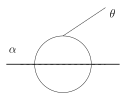
A set of rectangular axes \(Ox\), \(Oy\) is taken in a given plane; a force \(R\) in the plane may be regarded as the resultant of two components \((X, Y)\) respectively parallel to \(Ox\) and \(Oy\). Prove that the moment of \(R\) about \(O\) is equal to the algebraic sum of the moments of \(X\) and \(Y\) about \(O\). A number of forces \((X_i, Y_i)\) act respectively at points \((x_i, y_i)\) of the plane, where \(i = 1, 2, 3, \ldots, n\). Show that, if the system reduces to a single force, the line of action of the force is $$x \sum Y_i - y \sum X_i + \sum (y_iX_i - x_iY_i) = 0.$$ Deduce that, if the algebraic sum of the moments of the forces of the system about each of three points in the plane vanishes, then in general the points must be collinear. Mention any exceptional cases.
The vertical cross-section of a smooth bowl is a parabola with equation \(r^2 = 4ah\), \(r\) being the radius at a height \(h\) above the bottom of the bowl. A needle (whose centre of gravity is at its mid-point) of length \(25a/4\) is put in the bowl. Discuss the possible positions of equilibrium of the needle.
Two cylinders lie in contact with axes horizontal on a plane inclined at 30° to the horizontal; the lower cylinder has radius \(r\) and mass \(m\) and the upper has radius \(3r\) and mass \(M\). Between the cylinders the coefficient of friction is \(\mu\), and between each cylinder and the plane the coefficient of friction is \(\mu'\). Show that the system is in equilibrium so long as \(3M > m\) and both \(\mu\) and \(\mu'\) exceed $$\sqrt{3(M + m)/(3M - m)}.$$
An ancient catapult consists of a uniform lever arm \(ABC\) of mass \(3M\) through \(\frac{1}{4}\pi\) and pivoted at \(B\). \(AB\) is above \(BC\) which is horizontal and of length \(l\). The projectile of mass \(m\) fills the cupped end at \(A\) which is a heavy weight of mass \(M\) is banked to a height and dropped onto \(C\). Assume that the weight remains in contact with \(C\) and that the projectile leaves as soon as it feels the impulse. If \(AB\) is of length \(\frac{l}{4}\), show that the value $$x = \left(\frac{M + M'}{m + M'}\right)^{\frac{1}{4}}$$ will give the greatest range. What is that range?
A uniform heavy rod is in equilibrium with one end resting on a fixed horizontal plane and the other supported by a vertical string; the rod makes an angle of \(45^\circ\) with the vertical. The string is then cut. Show that, so long as the coefficient of friction \(\mu\) between the rod and the plane does not exceed a certain critical value \(\mu_0\), the normal reaction of the plane on the rod immediately after the string is cut is \(\frac{4}{5}(\sqrt{5}-3\mu)\) times its value before the string is cut. Find \(\mu_0\), and determine the corresponding ratio in the case \(\mu > \mu_0\).
A parallelogram \(ABCD\) of freely jointed rods is in equilibrium on a smooth horizontal table. If \(T_1, T_2\) are the tensions in two strings, of which the first joins a point \(P\) of \(AB\) to a point \(Q\) of \(CD\), while the second joins a point \(R\) of \(BC\) to a point \(S\) of \(DA\), prove that \[ \frac{(AP-DQ)}{AB} \frac{T_1}{PQ} = \frac{(BR-AS)}{DA} \frac{T_2}{RS}, \] and explain the significance of this equation if \((AP-DQ)/(BR-AS)\) is zero or negative.
\(ABC\) is a triangular lamina, and \(D, E, F\) are points in the sides \(BC, CA, AB\) respectively such that \(BD=\frac{1}{3}BC\), \(CE=\frac{1}{3}CA\), \(AF=\frac{1}{3}AB\). Forces of magnitudes \(kAD, kBE, kCF\) act along \(AD, BE, CF\) respectively. Show that these forces are together equivalent to a couple of moment \(k\Delta\), where \(\Delta\) is the area of the triangle \(ABC\).
A motor-car stands on level ground with its back wheels, which are of radius \(a\), in contact with a fixed obstacle of rectangular cross-section and height \(\frac{1}{2}a\). The coefficient of friction between the wheels and the ground and between the wheels and the obstacle is \(\mu\). These back wheels together carry a vertical load \(V\), including their own weight. A torque of gradually increasing moment \(M\) is applied to the back axle. Find how, and for what value of \(M\), equilibrium is broken, distinguishing the cases that can arise. Neglect the friction in the bearings.
A tripod consists of three uniform rods \(AB, AC\) and \(AD\), each of length \(l\) and weight \(W\), smoothly jointed at \(A\). It rests in the form of a regular tetrahedron, with apex \(A\), upon a smooth horizontal surface. The feet \(B\) and \(C\) are fixed (the rods \(AB\) and \(AC\) being free to rotate about these points), and the foot \(D\) is prevented from slipping by inextensible strings \(BD\) and \(CD\). A horizontal force \(F\), in the direction of the perpendicular from \(D\) to \(BC\), acts at \(A\). Calculate (i) the force of interaction between \(AD\) and the surface, (ii) the tension in the strings. If the magnitude of the applied force is gradually increased, for what value of \(F\) will equilibrium be broken?
The fixed rods \(OX\) and \(OY\) lie in a vertical plane and are each inclined to the upward vertical at an acute angle \(\alpha\). The ends \(A, B\) of a light rod of length \(l\) can slide along \(OX, OY\) respectively, the angle of friction at \(A\) and at \(B\) being \(\lambda\). The rod is initially horizontal, and a downward vertical force is then applied to it at a point at a distance \(k\) from the mid-point of the rod. Show that (i) if \(\lambda < \alpha\) and \(\lambda+\alpha < \frac{1}{2}\pi\) equilibrium will be broken if \(k\) exceeds a certain value (to be found), and (ii) if \(\lambda > \alpha\) or \(\lambda+\alpha > \frac{1}{2}\pi\) equilibrium cannot be broken whatever the value of \(k\).
The moments of a system of forces acting in the \(Oxy\) plane taken about the points \((0,0), (1,0), (0,1)\) are \(\alpha, \beta, \gamma\) respectively. Find the magnitude and line of action of the resultant. Another system of forces give a resultant which has the same magnitude and direction as in the previous case, but its line of action is \(K\) times as far from the origin. If the moments of this system about the same points are \(\alpha', \beta', \gamma'\) respectively, express \(\alpha', \beta', \gamma'\) in terms of \(K\) and \(\alpha, \beta, \gamma\).
Two fixed equally rough planes, intersecting in a horizontal line, are inclined at equal angles \(\theta\) to the vertical. A uniform rod rests between the planes, in a vertical plane at right angles to their line of intersection, and makes an angle \(\alpha\) with the vertical. If the rod is about to slip, show that \(\tan(\theta+\lambda) - \tan(\theta-\lambda) = 2 \cot \alpha\), where \(\lambda\) is the angle of friction. Deduce, or show otherwise, that if \(\alpha = \alpha_0\) in the position of limiting equilibrium then all positions with \(\alpha > \alpha_0\) are positions of equilibrium: and hence that if \(\mu\), the coefficient of friction, exceeds the positive root of the equation \(\mu^2 \sin^2 \theta + \mu \tan \theta - \cos^2 \theta = 0\), then all physically possible positions are positions of equilibrium.
Forces proportional to the sides of a convex polygon are applied (a) along the sides in the same sense round the polygon, (b) at the middle points of the sides and perpendicular to them, all being directed inwards. Show that the forces in case (a) reduce to a couple proportional to the area of the polygon, and in case (b) are in equilibrium.
(a) \(ABCO\) is a quadrilateral in which \(AB=BC\), \(CO=OA\), and the lengths of the sides are given. Given forces act along \(AB\) and \(BC\). Show that the moment about \(O\) is a maximum when the points \(A, B, C, O\) are concyclic. \item[(b)] Four forces act, in the sense \(\vec{AB}, \vec{BC}, \vec{CD}, \vec{DA}\), along the sides of a quadrilateral \(ABCD\) inscribed in a circle. If each force is inversely proportional to the length of the side along which it acts, show that the resultant force passes through the points of intersection of \(AB, CD\) and of \(AD, BC\).
A uniform ladder of weight \(w\) rests with one end on the ground and with the other against a vertical wall, its angle of inclination being \(45^\circ\). The coefficient of friction at each end is \(\frac{1}{2}\). A man of weight \(4w\) begins to climb the ladder. Show that slipping will commence when he has covered three-eighths of the length of the ladder.
A uniform thin rod of length \(2a\) is supported by two small rough pegs at different levels. The upper peg lies above and the lower peg below the rod. The pegs are at a distance \(c( < a)\) apart, and the line joining them makes an angle \(\alpha\) with the horizontal. The coefficient of friction at the upper peg is \(\mu_1\) and at the lower peg \(\mu_2\). Find the greatest value of \(\alpha\) at which equilibrium can be maintained.
A horizontal trough is formed by two planes both inclined at angles \(\theta\) to the horizontal. A uniform circular cylinder of weight \(W\) rests in contact with both planes at the bottom of the trough with its axis parallel to the line of intersection of the planes. Another circular cylinder of weight \(w\) rests in contact with this cylinder and one of the planes. The radius of the second cylinder is such that the axes are at the same horizontal level. All the surfaces are smooth. Show that equilibrium is only possible if \(w < W\), and find the reactions at the points of contact.
A uniform rod \(AB\) of weight \(w\) and length \(2l\) is supported by a smooth hinge at \(A\), and an equal rod \(BC\) is smoothly hinged to the first at \(B\). The hinges allow the rods to rotate freely in a vertical plane. A couple of moment \(L\) is applied to \(AB\) and a couple of moment \(M\) is applied to \(BC\) (the two couples lying in this vertical plane) and the system is maintained in a position of equilibrium with the rods inclined at angles \(\theta\) and \(\phi\) to the vertical. Prove that \[ 3wl \sin \theta = L, \quad wl \sin \phi = M. \]
A uniform beam of weight \(W\) stands with one end on a sheet of ice and the other end resting against the smooth vertical side of a heavy chair of weight \(\lambda W\). Show that the maximum inclination of the beam to the vertical is given by \(\tan^{-1} 2\mu\) or \(\tan^{-1} 2\lambda\mu\) according as the chair or the beam is the heavier, the coefficient of friction between the ice and beam, and the ice and chair, being \(\mu\).
A light rod of length \(a\) rests horizontally with its ends on equally rough fixed planes inclined at angles \(\alpha\) and \(\beta\) to the horizontal. The vertical plane through the rod is perpendicular to the line of intersection of the rough planes. The coefficient of friction between the ends of the rod and the planes on which they lie is \(\tan \lambda\), and \(\alpha < \lambda < \pi/2 - \alpha\), \(\beta < \lambda < \pi/2 - \beta\). Show that the length of that section of the rod on which a weight can be placed without disturbing the equilibrium is \[\frac{a \sin 2\lambda \cos(\alpha - \beta)}{\sin(\alpha + \beta)}.\]
One edge of a uniform cube lies against a smooth vertical wall and another edge rests on a horizontal surface with coefficient of friction \(\mu\). The face between these two edges is inclined at an angle \(\phi\) to the wall. Find the range of values of \(\phi\) for which equilibrium is possible. What happens if the wall is rough but the horizontal surface is smooth?
A heavy rod \(AB\) slides by means of smooth rings on the two fixed rods \(CD, CE\) which lie in a vertical plane and make acute angles \(\alpha, \beta\) respectively with the horizontal (see the diagram below). The centre of gravity of the rod \(AB\) is at a fraction \(\lambda\) of its length from \(B\). If the rod makes an angle \(\theta\) with the vertical, show that in equilibrium \[\cot\theta = \lambda\cot\beta-(1-\lambda)\cot\alpha.\] Show that the equilibrium is always stable when \(A\) and \(B\) lie below \(C\).
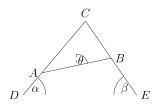
Show that necessary and sufficient conditions for the equilibrium of a system of coplanar forces are that the resultant forces in any two directions are zero, and that the sum of the moments of the forces about any point in the plane is zero. A uniform ladder, weight \(W\), leans against a vertical wall and makes an angle \(\theta\) with the horizontal ground. The vertical plane through the ladder is perpendicular to the wall. The coefficient of friction between the ladder and both the ground and the wall is \(\mu\). A force \(P\), perpendicular to and away from the wall, is applied to the top of the ladder. Obtain an expression in terms of \(P\) for the minimum value of \(\mu\) which will prevent the ladder from slipping. Show that if \(\mu > \frac{1}{2}\cot\theta\) it will not be possible to make the ladder slip for any value of \(P\).
A ladder stands on rough horizontal ground and leans against a rough vertical wall, in a vertical plane perpendicular to the wall. The coefficient of friction between the ladder and the ground is 1. A man stands on the ladder. Find the minimum slope the ladder may have if it is not to slip, no matter how much the man weighs nor where he stands. Justify your answer.
A hemispherical shell, with a rough inner surface, is held fixed with its rim horizontal. A uniform narrow ladder of weight \(W\) and length \(2l\) is placed with its ends \(A\), \(B\) touching the inner surface so as to lie in a vertical plane through the centre \(O\) of the hemisphere and be inclined at an angle \(\alpha\) to the horizontal. The coefficient of friction between the ladder and the inner surface of the shell is \(\tan \lambda\) at both \(A\) and \(B\). The angle \(BAO\) is \(\beta\). A man of weight \(W'\) stands on the lower end \(A\) of the ladder. What are the conditions to be imposed upon the ratio \(W'/W\), in terms of the angles \(\alpha\), \(\beta\) and \(\lambda\), so that the ladder will not slip? If these conditions are satisfied, how far may the man walk along the ladder before it will slip?
Two equal uniform planks \(AB\), \(B'A'\), of length \(2l\), rest symmetrically across a rough circular cylinder of radius \(a\), the ends \(B\) and \(B'\) making free contact with each other vertically above the axis of the cylinder which is horizontal. The long edges of the planks are perpendicular to the axis of the cylinder, and are inclined at an angle \(\alpha\) to the horizontal. Show that equilibrium is possible if and only if \[l\cos\alpha(\cos\alpha + \mu\sin\alpha) > a\tan\alpha > l,\] where \(\mu\) is the coefficient of friction between plank and cylinder. Hence, or otherwise, show that there are such positions of equilibrium if \(\mu > l/a\), but not if \(\mu < l/a\).
A long thin uniform plank of weight \(W\) lies symmetrically along the corner at the bottom of a smooth wall. Its breadth makes an angle \(\alpha\) with the ground. A horizontal force \(F\) acting along the line of contact of the plank with the ground is applied to one end of the plank. If \(\mu\) is the coefficient of friction between the plank and the ground, find the least value of \(F\) that will cause the plank to move.
A uniform rod \(AB\) of length \(l\) lies in a horizontal position on a rough inclined plane of angle \(\alpha\) for which the coefficient of friction \(\mu > \tan \alpha\). At the end \(B\) a gradually increasing force is applied acting upwards along the line of greatest slope. If the rod starts to turn about a point \(O\) such that \(OB = p\), show that \[(p/l)^2 = (\mu - \tan \alpha)/2\mu,\] and hence show that the length of rod that begins to move upwards is less than \(l/\sqrt{2}\).
Two light rods \(AB\) and \(BC\) are hinged together at \(B\); \(BC\) turns on a hinge at a fixed point \(C\), and the end \(A\) of \(AB\) is constrained to move in a smooth guide along \(AC\), the axes of the hinges being at right angles to the plane \(ABC\). The hinges at \(B\) and \(C\) are tightened so that relative rotation is resisted by friction couples \(L\) and \(M\) respectively, and a force \(F\) is applied at \(A\) along \(AC\). Show that motion will not occur unless \(F\) exceeds the value \[ \frac{L}{BN} + \frac{M\cdot AN}{AC \cdot BN}, \] where \(N\) is the foot of the perpendicular from \(B\) on to \(AC\).
Two ladders, \(AB, BC\), each of weight \(w\) and length \(2a\), and with their centres of gravity at the middle points, are freely hinged together at \(B\), and rest with their lower ends \(A, C\), on a smooth horizontal floor. A string of length \(2l \ (<2a)\) joins the middle points of the ladders, and carries at its mid-point a weight \(2W\). If the system is in equilibrium with the angle \(ABC\) equal to \(2\theta\), show that \(\theta\) is either zero or is given by \[ (w^2+2Ww) a^2 \cos^2\theta = (w+W)^2(a^2-l^2). \]
A heavy uniform equilateral triangular plate \(ABC\) is fitted with three light studs at the vertices \(A, B, C\) and rests in a horizontal position with the studs in contact with the rough surface of a table. If a gradually increasing horizontal force is applied at the vertex \(A\) in a direction parallel to \(BC\), show that eventually the plate will begin to turn about a point on the circumcircle of the triangle \(ABC\). If \(W\) is the weight of the plate and \(\mu\) the coefficient of friction between the studs and the table, find the limiting value of the force that has to be applied.
A rectangular trapdoor of weight \(W\) can turn freely about smooth hinges attached at one edge which makes an angle \(\alpha\) with the horizontal. The door is held in equilibrium with its plane making an angle \(\beta\) with the vertical plane \(p\) through the line of hinges by means of a force \(F\) applied at the centre of gravity of the door in a direction perpendicular to \(p\). Find the size of the requisite force \(F\).
A heavy circular cylindrical axle of weight \(W\) and radius \(a\) rests in a V-shaped bearing, the two sides of the V being at equal angles \(\alpha\) with the vertical. If the coefficient of friction between the axle and the bearing is \(\mu\), where \(\mu < \cot\alpha\), show that the couple required to turn the axle is \(W a \mu \operatorname{cosec}\alpha / \sqrt{1+\mu^2}\). If a weight \(w\) hangs vertically by a string wrapped round the axle, find the greatest value of \(w\) that will not turn the axle.
A uniform rod of weight \(W\) is placed with one end on a rough horizontal plane with the coefficient of friction \(\mu\) and the other end resting against a smooth vertical wall, such that the vertical plane containing the rod is perpendicular to the wall. Show that, for equilibrium to be possible, the inclination \(\theta\) of the rod to the horizontal must satisfy \[ \cot\theta \le 2\mu. \] If this condition is satisfied and also \(\cot\theta > \mu\), show that the maximum weight that can be attached to the highest point of the rod without breaking the equilibrium is \[ \frac{2\mu \tan\theta-1}{2(1-\mu\tan\theta)} W. \] What is the corresponding result if \(\cot\theta \le \mu\)?
A light ladder of length \(l\) rests at an angle of 45\(^\circ\) to the vertical, with its foot on the ground and its head against a vertical wall. The coefficients of friction at the two ends of the ladder are both \(\mu\) (\(<1\)). A man walks very slowly up the ladder. Show that he can go a distance \(l(\mu+\mu^2)/(1+\mu^2)\) before it starts to slip. Discuss briefly whether he could have gone further by varying his speed.
A rigid body is in equilibrium under three forces. Show that their lines of action must be coplanar, and either parallel or concurrent. A uniform heavy bar hangs in equilibrium from two strings attached to its ends. The strings make angles \(\theta_1, \theta_2\) with the vertical and \(\phi_1, \phi_2\) respectively with the bar. Prove that \[ \sin\theta_1 \sin\phi_2 = \sin\theta_2 \sin\phi_1. \]
Four equal uniform rods, each of weight \(W\), are freely hinged to form a rhombus \(ABCD\), and a light rod of the same length joins \(BD\). The framework is suspended from \(A\), and a horizontal force is applied at \(C\) to maintain equilibrium with \(AD\) and \(BC\) vertical. Find the reaction at \(A\), and show that the thrust in \(BD\) is \(\frac{4}{3}W\).
A heavy uniform rod \(AB\) is held in equilibrium at an inclination \(\alpha\) to the vertical with one end resting on a rough horizontal plane and the other end supported by the tension of a string inclined at \(\theta\) to the vertical. If \(\mu=\tan A\) is the coefficient of friction between the rod and the plane, prove that the greatest possible value of \(\theta\) is given by \(\cot\theta = \cot A \pm 2\cot\alpha\), where the alternate sign is chosen if the string and rod are inclined to the vertical in opposite senses. Explain what happens if \(\mu \ge \frac{1}{2}\tan\alpha\).
\(l, m\) are two fixed lines in space, which do not lie in the same plane, and \(L, M\) are variable points on \(l, m\) respectively, such that the length \(LM\) is constant. Prove that the plane through \(L\) perpendicular to \(l\) and the plane through \(M\) perpendicular to \(m\) meet in a line, which is a generator of a fixed circular cylinder, whose axis lies along the common normal of the lines \(l, m\).
Explain what is meant by a conservative co-planar field of force. A particle moves under a force whose components at the point \((x, y)\) are \((\lambda x + \mu y, \nu x)\). Find the relation among the constants \(\lambda, \mu, \nu\) in order that the field may be conservative. When this condition is satisfied, find the potential energy.
Prove Pappus' Theorem about the volume of a solid of revolution. \(O\) is the centre and \(OA\) a radius of a circle; \(OB\) and \(OC\) are radii inclined at \(\alpha\) to \(OA\). Locate the centre of gravity of the sector between \(OB\) and \(OC\). By considering the solid obtained by rotating this sector about a diameter perpendicular to \(OA\), or otherwise, prove that the volume cut off on a cone of semi-vertical angle \((\frac{\pi}{2}-\alpha)\) by a sphere of radius \(r\) is \(\frac{2}{3}\pi r^3(1-\sin\alpha)\).
Prove that, if three forces are in equilibrium, their lines of action are in one plane and either meet in a point or are parallel. Three light rods are freely jointed together, not necessarily at their ends, so as to form a triangle ABC. Forces are applied to the rods BC, CA and AB at points P, Q and R respectively, their lines of action meeting in the point O, and the system is in equilibrium. Indicate how to determine the stresses at the joints. Prove that, if P, Q, R are collinear, the lines of action of these stresses are along OA, OB, OC.
\(AFBCED\) is a light horizontal beam 12 ft. long, bearing equal weights \(W\) at \(A,B,C,D\) and supported at \(F\) and \(E\). The lengths of \(AB, BC, CD\) are each 4 ft., of \(AF\) 2 ft. and of \(ED\) 3 ft. Find graphically the pressures on \(F\) and \(E\), and obtain a diagram showing the distribution of the bending moment along the beam.
A uniform cylinder of radius \(a\) and mass \(M\) rests on horizontal ground with its axis horizontal. A uniform rod of length \(2l\) and mass \(m\) rests against the cylinder and has one end attached to the ground by a smooth hinge. The rod makes an angle \(2\alpha\) with the horizontal such that \(a\cot\alpha < 2l\), and it lies in the vertical plane through the centre of the cylinder which is perpendicular to its axis. The coefficients of friction between the cylinder and the rod, and between the cylinder and the ground, both have value \(\mu\). Show that the system is in equilibrium provided that \(\mu > \tan\alpha\). A force \(P\) is now applied at the centre of the cylinder along a line parallel to the rod and directed away from the hinge. Find the smallest value of \(P\) for which the cylinder will move, on the assumption that slipping occurs first between the cylinder and the rod.
A light inextensible string of length \(aL\) is attached at one end \(C\) to a smooth vertical wall and at the other end \(B\) to a uniform rigid straight rod \(AB\) of mass \(M\) and length \(L\). The end \(A\) rests against the wall; \(A\), \(B\) and \(C\) are not collinear, and the plane \(AB\) is vertical. Determine the inclination of the rod to the vertical and the limits on \(a\) between which equilibrium is possible. Show also that the tension in the string is \[\frac{3MgaL}{|2(a^2-1)|}.\]
A uniform solid sphere of radius \(r\) and mass \(m\) is drawn slowly and without slipping up a flight of steps by a horizontal force which is always applied to the highest point of the sphere and is always perpendicular to the vertical planes which form the faces of the steps. If each step is of height \(\frac{1}{2}r\) (and of breadth greater than \(r\)), prove that the coefficient of friction between the sphere and the edge of the steps must exceed \(\tan (\pi/6)\), and find the maximum horizontal force throughout the movement.
The figure represents a vertical section through an ``overhead'' garage door. The door is rectangular, and of height 6 ft. On each side is a horizontal pin \(P\), 2 ft from the bottom edge, that slides smoothly in a vertical groove. The point \(Q\), 2 ft from the bottom edge, is connected by a light smoothly pivoted arm of length 2 ft to a joint \(R\) at the top of the groove 6 ft above the ground. From each pin \(P\) passes a vertical wire of weight taken over a pulley and carries at its other end a weight \(w\). The door is of weight \(W\), its centre of gravity \(G\) being equidistant from its top and bottom edges. Find the moment of the couple needed to hold the door in equilibrium at an angle \(\theta\) with the vertical, and show that, for a certain value of \(w/W\), \(L\) is zero for all positions of the door.
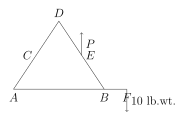
In Fig. 1, \(A\) and \(B\) are fixed points at the same level 6 in. apart, to which are hinged the stiff rods \(AD\), 5 in. long, and \(BF\), 3 in. long. \(C\) is the middle point of \(AD\) and the hinged rods \(DE\), \(EF\) and \(CF\) are each \(2\frac{1}{2}\) in. long. A weight of 10 lb. is hung from the point \(F\) and the system is maintained in equilibrium with \(BF\) horizontal by a vertical force \(P\) acting at \(E\). Determine the magnitude of \(P\) and the force in the rod \(FB\), neglecting the weights of the rods and any friction at the hinges.
A light rod is freely hinged at its lower end to a point on horizontal ground, and rests symmetrically across a uniform circular cylinder, of radius \(a\) and weight \(w\), lying on the ground with its axis horizontal; the rod and the end faces of the cylinder are perpendicular to the axis. The coefficients of friction at the points of contact of the cylinder with the rod and the ground are \(\mu_1\), \(\mu_2\) respectively. The rod makes an acute angle \(2\theta\) with the ground. If a weight \(W\) is hung from a point of the rod distant \(l\) from the hinge, find the conditions that slipping does not occur at either point of contact. Find also the conditions that slipping will never occur however much \(W\) is increased.
A uniform circular cylinder of weight \(W\) rests on a rough horizontal plane with coefficient of friction \(\mu_1\). A second cylinder, of weight \(kW\), rests partly on the first, touching it along one generator, with coefficient of friction \(\mu_2\); it is also supported (along a generator) by an inclined plane that makes an angle \(2\beta\) with the horizontal and with which the coefficient of friction is \(\mu_3\). The plane through the axes of the cylinders makes an angle \(2\alpha\) with the vertical. Show that for equilibrium \[\mu_1 \geq \frac{k \tan \alpha \tan \beta}{\tan \alpha + (1 + k) \tan \beta}, \quad \mu_3 \geq \tan \alpha, \quad \mu_3 \geq \tan \beta.\]
Five equal uniform rods are smoothly jointed at their ends to form a closed pentagon \(ABCDEA\). The rod \(AE\) is fixed horizontally and the rest of the system hangs symmetrically. Prove that if \(AB\) and \(BC\) are inclined to the vertical at angles \(\theta\) and \(\phi\) respectively, \[ 3 \tan \theta = \tan \phi. \] Show that \(\sin\theta\) must lie between 0 and \(\frac{1}{2}\) and satisfy the equation \[ (1-2x)^2 = \frac{36x^2}{8x^2+1}. \] Prove that this equation has exactly one root in this range.
A heavy uniform rod \(AB\) is suspended in equilibrium under gravity by two equal inextensible light strings \(OA, OB\) attached to a fixed point \(O\). If one of the strings is suddenly cut, show that the tension in the other is instantaneously divided by the factor \(2+\frac{1}{2}\cot^2 OAB\).
Two equal uniform smooth cylinders of radius \(r\) are placed inside a fixed hollow cylinder of internal radius \(R\) and a third equal cylinder is placed symmetrically on the first two, all the generators being parallel. Show that the system cannot remain in equilibrium unless \(R<6\cdot3\,r\), approximately.
Explain what is meant by a couple and define its moment. From the definition, show that two couples of equal moment are equivalent if they act in the same plane or in parallel planes. A system of forces in a plane is such that the total moment of the forces about any point of the plane can be ascertained. Show that from a knowledge of moments about three suitably chosen points can be determined the nature and magnitude of the resultant of the system, whether it reduces to a couple or a force.
A thin rectangular window of height \(a\) is smoothly hinged along its upper horizontal edge. The centre of gravity of the window is at its geometrical centre and the weight is \(W\). The window can be held open by a thin light stay smoothly pivoted at a point on the lower horizontal edge of the window. The stay is of length \(a\) and has four equally spaced holes of which the first is distant \(\frac{1}{4}a\) from the end attached to the window and the fourth is distant \(\frac{1}{4}a\) from the opposite end. When the window is shut the stay rests along the bottom edge of the window and the first hole is over a smooth peg on the lower horizontal edge of the fixed window-frame. Find the thrust in the stay when the window is fully open with the peg through the fourth hole of the stay.
A four-wheeled truck of weight \(W\) has wheels of radius \(r\); the distance between the axles is \(l\), and the centre of gravity is equidistant from them. It is standing on level ground with the front wheels in contact with a vertical step of height \(h\) (less than \(r\)). Show that the value of the least force which, applied horizontally to the truck at a height \(a\) (less than \(r\)) above the ground, will cause the wheels to begin to mount the step is \[ \frac{Wl}{2(r+l\tan\alpha-a)}, \] where \(\sin\alpha = \frac{r-h}{r}\). Friction at the axles is to be neglected.
Four light rods are hinged together at their ends to form a quadrilateral \(ABCD\). \(AB=a, CD=b, AD=BC\), and when \(AB\) and \(CD\) are parallel the distance between them is \(c\). The rod \(AB\) is held in a vertical position and the others are adjusted to form a trapezium, \(CD\) being then also vertical: the hinges are then tightened so that relative rotation at each of them would be resisted by a friction couple \(M\). Show that the greatest weight which can be supported at C without displacing the rods is \(\frac{2M(a+b)}{bc}\).
A rod of length \(a\) moves so that its ends \(P\) and \(Q\) always lie on two fixed lines \(OA\) and \(OB\) respectively. The angle \(AOB\) is \(120^\circ\). At the instant when \(OP = \frac{a}{\sqrt{7}}\) and \(OQ = \frac{2a}{\sqrt{7}}\), \(P\) is moving with a velocity \(v\) away from \(O\). Determine, graphically or otherwise, the magnitude of the velocity of the middle point of \(PQ\) and the angular velocity of \(PQ\).
\(AB, BC\) are two uniform rods of weights \(W, W'\), freely hinged to each other at \(B\) and freely hinged to points \(A\) and \(C\) in a horizontal plane. The rods stand in a vertical plane. The length of \(AB\) is 20 ft., of \(BC\) 15 ft. and of \(AC\) 10 ft. Find the magnitudes of the horizontal and vertical components of the reaction at \(B\), and the distance from \(C\) of the point at which the line of action of the resultant reaction meets \(AC\).
Two identical uniform rectangular blocks of weight \(w\), height \(2h\), breadth \(2a\) and length \(l\), lie on a rough horizontal plane (coefficient of friction \(\mu\)) with their ends in the same planes. A wedge of the same length \(l\) whose section is an isosceles triangle of vertex angle \(2\alpha\) lies with its vertex downwards resting symmetrically on the blocks. The angle of friction between an edge of each block and a face of the wedge is \(\gamma\). A gradually increasing weight is placed symmetrically on the wedge. Shew that the blocks will slip or tip first according as \(\mu/\{\cot(\alpha+\gamma)-\mu\}\) is less or greater than \(a/2\{h\cot(\alpha+\gamma)-a\}\), provided both of these quantities are positive. What happens if either or both are negative?
A table stands on four identical vertical legs on a horizontal plane, the feet of the legs forming a square \(ABCD\) of side \(a\). The vertical line drawn through the centre of gravity of the table and the load upon it meets the plane \(ABCD\) in a point \(O\) distant \(p\) from \(AB\) and \(q\) from \(DA\). The legs are slightly compressible so that the thrust in each leg is \(k\) times its compression. Shew that the pressures on the ground at \(A, B, C, D\) are in the ratios \[ 3a - 2(p+q) : a+2(q-p) : 2(p+q)-a : a-2(q-p), \] provided that these are all positive.
Each side of a steep ramp is composed of eleven equal smoothly jointed light rods in a vertical plane as indicated in the diagram. The ramp is smoothly hinged at \(G\) and rests smoothly on a horizontal plane at \(A\); the inclination of the ramp to the horizontal is \(30^\circ\). A vehicle of weight \(W\) two-thirds of the way down the ramp produces a stress in the frame- work comprising either side of the ramp equal to that due to weights \(\frac{1}{6}W\) at \(A\), \(\frac{1}{3}W\) at \(C\) and \(\frac{1}{2}W\) at \(E\). Draw a stress diagram and find the stress in each member of the framework. % Diagram is omitted as per instruction limitations.
A bead of mass \(m\) slides on a smooth wire in the form of an ellipse in a horizontal plane. It is attached to a particle of equal mass \(m\) by an inelastic string, which passes through a small smooth ring fixed at the centre of the ellipse. Initially the system is at rest in unstable equilibrium, with the bead at one end of the major axis of the ellipse: it is then slightly disturbed. For the instant when the bead passes through one end of the minor axis of the ellipse, find (i) the velocity of the bead, (ii) the tension in the string, (iii) the reaction of the wire on the bead.
Prove that, in two dimensions, a system of forces is in general equivalent to a force acting in a given direction together with a force acting in a given line not in the given direction. What are the exceptional cases which may arise? A, B, C, D, E, F, G, H are the vertices, taken in order, of a regular octagon. Forces of magnitudes 1, 2, 2 lb. wt. act in AB, BD, DH respectively. Show that these forces are equivalent to a force in FE together with a force of magnitude \(2\sqrt{2}-\sqrt{2}\) lb. wt. parallel to AH, and find the magnitude of the force in FE.
Four equal smooth cylinders of weight \(W\) are placed inside another cylinder as shewn in the diagram, all axes being horizontal. Assuming that the reaction at the point of contact \(M\) vanishes, shew that the reaction between the cylinders, centres \(A\) and \(B\), is \[ \frac{1}{\sqrt{2}}W (3 \cos \theta + \sin \theta). \] [Diagram showing a large circle containing four smaller circles of equal size. The two lower circles have centers A and B. A vertical line from the center of the large circle passes between A and B, labeled W with a downward arrow at the bottom. An angle \(\theta\) is indicated.]
Two rough planes are equally inclined at an angle \(\alpha\) to the horizontal. A cylinder of radius \(a\), whose centre of mass is at distance \(c\) from its axis, rests between them. If \(\lambda\) be the angle of friction between the cylinder and each plane \((\lambda < \frac{1}{2}\pi - \alpha)\), shew that it is impossible for the cylinder to be placed in any position of limiting equilibrium if \[ c < a \sin \alpha \sin 2\lambda / \sin 2\alpha. \]
A smoothly jointed framework of light rods is loaded at the joints and supported as shown in the figure below. Give a diagram determining the stresses in the various members, and find the value of \(\alpha\) so that the stress in the rod \(PQ\) shall vanish. [A diagram of a loaded framework is shown. A horizontal rod PQ has a joint below its midpoint from which a weight 2W is suspended. A weight of 4W is suspended from joint Q. The framework is supported by two vertical upward forces. Various angles are given as 30\(^\circ\), 90\(^\circ\), and \(\alpha\).]
Two smoothly jointed uniform beams \(AB\), \(BC\), lengths \(l\), \(3l\) and weights \(W\), \(3W\), rest in a horizontal line on three smooth supports at \(A, D, C\), where \(AD = DC\). Find the reactions on the supports. If the beam \(BC\) is cut at \(E\), between \(D\) and \(C\), at a distance \(x\) from \(D\), show that the couple which, applied to the rod \(BE\), maintains the rods \(AB, BE\) in their horizontal position is \(W(l - x^2/2l)\).
A heavy uniform string hangs in a vertical plane over a rough peg which is a horizontal cylinder of circular cross-section whose axis is perpendicular to the plane. The radius of the cylinder is \(a\) and the coefficient of friction is \(\mu\). Let \(T\) be the tension in the string at the point of the cross-section where the tangent makes an angle \(\theta\) with the horizontal. If the string is on the point of slipping in the direction of increasing \(\theta\), show that \[\frac{dT}{d\theta} - \mu T = A(\mu \cos \theta - \sin \theta)\] for a suitable constant \(A\). If one free end lies at the point \(\theta = -\pi/2\), show that the greatest length of string which can hang vertically on the other side of the peg is \(2\mu a (1+e^{\mu\pi})/(1+\mu^2)\).
Two weights \(W_1\) and \(W_2\) are attached to the ends of a rope (of negligible weight) which is passed over a fixed rough horizontal cylinder of circular cross-section. By considering the forces on an element of rope in contact with the cylinder when the friction is limiting, find the manner in which the tension in the rope varies along its length, and hence show that static equilibrium is possible only if \[e^{-\mu\pi} \leq W_1/W_2 \leq e^{\mu\pi},\] where \(\mu\) is the static coefficient of friction between rope and cylinder. How is this result modified if the rope is coiled round the cylinder \(n\) times, the weights \(W_1\) and \(W_2\) being still suspended from its ends?
A heavy uniform chain of weight \(w\) per unit length rests in a vertical plane on a fixed rough circular cylinder of radius \(a\), the axis of which is horizontal and at right angles to the plane in which the chain rests. The coefficient of friction is \(\mu = 1\) and the chain is on the point of slipping. By consideration of an element of the chain whose ends \(P\) and \(Q\) are at the extremities of radii of the cylinder which make angles \(\theta\) and \(\theta + \delta\theta\) with the upward vertical, derive a differential equation for \(T(\theta)\), the tension in the chain at \(P\), and verify that \begin{align*} T(\theta) = wa \sin \theta + ce^{\theta} \end{align*} satisfies it for \(c\) constant. If one end of the chain is at \(\theta = 0\) and a length \(s\) hangs vertically beyond the lowest point of contact between the chain and the cylinder, show that \(s = a\).
A rope of length \(L\) and weight \(w\) per unit length hangs in a vertical plane over two small rough pegs, which are parallel in the same horizontal plane and a distance \(2a\) apart. Particles of weight \(W\) are attached at the ends of the rope so that equal amounts of rope hang vertically from the pegs. If \(wLe^{\mu \pi/2} W\) is very small and all powers of this quantity above the first are neglected, show that the inclination of the rope to the horizontal between the pegs takes the value \(awe^{\mu \pi/2}/W\) at the pegs, where \(\mu\) is the coefficient of friction between the rope and the pegs, this friction assumed limiting.
A uniform heavy string hangs in a vertical plane over a rough peg which is a horizontal cylinder of circular cross-section whose axis is perpendicular to the plane. The radius of the cylinder is \(a\) and the coefficient of friction is \(\mu\). If one free end of the string lies at a point of the cross-section where the tangent is vertical, prove that the greatest length of string which can hang vertically on the other side of the peg is \(2\mu a(1 + e^{\mu\pi})(\mu^2 + 1)\).
Weights \(P\) and \(Q\) are attached to the ends of a light flexible rope which is in limiting equilibrium hanging over a rough circular cylinder, the rope lying in a plane perpendicular to the axis of the cylinder which is horizontal. If \(Q\) is on the point of ascending, what weight must be added to it so that it becomes on the point of descending?
A loop of light inextensible string \(OABCO\) passes in a vertical plane over a horizontal circular cylinder, and a weight \(W\) is attached at \(O\). The portions \(OA\), \(OC\) are straight and perpendicular to each other and tangential to the cylinder at \(A\) and \(C\), and the weight hangs in equilibrium. A gradually increasing couple is applied to the cylinder and slipping is found to occur when it attains the value \((5 \sqrt{2}/13) W \cdot OA\). Find the coefficient of friction between the string and cylinder.
A uniform straight rod of length \(2a\) and mass \(M\) lies on a rough horizontal table with coefficient of friction \(\mu\). A gradually increasing horizontal force is applied to one end in a direction perpendicular to the length of the rod. Show that the rod will move when the force reaches a value \((\sqrt{2}-1)\mu Mg\) and that it begins to turn about a point \(a\sqrt{2}\) from the point of application. (It may be assumed that the vertical reaction is distributed uniformly along the rod.)
Two uniform thin rods \(AB, BC\), each of length \(2a\) and of weights \(W_1, W_2\) respectively, are held together rigidly by a bolt and nut at \(B\) so as to form a V, enclosing an angle \(2\beta\); the axis of the bolt is perpendicular to the plane of the V. The rods are hung from a smooth horizontal rail by light rings attached at \(A\) and \(C\). Find the force and the frictional couple exerted at \(B\) by the rod \(BC\) on the rod \(AB\). Show these in a clear diagram. Deduce that the frictional couple at \(B\) may be reduced to zero by the application of equal and opposite horizontal forces at \(A\) and \(C\) of magnitude \(\frac{1}{4}(W_1+W_2)\tan\beta\).
A ladder, inclined at \(30^\circ\) to the vertical, leans against a vertical wall. The centre of gravity is half-way up the ladder, and the upper end can slide smoothly up and down the wall. Show that the ladder will not slip if the angle of friction between the ladder and the ground is greater than about \(16^\circ\) 6'. If the angle of friction is \(30^\circ\) and the weight of the ladder is \(W\), find the magnitude and direction of the least force which, if applied to the foot, will cause the ladder to slide outwards.
A circular cylinder of weight \(W\) rests between two equally rough planes, each inclined at an angle \(\alpha\) to the horizontal and intersecting in a horizontal line which is vertically below the axis of the cylinder. A couple \(G\) is applied about the axis of the cylinder and is just sufficient to cause the cylinder to rotate without rolling up either plane. Shew that the coefficient of friction cannot exceed \(\tan\alpha\) and find the value of \(G\).
A string is in limiting equilibrium in contact with a normal section of a rough cylindrical surface (coefficient of friction \(\mu\)) and is under the action of no forces except the reaction of the surface and the tensions applied to its ends. Write down the equations of equilibrium of an element of the string, and find the way in which tension varies along the string. A torque amplifier consists of a circular drum which is made to revolve on its axis with uniform angular velocity \(\Omega\) and round which are wrapped \(n\) closely spaced turns of a thin light rough string as indicated in the diagram. The ends of the string are attached to the arms of a pair of cranks whose shafts are coaxal with the axis of the drum and on opposite sides of it. The arms of the cranks are each of length greater than the radius of the drum. The crank shafts are unconnected to each other or to the drum except via the string. The output shaft of the torque amplifier is used to drive, with angular velocity less than \(\Omega\), a mechanism which requires a torque \(G\) to operate it. Find the minimum torque that needs to be applied to the input shaft in terms of \(G, n\) and \(\mu\), the coefficient of friction between the string and the drum. All directions of rotation are left-handed about a line drawn from the input to the output shaft, but the string forms a right-handed spiral about this direction so that it remains taut. % Diagram is omitted as per instruction limitations.
A uniform heavy inelastic string hangs over a circular cylinder of radius \(a\) which is fixed with its axis horizontal. The string lies in a plane perpendicular to the axis of the cylinder, and the lengths of the straight pieces of the string hanging on either side are \(l\) and \(l'\), where \(l > l'\). The coefficient of friction is unity, and the string is on the point of slipping. Prove that \(l' = a+(a+l)e^\pi\).
A concrete wall tending to fall over is to be stayed by a round iron bar fixed to the wall at one end and anchored to the ground at the other end. The bar is 10 feet long and is to make an angle of 45° with the horizontal in a plane perpendicular to the wall. It is heated to a uniform temperature of 600° F. and is then quickly secured in position so as to be just tight while hot. When the bar has cooled to 60° F. it is found that its point of attachment to the wall has moved ¼ an inch horizontally. Find the tensile stress then existing in the bar, given that the coefficient of expansion of iron is \(6.8 \times 10^{-6}\) per degree F., and that Young's Modulus of Elasticity is \(30 \times 10^6\) lbs. per sq. inch. It may be assumed that the force in the bar acts along its axis.
A car rests on four equal weightless wheels of diameter 3 feet, which can rotate about central bearings of diameter 2 inches. If the angle of friction between each wheel and its bearing be 18\(^\circ\), show that the car will not rest on a rough inclined plane, if the inclination of the plane to the horizontal be greater than 1\(^\circ\), approximately, assuming that a wheel and its bearing are in contact along a single generator.
A cylindrical barrel of radius \(a\) rests with its curved surface on a horizontal floor. A uniform straight plank of length \(2l\) lies symmetrically across it in such a position that its centre is in contact with the barrel, and its lower end rests on the floor. The coefficients of friction at all three points of contact are equal. There is limiting friction at one of the three points of contact. Shew that this point is never the point of contact of the barrel with the floor, but is the point of contact of the plank with the floor or with the barrel according as \(3a^2 \lesseqgtr l^2\).
A uniform rectangular door of depth \(a\) weighing \(W\) lbs. slides in vertical grooves and is supported by a vertical chain which is attached at a distance \(c\) from the centre line of the door. The distance apart of the grooves is slightly greater than the width of the door, the coefficient of friction between the door and the grooves is \(\mu\) and \(\mu\) is less than \(a/2c\). Show that the difference between the tensions of the chain when the door is being raised and lowered slowly is \[ \frac{4a\mu c W}{a^2 - 4\mu^2 c^2}. \]
A plank of breadth \(2b\) and thickness \(2c\) rests inside a horizontal cylinder of radius \(a\) with its long edges parallel to the axis of the cylinder and at such a height that it is just about to slip down. Show that the plank makes an angle \(\theta\) with the horizontal given by \[ a \sin \lambda \cos(\theta-\lambda) = (a \cos\alpha - c) \sin\theta \cos\alpha, \] where \(\lambda\) is the angle of friction and \(\sin\alpha = b/a\).
A light inextensible string is in contact with a rough cylinder of any convex section, and is in a plane perpendicular to the generators. If the string is about to slip, show that the difference of the logarithms of the tensions at any two points is proportional to the angle between the normals at these points. A rough horizontal shaft of radius \(a\) is rotating about its axis, and carries a loop of light inextensible string, to one point of which a mass \(M\) is fastened. If the coefficient of friction is \(\mu\) and the mass remains at rest, so that the two straight portions of the string enclose an angle \(2\alpha\), show that the plane through the mass and the axis of the shaft is inclined at an angle \(\theta\) to the vertical, where \(\tan\theta = \tan\alpha \tanh\mu(\frac{1}{2}\pi+\alpha)\). Show also that at the highest point of the string the normal reaction, per unit length, exerted on the string by the shaft is \[ M(g/a) \sin(\alpha-\theta) \operatorname{cosec} 2\alpha \, e^{\mu(\frac{1}{2}\pi+\alpha+\theta)}. \]
Explain and contrast the nature and laws of sliding and rolling friction. A light string, supporting two weights \(w\) and \(w'\), is placed over a wheel (radius \(a\)) which can turn round a fixed rough axle (radius \(b\), friction coefficient \(\mu\)). There being no slipping of the string on the wheel, shew that the wheel will just begin to rotate round the axle if \((w-w')a = (w+w'+W)b\sin\epsilon\) where \(\mu=\tan\epsilon\) and \(W\) is the weight of the wheel. A ladder is placed in a vertical plane with one end on a rough horizontal floor (\(\mu\)) and the other against a rough vertical wall (\(\mu'\)). (i) Find the inclinations for which equilibrium is possible. (ii) When the inclination and friction coefficients are such that equilibrium is not possible, shew how to determine the position and weight of the smallest mass which when suspended from a rung of the ladder will produce equilibrium.
Discuss the friction between (1) a wheel of a vehicle in limiting equilibrium and its axle, assuming a loose bearing fit, (2) the wheel and the ground when (a) its weight is negligible compared with the load it carries, (b) its weight constitutes the greater part of the load, (c) a brake is directly applied to the wheel. Consider the resistance to the motion of a body which is placed on cylindrical rollers, and discuss your conclusions in connection with the assumptions usually made as to the nature of the contact between two bodies.
Find the intrinsic and Cartesian equations of the curve in which a uniform heavy chain hangs when suspended from two fixed points. One end of a rough uniform chain of length \(l\) is fastened to a point on a vertical wall at a height \(h\) above the ground. Shew that the greatest distance from the wall at which the free end of the chain will rest on level ground is given by the expression \[ u\left(1+\mu \log \left(\frac{h+l+1-u}{\mu u}\right)\right), \] where \[ u = l+\mu h - \{(\mu^2+1)h^2 + 2\mu lh\}^{\frac{1}{2}}, \] and \(\mu\) is the coefficient of friction.
Find the intrinsic and Cartesian equations of a heavy uniform chain suspended from two fixed points. A uniform chain of length \(l\) rests in a straight line on a rough horizontal table. One end is raised to height \(h\) above the table and the chain is on the point of motion. Shew that the length of the straight part on the table is \[ l+\mu h - \{(\mu^2+1)h^2+2\mu lh\}^{\frac{1}{2}}. \]
Explain the term `angle of friction.' A cylinder rests inside a fixed hollow cylinder whose axis is horizontal and subtends an angle \(2\alpha\) at this axis. A cylinder equal to the former is placed so as to rest in contact with both without disturbing the former. Show that if the surfaces are equally rough, the angle of friction must be greater than each of \(\frac{\pi}{4}-\frac{\alpha}{2}\) and \(\alpha\).
A uniform chain is suspended from one end and the other end hangs over a rough pulley. Prove that the friction brought into play at the pulley is the weight of a length of chain which would reach from the loose end to the directrix of the catenary formed by the chain.
A canny Cambridge student attempts to build a rapid fuelless transport system which operates by dropping vehicles into straight frictionless tunnels that connect the major cities of the world. Assuming the density of the Earth to be uniform, show that the anticipated duration of each journey is \(T = \pi\sqrt{(R/g)}\), irrespective of the destination, where \(R\) is the radius of the Earth and \(g\) is the gravitational acceleration on the Earth's surface. An inevitable small frictional force of magnitude \(kv\), where \(k\) is constant, prevents the prototype vehicle from reaching its destination. Small motors fitted to subsequent models are adjusted to propel the vehicles such that they always travel at the speed \(v\) they would have attained had friction been absent. Show that the work done by the motors never exceeds \(\frac{1}{2}kgTR\) per journey. [You may assume the gravitational acceleration inside a uniform spherical body at a distance \(r\) from its centre is proportional to \(r\).]
A kite of mass \(m\) possesses an axis of symmetry on which lie the mass centre \(G\) and the point of attachment, \(P\), of the light string by which it is held. The string, \(PG\), may be assumed to lie in a fixed vertical plane, in which a horizontal wind blows with speed \(v\). The string makes an angle \(\theta\), and the kite an angle \(\phi\), with the horizontal in the senses shown. It is known that the force exerted by the wind on the kite has a magnitude \(F\) passing through a fixed point \(Q\) on \(PG\) (\(PQ = a\), \(QG = b\)), normal to the kite, where \(F = Cv\sin\phi\), \(C\) being a constant. Show that the kite adopts an equilibrium position described by \begin{equation*} \tan\phi = \frac{mg}{Cv}\left(1+\frac{b}{a}\right). \end{equation*} The string has fixed length \(l\) and is attached to the ground, and the wind speed at height \(h\) is given by \(v = \beta h\). Neglecting the variation of wind speed over the kite, show that it flies at a height governed by \begin{equation*} \tan\theta = \frac{\lambda ab}{(a+b)^2}\sin\theta-\frac{1}{\lambda\sin\theta}, \end{equation*} where \(\lambda = C\beta l/mg\). Show graphically that, for sufficiently large \(\lambda\), this equation has two roots in \(0 < \theta < \frac{\pi}{2}\).
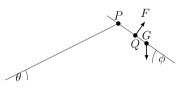
Water, of density \(\rho\) lb./ft.\(^3\), is pumped from a well and delivered at a height \(h\) ft. above the level in the well in a jet of cross-section \(A\) sq. in. with velocity \(v\) ft./sec. Find the horse-power at which the pump is working. If the water strikes a vertical wall normally and falls to the ground without recoil, find in lb. wt. the force exerted on the wall.
A train of mass \(M\) lb. is pulled along a level track by an engine which works at a constant rate. The resistance to the motion is \(kv^2\) lb.-wt., where \(v\) is the speed in feet per second. If the maximum speed is \(V\) ft./sec., find the horse-power of the engine, and calculate the distance travelled while the speed increases from \(v_1\) to \(v_2\) ft./sec.
A fire-pump is raising water from a reservoir 50 ft. below the nozzle and delivering in a jet 4 in. in diameter with nozzle-velocity 60 ft./sec. Taking \(g\) to be 32 ft./sec.\(^2\), \(\pi\) to be 22/7 and the density of water to be \(62\frac{1}{2}\) lb/ft.\(^3\), find approximately the horse-power at which the pump is working. Frictional resistances are supposed neglected. If the jet impinges horizontally on a vertical wall and does not rebound, find in lb. wt. the force exerted on the wall.
A particle is projected from a point on level ground with velocity \(V\). Show that, if the effect of air resistance is neglected, the maximum range of the particle is \(V^2/g\). Water is pumped from a sump in which the free surface is 20 ft. below ground level. It is delivered to a nozzle, of cross-sectional area 8 sq. in., which is situated on the level ground. At the nozzle the speed is such that the jet can just reach a point on the ground 200 ft. away. Taking the density of water to be 62.5 lb. per cu. ft., and neglecting frictional losses, calculate the horse-power of the pump.
A particle of mass \(m\) is projected with velocity \(u\) along the central line of greatest slope of a smooth wedge of inclination \(\alpha\) and mass \(M\). The wedge is initially at rest on a smooth horizontal plane but is free to slide on it. Show that if \(u\) is upwards along the wedge, the height \(h\) that the particle rises above its initial level is \[ u^2(M+m\sin^2\alpha)/2g(M+m). \] Find also the distance that the wedge has moved when the particle has returned to the point on the wedge from which it started.
A small ring of mass \(m\) can slide on a fixed smooth wire which is in the form of a single arc of the cycloid, \(x=a(\theta-\sin\theta)\), \(y=-a(1-\cos\theta)\), from \(\theta=0\) to \(\theta=2\pi\), the positive \(y\)-axis being vertically upwards. The ring is released from rest at the point \(x=0, y=0\). Prove that its a vertical velocity is greatest when it has fallen through a vertical distance equal to \(a\). Calculate the time taken by the ring in falling to the lowest point of the wire.
The power output of a car at speed \(v\) is \[ W \frac{v^3 w^2}{(v^2+w^2)^2}, \] where \(W\) is the weight of the car and \(w\) is 30 m.p.h., so that, if the weight of the car is \(1\frac{1}{4}\) tons, its power at 30 m.p.h. is 56 h.p. The car climbs a hill inclined at an angle \(\alpha\) to the horizontal. Show that if \(\sin\alpha > \frac{3}{32}\) its speed will decrease on the hill in all circumstances. Find the inclination of the steepest hill on which the car can maintain a speed of 15 m.p.h.
A train of mass 600 tons is originally at rest on a level track. It is acted on by a horizontal force \(X=\frac{1}{2}t\), where \(X\) is measured in tons weight and \(t\) in seconds. There is a resistance to motion of \(4\frac{1}{2}\) tons weight, and this resistance is independent of the speed of the train. Find the instant of starting \(t_0\), and prove that at the instant \(t=20\) the speed of the train is about 1.1 miles per hour. What is the horse-power required at \(t=20\)?
A motor-car weighing 33 cwt. travels at a constant speed of 30 m.p.h. up a hill which is a mile long (measured along the road) and rises 625 ft. The engine works at a rate of 40 h.p. Find the resistance to the motion in lb. wt. Assuming that the resistance is proportional to the square of the speed, find the maximum speed at which the car can travel on a level road with the same rate of working. [1 h.p. = 550 ft. lb. per sec.; 1 cwt. = 112 lb.]
A fire-engine working at a rate of \(E\) horse-power pumps \(w\) cubic feet of water per second from a part of a reservoir at depth \(d\) feet below the open end of the hose. If the hose is held at an angle \(\alpha\) to the horizon, find the maximum height that the resulting jet of water can reach. 1 H.P. = 550 ft.-lb. per sec., 1 cu. ft. of water weighs 62.5 lb.
The driving force of a car is constant and the resisting forces vary as the square of its speed; the mass of the car is 1 ton, its maximum horse-power 42 and its maximum speed 75 miles per hour. Find the distance in which the car accelerates from 30 to 60 miles per hour.
A heavy ring of mass \(2m\) can slide on a fixed smooth vertical rod and is attached to one end of a light inextensible string that passes over a small smooth peg at perpendicular distance \(a\) from the rod. The string carries at its other end a heavy particle of mass \(4m\) that hangs freely. If the system is released from rest with the ring at the level of the peg, prove that the ring descends a distance \(\frac{8}{3}a\) before coming to rest again. If at this instant the mass of the ring is suddenly reduced to \(m\), show that it will slide upwards through a distance \(\frac{12}{5}a\) before coming to rest again.
A motor car weighing 10 cwt. travels at a uniform speed of 25 miles per hour up a hill of uniform gradient. The hill is 800 feet high and one mile long. Find the horsepower exerted by the engine in overcoming gravity. If the engine is actually working at 20 horse-power, find the frictional resistance. If the frictional resistance varies as \(v^2\), where \(v\) is the speed, find how far the car would travel on the flat if the engine were disconnected at a speed of 25 miles per hour.
Define Work, Power, Kinetic Energy, Potential Energy, Momentum. Prove any general theorems you know concerning them as applied to a system of particles, laying stress on the difference between conservative and non-conservative systems.
A ship of mass 8000 tons slows, with engines stopped, from 12 knots to 6 knots in a distance of 1500 feet; calculate (in tons weight) the average force of resistance to the ship in slowing down. Assuming that the same resistance is experienced in increasing speed, calculate the horse-power necessary in order that the ship may regain its original speed in a distance of 2000 feet. [A knot is a speed of 100 feet per minute.]
A particle of mass \(M\) is hung from two strings, each of length 12 feet, whose other ends are attached to two rings, each of mass \(\frac{1}{2}M\), which slide on a smooth horizontal rod. The system is released from rest with the strings taut, and the particle level with the rod and between the rings. Shew that when the particle has descended a distance 8 feet, its velocity is 16 feet per second. [Take \(g=32\) feet per second per second.]
Explain briefly the principle of the conservation of energy in dynamics. A bead of mass \(m\) slides on a smooth parabolic wire whose axis is vertical and vertex upwards. It is connected to a particle of mass \(3m\) by a light inelastic string passing through a smooth ring at the focus. The system is let go from rest when the bead is at a depth \(\frac{1}{2}a\) below the vertex, where \(4a\) is the latus rectum of the parabola. Shew that in the subsequent motion the greatest velocity of the particle is \(\frac{1}{2}\sqrt{ga}\), and that the velocity of the bead when it passes through the vertex is \(\frac{1}{2}\sqrt{ga}\).
Find the horse-power of an engine which can just pull a train of \(m\) tons with velocity \(v\) miles per hour up an incline of 1 in \(n\); the resistance to motion being \(x\) lbs. per ton on the level. If \(v=40\) miles per hour when \(x=15\) and \(n=500\), shew that the engine will be able to pull the train down the same incline at 74 miles per hour approximately.
\(A\) and \(C\) are the ends of an unstretched light elastic string of length \(a\) which is lying on a horizontal table. One particle of weight \(w\) is attached at \(C\) and an equal particle at \(B\), where \(B\) divides the string in the ratio \(p:q\). If the system is now freely suspended in equilibrium from the end \(A\), it is observed that \(B\) becomes the mid-point of the string. Find in terms of \(w, p, q\) the modulus of elasticity of the string. If \(A\) remains at the same horizontal level, show that the potential energy in the second position is less than in the first position by an amount \[ \frac{wa(4p-q)}{4p-2q}. \] Discuss the case \(q=2p\).
Find the Horse Power of an engine required to pump out a dock 300 feet long, 90 feet wide and 20 feet deep in 3 hours, if the water is delivered through a pipe of section one square foot at a level 30 feet above the bottom of the dock, the efficiency of the pump being 75 per cent. and account being taken of the energy of the water as it leaves the pipe.
Define work, energy, horse-power. Find the average horse-power of the engine required to pump out a dock 450 ft. long, 60 ft. broad and 30 ft. deep in three hours at a uniform rate, if the water is delivered at a level 40 ft. above the bottom of the dock through a 30 inch pipe (a cubic foot of water weighs 62.5 lbs.).
A cyclist works at the constant rate of \(P\) horse-power. When there is no wind he can ride at 22 feet per second on level ground, and at 11 feet per second up a hill making an angle \(\sin^{-1}\frac{1}{5}\) with the horizon. The total mass of man and cycle is 180 lb. The resistance of the air is \(kv^2\) lb. weight, when the velocity of the man relative to the air is \(v\) feet per second; the other frictional forces are negligible. Find \(P\), and show that the speed of the cyclist when riding on level ground against a wind of 22 feet per second is between 10 and 10.5 feet per second.
State the principle of conservation of energy and prove it for the motion of a particle under gravity. \par Two small rings of equal mass can slide on a smooth parabolic wire with axis vertical and vertex upwards. The rings are connected by an elastic string equal in length to the latus rectum, the modulus of elasticity being equal to four times the weight of either ring. If the rings slide down the two sides of the parabola starting from rest at the vertex, shew that they will come to rest at a depth equal to the latus rectum.
A horizontal conveyor belt moves with a constant velocity \(u\). At time \(t = 0\), a parcel of mass \(m\) is dropped gently onto the belt. If the coefficient of friction between the parcel and the belt is \(\mu\), find
- the time that elapses before the parcel is at rest relative to the belt;
- the distance the parcel slides relative to the belt;
- the energy dissipated during this sliding;
- the impulse of the frictional force.
In a cannery, peas of mass \(M\) come out of a pipe uniformly at a velocity \(V\) with a separation \(d\). A fly of mass \(m\) sitting on the end of the pipe hops with negligible speed on to a passing pea. How much energy must the fly's legs absorb in order to hang on to the pea? How far does the fly travel before the pea behind catches up? Just before the peas collide, the fly lets go of the first pea with no change of velocity. The peas then collide without loss of energy, after which the fly catches hold of the second pea. How fast is the first pea travelling after the collision? How far does the fly travel on the second pea before being caught up by the third pea?
Two spheres \(A\), \(B\) (not necessarily equal) are in direct collision, momentum being conserved. The velocities before the collision are \(u_A\), \(u_B\) and after the collision \(v_A\), \(v_B\), all velocities being measured in the direction from the centre of \(A\) to that of \(B\). Prove the equivalence of the following statements:
- [(i)] \(v_B - v_A = e(u_A - u_B)\),
- [(ii)] \(I_{\text{exp}} = eI_{\text{comp}}\),
- [(iii)] \(T_2 = e^2T_1\),
Identical ball-bearings \(A\), \(B\), \(C\), of diameter \(a\), are collinear. \(B\) and \(C\) are initially at rest with their centres a distance \(b\) apart, and \(A\), moving co-linearly towards them, strikes \(B\). The coefficient of restitution is \(e\). Show that \(A\) will strike \(B\) again, after \(A\) has travelled a further distance \[\frac{1+e}{1-e}(b-a).\]
Equal particles lie at rest at equal intervals along a straight line on a smooth level table. The particle at one end of the line is struck towards its neighbour, hitting it after a time \(t_1\). The coefficient of restitution \(e\) is only slightly less than unity. Find the time that elapses until the \(n\)th particle begins to move, and show that the `collision wave' propagates at a velocity which ultimately is inversely proportional to the time elapsed. Sketch the trajectories of the particles in the (distance, time) plane, and use your sketch to indicate how a second collision wave of slower speed will propagate in the same direction some time later (no detailed calculation required).
Two perfectly elastic balls collide without loss of energy. Show that the relative speed of the balls is the same before and after the collision. A child has a collection of perfectly elastic balls of various sizes. He arranges three of them separated by tiny gaps in a vertical line, the lightest being at the top, at a height much greater than any diameter and drops them simultaneously on to a rigid floor. Show that if the ratio of the masses is 1 : 2 : 6 the lightest ball rises to a height of \(9h\), the other balls being at rest. Show further that with a different choice of sizes the upper ball can move to a height of almost \(49h\).
Two spheres of masses \(m_1\) and \(m_2\) move with their centres travelling on the same line with velocities \(u_1\) and \(u_2\) and collide. If the coefficient of restitution is \(e\), find the changes of speed produced by the impact. If the initial velocities of the spheres are interchanged and reversed in direction, show that the impulse between the spheres is the same as in the first case. A spherical particle is released at a height \(h\) above a horizontal table with which the coefficient of restitution is \(e\). Show that its average speed, with regard to time, while it is being reduced to rest is \[(\tfrac{1}{2}gh)^{\frac{1}{2}}{(1 + e^2)(1 + e)^{-2}}.\] Explain why this formula does not apply in the case when \(e = 1\).
Three beads \(ABC\) of equal mass are threaded in order on a smooth horizontal straight wire. The coefficient of restitution between the beads is \(e\), where \(0 < e < 1\). Initially, \(B\) and \(C\) are at rest, and \(A\) is moving towards \(B\). Show that there will always be at least three collisions. In particular, show that if $$1 - 6e + e^2 > 0$$ there will be at least five collisions.
Starting from Newton's laws of motion, deduce the principle of conservation of momentum for a system of particles. A locomotive of mass \(M\) is attached to a train of \(n\) trucks each of mass \(m\), and initially all the inelastic chain couplings are slack to an extent \(a\) each. The locomotive starts from rest, and the propulsive force exerted by its driving wheels has the constant value \(P\). Neglecting all frictional effects, find the velocity of the train just after the last truck has been jerked into motion, and show that the energy dissipated in the jerks is $$\frac{1}{2}Pna\left[\frac{(n+1)m^2}{M+nm}\right].$$
Two scale pans each of mass \(M\) hang in equilibrium at opposite ends of a string passing over a pulley. A freely falling particle of mass \(m\) strikes one pan and its velocity at the moment of impact is \(V\). Show that it comes to rest in the pan after a time $$\frac{2eV}{(1-e)g},$$ where \(e\) is the coefficient of restitution between the particle and the pan. What is the velocity of the pan at this instant?
Two particles collide elastically on a smooth horizontal plane. Write down the law of the conservation of energy for the system. An observer moving with uniform velocity in the same plane evaluates the kinetic energy of the particles before and after collision using the particle velocities as seen by him. Show that the necessary and sufficient condition for all such observers to agree on the conservation of energy in the collision is that momentum should be conserved. What is the corresponding theorem if energy is lost in the collision?
Two small spheres of masses \(m_1\) and \(m_2\) are in motion along the same straight line. Show that their kinetic energy may be written in the form \[\frac{1}{2}Mu^2 + \frac{1}{2}\mu v^2,\] where \(M = m_1 + m_2\), \(\mu^{-1} = m_1^{-1} + m_2^{-1}\), and \(u\) is the velocity of their centre of gravity and \(v\) is the velocity of one sphere relative to the other. If the spheres subsequently collide and their coefficient of restitution is \(e\), find the loss of kinetic energy.
Two particles collide and coalesce. Show that it is impossible for mass, momentum, and kinetic energy all to be conserved in such a collision. In particular, if mass and momentum are conserved, find an expression for the energy loss in terms of the masses \(m_1\), \(m_2\) of the particles and their velocities \((u_1, v_1)\), \((u_2, v_2)\) in the common plane of their trajectories. Show further that, if the particle velocities and the total mass are prescribed, the energy loss is greatest if the particles have equal mass.
A uniform cubical block of wood of edge \(a\) and mass \(M\) rests with one of its faces in contact with a smooth horizontal plane. A small bullet of mass \(m\) travelling with high velocity \(U\) impinges normally on one of the vertical faces of the block. It hits the centre of this face at time \(t = 0\) and penetrates the wood, in which it is subject to a retarding force of magnitude \(kv\), where \(v\) is the velocity of the bullet relative to the block. Show that if $$U > \frac{(M + m)kA}{Mm}$$ the bullet will go right through the block, emerging with velocity $$U - \frac{kA}{m}$$ at time $$t = -\frac{Mm}{(M + m)k}\log\left(1 - \frac{(M + m)kA}{MmU}\right).$$ [Gravity may be ignored.]
Three equal smooth billiard balls \(A, B, C\), are at rest on a smooth horizontal table with their centres in a straight line. The ball \(A\) is projected directly towards \(B\) with velocity \(U\), and after the impact \(B\) goes on to strike \(C\). If the coefficient of restitution for all impacts is \(e\), find the velocity with which \(C\) moves off. Investigate whether \(A\) will strike \(B\) a second time and whether \(B\) will subsequently strike \(C\) again.
A gun of mass \(M\), which can recoil freely on a horizontal platform, fires a shell of mass \(m\), the elevation of the gun being \(\alpha\). Show that the angle \(\phi\) which the path of the shell initially makes with the horizontal is given by \(\tan\phi = (1+\frac{m}{M})\tan\alpha\). Assuming that the whole energy of the explosion is transferred to the shell and the gun, show that the energy given to the shell is less than it would be if the gun were fixed, in the ratio \(M:(M+m \cos^2\phi)\).
A rigid uniform plank \(ABC\) of mass 30 lb. can turn freely about a fixed horizontal hinge at \(B\) and rests on a support at \(A\) so that \(ABC\) is horizontal. \(AB=BC=3\) ft. A concentrated mass of 30 lb. is attached to the end \(A\). To what height will the end \(A\) rise if a concentrated mass of 20 lb. is dropped from a height of 1 ft. on to the end \(C\) and adheres to it without rebound?
Two spheres, of masses \(m_1\) and \(m_2\), move without rotation along the same straight line with velocities \(u_1\) and \(u_2\). Their centre of mass is \(G\). Prove that their total kinetic energy is equal to the sum of (a) the kinetic energy of a particle of mass \(m_1+m_2\) moving with the velocity of \(G\), (b) the kinetic energies of the two spheres moving with velocities equal to their actual velocities relative to \(G\). Prove that, if the spheres impinge directly, the first term (a) is unaltered and the second term (b) is reduced to a fraction \(e^2\) of its original value, where \(e\) is the coefficient of restitution.
A light inextensible rope is fastened at one end to a fixed point \(O\), and passes first under a smooth light pulley carrying a load \(2M\) suspended from its centre, then over a smooth fixed light pulley, and finally carries a bucket of mass \(M\) at its other end. The system is in equilibrium with the parts of the rope not in contact with the pulleys vertical when an elastic ball of mass \(m\) drops vertically with velocity \(v\) on to the bottom of the bucket and rebounds vertically. Show that the velocity thereby given to the bucket is \[ 2mv(1+e)/(2m+3M), \] where \(e\) is the coefficient of restitution between the ball and the bucket. Find also the impulse on the ball.
Three equal imperfectly elastic spheres lie on a smooth horizontal table and their centres are collinear. One of the outer spheres is then projected directly towards the central one. Show that there will be only three collisions if the coefficient of restitution \(e\) exceeds \(0 \cdot 172\) approximately. Find the percentage loss of kinetic energy if \(e=0 \cdot 2\).
A wooden body of mass \(5m\) is projected at an angle to the vertical from a point of a horizontal plane. When it is at the highest point of its trajectory it is hit by a bullet of mass \(m\) flying vertically upwards. The bullet becomes embedded in the body which then falls on the plane at the same point as if the bullet had not hit it. Show that if the bullet was fired from a point of the plane its muzzle velocity must have been \((2\cdot21)^{\frac{1}{2}}\) times the vertical component of the velocity of projection of the wooden body.
Three uniform spheres, \(A, B, C\), of masses \(2m, m, 2m\) respectively, lie in a straight line on a horizontal table, with \(B\) between \(A\) and \(C\). Initially \(B\) and \(C\) are at rest, and \(A\) is projected along the line of centres towards \(B\); the coefficient of restitution for any pair of the spheres is \(e\). Show that, if \(e>0\), there will be at least three collisions, and that there will be only three provided that \(e \ge \frac{1}{3}\).
Two small spheres \(A\) and \(B\) of masses \(3m\) and \(m\) respectively lie on a horizontal table, so that \(B\) lies between \(A\) and a perfectly elastic barrier perpendicular to the line of centres of \(A\) and \(B\). Initially \(B\) is at rest and \(A\) is projected towards \(B\) along the line of centres. If the coefficient of restitution between the spheres is \(\frac{1}{2}\), show that there will be exactly three collisions.
Two equal spheres are at rest in a smooth tube bent in the form of a circle whose plane is horizontal. They are initially at opposite ends of a diameter when one of them is projected along the tube to collide with the other after time \(t\). If \(e\) is the coefficient of restitution, find the time that elapses between the first collision and the succeeding one.
A shell of mass \(m_1+m_2\) is fired with a velocity whose horizontal and vertical components are \(u\) and \(v\). At the highest point of the path the shell explodes into two fragments of masses \(m_1\) and \(m_2\). The explosion produces additional kinetic energy \(E\) and occurs in such a way that the fragments separate in a horizontal direction. Find the distance apart of the points where the two fragments strike the ground. Show that for a given total mass \(M\) of the shell this distance has least value \(\frac{2v}{g}\sqrt{\frac{2E}{M}}\).
Eg bullets into blocks etc
A shot whose mass is \(m\) penetrates to a depth \(a\) when fired at a plate of mass \(M\) which is free to move. Determine the depth to which it would have penetrated had the plate been fixed.
If a bullet of mass \(m\) moving with velocity \(v\) is found to penetrate a distance \(a\) into a fixed body, the resistance being supposed uniform, prove that if it meet directly a body of mass \(M\) and thickness \(b\) moving with velocity \(V\), it will be imbedded if \[ b/a > (1+V/v)^2 M/(M+m), \] the uniform resistance being assumed the same in both cases. If however the bullet penetrates the body, shew that it will emerge with velocity \[ \frac{mv-MV+Mv\sqrt{(1+V/v)^2 - (1+m/M)b/a}}{M+m}, \] and that the time of penetration will be \[ \frac{2a}{v}\frac{M}{M+m}\left[1+\frac{V}{v} - \sqrt{\left(1+\frac{V}{v}\right)^2 - \left(1+\frac{m}{M}\right)\frac{b}{a}}\right]. \] Determine also the final velocity of the body in both these cases.
A bullet of mass \(\frac{1}{2}\) oz., moving in the path \(BC\), strikes and embeds itself in \(M\), a mass of 5 lbs. which is suspended from \(A\) by a light, flexible and inextensible string. The two masses then move together, as shewn, with common velocity \(V=5\) f.p.s. What is the mean value of the extra tension imposed on the string, if the bullet becomes fixed in the mass \(M\) within \(\frac{1}{2000}\) sec. after impact?
A bullet of mass 1 oz. is fired into a block of wood of mass 20 lb. which is suspended by a long string. The bullet becomes embedded in the block and the centre of mass of block and bullet rises to a height of 12 in. above its original position. What is the velocity of the bullet? \par If the resistance to the penetration of the bullet is \(675 v x^{1/2}\) lb. wt., where \(v\) is the velocity and \(x\) the penetration, shew that the final value of \(x\) is about 1 ft. The movement of the block during penetration may be neglected.
A bullet of mass \(m\) is fired into a block of wood of mass \(M\), which hangs by vertical cords of equal length, the other ends of the cords being fastened to fixed points on the same level. The bullet penetrates a distance \(a\) horizontally into the block and in the subsequent motion the block rises through a height \(h\). Calculate the velocity with which the bullet strikes the block, and shew that the average resistance to penetration is equal to \(gM(1+M/m)h/a\).
A projectile of mass \(m\) lb., moving horizontally with velocity \(v\) feet per second, strikes an inelastic nail of mass \(m'\) lb. projecting horizontally from a mass of \(M\) lb. which is free to slide on a smooth horizontal plane. Prove that the nail is driven \[ \frac{m^2M}{(M+m+m')(m+m')}\frac{6v^2}{gP} \text{ inches} \] into the block, where \(P\) lb. weight is the mean resistance of the block to penetration by the nail.
Two smooth planes meet at right angles in a horizontal line. A rod, whose density is not necessarily uniform, is placed above this line and perpendicular to it, and rests on the planes. If the steeper plane is inclined at an angle \(\theta\) to the horizontal, find the equilibrium positions of the rod. Discuss explicitly the following special cases:
- [(i)] the density of the rod is uniform,
- [(ii)] the density of the rod is proportional to the distance from one end.
Five equal uniform bars, each of mass \(M\), are freely jointed together to form a plane pentagon \(ABCDE\). They are suspended from \(A\), and are constrained by equal light strings \(AC\) and \(AD\) so as to form a regular pentagon. Show without direct calculation that the tension in each string is the same as it would be if the bars were replaced by light rods and a mass \(M\) attached at each vertex. Hence show that this tension has magnitude \(2Mg\cos\frac{1}{5}\pi\).
A four-wheeled truck runs forward freely on level ground. The distance between the front and rear axles is \(D\), and the centre of gravity of the truck is at a distance \(\beta\) from the vertical plane through the front axle and at a height \(H\) above the ground. The moments of inertia of wheels and axles are negligible. Find the deceleration of the truck if the rear wheels become locked (the front wheels remaining free), and \(\mu\) is the coefficient of friction between the wheels and the ground. If the front rather than the rear wheels become locked show that the rear wheels remain on the ground provided that \(\mu < \beta/H\).
A tumbler which has square cross-section of side \(2a\) and height \(Ka\) is closed at one end and this end rests on a rough horizontal table. The tumbler is filled to a height \(ka\) with liquid of uniform density. Assuming that no sliding takes place and that the weight of the tumbler is negligible compared with that of the liquid, show that when the table is tilted slowly through an angle \(\theta\) about an axis parallel to one face of the tumbler then, provided \[\tan\theta \leq k \leq K - \tan\theta,\] the tumbler will topple when \(\theta\) is given by \[\tan^3\theta + (3k^2 + 2)\tan\theta - 6k = 0.\] If it is required to tilt the table through an angle \(\tan^{-1}\frac{1}{2}\) without spillage, determine what height of tumbler is required and how full it can be.
A pile of \(n\) bricks is in equilibrium, each brick resting horizontally on the one and their long sides lying in the same vertical north-south planes. The bricks are uniform rectangular blocks of the same material, of length \(a\) and height \(b\). The sun is due south at an elevation \(\alpha\). Find the minimum length of the shadow of the pile (in the north-south direction) in the following two cases:
- [(i)] \(\frac{a\tan\alpha}{b} > n\);
- [(ii)] \(\frac{a\tan\alpha}{b} < 2\).
A uniform rigid rod \(AB\) of length 5 inches and weight \(w\) hangs from a point \(O\) by two inextensible strings \(AO\), \(BO\) of lengths respectively 3 and 4 inches. A variable weight \(W\) is attached at \(B\). Find the tension in \(OA\), and verify that it decreases as \(W\) increases.
A uniform rod \(AB\) is suspended from a point \(O\) by light inelastic strings \(OA\), \(OB\) attached to its ends. Prove that the tensions in the strings are proportional to their lengths. Examine whether the result can be extended to (i) a uniform triangular lamina \(ABC\) suspended by strings \(OA\), \(OB\), \(OC\); (ii) a uniform polygonal lamina with four or more vertices suspended by strings attached to its vertices.
When it is on level ground, the centre of gravity of a motor car is at height \(h\) and its front and rear axles are at horizontal distances \(a\) and \(b\) from the centre of gravity. If it is parked facing up a slope which makes an angle \(\alpha\) with the horizontal, with its rear wheels locked, show that the coefficient of friction between the rear wheels and the road must not be less than \((a + b)/(h + a \cos \alpha)\). What is the corresponding result if it is parked facing down the slope?
A pedestal is constructed of three uniform right circular cylinders placed with their axes vertical and in the same line. The weights of the cylinders are in the ratios 2:1:3, and their radii are in the ratios 12:11:9, where the cylinders are taken in order from the topmost downwards. If no mortar is used in the pedestal, find the greatest weight of a statue which may be placed safely anywhere on the top of the pedestal, in terms of the weight of the middle cylinder. If the three cylinders are cemented together, while the base is still not fixed to the ground, show that the greatest weight of a statue which may now be placed safely on the top of the pedestal is \(1 + k\) times its value when the cylinders were not cemented.
A light rigid wire is bent into the shape of a rectangle \(ABCD\), with \(AB = a\), \(BC = b\). Particles of weights \(w\), \(5w\), \(w\), \(2w\) are attached to the vertices, \(A\), \(B\), \(C\), \(D\) respectively, and the wire is then suspended freely from \(A\). What is the inclination of \(AB\) to the vertical when the system composed of wire and particles is in equilibrium? A rough horizontal plane is held so as to touch the wire at \(C\), and another particle of weight \(w\) is attached to \(C\). If \(\mu\) is the coefficient of friction between the wire at \(C\) and the plane, what further force must be applied vertically upwards to the plane so that sliding will just commence at \(C\)?
Calculate the position of the centroid of a uniform hemisphere. A solid is shaped by cutting out from a uniform hemisphere of radius \(R\) a sphere of radius \(\frac{1}{2}R\). This solid rests with its plane face in contact with a rough inclined plane, and a gradually increasing force is applied at the pole of the hemisphere in the direction parallel to the line of greatest (upward) slope of the plane. The coefficient of friction is \(\mu\) and the angle of inclination of the plane is \(\alpha\). Show that the solid slides or tilts first according as $$\mu \lessgtr 1 - \frac{3}{2}\tan\alpha.$$
A particle of weight \(2W\) is attached to the end \(A\), and a particle of weight \(W\) attached to the end \(B\), of a light rod \(AB\) of length \(2a\). The rod hangs from a point \(O\) by light strings \(AO\), \(BO\), each of length \(b\). Prove that in equilibrium the inclination of the rod to the horizontal is \(\theta\), where \[ \tan \theta = \frac{a}{3\sqrt{(b^2-a^2)}}. \] Find the tension in the string \(AO\) in terms of \(a\), \(b\), and \(W\).
A uniform rod of length \(2a\) is supported symmetrically in a horizontal plane by two pegs distant \(2d\) apart. A second uniform rod of equal length but of mass twice that of the first is suspended by two equal inextensible vertical cords from the ends of the first rod. If one cord is cut find the smallest value of \(d\) for which the upper rod will not begin to tilt.
\(A\), \(B\) and \(C\) are three smooth horizontal parallel pegs, \(A\) and \(C\) being a distance \(a\) from \(B\) in a horizontal plane. Two uniform rods, \(DB\) and \(EF\), of the same weight per unit length and of length \(3a\) and \(a\), respectively, are smoothly jointed at \(E\) and are laid perpendicularly across the pegs \(A\), \(B\), \(C\). Show that, if the rods are to remain horizontal, \(D\) must be \(\frac{5a}{6}\) beyond an end peg.
A flat plate of uniform thin material is in the form of a plane quadrilateral \(ABCD\). The diagonals meet at a point \(O\). Show that its centre of mass coincides with that of four particles each of mass \(m\) at \(A\), \(B\), \(C\), \(D\) and one of mass \(-m\) at \(O\).
The ends \(A\), \(B\) of a light rod \(AB\) are joined by light inextensible strings \(AO\), \(BO\) to a fixed point \(O\), and \(AO\) and \(BO\) are equal in length and perpendicular to each other. If weights \(W_1\) and \(W_2\) are now suspended from \(A\) and \(B\), find the angle to the horizontal that the rod will take up in equilibrium.
A long plank of length \(2l\) and mass \(m\) is supported horizontally at its two ends by vertical ropes, the weaker of which can only stand a tension \(\frac{5}{4}mg\). A man of mass \(m\) walks across the plank starting at the stronger rope. When the weaker rope breaks the man clings to the plank at the position he has reached. Show that when the weaker rope breaks the tension in the stronger rope suddenly becomes \(1\frac{3}{16}mg\).
The centre of mass of a car, moving in a straight line on level ground, is at height \(h\) above ground level and at a distance \(a\) from the vertical plane through the rear axle and \(b\) from the vertical plane through the front axles. Show that if braking is applied equally to the two rear wheels only, excessive braking may cause a skid but cannot cause the wheels to leave the ground; but that if braking is applied to the front wheels the rear wheels may leave the ground if the coefficient of friction \(\mu\) is great enough; and find the condition for this to happen, neglecting the rotatory inertia of the revolving parts. If the braking force is divided between the front and back wheels, determine whether it is possible to get more effective braking than with front-wheel brakes only, and whether the result is any different if the car is running downhill. If the angular momentum of all rotating parts may be assumed to be in the same direction as that of the wheels, and proportional to the car's speed, determine whether the maximum attainable retardation is greater or less than if this angular momentum were negligible.
A number \(n\) of equal uniform rectangular blocks are built into the form of a stairway, each block projecting the same distance \(a\) beyond the one below. The top block is supported from below at its outer edge. Show that the stairway can stand in equilibrium if, and only if, \(2l > a(n-1)\), where \(2l\) is the width of each block.
A uniform solid cube of side \(2a\) starts from rest and slides down a smooth plane inclined at an angle \(2\tan^{-1}\frac{1}{4}\) to the horizontal, the orientation of the cube being such that its front face is perpendicular to the lines of greatest slope of the plane. The cube meets a fixed horizontal bar placed perpendicular to the direction of motion and at a perpendicular distance \(a/4\) from the plane. Show that, if the cube is to have sufficient velocity to surmount the obstacle when it reaches it, the cube must be allowed first to slide down the plane through a distance greater than \(107a/60\). (The obstacle may be taken to be inelastic and so rough that the cube does not slip on it.)
The ends \(A, B\) of a heavy uniform rod of weight \(w\) and length \(2a\) are attached by two light inextensible strings each of length \(b\) to two points \(C, D\) at the same level a distance \(2c\) apart where \(a+c>b>\sqrt{(a^2+c^2)}\). The rod is now moved in such a way that it always remains horizontal and so that the mid-point of \(AB\) remains vertically below the mid-point of \(CD\). Find the potential energy of the rod as a function of the angle between \(AB\) and \(CD\), if both strings remain taut and do not cross. Also find the couple necessary to keep \(AB\) perpendicular to \(CD\).
A rectangular picture frame hangs from a smooth peg by a string of length \(2a\) whose ends are attached to two points on the upper edge at distances \(c\) from its middle point. Prove that if the depth of the frame exceeds \(2c^2(a^2-c^2)^{-1/2}\) there is no position of equilibrium except that in which the picture frame hangs symmetrically.
The uniform scalene triangular lamina \(ABC\) is at rest in equilibrium freely suspended from a point \(K\) by three equal light inextensible strings \(KA, KB, KC\). Prove that the Euler line of the triangle \(ABC\) is a line of greatest slope of the plane \(ABC\). [The Euler line is the line containing the circumcentre, centroid, nine-point centre and orthocentre.]
A uniform cylinder, whose normal cross-section is an ellipse with eccentricity \(e\), is placed with its generators horizontal on a perfectly rough plane inclined at an angle \(\alpha\) to the horizontal. Show that, if it is released from rest, complete revolutions will occur, whatever the initial position, provided that \[ \tan\alpha > \frac{e^2}{2\sqrt{(1-e^2)}}. \]
Define the mass-centre of \(n\) coplanar point-masses \(m_i\) (\(i=1,2,\dots,n\)), situated at points \((x_i, y_i)\), and prove that it is a unique point. If the coordinates \(x_r, y_r\) of one of the masses \(m_r\) are changed to \((x_r+\xi_r, y_r+\eta_r)\), show that the coordinates of the mass-centre are changed by \((m_r\xi_r/M, m_r\eta_r/M)\), where \(M\) is the total mass. Generalise this to cover the case in which any number of the point-masses are moved in their plane. A circular disc of uniform thin paper, of radius \(a\), is cut along a radius and one of the quadrants is folded over so as to lie in the plane of the remaining three quadrants. Find the distance of the mass-centre of the folded paper from the centre of the circle. [It may be assumed that the mass-centre of a sector of the circle, of angle \(2\beta\), is at a distance \((2a \sin\beta)/(3\beta)\) from the centre of the circle.]
A boy standing at the corner \(B\) of a rectangular pool \(ABCD\) with \(AB = 2\)m, \(AD = 4\)m has a boat in the corner \(A\) at the end of a string of length 2m. He walks slowly towards \(C\) along \(BC\) keeping the string taut. Locate the boy on \(BC\) when the boat is 1m from \(BC\). $$[\int \operatorname{cosec}\theta d\theta = \ln \tan \frac{1}{2}\theta.]$$
The components \(f_i(t)\) (\(i = 1, 2, \ldots, n\)) of the \(n\)-dimensional vector \(\mathbf{F}\) are functions of time \(t\), and not all of them are constant. Show that the vectors \(\mathbf{F}\) and \(\dot{\mathbf{F}}\) (where \(\dot{\mathbf{F}}\) is the vector with components \(df_i/dt\)) are orthogonal for all \(t\) if and only if \(\mathbf{F}\) has constant length. Is it possible for \(\mathbf{F}\) and \(\dot{\mathbf{F}}\) to be orthogonal for all \(t\) if \(\mathbf{F}\) has constant length? Another vector \(\mathbf{G}\), with components \(g_i(t)\) (\(i = 1, 2, \ldots, n\)), is parallel to \(\mathbf{F}\) for all \(t\). \(\mathbf{G}\) has constant length, and \(\mathbf{F}\) has length proportional to \(e^{kt}\), where \(k\) is a constant. Show that \(\dot{\mathbf{F}}\) and \(k\mathbf{G}+\dot{\mathbf{G}}\) are parallel for all \(t\). [If the vectors \(\mathbf{A}, \mathbf{B}\) have components \(a_i, b_i\) (\(i = 1, 2, \ldots, n\)) respectively, \(\mathbf{A}\) and \(\mathbf{B}\) are said to be orthogonal if \(\sum_{i=1}^n a_i b_i = 0\), and are said to be parallel if there is a scalar \(\lambda\) such that \(a_i = \lambda b_i\) for \(i = 1, 2, \ldots, n\). The length of \(\mathbf{A}\) is \(\sqrt{a_1^2 + a_2^2 + \ldots + a_n^2}\).]
The position vector, \(\mathbf{r}(t)\), of a moving point \(P\) relative to a fixed origin satisfies the equation $$\ddot{\mathbf{r}} = \mathbf{k} \times \mathbf{r},$$ where \(\mathbf{k}\) is a constant vector and \(\dot{\mathbf{r}} = d\mathbf{r}/dt\). Show that the locus of \(P\) is a circle. Describe the motion of \(P\) when \(\mathbf{r}\) satisfies the equation $$\ddot{\mathbf{r}} = \mathbf{k} \times \dot{\mathbf{r}}.$$
By writing \(x = r\cos\theta\) and \(y = r\sin\theta\) (where \(r\), \(\theta\) are polar coordinates at origin \(O\)), or otherwise, show that the components of acceleration of a particle \(P\) along and perpendicular to \(OP\) are \begin{equation*} \ddot{r}-r\dot{\theta}^2 \quad \text{and} \quad r\ddot{\theta}+2\dot{r}\dot{\theta} \end{equation*} respectively, where dots denote differentiation with respect to time. A particle of unit mass is moving under the action of a force \(F(1/r)\) directed toward the origin. Show that \begin{equation*} r^2\dot{\theta} = h, \end{equation*} where \(h\) is a constant, and also that, if \(u = 1/r\), \begin{equation*} h^2u^2\left(u+\frac{d^2u}{d\theta^2}\right) = F(u). \end{equation*} Find the equation of the path of the particle if \(F(u) = Au^3\), where \(A < h^2\).
A point \(P\) with position vector \(\mathbf{p}(t)\) at time \(t\) moves in a plane in such a way that \begin{equation*} \mathbf{p}\cdot\dot{\mathbf{p}} = 0 \quad \text{and} \quad \ddot{\mathbf{p}} = -\lambda(t)\mathbf{p}, \quad \text{for all} \, t, \end{equation*} where dots denote differentiation with respect to \(t\). If \(P\) is initially at unit distance from the origin, describe its subsequent motion and show that \(\lambda(t)\) is constant. Points \(Q\) and \(R\), with position vectors \(\mathbf{q}(t)\) and \(\mathbf{r}(t)\), move in the same plane so that \begin{equation*} \dot{\mathbf{q}} = \mathbf{k} \quad \text{and} \quad \mathbf{r} = \mathbf{p} + \mathbf{q}, \end{equation*} where \(\mathbf{k}\) is a constant unit vector. Find the conditions required to make \(\mathbf{r}(t)\) vanish at some \(t\), and describe the possible motions of \(R\).
A circular disc rolls without slipping along a straight line, with uniform angular velocity. Show that the acceleration of each point of the disc is directed towards the centre. Discuss, without making detailed calculations, whether the same result holds if the disc rolls with non-uniform angular velocity.
(i) A smooth tube \(AB\) of length \(\frac{1}{2}\pi a\) and of small cross-section is bent in the form of a circular arc of radius \(a\) and is fixed in a vertical plane with the end \(A\) uppermost, the tangent to the axis of the tube at \(A\) being horizontal and the tangent at \(B\) being vertical. The tube contains a uniform flexible inextensible chain of length \(\frac{1}{2}\pi a\) which just extends throughout the length of the tube. The chain is released from rest and slides out of the tube under gravity. Find its speed when it is just clear of the lower end of the tube. (ii) The same tube is now held fixed in a horizontal plane and a stream of identical particles is fired into the tube at \(A\), emerging from the tube at \(B\). Assuming that each particle loses half its energy in its passage through the tube, and that there is no accumulation of particles in the tube, find the magnitude and direction of the force experienced by the tube in terms of the mass \(m\) of each particle, the number \(N\) per unit time entering the tube at \(A\), and the speed \(v\) of the particles at \(A\). [You are not asked to find the torque or the line of action of the force.]
A uniform circular disc of mass \(M\) and radius \(a\) is free to rotate about a fixed vertical axis through its centre and perpendicular to it. A shallow groove is cut in the upper surface of the disc along a diameter. Two insects each of mass \(m\) are together on the upper surface of the disc at one end of the groove and the disc is rotating with angular velocity \(\Omega\). At time \(t = 0\) one insect starts to crawl along the groove with uniform velocity \(V\) relative to the disc. Show that when it reaches the other end of the diameter the disc has rotated through an angle \[\frac{2a}{V}\sqrt{\frac{2m}{M+2m}}\left\{\Omega\left(2+\frac{M}{2m}\right)\right\}\tan^{-1}\sqrt{\frac{2m}{M+2m}}.\] If at time \(t = 0\) the other insect starts to crawl round the circumference in the direction of rotation of the disc at such a constant velocity relative to the disc that it arrives at the far end of the diameter at the same instant as its companion, find the angle the disc has turned through when they meet.
A large massive circular cylinder, radius \(a\), rotates about its axis with constant angular velocity \(\Omega\). A projectile is launched from the inside curved surface in a plane perpendicular to the axis of the cylinder with velocity \(V\) and elevation \(\alpha\) relative to the cylinder. Show that the particle hits the cylinder again after a time \begin{equation*} \frac{2aV\sin\alpha}{V^2+a^2\Omega^2+2aV\Omega\cos\alpha}. \end{equation*} Write down the condition that the projectile passes through the axis of the cylinder and find in this case the set of solutions to the condition that the particle strikes the cylinder at its launching point. [You may ignore the effects of gravity.]
A large horizontal disc has a toy gun mounted on it in such a way that the barrel of the gun lies in a vertical plane through the centre of the disc and the muzzle of the gun is in the plane of the disc and at a distance \(a\) from its centre. The gun is directed upwards at an angle \(\alpha\) to the horizontal and towards the axis of the disc. The disc is set rotating with angular velocity \(\omega\) about its axis and the gun fires a projectile with velocity \(V\) relative to the gun. Allowing for gravity but ignoring air-resistance, find the value of \(V\) which minimises the distance between the axis of the disc and the point at which the projectile strikes the disc.
The behaviour of some radial-ply tyres on icy roads can be approximated as follows. The tyre can withstand a horizontal force in any direction up to a limiting magnitude \(F_0\). If a greater force is applied the tyre starts to slip and the coefficient of sliding friction is negligible. An imprudent motorist using such tyres is travelling fast on a wide almost empty icy road when he encounters a T-junction with a long brick wall opposite him. If a collision can be avoided compare the strategies of braking in a straight line or swerving without braking. If a collision is inevitable how can the driver reduce the kinetic energy as fast as possible?
The Cartesian components of a force which acts on a given particle of unit mass are \((E\cos\alpha t + \dot{y}B, E\sin\alpha t - \dot{x}B)\), where \((x, y)\) is the position of the particle relative to the origin \(O\). \(E\) and \(B\) are positive constants and a dot denotes differentiation with respect to time. The particle is at rest at \(O\) at time \(t = 0\). By introducing the variable \(\omega = x + iy\), or otherwise, find the position of the particle at all future times for any positive value of \(\alpha\). By examination of the solution for small values of \(\alpha\), or otherwise, describe the motion of the particle if \(\alpha = 0\).
\(P\) is a passenger on a roundabout at a fair. When the roundabout is rotating uniformly, a given point \(A\) on the roundabout moves in a circle of radius \(3a\) about the central axis of the roundabout with constant angular velocity \(\omega\). The passenger \(P\) is moving relative to the roundabout in a circle of radius \(a\) about \(A\) with constant angular velocity \(2\omega\). How many times is \(P\) stationary during one revolution of \(A\)? Find the distance travelled by \(P\) between two points when he is at rest.
As seen from axes fixed on the rotating earth, a projectile experiences in addition to gravity an additional acceleration \(2\mathbf{t} \times \boldsymbol{\omega}\), where \(\mathbf{t}\) is its velocity and \(\boldsymbol{\omega}\) is the angular velocity of the earth. It may be assumed throughout that \(\omega = |\boldsymbol{\omega}|\) is so small that powers of \(\omega\) of degree \(> 2\) may be neglected. Let \(O\) be a point in the northern hemisphere at latitude \(\lambda \neq \pi/2\). Choose axes with \(Ox\) due south, \(Oy\) due east and \(Oz\) vertical. Show that the equations of motion of the projectile can be written: \begin{align*} \ddot{x} &= 2\omega\dot{y}\sin\lambda, \\ \ddot{y} &= -2\omega(\dot{z}\cos\lambda + \dot{x}\sin\lambda), \\ \ddot{z} &= -g + 2\omega\dot{y}\cos\lambda. \end{align*} A projectile is thrown vertically upwards, reaches maximum height and falls back to ground. Show that the horizontal displacement is opposite in direction and 4 times greater in magnitude than that of a projectile dropped from rest relative to the earth at the same maximum height.
A force \(\mathbf{F}\) acts at a point whose position vector from \(O\) is \(\mathbf{r}\). Define the moment of \(\mathbf{F}\) about \(O\) and the work done by \(\mathbf{F}\) in a displacement \(\delta \mathbf{r}\) of the point of application. A number of forces act at points of a rigid sheet of material, and are coplanar with the sheet. Deduce from your definitions the following. (If you express your definitions in terms of scalar or vector products, you should prove any properties of these products on which your deductions depend.) (i) If the sheet is given a uniform displacement \(\delta \mathbf{a}\) the total work done by the forces is equal to the work done by the resultant force \(\mathbf{F}\) in the displacement \(\delta \mathbf{a}\). (ii) If the sheet is given two uniform displacements \(\delta \mathbf{a}\) and \(\delta \mathbf{b}\) in succession, the total work done by the forces is equal to the work done by \(\mathbf{F}\) in the resultant displacement \(\delta \mathbf{a} + \delta \mathbf{b}\). (iii) If the sheet is given a small rotation \(\delta \theta\) about \(O\) the work done by the forces is \(L\delta \theta\), \(L\) being the total moment of the forces about \(O\). Find an expression for the work done by the forces in a small rotation \(\delta \theta\) about the point whose position vector is \(\mathbf{p}\).
A satellite rotates in a circular orbit around the earth with a period of one day. Find the radius of its orbit. Three such satellites rotate in the earth's equatorial plane. If the satellites lie at the corner of an equilateral triangle, find the largest angle of latitude such that all places on earth at this latitude are visible from at least one of the satellites. [\(g = 9.8\) m/sec\(^2\); radius of the earth \(= 6.4 \times 10^6\) m.]
In order to steer a car, the short axles carrying the front wheels are turned about vertical pins at \(A\) and \(B\) through angles \(\alpha\) and \(\beta\). If the curvature of the path of the mid-point of \(CD\) is \(\kappa\), find approximate expressions for the values that \(\alpha\) and \(\beta\) should have to avoid side-slip, neglecting \(\kappa^3\) and higher powers. (\(AC = a\), \(CD = AB = b\).) Two arms \(AE\) and \(BF\) of length \(c\), making a fixed angle \(\theta\) with the front axles, are connected by a bar \(EF\) (not drawn). Find the best angle to choose for \(\theta\), given that \(c^2\) is small enough to be neglected.
A plane lamina is moving in its own plane. Show that in general its motion at any instant can be represented as a rotation about a point (the instantaneous centre of rotation). A thin rod \(PQ\) of mass \(M\) and length \(l\) is constrained to move so that \(P\) and \(Q\) lie on two lines \(OA\) and \(OB\) respectively, where \(\angle AOB = 60^\circ\). At a certain instant the end \(P\) is moving with a velocity \(v\) and \(OP = OQ = l\). Calculate the kinetic energy of the rod.
A normal bicycle is constrained to remain in a vertical plane. Its wheels are rough. The lower of the pedals is pushed horizontally towards the back wheel by a person \(P\), who describes the motion that ensues and the sense of rotation of the back wheel. Does it matter whether \(P\) is squatting beside the bicycle or sitting on it as he pushes the pedal? Explain the forces and couples that act in and on the bicycle to cause the motion. [In any diagram the front wheel of the bicycle should be on the left.]
Two masses \(M\), \(m\) are connected by a string that passes through a hole in a smooth horizontal table, the mass \(m\) hanging vertically. Show that, so long as the string remains taut, \(M\) describes a curve whose differential equation is \begin{align} \left(1 + \frac{m}{M}\right)\frac{d^2u}{d\theta^2} + u = \frac{mg}{Mh^2u^2}, \end{align} where \(h\) is a constant and \(u = r^{-1}\). Find an expression for the tension in the string in terms of \(M\), \(m\), \(g\), \(h\) and \(u\).
The ends \(P\), \(Q\) of a thin straight rod are constrained to move on two straight lines \(OX\), \(OY\) respectively that are perpendicular to each other. If the velocity of \(P\) is constant, prove that the acceleration of any point on the rod is at right angles to \(OX\), and find how it varies for different points of the rod.
A heavy uniform disc, with centre \(O\) and mass \(m\), rests on a rough floor. It is supported by three small feet under its circumference, forming an equilateral triangle \(ABC\), and does not touch the floor elsewhere. A tangential force \(T\) is applied to its circumference at a point \(P\), such that the angle \(DOP\) (= \(\theta\)) between \(OP\) and the diameter \(AOD\) is less than \(30^\circ\); and the force is increased until the disc begins to move. Given that only the nearest two feet \(B\) and \(C\) will begin to slip, find the magnitude of the force \(T\) when slipping begins, and prove that it does not exceed \((8\sqrt{3} - 12)F\), where \(F\) denotes the limiting friction (\(\frac{1}{2}\mu mg\)). Show also that the horizontal component of the reaction at \(A\) when slipping begins is $$\frac{1}{2}T\sqrt{5 - 2\cos \theta - 3\cos^2 \theta A}.$$
A particle moves in a plane under a force of magnitude \(\omega^2 r\) per unit mass directed towards a fixed point \(O\) in the plane, where \(r\) is the distance of the particle from \(O\) and \(\omega\) is constant. \(O\) is taken as the origin of a system of rectangular Cartesian coordinates. The particle is projected from the point \((a, b)\) with velocity \((u, v)\) at time \(t=0\). Find the coordinates of the particle after a time \(t\). Verify that the moment of momentum about \(O\) is constant. Show that the particle is moving at right angles to the radius vector at times given by \[ \tan 2\omega t = \frac{2(au+bv)\omega}{(a^2+b^2)\omega^2 - (u^2+v^2)}. \]
A rod \(OA\) of length \(a\) which lies on a smooth horizontal table is made to rotate with constant angular velocity \(\omega\) about the end \(O\) which is fixed. Another rod \(AB\) of length \(b\) and of negligible weight, which also rests on the table, is clamped at \(A\) so that the angle \(OAB\) is kept constant, and a particle of mass \(m\) is attached to the end \(B\). Find the force and the couple exerted by the clamp at \(A\).
A reel of thread of radius \(a\) is unwound by moving the end of the thread in a plane \(p\) perpendicular to the axis of the reel in such a way that the free part of the thread is straight and moves with constant angular velocity \(\omega\); the reel is kept fixed, and it may be assumed that all the thread on the reel is in the plane \(p\). Find the magnitude and direction of the acceleration of the end of the thread when the free part of the thread is of length \(l\).
An aircraft is flying above a plane inclined at an angle \(\alpha\) to the horizontal. A smooth sphere is dropped from the aircraft when it is travelling horizontally with speed \(u\) and at such a height as to make the sphere impinge normally on the plane. Show that the sphere travels a distance \begin{equation*} \frac{2u^2e^2}{g\sin\alpha\cos^2\alpha(1-e)^2} \end{equation*} along the plane before it ceases to bounce. (Here \(e\) is the coefficient of restitution between the sphere and the plane.)
A particle which is moving freely under gravity has a perfectly elastic collision with a vertical wall. Show that the path followed after the collision is the mirror image of the path that would have been followed if the wall were absent. A cubical room has a horizontal floor. A particle is projected from a point of the floor at an angle of elevation \(\alpha\), so as to move in a vertical plane parallel to one of the walls. It bounces successively off a wall, the ceiling, and the opposite wall, and then strikes the floor at the point of projection. All the bounces are perfectly elastic. Show that \(1 < \tan\alpha < 2\).
A particle is projected horizontally from a point \(A\) on a vertical wall directly towards a parallel wall, which is a distance \(d\) away. The particle strikes the ground, which is horizontal, at \(B\), a distance \(b\) from the first wall, before bouncing on to hit the parallel wall at \(C\). It then rebounds towards the first wall. Assuming all impacts are perfectly elastic, find the condition on \(b/d\) for the particle to hit the first wall again before it hits the ground a second time. If this condition is satisfied and the particle hits this wall at a height \(\frac{1}{2}h\) above the ground, where \(h\) is the height of \(A\), calculate the height of \(C\) as a fraction of \(h\).
A particle bounces down a staircase, one bounce on each step. The coefficient of restitution is \(e\), and the bounces are exactly repetitive. Show that the maximum height of each bounce above the step just bounced off is \(\frac{e^2}{(1 - e^2)}\) times the height of each step.
An arthritic squash player cannot move from the point where he is placed initially, and can project the ball only with a fixed velocity in a fixed direction. Since no-one will play with him he bounces the ball back exactly to himself, with a single bounce off a wall, not the floor or ceiling). If the coefficient of restitution at the bounce is \(e\), show that the distance from the wall at which he should have himself positioned is proportional to \(e/(1+e)\).
An inclined plane makes an angle \(\alpha\) with the horizontal. A small, perfectly elastic sphere is projected up the plane at an angle of elevation \(\beta\) relative to the plane. Its second bounce occurs at the point of projection. Show that \(2 \tan \alpha \tan \beta = 1\).
A plane \(P\) passing through a point \(O\) is inclined at \(30^\circ\) to the horizontal. A ball, whose coefficient of restitution with \(P\) is \(\frac{1}{3}\), is projected from \(O\) in a vertical plane through the line of greatest slope of \(P\) with speed \(V\), at an angle of \(60^\circ\) to the horizontal and \(30^\circ\) to the line of greatest slope. Find the maximum height above \(O\) (measured vertically) that it attains between the first and second bounces.
A sphere moving with velocity \(\mathbf{u}_1 = a_1\mathbf{u}\) collides with a similar sphere moving with velocity \(\mathbf{u}_2 = a_2\mathbf{u}\). Momentum and energy are conserved in the collision, after which the spheres have velocities \(\mathbf{v}_1\) and \(\mathbf{v}_2\) respectively. Show that if \(\mathbf{v}_1\) and \(\mathbf{v}_2\) are mutually perpendicular then one of the spheres must initially have been stationary. Is the converse true? If both spheres have the same speed \(c|\mathbf{u}|\) after the collision, show that \(c^2 \cos \theta = a_1 a_2\), where \(\theta\) is the angle between \(\mathbf{v}_1\) and \(\mathbf{v}_2\).
Particles of masses \(m_1\) and \(m_2\) move in a plane. Show that their kinetic energy is $$\frac{1}{2}(m_1 + m_2)\bar{v}^2 + \frac{1}{2}\frac{m_1 m_2}{m_1 + m_2}V^2,$$ where \(\bar{v}\) is the speed of the centre of mass and \(V\) is the relative speed. A particle of mass \(m\) collides with another particle of mass \(km\) (\(k < 1\)) which is initially at rest, energy being conserved. Find the greatest angle through which the direction of motion of the first particle can be turned.
A uniform rod \(AB\) of mass \(m\) is at rest and is set in motion by parallel impulses \(J\) and \(K\) applied at \(A\) and \(B\) in a direction perpendicular to the rod. Prove that \(A\) starts to move with velocity \((4J-2K)/m\) and \(B\) with velocity \((4K-2J)/m\). Three equal uniform rods, \(AB\), \(BC\), \(CD\), each of mass \(m\), are freely jointed together at \(B\) and \(C\): they are at rest on a smooth table with the rods lying along three sides of a square \(ABCD\). If the framework is set in motion by an impulse \(J\) in the direction \(AB\) applied at \(A\) to the rod \(AB\), show that the velocity with which \(D\) starts to move is \(J/6m\).
A uniform cube of mass \(m\) lies at rest on a smooth horizontal table. A small, smooth sphere of mass \(km\), \(k < 1\), is projected with speed \(u\), and at an angle of elevation \(\alpha\), from a point \(P\) on the table. It hits a vertical face of the cube at a point \(Q\), rebounds, and lands back at the point of projection. The vertical plane through \(P\) and \(Q\) bisects those edges of the cube which it intersects. If \(e\) is the coefficient of restitution between the sphere and the cube, show that \(e > k\) and that \(P\) must be at a distance \begin{equation*} \frac{u^2(e-k)\sin 2\alpha}{g(1+e)} \end{equation*} from the initial position of that face of the cube which is struck, where \(g\) is the acceleration due to gravity.
Two small spherical particles of mass \(m\) are joined by inextensible light strings of length \(a\) to a particle of mass \(M\); the strings lie taut in a straight line on opposite sides of \(M\) on a smooth horizontal table. The particle of mass \(M\) is set in motion by an impulse \(I\) perpendicular to the line of the particles. Show that when the two small spheres collide their relative velocity is \(2I/\sqrt{M(M+2m)}\). The spheres are imperfectly elastic, with coefficient of restitution \(e\). Find the angular velocities of the strings when they are next in line. [You may assume that the strings remain taut throughout the motion.]
A perfectly elastic particle bounces off a smooth wall. Let \(\mathbf{n}\) denote the unit vector normal to the wall and directed away from the wall at the point of impact, \(\mathbf{k}_1\) denotes the unit vector in the direction of motion of the particle immediately prior to impact, and \(\mathbf{k}_2\) denotes the unit vector in the direction of motion immediately after impact, show that \begin{equation} \mathbf{k}_2 = \mathbf{k}_1 - 2(\mathbf{n} \cdot \mathbf{k}_1)\mathbf{n}. \end{equation} Such a particle bounces successively off each of three mutually perpendicular smooth planes. If the particle is acted upon by no forces other than those occurring during impact with the planes, show that the particle emerges travelling parallel to (but in the opposite sense from) its initial direction of motion.
Two particles of equal mass \(m\) are connected by a light inextensible rod and lie upon a smooth horizontal table. One of them is struck by a blow of impulse \(I\) in a direction that makes an angle \(\theta\) with the rod, creating an impulsive thrust in the rod. Show that the kinetic energy created by the blow is \(I^2(1 + \sin^2\theta)/4m\). Four particles, of equal mass, connected by light inextensible rods smoothly jointed to the particles, lie upon a smooth horizontal table in the configuration of a square \(ABCD\). An impulse is applied at \(A\) in the plane of the square. Show that the kinetic energy created is independent of the direction of the impulse.
Two equal smooth perfectly elastic spheres lie at rest on a smooth table, and one is projected so as to strike the other. Show that (unless the impact is direct) the two spheres move at right angles after the impact. Three smooth perfectly elastic spheres of radius \(a\) and equal masses have their centres at the corners \(A\), \(B\), \(C\) of a square, on a smooth table, with \(AB = BC = 2a\) and \(c > 2a\). The sphere at \(A\) is to be projected so as to strike in turn the spheres at \(B\) and \(C\) and finally to move parallel to \(AB\). Show that the direction of projection makes an angle \(\theta\) with \(AB\), where \[a \cos (\theta - \phi) = c \sin \theta \quad \text{and} \quad (c-a)\cos \phi = a.\]
Two uniform rods AB, BC, of lengths \(2a\) and \(2b\) and masses \(m_1\) and \(m_2\) respectively, are smoothly jointed at B. They lie in a straight line on a smooth horizontal table. A horizontal impulse \(F\) is applied at A, perpendicular to AB. Find the initial velocity of C, and show that the kinetic energy \(T\) generated is \[T = \frac{F^2(4m_1 + 3m_2)}{2m_1(m_1 + m_2)}.\] If instead the impulse were applied at C, what would be the initial velocity of A?
A stream of particles, of mass \(\rho\) per unit volume and moving with velocity \(v\), impinges on a fixed plane \(S\), the normal to which makes an angle \(\alpha\) with the initial velocity. The impact is frictionless and the coefficient of restitution is \(e\). Find the pressure exerted on \(S\) by the stream. Show that the loss of kinetic energy per unit volume of the impinging stream is \(\frac{1}{2}(1-e)\rho\).
A smooth wedge of mass \(M\) rests on a smooth horizontal plane. The sloping face of the wedge makes an acute angle \(\alpha\) with the horizontal. A particle of mass \(m\) is dropped from a point vertically above the centre of mass of the wedge, so that its velocity immediately before impact is \(u\). The coefficient of restitution for impacts between the particle and the wedge is \(e\). Immediately after the \(n\)th impact, the velocity of the wedge is \(U_n\), the component of the velocity of the particle parallel to the sloping face of the wedge is \(V_n\), and the component of the relative velocity of the particle and wedge perpendicular to the sloping face of the wedge is \(W_n\), all measured so as to have positive values. Find \(U_1\), \(V_1\) and \(W_1\), and show that \begin{align} (M + m\sin^2\alpha)U_n &= m(V_n\cos\alpha + W_n\sin\alpha),\\ V_{n+1} &= V_n + 2W_n\tan\alpha\\ \text{and} \quad W_{n+1} &= eW_n. \end{align}
A particle projected from a point on a smooth inclined plane strikes the plane normally at the \(r\)th impact, and is at the point of projection at the \(n\)th impact; if the coefficient of restitution is \(e\), prove that \[e^n - 2e^r + 1 = 0.\]
Show SolutionA particle of mass \(m\) moves horizontally in a long horizontal cylinder. The walls and one end of the cylinder are fixed, but the other end is a piston of mass \(\beta^2 m\) which can move freely. Collisions between the particle and the cylinder or the piston are perfectly elastic. Let \(V_n\) be the speed of the piston and \(U_n\) be the speed of the particle, both measured just before the \((n+1)\)th collision between the particle and piston. Show that \[2U_n = (\beta^2-1)V_n - (\beta^2+1)V_{n-1}\] and \[V_n - \frac{2(\beta^2-1)}{\beta^2+1}V_{n-1} + V_{n-2} = 0\] Verify that these equations have a solution with \[V_n = Ae^{ins} + Be^{-ins}\] where \(s\) is an angle between 0 and \(\pi\) to be determined, and \(A\) and \(B\) are complex constants. Hence show that if the piston is initially stationary, the particle will only collide with the piston \(N\) times, where \(N\) is the integral part of \[\frac{\pi}{4\cot^{-1}\beta} + \frac{1}{2}\]
\(E\) is the elliptical billiard table whose boundary is \begin{align} \frac{x^2}{a^2} + \frac{y^2}{b^2} = 1. \end{align} A ball \(B\) leaves the focus \((ae, 0)\) of \(E\) and bounces perfectly elastically whenever it hits the boundary. Describe the path of \(B\), and show that it eventually approximates to the major axis of the ellipse.
A circular hoop of radius \(a\) rolls along the ground with velocity \(U\). It strikes a horizontal bar fixed at height \(2a/5\), rotates about the bar until it touches the ground again, and then rolls along the ground with velocity \(V\). If the hoop does not slip on or rebound from the bar or the ground, show that \(10ga < 16U^2 < 16ga\) and \(25V = 16U.\)
A smooth ball of unit mass collides with a second equal ball, which is initially at rest. The coefficient of restitution \(e\) is less than 1. The first ball is aimed so as to suffer the maximum change of direction in the collision. Find this change of direction, and also the proportion of energy which is lost in the collision.
The two ends of a cricket pitch are denoted by \(A\), \(B\) and are at a distance \(l\) apart. The bowler bowls from \(A\), the ball leaving his hand at a height \(a\) from the ground at an angle \(\theta\) above the horizontal. The ball bounces at a point which divides \(AB\) in the ratio \(1 : \alpha\), and then hits the stumps at \(B\) at a height \(b\). The ground is assumed to be smooth and the coefficient of restitution between the ball and the ground is \(e\), where \(e > \sqrt{b/a}\). Show that, if \(\alpha > 0\), one value of \(\alpha\) lies between \(0\) and \(e\) while the other lies between \(e\) and \(2e\).
A moving particle of mass \(M\) hits another particle of mass \(m\) which is at rest. The first particle goes on at an angle of \(30^{\circ}\) to its original track, but the subsequent path of the second particle is not observed. Supposing the collision is elastic, i.e. no kinetic energy is lost, prove (using vectors or otherwise) that \(M\) cannot have been more than \(2m\). It is later found that the particles were of equal mass, but that the collision may have been inelastic, some energy being taken up in producing internal motions in the particles. Find the greatest amount of energy that can have been absorbed in this way, as a fraction of the original kinetic energy of the first particle.
Two particles, of masses \(M\) and \(m\), lie in contact and at rest on a smooth horizontal table. They are connected together by a light elastic string of natural length \(l\) and modulus \(\lambda\). If the particle of mass \(m\) is set in motion with a horizontal velocity \(v\), show that the particles will collide after a time \begin{equation*} \frac{2l}{v} + \pi\sqrt{\frac{Mm}{\lambda(M+m)}}. \end{equation*} Find their distance, at the instant of collision, from their initial position.
One end \(A\) of a uniform rod \(AB\) of length \(2a\) and weight \(W\) can turn freely about a fixed smooth hinge; the other end \(B\) is attached by a light elastic string of unstretched length \(a\) to a fixed support at the point vertically above \(A\) and distant \(4a\) from \(A\). If the equilibrium of the vertical position of the rod with \(B\) above \(A\) is stable, find the minimum modulus of elasticity of the string.
A breakdown truck tows away a car of mass \(m\) by means of an extensible rope whose unstretched length is \(l\) and whose modulus of elasticity is \(\lambda\). Initially the rope is slack and the car stationary; the truck then moves off with speed \(v\) which it maintains constant. The movement of the car is opposed by a constant frictional force \(F\). Determine the motion of the car as a function of time elapsed from the instant the rope becomes taut.
An aeroplane flies at a constant air speed \(v\) around the boundary of a circular airfield. When there is no wind it takes a time \(T\) to complete one circuit of the airfield. Show that when there is a steady wind blowing, whose speed \(u\) is small compared with \(v\), the increase in the time required for one circuit is approximately \(3Tu^2/4v^2\).
A light elastic string of unstretched length \(3l\) passes over a small smooth horizontal peg. Particles \(A\) and \(B\) of masses \(m\) and \(3m\) respectively are attached to the ends of the string. Initially \(B\) is held fixed at a distance \(2l\) vertically below the peg, and the string hangs in equilibrium with \(A\) and \(B\) at the same level. Particle \(B\) is now released. Show that \(A\) moves upwards until it strikes the peg, and that the maximum length of the string during this motion is \(5l\).
A small body of mass \(M\) is moving with velocity \(v\) along the axis of a long, smooth, fixed, circular cylinder of radius \(L\). An internal explosion splits the body into two spherical fragments, with masses \(qM\) and \((1-q)M\), where \(q \leq \frac{1}{2}\). After bouncing elastically off the cylinder (one bounce each) the fragments collide and coalesce. The collision occurs a time \(5L/v\) after the explosion and at a point \(\frac{3}{4}L\) from the axis. Show that \(q = \frac{3}{8}\). Find the energy imparted to the fragments by the explosion, and find the velocity after coalescence. The effect of gravity may be neglected.
A uniform rod \(BC\) is suspended from a fixed point \(A\) by stretched springs \(AB\), \(AC\). The springs are of different lengths but the ratio of tension to extension is the same constant \(k\) for each. The rod is not hanging vertically. Show that the ratio of sums of the stretched springs is equal to the ratio of the lengths of the unstretched springs.
A mountaineer falls over a cliff. He is attached to a rope which, providentially, catches so that he just touches the ground at the foot of the cliff. Find the height of the cliff and the time taken for the mountaineer to reach the ground (in terms of his mass, the length of the unstretched rope and the elastic modulus of the rope).
A bead of mass \(m\) slides on a smooth horizontal rail; a particle, also of mass \(m\), is attached to the bead by a light inelastic string of length \(2a\). The system is released from rest with the string taut, in the vertical plane through the rail, and making an angle \(\alpha\) with the downward vertical. Prove that, if the inclination of the string to the downward vertical at time \(t\) is \(\theta\), then \begin{equation*} \frac{1}{2}\dot{\theta}^2 = \frac{g}{a}\left(\frac{\cos\theta - \cos\alpha}{2-\cos^2\theta}\right). \end{equation*} Hence or otherwise find an expression for the tension in the string at any time in the subsequent motion.
An elastic string, of natural length \(l\) and modulus of elasticity \(mg/k\), has one end fixed at the point \(O\). To the other end is attached a particle of mass \(m\). The particle is dropped from \(O\). Find the distance through which it falls before it first comes to rest instantaneously, and show that the time taken for this to happen is \[\left[\sqrt{2}+\sqrt{k}\left\{\frac{1}{2}\pi + \cos^{-1}\left(\sqrt{\frac{2}{2+k}}\right)\right\}\right]\sqrt{\frac{l}{g}}.\]
When a soap film is punctured, a circular hole grows rapidly under the action of surface tension. It is observed that the mass of the film from the hole is concentrated on the rim of the hole and is spread evenly around the rim. Let the soap film, before being punctured, have a thickness \(h\) and a density \(\rho\), and let the radius of the hole at time \(t\) be \(r(t)\). How much mass is there in that segment of the rim which subtends a small angle \(\delta\theta\) at the centre of the hole? Write down Newton's equation of motion for this small segment given that the surface tension gives rise to a net outwards force on the segment of \(2T \cdot r\delta\theta\). Thence show that \begin{align*} r^4\ddot{r} = \frac{2T}{\rho h}r^4 + \text{constant}, \end{align*} and conclude that when the hole is large it grows like \begin{align*} r = t\left(\frac{2T}{\rho h}\right)^{\frac{1}{2}} + \text{constant}. \end{align*}
A light frictionless pulley is supported by a mounting of mass \(m\), which is attached to the ceiling of a room by an elastic string with force constant \(k\). A light inextensible string has one end attached to the floor of the room. It passes over the pulley and carries a load of mass \(M\) at its other end. The whole system rests in equilibrium with the straight sections of both strings being vertical. Find the extension of the elastic string. The load is now pulled vertically downwards through a distance \(a\) and then released. If neither string becomes slack in the subsequent motion, show that \(a\) must be less than \((m+4M)g/k\) and find the period of oscillation of the system. [The tension in the string is the product of the force constant and the extension.]
It may be assumed without proof that, in a position of equilibrium of a system, the potential energy has a stationary value; the position of equilibrium is stable when the potential energy is a minimum and unstable when it is a maximum. Three points \(B\), \(A\), \(C\) are in a horizontal line, \(A\) is the midpoint of \(BC\) and \(BC = 2l\). A uniform rod \(AD\), of mass \(M\) and length \(l\), is free to turn about \(A\) in the vertical plane through \(BAC\). Two light strings are attached to the rod at \(D\): one passes through a smooth ring fixed at \(B\) and supports a mass \(m\) which hangs vertically below \(B\); the other passes through a smooth ring fixed at \(C\) and supports an equal mass \(m\) which hangs vertically below \(C\). Show that the potential energy, \(V\), of the system when \(AD\) makes an angle \(\theta\) with the downward vertical is given by the equation \[V = 2\sqrt{2} mgl \cos \frac{1}{2}\theta - \frac{1}{2}Mgl \cos \theta + \text{constant}.\] Prove that there is always at least one position of equilibrium with \(D\) below the line \(BAC\), and that there are three such positions when \(M < 2m < \sqrt{2}M\). Determine for what values of \(M/m\) the position with \(AD\) vertical is stable.
A uniform elastic ring has weight \(W\), unstretched length \(2\pi r\) and modulus of elasticity \(\lambda\). It rests horizontally around a smooth cone of semi-angle \(\alpha\) of which the axis is vertical. Find the depth below the apex of the cone at which the ring will be in equilibrium.
A uniform elastic ring rests horizontally on a smooth sphere of radius \(a\). The natural length of the ring is \(2\pi a \sin \alpha\), and the tension needed to double its length is \(k; 2\pi\) times its weight. By consideration of potential energy, or otherwise, show that the ring rests in equilibrium at a height \(a \cos \theta\) above the centre of the sphere, where \(\theta\) is given by \[\tan \theta + k = k \sin \theta/\sin \alpha.\] Show graphically that there is a value below which \(k\) must not fall if such an equilibrium position is to exist. What is the physical meaning of this restriction?
A particle \(A\) of mass \(m\), and a particle \(B\) of larger mass \(M\), are attached to the ends of a light inelastic thread which hangs over a smooth peg; the particle \(A\) is also attached to one end of a light elastic string, whose unstretched length is \(a\) and whose other end is attached to a fixed point \(C\) which is vertically below the peg. Originally the system is at rest in equilibrium, and then the stretched length of the elastic string is \((a+c)\). The system is set in motion by a downward impulse \((M+m)v\) on the particle \(B\). Show that during the subsequent motion the string and the thread both remain taut if $$v^2 < \frac{M-m}{M+m} gc.$$
A particle is released from rest and slides under gravity down a rough rigid wire in the shape of a loop of a cycloid held fixed in a vertical plane with its line of cusps horizontal and uppermost. If the particle starts from a cusp and comes to rest at the lowest point, prove that the coefficient of friction \(\mu\) must satisfy the equation \(\mu^2 = e^{-\mu\pi}\). [The usual parametric equations for the cycloid may be taken in the form: $$x = a(\theta + \sin\theta), \quad y = a(1 - \cos\theta).]$$
A bead of unit mass is projected with horizontal velocity \(u\) at the vertex of a smooth rigid parabolic wire held fixed in a vertical plane with its axis vertical and its vertex uppermost and moves under gravity on the wire. Prove that when the bead is at depth \(y\) below the vertex, the pressure on the wire is given by $$\left(\frac{a}{a+y}\right)^{\frac{1}{2}}\left(g-\frac{u^2}{2a}\right),$$ where \(2a\) is the length of the semi-latus rectum of the parabola. Explain what happens when \(u^2 = 2ga\). Show also that if the wire is made to terminate at any point and the bead allowed to fly off at a tangent, the resulting path is a parabola with the same directrix whatever the point at which the bead leaves the wire. Find the position of this directrix.
\(A\), \(B\) and \(C\) are three equal particles attached to a light inextensible string at equal intervals \(a\). The system is placed on a smooth horizontal table with the three particles in a straight line. \(B\) is suddenly started moving with velocity \(v\) perpendicular to the string. Show that, until the first impact, the angular velocity of \(AB\) is given by \(v/a(2 + \cos^2 \theta)\), where \(\theta\) is the angle \(ABC\).
Two beads each of mass \(m\) are threaded on to a smooth straight rod one end of which is freely hinged to a fixed point. They are connected by an elastic string of natural length \(l\) and modulus \(\lambda\). The rod is set in uniform rotation in a horizontal plane with angular velocity \(\omega\). Show that, if \(2\lambda< ml\omega^2\), the string must in general ultimately break.
A particle \(P\) of mass \(m\) is attached by a light elastic string, of unstretched length \(l\) and modulus of elasticity \(\lambda m\), to a point \(O\) on a smooth horizontal plane. Initially the particle is at rest on the plane and \(OP\) is of length \(l\). The particle is then given an initial velocity \(V\) on the plane in a direction perpendicular to \(OP\). Prove that, if \(3V^2 < 4\lambda l\), the length of \(OP\) in the ensuing motion never exceeds \(2l\).
A bead of mass \(m\) is free to slide on a smooth circular wire of radius \(a\) which is fixed in a vertical plane. The bead is attached to the highest and lowest points of the wire by two light elastic strings of natural length \(a\) and moduli \(\lambda_1\) and \(\lambda_2\) respectively. Show that the bead will be in equilibrium at a point of the circle with vertical tangent if \[ \lambda_1-\lambda_2 = mg(2+\sqrt{2}). \] Investigate the stability of this equilibrium.
A catapult is formed by holding a particle of mass \(m\) against the mid-point of a light elastic string of natural length \(2l\) and modulus \(\lambda\), whose ends are fixed at a distance \(2l\) apart, and then pulling back horizontally a distance \(\frac34l\). The whole system lies in contact with a smooth horizontal table. Show that when the particle is released it attains a final velocity of \[ \sqrt{(\lambda l/8m)}. \] What difference, if any, does it make if the catapult is made from two elastic strings of length \(l\) and modulus \(\lambda\) joined end to end by a non-elastic connection whose length and mass may be neglected?
The ends of a light elastic string of modulus of elasticity \(\lambda\), whose unstretched length is \(2l\), are attached to two fixed points which are separated by a horizontal distance \(2l\). A particle of weight \(w\) is attached to the centre of the string. Verify that if \(\lambda = w/2\) the tension in the string is approximately \(0.57w\) when the system is in equilibrium.
A particle of mass \(m\) is suspended by a light inelastic string of length \(l\) from a point \(A\) which is constrained to move in a horizontal circle of radius \(a\) at a constant speed \(a\omega\). Prove that, if the particle can describe a horizontal circle of radius \(x\) with constant speed, then \(x\) satisfies the equation \[ \omega^4 x^2 \{l^2 - (x-a)^2\} = g^2(x-a)^2. \] If \(\omega, l\) and \(a\) are given, show how to decide which of the four roots of this equation can be an actual value of \(x\).
The curve \(x^2+(y-a)^2 = a^2\) \((-a \leq x \leq a, 0 \leq y \leq a)\) is rotated about the \(x\)-axis. Find the volume contained between the resulting surface and the planes \(x = -a\) and \(x = a\). Find also the centre of gravity of the plane area bounded by the curve, the lines \(x = -a\) and \(x = a\), and the \(x\)-axis.
A chocolate orange consists of a sphere of smooth uniform chocolate of mass \(M\) and radius \(a\), sliced into segments by planes through its axis. It stands on a horizontal table with its axis vertical, and it is held together only by a narrow ribbon around its equator. Show that the tension in the ribbon is at least \(\frac{3}{8\pi}Mg\). [You may assume that the centre of mass of a segment of angle \(\theta\) is at a distance \((3a/2\pi)\sin(\theta/2)\) from the axis.]
Show that the centre of mass of a uniform thin hemispherical bowl of radius \(a\) is at a distance \(\frac{3}{8}a\) from the plane of the rim. The bowl is placed with its rough outer curved surface on a horizontal table. A smooth rod whose mass is half that of the bowl rests with one end on the smooth inner surface of the bowl and a point of the rod in contact with the rim. In a position of equilibrium the rod and the plane of the rim each make an angle \(\theta\) with the horizontal. Show that \(\theta = \frac{1}{4}\pi\).
A uniform sphere of radius \(a\) and mass \(m\) with centre \(B\) has a particle of mass \(m\) embedded in it at a point \(A\) just below its surface. It is placed upon a perfectly rough fixed sphere of radius \(a\) and centre \(O\) in such a way that \(O\), \(A\) and \(B\) are in the same vertical plane. Let \(\alpha\) be the angle between \(OB\) and the upward vertical, and let \(\beta\) be the angle between \(BA\) and the downward vertical. Use a geometrical argument to derive a condition for equilibrium in terms of \(\alpha\) and \(\beta\). Show that there is a position of equilibrium for any fixed \(\alpha\) in the range \(0 \leq \alpha \leq \pi/6\). For rolling displacements of the movable sphere upon the fixed sphere in which \(A\) remains in the same vertical plane as \(O\) and \(B\), show that \(d\beta/d\alpha = 2\) and evaluate \(dV/d\alpha\), where \(V\) is the potential energy of the system; hence show that the positions of equilibrium of the system are unstable.
- [(i)] Prove the following theorem of Pappus: If a uniform thin wire is bent into the shape of a plane arc \(\gamma\), and \(l\) is a straight line in its plane not intersecting \(\gamma\), then the area of the surface of revolution formed by rotating \(\gamma\) once about \(l\) equals the product of the length of the arc with the distance traced out by its centre of mass \(G\) when \(\gamma\) is so rotated.
- [(ii)] If \(C\) is a circular cylinder circumscribed to a sphere \(S\), prove that two parallel plane sections of \(C\) and of \(S\) of equal curved surface area.
- [(iii)] Now let \(\gamma\) be the arc of a circle of radius \(R\) and centre \(O\) lying between two radii inclined at an angle \(2\theta\) to one another, with \(0 < \theta < \frac{1}{2}\pi\). Using the above two results, show that the centre of mass of the wire is at a distance \((R\sin\theta)/\theta\) from \(O\).
A tripod \(VA\), \(VB\), \(VC\) is made of three uniform rods of length \(2l\) and weight \(w\). If freely pivoted together at \(V\), it stands symmetrically making a regular tetrahedron, one face of which is flat on the ground. A wind is blowing and the projection of \(VA\) on the ground points exactly into the wind. The feet \(B\) and \(C\) are gently dug into the ground and may be taken as freely pivoted but the foot \(A\) rests on hard ground whose coefficient of friction is \(\mu\). If the force due to the wind on each rod is directed exactly downwind and of magnitude \(\frac{1}{2}w^2l\) per unit length, show that the least wind speed \(v\) that will topple the tripod is given by \[2v^2 = \frac{2\sqrt{2}\mu + 1}{2\sqrt{2}\mu + 3}\sqrt{2}.\]
A thin uniform lamina is in the form of a sector of a circle, of radius \(a\) and angle \(\frac{2\alpha}{3}\). Show that the mass-centre of the lamina is distant \(\frac{3a\sin\beta}{\beta}\) from the centre of the circle. A circular disc, of radius \(a\) and made of uniform sheet material, is cut along a radius. A quadrant of the circle is folded along a radius so as to lie in contact with the remainder. Find the distance of the mass-centre of the folded sheet from the centre of the circle.
A corner is sawn off a uniform cube. The plane of the cut is equally inclined to the three edges it meets, and is distant \(h\) from the vertex of the cube. Find the distance of the centre of mass of the smaller piece from the vertex. Another corner is sawn off; this time the plane meets the edges at distances \(a\), \(b\), \(c\) from the nearest vertex. What can you say about the position of the mass-centre of this piece?
The axis of a right circular cylinder of radius \(a\) passes through the centre of a sphere of radius greater than \(a\). The length of a generator cut off by the sphere is \(2b\). Prove that the volume of the ring lying within the sphere but outside the cylinder is the same as that of a sphere of radius \(b\). Find the surface area of the same ring.
The curve formed by the part of \(y = xe^{-x}\) between \(x = 0\) and \(x = a\), together with the part of \(x = a\) between \(y = 0\) and \(y = ae^{-a}\), is rotated about the \(x\)-axis, and the enclosed region is filled by a uniform solid. Find the volume and centre of gravity of the solid.
Weights \(w_i\) (\(i = 1, 2, \ldots, n\)) are hung from points of a light inextensible string which is suspended at its two ends from given fixed points. The lengths of the segments are given. Show how to obtain sufficient equations to determine the tension and inclination of each segment. Equal weights \(W\) are attached at equal horizontal intervals \(a\) to a light inextensible string which hangs between given points. Show that the points of attachment of the weights lie on a parabola of latus rectum \(2aW/H\), where \(H\) is the horizontal component of tension.
A uniform chain of weight \(w\) per unit length forms a closed loop and hangs at rest over a smooth cylindrical peg having a section of arbitrary convex shape. Prove that if \(T\) is the tension in the chain at height \(y\) above a fixed level, then \(T - wy\) is the same for all points of the chain whether or not they are in contact with the peg.
A uniform solid elliptic cylinder is in stable equilibrium resting on a perfectly rough horizontal table. Show that no amount of loading along its highest generator will render it unstable if the eccentricity of the orthogonal cross-section exceeds a certain value, to be found.
A body consists of a uniform solid hemisphere of radius \(a\) and a uniform solid right circular cone of base radius \(a\) and height \(h\) of the same density as the hemisphere, the base of the cone coinciding with the circular face of the hemisphere. Find the greatest permissible value of \(h/a\) in order that the body may be in stable equilibrium in an upright position with the hemisphere resting on a horizontal table.
Prove that the mass centre of a uniform solid hemisphere of radius \(a\) is situated at a distance \(\frac{3}{8}a\) from the plane face. From a uniform solid cube, of edge \(2a\) and density \(\rho\), a hemispherical portion of radius \(a\) is removed, the centre of which coincides with the centre of one of the faces of the cube. The cavity is filled with solid material of density \(2\rho\), so that the external form of the solid is a cube. Find the distance of the mass centre of the composite solid from the centre of the cube.
A wedge is cut from a uniform solid circular cylinder of radius \(a\) by two planes inclined at an angle \(\alpha\). One plane is perpendicular to the axis of the cylinder, and the line of intersection of the planes touches the surface of the cylinder. Prove that the mass-centre of the wedge is at a perpendicular distance \(\frac{3}{8}a \tan\alpha\) from the circular base of the wedge, and explain why the mass-centre is not near the centre of the base when \(\alpha\) is small.
A right circular cone of height \(h\) and volume \(\frac{1}{3}\pi a^2 h\) is made of non-uniform material whose density is proportional to the perpendicular distance from the base of the cone. Find the position of the centre of gravity. If the cone rests with its base on a perfectly rough horizontal plane with a small bead whose mass is equal to the mass of the cone attached to the vertex, show that the plane may be tilted through an angle \(\tan^{-1}(10a/7h)\) before the cone falls over.
A water-trough for cattle is made by putting semicircular ends on to a hollow half-cylinder of length \(l\) and radius \(r\). The sheeting from which the trough is made has weight \(W\) per unit area. If the trough is filled to the brim with water of weight \(w\) per unit volume, how far below the surface of the water will the centre of gravity of the full trough be?
A heavy uniform solid hemisphere rests in equilibrium with its curved surface in contact with a horizontal plane and a vertical wall, and is symmetrically situated so that the plane face is parallel to the line in which the wall and plane meet. Show that, if \(\mu\) is the coefficient of friction at the ground and \(\mu'\) that at the wall, the greatest inclination \(\theta\) of the plane face to the horizontal is given by \[ \sin\theta = 8\mu(1+\mu')/3(1+\mu\mu'), \] provided the value of this expression does not exceed unity. Discuss briefly the case when it does exceed unity.
Find the position of the centre of mass of a thin uniform hemispherical shell. A hollow vessel of thin uniform material consists of a right circular cylinder of radius \(a\) and height \(h\), one end of which is closed by a plane face and the other by a hemispherical shell. Show that it will stand in stable equilibrium in a vertical position with the hemisphere in contact with a horizontal table provided \(2h < (\sqrt{5}-1)a\).
Define the centre of mass, and the centre of gravity of a rigid body, and indicate suitable assumptions for the nature of the gravitational force of the earth in order that these two points may be identical, proving any theorem you may use about systems of parallel forces. \newline A uniform rigid body consists of a solid hemisphere of radius \(a\) and a right circular cone of height \(h\) with base circle of radius \(a\) in contact with the plane face of the hemisphere. Find, in terms of \(h\) and \(a\), the condition that the body can rest in stable equilibrium with the spherical surface in contact with a horizontal table.
Find the centre of gravity of a thin uniform hemispherical bowl. A uniform hemispherical bowl is bounded by two concentric spheres of radii \(a, b\) (\(b>a\)) and a diametral plane. Shew that the distance of the centre of gravity of the bowl from the common centre of the spheres is \(3(b^4-a^4)/8(b^3-a^3)\). A particle of mass \(m\) is fixed to the bowl at a point of the boundary common to the diametral plane and the sphere of radius \(b\), and the bowl rests in equilibrium with its curved surface on a smooth horizontal table. Prove that the axis of symmetry of the bowl makes an angle \(\theta\) with the vertical, where \[ \tan\theta = 4mb/\pi\rho(b^4-a^4), \] \(\rho\) being the density of the bowl.
The equations of motion of a particle in a plane, referred to rectangular axes \(Ox, Oy\) in the plane, are $$\ddot{x} = ky, \quad \ddot{y} = -kx.$$ Show that the equations of motion become $$\ddot{x'} = ky', \quad \ddot{y'} = -kx',$$ and are thus unaltered in form, when referred to axes \(Ox', Oy'\) derived from the first by rotation about \(O\) through an arbitrary angle \(\alpha\). Are the equations of motion unaltered in form when referred to axes \(Ox, Oy\) derived from \(Ox, Oy\) by reflection in an arbitrary line \(x/\cos\beta = y/\sin\beta\) through the origin? Make a similar investigation for the equations $$\ddot{x} = k(x\ddot{y} - y\ddot{x})y, \quad \ddot{y} = -k(x\ddot{y} - y\ddot{x})x.$$
A particle of mass \(m\) is suspended from a fixed point \(O\) by a light elastic string of natural length \(l\). The particle hangs in equilibrium under gravity, and the length of the string is \(l+a\); an upward vertical impulse is then applied to the particle and it first comes to rest at \(O\). Show that the magnitude of the impulse is \(m[g(a+2l)]^{\frac{1}{2}}\), and find the time the particle takes to reach \(O\).
The two ends \(A\) and \(B\) of a uniform rod of length \(2a\) and mass \(m\) are attached by light rings to a smooth vertical wire and a smooth horizontal wire respectively. The wires are fixed in space so that the shortest distance between them is equal to \(a\). The rod is released from rest with the end \(A\) at a vertical height \(a\) above the level of the horizontal wire. Find the speed of \(A\) when the rod \(AB\) becomes horizontal.
A particle is projected horizontally with speed \(\sqrt{(\lambda ag)}\), where \(0<\lambda<1\), from the highest point of a fixed smooth sphere of radius \(a\). Find the velocity of the particle at the instant it leaves the sphere. After leaving the sphere the particle describes a parabola. Find the depth of the vertex of this parabola below the point of projection.
Show that the centre of gravity of a hemispherical bowl, of radius \(a\) and made of uniform thin sheet material, is distant \(\frac{1}{2}a\) from the plane of the rim. The bowl, whose weight is \(W\), can rest in equilibrium with its curved surface in contact with an inclined plane, rough enough to prevent slipping, and a particle of weight \(sW\) fastened to the lowest point of the rim. If \(\beta\) is the inclination of the plane to the horizontal and \(2s = \tan\gamma\), show that \((2\cos\gamma + \sin\gamma)\sin\beta \le 1\).
A particle is released from rest on the surface of a smooth fixed sphere at a point whose angular distance from the highest point is \(\alpha\). Find the point where the particle leaves the surface, and prove that the angular distance of this point from the highest point of the sphere cannot be less than about \(48^\circ\). Show that the radius of curvature of the trajectory of the particle after it leaves the surface is initially equal to the radius of the sphere.
A smooth hollow tube, in the form of an arc of a circle subtending an angle \(2(\pi-\theta)\) at its centre, where \(0<\theta<\frac{1}{2}\pi\), is fixed in a vertical plane with the ends of the tube uppermost and at the same horizontal level. Show that it is possible for a particle which fits the interior of the tube to perform continuous revolutions, leaving the tube at one end and re-entering it at the other. If the particle is of mass \(m\) and the arc of radius \(a\), find the velocity of the particle at the lowest point of its path, and the reaction between the particle and the tube at this point.
A particle can move on a smooth plane inclined at an angle \(\alpha\) to the horizontal and is attached to a point of the plane by a light inextensible string of length \(l\). The particle is at rest in equilibrium when it is given velocity \(V\) in the horizontal direction in the plane. Find the limits within which \(V\) must lie if the string is to become slack during the subsequent motion.
A simple pendulum is making complete revolutions in a vertical plane in such a way that its greatest and least angular velocities are \(\omega_1\) and \(\omega_2\). Show that when the inclination of the pendulum to the downward vertical is \(\theta\) the angular velocity is \[ (\omega_1^2 \cos^2 \theta/2 + \omega_2^2 \sin^2 \theta/2)^\frac{1}{2}. \] Find the corresponding formula for the tension in terms of its greatest and least values, and hence show that critical values of the tension can never occur except at the highest and lowest points.
A smooth rigid wire bent in the form of a circle of radius \(a\) and centre \(C\) is constrained to rotate in its own plane (horizontal) with constant angular velocity \(\omega\) about a point \(A\) of its circumference. A bead \(P\) can move on the wire and \(\theta\) is the angle \(ACP\) measured from \(CA\) in the same sense as \(\omega\). By considering the acceleration of the bead along the tangent to the wire at \(P\), show that \[ \ddot{\theta} = \omega^2\sin\theta. \] If \(\dot{\theta}=2\omega\) when the line \(ACP\) is a diameter, prove that in the subsequent motion \[ \dot{\theta} = 2\omega \sin\frac{\theta}{2}. \]
A small smooth sphere of mass \(m\) hangs at rest from a point \(O\) by a light inelastic string of length \(a\). Another small sphere of mass \(M\) is allowed to slide from rest at a point of a smooth rigid tube, bent in the form of a semicircle centre \(O\) and radius \(a\) with diameter vertical, and to strike the first sphere with direct impact. Prove that, if in the subsequent motion the suspended sphere reaches the point at a height \(a\) vertically above \(O\), then \[ \frac{m}{M} \le \frac{4-\sqrt{5}}{\sqrt{5}}, \] and the coefficient of restitution must exceed the value \(\frac{1}{2}(\sqrt{5}-2)\).
Derive the usual formulae for the tangential and normal accelerations of a particle moving in a plane curve. A particle moves under gravity in a medium offering a constant resistance to its motion equal to \(n\) times its weight. Prove that if at any instant the resultant velocity is \(w\), with horizontal and vertical components \(u\) and \(v\) respectively, then \((w+v)^n \cdot u^{-(n+1)}\) is constant.
A smooth thin tube \(ABCDE\) is composed of a pair of horizontal straight sections \(AB, DE\) and a pair of equal curved sections \(BC\) and \(CD\) each in the form of a quadrant of a circle. The tube is mounted in a vertical plane with \(DE\) at a higher level than \(AB\). The tube is used for conveying messages by means of small containers, which are sucked pneumatically through the tube in the direction from \(A\) to \(E\). Each container may be regarded as a heavy particle of mass \(M\), and the suction is equivalent to a constant force \(F\) acting on the particle. Containers may be released from rest at any point on \(AB\) and are required to reach \(E\). Shew that \(F\) must exceed the value \(Mg\sin\theta\), where \(\theta\) is the root of the equation \(\theta = \tan\frac{1}{2}\theta\) lying between \(\frac{1}{2}\pi\) and \(\pi\). Explain why the result is independent of the height of \(DE\) above \(AB\).
A particle is free to move on the smooth inner surface of a sphere of radius \(a\). It is projected with velocity \(V\) along the surface from its lowest point. Show that during the subsequent motion it will lose contact with the surface if and only if \(2ag < V^2 < 5ag\). If this condition is satisfied find the height above the point of projection at which contact is lost.
A heavy particle, suspended in equilibrium from a fixed point by a light inextensible string of length \(a\), is projected horizontally with initial velocity \(v\). Show that in the subsequent motion the string will not become slack if \(2v^2-7ga\) is numerically greater than \(3ga\).
A bead threaded on a fixed circular loop of wire lying in a vertical plane is set in motion from the lowest point of the wire with velocity \(V\) and first comes to rest at one end of the horizontal diameter of the wire. The radius of the loop is \(a\) and the coefficient of friction between the bead and the wire is \(\frac{1}{2}\). If \(v\) is the velocity of the bead when the line joining it to the centre of the loop makes an angle \(\theta\) with the downward vertical, show that \[ \frac{d}{d\theta} (v^2 e^\theta) = -ga e^\theta (2 \sin \theta + \cos \theta), \] and hence that \[ 2V^2 = ag(1+3\pi/2). \]
A particle is projected horizontally with velocity \(u\) from the lowest point of a fixed smooth hollow sphere of internal radius \(a\). Show that, if \(2ag < u^2 < 5ag\), the particle will leave the sphere when it is at a height \((u^2+ag)/3g\) above the lowest point. Show further that if \(2u^2=7ag\) the particle will subsequently strike the sphere at the lowest point.
A particle is released from rest at a point of a smooth thin tube in the form of a parabola held fixed in a vertical plane with axis vertical and vertex downwards, and moves under gravity in the tube. Prove that for the given motion the vertical component of the pressure of the particle on the tube is inversely proportional to the square of the height of the particle above the directrix of the parabola.
State and prove the principle of conservation of momentum for a system of interacting particles. \par A particle of mass \(2m\) is attached by a light inextensible string of length \(l\) to a small ring of mass \(m\) that can slide without friction along a straight horizontal wire. The system is released from rest with the string taut and horizontal. Find the angular velocity and the tension of the string when it is inclined at an angle \(\theta\) to the horizontal.
Define the angular velocity of a rigid lamina moving in its own plane, and prove that, in general, just one point of the lamina is instantaneously at rest. \par Show that, if two such rotations of angular velocities \(\omega_1, \omega_2\) about points \(P_1, P_2\) respectively are superposed, the resultant motion is a rotation of angular velocity \(\omega_1+\omega_2\) about \(G\), the centre of mass of a mass \(\omega_1\) at \(P_1\) and a mass \(\omega_2\) at \(P_2\). \par State and prove the generalisation of this theorem for the case of any number of superposed rotations.
Two particles of masses \(m\) and \(m'\) travelling in the same straight line collide. Shew that the impulse \(I\) between them is given by \[ I\left(\frac{1}{m}+\frac{1}{m'}\right) = U+U', \] where \(U\) is the relative velocity of approach before the impulse and \(U'\) the relative velocity with which they separate. Shew also that the loss of kinetic energy is \(\frac{1}{2}I(U-U')\), and express this in terms of the initial motion and the coefficient of elasticity. Two pendulums of equal length have small spherical bobs of masses \(m\) and \(m'\) which hang in contact with one another. The bob \(m\) is drawn aside through an angle \(\theta\) and allowed to fall so as to strike the second, which comes to rest after turning through an angle \(\theta'\). Shew that the coefficient of elasticity is \(\frac{(m+m')\sin\frac{1}{2}\theta'}{m\sin\frac{1}{2}\theta}-1\).
A particle of mass \(m\) is attached by a string to a point on the circumference of a fixed circular cylinder of radius \(a\) whose axis is vertical, the string being initially horizontal and tangential to the cylinder. The particle is projected with velocity \(v\) at right angles to the string along a smooth horizontal plane so that the string winds itself round the cylinder. Shew (i) that the velocity of the particle is constant, (ii) that the tension in the string is inversely proportional to the length which remains straight at any moment, (iii) that if the initial length of the string is \(l\) and the greatest tension the string can bear is \(T\), the string will break when it has turned through an angle \[ l/a-mv^2/aT. \]
Particles of mud are thrown off the tyres of the wheels of a cart travelling at constant speed \(V\). Neglecting air resistance, show that a particle which leaves the ascending part of a tyre at a point above the hub will be thrown clear of the wheel provided its height above the hub at the instant when it leaves the tyre is greater than \(a^2/V^2\), where \(a\) is the radius of the tyre.
A particle is placed inside a fixed smooth hollow sphere of internal radius \(a\). It is projected horizontally from the lowest point with speed \(u\). Show that it will leave the surface in the subsequent motion provided that \[2ag < u^2 < 5ag.\] Show that the time that elapses between the particle leaving the surface and subsequently striking it again is greatest when \[u^2 = ag(2 + \sqrt{3}).\]
A light rod \(OA\) of length \(l\) rotates freely about a fixed point \(O\). A point particle of mass \(m\) attached to the rod at \(A\) is initially at rest vertically below \(O\). A projectile of mass \(m\) moving horizontally with speed \(v\) (\(v^2 < 16gl\)) embeds itself instantaneously in the target. Obtain the height \(h\) through which the target would rise before first coming to rest if undisturbed in the subsequent motion. However, after rising through a height \(3h/4\) another similar projectile embeds itself in the target. How much further will the target rise? If the total height through which the target rises is \(3h/4 + h'\), show that \(h'\) is greatest (for variable \(v\)) if \(v^2 = 16gl/3\).
A particle is released from rest at a point on the surface of smooth sphere very near to the top. Find where it leaves the sphere. If the sphere is roughened in patches and the particle, released in the same way, eventually leaves the surface, prove that it does so at a lower point than in the previous case.
A bead of mass \(m\) slides on a smooth wire in the form of a circle of radius \(a\) which is fixed in a vertical plane. The bead is projected from the lowest point of the circle at the instant \(t = 0\) with velocity \(2\sqrt{(ga)}\), and in the subsequent motion the radius from the centre of the circle to the bead makes an angle \(\theta\) with the downward vertical at time \(t\). Prove that \[ \sin \frac{\theta}{2} = \tanh nt, \] where \(n^2 = g/a\). If \(R\) is the reaction of the wire on the bead at any time during the motion, \(R\) being measured towards the centre of the circle, express \(R\) (i) as a function of \(\theta\), and (ii) as a function of \(t\).
A particle falls from a position of limiting equilibrium near the top of a nearly smooth glass sphere. Show that it will leave the sphere at a point whose radius is inclined to the vertical at an angle \begin{align} \alpha + \mu\left(2 - \frac{4}{3\sin\alpha}\right), \end{align} approximately, where \(\cos\alpha = \frac{2}{3}\) and \(\mu\) is the coefficient of friction.
A particle is attached to one end of a light perfectly flexible string of length \(a\) whose other end \(O\) is fixed. When hanging at rest the particle is given a horizontal velocity \(u\). Find conditions to ensure that \(O\) will be the lowest point at which, in the subsequent motion the string remains taut, and show that if these conditions are not satisfied the particle will pass through \(O\) if \(u^2 = (2 + \sqrt{3})ga\).
A wire in the form of a circle of diameter \(6a\) is fixed in a vertical plane. A bead of mass \(m\) is connected to the highest point by means of an elastic string of natural length \(3a\) which exerts a force \(\lambda (l - 3a)\) when stretched to length \(l\), where \(\lambda = 2mg/a\). The bead is initially sliding down the wire, and when its angular distance \(2\theta\) from the lowest point is \(120^\circ\), so that the string becomes taut, its speed is \(3\sqrt{(ga)}\). Show that it will continue moving down till it reaches the bottom and that its speed will then be \(4\sqrt{(ga)}\). Find also how long it takes to get there.
One end \(A\) of a light elastic string of natural length \(a\) and modulus of elasticity \(\lambda\) is fixed. The other end is attached to a particle of mass \(m\) which moves on a smooth horizontal table at a depth \(b\) below \(A\). If the particle moves in a circle with constant angular velocity \(\omega\) and with the string inclined at a constant angle \(\alpha\) to the vertical, prove that \[ b\omega^2 \le g, \quad mab\omega^2 = \lambda (b - a\cos\alpha). \] Deduce that \(\omega\) must satisfy the conditions \[ \lambda(b-a) < mab\omega^2 < \lambda b \] and that no such motion (whatever the values of \(\omega\) and \(\alpha\)) is possible if the particle can hang in equilibrium without reaching the table.
A simple pendulum is making complete revolutions in a vertical plane in such a way that its greatest and least angular velocities are \(\omega_1\) and \(\omega_2\) respectively. Show that when the inclination of the pendulum to the downward vertical is \(\theta\) the angular velocity is \[ (\omega_1^2 \cos^2\tfrac{1}{2}\theta + \omega_2^2 \sin^2\tfrac{1}{2}\theta)^{\frac{1}{2}}. \] Show further that stationary values of the tension can never occur except at the highest and lowest positions, and find the corresponding formula for the tension at a general position in terms of its greatest and least values \(T_1\) and \(T_2\).
A uniform rod of length \(l\) and mass \(m\) swings in a plane under gravity about one end where it is freely hinged. Given that the maximum deflection from the vertical is \(\alpha\), obtain (a) the angular velocity, and (b) the horizontal and vertical reactions at the hinge, when the rod makes an angle \(\theta\) with the vertical.
A uniform heavy chain of length 10 feet is given two complete turns and a half turn round a smooth circular cylinder of diameter 1 foot whose axis is horizontal. The chain is to be assumed to lie in a vertical plane perpendicular to the axis of the cylinder and its free ends to hang symmetrically one on each side of the cylinder. Investigate whether the chain remains in contact with the lowest generator of the cylinder.
A flywheel with radius \(r\) and moment of inertia \(I\) is mounted in smooth bearings with its axle horizontal. The flywheel being at rest, an inelastic particle of mass \(m\), falling vertically with velocity \(v\), strikes the rim at a point where the radius makes an angle \(\alpha\) with the vertical, and adheres without rebound. Determine the angular velocity of the flywheel immediately after the impact, and also when it has turned through an angle \(\frac{3}{2}\pi - \alpha\).
A particle rests on top of a smooth fixed sphere. If the particle is slightly displaced, find where it leaves the surface. Find also where it crosses the horizontal plane through the centre of the sphere.
Two particles of masses \(4m, 3m\) connected by a taut light string of length \(\frac{1}{2}\pi a\) rest in equilibrium on a smooth horizontal cylinder of radius \(a\). If equilibrium is slightly disturbed so that the heavier particle begins to descend, find at what point it will leave the surface, and shew that at that moment the pressure on the other particle is slightly greater than two-thirds of its weight. [Trigonometrical tables should be used.]
A simple pendulum consists of a particle of mass \(m\) attached to a fixed point \(O\) by a light inelastic string of length \(a\). The particle moves in a complete vertical circle in such a way that the tension in the string just vanishes at the highest point. What is the tension at the lowest point? Prove that the greatest value of the horizontal component of the tension during the motion is \(9\sqrt{3}mg/4\).
A smooth wire is bent into the form of a circle of radius \(a\) and is held with its plane inclined to the horizontal at an angle \(\alpha\). A small bead, projected with speed \((\frac{8}{3}ga \sin\alpha)^{\frac{1}{2}}\) from the lowest point of the wire, moves on the wire. Prove that if \(\alpha > \frac{\pi}{6}\) the resultant reaction between the bead and the wire is horizontal in two and only two positions of the bend.
A particle can move freely on a horizontal table inside a circular barrier of radius \(a\) formed by a circular cylinder fixed to the table with its axis vertical. The particle is projected with velocity \(V\) along the table from a point \(A\) of the barrier along a chord \(AB\) subtending an angle \(2\alpha\) (\(<\pi\)) at the centre. The coefficient of restitution between the particle and the barrier is \(e\). Show that the particle ultimately reaches a steady state of motion circulating uniformly round the inside of the barrier in a time less than \(\frac{2a\sin\alpha}{V \cos^2\alpha}\frac{1}{1-e}\). What is the velocity of this circular motion? Discuss briefly the case \(\alpha = \pi/2\).
A heavy particle is attached by two light strings of lengths \(a\) and \(b\) to two points in the same vertical line at distance \(c\) apart such that \(c^2 < a^2-b^2\). If the particle describes a horizontal circle with constant angular velocity \(\omega\), show that both strings will be taut provided \[ \frac{\omega^2}{2gc} (a^2-b^2+c^2)^{-1} < 1 < \frac{\omega^2}{2gc} (a^2-b^2-c^2)^{-1}. \] What are the corresponding conditions if \(c^2 > a^2-b^2\)?
State Newton's law relating to impact between imperfectly elastic bodies. A circular hoop of mass \(M\) is free to swing in a vertical plane about a frictionless horizontal pivot passing through a point \(O\) of its circumference. The hoop is hanging in equilibrium when a smooth spherical ball of mass \(m\) falls vertically and strikes it at a point \(P\) at angular distance \(\theta\) (acute) from \(O\). If the ball rebounds horizontally in the vertical plane of the hoop, show that the coefficient of restitution, \(e\), between the ball and the hoop is \[ \left(1+\frac{m}{2M}\right)\tan^2\theta. \] What would be the requisite value of \(e\) for horizontal rebound to occur if the hoop were made immovable?
An equilateral triangle \(ABC\) is drawn on an inclined plane. The heights of \(A\), \(B\), \(C\) above a horizontal plane are as \(1:12:14\). Show that the side \(BC\) makes an angle \(\sin^{-1}(1/7)\) with a horizontal line drawn on the inclined plane.
Two small rings of masses \(m, m'\) are moving on a smooth circular wire which is fixed with its plane vertical. They are connected by a straight massless inextensible string. Prove that, while the string remains tight, its tension is \(2mm'g \tan\alpha \cos\theta/(m+m')\), where \(2\alpha\) is the angle subtended by the string at the centre of the ring, and \(\theta\) is the inclination of the string to the horizon.
A heavy particle slides down a smooth vertical circle of radius \(R\) from rest at the highest point. Shew that on leaving the circle it moves in a parabola whose latus rectum is \(\frac{16}{27}R\).
A disc is rotated about its axis, which is vertical, from rest with uniform angular acceleration \(\alpha\). A particle rests on it at distance \(a\) from the centre of the disc. The coefficient of friction between disc and particle is \(\mu\). After a time the particle slips; when does this happen and in what direction over the disc does slipping begin?
A heavy particle hangs by a string of length \(a\) from a fixed point \(O\) and is projected horizontally with the velocity due to falling freely under gravity through a distance \(h\); prove that if the particle makes complete revolutions \(h \geq \frac{5}{2}a\), that if the string becomes slack \(\frac{5}{2}a > h > a\), and that in this latter case the greatest height reached above the point of projection is \((4a-h)(a+2h)^2/27a^2\).
The motion of particles in the solar system, under the influence of the sun's gravity, is described by the equations (in appropriate units) \begin{align*} r - r\dot{\theta}^2 &= -1/r^2\\ r^2\dot{\theta} &= h = \text{const.} \end{align*} Using the second of these equations to give \(\theta\) as a function of \(r\), or otherwise, show that the first equation has the solution \begin{align*} \frac{1}{r} = \frac{1 + e\cos\theta}{h^2} \end{align*} for any constant \(e\). In the case \(0 \leq e < 1\), find the speed when the particle is nearest to the sun, and when it is furthest from it. A spaceship is in a circular orbit around the sun. Its velocity is increased instantaneously, parallel to itself, by a factor \(5/4\). Show that it will reach out to a distance \(25/7\) times its initial distance.
The moment of momentum about a point \(O\) of a particle of mass \(m\) moving with velocity \(\mathbf{u}\) is defined as the vector product \(\mathbf{r} \times m\mathbf{u}\), where \(\mathbf{r}\) is the vector drawn from \(O\) to the particle. Prove that, if \(O\) is such that \(\mathbf{r}\) is parallel and the particle moves along a straight line with constant velocity, its moment of momentum about \(O\) is constant. A number of particles interact during a finite time interval. The mass of a typical particle is \(m_i\), its velocity before the interaction is \(\mathbf{u}_i\), and its velocity after the interaction is \(\mathbf{v}_i\). We postulate that $$\sum m_i \mathbf{u}_i = \sum m_i \mathbf{v}_i,$$ i.e. the total momentum is conserved in the interaction (postulate \(A\)). We postulate also that there is a fixed point about which the total moment of momentum of all the particles is zero before and after the interaction (postulate \(B\)). Show that \(A\) and \(B\) together imply that the total moment of momentum about an arbitrary fixed point is conserved in the interaction (principle \(C\)). Show also that \(C\) implies \(A\).
A particle is attached to the end of a light string which passes through a fixed ring. Initially the particle is moving in a horizontal circle, the string making an angle with the vertical. The string is then drawn upwards slowly through the ring until the distance of the particle from it has been halved. Assuming angular momentum is conserved, show that the string now makes an angle \(\alpha'\) with the vertical, where $$\frac{\sin^4 \alpha'}{\cos \alpha'} = 8 \frac{\sin^4 \alpha}{\cos \alpha}.$$
A heavy particle is projected horizontally with velocity \(V\) along the smooth inner surface of a sphere of radius \(a\). Its initial depth below the centre is \(d\) and in the subsequent motion it never leaves the surface of the sphere. Show that, if \(u\) is the horizontal component of its velocity when the radius to the particle makes an angle \(\theta\) with the downward vertical, \[au\sin\theta = V(a^2 - d^2)^{\frac{1}{2}}.\] Calculate the maximum and minimum heights attained by the particle and determine whether it moves upwards or downwards initially.
A particle of unit mass orbits the sun under an inverse square law of gravity. Interplanetary gas imposes a resistive force which is \(-k\) times the velocity, in magnitude and direction. Use the equation of motion in polar coordinates to show that the angular momentum decreases exponentially with time. If the resistive force is neglected show that the particle can move in a circular orbit, say with angular frequency \(\omega\). If \(k \ll \omega\), so that \(k^2\) can be neglected in comparison with \(\omega^2\), show that the radius of the orbit decreases by a fraction \(4\pi k/\omega\) per revolution, and that the tangential velocity increases by a fraction \(2\pi k/\omega\). Comment on the fact that as a result of the resistive force the velocity actually increases.
The polar coordinates of a moving particle are \((r, \theta)\). Prove that the radial and transverse components of its acceleration are \(\ddot{r} - r\dot{\theta}^2\) and \(2\dot{r}\dot{\theta} + r\ddot{\theta}\). A particle moves under the action of a force directed towards the origin and of magnitude \(\mu\) per unit mass (\(\mu\) constant). Establish the equations of conservation of energy and moment of momentum: \(\frac{1}{2}(\dot{r}^2 + r^2\dot{\theta}^2) - \frac{\mu}{r} = E, \quad r^2\dot{\theta} = h,\) and prove that the differential equation of the orbit is \(\frac{d^2u}{d\theta^2} + \left(u - \frac{\mu}{h^2}\right) = 0,\) where \(u = 1/r\). If the particle is initially at a point \(A\) at a distance \(c\) from the origin \(O\), and its velocity is at right angles to \(OA\) and of magnitude \(V\), find the conditions that the orbit shall be (i) an ellipse, (ii) an ellipse with its centre between \(O\) and \(A\).
Two particles \(P_1\) and \(P_2\) of masses \(m_1\) and \(m_2\) respectively are connected by a light inextensible string. \(P_1\) lies on a smooth horizontal table, the string passes through a small hole \(O\) in the table, and \(P_2\) hangs below the table. Initially \(P_1\) is at distance \(a\) from \(O\) and moves at right angles to the radius \(OP_1\) with speed \(V\). In the subsequent motion the distance \(OP_1\) at time \(t\) is \(r\). Obtain an equation for this motion in the form \(r^3 = f(r, a, V)\). Show that if at any subsequent instant \(P_1\) again moves at right angles to \(OP_1\), then at that instant \(r\) must equal \(a\) or \(l + \sqrt{(l^2 + 2al)}\), where \(l = m_1V^2/m_2g\).
A particle \(P\) moves with acceleration \(\lambda r^{-3}\) directed towards a fixed origin \(O\), where \(r\) is the length of \(OP\) and \(\lambda\) is a positive constant. Using polar coordinates, when \(r=d\), and \(\theta=0\) the direction of the velocity \(v\) is inclined at \(\dfrac{\pi}{4}\) to the outward radius vector, and \(v^2\) is positive and greater than unity and denoted by \(n^2\). Establish the equation of motion in the form \(a^2 (\frac{du}{d\theta})^2 + u^2 = n^2u\), where \(u=1/r\), and prove that the greatest value of \(r\) during the motion is given by \(an(n^2-1)^{-\frac{1}{2}}\).
Obtain the components of acceleration in polar coordinates and prove that, if a point moves under an acceleration to a fixed point, \(r^2\dot{\theta}=h\), where \(h\) is a constant; prove also that, if \(u=r^{-1}\), \[ \frac{d^2u}{d\theta^2}+u = \frac{f}{h^2u^2}, \] where \(f\) is the acceleration to the point. Deduce that, if a point moves in a circle under an acceleration towards a point on the circumference, \(f\) varies as \(r^{-5}\). If \(f=\mu r^{-5}\) and the point starts from a point at distance \(a\) from the centre of acceleration at right angles to the line joining it to the centre of acceleration, shew that the point will describe a semi-circular path, if the initial velocity is \(\frac{1}{a^2}\sqrt{(\frac{\mu}{2})}\), and that it will reach the centre of acceleration in a time \(\pi a^3 / \sqrt{(8\mu)}\).
A particle moves in a plane under a force directed towards a fixed point \(O\) and of magnitude \(n^2r\) per unit mass, where \(n\) is a constant and \(r\) is the distance of the particle from \(O\). Initially the particle is at a point \(A\) at a distance \(a\) from \(O\) and has speed \(an\) in a direction making an angle \(\pi/4\) with \(AO\). Prove that the particle describes an ellipse, and find the lengths of the semi-axes.
Find the formulae for the radial and transverse components of acceleration of a particle moving in a plane, the position of the particle at time \(t\) being described by the polar coordinates \(r, \theta\). A particle \(P\) of mass \(m\) moves in a plane under the action of a centre of force \(O\) (i.e. a force in the line \(OP\)), and of a force of magnitude \(2mkv\) at right angles to the direction of motion, where \(v\) is the speed and \(k\) a constant. The particle is projected from \(O\) with velocity \(v_0\). Prove that the angular velocity \(\dot\theta\) remains constant throughout the motion. Find the path of the particle (i) when the central force is an attraction \(3mk^2r\) towards \(O\), (ii) when the central force is a repulsion \(mk^2r\) away from \(O\).
A particle \(P\) moves under a central force of amount \(nk/r^{n+1}\) directed to a fixed point \(O\), where \(r=OP\), and \(k,n\) are positive constants with \(n>2\). Initially the particle is at great distance from \(O\) and is projected towards \(O\) with velocity \(v\) along a line that passes within a perpendicular distance \(p\) from \(O\). Prove that in the subsequent motion \[ r^n\left(\frac{dr}{dt}\right)^2 = v^2r^n - v^2p^2r^{n-2} + 2k. \] Show that the particle will eventually again reach a great distance from \(O\) if \[ v^2p^n(n-2)^{2n-1} > k n^{2n}. \] % OCR error on last line, will correct based on dimensional analysis and context. % v^2 p^n has dimensions (L/T)^2 L^n = L^(n+2)/T^2. % k has dimensions F * L^(n+1) / M = (ML/T^2) * L^(n+1) / M = L^(n+2)/T^2. Dimensions match. % OCR: v²pⁿ(n-2)²ⁿ⁻¹ > kn²ⁿ. The powers look strange. I'll stick to OCR.
A right circular cone is circumscribed to a sphere. Shew that, if the radius of the sphere is given, the volume and the total surface area of the cone will each be a minimum when the height of the cone is twice the diameter of the sphere, and that the volume and surface of the cone are then twice those of the sphere.
An electric motor which gives a uniform driving torque drives a pump for which the torque required varies with the angle during each revolution according to the law \(T \propto \sin^2\theta\): the mean speed of the pump is 600 rev. per min. and the mean horse-power required is 8. To limit the fluctuation of speed during each revolution, a flywheel is provided between the motor and the pump which successively stores and gives out energy. Shew that the energy thus successively stored and given out by the flywheel is approximately 70 foot pounds.
The position of a point moving in two dimensions is given in polar co-ordinates \(r, \theta\): find the component velocities and acceleration along and perpendicular to the radius vector. The velocities of a particle along and perpendicular to a radius vector from a fixed origin are \(\lambda r^2\) and \(\mu \theta^2\): find the polar equation of the path of the particle and also the component accelerations in terms of \(r\) and \(\theta\).
A particle of mass \(m\) is describing an orbit in a plane under a force \(\mu m r\) towards a fixed point at a distance \(r\). Taking this point as origin of coordinates, shew that, if when the particle is at a point \((a,b)\) it has a velocity with components \(u,v\) parallel to the axes, the orbit will be given by \[ \mu(bx-ay)^2 + (vx-uy)^2 = (av-bu)^2. \]
Two equal particles are joined by a light inextensible string of length \(\pi a/2\) and rest symmetrically on the surface of a smooth circular cylinder of radius \(a\), the axis being horizontal. If the particles are slightly disturbed, show that one of the particles will leave the surface at a height \[ \frac{1}{5}(2\sqrt{2}-\sqrt{3})a \] above the axis of the cylinder. The motion takes place in one plane.
Two masses \(m, m'\) lie on a smooth horizontal table connected by a taut unstretched elastic string of modulus of elasticity \(\lambda\) and natural length \(l\). The mass \(m\) is projected with velocity \(v\) in the direction away from the mass \(m'\). Shew that the masses will collide after a time \(\frac{\pi}{a}\frac{l}{v}\), where \(a^2 = \frac{m+m'}{mm'}\frac{\lambda}{l}\).
A particle moves under a force directed towards a fixed point \(O\). Shew that its path lies in a plane and that \(pv\) is constant, where \(v\) is the velocity of the particle at any instant and \(p\) the length of the perpendicular from \(O\) to the tangent to the path. A particle is repelled from a centre of force \(O\) with a force \(\mu r\) per unit mass, where \(r\) is the distance of the particle from \(O\). Shew that, if the particle is projected from a point \(P\) in any direction with velocity \(OP\sqrt{\mu}\), its path is a rectangular hyperbola with \(O\) as centre.
A light bar \(OA\) of length \(2a\) with a particle of mass \(m\) attached to its middle point turns in a horizontal plane about a vertical axis through \(O\); and a light bar \(AB\), of the same length as \(OA\) and with a similar particle attached to its middle point, is freely jointed at \(A\) to the bar \(OA\). A smooth guide compels the end \(B\) to move along a horizontal straight line \(Ox\). The angle \(AOx=\theta\). Shew that \[ \frac{d^2\theta}{dt^2} + \frac{4\omega^2\sin\theta\cos\theta}{(5-4\cos^2\theta)^2} = 0, \] where \(\omega\) is the value of \(\frac{d\theta}{dt}\) when \(\theta=0\).
A bead moves without friction on a fixed circular wire; it is repelled from a fixed point of the wire by a force \(F\) which depends on the distance \(r\) between the bead and the fixed point. Find \(F\) in terms of \(r\) so that the reaction between the bead and the wire is the same for all positions of the bead.
Prove that, when a particle describes a path under the action of a force directed to a fixed point, the radius vector drawn from the point to the particle describes equal areas in equal times. A particle of mass \(m\) is held on a smooth table. A string attached to this particle passes through a hole in the table and supports a particle of mass \(3m\). Motion is started by the particle on the table being projected with velocity \(V\) at right angles to the string. If \(a\) is the original length of the string on the table, prove that when the hanging weight has descended a distance \(a/2\) (assuming this possible) its velocity will be \[ \frac{\sqrt{3}}{2}\sqrt{(ga-V^2)}. \]
An elastic string has one end fixed at \(A\), passes through a small fixed ring at \(B\) and has a heavy particle attached at the other end. The unstretched length of the string is equal to \(\frac{1}{2}AB\). The particle is projected from any point in any manner. Assuming that it will describe a plane curve, show that the curve is in general an ellipse.
A particle of mass \(m\) moves in a plane, and is attracted towards a fixed origin \(O\) in the plane with a force \(mn^2r\), where \(r\) denotes distance from \(O\). It is projected from the point \((c,0)\), the axes being rectangular, with velocity \(nb\) and in a direction inclined at an angle \(\theta\) to the axis \(Ox\). Shew that the path of the particle is the ellipse \[ b^2(x\sin\theta-y\cos\theta)^2 + c^2y^2 = b^2c^2\sin^2\theta. \] Shew further that the points of the plane which are accessible by projection from the given point with the given velocity lie within the ellipse \[ \frac{x^2}{b^2+c^2} + \frac{y^2}{b^2} = 1. \]
Two equal particles are connected by a light inelastic string of length \(2l\). The particles are at rest on a smooth horizontal table at points \(A, B\) at a distance \(l\sec\phi\) apart when the particle at \(B\) is caused to move on the table with velocity \(V\) in a direction making an acute angle \(2\phi\) with the direction of \(AB\) produced. Shew that the particle which was at \(B\) initially is again moving parallel to its initial direction of motion after time \[ \frac{l}{V}\{\sec\phi + (\pi+2\phi)\text{cosec}\phi\}. \]
A smooth, plane, unbounded lamina is kept in rotation with constant angular velocity \(\omega\) about a fixed horizontal axis in the plane of the lamina. When the angle which the lamina makes with the vertical is \(\frac{1}{4}\pi\), and is increasing, a particle is placed gently on the upper surface of the lamina at a point on the axis of rotation. Show that, as long as the particle remains on the surface of the lamina, its distance \(r\) from its original position after a time interval \(t\) is $$\frac{g}{2\sqrt{2\omega^2}} [e^{-\omega t} - \sqrt{2} \cos(\frac{1}{4}\pi + \omega t)].$$ Deduce, by reference to a graph, or otherwise, that the particle remains on the surface of the lamina until the lamina is nearly vertical, and that meanwhile the value of \(r\) passes through a maximum.
A smooth straight narrow tube \(AB\), of length \(b\) and closed at \(B\), is kept in rotation about \(A\) in a horizontal plane with constant angular velocity \(\omega\). A particle inside the tube is released from rest relative to the tube at a distance \(a\) from \(A\). Show that, if impact of the particle on the end of the tube at \(B\) is perfectly elastic, then the motion of the particle relative to the tube is periodic with period \(T = (2/\omega)\cosh^{-1}(b/a)\). Show also that, if the impact is not perfectly elastic, but has coefficient of restitution \(1-\epsilon\) where \(\epsilon\) is small, then the particle first comes to relative rest again near its point of release after a time \[T - \frac{b\sqrt{(b^2-a^2)}\epsilon}{a^2\omega}\] approximately.
A particle of mass \(m\) slides on a long smooth helical wire which can rotate freely about its vertical axis. The wire is of mass \(\beta m\) and its gradient is \(\alpha\). The projection of the wire onto a horizontal plane is a circle of radius \(a\). If the particle is released from rest, show that it falls through a height $$z = \frac{\alpha^2 \beta^2(1+\beta)}{2\{\alpha^2(1+\beta)+\beta\}}$$ in time \(t\).
A smooth tube of length \(2a\) is constrained to rotate in a horizontal plane about its centre \(O\) with constant angular velocity \(\omega\). A particle in the tube is projected with velocity \(u\) from \(O\). Find its speed immediately after it leaves the tube. Find also the force acting on it while still in the tube, at a time \(t\) after it has left \(O\). Verify that the kinetic energy gained by the particle is equal to the work done in keeping the angular velocity of the tube constant.
A smooth hollow straight tube \(AB\) is inclined at a constant acute angle \(\alpha\) to the horizontal and is constrained to rotate with constant angular velocity \(\omega\) in a vertical plane through \(A\). A heavy particle is projected with speed \(u\) along the tube towards \(B\). Assuming that the tube is infinitely long, find the smallest value of \(u\) which will ensure that the particle never comes to rest relative to the tube. If \(u = \frac{g}{6}\omega^{-1}\sqrt{2}\), find how far the particle moves along the tube before coming to relative rest.
A lamina is moving in any manner in a plane. The coordinates of a point \(P\) fixed in the lamina are \((X,Y)\) with respect to axes with origin \(O\) fixed in space, and \((x,y)\) with respect to axes, with origin \(O'\), fixed in the lamina. The velocity of \(O'\) has components \((u,v)\) parallel to the \((X,Y)\) axes and the \(x\)-axis makes an angle \(\theta\) with the \(X\)-axis, \(u,v\) and \(\theta\) being given functions of time. Determine the components parallel to the \((X,Y)\) axes of the velocity and acceleration of \(P\) in terms of \(x,y\) and \(u,v\) and \(\theta\) and their time derivatives. Show that in general the points where the acceleration is perpendicular to the velocity at any given instant lie on a circle. \(A\) and \(B\) are two points fixed in the lamina distant \(l\) apart, and they are constrained to move along \(OX\) and \(OY\) respectively, their displacements from \(O\) at time \(t\) being \(l\sin nt\) and \(l\cos nt\). Show that at any instant the points where the velocity is perpendicular to the acceleration lie on the straight line joining \(O\) to the instantaneous centre of rotation.
A point \(A\) describes a circle of radius \(a\) about the fixed centre \(O\) with constant speed \(a\omega\). A point \(B\) moves along a fixed diameter of the circle and is connected to \(A\) by a rigid rod \(AB\) whose length is \(l\) (\(l>a\)). Find the instantaneous centre of rotation \(I\) of the rod \(AB\), and show that \[ IA = l \left| \frac{\cos\phi}{\cos\theta} \right|, \] where \(\angle AOB = \theta, \angle ABO = \phi\). Prove that the component \(V\) along \(AB\) of the velocity of any point of \(AB\) satisfies \[ \frac{dV}{d\theta} = \frac{1}{4}a\omega \frac{\sin 2(\theta+\phi)}{\sin\theta\cos\phi}. \] Hence or otherwise deduce that if \(v\) is the velocity of \(B\), then \(\frac{dv}{d\theta}\) vanishes when \[ \cot\theta = \frac{1}{2} \sin(2\phi). \]
A four-wheeled railway-truck has a horizontal floor and may be regarded as a rect- angular box of length \(2l\) and width \(2a\) with axles distant \(2d\) apart. The vertical planes through the geometrical centre of the box parallel and perpendicular to the axles are planes of symmetry for the whole structure, and the wheels together with their axles do not protrude outside the vertical planes containing the sides and ends of the box. The truck moves through a tunnel having vertical sides distant \(2b\) apart. The tunnel is curved and the vertical sides are portions of coaxal circular cylinders of radii \(R-b\) and \(R+b\). The track is laid in such a way that the mid-points of the axles trace out a horizontal circle of radius \(R\) with centre on the common axis of the cylindrical walls. Find the minimum value of \(b\) necessary to allow a clearance \(c\) between the truck and the tunnel. Show that, for tunnels of small curvature, the clearances on both sides of the tunnel are the same, if \(d^2 = \frac{1}{3}l^2\), and that in these circumstances the reduction in clearance due to the curvature of the tunnel is \(l^2/R\).
A particle moves inside a fine smooth straight tube which is made to rotate about a point O of itself with constant angular velocity in a horizontal plane. Initially the particle is at relative rest at a distance \(b\) from O and it subsequently rebounds from a closed end of the tube at a distance \(a\) from O. If \(e\) is the coefficient of restitution, show that after \(n\) rebounds the least distance of the particle from O is \(\{a^2(1-e^{2n}) + b^2e^{2n}\}^{\frac{1}{2}}\).
Give a discussion of the hodograph and its applications. Shew that the motion of a moving point is completely given when its path and the hodograph of its motion constructed with a given pole are given. Illustrate your arguments by reference to the hodograph of a point on the rim of a wheel rolling with uniform velocity along a level road. \par A point describes a circle of radius \(a\) so that its hodograph is a second circle of radius \(b\). If the pole of the hodograph be at distance \(c\) from its centre, where \(c/b\) is small, shew that the time of a complete revolution is approximately \[ 2\pi a(1+\tfrac{1}{2}c^2/b^2)/b. \]
A smooth wire is bent in the form of a plane horizontal curve and constrained to rotate with constant angular velocity \(\omega\) about a vertical axis through any point \(O\) of its plane. Shew that the velocity relative to the wire of a smooth bead moving freely along it is given by \(v^2=\omega^2r^2+\text{constant}\), where \(r\) is the radius from \(O\) to the bead. Shew also that the normal reaction per unit mass on the bead is \[ \left(\frac{v^2}{\rho}+2v\omega+r\omega^2\sin\phi\right), \] where \(\rho\) is the radius of curvature at the point of the wire, and \(\phi\) the angle between the radius vector and the tangent to the wire.
A bead is free to move on a smooth straight wire rotating in a horizontal plane about a given point of itself with constant angular velocity \(\omega\). Find the equation of motion of the bead if released from rest at a point of the wire, and shew that the path is a spiral whose polar equation can be expressed in the form \(r=a\cosh\theta\). Shew also that the velocity \(v\) of the particle in any position is given by \(v^2 = a^2\omega^2\cosh 2\theta\), and that \(r\) doubles its initial value in a time which is \(\cdot 2096\) of the time of a complete revolution.
A particle is moving on the inside of a rough circular cylinder whose radius is \(a\) and axis vertical. Establish the equations \[ \dot{V}\phi = -g\sin\phi, \] \[ \frac{V\dot{\phi}}{a}+V^2\sin^2\phi=g\cos\phi, \] where \(V\) is the velocity of the particle at any time, \(\phi\) the angle the direction of motion makes with the downward vertical, and \(\mu\) the coefficient of friction. Find \(V\) and \(\phi\) in terms of \(\dot{\phi}\).
Two identical small smooth spheres \(S_1\) and \(S_2\) of radius \(b\) are free to slide inside a long smooth hollow tube whose inner circular cross-section is just large enough to contain the spheres. The tube has length \(2\pi a\) where \(a\) is much greater than \(b\), and it is bent in the form of a large circle of radius \(a\) and closed on itself. Suppose that the tube is held fixed in a horizontal plane, that \(S_1\) and \(S_2\) are initially touching each other, that \(S_1\) is at rest and that \(S_2\) is projected away from \(S_1\) with speed \(U\). Find, in terms of \(U\), \(a\), and the coefficient of restitution \(e\) for collision between the spheres,
- [(a)] the speeds of \(S_1\) and \(S_2\) after the \(n\)th collision,
- [(b)] the time that elapses before the \(n\)th collision.
A circular hoop of mass \(m\) is pivoted so as to be able to rotate freely in a horizontal plane about a point \(O\) on its circumference. A small, smooth ring of mass \(km\) is free to slide on the hoop. Initially the ring lies at \(P\), the opposite end of the diameter through \(O\), and the system is at rest. It is then set in motion by equal and opposite impulses \(I\) applied at \(P\) to the ring and the hoop. By using the principle of conservation of angular momentum, or otherwise, show that when the ring reaches \(O\), the hoop has rotated through an angle \[\frac{1}{2}\pi\{1 - (1 + 2k)^{-\frac{1}{2}}\}.\]
A light inextensible string, carrying equal masses \(m\) at the two ends, hangs over two smooth pegs \(A\), \(B\) at the same level and at distance \(2a\) apart. A mass \(2m\) is attached at the point \(C\) of the string which lies midway between \(A\) and \(B\), and the system is then released from rest. In the subsequent motion the angle between \(AC\) and the vertical is \(\theta\). Find the velocity of the mass \(2m\) as a function of \(\theta\) as long as neither mass \(m\) has reached the corresponding peg. Find also the tension in the string when \(\theta = \frac{1}{4}\pi\).
Two particles of equal mass are joined by a light inextensible string of length \(\pi a/3\). Initially they rest in equilibrium with the string across the top of a smooth circular cylinder of radius \(a\). The particles are then slightly disturbed from rest, the string remaining taut. Find the position of the particles when the first one leaves the cylinder.
A flat disc, with its plane horizontal, is spinning in frictionless bearings at an angular velocity \(\omega_1\) about a vertical axis through its centre, its moment of inertia about that axis being \(I\). A uniform ring of mass \(m\) and radius \(R\), with its plane horizontal and its centre on the axis of the disc, is lowered on to the latter while spinning in its own plane about its centre with an angular velocity \(\omega_2\) in the opposite direction to \(\omega_1\). If the coefficient of friction between the ring and the disc be \(\mu\), derive an expression for the time during which relative slipping will continue.
Two particles of masses \(m\) and \(m'\) are joined by a light inextensible string of length \(a+b\) and rest on a smooth horizontal plane at points \(A, B\) at distances \(a, b\) from a smooth vertical peg \(O\) round which the string passes so that initially the two portions \(OA, OB\) are at right angles. Shew that if the first particle is projected with velocity \(u\) parallel to \(OB\), its distance \(r\) from \(O\) at time \(t\) is given by \(\dot{r}^2 = a^2 + \frac{m}{m+m'}u^2t^2\) if the string is still in contact with the peg.
A vertical iron door, 6 feet high, 4 feet broad and 1 inch thick, and weighing 490 pounds per cubic foot, is swinging to, its outer edge moving at 6 feet per second. Neglecting friction, find the least steady force which, applied at its outer edge, will stop it while it swings through 10 degrees.
If \(A\) and \(B\) are points on a rod which is moving in any way in a plane, and if \(Oa\) and \(Ob\) represent the velocities of \(A\) and \(B\) at any instant, prove that \(ab\) is perpendicular to \(AB\). If \(C\) is any other point on the rod and if \(c\) divides \(ab\) in the same ratio as that in which \(C\) divides \(AB\), prove that \(Oc\) represents the velocity of \(C\) at the same instant. \par \(PQ, QR, RS\) are three rods in a plane jointed together at \(Q\) and \(R\), and with the ends \(P\) and \(S\) jointed to fixed supports. If a triangle \(Oqr\) is drawn with \(Oq, qr, ro\) perpendicular to \(PQ, QR, RS\) respectively for any position of the rods, prove that as the rods move through this position \(Oq\) and \(Or\) represent on the same scale the velocities of \(Q\) and \(R\).
Two particles \(A, B\), whose masses are \(m_1, m_2\), are tied to the ends of an elastic string whose natural length is \(a\), and they are placed on a smooth table so that \(AB=a\). If \(B\) is now projected with velocity \(v\) in the direction \(AB\), prove that the string will become slack after a time \[ \pi \sqrt{\frac{m_1 m_2 a}{(m_1+m_2)\lambda}}, \] and that the maximum value of the tension of the string is equal to \[ v\sqrt{\frac{m_1 m_2 \lambda}{(m_1+m_2)a}}, \] \(\lambda\) being the modulus of elasticity of the string.
A flywheel of mass \(M\) is made of a solid circular disc of radius \(a\). Find its kinetic energy when it rotates \(n\) times a second. A ring of radius \(b\) is mounted on a shaft in line with the axis of the flywheel, and is driven by an engine at \(n'\) revolutions a second. It can be pressed against the flywheel so as to act as a clutch. If the pressure is \(P\) and the coefficient of friction \(\mu\), find how long it takes for the flywheel to get up full speed from rest, and find the rate at which the engine does work during the process.
Two flywheels, whose radii of gyration are in the ratio of their radii, are free to revolve in the same plane, a belt passing round both. Initially one, of mass \(m_1\) and radius \(a_1\), is rotating with angular velocity \(\Omega\), and the other, of mass \(m_2\) and radius \(a_2\), is at rest. Suddenly the belt is tightened, so that there is no more slipping at either wheel. Show that the second wheel begins to revolve with angular velocity \[ \frac{m_1 a_1}{(m_1+m_2)a_2} \Omega. \]
A rigid body is capable of rotation about a fixed axis. Prove that the rate of change of moment of momentum about this axis is equal to the moment of the applied forces about this axis. Point out clearly at which stage of the proof the assumption that the body is rigid is introduced. Two gear wheels, of radii \(a_1, a_2\) and of moments of inertia \(I_1, I_2\), rotate about parallel axes. At an instant when their respective angular velocities are \(\Omega_1, \Omega_2\) in the same sense the wheels are suddenly put into mesh, with their axes held fixed. Find their new angular velocities.
A particle of mass \(m\) is freely suspended by a light rigid wire of length \(l\) from a support of mass \(m\) which can move freely on a smooth horizontal rail. The system is started by a blow \(B\) parallel to the direction of the rail given to the particle. Shew that provided \(B<2m\sqrt{gl}\), the particle will not rise above a certain level below the rail. Shew also that when the inclination of the string to the vertical is \(\theta\), the velocity \(v\) of the support is given by \[ v = \frac{B}{2m} \pm \frac{1}{2}\cos\theta\sqrt{\frac{B^2}{m^2}-4gl(1-\cos\theta)}{2-\cos^2\theta}}, \] and explain the ambiguity of sign.
A rigid body consisting of two equal masses joined by a weightless rod rests on a smooth horizontal table. One of the masses receives a horizontal blow perpendicular to the rod. Prove that each mass describes a cycloid. \par If the body is thrown up in the air in any manner, and air resistance is neglected, describe the motion in general terms.
A rigid light rod \(ABC\) has three particles of the same mass \(m\) attached to it at \(A, B, C\), where \(AB=a\) and \(BC=b\) (\(a>b\)). The rod is moving at right angles to its length with velocity \(u\), when its middle point \(O\) is suddenly fixed. Find the impulse at \(O\) and prove that there is a loss of energy \[ 4mu^2(a^2+ab+b^2)/(3a^2+2ab+3b^2). \]
Find the moment of inertia of a uniform rectangular lamina about a diagonal in terms of the mass and the lengths of the sides. \par A uniform rectangular lamina ABCD of mass M is free to rotate about the diagonal BD, which is horizontal, and a particle of mass \(m\) is attached to the lamina at C. When the system is in stable equilibrium an impulse is applied at its mass centre, and perpendicular to the lamina. If the lamina is instantaneously at rest when horizontal, determine the magnitude of the impulse.
A smooth non-circular disc is rotating with angular velocity \(\omega\) on a smooth horizontal plane about its centre of mass, when it strikes a smooth uniform rod of mass \(m\) at the middle point of the rod. Prove that the new angular velocity is \[ \frac{(M+m)I-ep^2Mm}{(M+m)I+p^2Mm}\omega, \] where M and I are the mass and moment of inertia of the disc, p the perpendicular from its centre of mass to the normal at the point of contact, and e the coefficient of restitution.
A square plate of side \(a\) and mass \(M\) is hinged about its highest edge, which is horizontal. When at rest it is struck horizontally, at a depth \(h\) below the hinge, by a particle of mass \(m\) travelling with velocity \(v\). The particle becomes embedded in the plate close to the surface. Determine the subsequent motion of the plate.
A circular hoop of radius \(a\) rolls without slipping, in a vertical plane, with angular velocity \(\omega\) along a rough horizontal table in a direction perpendicular to the edge. Prove that when it reaches the edge the centre of the hoop will fall through a vertical distance \(a(g-a\omega^2)/2g\) before the hoop leaves the edge, provided that \(a\omega^2 < g\). What happens if \(a\omega^2 \geq g\)?
A uniform rectangular lamina of mass \(M\) moves on a smooth horizontal plane with velocity \(u\) in the direction of an axis \(AB\) of symmetry of the lamina. At time \(t = 0\) a uniform sphere, of mass \(m\) and radius \(a\), whose centre is at rest but which has angular velocity \(\Omega\) about a horizontal axis at right angles to \(AB\), is placed on the lamina at a point on \(AB\). The coefficient of friction between the sphere and the lamina is \(\mu\). The sense of \(\Omega\) is such that at \(t = 0\) the lowest point of the sphere is moving in the direction \(BA\). Show that slipping ceases after a time \(T\) given by \begin{align*} \mu gT(7M + 2m) = 2M(u + a\Omega), \end{align*} and obtain an expression for the angular velocity of the sphere at \(t = T\), assuming that the sphere has not reached the edge of the lamina before \(t = T\). State briefly the nature of the motion after \(t = T\) and before the sphere reaches the edge of the lamina.
A hollow cylinder of radius \(a\) rolls without slipping on the inside of a cylinder of radius \(b(b > a)\). The axes are always horizontal. If \(\theta\) is the angle between the vertical and the line-of-centres of the cylinders (in a plane perpendicular to the axes), obtain the equation of motion \[\ddot{\theta} = -\omega^2\sin\theta,\] where \(\omega^2(b-a) = g\). If the coefficient of limiting friction is \(\mu\), show that two classes of motion are possible: (i) where \(\dot{\theta}^2 \leq \omega^2[1-(1+4\mu^2)^{-\frac{1}{2}}]\), and \(\theta\) oscillates about zero; (ii) where \(\dot{\theta}^2 \geq \omega^2[(1+16\mu^2)^{\frac{1}{2}}/2\mu-1]\), and \(\theta\) increases or decreases monotonically.
A uniform circular disc of radius \(r\) has a particle, of mass \(m\), attached to it at a distance \(a\) from its axis. It is caused to roll without slipping in a vertical plane on a rough horizontal surface at a constant angular velocity \(\omega\) by means of a varying horizontal force applied through its axis. Obtain an expression for this force at the instant when the particle is at the above the horizontal.
A uniform circular disc of mass \(m\) and radius \(a\) has a particle of mass \(m\) attached at a point on it distant \(\frac{1}{2}a\) from its centre \(C\). Initially the disc is in equilibrium in a vertical plane, with its rim resting on a rough horizontal surface and the particle vertically below \(C\). An impulse \(J\), directed towards \(C\), is then applied at a point on the rim level with \(C\). Assuming that the disc maintains contact with the surface, and rolls without slipping, show that it makes complete revolutions if \[J > m\sqrt{(7ag/2)}.\] Find the maximum displacement of \(C\) from its initial position in the case \(J < m\sqrt{(7ag/2)}\).
The figure represents an inextensible string attached to a fixed point \(O\), passing under a rough pulley \(B\) which hangs in the loop, passing over another rough pulley \(A\) with fixed centre and supporting a mass \(M\) at its other end. All the strings are vertical. \(M_1\) is the combined mass of the pulley \(B\) and the attached load. \(I, I_1\) are the moments of inertia of the pulleys about their centres, and \(a,b\) their radii. Find the acceleration with which \(M\) moves. % Figure shows a pulley system. A fixed point O at the top. % String goes from O, under a movable pulley B, over a fixed pulley A. % Mass M hangs from the end of the string after pulley A. % Pulley B has a mass M1 attached to it.
Define the instantaneous centre for a lamina moving in its own plane, and show that the motion of the lamina can be reproduced by the rolling of the locus of \(I\) in the lamina (body centrode) on the locus of \(I\) in space (space centrode). A straight rod \(AB\) is constrained to move with its ends \(A, B\), respectively in two intersecting straight guide rails. Determine the body and space centrode for the motion of the rod.
A uniform solid circular cylinder of mass \(m\) and radius \(a\) is rolled with its axis horizontal up a rough inclined plane by means of a constant couple \(L\). Shew that, for this to be possible, the coefficient of friction must be greater than \[ \frac{1}{3} \tan\theta + \frac{2}{3} \frac{L \sec\theta}{mag} \] where \(\theta\) is the inclination of the plane to the horizontal.
Two gear wheels \(A\) and \(B\), of radii \(a, b\) and moments of inertia \(I, I'\) respectively, are mounted so as to be able to rotate without appreciable friction about their respective axes. The wheels are toothed and run permanently in mesh. A constant torque \(G\) is applied to \(A\) about its axis. Find
- the tangential force between the wheels,
- the angular acceleration of \(B\),
- the number of revolutions made by \(B\) in acquiring from rest an angular velocity of \(N\) revolutions per second.
If a particle is describing a circle of radius \(a\) with constant speed \(v\), show that the acceleration is along the radius, and that its magnitude is \(v^2/a\). \par A cylindrical shaft is rotating about its axis, which is vertical, with constant angular velocity \(\omega\), and AOA' is a diameter of the shaft. Light rods AB, A'B' are freely pivoted to the shaft at A, A', and carry at their ends blocks B, B', each of mass \(m\), which slide against the rough inside surface of a fixed cylindrical drum. The drum surrounds the shaft and is co-axial with it; the plane containing AB, A'B' and O is perpendicular to the axis of the shaft, and the angles ABO, A'B'O are equal to \(\alpha\). Show that the couple exerted on the drum is \[ 2\mu m b^2 \omega^2 \sin\alpha / (\sin\alpha + \mu\cos\alpha), \] where \(b = OB\) and \(\mu\) is the coefficient of friction between the blocks and the drum. \par [Diagram of a rotating shaft with pivoted rods and blocks inside a drum is shown]. \par Investigate whether this result still holds when the shaft is rotating in the opposite direction to that shown in the diagram.
Establish the existence of the instantaneous centre of rotation (i.e. the point of no velocity) and the point of no acceleration for a rigid lamina moving in its own plane. Given these points and the angular velocity and acceleration of the lamina, determine the velocity and acceleration of any point. Shew that the locus of points of the lamina which are passing inflexions of their paths is a circle.
Find the moment of inertia of a uniform elliptic lamina about a line through its centre perpendicular to its plane. If the lamina is suspended from a focus and is free to rotate in a vertical plane, shew that the length of the simple equivalent pendulum for small oscillations is \((2+3e^2)a/4e\), where \(e\) is the eccentricity, and \(2a\) the length of the major axis. A string is fastened to the lamina at the other focus, and to a fixed point at a vertical distance \(4ae\) below the fixed focus. If the tension of the string is \(T\), which may be taken to be constant, find the value of \(T\) if the length of the simple equivalent pendulum for small oscillations is halved.
A circular disc of radius \(a\) is made to roll, without slipping, in contact with a fixed disc of the same size in the same plane. Prove that, with a suitable choice of axes, the equation of the tangent to the curve \(S\) traced out by a given point on the rim of the moving disc is \[ x\sin 3\theta - y\cos 3\theta = 3a\sin\theta, \] where \(\theta\) is half the angle through which the line of centres has turned. Prove that the radius of curvature of \(S\) is \(\frac{3}{4}a\sin\theta\).
Shew that the kinetic energy of a rigid body moving in a plane with its centre of mass having velocity \(V\), and the body with angular velocity \(\omega\) about it, is \(\frac{1}{2}I\omega^2+\frac{1}{2}MV^2\), where \(M\) is total mass, and \(I\) the moment of inertia about the axis through the centre. A goods train climbs a steady slope of inclination \(\alpha\) with velocity \(V\) feet per second when the last truck becomes uncoupled. Shew that the truck will come to rest instantaneously after travelling a distance given in feet by \(\frac{V^2(I/a^2+M)}{R+Mg\sin\alpha}\), where \(R\) is the steady frictional resistance to the motion of the truck, \(M\) the total mass of the truck, \(a\) the radius of the wheels, and \(I\) the moment of inertia of each of the two pairs of wheels and axle. If the truck is allowed to run down the slope, shew that its velocity on reaching the point at which it was uncoupled is \(V\sqrt{\frac{Mg\sin\alpha-R}{Mg\sin\alpha+R}}\).
Trace the curve \(r=2+3\cos 2\theta\), and find the area of a loop.
A uniform circular cylinder of radius \(a\) rests on a rough horizontal plane. A horizontal blow is delivered in a vertical plane through its centre of gravity and at a height \(\frac{3}{2}a\) above the ground. Neglecting impulsive frictional force, shew that slipping ceases when the linear velocity of the cylinder is \(\frac{5}{9}\) of its original instantaneous value.
A uniform solid circular cylinder makes complete revolutions under gravity about a horizontal generator. Show that the supports must be able to bear at least \(11/3\) times the weight of the cylinder.
A rod moves in any manner in a plane; show that it may at any instant be considered to be turning about a point \(I\) (instantaneous centre) in that plane. A circle and a tangent to it are given. A rod moves so that it touches the circle and one end is upon the tangent. Show that the loci of \(I\) in space and relative to the rod are both parabolas.
A homogeneous sphere is set rotating about a horizontal axis. It is projected in the direction of this axis on a horizontal table. The coefficient of friction between the sphere and the table is \(\mu\). Discuss the subsequent motion.
Obtain Euler's equations for the motion of a rigid body about a fixed point in the form \[ A\dot\omega_1 - (B-C)\omega_2\omega_3 = L, \] and two similar equations. Show that \((B-C)\omega_2\omega_3\) is equal to the sum of the moments round the axis \(O\xi\) of the centrifugal forces of the separate element of the body considered as arising from their motion of rotation about the instantaneous axis. Show further that the moment of the same centrifugal forces about the axis of resultant angular momentum is zero.
(i) If the basic units of mass, length and time are changed in such a way that the measures of these quantities are multiplied by factors \(\mu\), \(\lambda\) and \(\tau\) respectively, what is the effect on the measure of a physical quantity that has dimensions \(M^a L^b T^c\)? Explain why the terms in an equation representing a physical relationship must all have the same dimensions. (ii) Either Show that the transformation of physical measures effected by a change of basic units is an element of a commutative group, explaining the meaning to be given to group multiplication (composition). Or A sailing boat has a critical speed \(V\) that cannot ordinarily be exceeded. Assuming that \(V\) depends only on the density of water \(\rho\), the acceleration due to gravity \((g)\), the length of the boat \((l)\) and the shape of the hull, find for a given shape of hull how \(V\) depends on these parameters.
- [(i)] An organ pipe is made of a tube of length \(l\); the passage of a sound wave through the air in the pipe is accompanied by oscillatory motion of the particles in the air. If both the velocity \(c\) and the frequency \(f\) of the sound wave depend (at most) on the pressure \(p\), the density \(\rho\) of the air and \(l\), what is the dependence of each of \(c\) and \(f\) on these variables?
- [(io)] The volume of fluid per unit time flowing down a straight circular pipe of length \(l\) and radius \(a\) is given by
\begin{equation*}
\frac{\pi a^4(p_1 - p_2)}{8\mu l}, \tag{1}
\end{equation*}
where \(p_1\) and \(p_2\) are the pressures at the two ends of the pipe and \(\mu\) is the viscosity of the fluid (which is a constant for a given fluid). When a sphere of radius \(r\) moves slowly through a very large volume of fluid with steady velocity \(U\), the resisting force \(F\) depends only on \(r\), \(U\) and \(\mu\). Find how \(F\) depends on \(r\), \(U\) and \(\mu\), by using (1) to find the dimensions of \(\mu\). Indicate how this result would be modified in each of the following cases:
A particle of mass \(m\) moves in a horizontal straight line under a force equal to \(mn^2\) times the displacement from a point \(O\) in the line and directed towards \(O\). In addition, the motion of the particle is resisted by a force equal to \(mk\) times the square of its speed. The particle is projected with speed \(V\) from \(O\) along the line; by considering the motion in dimensionless form, show that the displacement \(x\) is of the form \[x = \frac{V}{n}f\left(\frac{v}{V}, \frac{kV}{n}\right),\] where \(v\) is the non-zero speed of the particle when at \(x\). Show that the particle first comes to rest at distance \(X\), of the form \[X = \frac{V}{n}g\left(\frac{kV}{n}\right).\] If \(\frac{kV}{n}\) is small, show that \(g\left(\frac{kV}{n}\right)\) is approximately \[1-\frac{2kV}{3n}.\]
Owing to wave formation a yacht has a critical speed which cannot be exceeded in ordinary circumstances. This speed is related empirically to the length of the yacht by the approximate formula \[ \text{critical speed in ft./sec.} = k \sqrt{(\text{length in ft.})}, \] where the constant \(k\) has the approximate value 2.5. Show that, if the critical speed is assumed to depend only on the length, the density of water and the acceleration due to gravity (\(g\)), the proportionality between the critical speed and the square root of the length can be predicted by consideration of dimensions. Find the dimensions of the constant \(k\). Find also the formula relating the speed in metres per second to the length in metres.
A jet of water, moving at a speed of 64 ft./sec., impinges normally, without appreciable rebound, on a vertical door. If the force exerted on the door is 250 lb. wt., find in sq. in. the cross-sectional area of the jet. If this water is being pumped from a pond whose surface is 20 ft. below the jet, find the horse-power at which the pump is working. [Take \(g\) to be 32 ft./sec.\(^2\), and assume that the mass of one cubic foot of water is 62\textonehalf{} lb. Frictional losses are to be neglected.]
Find the relation between the ``Watt'' and the ``Horse-power,'' given that 1 inch = 2.54 cms., and that 1 lb. = 453.6 grammes. \par An electric motor costs \pounds100 and runs for 1000 hours per annum: interest on the capital cost, depreciation and upkeep amount to 15\% of the cost per annum. If the average load be 10 H.P., if the average motor efficiency be 80\% and if electric energy costs 2d. per kilowatt-hour, find the total cost per horse-power-hour.
It is desired that the performance of a model of a machine should correspond with that of the machine itself. Explain how its masses, linear dimensions, and speed, and the forces applied to it, must be adjusted in comparison with those of the machine.
Define "specific resistance." Find the drop in volts per hundred yards of copper cable for a current density of 1000 amperes per sq. in., if the specific resistance of copper is \(0.66 \times 10^{-6}\) ohm when one inch is employed as the unit of length for measurement of the copper.
Explain fully what is meant by the dimensions of a physical quantity. The measure of a certain physical quantity is found to be 1 when pound-foot-second units are used, \(16\) when ounce-foot-second units are used, \(9\) when ounce-inch-second units are used, and \(h\) when ton-mile-hour units are used. Find its dimensions in mass, length and time, and compare the unit of this physical quantity in the ounce-inch-second system with that in the ton-mile-hour system.
The mass of an electron is found to vary with the velocity according to the law \[ m = \frac{\lambda}{\sqrt{(1-v^2/\mu)}}, \] where \(m\) is the mass in grams, \(v\) is the velocity in centimetres per second, \(\lambda = 9 \times 10^{-28}\) and \(\mu=9 \times 10^{20}\). Write down the law relating the mass M in kilograms with the velocity V in kilometres per minute. \par Explain and justify the statement that the constants \(\lambda\) and \(\mu\) have the dimensions of mass and (velocity)\(^2\) respectively.
The coefficient of viscosity \(\eta\) of a fluid has dimensions --1 in length, 1 in mass and --1 in time. If for a certain fluid \(\eta\) has the value 0.23 in the centimetre-gram-second system, find its value in the metre-kilogram-minute system. If a sphere of radius \(a\) and weight \(W\) falls through a fluid whose coefficient of viscosity is \(\eta\), its speed approaches a terminal speed \(v\). Assuming that no other variables are involved, find by a consideration of dimensions how \(v\) depends on \(a, W\) and \(\eta\).
What is meant by the statement that ``the mechanical equivalent of a Thermal Unit in Pound-Centigrade units is 1400 ft. lbs.''? Describe any experiment for determining this ratio. A 30 H.P. petrol engine at full load consumes 21 lbs. of petrol per hour, the calorific value of the fuel being 9500 Pound-Centigrade Thermal Units per pound. Find the thermal efficiency of the engine. If the power is absorbed by a friction brake kept cool by a steady stream of water, which is supplied at 20\(^{\circ}\) C. and slowly boiled away, find how much water will be used per hour, if the latent heat of steam at atmospheric pressure be 536 Thermal Units.
Explain what is meant by the dimensions of a physical quantity, and illustrate the explanation by comparing the dynamical units of work in the ft. lb. sec. and C.G.S. systems, taking 1 ft. = 30 cm. and 1 lb. = 450 gr. The driving wheels of a locomotive exert a constant force on the rails when the velocity \(\le V\) ft./sec., and the engine works at constant horse power \(H\) when the velocity \(\ge V\) ft./sec. If the train, starting from rest, attains the velocity \(V\) in \(t\) seconds, prove that full speed is \[ \frac{550HVgt}{550Hgt - \frac{1}{2}MV^2} \text{ ft./sec.,} \] where \(M\) lbs. is the mass of the train (including engine) and the frictional resistance to motion is supposed to be constant.
A small insect of mass \(m\) stands on a thin flat plate of mass \(M\) which rests on a horizontal table. The insect jumps off the plate so that when it lands on the table it has travelled a horizontal distance \(a\). Show that, immediately after the insect jumps, the minimum value of the total energy of the motion is \[ \frac{1}{4}ga\left[\frac{m}{M}\left\{(M+m)(M+\mu^2m)\right\}^{\frac{1}{2}} - \mu m\right], \quad (\mu<1) \] where \(\mu\) is the coefficient of impulsive friction between the plate and the table. [It is to be assumed that the plate slides on the table without rotating.]
Obtain the dimensions of the quantities (velocity, force, power, etc.) which occur in dynamics in terms of mass, space, time. Shew that 1 watt, which is \(10^7\) C.G.S. units of power, is equal to \(\frac{1}{746}\) horse-power, taking 1 lb. = 453.6 grams, \(g=32.2\) foot second units = 981 centimetre second units.
In a relay race the baton cannot be passed successfully between two runners unless they are in the same place, travelling at the same speed. The race is run on a straight track and the team manager watches from a point \(O\). Runner \(A\), carrying the baton, passes the manager at time \(t = 0\). \(A\) is running at the speed \(\lambda v_0\), but as he passes the point \(O\) he begins to slow down. His deceleration at any subsequent point is numerically equal to his distance \(s\) from \(O\). As \(A\) passes him, the manager observes \(B\) (to whom the baton is to be passed) at a distance \(s_0\) ahead of \(A\) travelling at a steady speed \(v_0\). Assuming that \(B\) will maintain this speed, prove that the baton can be passed successfully provided \(\lambda \geq 1\) and $$s_0 = v_0\{(\lambda^2-1)^{\frac{1}{2}} - \cos^{-1}(\frac{1}{\lambda})\}.$$ Hence show that if \(\lambda > 1\), a value of \(s_0 > 0\) can be chosen in such a way that a successful hand-over can be made.
A motor car of mass \(M\) kg has an engine which, at full throttle, will supply a power \(A\omega(a-\omega)\) watts, where \(A\), \(a\) are constants and \(\omega\) is the speed of the engine in radians/sec. The speed \(v\) of the car, in m/sec, is related to the engine speed by \(v = r\omega\), where the constant \(r\) can be varied by changing gear. Find the time it would take, without changing gear, to accelerate in a straight line from rest to a speed \(V\), where \(V < ar\). Show that this is least, for fixed \(V\), when the chosen gear has \begin{equation*} r = \frac{V}{a}\left(\frac{x}{x-1}\right), \end{equation*} where \(x\) is the root of \begin{equation*} 2\log x = x-1 \end{equation*} which satisfies \(x > 2\). You may neglect air resistance, and assume that the engine power is transmitted to the car with perfect efficiency.
The atmosphere at a height \(z\) above ground level is in equilibrium and has density \(\rho(z)\). By considering the force balance on a thin layer of the atmosphere and neglecting the curvature of the earth, show that the pressure \(p(z)\) is given by \[\frac{dp}{dz} = -\rho g,\] where \(g\) is the acceleration due to gravity (assumed constant). Hence derive an expression for the pressure in an isothermal atmosphere (in which \(p = k\rho\), where \(k\) is a constant) in terms of the pressure \(p_0\) at the surface of the earth. A large spherical balloon of radius \(a\) and total mass \(m\) floats with its centre at a height \(h\) above the surface of the earth. Show that \(h\) is given by \[e^{\alpha h/k} = \frac{2\pi p_0 k^2}{mg^3}\{e^{\alpha(a-1)}+e^{-\alpha(a+1)}\},\] where \(\alpha = ga/k\).
A small bead can slide on the spoke of a wheel of radius \(b\) that is constrained to rotate about its axle with angular velocity \(\omega\). Initially the bead is at rest relative to the wheel, at a distance \(d > 0\) from the centre. Show that if gravity can be ignored, the bead will always slide to the rim of the wheel, whatever the coefficients \(\mu_1\) and \(\mu_2\) of static and sliding friction. When its distance from the centre of the axle is \(a\), the bead has an outward velocity of magnitude \([\sqrt{(1 + \mu_1^2)} + \mu_2]a\omega\). Show that the bead hits the rim of the wheel at a time \[t = \frac{\ln(b/a)}{[\sqrt{(1 + \mu_1^2)} - \mu_2]\ \omega}\] later. [You may assume the spoke to lie in the radial direction.]
A particle of unit mass moves in a plane under the influence of a force which is directed towards a fixed point \(O\) in the plane and whose magnitude is \(3a^2u^2/(4r^3)\), where \(r\) is the distance of the particle from \(O\) and where \(a\) and \(u\) are constants. If the particle is projected from a point \(A\) in the plane such that \(OA = a\), with speed \(u\) in a direction in the plane perpendicular to \(OA\), show that the particle eventually approaches infinity along a line parallel to \(AO\).
In the theory of relativity the following relations hold for a particle: \begin{align} E = mc^2, \quad m = m_0\left(1-\frac{v^2}{c^2}\right)^{-\frac{1}{2}}, \\ p = mv \text{ and } F = \frac{dp}{dt} \end{align} [Here \(E\) is energy, \(m\) is mass which varies with speed, \(m_0\) is the constant rest mass, \(v\) is velocity, \(p\) is momentum, \(F\) is force and \(c\) is the constant speed of light.] Show that \begin{align} Fv = c^2\frac{dm}{dt} \end{align} and \begin{align} p^2c^2 = E^2 - E_0^2 \end{align} where \(E_0 = m_0c^2\), the rest energy. If \(T = E - E_0\), show that for small values of \(v/c\), \(T\) is approximately \(\frac{1}{2}mv^2\), whereas for values of \(v/c\) close to but smaller than 1, \(T\) is approximately \(pc\).
According to the Special Theory of Relativity, the dynamics of a particle, moving on a straight line, may be treated in a given frame of reference by solving the equation \[\frac{dp}{dt} = F\] where \(p\) is the momentum and \(F\) the force, the only difference between relativistic and ordinary mechanics being that the formula for the momentum is \[p = \frac{mv}{(1-v^2/c^2)^{1/2}}\] instead of \(mv\). Here \(m\) is the mass (a given constant), \(v\) is the velocity observed in that frame, and \(c\) the speed of light. Show that \[Fv = \frac{d}{dt}\left[\frac{mc^2}{(1-v^2/c^2)^{1/2}}\right].\] In the case where \(F\) is a constant force, and the particle starts from rest at the origin at time \(t = 0\), show that the distance covered after time \(t\) is \[x = \frac{c^2}{a}\left[\left(1 + \frac{a^2t^2}{c^4}\right)^{1/2} - 1\right],\] where \(a = F/m\). Give approximations to this result for \(at \ll c\) and \(at \gg c\) respectively, and comment on them.
A particle of mass \(m\) moves in a plane under the action of a force of magnitude \(f(r)\) directed towards a fixed point \(O\) in the plane, where \(r\) is the distance of the particle from \(O\). Deduce from the equations of motion that the angular momentum about \(O\) and the total energy \(\frac{1}{2}mv^2 + \int f(r)dr\) remain constant. If \(f(r) = kr\), and initially \(r = r_0, v = v_0\) and the direction of motion is at right angles to the radius vector, find the value of \(r\) when the direction of motion is next at right angles to the radius vector.
\(\,\)
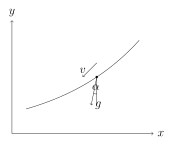
Define the terms work, energy, and power. A motor-car can travel with speed \(U\) up a slope of 1 in \(a\) and with speed \(V\) down a slope of 1 in \(b\), the power of the engine remaining constant. If the resistance is proportional to the square of the speed, find the maximum speed attainable on a level road. Find also equations for the speed attainable up a slope of 1 in \(c\), and down such a slope. [A slope of 1 in \(a\) is here defined as a slope where the car rises 1 ft. in travelling \(a\) ft. along the road.]
A locomotive working at constant power \(P\) draws a total load \(M\) against a constant resistance \(R\). It starts from rest. Show that the distance travelled in reaching the speed \(v_1\) is $$\frac{Mv_0^2}{R}\left[\log\frac{v_0}{v_0 - v_1} - \frac{1v_1^2}{v_0 2v_0^2}\right],$$ where \(v_0 = P/R\). What is the time taken to reach the speed \(v_1\)?
A plane is inclined at an angle \(\alpha\) to the horizontal. Its surface is rough, but not uniformly rough, the coefficient of friction \(\mu\) being proportional to the distance \(r\) from a point \(O\) in the plane, \(\mu = kr\). A particle of mass \(m\) is placed on the plane at \(O\) and released from rest. How far does the particle travel before it comes to rest, and how long is it in motion before it comes to rest? Verify that the work wasted through friction is equal to the potential energy lost.
A smooth wire is in the form of one bay of a cycloid (with intrinsic equation \(s = 4a\sin\psi\)) vertical and concavity upwards. A bead of mass \(m\) slides down the wire from rest at the highest point under the action of gravity \(g\). Find the reaction of the wire when the particle reaches the point where the tangent is inclined at angle \(\psi\) to the horizontal. Show also that the magnitude of the resultant acceleration of the particle remains constant throughout the motion.
A train of mass \(M\) is pulled by its engine against a constant resistance \(R\). The engine works at constant power equal to \(H\) units of work per second. Find the time taken for the velocity to be increased from \(v_0\) to \(v_1\) feet per second.
A particle of unit mass is projected vertically upwards with velocity \(v_0\) in a slightly resisting medium, the resistance being \(kgv^\lambda\), where \(v\) is the velocity and \(k, \lambda\) are constants; \(k\) is so small that \(k^2\) may be neglected. If the time which elapses before the particle returns to the point of projection is \(\frac{2v_0}{g}(1-\alpha)\), show that, to the first order in \(k\), \[ \alpha = k v_0^\lambda / (\lambda+2). \]
A particle of mass \(m\) is projected with velocity \(v_0\) at an inclination \(\psi_0\) to the horizontal in a medium whose resistance to the particle's motion is \(mkv^2\) at speed \(v\), where \(k\) is a constant. Prove that the horizontal component of the velocity decreases exponentially with the arc length traversed, and show that the length of the trajectory to the highest point of flight is \[ \frac{1}{2k} \log \{1+(kv_0^2/g)[\sin\psi_0+\cos^2\psi_0\log\tan(\frac{1}{2}\psi_0+\frac{1}{4}\pi)]\}. \]
A particle of unit mass is projected vertically upwards in a medium whose resistance is \(k\) times the square of the velocity of the particle. If the initial velocity is \(V\), prove that the velocity \(u\) after rising through a distance \(s\) is given by \[ u^2 = V^2 e^{-2ks} + \frac{g}{k}(e^{-2ks}-1). \] Deduce an expression for the maximum height of the particle above its point of projection.
A particle of mass \(m\) is projected with velocity \(v_0\) along a smooth horizontal table and the motion is opposed by a resistance \(mkv^3\), where \(v\) is the velocity of the particle after it has travelled a distance \(x\) in a time \(t\). Obtain the relations \[ \frac{2t}{x} = \frac{1}{v_0} + \frac{1}{v}; \quad t = \frac{x}{v_0} + \frac{1}{2}kx^2. \]
Obtain an expression for the energy required to raise a mass \(m\), initially at rest on the surface of the earth, to a height \(h\) above it with a final velocity sufficient to enable it to circle the earth continuously at that height, neglecting the effects of air resistance. (The acceleration due to gravity at a height \(x\) may be taken as \((\frac{r}{r+x})^2 g\) where \(r\) is the radius of the earth.)
A train of mass \(M\) travels along a horizontal track; the resistance to motion is \(kv^2\), where \(v\) is the velocity of the train. Show that, if the engine is assumed to work with constant power \(P\) and to start from rest, then the velocity of the train never exceeds \(\sqrt[3]{(P/k)}\), and that when the velocity is half this amount the distance gone is \((M/3k)\log(8/7)\).
A railway engine of weight \(W\) lbs. is moving initially at a steady velocity \(v_0\) under no external forces. It begins to pick up water at a rate of \(w\) lbs. per unit length travelled. How long will it take to pick up its own weight of water?
A particle of unit mass is allowed to fall from rest under gravity in a medium that produces on it a retardation equal to \(k\) times its velocity, and at the instant of release an equal particle is projected vertically downwards from the same place with initial speed \(v\). Show that their vertical distance apart tends ultimately to the value \(v/k\).
A unit mass at \(P\) moves in a horizontal straight line \(Ox\), and is subject to a force \(n^2x\) directed towards \(O\) where \(OP=x\), and to a resisting force which acts only if \(\dot{x}\) is positive, and has constant value \(na\) where \(a\) is positive. The mass is released from rest when \(x\) is negative and \(|x|=b\). Indicate briefly the nature of the subsequent motion and show that exactly \(r\) half-swings will be made before the mass comes finally to rest where \[ ra < (b^2+a^2)^{\frac{1}{2}} < (r+1)a. \]
A particle of mass \(m\) is projected horizontally with velocity \(V\) from the top of a tower which stands on a horizontal plain. The air resistance is \(mk\) times the velocity of the particle. What is the height of the tower if the particle hits the plain at a distance \(V/2k\) from the base of the tower?
A particle of mass \(m\) moves under gravity in a medium that opposes the motion with a resisting force \(kmv\), where \(k\) is a constant and \(v\) is the speed. If it is projected up vertically with speed \(v_0\), show that after time \(t\) its height above the point of projection is \[ \left(v_0 + \frac{g}{k}\right) \frac{(1-e^{-kt})}{k} - \frac{gt}{k}. \] Hence find the greatest height reached by the particle. \newline Show that subsequently the speed cannot exceed a certain finite value however far the particle falls.
A particle of mass \(m\) moves along a straight line in a resistive medium. It experiences a retarding force of magnitude \(\lambda v^3 + kv\), where \(v\) is its velocity and \(\lambda\) and \(k\) are positive constants. Given that the initial velocity of the particle is \(w\), find \(v\) as a function of time. Find \(v\) as a function of \(s\), the distance travelled, and show that \(s\) never exceeds \begin{equation*} \frac{m}{\sqrt{\lambda k}}\tan^{-1}\left(w\sqrt{\frac{\lambda}{k}}\right) \end{equation*}
A particle of unit mass is projected vertically upwards with initial speed \(V\). There is a resisting force \(kgv\), where \(v\) is the speed of the particle. Show that the particle reaches a maximum height above the point of projection \[\frac{1}{kg}\left\{V - \frac{1}{k}\ln(1 + kV)\right\}.\] Find the total time taken, and the distance below the point of projection, for the particle to attain speed \(V\) again. Can it always do this?
A particle of mass \(m\) is projected vertically upwards in a medium which resists the motion with a force \(mk v^2\), where \(v\) is the speed of the particle. Show that it reaches its greatest height in a time less than \(\pi/2\sqrt{(kg)}\), where \(g\) is the acceleration of gravity. If its speed of projection is \(u\), find its speed when it returns to ground level.
A ship has an engine which exerts a constant force \(f\) per unit mass. The resistance of the water varies as the square of the speed. Verify that if \(x\) is the distance travelled in a time \(t\) starting from rest and \(V\) is the maximum possible speed of the ship, then \begin{equation*} x = \frac{V^2}{f}\ln\cosh\frac{ft}{V} \end{equation*} is a solution of the equation of motion. If the ship is travelling at full speed, find the distance travelled before the ship can come to a stop on reversing the engines.
A car has two gears, and its performance (after allowing for air resistance and friction) is such that in bottom gear the acceleration is \(2C(V-v)\), and in top gear it is \(C(V-\frac{1}{2}v)\). Here \(v\) is the speed of the car, \(C\) and \(V\) are constants. The car is started from rest and accelerated as quickly as possible, the gear change occupying negligible time. Show that a speed \(v = 4V/3\) is reached after time \(C^{-1}\log 4/3\), and calculate the distance travelled by then.
A small bullet of mass \(m\) strikes the centre of one of the faces of a uniform cubical block of wood, of edge \(a\) and mass \(M\), at right angles. The block rests on a smooth horizontal plane. The bullet enters the wood at \(t = 0\), travelling with velocity \(v\), and it is then retarded by a force of magnitude \(ku\) where \(u\) is the velocity of the bullet relative to the block. Gravity and all other forces may be neglected, apart from the retarding forces between the bullet and the block and between the block and the plane. Show that, whilst in the block, the bullet has at time \(t\) travelled a distance \[\frac{v}{k}(1-e^{-kt}) + e^{-kt}\int_0^t G(s)e^{ks}\,ds\] through the block, where \(MdG/dt\) is the frictional force between the block and the plane, \(G(0) = 0\) and \(b = k(m+M)/mM\). Deduce that the bullet spends less time in the block than if the plane were smooth. Show that, if the bullet goes right through the block, it leaves with velocity \(v - ka/m\), and find the condition for it to do this if friction between block and plane can be neglected.
An airgun fires a shot of mass \(m\) vertically upwards, with velocity \(u\). In passing through the air its motion is resisted by a force equal to \(mg/u^2\), multiplied by the square of its velocity. Show that it will reach a height \(\frac{1}{2}(u^2/g)\log 2\), and find the velocity with which it hits the ground again.
A particle is moving in a straight line on a smooth horizontal plane. Its motion is opposed by a force proportional to the cube of the velocity. Show that:
- [(i)] the time taken to travel from a point \(A\) to a point \(B\) is the same as if the particle moved at a constant velocity equal to the harmonic mean of the velocities at \(A\) and \(B\);
- [(ii)] if \(C\) is the point in \(AB\) produced such that \(AB = BC\), then the velocity of the particle at \(B\) is the harmonic mean of the velocities at \(A\) and \(C\);
- [(iii)] the time taken to travel from \(A\) to any point \(X\) exceeds the time taken by a similar particle, starting from \(A\) with the same velocity but under no resistance, by an amount proportional to \((AX)^2\).
A train of mass \(m\) is driven by electric motors which exert a force. The force depends linearly on the velocity, decreasing to zero at a speed \(V\), and its resistance to its motion is \(m(2v/3V)^2\) at any speed \(v\). Find how far it has travelled from rest when it attains a given speed \(V\).
A particle of unit mass moves along a straight line under a constant force of magnitude \(2a\) directed along the line and is subject to the resistance \(a + 2bv + cv^2\), where \(v\) is speed. Prove that if \(a\), \(b\), \(c\) are positive and the particle starts with zero velocity at time \(t = 0\), then in the subsequent motion the displacement is given by \[\frac{1}{c} \log \frac{\cosh (kt + \alpha)}{\cosh \alpha} - bt/c,\] where \(k = (b^2 + ac)^{\frac{1}{2}}\) and \(\tanh \alpha = b/k\). Describe the nature of this motion.
A car of mass \(m\) moves in a straight line on a level road. It is acted on by a constant propulsive force \(kv^2\), and the motion is opposed by a resisting force \(kv^2\) when the speed is \(v\). Prove that the steady speed at which the car can travel is \(c\), and that if it starts from rest it attains the speed \(v\) when it has travelled a distance \[ \frac{m}{2k} \log \frac{c^2}{c^2-v^2}. \] If the mass of the car is one ton, the steady speed is 60 miles per hour, and the horse-power developed by the engine at this speed is 30, find, correct to the nearest foot, the distance travelled when the car attains a speed of 30 miles per hour. [Assume \(g = 32\) ft. sec.\(^{-2}\).]
A particle moving under gravity in a medium offering resistance proportional to the speed suffers an explosion in which it splits into two parts of equal masses, the speed being relative one to the other not necessarily in the same direction as the combined velocity of the undivided particle immediately before the explosion. Prove that at any subsequent instant the distance separating the two fragments is given by $$d = \frac{v}{k}(1 - e^{-kt}),$$ where \(v\) is the initial relative velocity and \(k\) is a constant.
An engine and train of combined weight \(W\) tons can attain a limiting speed of \(V\) ft. per sec. on a level track. If the engine is assumed to exert a constant force equal to \(P\) tons under all conditions, and if the resistance to the motion at speed \(v\) ft. per sec. is taken as \(a+bv^2\) tons, where \(a\) and \(b\) are constants, show that the horse-power developed by the engine when the train is climbing steadily an incline of angle \(\alpha\) is \[ 4\cdot073\; PV \left\{1 - \frac{W\sin\alpha}{P-a}\right\}^{\frac{1}{2}}. \]
A ball of unit mass is thrown vertically upwards with velocity \(u\), and is subject to a resistance of magnitude \(k\) times the velocity. Show that it comes to rest after a time \(\frac{1}{k}\log(1+\frac{ku}{g})\) has elapsed, and find the height above the point of projection at that instant. It is desired to throw the ball to a height \(h\). Show that the least velocity required to achieve this is approximately \[ u = u_0\left(1+\frac{k}{3}\sqrt{\frac{2h}{g}}\right), \] where \(u_0\) is the corresponding minimum velocity in the absence of any resistance, and where \(k\) is so small that powers of \(k\sqrt{h/g}\) above the first may be ignored.
A particle is allowed to fall from rest under gravity in a medium offering resistance per unit mass \(\kappa v+\lambda v^2\), where \(v\) is the velocity of the particle, and \(\kappa\) and \(\lambda\) are positive constants. Show that at any time \(t\) after release the particle moves with velocity \(v\) given by \(v+\mu=(u+\mu)\tanh\{\lambda(u+\mu)t+\alpha\}\), where \(\mu=\kappa/2\lambda\), \(\alpha=\tanh^{-1}\mu/(u+\mu)\), and where \(u\) is the positive quantity defined by the equation \(\lambda u^2+\kappa u-g=0\). Deduce that there is a limiting velocity and state its value.
In starting a train the pull of the engine is at first a constant force \(P\), and after the speed attains a certain value \(u\) the engine works at a constant rate \(R=Pu\). Prove that the time \(t\) required for the engine to attain a speed \(v\), greater than \(u\), is given by \[ t = \frac{1}{2}\frac{M}{R}(v^2+u^2), \] where \(M\) is the total mass of the engine and train. Find also the distance travelled at this time in terms of \(v\). Calculate the time and distance taken in attaining from rest a speed of 45 m.p.h. if the total mass is 300 tons, the initial pull of the engine is 12 tons, and its horse-power is 420.
A particle moves in a medium that resists the motion with a force proportional to the speed. Prove that, if the particle falls vertically under gravity, the speed approaches a limiting value, \(w\) say. Show that, if the particle is projected vertically upwards with a speed \(V\) that is small compared with \(w\), it reaches its starting point again after a time \[ \frac{2V}{g} \left(1 - \frac{1}{3} \frac{V}{w}\right), \] approximately.
A particle of mass \(m\) is projected vertically upwards under gravity with initial velocity \(V\tan\alpha\), and the resistance of the air is assumed to be of magnitude \(mg(v/V)^2\) when the velocity of the particle is \(v\). Show that the particle returns to the point of projection with velocity \(V\sin\alpha\). If \(\tan\alpha\) is small, prove that the height attained by the particle is less than it would be if there were no air resistance by \(\frac{1}{3}V^2g^{-1}\tan^4\alpha\), approximately.
A train moves from rest under a force \(P-kv^2\), \(k\) being a constant and \(v\) the velocity. Shew that the time taken to reach two-thirds of the greatest possible velocity is \(t_0 \log_e 5\), where \(t_0\) is the time that would be taken to reach the same velocity, if the force remained constant at the value \(P\), and that the distance moved in acquiring that velocity is \(s_0 \log_e \frac{9}{5}\), where \(s_0\) is the corresponding distance if the force remained constant.
A truck runs down an incline of 1 in 100; the resistance to motion is proportional to the square of the speed, and the terminal velocity is 40 miles per hour. Prove that the truck, starting from rest, acquires a velocity of 20 miles per hour in a distance of about 1550 feet.
A heavy particle is projected vertically upwards with velocity \(v\) in a medium that produces a resistance \(g(\text{velocity})^2/V^2\) per unit mass, where \(g\) is the acceleration of gravity and \(V\) a constant. Prove that the particle returns to the point of projection after a time \[ \frac{V}{g}\left(\tan^{-1}\frac{v}{V} + \sinh^{-1}\frac{v}{V}\right). \]
In sinking a caisson in a muddy river bed the resistance is found to increase in direct proportion to the depth in the mud. A caisson weighing 6 tons sinks 4 feet under its own weight before coming to rest. Shew that, if a load of \(S\) tons is then suddenly added, it will sink 16 inches further.
The weight of a car is 3200 pounds and the resistance to its motion consists of a constant frictional resistance of 34 pounds weight and a wind resistance proportional to the square of its speed. If the engine exerts a constant pull of 100 pounds weight and the maximum speed attainable is 45 miles per hour, determine its acceleration at 30 miles an hour, and shew that the distance traversed in speeding up from 15 to 30 miles an hour is 1551 feet, given \(\log_e 2 = \cdot 69315\), \(\log_e 10 = 2\cdot 30258\).
Show that in rectilinear motion the time taken for any change of velocity is given by the area of the curve connecting the reciprocal of the acceleration and the corresponding velocity. A tramcar starts from rest with an acceleration of 3 ft. per sec. per sec.; the relation between acceleration and speed is linear and the acceleration is 1 ft. per sec. per sec. when the speed is 5 miles an hour. Prove graphically or otherwise that the time taken to reach this speed is 4\(\cdot\)03 seconds. [\(\log_{10} e = \cdot 4343\).]
The resistance of the air to bullets of given shape varies as the square of the velocity and the square of the diameter, and for a particular bullet (diameter 0.3") is 40 times the weight at 2000 f.s. For an exactly similar bullet of the same material (diameter 0.5") show that the velocity will drop from 2000 f.s. to 1500 f.s. in about 500 yards, assuming the trajectory horizontal. [\(\log_e 10 = 2.30\).]
A particle of mass \(m\) is projected with velocity \(U\) horizontally and \(V\) vertically; gravity is constant with magnitude \(g\). Obtain the components of velocity as functions of time, and find the time of flight and the range to the point where it returns to its starting level. Slight air resistance, providing a force \(mk\) times the velocity, has now to be allowed for; \(k V/g\) is much less than unity. Approximating the vertical resistive force by using the velocity component found in (i), or otherwise, show that to first order in \(k V/g\) the time of flight is decreased by a fraction \(kV/3g\).
A soaring bird of weight \(mg\) experiences a lift force \(L\) perpendicular to the velocity of the air relative to the bird, and a drag force \(D\) parallel to it. This relative velocity has magnitude \(U\) and makes an angle \(\theta\) with the horizontal. \(L\) and \(D\) are given by \begin{align} L = \alpha U^2, \quad D = \beta U^2 + \gamma/U^2 \end{align} where \(\beta\) and \(\gamma\) are constants and \(\alpha\) can be varied by the bird up to a maximum value \(\alpha_{\text{max}}\). Show that the bird can glide with constant relative velocity \(U\) only if \(U\) satisfies \begin{align} \left(\frac{mg\cos\theta}{\alpha_{\text{max}}}\right)^{\frac{1}{2}} \leq U < \left(\frac{mg\sin\theta}{\beta}\right)^{\frac{1}{2}} \end{align} Find the value of \(U\) at which \(D\) is a minimum. The bird glides stably if a small increase in \(U\), with \(\theta\) fixed, leads to a resultant force in the direction of \(-\mathbf{U}\), and a small decrease to a resultant force in the opposite direction. Show that stable gliding is possible only if \begin{align} \left(\frac{mg\sin\theta}{2\beta}\right)^{\frac{1}{2}} < U \end{align}
The motion of a boomerang is illustrated by a particle of mass \(m\) moving in a horizontal plane with instantaneous speed \(v\) under the action of a tangential resistive force \(mkv^2 \cos \alpha\) and a normal force \(mkv^2 \sin \alpha\) tending to deflect the particle to the right, where \(\alpha\) is a constant acute angle. What is the shape of its path? If it is projected with speed \(v_1\), show that it returns to the point of projection after a time $$\frac{e^{2\pi \cot \alpha} - 1}{kU \cos \alpha}.$$
A particle of unit mass is projected from level ground with speed \(u\sqrt{2}\) at an elevation of \(\frac{1}{4}\pi\) above the horizontal. It experiences a resisting force directly opposing its motion whose magnitude is \(k\) times the square of the particle's speed, where \(ku^2/g\) is a small number. Show that, after a lapse of time \(t\) during the flight, the vertical component of the acceleration is approximately equal to \[-g-k(u-gt) \{(u-gt)^2 + u^2t^2\}^{\frac{1}{2}}.\] Deduce that the highest point of the trajectory is attained when \(t\) is approximately equal to \[\frac{u}{g} - \frac{ku^3}{3g^2}(2^{\frac{1}{2}}-1).\]
A particle is projected from the origin with velocity \(u\) in a direction making an angle \(\alpha\) with the horizontal in a medium that resists the motion by a force \(kv\) per unit mass, where \(v\) is the velocity of the particle. Write down the Cartesian equations of motion of the particle, and hence show that the trajectory is given by $$y = \frac{g}{k^2}\log\left[1-\frac{kx}{u\cos\alpha}\right] + \frac{x}{u\cos\alpha}\left[u\sin\alpha + \frac{g}{k}\right].$$ Show further that the maximum height is attained after a time $$\frac{1}{k}\log\left[1+\frac{ku\sin\alpha}{g}\right].$$ Verify that on passing to the limit \(k \to 0\), these results reduce to those obtained by omitting the resistance in the original equations.
A particle of mass \(m\) falls in a vertical plane from rest under the influence of constant gravitational force \(mg\) and a force \(mkv\) perpendicular to its velocity, where \(k\) is a constant. Write down expressions for \(v\) and the curvature of its path after it has fallen through a vertical distance \(y\). Show that \(y\) never exceeds \(2g/k^2\).
A particle whose horizontal and upward vertical co-ordinates are \(x\) and \(y\), respectively, moves under gravity in a resisting medium in which the retardation always acts in a direction opposite to the velocity. Show that at time \(t\) $$\frac{d^2y}{dx^2} = -g \left( \frac{dx}{dt} \right)^2,$$ where \(g\) is the acceleration due to gravity. Show also that \(\psi\), the inclination to the horizontal of the tangent to the path when the particle is at a height \(y_0\), is given by $$\tan \psi = \int_{y'}^{y_0} 2g \left( \frac{dx}{dt} \right)^2 dy,$$ where \(y'\) is the maximum height attained. Deduce that the angle at which the particle strikes the ground exceeds the angle of projection whatever the form of the retardation as a function of velocity.
A car is moving along a straight horizontal road at a speed \(v\). It is desired to fire a shell which hits the car from a gun placed a distance \(p\) from the road, the trajectory of the shell being along horizontal. The gun fires the shell with muzzle velocity \(v_0\) immediately. The resistance to the motion is \(kv^2\) per unit mass when the speed of the shell is \(v\). Determine the resistance to the point that, when \(kp\) and \(v/v_0\) are small quantities of the same order of magnitude, the value of \(\alpha\) is approximately \(\frac{1}{2}\pi - (1 + \frac{1}{2}kp) u/v_0\).
A particle of unit mass is projected with speed \(v\) at an inclination \(\theta\) above the horizontal in a medium whose resistance is \(k\) times the velocity. Find the time \(T\) that elapses before the motion of the particle is inclined below the horizontal at the same angle \(\theta\). Is the particle above or below the point of projection after this time \(T\) has lapsed?
A straight river of unit width is flowing with speed \(w\), and a swan starts and swims across, always endeavouring to reach the point \(O\) on the opposite bank directly opposite its starting point. The speed of the swan relative to the water is constant and equal to \(u\) (where \(u > w\)). If \(Or\) is taken along the river bank to correspond perpendicular to it across the river, show that the path of the swan has equation $$2x = y^{1-c} - y^{1+c},$$ where \(c = w/u\).
A particle is projected from a point \(O\) with velocity having components \(u\) and \(v\) horizontally and vertically upwards respectively, and moves under gravity and a resisting force per unit mass of \(k\) times the square of the resultant velocity in the reverse direction of this velocity. Show that at the point on the path at a distance along the path of \(s\) from \(O\), the horizontal component of the velocity is \(ue^{-ks}\). By considering the special case when \(u\) is zero, show that in general the vertical height attained above \(O\) cannot exceed $$\frac{1}{2k}\log_e\left(1+\frac{kv^2}{g}\right).$$
A particle of mass \(m\) is projected vertically upwards with speed \(v_0\). The resistance to its motion when its speed is \(v\) is \(kmv^2\). Show that it reaches the height \[ \frac{1}{2k} \log\left(1+\frac{kv_0^2}{g}\right). \] If it returns to the point of projection with speed \(v_1\), prove that \[ \frac{1}{v_1^2} - \frac{1}{v_0^2} = \frac{k}{g}. \]
A particle of mass \(m\) is projected vertically upwards in vacuo with speed \(u\). Prove that it returns to the point of projection after a time \(2u/g\). If the motion takes place in a resisting medium offering a resistance \(km|v|\) when the speed is \(v\), prove that the particle returns to the starting point after a time \(t_0\) given by the equation \[ 1-e^{-kt_0} = \frac{kgt_0}{g+ku}. \]
A particle is projected from a point \(O\) with velocity \(u\) at an angle \(\alpha\) to the horizontal and moves under gravity in a medium offering a resistance per unit mass of \(kv\), where \(v\) is the speed and \(k\) is a positive constant. Prove that there is a fixed direction in which the component of velocity is constant, and show that the value \(V\) of the component is related to the velocity \(u_0\) at the highest point of the path by the equations \[ V = \frac{g}{k}\cos\beta, \quad u_0 = \frac{g}{k}\cot\beta, \] where \(\beta\) is an acute angle. State the significance of the angle \(\beta\).
A bead is threaded on a rough wire bent in the form of a circle held fixed in a vertical plane. The coefficient of friction between the bead and wire is \(\frac{1}{\sqrt{2}}\). If \(u\) is the velocity of projection at the lowest point for the bead to come to rest at the level of the centre of the circle, and \(v\) is the velocity of projection downwards at this latter point for the bead to come to rest at the lowest point, prove that \[ u/v = \exp(\pi/2\sqrt{2}). \]
A particle moves in a straight line with retardation \(a^2v^3 + b^2v^5\). The initial velocity is \(a/b\). Shew that the time taken to reduce the velocity to \(\frac{a}{b\sqrt{3}}\) is \[ \frac{b^2}{a^3}(1-\log_e 2), \] and that the space moved in this time is \[ \frac{b}{a^2}(\sqrt{3}-1-\frac{\pi}{12}). \]
A long chain \(AB\) of mass \(\lambda\) lb. per ft. is laid upon the ground in a straight line. The end \(A\) is attached to a motor car which is then driven towards \(B\) with acceleration \(f\) ft. per sec.\(^2\), so that the chain is doubled back on itself. Neglecting friction between the chain and the ground, calculate the tension at \(A\) after \(t\) sec. Show that the kinetic energy of the chain is two-thirds of the work done by the car; explain why these quantities are not equal.
A balloon, whose capacity is 40,000 cubic feet, is filled with hydrogen, whose density is \(\cdot069\) that of air. Find the initial vertical acceleration when the temperature is 25\(^\circ\) C., if the total weight of envelope, car and passengers be 2500 lbs. The weight of a cubic foot of air at 0\(^\circ\) C. and at the pressure then prevailing is \(\cdot081\) lb.
Taking as rectangular coordinates the kinetic energy of a particle moving in a straight line and the reciprocal of the resultant force acting on it, and drawing a curve to represent the motion, shew that the distance travelled is represented by the area under this curve. Sketch the curve for the case of a vehicle driven by an engine which is working at constant horse-power, the only resistance being a force proportional to the square of the velocity. Shew that the velocity has a certain limiting value; and calculate the distance travelled while the velocity increases from a half to three quarters of this limiting value, taking the mass of the vehicle as 2000 pounds, the horse-power as 100, and the limiting velocity as 150 feet per second.
Air is to be compressed into a chamber of volume \(V\) by means of a pump. The pump has a cylinder of volume \(v\); it takes in air from the atmosphere, compresses it adiabatically, and forces it into the chamber through a non-return valve. Show that, neglecting the clearance of the pump, the pressure in the chamber after \(n\) strokes of the pump is \(\left(1 + n\frac{v}{V}\right)^\gamma\) times the pressure of the atmosphere. (\(\gamma\) is the ratio of specific heat at constant pressure to specific heat at constant volume.)
The effective tractive force acting on a car of mass 1 ton which starts from rest is initially 350 lb. wt. It decreases uniformly (1) at the rate of 7 lb. wt. for every 10 feet travelled, (2) at the rate of 14 lb. wt. every second. Show that the velocity after the car has run 200 feet in the first case will be equal to its velocity after 10 secs. in the second case. [\(g=32\).]
The effective horse-power required to drive a ship of 15,000 tons at a steady speed of 20 knots is 25,000. Assuming that the resistance consists of two parts, one constant and one proportional to the square of the speed, these parts being equal at 20 knots, and that the propeller thrust is the same at all speeds, find the initial acceleration when starting from rest, and the acceleration when a speed of 10 knots is attained. Shew that this speed is attained from rest in about 93 seconds and the distance traversed is about 271 yards. [One knot = 100 ft. per minute; \(\log_e 4 = 1.3863\), \(\log_e 3 = 1.0986\).]
A naval target is rising and falling on the waves with simple harmonic motion, the height of the waves from crest to trough being 6 feet and their period 10 seconds. At a range of 3000 yards a gun is sighted correctly and fired whilst the target is at the crest of a wave: by what distance will the shot miss the centre of the target, if the horizontal velocity of the shot be 2000 ft. per sec.?
A heavy particle is attached to a fixed point by a fine inextensible string of length \(a\), and is projected horizontally with velocity such that the string becomes slack when inclined at angle \(\theta\) to the upward drawn vertical. Shew that, when the string again becomes taut, it makes angle \(3\theta\) with the vertical, that the time of the free parabolic path is \(4 \sin\theta \sqrt{\frac{a}{g}\cos\theta}\) and that the velocity of the particle immediately after the impulse is \(\frac{1}{2}(2\cos 2\theta - \cos 4\theta)\sqrt{(ga \cos\theta)}\).
From a fixed orifice \(m\) pounds of water issue per second with velocity \(V\) feet per second. The jet impinges at once upon a smooth flat plate whose plane is inclined so that its normal makes an angle \(\theta\) with the direction of the jet. If the plate is moved in the same direction as the jet with a velocity \(v\) feet per second and the water does not rebound from the plate, show that the power delivered by the jet to the plate is a maximum when \(v=\dfrac{V}{3}\) and obtain an expression for this maximum power.
A particle of mass \(m\) moves in a straight line under a force \(mf(t)\); the motion is opposed by a resistance \(mkv\) where \(k\) is constant and \(v\) is the velocity. The function \(f(t)\) has the constant value \(F\) when \(0< t< T, 2T
A bead can slide on a straight wire of unlimited length, and the wire can rotate in a horizontal plane about a fixed point \(O\) of itself. The coefficient of friction between the wire and the bead is \(\mu\). The system is at rest with the bead at a distance \(a\) from \(O\), and the wire is then suddenly set in motion and made to rotate with constant angular velocity \(\omega\). Show that, if \(\mu g > a\omega^2\), the bead will remain at rest relative to the wire, but that, if \(\mu g < a\omega^2\), it will move outwards so that its distance \(r\) from \(O\) satisfies the differential equation \[ \ddot{r} - \omega^2 r + \mu (4\omega^2 r^2 + g^2)^{\frac{1}{2}} = 0 \] (where the positive square root is to be taken in the third term). In the latter case prove that the variable \(x\) defined by \[ \omega^2 x = (4\omega^2 r^2 + g^2)^{\frac{1}{2}} \] satisfies the differential equation \[ \frac{dx}{dr} = 4\left(\frac{r}{x} - \mu\right). \]
A light inelastic string, of length \(2l\), is fixed at its upper end; it carries a particle of mass \(m\) at its mid-point and a particle of mass \(M\) at its lower end. The particles move in a vertical plane so that the upper and lower portions of the string make angles \(\theta\) and \(\phi\) respectively with the vertical, and on the same side of it. If the angular displacements \(\theta, \phi\) are small, write down the equations of motion of \(m\) and \(M\), neglecting quantities of order higher than the first. Show that solutions of these equations can be obtained by assuming that \(\phi=k\theta\), where \(k\) is a constant. In particular, describe the corresponding motions when \(m=3M\).
A particle lies on a horizontal plank at a distance \(a\) to the right of a point \(O\) of the plank. The coefficient of friction between the particle and the plank is \(\mu\). The plank is then rotated with constant positive angular velocity \(\omega\) about a horizontal axis through the point \(O\) of the plank and perpendicular to its length. Show that when the particle begins to move \[ \ddot{x} \pm 2\mu\omega\dot{x} - x\omega^2 = -g\sec\alpha\sin(\omega t\pm\alpha), \] where \(x\) is the distance of the particle from \(O\) and \(\tan\alpha=\mu\), the positive or negative sign being taken according as the particle moves away from or towards \(O\). Also show that, if \(\mu< 1\) and \(a > g\mu\omega^{-2}\), the particle begins to move outwards at once, but that, if \(\mu< 1\) and \(0 < a< g\mu\omega^{-2}\), the particle begins to move inwards at time \(t\) given by \[ \omega t = \alpha + \sin^{-1}(\omega^2 a \cos\alpha \cdot g^{-1}). \] Discuss the cases that arise when \(\mu>1\).
A light uniform elastic string of natural length \(8l\) and modulus \(\lambda\) has its ends fixed at two points \(A\) and \(D\) at a distance \(8a\) apart. Two particles, each of mass \(m\), are attached to the string at \(B\) and \(C\) respectively, so that in equilibrium (gravity being neglected throughout) \(AB=CD=3a, BC=2a\). The system is then set in motion by giving the particle at \(B\) a velocity \(u\) towards \(C\). Denoting by \(x\) and \(y\) the displacements of the particles from their equilibrium positions, measured in the same sense, show that, if all parts of the string remain taut, then \(x+y\) and \(x-y\) vary in simple harmonic manner with periods \(2\pi/p\) and \(\pi/p\) respectively, where \(p^2=\lambda/3ml\). Find the largest value of \(u\) such that all parts of the string remain taut.
The point of suspension of a simple pendulum with a bob of mass \(m\) is made to move in a horizontal straight line with constant acceleration \(f\); if \(3f^2=g^2\), and if the string is initially at rest and vertical with the bob vertically below the point of suspension, find the greatest angle the string makes with the vertical in the motion. Also show that the maximum tension in the string is \(2(\sqrt{3}-1)mg\).
A particle hangs in equilibrium from the ceiling of a stationary lift, to which it is attached by an elastic string (of natural length \(l\)) extended to length \(l+a\). The lift descends, moving for time \(T\) with constant acceleration \(f\) and subsequently with constant velocity. Prove that, if \(f < g\), the string never becomes slack, and show that the amplitudes of the oscillations before and after time \(T\) are respectively \(af/g\) and \(2af|\sin\frac{1}{2}nT|/g\), where \(n^2=g/a\).
Establish the equivalence of the two definitions of simple harmonic motion in a straight line (i) as the projection of uniform circular motion, (ii) as motion under an acceleration proportional to the distance \(x\) from a fixed point \(O\) in the line and directed towards \(O\). In such a motion the speed is 16 cm./sec. when \(x=6\) cm., and equals 12 cm./sec. when \(x=8\) cm. Find the amplitude and period of the motion. In simple harmonic motion, show that the energy, averaged with respect to time, is one-half kinetic and one-half potential. If in the above example the mass of the moving particle is 50 gm., find the total energy, stating in what units this energy is measured.
A particle of mass \(m\) is suspended from a fixed support by a light elastic string. When the mass is in equilibrium the extension of the string is \(c\). Show that, when the extension of the string is \(x\), the energy stored in the string is \(\frac{1}{2}m\omega^2 x^2\), where \(\omega^2=g/c\), and prove that, for vertical oscillations (in which the string does not become slack) about the position of equilibrium, the length of the equivalent simple pendulum is \(c\). If the mass is pulled vertically downwards a distance \(kc\) (\(k>1\)) below the position of equilibrium and released from rest, show that the mass first reaches the highest point of its path in a time \[ \{\pi + \text{cosec}^{-1} k + (k^2-1)^{\frac{1}{2}}\}/\omega. \] It may be assumed that \(k\) is such that the mass does not rise as high as the support.
A particle is attached to a point \(P\) of a light uniform elastic string \(AB\). The ends of the string are fixed to points in a vertical line, and the particle oscillates along this line. Show that, provided that the two parts of the string remain taut, the motion is simple harmonic. Show also that the period is the same whatever the distance between the points to which \(A\) and \(B\) are attached and whichever end of the string is uppermost.
A see-saw consists of a smooth light frame \(ABC\) in the form of an isosceles triangle (\(AC=BC\)), freely pivoted at the mid-point \(D\) of \(AB\), and with a mass \(M\) attached at \(C\), where \(CD=h\). A particle of mass \(m\) is placed near \(D\). Assuming that when \(AB\) is inclined at \(\alpha\) to the horizontal the acceleration of the particle along \(AB\) is \(g\sin\alpha\), and that the amplitude of motion is so small that the reaction of the particle on the see-saw may be taken as \(mg\) perpendicular to \(AB\), show that (approximate) simple harmonic motion is possible, in which the oscillations of the particle along \(AB\) are in phase with those of the frame of the see-saw. Obtain equations giving the ratio of the amplitudes of these oscillations, and the frequency.
A particle of mass \(m\) is attached by an inextensible string of length \(l\) to a ring, also of mass \(m\), which can slide on a fixed smooth horizontal rod. The system is released from rest with the string taut, nearly vertical, and in a vertical plane below the rod. Prove that the ring and the particle perform approximately simple harmonic oscillations, and find their period.
An arc of a circle formed of thin uniform wire hangs at rest under gravity from a point \(P\) of the arc; \(Q\) is the point of the circle (not necessarily on the arc) vertically below \(P\). If the wire oscillates freely about \(P\) in a vertical plane through \(P\), prove that the equivalent simple pendulum is of length \(PQ\).
Two fixed points \(A\) and \(B\) are on the same horizontal level and a distance \(2l\) apart. They are joined by an elastic string, of natural length \(2l\) and modulus of elasticity \(\lambda\), which carries a particle of mass \(m\) at its mid-point. The particle is released from a point vertically below the mid-point of \(AB\). Prove that its equation of motion is \[ m\ddot{y} = mg - \frac{2\lambda y}{l}\left(1-\frac{l}{\sqrt{(l^2+y^2)}}\right), \] where \(y\) is its distance at time \(t\) below the mid-point \(AB\). Given that \(\lambda=mg/\sqrt{3}\), prove that the particle can rest in equilibrium when \(y=l\sqrt{3}\), and find the period of small vertical oscillations about the position of equilibrium.
A compound pendulum consists of a plane lamina which can swing about a horizontal axis perpendicular to the plane of the lamina. The axis can be made to pass through either of two points \(A_1, A_2\) in the lamina. The distances of the centre of gravity of the lamina from \(A_1\) and \(A_2\) are \(h_1\) and \(h_2\). The period of small oscillations when swinging about \(A_1\) is \(T_1\), and when swinging about \(A_2\) is \(T_2\). Prove that \[ \frac{8\pi^2}{g} = \frac{T_1^2+T_2^2}{h_1+h_2} + \frac{T_1^2-T_2^2}{h_1-h_2}, \] if \(h_1 \ne h_2\).
Two light elastic strings \(AB, BC\) are connected at \(B\) and attached to points \(A\) and \(C\) respectively which are at the same level and distance \(2l\) apart. The strings each have unstretched length \(l\) and modulus of elasticity \(\lambda\). A weight \(w\) is placed at \(B\). If the weight remains in equilibrium when \(AB=BC=2l\), show that \(w=\lambda/\sqrt{3}\). The weight is given a small vertical displacement from its equilibrium position and then released. Find the period of the small oscillations which it performs.
Explain what is meant by simple harmonic motion. Derive and solve the differential equation of such motion. A particle is describing simple harmonic motion with period \(2\pi/n\) and its velocities at two points distance \(h\) apart are \(u\) and \(v\). Show that the square of the amplitude of the motion is \[ \tfrac{1}{4}\{h^2 + 2(u^2+v^2)/n^2 + (u^2-v^2)^2/n^4h^2\}. \]
Explain what is meant by the ``equivalent simple pendulum'' for a rigid body free to rotate round a horizontal axis, and derive a formula for the length of the equivalent simple pendulum. Two equal uniform rods \(AB, BC\) each of length \(a\) are rigidly joined at \(B\) with the angle \(ABC\) a right angle. The system oscillates in a vertical plane about a smooth horizontal axis at \(A\). Find the length of the equivalent simple pendulum.
(i) If \(y = \sinh^{-1}x\), prove that for \(n>2\) \[ (1+x^2)\frac{d^ny}{dx^n} + x(2n-3)\frac{d^{n-1}y}{dx^{n-1}} + (n-2)^2 \frac{d^{n-2}y}{dx^{n-2}} = 0. \] (ii) Find the most general form of \(y\) which will satisfy the condition \[ y \frac{d^2y}{dx^2} = \left(\frac{dy}{dx}\right)^2. \]
A simple pendulum, consisting of a bob of mass \(m\) attached to a fixed point by a light string, executes small damped oscillations in a medium that produces a retarding force given by \(2\mu m\) times the speed of the bob. Show that the equation of motion can be written as \[ \frac{d^2x}{dt^2} + 2\mu\frac{dx}{dt} + \left(\mu^2 + \frac{4\pi^2}{p^2}\right)x = 0, \] where \(x\) is the displacement of the bob from the position of equilibrium and \(p\) is the observed period of the oscillations. \newline Initially the pendulum is set in motion with \(x=0, dx/dt=v\). At every half swing, when \(x=0\), an impulse \(I\) is applied in the direction of motion, and of such an amount that successive swings have the same amplitude. Show that \[ I = mv(1-e^{-\mu p/2}). \]
A particle of unit mass is attached to one end \(A\) of an elastic thread of natural length \(l\) and modulus \(\lambda n^2\), in a medium the resistance of which to the motion of the particle is \(2k\) times the speed. The other end \(B\) of the thread is fixed and the particle is held at a distance \(h\) below the fixed point. Show that when the particle is released its motion is given by the equation \[ \ddot{x}+2k\dot{x}+n^2x=0, \] as long as the string does not become slack, where \(x\) is the displacement of the particle from the equilibrium position. Find the subsequent motion in the cases: \[ \text{(i) } n^2 < k^2, \quad \text{(ii) } n^2=k^2, \quad \text{(iii) } n^2 > k^2, \] and discuss their physical significance. Develop in the same manner the case when the end \(B\) is forced to execute simple harmonic motion of period \(\dfrac{2\pi}{p}\).
The point of suspension of a simple pendulum of length \(l\) is made to move in a horizontal straight line so that its displacement from a fixed point \(O\) of the line is \(a \sin mt\) at time \(t\). The pendulum oscillates in a vertical plane through the line and makes a small angle with the vertical throughout the motion. Prove that \(x\), the horizontal component of the displacement at time \(t\) of the bob from \(O\), satisfies the equation \[ \frac{d^2x}{dt^2} + n^2x = n^2a \sin mt, \] where \(ln^2=g\); prove that if \(m \neq n\), a solution of this equation is \[ x = (A-\frac{1}{2}nat)\cos nt + B \sin nt, \] where \(A\) and \(B\) are arbitrary constants, and hence find the solution such that \(x=dx/dt=0\) when \(t=0\).
If \(\theta\) is the angular displacement of a simple pendulum of length \(l\) from the vertical, prove that \[ l \left(\frac{d\theta}{dt}\right)^2 = 2g (\cos \theta - \cos \alpha), \] where \(\alpha\) is the greatest value of \(\theta\). Deduce that the period is given by \[ 2 \left(\frac{l}{g}\right)^{\frac{1}{2}} \int_0^{\alpha} (\sin^2 \frac{1}{2}\alpha - \sin^2 \frac{1}{2}\theta)^{-\frac{1}{2}} d\theta. \] By making the substitution \(\sin \frac{1}{2}\theta = \sin \frac{1}{2}\alpha \sin \phi\) and expanding the integrand in powers of \(\sin \frac{1}{2}\alpha\), prove that the period is approximately \[ 2\pi \left(\frac{l}{g}\right)^{\frac{1}{2}} (1 + \frac{1}{16}\alpha^2) \] for small values of \(\alpha\).
A smooth straight tube is closed at one end \(O\), and is made to rotate about \(O\) in a vertical plane with constant angular velocity \(\omega\). A particle moves inside this tube. Initially the tube is vertically downwards and the particle is released from \(O\). If the particle is at distance \(r\) from \(O\) after a time \(t\), show that \[ \frac{d^2r}{dt^2} - \omega^2 r = g \cos \omega t, \] and hence that \[ 2\omega^2 r = g(\cosh \omega t - \cos \omega t). \]
A waggon of mass \(M\) carries a simple pendulum of mass \(m\) and length \(l\) which can swing in the direction of motion of the waggon. If \(V\) be the velocity of the waggon and \(\theta\) the inclination of the pendulum to the vertical, measured in a suitable sense, prove that the kinetic energy \(T\) of the system is given by the equation \[ 2T=(M+m)V^2+2mlV\dot{\theta}\cos\theta+ml^2\dot{\theta}^2. \] Show that, if the waggon is jolted into motion with initial velocity \(V\), then the initial value of \(\dot{\theta}\) is equal to the value of \(\omega\) which makes the quadratic form \[ (M+m)V^2+2mlV\omega+ml^2\omega^2 \] a minimum.
A light spring has natural length \(a\) and is such that when compressed a distance \(x\) it produces a force of magnitude \(kx\). It joins two particles of masses \(m_1\) and \(m_2\). The spring is compressed a distance \(b\) and the system released from rest on a smooth table, so that the particles move in a straight line. Find the positions of the particles at time \(t\) later.
Three linear springs each of modulus \(\lambda\) and natural length \(l\) are connected end to end and lie in a straight line on a smooth horizontal table. At each of the two points where the springs join, a mass \(m\) which is free to move is attached. The two ends of the composite spring are attached to the table, so that in equilibrium the springs are all stretched. If \(x\) and \(y\) denote small displacements of the masses from their equilibrium positions along the line of the springs, show that \begin{equation*} ml(\ddot{x}+\ddot{y})+\lambda(x+y) = 0 \end{equation*} and \begin{equation*} ml(\ddot{x}-\ddot{y})+3\lambda(x-y) = 0. \end{equation*} Describe exactly the subsequent motion if, at \(t = 0\), one of the masses is given a sudden unit velocity towards the second which is itself stationary.
A bead of mass \(m_1\) can slide freely and without friction on a straight horizontal wire. A second bead of mass \(m_2\) hangs from the first bead by a string of constant length \(l\). Find the frequency of small oscillations about the equilibrium configuration. [You may assume that the centre of gravity of the two beads does not move horizontally.]
A vibrating carbon dioxide molecule can be thought of as three particles constrained to move along a line, the outer two particles each of mass 16 units being joined to the central particle of mass 12 units by identical springs. If the displacements of the three particles from their equilibrium positions are \(x_1\), \(x_2\) and \(x_3\) (\(x_2\) referring to the central particle), write down the equation of motion for each particle. Show that these equations can be satisfied by two modes of vibration \begin{align*} \text{(I)} \quad &x_1 = \cos \omega t, \quad x_2 = 0, \quad x_3 = -\cos \omega t\\ \text{and} \quad \text{(II)} \quad &x_1 = \cos \Omega t, \quad x_2 = -A \cos \Omega t, \quad x_3 = \cos \Omega t \end{align*} with suitable choices of \(\omega\), \(\Omega\) and \(A\). Show that the ratio of the frequencies of the two modes is \(\sqrt{\frac{4}{3}}\).
An elastic string is held between two fixed supports P, Q which are a distance \(3d\) apart. The tension in the string is proportional to its extension, and is \(k^2md\) when the length of the string is \(3d\). A bead of mass \(m\) is attached to the string a distance \(d\) from P, and an identical bead is attached a distance \(d\) from Q. Find the equations of motion of small displacements \(\alpha\), \(\beta\) of the beads perpendicular to PQ. Ignore gravity and motion parallel to PQ. Show that \(\alpha + \beta\) and \(\alpha - \beta\) each undergo simple harmonic motion, and find the periods. Describe the motions corresponding to \(\alpha + \beta = 0\), and \(\alpha - \beta = 0\). At time \(t = 0\) \[\alpha = \alpha_0, \beta = \beta_0, \frac{d\alpha}{dt} = \frac{d\beta}{dt} = \gamma_0.\] Show that if \[\frac{(\alpha_0 + \beta_0)k}{2\gamma_0} = -\tan\left(\frac{\pi}{2\sqrt{3}}\right)\] then \(\alpha = \beta = 0\) at some subsequent time.
A particle is suspended from a fixed point by a light spring. If \(c\) is the extension of the spring when the particle hangs in equilibrium, and \(2\pi/\omega\) is the period of small vertical oscillations when equilibrium is disturbed, show that \(c\omega^2 = g\). From this particle is now suspended a second particle, of the same mass, by a similar spring. The particles are set in motion in a vertical line. Denoting the extensions of the upper and lower springs by \(2c + x\) and \(c + y\) respectively, write down the equations of motion. Show that two periodic motions each of the form $$x = a \cos \omega t, \quad y = b \cos \omega t$$ are possible, the frequencies being given by $$(\omega/\omega_0)^2 = \frac{1}{2}(3 \pm \sqrt{5}).$$ Find the corresponding values of \(b/a\).
Four equal stretched strings \(X_0X_1\), \(X_1X_2\), \(X_2X_3\), \(X_3X_4\), each of natural length \(l\), and modulus of elasticity \(\lambda lm\), lie in a straight line on a smooth horizontal table. The ends \(X_0\), \(X_4\) are fixed, and masses \(m\), \(nm\), \(m\) are attached to the points \(X_1\), \(X_2\), \(X_3\), respectively. The system performs oscillations along the line of the springs. Determine the equations of motion for the masses in terms of their displacements from their equilibrium positions. Show that if all the masses oscillate with the same period \(2\pi/p\), then in order to have a non-trivial solution, either \(p^2 = 2\lambda\), or \(p^2\) satisfies the equation \[(2\lambda - np^2)(2\lambda - p^2) = 2\lambda^2.\]
A particle \(Q\) of mass \(2m\) is attached to one end of a light elastic string \(PQ\) of length \(2a\) and modulus of elasticity \(\lambda\); a particle \(R\) of mass \(3m\) is attached to the mid-point of the string. The system is then hung in equilibrium from a fixed point \(P\). The particle \(Q\) is given a small downward impulse \(\epsilon\sqrt{\frac{m\lambda}{a}}\). After time \(t\) the ensuing displacements of \(Q\), \(R\) from the equilibrium position are \(x\), \(y\), respectively. Prove that \(\ddot{x} = -3\omega^2(x-y), \quad \ddot{y} = 2\omega^2(x-2y), \quad \text{where } \omega = \sqrt{\frac{\lambda}{6am}}.\) Verify that \(x = \epsilon\left(\frac{3\sqrt{6}}{10}\sin\omega t + \frac{1}{5}\sin\sqrt{6}\omega t\right)\) satisfies the initial conditions. Deduce that this is the correct solution for \(x\), by finding a similar formula for \(y\), which, together with that for \(x\), satisfies the equations of motion and the initial conditions. Is the motion periodic?
Two particles, each of mass \(m\), hang at the ends \(A\), \(B\) of two light inextensible strings, each of length \(a\), the other ends of which are fixed at the same level at a distance \(b\) apart. The particles are joined by a light spring of natural length \(b\) and modulus \(\lambda\) and initially the system is at rest in its equilibrium position. The particle at \(A\) is then struck by an impulse \(I\) directed towards \(B\). In the subsequent motion the angles \(\theta\), \(\phi\) which the strings make with the vertical (measured in the same sense) remain small. Show that \[\theta + \phi = -\frac{(g/a)(\theta + \phi)}{x}\] \[\theta - \phi = -\frac{(g/a)(1 + \epsilon)(\theta - \phi)}{x}\] where \(\epsilon = 2\lambda a/(mga)\), and hence find \(\theta\) and \(\phi\) as functions of \(t\). Defend the statement that, if \(\epsilon\) is small, the motion can be described as the repeated transfer, from particle \(A\) to particle and \(B\) back, of an oscillatory motion, with a repetition time approximately \(4\pi\sqrt{(a/g)\epsilon}\).
Two identical simple pendulums each of mass \(M\) and length \(l\), suspended from the same horizontal plane, are connected by a light straight spring (which is both inextensible and extensible) of natural length \(d\) and modulus of elasticity \(\lambda\), as shown in the figure. The system is released from rest with the pendulums coplanar and \(\theta\) and \(\phi\) small. Prove that the quantities \((\theta + \phi)\) and \((\theta - \phi)\) vary periodically with time, and find their approximate periods.
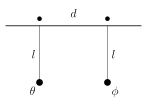
The elastic strings \(AB\), \(BC\) have unstretched lengths \(l\) and moduli of elasticity \(3\lambda mg\) and \(2\lambda mg\) respectively. \(A\) is attached to a fixed support and particles of mass \(m\) are attached at \(B\) and \(C\) and the system hangs in equilibrium vertically. The particles at \(B\) and \(C\) are now displaced vertically downwards through distances \(x_0\) and \(y_0\) respectively from their equilibrium positions and are then released. If the subsequent displacements of the particles from their equilibrium positions are \(x\) and \(y\), show that \(x + 2y\) and \(2x - y\) vary harmonically with time and find their periods. If \(y_0 = 2x_0\), find expressions for \(x\) and \(y\) as functions of the time. (It may be assumed that \(x_0\) and \(y_0\) are so small that neither string ever becomes slack.)
Two similar simple pendulums of length \(l\) are suspended at the same height. They have light bobs attached to the opposite ends of a light inextensible string also of length \(l\), so that they are pulled together, and the pendulums make a small angle \(s\) with the vertical. The pendulums are displaced at right angles to the original plane of the system through angles small compared with \(s\). Assuming that all the tensions maintain their original values to the degree of approximation necessary, show that the subsequent displacements of the pendulums can be represented by the sum and difference of two harmonic oscillations with slightly different frequencies. Deduce that if only one pendulum is displaced, the motion is concentrated in the other after a time approximately \((n/\alpha)\sqrt{(l/g)}\). Describe the motion.
Three springs of unit length and modulus \(M\) are joined together end to end and restricted to lie on a horizontal line. Two masses \(m\) are fixed to the junctions and the outer ends are held fixed. By taking the coordinates \(x_1\) and \(x_2\) to represent the displacements of the two masses from their respective positions of equilibrium, show that two simple harmonic motions are possible, in which either \(x_1 + x_2\) or \(x_1 - x_2\) is zero. What is the ratio of their periods? If the masses are released from rest at arbitrary values of \(x_1\) and \(x_2\), show that in general at no later time are both particles at rest.
A uniform rigid wire \(ABC\) consisting of a straight section \(AB\) of length \(2l\) at right angles to a straight section \(BC\) of length \(4l\) is freely suspended at \(A\). Show that in the position of stable equilibrium \(AB\) makes an angle \(\tan^{-1}4/5\) with the downward vertical. If the wire makes small oscillations in the vertical plane about the position of equilibrium, find the length of the equivalent simple pendulum.
A particle of unit mass moves in a plane under a force with components \[ (-ax - hy, -hx - by) \] referred to rectangular axes \(Ox, Oy\), where \(a, b\) and \(h\) are constants such that \(a>0, b>0, ab > h^2\). Show that there are two straight lines through \(O\) along which the particle can move in simple harmonic motion, and that these lines are orthogonal. Determine these lines and the corresponding periods of oscillation for the case \(a=13\), \(b=7\), \(h=3\sqrt{3}\).
A short train consists of an engine of mass \(M\) coupled to a single coach of mass \(m\) whose bearings are smooth. Between the engine and the coach there are two pairs of spring buffers of negligible mass, one pair being on the engine and the other on the coach. The coupling is such that, with the train at rest and the coupling taut, the buffers on the engine are just in contact with the corresponding buffers on the coach but none of the buffers are compressed. Each buffer has a compliance \(C\), compliance being the ratio of compression to force producing compression. When the train is in steady motion with uniform velocity along a straight track, brakes are applied, but only to the engine. The braking force is such that it would produce a retardation \(f\), if there were no coach. Prove that, after application of the brakes, the separation between engine and coach oscillates with frequency \[ \frac{1}{2\pi}\sqrt{\frac{M+m}{MmC}}. \] Prove further that, if this oscillation is damped out, the effect of the retardation is to reduce the separation between engine and coach by \[ \frac{MmCf}{M+m}. \]
Two particles of masses \(m, m'\) are attached to the middle point \(A\) and to the end point \(A'\) of a light inextensible string \(OAA'\) of length \(2l\). The end \(O\) is fixed and the system executes a small oscillation under gravity in a vertical plane through \(O\). If \(x, x'\) are the horizontal distances of the particles from the vertical line through \(O\) at time \(t\), and \(n^2=g/l\), prove that \begin{align*} m\frac{d^2x}{dt^2} + (m+2m')n^2x - m'n^2x' &= 0, \\ \frac{d^2x'}{dt^2} + n^2x' - n^2x &= 0, \end{align*} and hence show that if \(m=3m'\), a motion is possible in which \(x+x'=0\).
A point is moving with simple harmonic motion, of period \(2\pi/n\) and amplitude \(a\), in a straight line. If at any instant the distance of the point from its mean position is \(x\), show that the speed of the point is \(n\sqrt{a^2 - x^2}\). A mass \(m\) hangs at rest at the lower end of a light elastic string, of unstretched length \(l\) and modulus of elasticity \(\lambda\). A second mass \(m\), moving vertically upwards with velocity \(U\), impinges on the first mass and coalesces with it. Show that in the subsequent motion the string remains taut provided that \(\lambda U^2 < 6mlg^2\).
Two particles, \(A\), \(B\), of masses \(m_1\), \(m_2\) respectively, are connected by a light spiral spring, which obeys Hooke's law, and move on a smooth horizontal table along the line of the spring (supposed to remain straight). Write down the equations of motion of the masses in terms of their displacements \(x_1\), \(x_2\) and deduce that
- the centre of gravity \(G\) of the system moves with constant velocity;
- the distance \(x_2 - x_1\) between \(A\) and \(B\) varies harmonically;
- the distance of either mass from \(G\) varies harmonically with the same period as \(x_2 - x_1\).
A particle of mass \(m\) is attached by two elastic strings of different moduli of elasticity to two points \(A, B\) of a horizontal table. The unstretched lengths of the strings are \(a,b\) and the stretched lengths in the equilibrium position \(a', b'\). If the periods of small oscillations in the directions along \(AB\) and perpendicular to \(AB\) are \(2\pi/n_1\) and \(2\pi/n_2\) respectively, shew that \[ n_1^2 = \frac{1}{m}(\frac{\lambda_1}{a}+\frac{\lambda_2}{b}) \quad \text{This seems to be missing from the OCR, I will transcribe what is there.} \] shew that \[ n_2^2 = \frac{1}{m}(\frac{1}{a'} + \frac{1}{b'}) \quad \text{This seems to be missing from the OCR, I will transcribe what is there.} \] \[ n_1^2 = \dots \quad \frac{1}{a'} + \frac{1}{b'} \] \[ n_2^2 = \dots \quad \frac{1}{a'-a} + \frac{1}{b'-b} \] % The OCR is extremely garbled for this question. I'm transcribing the visible fragments. The formulas seem to be definitions for n1^2 and n2^2. % A reasonable guess would be: % \frac{n_1^2}{m} = \frac{\lambda_1}{a'-a} + \frac{\lambda_2}{b'-b} % \frac{n_2^2}{m} = \frac{T_1}{a'} + \frac{T_2}{b'} = \frac{\lambda_1(a'-a)}{a a'} + \frac{\lambda_2(b'-b)}{b b'} % But I will transcribe what is there: \[ n_2^{-2} = \frac{1}{a'} + \frac{1}{b'} \] \[ n_1^2 = \frac{1}{a'-a} + \frac{1}{b'-b} \] % This is almost certainly wrong, but it's what's printed.
A light inelastic string ABC, of length \(2a\), has a particle of mass \(m\) attached at its mid-point B, and a second particle of mass \(m\) is attached to the end C. The end A is fixed, and the particle at C is constrained to move, without friction, on the vertical line through A. The particle at B moves in a vertical plane through A. Prove that, if the system executes small oscillations about the position of stable equilibrium, the length of the equivalent simple pendulum is \(a/3\). Prove also that, if the amplitude of the motion of AB is a small angle \(\alpha\), the tensions in the two parts of the string when B is vertically below A are \(mg(2+9\alpha^2)\) and \(mg(1+6\alpha^2)\).
A particle of mass \(m\) moves on a straight line under a force \(mn^2r\) towards a fixed point \(O\) of the line, where \(r\) denotes distance from \(O\). Prove that the motion is periodic, with period \(2\pi/n\). A particle of mass \(m\) is attached to the mid-point of a light uniform elastic string, of natural length \(2a\). When the ends of the string are attached to fixed points at the same level and at a distance \(2a\) apart, and the particle hangs in equilibrium, the stretched length of the string is \(2b\). Prove that the period of a small vertical oscillation about the position of equilibrium is \(2\pi/n\), where \[ n^2 = \frac{b^2+ba+a^2}{b^2\sqrt{(b^2-a^2)}}g. \]
A uniform heavy bar of length \(2l\) hangs in equilibrium under gravity by means of two equal crossed strings that are attached to its ends and to two points distance \(2l\) apart at the same horizontal level at a height \(2h\) above the beam. If the motion of the bar is restricted to the vertical plane through the points of suspension, show that, if \(h>l\), the period of small oscillations about the equilibrium position is \[ 2\pi\sqrt{\frac{2h(l^2+3h^2)}{3(h^2-l^2)g}}. \]
A particle rests on a smooth horizontal table and is constrained by two springs, attached to fixed points in the plane of the table, whose tensions are \(\mu_1\) and \(\mu_2\) times their lengths. It is started in motion in any manner so as to remain on the table and left to itself. Show that the projection of the motion on any direction is simple harmonic with the same period. What is the most general form of the path of the particle?
Two particles can move in the same straight line in a field of force per unit mass directed towards a point in that line and varying as the distance from that point. Shew that consecutive impacts between the particles take place at equal intervals of time and at one or other of two points in the line, and that the greatest distances between the particles during these intervals form a geometrical progression of ratio \(e\), where \(e\) is the coefficient of restitution between the particles.
A bifilar pendulum consists of two point masses at the ends of a light horizontal rigid rod of length \(2L\). This rod is suspended symmetrically by two thin vertical threads of length \(l\), separation \(2d < 2L\). Show that the frequency of small oscillations in which the system rotates about a vertical axis through the centre of the rod is smaller than that when the whole system performs small oscillations perpendicular to its equilibrium plane. [Vertical displacements may be neglected.]
A form of seismograph for detecting horizontal vibrations consists of a thin rod \(OA\) of length \(a\) supported horizontally as shown in the figure. \(O\) is a smooth pivot, and \(AB\) a light inextensible wire. Calculate the period of oscillation for free oscillations of small amplitude. [You may if you wish assume the conservation of energy after the initial disturbance.]
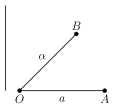
The pendulum of a grandfather clock comprises a thin uniform rod of mass \(m\) and of length \(2a\) which is fixed at one end and a circular disc of mass \(12m\) and radius \(a\) which can be clamped on to the rod so that its centre is on the rod. The clock is designed so that, when the centre of the disc is \(\frac{3}{4}a\) from the fixed end, each half period of the pendulum is exactly one second. By adjusting the position of the disc on the rod a clock can be made to gain or lose time. Neglecting the effect of any mechanism and assuming the pendulum to turn freely about its fixed end in the plane of the rod, calculate the maximum number of minutes which the clock can be adjusted \((a)\) to gain and \((b)\) to lose in one actual hour.
A circle of radius \(a\) lies inside a circle of radius \(2a\) and touches it. The two circles lie in the boundary of a uniform lamina which is free to rotate in a vertical plane about a fixed horizontal axis through a point \(P\) on the line of centres. Show that, as \(P\) is varied, the minimum period of oscillations of small amplitude is $$2\pi \left(\frac{a}{g}\right)^{\frac{1}{2}} \left(\frac{74}{9}\right)^{\frac{1}{2}}.$$
A thin uniform plate in the shape of a square \(ABCD\) is of mass \(M\) and side \(2a\), and can rotate freely and smoothly about the side \(AB\), which is horizontal. The plate is held along \(CD\) so that its plane is horizontal, and it is sufficiently rough to prevent the slipping of a particle of mass \(m\) on its upper surface, lying on the perpendicular bisector of \(AB\) at a distance \(d\) from it. Find the condition that the particle initially remains on the plate, and if it is satisfied find the initial angular acceleration of the plate. If the particle is now fixed firmly to the plate and the system performs small oscillations about its equilibrium position, find the length of the equivalent simple pendulum.
A thin uniform circular disc of radius \(r\) and mass \(6m\) is attached along a diameter to a thin uniform straight rod of length \(6r\) and mass \(m\). The compound pendulum so formed is suspended from one end and can oscillate about a smooth horizontal axis whose direction is normal to the plane of the disc. It is found that the length of the equivalent simple pendulum equals the distance of the centre of the disc from the axis. Find this length. A clock governed by this pendulum (making small oscillations) loses 1 min. every 24 hr. Show that this loss can be corrected by moving the disc along the rod a distance approximately 0.0076\(r\).
A rigid body consists of a thin heavy rigid wire in the shape of a circle of radius \(a\) and centre \(O\), and a heavy particle of negligible dimensions attached to the wire at a point \(P\) of its circumference. The body is suspended freely from a point \(Q\) of the circumference which can be varied at will. The body executes small oscillations in plane of the circle about the position of stable equilibrium. If \(l\) is the length of the equivalent simple pendulum, show that the least value of \(l\) is given by \(2a(1+2\lambda)\frac{1}{2}(1+\lambda)^{-1}\), where \(\lambda\) is the fixed ratio of the mass of the particle to that of the wire, and find the value of the angle \(POQ\) to give this value. Find also the greatest value of \(l\) and the corresponding values of the angle.
A uniform rod \(AB\) of mass \(m\) and length \(2a\) is suspended by light inextensible strings \(AC\) and \(BD\), each of length \(l\), from fixed points \(C\) and \(D\) which are at the same height and \(2a\) apart. Initially the rod is horizontal and the strings vertical. The rod is then twisted through an angle \(\theta\) and held in equilibrium in this position by a couple consisting of two horizontal forces applied to the rod. Calculate (i) the moment of the couple, (ii) the vertical displacement of the centre of the rod. The rod is allowed to oscillate freely about its equilibrium position, the motion consisting of a small angular rotation about a vertical axis together with a vertical displacement of the centre of the rod. Determine the frequency of the oscillations.
A particle of mass \(4m\) is attached by four elastic strings of natural length \(l\) and elastic modulus \(\lambda\) to the four corners of a horizontal square whose diagonal is \(2a\). Show that the system will be in equilibrium with the strings making an angle \(\theta\) with the horizontal, where \[ a\tan\theta-l\sin\theta = mgl/\lambda. \] Show also that the period of small vertical vibrations is \[ 2\pi\left(\frac{ml}{a}\left(1-\frac{l}{a}\cos^3\theta\right)\right)^{\frac{1}{2}}. \]
Two light elastic strings, \(AB\) and \(CD\), of the same unstretched length but of different elasticity, extend by amounts \(a\) and \(b\) respectively when a certain mass hangs in equilibrium on each in turn. Obtain expressions for the frequency of a vertical oscillation of the mass in each of the following cases:
- [(i)] when the ends \(A\) and \(C\) are attached to a fixed point and \(B\) and \(D\) are attached together to the mass;
- [(ii)] when \(A\) is attached to a fixed point and \(D\) to the mass, \(B\) and \(C\) being joined;
- [(iii)] when \(B\) and \(C\) are attached to the mass and \(A\) and \(D\) to fixed points so that the strings are stretched in a vertical line \(ABCD\).
Establish the equivalence of the two definitions of simple harmonic motion, (i) as motion of a point in a straight line under a restoring acceleration proportional to the distance from a fixed point in that line, (ii) as the projection of uniform circular motion on a diameter of the circle. A mass \(M\) hanging at rest from a light spring stretches it by a length \(c\). Show that, if \(M\) is slightly displaced vertically and allowed to oscillate, the period of oscillation is that of the small vibrations of a simple pendulum of length \(c\). While the mass \(M\) is hanging at rest a second mass \(M\) moving vertically upwards with velocity \((2gc)^{\frac{1}{2}}\) strikes it, and the masses adhere. Show that in the subsequent motion the spring is always extended from its unstretched length. Find the greatest and the least extensions of the spring during the motion.
A hollow cone (with base) is made out of thin material of uniform weight per unit area, and has semi-vertical angle \(\frac{1}{6}\pi\) and height \(h\). It is free to rotate about a horizontal axis through its vertex. Show that the length of the equivalent simple pendulum is \(27h/28\). [The thickness of the material may be neglected.]
A uniform heavy inelastic string, whose weight per unit length is \(w\), hangs freely under gravity with its ends held at the same level. Prove that, if \(\psi\) is the inclination to the horizontal of the tangent, and \(T\) is the tension, at a point of the string whose distance along the string from the lowest point is \(s\), then \begin{align*} s &= c \tan\psi, \\ T &= wc \sec\psi, \end{align*} where \(c\) is a constant. Two uniform rods \(AB\) and \(CD\), each of length \(2a\) and weight \(2aw\), are freely attached at \(A\) and \(C\) to fixed points at the same level. The ends \(B\) and \(D\) are joined by a uniform string, of length \(2a\) and weight \(2aw\), and the system hangs in equilibrium. If \(\theta\) is the inclination of either rod to the vertical, and \(\beta\) is the inclination to the horizontal of the tangent to the string at \(D\), prove that \[ 2\tan\theta\tan\beta=1. \]
A rigid body is free to swing, as a pendulum, about a horizontal axis. Find the length of the equivalent simple pendulum. A uniform rod \(AB\), of mass \(M\) and length \(2a\), hangs freely from a fixed pivot at \(A\), and a particle of mass \(6M\) is attached to the rod at distance \(x\) from \(A\). Prove that the length of the equivalent simple pendulum is \[ \frac{2}{3} \left( \frac{9x^2+2a^2}{6x+a} \right). \] If \(x\) can take any value from \(0\) to \(2a\), shew that the least value of this length is \(2a/3\), and find the greatest value.
The pendulum of a clock is a uniform rod, of length \(2a\) and mass \(M\), suspended from one end. The clock keeps good time, but a particle of mass \(kM\) gets attached to the lower end of the rod, and then it is found that the clock loses one minute in a day. Prove that \[ k = \frac{2n-1}{n^2-6n+3}, \] where \(n\) is the number of minutes in a day.
A uniform solid circular cylinder of weight \(W\) is placed on top of a fixed horizontal circular cylinder (of different radius) and has contact with it along its highest generator. The upper cylinder is slightly displaced and begins to roll down in contact with the lower cylinder. If the coefficient of friction between the surfaces is \(3/8\), prove that slipping begins when the inclination to the vertical of the plane through the axes is \(\cos^{-1}4/5\). Show that at this instant the reaction between the cylinders is of magnitude \(W\sqrt{73}/10\) in a direction inclined to the vertical at an angle \(\tan^{-1}12/41\).
A point \(P\) moves in a straight line with an acceleration which is directed to a fixed point \(O\) and which is equal to \(\mu \cdot OP\), where \(\mu\) is constant; when the distance of \(P\) from \(O\) is equal to \(a\), the velocity of \(P\) is \(v\). Determine the amplitude and periodic time of the motion. One end of an elastic string of natural length \(l\) and modulus of elasticity \(4mg\) is fixed at \(A\), the other end is attached to a particle of mass \(m\). The particle is held at \(A\) and is then let fall. Prove that the time which elapses before the particle returns to \(A\) is \[ 2\sqrt{\frac{l}{g}}\left\{\tan^{-1}\sqrt{2} + \sqrt{2}\right\}. \] If the length of the string is 2 feet, evaluate this time in seconds, correct to two places of decimals, taking \(g=32\).
A conical buoy 4 ft. high with a base 3 ft. in diameter floats with its axis vertical and point downwards in a smooth sea. The buoy weighs 300 lbs., and sea water weighs 64 lbs. per cu. ft. If the buoy be slightly depressed, find the time of a small vertical oscillation.
A circular sheet of metal (of negligible thickness) is cut into two sectors of angles \((1+t)\pi\) and \((1-t)\pi\) respectively, and each piece is bent into the form of a right circular cone by joining together its two bounding radii. If \(V(t)\) is the sum of the volumes of the two cones, prove that \(V(t)\) has a minimum when \(t=0\). Deduce, by general considerations, that \(V(t)\) is greatest when \(t=\pm t_0\), where \(t_0\) is a certain number satisfying \(0 < t_0 < 1\).
A uniform rod \(AB\) of length \(a\) can rotate about \(A\) in a vertical plane. It is supported in a horizontal position with the end \(B\) attached to an elastic string, the other end of which is fastened to a point vertically above \(B\). The string is just taut and of length \(l\). Show that, if the support is removed, the rod will turn through an angle \(\phi\) before coming to rest, where \[ a \sin \phi = b - a^2 (1 - \cos \phi)^2/l, \] approximately, \(a/l\) being small, and the elasticity of the string being such that the weight of the rod would produce an extension \(b\).
A weight is hung by two elastic strings from two points in the same horizontal line, the distance between the points being \(2b\). Each string is of unstretched length \(l\), and each would separately be stretched a distance \(a\) by the weight hanging vertically. If in the position of equilibrium the angle between the strings is \(2\theta\), shew that the periodic time of a small vertical oscillation about that position of equilibrium is that of a simple pendulum of length \[ \frac{a}{\frac{2}{l}\left\{1 - \frac{l}{b}\sin^3\theta\right\}}. \]
Prove that if a weight be hung upon the lower end of a vertical spiral spring, it will oscillate vertically with a periodic time equal to that of a simple pendulum of length equal to the static extension of the spring which the weight produces when at rest.
A ring of mass \(m\) can slide on a smooth circular wire of radius \(a\) in a horizontal plane. The ring is fastened by an elastic string to a point in the plane of the circle at a distance \(c (> a)\) from its centre. Show that if the ring makes small oscillations about its position of equilibrium the period is \(2\pi \left\{\frac{mla(c-a)}{\lambda c(c-a-l)}\right\}^{\frac{1}{2}}\), where \(\lambda\) is the modulus of elasticity of the string and \(l (
Two equal light strings of length \(l\) are hung at their upper ends from two fixed points distant \(a\) apart in the same horizontal line, \(a\) being small compared with \(l\). Their lower ends are joined to one another and to a third equal string, from the lower end of which a small mass is suspended. The mass is drawn aside in the vertical plane containing the two fixed points through a distance \(x\) from the position of equilibrium. Shew that the time of a complete oscillation is \[ 4\sqrt{\frac{l}{g}} \left\{\sqrt{2}\cos^{-1}\frac{2}{3} + \sin^{-1}\frac{2}{\sqrt{7}}\right\}. \]
On a thin smooth wire in the form of a vertical circle of radius \(a\) are two beads of masses \(m\) and \(m'\) respectively which can slide freely on the wire and are connected by a light rod subtending an angle \(2\alpha\) at the centre. Find the angle that the rod makes with the horizontal in stable equilibrium and shew that the time of a small oscillation is \[ 2\pi\left\{ \frac{a(m+m')}{(m^2+m'^2+2mm'\cos 2\alpha)^{\frac{1}{2}}} \right\}^{\frac{1}{2}}. \]
A simple pendulum has length \(l\) and is deflected through an angle \(\theta(t)\) from the vertical. Without making any approximations, write down the equation of motion and deduce the equation of energy if \(\alpha\) is the greatest value of \(\theta\) reached. Show that the period is given by \[2\left(\frac{l}{g}\right)^\frac{1}{2} \int_0^\alpha (\sin^2 \frac{1}{2}\alpha - \sin^2 \frac{1}{2}\theta)^{-\frac{1}{2}} d\theta.\] By making the substitution \(\sin \frac{1}{2}\theta = \sin \frac{1}{2}\alpha \sin \psi\) and expanding the integrand appropriately, show that, for small values of \(\alpha\), the period is approximately \[2\pi\left(\frac{l}{g}\right)^\frac{1}{2} \left(1 + \frac{1}{16}\alpha^2\right).\]
Establish the equation of motion of a simple pendulum of length \(l\) in terms of the angle \(\theta\) that the pendulum makes with the upward vertical. Deduce the equation expressing the conservation of energy. Find \(\theta\) as a function of \(t\) given that, at time \(t = 0\), \(\theta = \pi\) and the kinetic energy is \(2mgl\); and show that the time taken for the pendulum to reach a position within a small angle \(\alpha\) of the upward vertical is approximately \(\sqrt{(l/g)} \ln (4/\alpha)\). $$\left[\int \text{cosec } x \, dx = \ln \tan \frac{1}{2}x.\right]$$
Consider a simple pendulum of length \(l\) and angular displacement \(\theta\) which is not assumed to be small. Show that \begin{align} \frac{1}{2}l\left(\frac{d\theta}{dt}\right)^2 = g(\cos\theta - \cos\gamma) \end{align} where \(\gamma\) is the maximum value of \(\theta\). Show also that the period \(P\) is given by \begin{align} P = 2\sqrt{\frac{l}{g}}\int_0^{\gamma}\left(\sin^2(\gamma/2) - \sin^2(\theta/2)\right)^{-\frac{1}{2}}d\theta \end{align} By using the substitution \(\sin(\theta/2) = \sin(\gamma/2)\sin\alpha\), or otherwise, show that for small values of \(\gamma\) the period is approximately \begin{align} 2\pi\sqrt{\frac{l}{g}}\left(1+\frac{\gamma^2}{16}\right) \end{align}
Derive the equation for a simple pendulum \[\ddot{\theta} = -\omega^2 \sin \theta,\] giving a value for \(\omega^2\) in terms of relevant physical quantities. Show that for small \(\alpha\) there is an approximate solution \[\theta_1(t) = \alpha \sin \omega t.\tag{1}\] By expanding \(\sin \theta\) for small \(\theta\), and using the approximation (1) in the cubic term, obtain the higher-order approximation \[\theta_2(t) = \alpha \sin \omega t - \frac{\alpha^3}{16}\omega t \cos \omega t + \frac{\alpha^3}{192}\sin 3\omega t, \tag{2}\] for suitable starting conditions at \(t = 0\). For how long an interval \(t\) would you expect this approximation to be reasonable? For a sufficiently small number of oscillations after \(t = 0\) show that \[\theta_3(t) = \alpha \sin \Omega t + \frac{\alpha^3}{192}\sin 3\Omega t, \tag{3}\] where \[\Omega = \omega(1-\alpha^2/16).\] Of the above two approximations (2) and (3), which do you prefer, and why?
A circular groove of radius \(a\) is marked out on a plane inclined at an angle \(\alpha\) to the horizontal. A particle is projected along the groove, from its lowest point, with velocity \(V_0\). For all values of \(V_0\), find in terms of a definite integral the time that elapses before the particle is again at the lowest point of the groove. Show that, if \(V_0\) is large, the time is approximately $$\frac{2\pi a}{V_0}\left[1 + \frac{g a}{4 V_0^2} \sin^2 \alpha\right].$$ (Frictional forces are to be neglected and it may be assumed that the particle does not leave the groove.)
The period of small oscillations of a compound pendulum is \(T\). It is hanging from a pivot and suddenly set in motion with angular velocity \(\omega_0\). Show that it makes complete revolutions in a vertical plane if \(\omega_0 T > 4\pi\).
In the finite motion of a simple pendulum of length \(l\) under gravity \(g\), the inclination to the vertical oscillates between \(-\alpha\) and \(+\alpha\). Show that the total period of oscillation is given by $$4(l/g)^{1/2}\int_0^{\pi/2}(1 - \sin^2\frac{1}{2}\alpha\sin^2\psi)^{-1/2}d\psi.$$ If \(\alpha\) is sufficiently small for the integrand to be expanded in powers of \(\sin\frac{1}{2}\alpha\), show that to order \(\alpha^2\) the period is $$2\pi(l/g)^{1/2}(1 + \frac{1}{16}\alpha^2),$$ and find also the next term, in \(\alpha^4\).
Find an expression for the velocity at any point in the path of a particle moving with simple harmonic motion. After the particle is 3 inches from the middle point of the path, moving away from the middle point, 4 seconds elapse until it is again in that position, moving towards the middle point, whilst a further 10 seconds elapses until it again arrives at that position. Find the length of the path.
Obtain the equation of motion of a simple pendulum of length \(l\), \[ l\frac{d^2\theta}{dt^2} + g \sin\theta = 0, \] and deduce that \[ \tfrac{1}{2}l \left(\frac{d\theta}{dt}\right)^2 - g \cos\theta = \text{constant}. \] If initially \(\theta=0\) and \(l\left(\frac{d\theta}{dt}\right)^2 = 4g\), prove that \(\sin\frac{1}{2}\theta = \tanh\sqrt{\frac{g}{l}}t\). Illustrate by a rough graph how \(\theta\) varies with \(t\).
Shew that the time of swing of a simple pendulum is independent of the amplitude if the cube of the ratio of the amplitude to the length is neglected. A pendulum of length 32 feet is drawn aside a distance of 1 foot and the bob is then projected towards the position of equilibrium with a velocity of 1 foot per second. Find the point at which the bob will first come to rest and the time from the moment of projection to that point.
A simple pendulum of length \(l\) makes oscillations of angular extent \(\alpha\) on each side of the vertical: find the equation expressing \(d\theta/dt\) in terms of \(\theta\), the inclination of the string to the vertical at time \(t\). If \(\sin\phi = \sin\frac{1}{2}\theta/\sin\frac{1}{2}\alpha\), shew that the period of a complete swing (to and fro) is equal to \[ 4\sqrt{\frac{l}{g}} \int_0^{\pi/2} \frac{d\phi}{\sqrt{(1 - \sin^2\frac{1}{2}\alpha \sin^2\phi)}}. \] The pendulum of a clock is calculated to have a period of 1 second for very small oscillations; shew that if the pendulum is kept swinging through an angle of 8° (so that \(\alpha=4^\circ\)) the clock will lose about 26 seconds a day.
A pendulum consists of a bob of mass \(M\) suspended by a light string of length \(l\) from a point that is forced to move along a horizontal straight line with displacement \(x(t)\). The air exerts a resistive force on the bob equal to \(kM\) times its speed. Find the exact equation of motion, and show that for small angular deviations \(\theta\) from the vertical it is approximately $$l\ddot{\theta} + kl\dot{\theta} + g\theta = -(\ddot{x} + k\dot{x}).$$ Show that, if \(x = a\cos\omega t\) where \(\omega^2 = g/l\) and \(a\) is small (so that the approximate equation of motion may be used), an (undamped) periodic motion is possible. Determine \(\theta(t)\) for this motion, and calculate the energy dissipated in one complete swing of the pendulum.
In a painting process, small charged paint drops move in an oscillating electric field. As a drop of mass \(m\) moves in the \(x\)-direction through the air it experiences a frictional force \(-k\dot{x}\), as well as the oscillating electric force whose amplitude varies in space, \(F(x)\cos\omega t\). When the electric field is weak, the motion of the paint drop can be obtained by successive approximations. To a zeroth approximation there is no electric field and the drop does not move, i.e. \(x \simeq x_0\), a constant. At the next approximation the drop oscillates a small distance about \(x \simeq x_0\) in the electric field which can be evaluated at \(x_0\) in this approximation. Thus, writing \(x \simeq x_0 + x_1(t)\), the first correction is governed by \begin{align*} m\ddot{x}_1 + k\dot{x}_1 = E(x_0)\cos \omega t. \end{align*} Find the forced response (i.e. particular integral for) \(x_1\) which has a frequency \(\omega\). At the following approximation it is necessary to take account of the small difference between the electric field at \(x = x_0 + x_1\) and \(x = x_0\), i.e. \begin{align*} x_1 \left.\frac{dE}{dx}\right|_{x_0} \cos \omega t. \end{align*} Thus, writing \(x \simeq x_0 + x_1(t) + x_2(t)\), the second correction \(x_2\) is governed by \begin{align*} m\ddot{x}_2 + k\dot{x}_2 = x_1(t) \left.\frac{dE}{dx}\right|_{x_0} \cos \omega t. \end{align*} The forced response (i.e. particular integral for) \(x_2\) consists of an oscillation with frequency \(2\omega\) and a steady velocity. Find just the steady velocity. If the paint drifts with the small steady velocity you have just calculated, where does it go?
A simple pendulum of mass \(m\) and period \(2\pi/\omega\) is initially at rest. It is then subject to a small horizontal force in the plane of oscillation which builds up linearly from 0 at \(t = 0\) to \(F_0\) at time \(t = T\) and thereafter remains constant. Determine the subsequent motion assuming the oscillations remain small. Show that the maximum possible amplitude of the final motion is \(F_0/m\omega^2\).
A light inextensible string \(AB\) of length \(l\) carries a small ring \(A\) at one end and a bob \(B\) at the other end. The ring can slide on a fixed horizontal wire, and initially the system hangs in equilibrium with \(AB\) vertical. At time \(t = 0\) a variable force begins to act on the ring, constraining it to move along the wire in such a way that its displacement is \(a \sin \omega t\). Find the components of acceleration of the bob along and perpendicular to \(AB\) and show that the angle \(\theta\) that \(AB\) makes with the downward vertical satisfies the differential equation $$\frac{d^2\theta}{dt^2} + \frac{g}{l}\sin \theta = \frac{a\omega^2}{l}\sin \omega t \cos \theta.$$ Assuming that \(\theta\) always remains small, calculate it as a function of time.
A block of mass \(M\) rests on a rough horizontal table, and is attached to one end of an unstretched spring of length \(l\) and modulus \(\lambda\). The other end is suddenly put into motion with uniform velocity \(V\) away from the block. The limiting coefficient of static friction \(\mu_s\) is larger than the coefficient of dynamic friction \(\mu_d\). Show that the motion of the block repeats itself every \[2\left\{\left(\frac{(\mu_s-\mu_d)g}{\alpha^2V} + \frac{1}{\alpha}\left[\pi-\tan^{-1}\frac{(\mu_s-\mu_d)g}{2V}\right]\right)\right\}\] units of time, where \(\alpha^2 = \lambda/Ml\). (It may be assumed that the tension in the spring is always positive.)
The displacement \(x\) of the indicator in a seismograph is related to the displacement \(s\) of the ground by the equation \(\ddot{x} + 2\lambda\omega\dot{x} + \omega^2x = -M\ddot{s}\) where \(\lambda\), \(\omega\), \(M\) are (positive) constants of the instrument and \((\,)\) denotes differentiation with respect to the time \(t\). (i) Show that the free motion of the seismograph (given by the solution of (1) identically zero) takes different forms according as \(\lambda \gtrless 1\). (ii) Show that if \(\lambda < 1\) the ratio \(\epsilon\) of the amplitudes of two successive half-swings is given by \(\log \epsilon = \pi\lambda/\sqrt{1-\lambda^2}\). (iii) Given \(\lambda = 1\), find a formula for the response \((x)\) of the instrument to an earth movement in which \(s\) is a given function \(f(t)\). How should the constants of the instrument be adjusted so that \(x\) is approximately proportional to \((a)\) the displacement \(s\), or \((b)\) the acceleration \(\ddot{s}\)?
A particle of unit mass is attached to one end of a light spring, the other end of which is fixed to a distant point on a smooth horizontal plane. The modulus of the spring is \(n^2\) times its natural length. The particle moves on the plane in a straight line under the joint influence of the spring, a retarding force of amount \(2k\) times the speed of the particle, and a force \(F\cos(\Omega t)\), where \(t\) is the time and \(F\) and \(\Omega\) are constants. At \(t = 0\) the particle is at rest, and the spring is neither stretched nor compressed. Determine the subsequent motion of the particle, distinguishing between the cases in which \(n^2\) is greater than, equal to, or less than \(k^2\).
A particle of mass \(m\) is suspended from a fixed support by a light elastic string which extends by unit distance under a tension \(\kappa\). Motion of the particle in a vertical line is resisted by a frictional force which is given at any instant by \(cv\), where \(c\) is a constant and \(v\) is the velocity of the particle at that instant. The particle is displaced vertically from the position of equilibrium and released. Show that the subsequent motion will be oscillatory provided that \(c\) is less than \(2\sqrt{m\kappa}\). Show also that if this condition is satisfied, the distances of successive positions of rest from the equilibrium position will be in geometrical progression; and obtain an expression for their common ratio. It may be assumed that the string does not become slack.
The top of a light spring is fixed. A weight is attached to the bottom of the spring and causes it to assume a static deflection \(\delta\). A force \(F_0(1 - \cos\omega t)\) is then applied vertically downwards to the weight when it is at rest at \(t = 0\). Calculate the tension in the spring at any subsequent time due to this force, provided that the forcing frequency is not equal to the undamped natural frequency of the system.
Two small rings \(P\) and \(Q\) can slide on a fixed horizontal wire \(OPQ\). The ring \(P\), of mass \(m\), is connected with \(P\) by a light spring of natural length \(l\), which exerts a force \(m\omega^2(l-i)\) when its length is \(i\). \(P\) is now attached by a rod of length \(a\) to a fixed vertical wire through \(O\). \(R\) is made to oscillate about \(O\) so that its displacement is \(s = h\sin\omega t\). Find a formula describing the possible motions of \(Q\), assuming that \((h/a)^2\) can be neglected. Comment, without calculations, on any exceptional case.
A particle of mass \(m\) is attached to two light springs each of natural length \(2l\). The other ends of the springs are fixed at points \(A\), \(B\) distance \(6l\) apart on a rough horizontal table. The springs are such that the tension in either when it is extended to twice its natural length is \(Mg\), and the coefficient of friction between the particle and the table is \(\mu\). Show that, if \(m\mu < 3M\), the particle can rest in equilibrium at any point of the line \(AB\) whose distance from its mid-point does not exceed \(d = (\mu m/M)l\). Show also that, if it is released from rest at a point on \(AB\) distant \(3d\) from \(C\), where \(1 < 3d < 6l\), the particle will eventually rest in equilibrium after oscillating for a time \(\pi\mu/\omega\), where \(\omega^2 = \mu g/d\) and the integer \(n\) is defined by \(2n - 1 < \lambda \leq 2n + 1\). [The springs are assumed to satisfy Hooke's law.]
A mass \(M\) can oscillate in the line \(Ox\), the restoring force being \(Kx\) when \(M\) is at distance \(x\) from \(O\). A second mass \(m\), also on \(Ox\), is attached to \(M\) by a spring in which the restoring force is \(k\) times the extension.
- [(i)] Show that \(M\) and \(m\) can oscillate freely with the same period \(2\pi/p\) if \(p\) is a root of \[ mMp^4 - (Mk+mK+mk)p^2+kK=0. \]
- [(ii)] Find the condition to be obeyed by \(m, k\) and \(\omega\) for a motion to persist in which an external force \(P\cos(\omega t)\) acts on \(M\) and yet \(M\) remains stationary.
Explain clearly and concisely how and why a boy seated on a swing is able to increase the amplitude of successive ``swings'' by his own efforts. Any physical principles assumed in your explanation should be stated precisely both in words and in mathematical terms.
A man, whose weight is 150 lb., is standing on a rung of a ladder near the top of a mast of a ship which is rolling with a period of 10 sec. Regarding the man as moving horizontally with simple harmonic motion of amplitude 8 ft. on either side of the vertical, find the total horizontal force that the man must be able to exert in order not to be thrown off. Find his horizontal speed and his displacement from his mean position at an instant when he is exerting a horizontal force of 10 lb. wt.
Upholstered seats of negligible mass are mounted on a vehicle and each seat supports the whole weight of a passenger. The compliance of the seat-springs (ratio of compression to downward force producing compression) is \(C\), and the upholstery is such that there is a resistance to vertical motion of the passenger equal to \(R\) times his vertical velocity. Prove that, if the floor of the vehicle receives a vertical impulse, passengers of mass greater than \(\frac{1}{4}CR^2\) will oscillate vertically. State what is the best mass for a passenger to have in order to enjoy the most comfortable ride, and why.
When unstretched, a light elastic string is of length \(2a\) and has a particle attached to it at its mid-point. When the ends of the string are fixed at two points a distance \(4a\) apart in the same vertical line and the particle is released from rest at the lower end it rises through a height \(3a\) before coming instantaneously to rest again. Show that the time taken to rise this height is \(\left(\frac{5a}{12g}\right)^{\frac{1}{2}}(\pi - \cos^{-1}\frac{1}{7} + 2\cos^{-1}\frac{1}{13})\).
On a given day the depth at high water over a harbour bar is 32 ft., and at low water \(6\frac{1}{4}\) hours earlier it is 21 ft. If high water is due at 3.20 p.m., what is the earliest time at which a ship drawing 28 ft. 6 ins. can cross the bar, assuming the rise and fall of the tide to be simple harmonic?
A light spiral spring is fixed at its lower end with its axis vertical; a mass, which would compress the spring a distance \(d\) when at rest on it, is dropped on the spring from a height \(h\): show that it will be shot off on the rebound after remaining on the spring for a time \[ \sqrt{\frac{d}{g}}\left\{\pi + 2 \tan^{-1}\sqrt{\frac{d}{2h}}\right\}. \]
A warship is firing at a target 3000 yards away dead on the beam, and is rolling (simple harmonic motion) through an angle of \(3^\circ\) on either side of the vertical in a complete period of 16 secs. A gun is fired during a roll 2 seconds after the ship passes the vertical. The gun was correctly aimed at the moment of firing, but the shell does not leave the barrel till 0.03 sec. later. Show that the shell will miss the centre of the target by about 4 feet.
A picture (which may be regarded as a uniform rectangular sheet) 48 inches high and 24 inches broad is suspended against a smooth wall by two equal parallel strings 25 inches long fixed at one end to two points on the wall at the same height 24 inches apart and at the other to two hooks that project backwards 7 inches from the middle points of the side edges of the picture at right angles to its plane. Shew that the strings make with the wall an angle of nearly \(14^\circ\).
Two particles of mass \(m\) and \(2m\) are hanging in equilibrium attached to the end of a light elastic string, of unstretched length \(l\) and modulus of elasticity \(mgl/a\). The particle of mass \(2m\) is suddenly removed. Show that the other particle will come to rest again after a time \[ \left(\frac{2\pi}{3}+\sqrt{3}\right)\sqrt{\frac{a}{g}}. \]
A smooth cylinder, whose normal cross section is a semi-circle of radius \(a\), is fixed with its plane face horizontal and in contact with the ground. A uniform chain lies in a small heap at the top of the cylinder, except for a length \(\frac{1}{4}\pi a\) which hangs down one side of the cylinder, the end just reaching the ground. The chain is released from rest. Assuming that each link is suddenly jerked into motion as the chain runs, show that, so long as a length \(x\) of the chain moves in contact with the cylinder, the velocity \(v\) of the chain satisfies the equation \[ \pi a v \frac{dv}{dx} + 2v^2 = 2ga, \] where \(x\) is the length of the chain heaped upon the ground. Hence show that \[ v^2 = ga(1-e^{-4x/\pi a}). \]
Define simple harmonic motion and establish its chief properties. A heavy particle hangs at one end of a light elastic string which is such that the period of a small vertical oscillation of the particle is \(2\pi T\). The string is moving vertically upwards with uniform velocity \(gT_o\), and the particle is in relative equilibrium. Shew that, if the upper end of the string is suddenly fixed, the string will become slack if \(T_o\) is greater than \(T\), and that in this case the new motion has a period \[ 2(\pi - \cos^{-1} T/T_o)T + 2(T_o^2 - T^2)^{\frac{1}{2}}.\]
The springs of a motor car are such that the weight of the parts carried on the springs depresses the latter through 2 inches from the position when unloaded. Find the natural period in which the car bounces; and shew that, on a road in which there is a series of ridges at intervals of 6 ft., the bouncing may become excessive at a speed of about 9 miles an hour.
A particle performs harmonic oscillations of amplitude \(a\) in a period \(T\). Find the velocity of the particle when at distance \(x\) from the position of equilibrium.
A particle \(P\) suspended by an extensible string \(AP\) is in equilibrium, and the extension of the string is equal to \(c\). Suddenly \(A\) is raised vertically through a height \(b(
A smooth ring of elastic material (modulus of elasticity \(\lambda\)) has natural radius \(R\), negligible cross section, and mass \(M\). A smooth-sided right circular cone, whose vertex angle is \(2\alpha\), is held fixed with its axis vertical and vertex uppermost. The ring is placed over the cone so that it is always in contact with the cone, and moves so that the plane of the ring is always horizontal. If \(x\) is the distance between the centre of the ring and the vertex of the cone, show that the potential energy of the ring is, to within an additive constant, \begin{align*} \frac{\pi\lambda}{R}(x\tan\alpha - R)^2 - Mgx, \end{align*} where \(g\) is the acceleration due to gravity. By considering the total energy of the ring (or otherwise), find the equilibrium position. Show that when disturbed the ring oscillates about this position with simple harmonic motion, and find the period. [Modulus of elasticity \(\lambda\) is defined so that tension=\(\lambda \times\) (extension)\(\div\)(natural length).]
A particle of mass \(m\) is attached to the midpoint of a light elastic string of modulus \(\lambda\) and of unstretched length \(2l\), the ends of which are fixed at the same horizontal level a distance \(2b\) apart. Show that the particle can hang in equilibrium at a depth \(a\) below this level, where \(a\) satisfies the equation \begin{equation*} a\left(1-\frac{l}{\sqrt{(a^2+b^2)}}\right) = \frac{mgl}{2\lambda}. \end{equation*} The particle is pulled a small distance vertically downwards from this equilibrium position and is then released. Show that the period of the resulting small oscillations is \(2\pi/\omega\) where \begin{equation*} \omega^2 = \frac{g}{a}\left(\frac{1-(b^2/l^2)}{1-l/c}\right) \end{equation*} and \(c = \sqrt{(a^2+b^2)}\).
Four freely jointed light rods \(AB, BC, CD\) and \(DA\) each have length \(a\). A spring of natural length \(\sqrt{2}a\) joins the points \(B\) and \(D\). A mass is attached at \(C\) and the whole system is suspended in a vertical plane from the point \(A\). When in equilibrium the spring has length \(a\). Show that the period of small vertical oscillations of the mass is \begin{equation*} 2\pi\left(\frac{(\sqrt{6} - \sqrt{3})a}{(4\sqrt{2} - 1)g}\right)^{1/2} \end{equation*}
A light rod \(AB\) of length \(r\) is hinged at \(A\); a second light rod \(BC\) of length \(nr\) is hinged at \(B\), the point \(C\) being so guided that \(AC\) is always horizontal, while \(ABC\) is in a vertical plane. A mass \(m\) is attached to \(B\) and a mass \(M\) to \(C\). In the equilibrium position, \(AB\) is vertical. Find the natural frequency of oscillation of the system for small displacements of \(AB\) through an angle \(\theta\) with the vertical, and show that it is independent of \(n\). (Neglect all friction.)
A heavy particle of mass \(2M\) is attached at one end of a light, inextensible string passes over a small smooth peg and carries at its other end a bead of mass \(M\) that can slide freely on a smooth fixed vertical rod at perpendicular distance \(a\) from the peg, so that there is a unique position of equilibrium, and that the period of small oscillations about it is \(\pi(6Mr^2/3y)^{1/2}\).
Show that the energy stored within an elastic string, of natural length \(L\) and modulus \(E\), when stretched to a length \(L + l\), is \(\frac{1}{2}El^2/L\). A mass \(m\) is attached by two elastic strings, of natural lengths \(L_1\) and \(L_2\) and moduli \(E_1\) and \(E_2\) respectively, between two fixed points a distance \(L_3\) apart on a smooth horizontal table, where \(L_3 > L_1 + L_2\). What is the stored elastic energy when the system is at rest? Show that if the mass is displaced slightly towards either fixed point the period of small oscillations is $$2\pi \sqrt{\frac{mL_1 L_2}{E_1 L_2 + E_2 L_1}}.$$
A uniform rod of length \(l\) and weight \(W\) is hinged to a fixed point at one end \(A\), and an elastic string of natural length \(l\) and modulus \(W\) is tied to its other end. To the free end of this string is attached a light ring which can slide on a smooth horizontal bar at a height \(2l\) above \(A\). Show that the period of small oscillations about a position of stable equilibrium is \(\frac{2}{3}\pi\sqrt{(l/g)}\).
A body free to rotate about an axis through its centre of mass has its motion controlled so that it can execute simple harmonic motion of period \(2\pi/n\) in the absence of friction. It is found that with a frictional couple proportional to the angular velocity the motion is still oscillatory but the ratio of successive angular displacements (regardless of sign) is the proper fraction \(\lambda\). Show that if released from rest with angular displacement \(\alpha\), the system first passes through the neutral position with angular velocity given by \(n\alpha\lambda^{\beta} e^{-\beta\tan\beta}\), where \(\beta\) is the acute angle given by the equation \(\pi\tan\beta = -\log_e\lambda\).
A uniform cube of edge \(2b\) rests in equilibrium on the top of a fixed rough cylinder of radius \(a\) whose axis is horizontal. By considering the potential energy when it is rolled over through an angle \(\theta\), shew that the equilibrium is stable, if \(b\) is less than \(a\). Shew also that, if this is the case, the cube can be rolled into another position of equilibrium, which is unstable. Discuss the stability of the first position when \(b\) is greater than \(a\) and also when \(b\) is equal to \(a\).
A uniform rod OA of weight \(W\) and length \(2a\) can turn in a vertical plane about the end O. It is supported in equilibrium in a horizontal position by a light string attached to the end A, passing over a smooth peg B vertically above the middle point of OA, and carrying a weight; and the angle OAB is \(30^\circ\) in the equilibrium position of the rod. Prove that to turn the rod about O through a small angle \(\theta\) requires an amount of work \(\sqrt{3}Wa\theta^2/4\). What do you infer about the stability of the equilibrium?
One end \(O\) of a uniform rod \(OA\), of length \(a\) and mass \(m\), is attached to a fixed smooth hinge, and the other end \(A\) is joined by a light elastic string, of natural length \(l\) and modulus of elasticity \(mg\), to the point vertically above, and distant \(2a\), from \(O\). If \(\frac{4}{5}a < l < \frac{12}{7}a\), prove that there is a stable configuration of equilibrium in which the rod is inclined to the vertical.
A light rod is freely hinged to a fixed point at one end \(A\) and has a heavy particle attached to the other end \(B\). It is held in a vertical position with \(B\) uppermost by means of an elastic string attached to the end \(B\) and to a point \(C\) vertically above it. The tension in the string is then equal to half the weight of the particle: \(AB=a\), and \(BC=b\), where \(b
Find the form in which a uniform heavy inelastic string hangs under gravity. The ends A, B of a uniform string, of length \(2b\) and weight \(W\), are held at the same level, and the sag in the middle is \(h\). Prove that the tension at either end is \[ \frac{b^2+h^2}{4bh} W. \] Prove also that the distance from A to B is \[ \frac{b^2-h^2}{h}\log\frac{b+h}{b-h}. \]
A bead of mass \(m\) slides on a smooth circular hoop of radius \(a\) which is fixed in a vertical plane. The bead is attached to one end of a light inextensible string which passes through a small smooth ring fixed at a height \(b\) (\(>a\)) vertically above the centre of the hoop; the other end of the string is attached to a particle of mass \(m\) hanging freely. Prove that when the bead is at an angular distance \(\theta\) from the highest point of the hoop the potential energy of the system is \[ mg(a\cos\theta+r) + \text{constant}, \] where \[ r^2 = a^2+b^2-2ab\cos\theta. \] Find the positions of equilibrium of the system, and discuss their stability.
Show that the potential energy of a light string of unstretched length \(a\) and modulus \(\lambda\) is \(\frac{\lambda}{2a}(x-a)^2\) when its length is \(x\) (\(>a\)). A bead of mass \(m\) can move freely along a smooth parabolic wire of latus rectum \(4a\) the plane of the wire being horizontal. A light elastic string of modulus \(\lambda\) and unstretched length \(a\) is attached to the bead the other end being fixed at the focus of the parabola. Show by energy considerations, or otherwise, that if the bead is released from rest at the end of the latus rectum it reaches the vertex in a time \(\pi\sqrt{\frac{ma}{\lambda}}\) and has then a velocity \(\sqrt{\frac{\lambda a}{m}}\).
A rough cylinder rests in equilibrium on a fixed cylinder, in contact with it along its highest generator, which is horizontal. Shew, by consideration of the potential energy, that the equilibrium is stable for rocking displacements if \(1/h > 1/\rho_1 + 1/\rho_2\), where \(h\) is the height of the centre of gravity above the point of contact, \(\rho_1\) and \(\rho_2\) the radii of curvature of the two surfaces. If the cylinder be weighted so that the equilibrium is apparently neutral, shew that it is really unstable unless the cylinders are in contact at vertices (points of stationary curvature). Shew that if a cylinder rest on a horizontal plane in neutral equilibrium and touch the plane at a vertex, the equilibrium is really stable if the curvature be a maximum at the point of contact. If it be in contact with a fixed cylinder, exactly similar to it, the apparently neutral equilibrium is really stable if at the vertex \(\rho \frac{d^2\rho}{ds^2} > 3\); that is, if \[ \rho^2 \frac{d^2\rho}{d\psi^2} - 2\rho\left(\frac{d\rho}{d\psi}\right)^2 - 3\rho > 0. \]
A wheel, which can rotate in a vertical plane about a horizontal axis through its centre, carries a particle at its rim, and motion is resisted by a constant frictional couple, such that in limiting equilibrium the radius to the particle makes 30\(^\circ\) with the vertical. Show that, if the wheel is slightly disturbed from the position of unstable equilibrium, the angle described in the first swing is between 188\(^\circ\) and 189\(^\circ\), and that in the second swing the particle comes to rest before the radius to it reaches the vertical.
A rectangular block of height \(2h\) rests with two faces vertical and its base in contact with a fixed rough circular cylinder of radius \(a\) whose axis is horizontal, the base of the block making an angle \(\alpha\) with the horizontal plane. Find the change in the potential energy when the block is rolled on the cylinder through a small angle \(\theta\); and shew that if \(h = a \cos \alpha\), the block is in neutral equilibrium to a first approximation, but is actually in unstable equilibrium.
Two uniform rods \(OA\), \(AB\), smoothly jointed at \(A\), hang under gravity from a fixed smooth hinge at \(O\); each rod is of mass \(m\) and length \(a\), and \(B\) is constrained to move on a smooth vertical wire passing through \(O\). The equilibrium of the system becomes unstable when the ends of a light elastic string of modulus of elasticity \(mg\) are attached to \(O\) and \(B\); find the largest possible natural length of the string.
A smooth wire bent into the form of a circle of radius \(a\) is fixed in a vertical plane. One end of a light elastic string of modulus \(\lambda\) and natural length \(a\) is attached to the highest point of the wire, and the other end to a bead of weight \(W\) that can slide along the wire. Show that, when the bead rests at the lowest point of the wire, the equilibrium is stable if \(\lambda < 2W\), and unstable if \(\lambda > 2W\). Investigate the stability if \(\lambda = 2W\).
A right circular conical tent has a given volume, find the ratio of its height to the radius of the base when as little canvas as possible is used. If the canvas is spread out what fraction does it form of a complete circle?
Prove that in a position of equilibrium of a body under given forces, the potential energy is stationary in value; and obtain the criteria for stable and unstable positions of equilibrium. A picture hangs in a vertical plane from a smooth nail by a cord of length \(2a\), fastened to two symmetrically placed rings at a distance \(2c=2\sqrt{a^2-b^2}\) apart. Shew that, if the depth of the centre of gravity below the line of rings is greater than \(c^2/b\), the symmetrical position of equilibrium is the only one, and it is stable. Prove also that if the depth is \(c^2/b\), the symmetrical position is unstable.
Define the Potential Energy of a connected system of bodies under the action of given external forces. Give an outline of the theory by which, when the Potential Energy is known for all possible positions of the system, the positions of equilibrium and their stability can be investigated, stating the principles that are assumed in the investigation. Two equal smooth circular cylinders of radius \(c\) are fixed with their axes parallel and in the same horizontal plane at a distance \(b\) apart. A cube of side \(2a\) rests with two adjacent faces touching the cylinders. Shew that, if \(a+c<\sqrt{2}b\), and \(a^2+c^2>b^2\), there are two positions of equilibrium in which the plane through the highest and lowest edges of the cube makes an angle \(\cos^{-1}\{(a+c)/\sqrt{2}b\}\) with the vertical. Also shew that these positions are unstable.
State the energy test of stability of equilibrium.
A uniform rod of length \(l\) is attached by small rings at its ends to a smooth wire in the form of a parabola of latus rectum \(a\) placed with its axis vertical and vertex downwards. Prove that, if \(a
A uniform rod \(AB\) of mass \(m\) and length \(a\) can turn freely about a fixed point \(A\). A small ring of mass \(m'\) slides smoothly along the rod, and is attached by a light inelastic string of length \(b\) (\(b
A ball is dropped from rest at time \(t = 0\) and falls a distance \(a\) on to a horizontal plane. If the coefficient of restitution between the ball and the plane is \(e\), show that the ball will come to rest at time \begin{equation*} \left(\frac{1+e}{1-e}\right)\sqrt{\frac{2a}{g}}. \end{equation*} Suppose now that the experiment is repeated with the plane attached to an apparatus that causes it to oscillate vertically about its previous position in such a way that its displacement, measured vertically downwards, at time \(t\) is \(b\sin \omega t\). Show that for certain values of \(b\) and \(\omega\), a steady motion is maintained, the ball bouncing back to its original position once each period.
A bob of mass \(m\) is attached to a light string. The free end of the string is passed from below through a small smooth hole in a fixed horizontal metal plate, and is then fastened so that a length \(l\) of string hangs below the plate. The bob is set oscillating as a simple pendulum, so that the angle \(\theta\) between the string and the vertical at time \(t\) has the form \(\theta = \alpha\cos(\omega t)\), where \(\alpha\), \(\omega\) are constants and \(\alpha\) is small. Write down the value of \(\omega\) in terms of \(l\) and the acceleration of gravity \(g\). Neglecting powers of \(\alpha\) greater than \(\alpha^2\), evaluate as functions of time \begin{align} \text{(i)} &\text{ the kinetic energy } K \text{ of the bob,}\\ \text{(ii)} &\text{ the potential energy } V \text{ of the bob relative to the level of the plate,}\\ \text{(iii)} &\text{ the tension } T \text{ in the string.} \end{align} Hence show that the total energy \(E = K + V\) and the time-averaged value \(T_{\text{av}}\) of \(T\) are given by \begin{align} E = -mgl\left(1-\frac{1}{2}\alpha^2\right), \quad T_{\text{av}} = mg\left(1+\frac{1}4\alpha^2\right) \end{align} The string is now pulled up very slowly and steadily through the hole, so that \(l\) and \(\alpha\) both change slowly with time and \(dl/dt\) is constant. Use energy considerations to obtain a relation between \(T_{\text{av}}\) and the rate of change of \(E\), and deduce that \(l^3\alpha^4\) remains constant as \(l\) and \(\alpha\) change.
An elastic string of natural length \(l\) is extended to length \(l + a\) when a certain weight hangs by it in equilibrium. This string and weight hang initially from the roof of a stationary lift. Then the lift descends, with acceleration \(f\) during time \(\tau\) and thereafter with constant speed. Prove that if \(f < \frac{1}{2}g\) the string never becomes slack. Given \(f < \frac{1}{2}g\), show that during the time \(\tau\) the amplitude of oscillation of the weight is \(af/g\) and that after the time \(\tau\) the amplitude is \(2af|\sin\frac{1}{2}n\tau|/g\), where \(n^2 = g/a\).
A smooth thin wire of mass \(M\) has the form of a circle of radius \(a\). It is constrained so that a certain diameter is vertical, but it can spin freely about this diameter. A small bead of mass \(m\) is free to slide on the wire. Initially the wire spins with angular velocity \(\Omega\) and the bead is at rest at the lowest point of the wire. Show that, if the bead is displaced slightly from its initial position, it will perform simple harmonic oscillations of period $$2\pi \left(\frac{g}{a} - \Omega^2\right)^{-\frac{1}{2}},$$ provided that \(\Omega^2 < g/a\).
A particle moves in a horizontal circle on the inner surface of a smooth spherical shell of radius \(a\) and is slightly disturbed. Show that the period of the small oscillation about the steady motion is \[2\pi \left(\frac{a \cos \alpha}{g(1+3\cos^2 \alpha)}\right)^{\frac{1}{2}},\] where \(a \sin \alpha\) is the radius of the circle.
A smooth hollow circular cylinder of mass \(M\) and radius \(a\) rests on a horizontal plane. A particle of mass \(m\) is released from rest at a point \(P\) on the inner surface of the cylinder, the line joining the middle point of the axis of the cylinder to \(P\) being normal to the axis and making the acute angle \(\alpha\) with the downward vertical. Show that the motion is periodic with period $$2 \sqrt{\frac{2a}{g}} \int_0^{\alpha} \sqrt{\frac{1 - \frac{m}{m + M} \cos^2 \theta}{1 - \cos \theta - \cos \alpha}} d\theta.$$ Hence, or otherwise, show that when \(\alpha\) is small the period is approximately $$2\pi \sqrt{\frac{a}{g} \frac{M}{m + M}}.$$
A small cork of density \(\rho\) and mass \(M\) is inside a large bottle filled with water of density \(\rho'\). The cork is in equilibrium completely immersed at a height \(x_0\) above the bottom of the bottle to which it is attached by a light spring of natural length \(a\). If the cork is moved through the water it experiences a resisting force whose magnitude is \(2\lambda\) times the speed of the cork through the water. The bottle and cork are initially at rest but they are then dropped. Show that the height \(x\) of the cork in the bottle at all times until the bottle hits the ground is given by \[x = a + (x_0 - a)e^{-\lambda t}[(z/m)\sin mt + \cos mt],\] where \[m^2 = \left[\frac{\rho' - \rho}{\rho} \cdot \frac{g}{x_0 - a} - \lambda^2\right].\]
A bead is released from rest on a rigid smooth wire in the shape of cycloid arc with its cusps pointing vertically up. Show that it oscillates with a period independent of its initial position. If the particle is released from a cusp, show that the reaction on the wire is always twice as great as if the bead were sliding on a straight wire, with the same slope as the point where it is on the cycloid. (The intrinsic equation of a cycloid is \(s = 4a\sin\psi\).)
The point of suspension of a simple pendulum \(AB\) of length \(l\) is \(A\), and the point \(A\) is caused to move along a horizontal straight line \(OX\) in such a way that \(OA = x(t)\) at time \(t\). If \(\theta\) is the inclination of the pendulum to the vertical, and \(g\) the acceleration of gravity, obtain the appropriate equation of motion. If \(\frac{d^2x}{dt^2}\) is constant and equal to \(f\), show that the pendulum can remain at a constant inclination \(\alpha\) to the vertical given by \(\tan \alpha = f/g\), and find the period of small oscillations about this position.
A rigid smooth straight thin tube is made to rotate in a vertical plane with angular velocity \(\omega\) about a fixed point \(O\) of itself. A particle can move freely inside the tube is released when at relative rest at a distance \(a\) from \(O\) when the tube is tangentially horizontal. Obtain an expression for the distance \(r\) of the particle from \(O\) at subsequent time \(t\) and verify that in the special case \(2\omega^2 = g\), the motion from \(O\) is with indefinite increase of time to a simple harmonic motion of period \(2\pi \omega^{-1}\) about \(O\), and that the tube may be assumed to be sufficiently long to contain the particle during its motion.
The lower end of a uniform rod of length \(a\) slides on a light smooth inextensible string of length \(2a\) whose ends are fixed to two points distant \(2\sqrt{(a^2-b^2)}\) apart in a horizontal line, and the upper end of the rod slides on a fixed smooth vertical rod which bisects the line joining the two fixed points. If the rod makes an angle \(\theta\) with the vertical at any time, find expressions for the kinetic and potential energy in terms of \(\theta, \dot{\theta}\). Prove that, if \(2b>a\), the time of a small oscillation about the vertical position of equilibrium is \(2\pi/\mu\), where \[ \mu^2 = \frac{3g(2b-a)}{2a^2}. \]
A bead of mass \(m\) slides on a smooth straight wire which is made to rotate about a point of itself in a horizontal plane with uniform angular velocity \(\omega\). The bead is attached by an elastic string of natural length \(a\) to the centre of rotation and the tension in the string when it is stretched to length \((a+x)\) is \(\lambda x/a + \mu(x/a)^2\), where \(\lambda\) and \(\mu\) are positive constants. Shew that there is one position in which the bead can remain in relative rest on the wire, and that this position is one of stable equilibrium relative to the wire. Shew that the period of small oscillations about this position is \(2\pi/n\), where \[ n^2 = \frac{1}{am}\{(\lambda - ma\omega^2)^2 + 4\mu ma\omega^2\}^{\frac{1}{2}}. \]
A small bead can move without friction on a smooth wire in the form of a circle of radius \(a\) which is made to rotate about a fixed vertical diameter with constant angular velocity \(\omega\). If the radius through the bead makes an angle \(\theta\) with the downward vertical at time \(t\), express \(d^2\theta/dt^2\) in terms of \(\theta\); hence prove that the bead can rest at the lowest point of the wire and that this configuration is stable provided that \(a\omega^2 < g\).
A particle is attached to the mid-point of a light elastic string of natural length \(a\). The ends of the string are attached to fixed points A and B, A being at a height \(2a\) vertically above B, and in equilibrium the particle rests at a depth \(5a/4\) below A. The particle is projected vertically downwards from this position with velocity \(\sqrt{(ga)}\). Prove that the lower string slackens after a time \(\frac{\pi}{12}\sqrt{\frac{a}{g}}\), and that the particle comes to rest after a further time \(\beta \sqrt{\frac{a}{2g}}\), where \(\beta\) is the acute angle defined by the equation \(\tan\beta=\sqrt{3}\).
A bead can move freely on a smooth rigid wire in the form of an ellipse of semiaxes \(a\) and \(b\) (\(a>b\)). The wire is made to rotate about the minor axis of the ellipse which is vertical with constant angular velocity \(\omega\). If \(gb < a^2\omega^2\), show that there are four positions of relative equilibrium of which two are given by eccentric angles \(\pi + \sin^{-1}\frac{gb}{a^2\omega^2}\), \(2\pi - \sin^{-1}\frac{gb}{a^2\omega^2}\). Show further that these two positions are stable.
A cage weighing 3000 lbs. is being hoisted up a mine shaft at a steady speed of 4 ft. per sec., when the hoisting gear fails and the upper end of the rope is suddenly held fast at a moment when the free length of the rope is such that a load of 5000 lbs. would stretch it 1 ft. Neglecting inertia of the rope, find the period and amplitude of the oscillations of the cage, and the greatest tension in the rope.
A simple engine governor consists of a parallelogram of jointed rods each \(9''\) in length: it rotates about a vertical diameter and carries a pair of balls at the side joints each 5 lbs. in weight, whilst the lowest joint carries a collar of 10 lbs. weight sliding on the vertical axis. Find the limits of speed between which the centres of the two balls will rotate at a radius of \(4\frac{1}{2}''\), if there is a frictional force of 2 lbs. weight tending to prevent sliding at the collar.
A particle describes backwards and forwards an arc of a circle subtending an angle of 2 radians at the centre, so that its acceleration resolved along the tangent is equal to \(\mu\) times its distance measured along the arc from the middle point; show that the least resultant acceleration is \(\sqrt{3}\mu a\), where \(a\) is the radius of the circle.
The ends of a bar of length \(l\) are fastened to studs which slide each in one of two communicating slots passing through \(O\) and forming a cross at right angles to each other. The centre of the bar is constrained to describe a circle round \(O\) with uniform speed. Shew that each extremity of the bar describes a simple harmonic motion, and that the velocity of a point on the bar distant \(a\) from one extremity is perpendicular to the line joining \(O\) to the point of the bar distant \(a\) from the other extremity.
A smooth straight tube rotates in a horizontal plane about a point in itself with uniform angular velocity \(\omega\). At time \(t=0\) a particle is inside the tube, at rest relatively to the tube, and a distance \(a\) from the point of rotation. Show that at time \(t\) the distance of the particle from the point of rotation is \[ a \cosh(\omega t). \] Find the force the tube is then exerting on the particle.
\(OAB\) is a vertical circle of radius \(a\). \(O\) is its highest point; \(OA\) subtends angle \(\alpha\) at the centre; \(AB\) subtends angle \(2\beta\). \((\alpha+\beta < \frac{1}{2}\pi.)\) Shew that the time taken for a particle to slide down the chord \(AB\) from rest at \(A\) is \(2\sqrt{(a\cos\alpha/g)}\), when the angle of friction is also \(\alpha\). Shew that if the motion is also subject to a resistance proportional to the velocity, the time of descent is still independent of \(\beta\).
Two small heavy rings connected by a light elastic string can slide without friction one on each of two fixed straight wires \(OA, OB\), which lie in a vertical plane through \(O\), the highest point, and are both inclined to the vertical at \(45^\circ\). Prove that there is only one configuration of equilibrium, and that if the weights of the rings are \(\frac{1}{2}\) and \(\frac{2}{3}\) of the modulus of elasticity of the string, the length of the string is twice its natural length. Investigate the stability of this configuration.
An elastic string of natural length \(2c\) has its ends attached to the upper corners of a square picture frame of side \(2c\). The string passes over a rough peg and the frame hangs symmetrically below, each half of the string making an angle \(60^\circ\) with the horizontal. The frame is pulled down through a small distance and then released. Shew that it will oscillate up and down and that the period of the small oscillations is the same as that of a simple pendulum of length \(\displaystyle\frac{4c\sqrt{3}}{7}\).
A thin straight tube \(AB\) is rotated in a horizontal plane with uniform angular velocity \(\omega\) about an axis through \(A\) perpendicular to the axis of the tube. The position of the tube is defined by the angle \(\theta\) which its axis makes with some fixed axis in the plane of rotation. When \(\theta=0\), a smooth particle of mass \(m\) is started along the tube from \(A\) with a velocity \(u\). Show that the equation of the path followed by the particle is given by \[ r = \frac{u}{\omega} \sinh\theta, \] where \(r\) is its distance from \(A\). Show also that the torque required to maintain the motion of the tube is given by \[ mu^2 \sinh 2\theta. \]
A tray of mass \(m\) hangs freely at the lower end of a spring for which the modulus is \(\lambda\). The upper end of the spring is held fixed and a mass \(M\) falls from a height \(h\) on to the tray, which is at rest. During the resulting motion the mass \(M\) remains on the tray. Shew that this motion is simple harmonic, find the amplitude \(a\) of the swing, and shew that the time that elapses after the impact before the tray is next at the same height is \[ \mu\{\pi + 2\sin^{-1}(Mg/a\lambda)\}, \] where \[ \mu^2 = (M+m)/\lambda. \]