LFM Stats And Pure
Year 12 course on Pure and Statistics
Find necessary and sufficient conditions on the coefficients of the quartic equation \[x^4 + a_3 x^3 + a_2 x^2 + a_1 x + a_0 = 0\] which ensure that whenever \(z\) is a root so is \(1/z\). Hence show that the roots of a quartic equation of this type may be found by solving several appropriate quadratic equations.
Investigate the behaviour of the function \[ f(x) = x^4+4x^3-2x^2-12x+5, \] and determine the roots of the equation \(f(x)=0\) accurately.
Show SolutionProve that the function \[ y = \frac{a_1x^2+b_1x+c_1}{a_2x^2+b_2x+c_2} \] will take all real values as \(x\) takes every real value provided \[ (b_2^2-4a_2c_2)y^2+2y(2a_2c_1+2c_2a_1-b_1b_2)+b_1^2-4a_1c_1 \] is never negative. Hence, or otherwise, show that the function \(y\) will take all real values if the pairs of roots of the two equations \(a_1x^2+b_1x+c_1=0\), \(a_2x^2+b_2x+c_2=0\) are both real and interlacing, i.e. one and only one root of either equation lies between the two roots of the other.
Prove that, if all the numbers involved are real, the function \(f(x)\) defined by \[ f(x) = \frac{ax^2+2bx+c}{x^2+k} \] is capable of all real values if \[ a^2k^2+2k(2b^2-ac)+c^2 < 0. \] Prove that this inequality implies the two \[ b^2>ac, \quad k<0, \] and investigate the conditions for the existence of two limiting values between which
- [(i)] \(f(x)\) cannot lie;
- [(ii)] \(f(x)\) must lie.
If \[ y = \frac{x-1}{(x+1)^2}, \] shew that \(y\) can never be greater than \(\frac{1}{8}\). Sketch the graph; and find the point in which the line which joins the points in which the curve meets the axes meets the curve again.
Shew that for all real values of \(x\) and \(\theta\) the expression \(\dfrac{x^2+x\sin\theta+1}{x^2+x\cos\theta+1}\) lies between \(\dfrac{4-\sqrt{7}}{3}\) and \(\dfrac{4+\sqrt{7}}{3}\).
Find the necessary and sufficient conditions that, if \(a \neq 0\), \[ ax^2 + 2bx + c \] should be positive or zero for all values of \(x\). Hence or otherwise prove that \[ \{x (b^2 + c^2) + y (c^2 + a^2) + z (a^2 + b^2)\}^2 - 4 (b^2c^2 + c^2a^2 + a^2b^2) (yz + zx + xy) \] is positive for all positive or negative values of \(x, y\) and \(z\), unless \(x/a^2 = y/b^2 = z/c^2\), in which case it is zero.
Find necessary and sufficient conditions that the expression \(ax^2 + 2bx + c\) should be positive for all real values of \(x\). Determine the range of values of \(k\) for which the roots of the equation \[ k (x^2 + 2x + 3) = 4x + 2 \] are real and unequal.
Find necessary conditions to be satisfied by the coefficients \(a, b, c\) in order that \(ax^2 + 2bx + c\) may be positive for all real values of \(x\). Prove that these conditions are sufficient. Assuming that these conditions are satisfied, find, in terms of \(a, b, c, k\), the greatest value that \(h\) can have if \[ ax^2 + 2bx + c \ge h(x-k)^2 \] for all real values of \(x\).
Shew that, if \(m,n,a,b\) be real and \(m \neq n, a \neq b\), the expression \(\dfrac{m^2}{x-a}-\dfrac{n^2}{x-b}\) is such that (1) there are two real values between which it cannot lie for real values of \(x\), and (2) the imaginary values of \(x\) which make the expression real and intermediate between these two real values are all included in \(\dfrac{bm^2-an^2}{m^2-n^2} + \dfrac{(a-b)mn}{m^2-n^2}(\cos\theta+i\sin\theta)\) where \(\theta\) is any angle not zero or a multiple of \(\pi\).
Prove that in an obtuse-angled triangle the square on the side opposite the obtuse angle is greater than the sum of the squares on the other two sides by twice the rectangle contained by one of these sides and the projection of the other on it. \item[*3.] Prove that the angle which an arc of a circle subtends at the centre is double that which it subtends at any point on the remaining part of the circumference.
Find the conditions that \(ax^2+2bx+c\) may be positive for all real values of \(x\). Shew that the expression \(\frac{8x}{x+a} + \frac{18x}{x-a}\) cannot have values lying between 1 and 25.
Show SolutionIf \(a, b, c, k\), and \(p\) are real quantities, find the necessary and sufficient conditions that \((ax^2+2bx+c)\) may be positive for all real values of \(x\). If these conditions are satisfied, prove that \[ ax^2+2bx+c > k(x-p)^2 \] for all real values of \(x\) if \[ k < \frac{ac-b^2}{ap^2+2bp+c}. \]
If \(\lambda = \frac{L_1 x^2 + 2M_1 x + N_1}{L_2 x^2 + 2M_2 x + N_2}\), prove that the condition for \(\lambda\) to attain all real values if \(x\) assumes all real values is \[ (L_1 N_2 - N_1 L_2)^2 < 4(M_1 N_2 - N_1 M_2)(L_1 M_2 - M_1 L_2). \] Find the limitations on the value of \(\lambda\) if this condition is not satisfied. Shew that the turning values of \(\frac{a_1 x^2+b_1}{a_2 x^2+b_2}\) are \(\frac{a_1}{a_2}, \frac{b_1}{b_2}\).
Find the conditions that
- \(ax^2+2bx+c\) may be positive for all real values of \(x\);
- \(ax^2+2hxy+by^2+2gx+2fy+c\) may be positive for all real values of \(x\) and \(y\).
Find the conditions that
- [(i)] \(ax^2+2bxy+cy^2\).
- [(ii)] \(ax^2+2hxy+by^2+2gx+2fy+c\)
Find the conditions that \(ax^2+2bx+c\) should be positive for all real values of \(x\). Find the greatest value of \[ (a-x)(x+\sqrt{b^2+x^2}). \]
Find the conditions that \(ax^2+bx+c\) may be positive for all real values of \(x\). Shew that for real values of \(x\) the fraction \((2x^2-5x+2)/(x^2-4x+3)\) assumes all values from \(-\infty\) to \(+\infty\). Draw a graph of the function for all values of \(x\) from \(-\infty\) to \(+\infty\).
Find necessary and sufficient conditions for \(ax^2+2bx+c\) to be positive for all real values of \(x\). \(a, b, c\) are real. \par If \(a,b,c\) are positive, find conditions such that \[ (a-c)x^2 + 2(b-c)^2 x + (a-c)^3 \] shall be positive for all real values of \(x\).
Find the limitations on the value of \(a\), in order that \(\dfrac{x^2+4x-5}{x^2+2x+a}\) may take every real value for real values of \(x\). \par Determine the restriction on the values of the function for all real values of \(x\), when \(a\) does not satisfy the limitations.
Investigate the conditions that \(ax^2+2bx+c\) should be positive for all real values of \(x\). Prove that the expression \(\frac{x+a}{x^2+bx+c^2}\) will be capable of all real values if \(a^2+c^2 < ab\).
Find the conditions that \(ax^2+2bx+c\) should be positive for all real values of \(x\). \par Prove that the function \(\frac{(x-b)(x-c)}{x-a}\) can take all values for real values of \(x\) if \(a\) lies between \(b\) and \(c\); but if this condition does not hold it can take all values except certain values which lie in an interval \(4\sqrt{(a-b)(a-c)}\).
Find the condition that \(lx+my+n=0\) should touch the circle \(x^2+y^2+2ax=0\).
Find the conditions that \(ax^2+2bx+c\) may keep one sign for all real values of \(x\). Shew that if \(x,y\) are real, and \(x^2+xy+y^2=1\), then \(x+2y\) must lie between \(-2\) and \(+2\).
If \(y=\frac{5x}{(4-x)(x-9)}\), shew that no real values of \(x\) can be found which will give \(y\) values between \(\frac{4}{5}\) and 5. Shew that the equation \(x^3-3a^2x+2b^3=0\) has three real roots if \(a\) is greater than \(b\).
Sketch the graph of the function given by \[f(x) = \frac{x-a}{x(x-2)},\] where \(a\) is a constant, in each of the following cases:
- \(0 < a < 2\),
- \(a > 2\).
Find \(a, b\) such that the function \(f(x) = \frac{(ax + b)}{(x - 1)(x - 4)}\) has a stationary value at \(x = 2\) with \(f(2) = -1\). Show that \(f(x)\) has a maximum at \(x = 2\), and sketch the curve.
Sketch the graph of \(z(t) = (\log t)/t\) in \(t > 0\). Find the maximum value of \(z(t)\) in this range. How many positive values of \(t\) correspond to a given value of \(z\)? Hence find how many positive values of \(y\) satisfy \(x^y = y^x\) for a given positive value of \(x\). Sketch the graph of \(x^y = y^x\) in \(x > 0\), \(y > 0\).
The cubic curve \(C\) in the \((x, y)\)-plane is defined by \(y^2 = x^3-x\). Sketch the curve. Let \(P\) be the point \((1, 0)\), and let \(Q\) be a point \((x_0, y_0)\), lying on \(C\) and distinct from \(P\). Show that the line \(PQ\) touches \(C\) at \(Q\) if and only if \(x_0^2 - 2x_0 - 1 = 0\). Let \(P'\) be the point \((1-\epsilon, 0)\), where \(\epsilon\) is small and positive. Sketch all the tangents from \(P'\) to \(C\).
Sketch the curve \(y^2 = x^3(1-x^2)\). From your sketch, estimate the number of times the line \(y = ax\) cuts the curve for various values of the constant \(a\). Find the range of values of \(a\) for which the line \(y = ax\) cuts the curve in exactly one point other than the origin.
Sketch the curve whose equation is \[y^2(1+x^2) = x^2(1-x^2),\] and find the area of a loop of the curve.
The end \(A\) of a line segment \(AB\) of length \(2a\) lies on the circle \(x^2 + y^2 = a^2\), and \(B\) lies on the line \(y = 0\). Show that the locus of the mid-point \(P\) of \(AB\) is the curve $$(x^2 + y^2)(x^2 + 9y^2) = 4a^2x^2.$$ Sketch this curve, indicating the relation between the position of \(B\) on the line \(y = 0\) and the position of \(P\) on the curve.
Sketch the curve \(x^2 = (y-k)^2(y-2k)\), where \(x\), \(y\) are real variables and \(k\) is constant, in the three cases (i) \(k < 0\), (ii) \(k = 0\), (iii) \(k > 0\). Describe the nature of the singularity in each case.
Sketch the three curves $$xy^2 = (a-x)^2(1-x)$$ for the following three values of the parameter \(a\): $$a = \frac{1}{2}, 1, 2.$$
Show that the cubic curve whose equation in rectangular Cartesian co-ordinates is $$x^3 - x^2y - 2xy^2 + 5xy + 2y^2 = 0$$ has a double point at the origin. Find the equations of the asymptotes and the co-ordinates of their finite points of intersection with the curve. Give a sketch of the curve.
Describe the curve \begin{align} (x^2 + y^2)^2 - 4x^2 = a \end{align} for \(a = -6, -4, -2, 0, 2, 4\). (Accurate diagrams are not necessary.)
Sketch the curve \(x^4 + y^4 - 2x^2 a = 0\) for the values 2, 1, \(\frac{1}{4}\), 0, \(-1\) of the parameter \(a\). A tetrahedron has the property that any two opposite edges are perpendicular. Prove that the line joining this point to the mid-point of any edge of the tetrahedron is equal and parallel to the line joining the mid-points of the opposite edge to the circumcentre of the tetrahedron.
Sketch the curves \[x^n + y^n = 1\] for \(n = -1, 1, 2, 3, 4\). Also, sketch the curves \(y = f(x)\), \(y = f'(x)\), for a function \(f(x)\) which obeys \[f'(0) < 0, \quad f''(x) > 0;\] \[\frac{f(x)}{x} \to 1 \text{ as } x \to +\infty\] in the range \(x > 0\).
Prove that, if no two of the real numbers \(a_1\), \(a_2\), \(\ldots\), \(a_n\) are equal, and all the real numbers \(A_1\), \(A_2\), \(\ldots\), \(A_n\) are positive, then the equation \[\frac{A_1}{x - a_1} + \frac{A_2}{x - a_2} + \ldots + \frac{A_n}{x - a_n} = 0\] has exactly \(n - 1\) real roots.
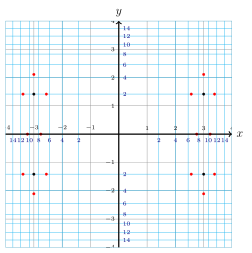
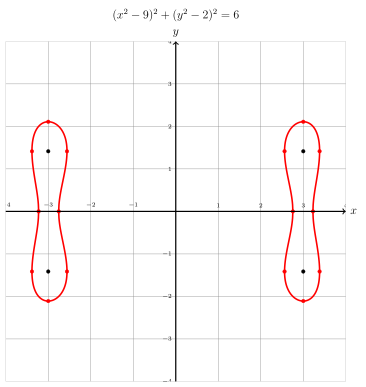
Sketch the curve \((x^2 - 9)^2 + (y^2 - 2)^2 = 6\).
Show Solution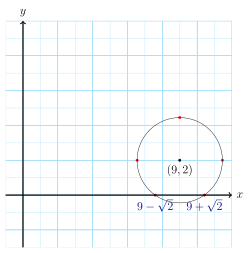
Sketch the cubic curve $$(xy - 12)(x + y - 9) = a$$
- [(i)] for a small positive value of the constant \(a\), and
- [(ii)] for a small negative value of the constant \(a\).
Sketch the curve $$x^3 + y^2 = 3xy.$$ By rotating the axes through \(45^\circ\), or otherwise, find the area of its loop.
Prove that the curve given by \(x^y = y^x\) in the region \(x > 0\), \(y > 0\) of the Cartesian plane has just two branches, and sketch them. What are the coordinates of the point where they cross?
Sketch roughly the possible forms of the curve given by the equation $$y(ax^2 + 2bx + c) = a'x^2 + 2b'x + c',$$ where \(a\), \(b\), \(c\), \(a'\), \(b'\), and \(c'\) are real, and \(a\) and \(a'\) are non-zero. Prove that a necessary condition for \(y\) to take every real value at least once as \(x\) takes all real values can be put in the form $$(ca' - ac')^2 \leqslant 4(ab' - ba')(bc' - cb').$$
Sketch the curve \[y = \frac{(x-2)(x-3)}{(x-1)(x-4)}.\] Prove that \[\frac{dy}{dx} = \frac{-2(2x-5)}{(x-1)^2(x-4)^2}, \quad \frac{d^2y}{dx^2} = \frac{12(x^2-5x+7)}{(x-1)^3(x-4)^3},\] and deduce that the radius of curvature at the point where the curve is parallel to the \(x\)-axis has the value \(3^4/4^3\). Find all the points both of whose coordinates \(x\), \(y\) are integers, positive, negative or zero.
Find the asymptotes of the curve \[ x^3+2x^2+x = xy^2 - 2xy + y. \] Show that there are values which \(y-x\) never takes, and sketch the curve.
Sketch roughly the curve \[ y^2(a^2+x^2) = x^2(a^2-x^2), \] and find the area of one of its loops.
Sketch the graph of a function \(f(x)\) that satisfies the conditions (i) \(f(0)=0\), (ii) \(f'(0)<0\), (iii) \(f''(x)>0\) for \(x>0\), (iv) \(f(x)\) tends to a limit as \(x\to\infty\). Also sketch the graph of a function \(g(x)\) that satisfies the conditions (i) \(g(0)=0\), (ii) \(g'(0)<0\), (iii) \(g''(0)>0\), (iv) \(\dfrac{g(x)}{x} \to 1\) as \(x\to\infty\).
Sketch the curve \[ (y^2-1)^2 - x^2(2x+3) = 0. \]
A family of curves is given by the equation \[ \left(y + \frac{1}{x^3}\right)(3x-1) = 8\lambda, \] where \(\lambda\) is a variable parameter which takes positive values only, and \(x > \frac{1}{3}\). Show that if \(0<\lambda<1\), the curves have one real maximum and one real minimum, while if \(\lambda > 1\) the curves have no real maximum or minimum. Show also that the locus of the maxima and minima is \(yx^3=3x-2\), and that this locus touches the curve \(\lambda=1\) at the point \(x=1, y=1\).
Be able to manipulate polynomials algebraically and know how to use the factor theorem Be able to simplify rational expressions
Let \(p(x)\) be a polynomial of degree 4, with real coefficients, and satisfying the property that, for all rational numbers \(\alpha\), \(p(\alpha)\) is a rational number. Prove that \(p(x)\) has rational coefficients. If \(q(x)\) is a polynomial with rational coefficients, and \(q(n)\) is an integer for every integer \(n\), does it follow that \(q(x)\) has integer coefficients? Give either a proof or a counter-example. [A rational number is a number of the form \(p/q\) where \(p\), \(q\) are integers, \(q \neq 0\).]
Suppose that \(f(n)\) is a polynomial with rational coefficients of degree \(k > 0\) in \(n\) where \(n\) is an integer. Show that the function \begin{align} g(n) = f(n) - f(n-1) \end{align} is a polynomial of degree \(k-1\). Show also that if \(f(n)\) has the form \(g(n)\cdot g(n+1)\cdot g(n+2)\) (for some polynomial \(g(n)\)), then \(g(n)\) is divisible by \(g(n) \cdot g(n+1)\). Evaluate the sum \begin{align} f(n) = \sum_{r=1}^{n} \frac{1}{r^3(r+1)^3(r^2+r+1)} \end{align} and hence show that \(f(n)\) is a perfect cube for all values of \(n\).
Let \(x_1,\ldots,x_n\) be distinct real numbers. Write down an expression for a polynomial \(e_k\), of degree \(n-1\), such that \begin{align*} e_k(x_l) = \begin{cases} 1 & (l = k),\\ 0 & (l \neq k). \end{cases} \end{align*} Given real numbers \(\alpha_1,\ldots,\alpha_n\), find a polynomial \(p\), of degree at most \(n-1\), for which \(p(x_k) = \alpha_k\) \((k = 1,\ldots,n)\). Show further, given numbers \(\beta_1,\ldots,\beta_n\), that there is a polynomial \(q\), of degree at most \(2n-1\), such that both \(q(x_k) = \alpha_k\) and \(q'(x_k) = \beta_k\) \((k = 1,\ldots,n)\). [It is sufficient to prove the existence of \(q\); you are not expected to find its coefficients in an explicit form. In the last part of the question, you may find it helpful firstly to find a polynomial \(\eta_k\) such that \begin{align*} \eta_k(x_l) = 0 \text{ } (l = 1,\ldots,n), \text{ } \eta'_k(x_k) = 1, \text{ } \eta'_k(x_l) = 0 \text{ } (l \neq k, l = 1,\ldots,n).] \end{align*}
Let \(m\) and \(n\) be integers with \(0 \leq m \leq n\). The function \(f_{n,m}(x)\), defined for \(|x| \neq 1\), is given by \[f_{n,m}(x) = \begin{cases} \frac{(x^n-1)(x^{n-1}-1)\ldots(x^{n-m+1}-1)}{(x^m-1)(x^{m-1}-1)\ldots(x-1)} & \text{if } m > 0, \\ 1 & \text{if } m = 0\end{cases}\] Prove that for \(0 < m < n\), \[f_{n,m}(x) = f_{n-1, m-1}(x) + x^m f_{n-1, m}(x).\] Show that \(f_{n,m}(x)\) can be expressed as a polynomial of degree \(m(n-m)\) for \(|x| \neq 1\), and that the value of this polynomial when \(x = 1\) is equal to the binomial coefficient \(\displaystyle \binom{n}{m}\).
Polynomials \(C_r(x)\) are defined by \[C_0(x) = 1,\] \[C_r(x) = \frac{x(x-1) \ldots (x-r+1)}{r!} \text{ for } r \geq 1.\] (i) Show that if \(n\) is an integer, then so is \(C_r(n)\). (ii) Show that any polynomial \(p(x)\) with rational coefficients can be expressed in the form \[b_kC_k(x)+b_{k-1}C_{k-1}(x)+ \ldots +b_0C_0(x),\] where all the \(b_r\)'s are rational and \(k\) is the degree of \(p(x)\). Suppose further that whenever \(n\) is an integer, then so is \(p(n)\). Show that all the \(b_r\)'s are integers. (iii) Suppose that \(p(x)\) is a polynomial with real coefficients such that whenever \(a\) is a rational number then so is \(p(a)\). Show that the coefficients of \(p(x)\) are all rational.
(i) By considering \(A(1 + \eta - x^2)^n\) for suitable values of \(A, \eta\) and \(n\), show that, given \(\epsilon > 0\) and \(0 < \beta < \alpha < 1\), we can find a polynomial \(P(x)\) such that \[P(x) \geq 1 \text{ for } |x| \leq \beta,\] \[0 \leq P(x) \leq 1 \text{ for } \beta \leq |x| \leq \alpha,\] \[0 \leq P(x) \leq \epsilon \text{ for } \alpha \leq |x| \leq 1.\] (ii) Show that, given \(\epsilon > 0\), there is a polynomial \(Q(x)\) such that \[|Q(x)| \leq \epsilon \text{ for } -1 \leq x \leq -\epsilon,\] \[-\epsilon \leq Q(x) \leq 1+\epsilon \text{ for } -\epsilon \leq x \leq \epsilon,\] \[|Q(x)-1| \leq \epsilon \text{ for } \epsilon \leq x \leq 1.\] (iii) Show that, given \(\epsilon > 0\) and \(0 < a \leq 1\), there is a polynomial \(R(x)\) such that \[|R(x)| \leq \epsilon \text{ for } a \leq |x| \leq 1,\] \[|R(x)-(1-a^{-1}|x|)| \leq \epsilon \text{ for } |x| \leq a.\]
Express the sum of the fifth powers of the roots of a cubic equation in terms of the sum of the roots, the sum of the squares of the roots and the product of the roots. Prove that \(\frac{(x-y)^5 + (y-z)^5 + (z-x)^5}{(x-y)^2 + (y-z)^2 + (z-x)^2} = \frac{5}{2}(x-y)(y-z)(z-x)\) for all distinct real numbers \(x\), \(y\), \(z\).
Prove that, if \(h(x)\) is the H.C.F. of two polynomials \(p(x)\), \(q(x)\), then polynomials \(A(x)\), \(B(x)\) exist such that $$A(x)p(x) + B(x)q(x) \equiv h(x).$$ Obtain an identity of this form when $$p(x) = x^{10} - 1, \quad q(x) = x^6 - 1.$$
\(x_1, \ldots, x_n\) are distinct numbers and, for \(1 \leq r \leq n\), \(p_r(x)\) is written for $$(x - x_1) \ldots (x - x_{r-1})(x - x_{r+1}) \ldots (x - x_n).$$ By considering $$\sum_{r=1}^{n} \alpha_r p_r(x),$$ for suitably chosen \(\alpha_r\), show that it is possible to find a polynomial of degree not exceeding \(n-1\) which takes given values at \(x_1, \ldots, x_n\). Similarly, by considering $$\sum_{r=1}^{n} (\beta_r x + \gamma_r)\{p_r(x)\}^3,$$ show that it is possible to find a polynomial of degree not exceeding \(2n-1\) which takes given values at \(x_1, \ldots, x_n\) and whose first derivative also takes given values at these points.
Explain how turning values and points of inflexion of the function \(y = f(x)\) can be found by studying the successive derivatives of \(y\). Find the values of \(x\) for which the function $$y = \frac{x^3 - x^2 + 4}{x^3 + x^2 + 4}$$ has turning values and discuss their character. How many real roots has the equation $$x^3(a-1) + x^2(a+1) + 4(a-1) = 0$$ for different values of \(a\)?
Explain briefly how to find the H.C.F. of two integers or two polynomials. If \(m\) and \(n\) are positive integers whose H.C.F. is \(k\), prove that the H.C.F. of the integers \(2^m-1\) and \(2^n-1\) is \(2^k-1\) and that the H.C.F. of the polynomials \(x^{2^m}-x\) and \(x^{2^n}-x\) is \(x^{2^k}-x\).
Prove what you can about the number of real roots of each of the equations
- [(i)] \((x-a_1)(x-a_2)\dots(x-a_n) + (x-b_1)(x-b_2)\dots(x-b_n) = 0\), where \[ a_1 > b_1 > a_2 > b_2 \dots > a_n > b_n; \]
- [(ii)] \((x-a)^m+(x-b)^m=0\) where \(a>b\) and \(m\) is a positive integer.
Find whether any of the roots of the equation \[ x^5 + 8x^4 + 6x^3 - 42x^2 - 19x - 2 = 0 \] are integers, and solve it completely.
Show that the conditions that an algebraic equation \(f(x)=0\) has a double root at \(x=a\) are that \(f(a)=f'(a)=0\). If the equation \[ x^4 - (a+b)x^3 + (a-b)x - 1 = 0 \] has a double root, prove that \[ a^\frac{2}{3} - b^\frac{2}{3} = 2^\frac{2}{3}. \]
Prove that the equation \(x^3-3px^2+4q=0\) will have three real roots if \(p\) and \(q\) are the same sign and \(p^6>q^2\). Show that two roots will be positive or negative as the sign of \(p\) and \(q\) is positive or negative. (It may be assumed that neither \(p\) nor \(q\) vanish.) Find out by these results as much as possible about the roots of the equation \[ x^3 - 6x^2 + 16 = 0. \]
Find a polynomial of the ninth degree \(f(x)\), such that \((x-1)^5\) divides \(f(x)-1\) and \((x+1)^5\) divides \(f(x)+1\). Prove that the quotients do not vanish for any real value of \(x\).
Find the highest common factor of \[ f(x)=27x^4+27x^3+22x+4 \quad \text{and} \quad g(x)=54x^3+27x+11. \] Hence show that the equation \(f(x)=0\) has a repeated root, and solve it completely.
Solve the equation: \[ 8x^6 - 54x^5 + 109x^4 - 108x^3 + 109x^2 - 54x + 8 = 0. \]
Show SolutionProve that, if the equation \[ a_0 x^n + a_1 x^{n-1} + \dots + a_n = 0 \] is satisfied for more than \(n\) distinct values of \(x\), then \(a_0, a_1, \dots, a_n\) are all zero. A function \(f(x)\) is said to be rational, if it can be expressed in the form \(P(x)/Q(x)\), where \(P(x), Q(x)\) are polynomials in \(x\). A function \(f(x)\) is said to be periodic, with period \(k\), if \(f(x+k)=f(x)\) for all values of \(x\) for which \(f(x)\) is defined. Prove that a periodic function cannot be a rational function.
If \(P\) and \(Q\) are polynomials and if the degree of \(Q\) is less than the degree of \(P\), show that polynomials \(P_0, P_1, P_2, \dots\) all of degree less than \(Q\) can be found such that \[ P = \Sigma P_i Q^i. \] Prove that the polynomials \(P_i\) are unique. \newline If the roots \(\alpha_1, \alpha_2, \dots, \alpha_n\) of the equation \(Q=0\) are all different, find the polynomial of least degree which takes the value \(a\) whenever \(Q=0\) and whose derived polynomial takes the value \(b\) whenever \(Q=0\). \newline [The derived polynomial of \(P(x)\) is the coefficient of \(h\) in the expansion of \(P(x+h)\) in powers of \(h\).]
State a necessary and sufficient condition that \[ z^2+4axz+6byz+4cxy+dy^2+2\lambda(x^2-yz) \] shall be the product of two linear factors. \newline By taking \(z=x^2, y=1\), state briefly the steps to be taken in order to find the roots of the quartic equation \[ x^4+4ax^3+6bx^2+4cx+d=0. \] Hence find the roots of the equation \[ x^4-x^3-4x^2+x+1=0. \]
A number of the form \(p/q\), where \(p\) and \(q\) are integers (\(q\neq 0\)), is said to be rational. Prove that a rational root of the equation \[ x^n+a_1x^{n-1}+a_2x^{n-2}+\dots+a_n=0, \] where \(a_1, a_2, \dots, a_n\) are integers, is necessarily an integer. Prove further that, if \(|a_n|\) is a prime number, the equation cannot have more than three distinct rational roots. Find the rational roots of the equation \[ 8x^5 - 4x^4 - 2x^3 - 3x^2 + 1 = 0, \] and hence solve the equation completely.
Prove that, if \(n\) is a prime number,
- [(i)] the coefficients in \((1 + x)^n\) except the first and last are all divisible by \(n\).
- [(ii)] the successive coefficients in \((1+x)^{n-1}\) when divided by \(n\) leave remainders \(1\) and \(n-1\) alternately.
- [(iii)] the successive coefficients in \((1+x)^{n-2}\) when divided by \(n\) leave remainders \(1, n-2, 3, n-4, 5, n-6, \dots\).
Shew that, if \(x^4 + ax + b\) has a factor \(x^2 + px + q\), then \[ p^6 - 4bp^2 - a^2 = 0 \quad \text{and} \quad q^6 - bq^4 - a^2q^3 - b^2q^2 + b^3 = 0. \] Solve the equation \[ x(x-1)(x-2)(x-3) = a(a-1)(a-2)(a-3), \] and find for what values of \(a\) the roots are all real.
Prove that in general three normals (real or imaginary) can be drawn to a parabola from an arbitrary point in its plane. If \(M\) is a fixed point on the parabola and \(P\) a variable point on the normal at \(M\), show that the line joining the feet of the other two normals from \(P\) is parallel to a fixed direction.
A zero of the polynomial \(f(x) = a_0 x^n + a_1 x^{n-1} + \ldots + a_n\) is \(p/q\), where \(p/q\) is a fraction in its lowest terms, and each \(a_r\) is an integer. Show that
- \(q\) divides \(a_0\) and \(p\) divides \(a_n\),
- if \(m\) is any integer \(p - mq\) divides \(f(m)\).
The polynomial \(f(x) = x^n + a_1 x^{n-1} + a_2 x^{n-2} + \ldots + a_n\) has integer coefficients. Prove that any root of \(f(x) = 0\) which is rational is an integer. What can be said about the rational roots of \(2x^n + b_1 x^{n-1} + \ldots + b_n = 0\), where the \(b_i\) are integers? Prove that the equation \(2x^5 - 9x^3 + 1 = 0\) has no rational roots. How many real roots does it have?
Let \(f(x)\) and \(g(x)\) be polynomials of degree \(m\), \(n\) respectively. Show that $$f(x) = q(x)g(x) + r(x)$$ where \(q(x)\) and \(r(x)\) are polynomials, and \(r(x)\) either is zero or has degree less than \(n\). Show also that \(q(x)\) and \(r(x)\) are determined uniquely by \(f(x)\) and \(g(x)\). Hence or otherwise show that a polynomial of degree \(n\) has at most \(n\) roots.
State and prove the Remainder Theorem for polynomials. What is the remainder when the polynomial \(f(x)\) is divided by \((x-a)(x-b)\) (where \(a \neq b\)), in terms of \(f(a)\) and \(f(b)\)?
The equations \begin{align} x^3 + 2x^2 + ax - 1 &= 0, \\ x^3 + 3x^2 + x + b &= 0 \end{align} have two common roots. Find all possible pairs of values of the constants \(a\), \(b\), and find the remaining roots in each case.
Let \(d\), \(e\), \(f\) and \(g\) be fixed integers. Let $$ax^6 + bx^5 + cx^4 + dx^3 + ex^2 + fx + g = 0$$ have at least three roots, not necessarily distinct, each of which is a non-zero integer. Prove that \(a\), \(b\) and \(c\) are rational numbers.
If \(f(x)\) and \(g(x)\) are two polynomials in \(x\) of degrees \(m\) and \(n\) respectively, \(m \ge n\), show that there exist unique polynomials \(q(x)\) and \(r(x)\) such that \[ f(x) = q(x)g(x) + r(x), \] where the degree of \(r(x)\) is less than \(n\). Deduce that the highest common factor of \(f(x)\) and \(g(x)\) is the same as that of \(g(x)\) and \(r(x)\). Find the highest common factor of \[ x^5-x+15, \quad x^4+5x^2+9. \]
The polynomials \(f(x), g(x)\) are of degrees \(m,n\) respectively, where \(m\ge n\ge 1\), and have real coefficients. Show that polynomials \(q(x), r(x)\) exist such that \(f(x)=g(x)q(x)+r(x)\), and such that the degree of \(r(x)\) is less than \(n\). Show also that \(q(x), r(x)\) are unique, and have real coefficients. If \(g(x) = x^2 - (\alpha+\beta)x + \alpha\beta\), prove that, if \(\alpha\neq\beta\), \[ r(x) = \frac{f(\alpha)-f(\beta)}{\alpha-\beta}x + \frac{\alpha f(\beta) - \beta f(\alpha)}{\alpha-\beta}. \] Verify that the coefficients of \(r(x)\) are real if \(\alpha, \beta\) are conjugate complex numbers. Find also the form of \(r(x)\) if \(\alpha=\beta\).
\(f(x)\) is a polynomial of the fifth degree, the coefficient of \(x^5\) being 3. \(f(x)\) leaves the same remainder when divided by \(x^2+1\) or \(x^2+3x+3\). It leaves the remainder \(4x+5\) when divided by \((x-1)^2(x+1)\). Find \(f(x)\).
Two polynomials \(f_0(x), f_1(x)\) are given and a sequence of polynomials \(f_2(x), f_3(x), \dots, f_r(x)\) are defined by the rule that \(f_{i+1}(x)\) is the remainder when \(f_{i-1}(x)\) is divided by \(f_i(x)\), \(f_r(x)\) being the last such remainder that is different from zero. Prove, by induction on \(i\), that
- [(i)] each of the polynomials \(f_i(x)\) can be expressed in the form \(a_i(x)f_0(x)+b_i(x)f_1(x)\), where \(a_i(x)\) and \(b_i(x)\) are polynomials;
- [(ii)] \(f_r(x)\) divides \(f_i(x)\) for \(i=1, \dots, r\).
Prove that \[ \frac{1}{1!(2n)!} + \frac{1}{2!(2n-1)!} + \frac{1}{3!(2n-2)!} + \dots + \frac{1}{n!(n+1)!} = \frac{2^{2n}-1}{(2n+1)!}. \]
Shew that, if \(n=3\), \(a+b+c\) is a factor of \[ \begin{vmatrix} a^n & b^n & c^n \\ a & b & c \\ 1 & 1 & 1 \end{vmatrix}, \] and that, if \(n\) is greater than 3, \(a+b+c\) is not a factor.
Factorise the expression \[ (bcd + cda + dab + abc)^2 - abcd (a + b + c + d)^2; \] prove that the expression \[ (a - b)^2 (a - c)^2 + (b - c)^2 (b - a)^2 + (c - a)^2 (c - b)^2 \] is a perfect square.
Express \[ \begin{vmatrix} 1 & a & a^3 \\ 1 & b & b^3 \\ 1 & c & c^3 \end{vmatrix} \] as a product of linear factors in \(a, b, c\). Hence, or otherwise, prove that, if \(\alpha + \beta + \gamma = \pi\), then \[ \begin{vmatrix} 1 & \sin\alpha & \sin 3\alpha \\ 1 & \sin\beta & \sin 3\beta \\ 1 & \sin\gamma & \sin 3\gamma \end{vmatrix} = -16 \sin\alpha \sin\beta \sin\gamma \sin\frac{\beta-\gamma}{2}\sin\frac{\gamma-\alpha}{2}\sin\frac{\alpha-\beta}{2}. \]
Prove that the polynomial \(X_n = \frac{d^n}{dx^n}(x^2-1)^n\) satisfies the equation \[ (1-x^2)\frac{d^2X_n}{dx^2} - 2x \frac{dX_n}{dx} + n(n+1)X_n = 0. \]
Prove, by use of the identity \[ \frac{1}{1+x+x^2} = \frac{1-x}{1-x^3}, \] or otherwise, that \[ 1 - (n-1) + \frac{(n-2)(n-3)}{1.2} - \frac{(n-3)(n-4)(n-5)}{1.2.3} + \dots \] (the series being continued so long as all the factors in the numerator are positive) is equal to \(-1, 0, \text{ or } 1\): and give rules for distinguishing between the different cases.
A curve of degree three is represented by the equation \(\phi(x,y)=0\) in which the coefficients are rational numbers. Prove that the tangent at any point whose coordinates \((x_n, y_n)\) are rational numbers meets the curve again in a point \((x_{n+1}, y_{n+1})\) whose coordinates are rational. If the curve is \[ x^3+y^3=9, \] find the relation between \(x_{n+1}\) and \(x_n\).
Give an account of the process by which the highest common factor of two polynomials \(f(x)\) and \(\phi(x)\) is obtained, and indicate the principles on which the process depends. Prove that, if \(X_1, X_2, X_3\) are the functions of \(x\) used as divisors at three successive stages of the process, a value of \(x\) which makes \(X_2\) vanish will make \(X_1=X_3\).
Prove that \[ \frac{(x-1)(x-2)\dots(x-n)}{x(x+1)(x+2)\dots(x+n)} = \sum_{r=0}^{n} (-1)^{n-r} \frac{(n+r)!}{r! r! (n-r)! (x+r)}, \] and deduce, or otherwise prove, that \[ \frac{(n+1)!}{(n-1)!} - \frac{(n+2)!}{1! 2! (n-2)!} + \frac{(n+3)!}{2!3!(n-3)!} - \frac{(n+4)!}{3!4!(n-4)!} - \dots\dots \] \[ \dots\dots + (-)^n \frac{2n!}{(n-1)! n!} = (-)^n n(n+1). \]
(i) If the remainders when a polynomial \(f(x)\) is divided by \((x-a)(x-b)\) and by \((x-a)(x-c)\) are the same, shew that \[ (b-c)f(a) + (c-a)f(b) + (a-b)f(c) = 0. \] (ii) When \(x\) and \(y\) are eliminated from the equations \[ x^2-y^2 = ax-by; \quad 4xy=bx+ay; \quad x^2+y^2=1, \] prove that \[ (a+b)^{\frac{2}{3}} + (a-b)^{\frac{2}{3}} = 2. \]
Shew that \[ 5\{(y-z)^7 + (z-x)^7 + (x-y)^7\} = 7\{(y-z)^5+(z-x)^5+(x-y)^5\}\{x^2+y^2+z^2-yz-zx-xy\}. \] Hence, or otherwise, find all the factors of \[ (y-z)^7 + (z-x)^7 + (x-y)^7. \]
Prove that the coefficient of \(x^n\) in the expansion of \[ \frac{a}{ax^2-2bx+c} \] in ascending powers of \(x\), where \(ac>b^2\), is \[ \left(\frac{a}{c}\right)^{\frac{n+1}{2}} \frac{\sin(n+1)\theta}{\sin\theta}, \] where \(\sqrt{(ac)}\cos\theta=b\).
Observations of a variable \(x\) are made at equidistant intervals of time; suppose that the values \(x_1, x_2, x_3\) correspond to the times \(t=-c, t=0, t=+c\), respectively, and find a quadratic expression in \(t\) to represent \(x\). A variable magnitude was observed as follows:
[This question was too poorly scanned to be transcribed reliably.]
P, Q are two polynomials in \(x\) which satisfy the identity \[ \sqrt{P^2-1} = Q\sqrt{x^2-1}. \] Prove the following results:
- [(i)] P, Q have no common factor.
- [(ii)] If P is of degree \(n\) in \(x\), Q is of degree \(n-1\) in \(x\).
- [(iii)] \(\dfrac{dP}{dx}=kQ\), where \(k\) is some constant.
Show that if \(\alpha\) is a repeated root of the equation \[a_n x^n + \ldots + a_1 x + a_0 = 0,\] then \(\alpha\) is also a root of the equation \[n a_n x^{n-1} + \ldots + 2 a_2 x + a_1 = 0.\] Hence, or otherwise, solve the equation \[24x^4 - 20x^3 - 6x^2 + 9x - 2 = 0,\] given that three of its four roots are identical.
A quartic polynomial \(f(x)\) with real coefficients is such that the equation \(f(x) = 0\) has exactly three distinct roots, which are all real. Show that just one of these roots is also a root of \(f'(x) = 0\). If \(f(x) = x^4 + 2x^3 - 3x^2 - 4x + a\) (where \(a\) is a constant) satisfies these conditions, show that there is only one possible value for \(a\), and find it.
Establish a condition on the coefficients \(p\), \(q\), \(r\) for the equation \(x^3 + 3px^2 + 3qx + r = 0\) to have a repeated root. Show that if this condition is satisfied and \(q \neq p^2\), then the repeated root is $$\frac{pq - r}{2(q - p^2)}.$$ Find an expression for the third root.
For each real value of \(y\) the number of real values of \(x\) which satisfy the equation $$x^4 - 8x^3 + 22x^2 - 24x + 7 + 9y^2 - 6y^3 = 0$$ is denoted by \(n(y)\). Illustrate graphically the relation between \(y\) and \(n(y)\). [Precise numerical solutions are not required.]
Let \(f(x) = x^4 - x^3 - x^2 - x + 1\). Show that \(f(x) = 0\) has two real roots. By considering \(f(x + 1)\) and \(f(x + \frac{1}{2})\), or otherwise, prove that \(f(x) + 2 > 0\) for all real \(x\).
\(f(x)\) is a polynomial of degree \(n > 0\), and \(f'(x)\) is its derivative. Every (real or complex) root \(x\) of \(f'(x) = 0\) also satisfies \(f(x) = 0\). Prove that \(f(x) = 0\) has a single root of multiplicity \(n\).
Given that the equation \[x^6 - 5x^5 + 5x^4 + 9x^3 - 14x^2 - 4x + 8 = 0\] has three coincident roots, find the value of this multiple root, and hence, or otherwise, solve the equation completely.
Show that, if \(P(x)\) is a polynomial of degree \(n\) such that the \(n\) repeated factors, then between any two consecutive real roots of the equation \(P(x) = 0\), the polynomial function must possess a maximum or minimum between any two consecutive real zeros of the function.) Show that, if the equation \(P(x) = 0\) has \(n\) real roots (counting multiple roots according to their multiplicity), then \(P'(x) = 0\) has \(n-1\) real roots. If \(P(x) = 0\) has \(m-1\) real roots, all distinct, where \(m < n\), show that \(P(x) = 0\) has \(m\) or \(m-2k\) real roots, where \(k\) is some positive integer. Show that this remains true if one, but only one, of the real roots of \(P'(x) = 0\) is repeated. A sequence of functions \(Q_n(x)\) is defined by the relations $$Q_0(x) = 1 \quad (\text{all } x),$$ $$Q_n(x) = xQ_{n-1}(x) - Q'_{n-1}(x) \quad (n \geq 1).$$ Prove that \(Q_n(x)\) is a polynomial of leading term \(x^n\) and with \(n\) distinct real zeros.
The graph in rectangular coordinates of a polynomial of the fourth degree in \(x\) is found to touch the \(x\)-axis at \((-a,0)\) and have a point of inflection at \((a,0)\). Show that the curve must also pass through the point \((2a,0)\) and possesses another point of inflection on the line \(x=-a/2\).
Show SolutionIf the equation \[ f(x) = x^n + a_1x^{n-1} + \dots + a_n = 0 \] has all its roots real and distinct, prove that the same is true of the equation \[ f(x) - \lambda f'(x) = 0, \] where \(\lambda\) is any real constant. Deduce, or prove otherwise, that the equation \[ f(x) + b_1f'(x) + b_2f''(x) = 0 \] has its roots real and distinct, if \(b_1\) and \(b_2\) are any constants for which the roots of \[ y^2 + b_1y + b_2 = 0 \] are real. Generalise this result.
Find the values of \(x\) for which \(y=x^2(x-2)^3\) has maximum and minimum values, and evaluate for these values of \(x\) the curvature at the points of the curve given by the equation above.
If \(f(x)\) denote the polynomial expression \(x^n+p_1x^{n-1}+\dots+p_n\), where \(n\) is a positive integer and the coefficients \(p_r\) are real, show that the equation \(f(x)=0\) can have at most one real root between two consecutive real roots of the derived equation \(f'(x)=0\). Show also that if \(\alpha\) is a root of both equations it will be a multiple root of \(f(x)=0\). Hence, or otherwise, show that the equation \(2x^9-9x^2-1=0\) has only one real root and that this root is greater than unity.
Shew that, if \(\lambda\) is a repeated root of the equation \[ a_0\lambda^3+a_1\lambda^2+a_2\lambda+a_3=0, \] and if \(y=xe^{\lambda x}\), then \[ a_0\frac{d^3y}{dx^3} + a_1\frac{d^2y}{dx^2} + a_2\frac{dy}{dx} + a_3y=0. \]
Two polynomials \(P(x)\) and \(Q(x)\) satisfy the identity \[ 1 - \{P(x)\}^2 = \{Q(x)\}^2(1-x^2). \] Prove that \(P'(x)\) is divisible without remainder by \(Q(x)\) and that \[ \frac{P'(x)}{\sqrt{1-\{P(x)\}^2}} = \frac{n}{\sqrt{1-x^2}}, \] where \(n\) is a constant, and interpret its value.
If \(P(x)\) is a polynomial, state what can be asserted about the number of (real) roots of \(P'(x)=0\) lying between two successive roots of \(P(x)=0\). Discuss also the number of roots of \(P(x)=0\) lying between two successive roots of \(P'(x)=0\). If \[ P_n(x) = 1 + x + \frac{x^2}{2!} + \dots + \frac{x^n}{n!}, \] prove, by considering \(P_1(x), \dots P_n(x)\) successively, that the equation \(P_n(x)=0\) has no root when \(n\) is even and exactly one when \(n\) is odd.
Explain what is meant by a point of inflexion on a plane curve, and prove that, if \(y=f(x)\) has a point of inflexion whose abscissa is \(x_0\), \(f''(x_0)=0\). The graph of a polynomial of the fourth degree in \(x\) touches the \(x\)-axis at \((a,0)\), and has a point of inflexion at \((-a,0)\). Prove that the graph passes through \((-2a,0)\), and that it has a second point of inflexion whose abscissa is \(a/2\).
Find the values of \(x\) for which \((x-a)^l (x-b)^m (x-c)^n\) has maxima or minima. \(a, b, c\) are real and \(l, m, n\) are integers. Determine which of these values give maxima and which minima (i) when \(l, m, n\) are all even, (ii) when \(l, m, n\) are all odd.
(i) Prove that if \[ H_n(x) = e^{x^2} \frac{d^n e^{-x^2}}{dx^n}, \] then \[ \frac{dH_n(x)}{dx} + 2nH_{n-1}(x) = 0. \] (ii) Find the \(n\)th derivative of the function \(y = \frac{x}{x^2-1}\).
Shew that there are in general two values of \(\lambda\) for which \[ ax^2+2bx+c+\lambda(a'x^2+2b'x+c') \] is a square and deduce that \(ax^2+2bx+c\), \(a'x^2+2b'x+c'\) may be put in the forms \[ p(x-\alpha)^2+q(x-\beta)^2, \quad p'(x-\alpha)^2+q'(x-\beta)^2. \] Express in these forms \(7x^2+2x+4\) and \(4x^2-28x-5\).
Prove that there are three values of \(c\) for which the equation \[ ax^3+3bx^2+3cx+d=0 \] has equal roots; and that if \(b^3=a^2d\), two of these values coincide and the third is \(-\frac{2}{3}\) of either.
Prove that in an equation with real coefficients imaginary roots occur in pairs of the type \(\lambda \pm i\mu\). \par If \(\alpha, \beta, \gamma\) are the roots of \[ x^3-px^2+qx-r=0, \] express \((\alpha^2-\beta\gamma)(\beta^2-\gamma\alpha)(\gamma^2-\alpha\beta)\) in terms of the coefficients.
Prove that if an algebraic equation \[ f(x) = x^n + a_1x^{n-1} + \dots + a_n = 0, \] has all its roots real, the derived equation \[ f'(x) = 0, \] has all its roots real. Prove that if \((n-1)a_1^2-2na_2\) is negative, the roots of the original equations are not all real.
Shew that the equations \[ x^2+\lambda x + \mu = 0 \] and \[ x^3 + \lambda' x + \mu' = 0 \] have one root the same if \((\lambda\mu' - \lambda'\mu)(\lambda - \lambda') + (\mu - \mu')^2 = 0\); and that the other two roots are given by the quadratic \[ (\mu - \mu')^2 x^2 + (\lambda\mu' - \lambda'\mu)(\lambda'^2 - \lambda^2 + 2\mu - 2\mu')x + \mu\mu'(\lambda-\lambda')^2 = 0. \]
If the equations \(x^3+px^2+qx+r=0\) and \(x^2+ax+b=0\) have a common root, prove that \[ \begin{vmatrix} 1 & 0 & 1 & a-p \\ a & 1 & p & b-q \\ b & a & q & -r \\ 0 & b & r & 0 \end{vmatrix} = 0. \] If the equations \(x^3+2x^2+3x+6=0\) and \(x^2+ax-6=0\) have a common root, find the possible values of \(a\) and the corresponding common roots.
Prove that \(a+b+c+d\) is a factor of the expression \[ (a+c)(a+d)(b+c)(b+d)-(ab-cd)^2, \] and find the other factor.
Show that the geometric mean of \(n\) positive numbers is less than or equal to their arithmetic mean. Use this result and the binomial theorem to show that \[(n+1)! \leq 2^n\left [1! \cdot 2! \cdots n! \right ]^{2/(n+1)}\]
Show SolutionBy writing \(n^{1/n} = 1 + x_n\) and using the fact that \((1 + x)^n \geq \frac{1}{2}n(n - 1)x^2\) if \(n \geq 2\) and \(x \geq 0\), prove that \(n^{1/n}\) tends to 1 as \(n \to \infty\). Sketch the graph of \(y = x^{1/x}\) for \(x > 0\).
Let \(n\) be a positive integer, and consider the sequence \(\binom{n}{1}\), \(\binom{n}{2}\), ..., \(\binom{n}{n-1}\), where \(\binom{n}{r}\) denotes the binomial coefficient \(\frac{n!}{r!(n-r)!}\). (i) Show that no three consecutive terms of the sequence can be in geometric progression. (ii) Show that if there are three consecutive terms \(\binom{n}{r-1}\), \(\binom{n}{r}\), \(\binom{n}{r+1}\) in arithmetic progression, then \((n - 2r)^2 = n + 2\), and find an \(n\) for which there are three such terms. (iii) Show that it is never possible to have four consecutive terms of the sequence in arithmetic progression.
(i) Show that \(\sum_{r=0}^{n} \binom{n}{r} = 2^n\) for each positive integer \(n\), where \(\binom{n}{r} = \frac{n!}{r!(n-r)!}\). (ii) Show that, for all positive integers \(r\) and \(n\), \(\sum_{s=0}^{n} \binom{r+s}{r} = \binom{n+r+1}{r+1}\).
Let \(a\) be a positive integer, and write \(r = \sqrt{a} + \sqrt{(a+1)}\). Show, for each positive integer \(n\), that \(a_n = \frac{1}{4}(r^{2n} + r^{-2n} - 2)\) is an integer, and that \(r^n = \sqrt{a_n} + \sqrt{(a_n + 1)}\). [Positive square roots are to be taken throughout.]
Prove that, if \(0 \leq r \leq n\), then \(\sum_{i=r}^n \binom{i}{r} = \binom{n+1}{r+1}\). Hence or otherwise show that, for \(n \geq 4\), \[\sum_{i=0}^n i^4 = 24 \binom{n+1}{5}+36 \binom{n+1}{4}+ 14 \binom{n+1}{3} +\binom{n+1}{2}\] (The binomial coefficient \(\binom{n}{r}\) is defined by \(\binom{n}{r} = \frac{n!}{r!(n-r)!}\); by convention, \(0! = 1\).)
Show by using the binomial expansion or otherwise that \((1 + x)^n \geq nx\) whenever \(x \geq 0\) and \(n\) is a positive integer. Deduce that if \(y > 1\) then, given any number \(K\), we can find an \(N\) such that \(y^n \geq K\) for all integers \(n \geq N\). Show similarly that if \(y > 1\) then, given any \(K\), we can find an \(N\) such that \(\frac{y^n}{n} \geq K\) for all integers \(n \geq N\).
State precisely, without proof, the arithmetic-geometric mean inequality. The equation \(f(x) = x^n+a_1x^{n-1}+a_2x^{n-2}+ ... + a_n = 0\) has \(n\) distinct positive roots. Writing \(a_i = (-1)^i\binom{n}{i}b_i\), where \(\binom{n}{i}\) denotes the usual binomial coefficient, prove that \(b_{n-1} > b_n\). By considering \(f'(x)\), or otherwise, prove further that \(b_1 > b_2 > ... > b_{n-1} > b_n\).
Prove that \(\displaystyle \binom{n}{r} = \binom{n-1}{r} + \binom{n-1}{r-1}.\) Hence prove that for \(n > r\) \(\displaystyle \binom{n}{r} = \sum_{i=0}^r \binom{n-i-1}{r-i}.\) [The binomial coefficient \(\displaystyle \binom{n}{r}\) is defined by \(\displaystyle \binom{n}{r} = \frac{n!}{r!(n-r)!}\).]
Show that \[\binom{n}{r} = \binom{n-1}{r-1} + \binom{n-1}{r}\] and hence, by induction or otherwise, evaluate \[\sum_{q=0}^{n} \binom{n+q}{q} \frac{1}{2^{n+q}}.\] [The binomial coefficient \(\binom{n}{r}\) is defined by \(\binom{n}{r} = \frac{n!}{r!(n-r)!}\).]
By considering \((1-1)^n\), prove that \[\binom{n}{0}-\binom{n}{1}+\binom{n}{2}- \ldots + (-1)^n\binom{n}{n} = 0,\] for \(n = 1, 2, \ldots\). Hence or otherwise prove by induction that \[1 + \frac{1}{2} + \frac{1}{3} + \frac{1}{4} + \ldots + \frac{1}{n} = \binom{n}{1}\frac{1}{1} - \binom{n}{2}\frac{1}{2} + \ldots + (-1)^{n-1}\binom{n}{n}\frac{1}{n}\] for \(n = 1, 2, \ldots\). [You may assume without proof that \(\displaystyle \binom{n}{r} = \binom{n-1}r + \binom{n-1}{r-1}\)]
By looking at the coefficient of \(x^n\) in \((1 + x)^{2n}\) in two different ways, or otherwise, show that \[\sum_{r=0}^{n} \left(\frac{1}{r!(n-r)!}\right)^2 = \frac{(2n)!}{(n!)^2}.\] By applying the theorem of the arithmetic and geometric means deduce that \[\left(\frac{(n!)^2(n+1)}{(2n)!}\right)^{(n+1)/4} \leq 1!2!3! \ldots n!.\]
Prove the Binomial Theorem, that \begin{equation*} (1+x)^n = \sum_{r=0}^{n} \binom{n}{r} x^r \end{equation*} (where \(n\) is a positive integer). Let \(m, k\) be positive integers. By considering the powers of 2 occurring in the numerator and denominator, or otherwise, show that \(\binom{2^k m}{2^k}\) and \(m\) are either both even or both odd. Deduce that if the coefficients of \(x^r\) in \((1+x)^n\) are all odd, then \(n+1 = 2^k\) for some \(k\).
Given a sequence \(u_0, u_1, u_2, \ldots\) we define a new sequence \(u'_0, u'_1, u'_2, \ldots\) by \begin{equation*} u'_n = \sum_{i=0}^{n} (-1)^i \binom{n}{i} u_{n-i}, \end{equation*} where \(\binom{n}{i}\) denotes the usual binomial coefficient. Applying the same process to the sequence \(u'_0, u'_1, u'_2, \ldots\) we obtain a sequence \(u''_0, u''_1, u''_2, \ldots\). Show that \(u''_n = \sum_{i=0}^{n} c_{n,i} u_i\) for some coefficients \(c_{n,i}\), and find these coefficients. If the sequence \(u_0, u_1, u_2, \ldots\) satisfies the recurrence relation \(u_n = nu_{n-1}\), show that \(u'_0, u'_1, u'_2, \ldots\) satisfies \(u'_n = nu'_{n-1}+(-1)^n u_0\).
Let \(k\), \(n\) be integers, \(k \geq 1\), \(n \geq 1\). Show that if \(n^2\) divides \((n+1)^k - 1\) then \(n\) divides \(k\), and deduce that if \((n+1)^k - 1 = n!\) and \(n \geq 6\), then \(n\) divides \(k\). [Hint: is \(n\) odd or even?] Hence find all pairs \((n, k)\) of positive integers such that \((n+1)^k - 1 = n!\)
A monomial of degree \(n\) in the \(m\) variables \(x_1, x_2, \ldots, x_m\) is defined to be an expression of the form $$x_1^{t_1} \ldots x_m^{t_m}$$ where each of \(t_1, \ldots, t_m\) is a non-negative integer and \(t_1 + \ldots + t_m = n\). Find the number of monomials of degree \(n\) in \(m\) variables, and show that the number of monomials of degree \(\leq n\) in \(m\) variables is $$\frac{(m+n)!}{m! \, n!}.$$
Writing \(C(n,r)\) for \(\frac{n!}{r!(n-r)!}\) (and taking \(C(n,0) = C(n,n) = 1\)), prove that, if \(0 \leq r \leq n\), $$\sum_{r=0}^{s} (-1)^r C(n,r)C(n,s-r) = 0 \quad \text{if } s \text{ is odd}$$ $$= (-1)^{s/2} C(n,\frac{s}{2}) \quad \text{if } s \text{ is even}.$$ What can you say about $$\sum_{r=0}^{s} (-1)^r C(n+r-1,r)C(n+s-r-1,s-r)?$$ Justify your answer.
For each positive integer \(n\), let \[u_n = 1 - (n-1) + \frac{(n-2)(n-3)}{2!} - \frac{(n-3)(n-4)(n-5)}{3!} + \cdots\] where the summation stops with the first term that is equal to \(0\). By considering \(u_{n-1} - u_n\) or otherwise, prove that \(u_n\) satisfies a recurrence relation of the form \[au_n + bu_{n+1} + cu_{n+2} = 0,\] and determine the relation. Hence, or otherwise, evaluate \(u_n\) for general \(n\); in particular, show that \(u_n = 0\) whenever \(n - 2\) is a multiple of \(3\).
If \((1 + x)^n = a_0 + a_1 x + \ldots + a_n x^n\), find
- [(i)] \(\sum_{r=0}^{r=n} \frac{(-1)^r a_r}{r + 1}\),
- [(ii)] \(\sum_{r=0}^{r=n-k} a_r a_{r+k}\).
If \(a_r = r!(n-r)!\) for \(0 < r < n\) and \(a_0 = a_n = n!\), prove that \(\frac{1}{a_0^2} + \frac{1}{a_1^2} + \cdots + \frac{1}{a_n^2} = \frac{(2n)!}{(n!)^4}.\)
The numbers \(c_0\), \(c_1\), \(\ldots\), \(c_n\) are defined by the identity \[(1 + x)^n = c_0 + c_1x + \ldots + c_nx^n;\] prove that \(\sum c_ic_j\) summed over all integer pairs \(i\), \(j\) such that \(0 \leq i < j \leq n\) is equal to \[2^{2n-1} - \frac{(2n-1)!}{n!(n-1)!}.\]
Prove that the binomial coefficient \(\binom{a+b}{b}\) is odd if and only if, when \(a\) and \(b\) are expressed in binary notation and added, there is no `carrying over'.
Prove that, if \((1+x)^n = c_0 + c_1 x + \dots + c_n x^n\), then
- [(i)] \(\dfrac{c_0}{1} - \dfrac{c_1}{2} + \dfrac{c_2}{3} - \dots + (-1)^n \dfrac{c_n}{n+1} = \dfrac{1}{n+1}\);
- [(ii)] \(c_0^2 - c_1^2 + c_2^2 - \dots + (-1)^n c_n^2\) is equal to \((-1)^m (2m)!/(m!)^2\) if \(n\) is an even integer \(2m\). Find its value when \(n\) is an odd integer.
Prove that, if the roots of the equation \[ x^n - \binom{n}{1}p_1 x^{n-1} + \dots + (-)^r \binom{n}{r} p_r x^{n-r} + \dots + (-)^n p_n = 0, \] where \(\binom{n}{r} = \frac{n!}{r!(n-r)!}\) and \(p_n \ne 0\), are all real and positive, so are the roots of the equation \[ x^{n-1} - \binom{n-1}{1}p_1 x^{n-2} + \dots + (-)^r \binom{n-1}{r} p_r x^{n-r-1} + \dots + (-)^{n-1} p_{n-1} = 0. \] Deduce that \[ p_{r-1}p_{r+1} < p_r^2 \quad (1< r< n; p_0=1), \] stating when equality occurs. Prove also that \[ p_1 \ge p_2^{1/2} \ge p_3^{1/3} \ge \dots \ge p_n^{1/n}. \]
Prove that, if \(n\) is a positive integer, \((1+x)^n\) can be expressed in the form \[ c_0+c_1x+\dots+c_nx^n, \] where \(c_r\) depends only on \(n\) and \(r\), and find the value of \(c_r\). Find the sums of the series \[ \text{(i) } \sum_{r=0}^{r=n-k} c_r c_{r+k}; \quad \text{(ii) } \sum_{r=0}^{r=n} \frac{c_r}{(r+1)(r+2)}. \]
Let \(f\) be the function of two real variables defined by \[f(x, y) = x^2 + xy + y^4.\] Find the range of \(f\) when the domain of \(f\) is:
- the line \(x = y\),
- the line \(y = y_0\),
- the entire \((x, y)\) plane.
Show that the graph of \(y = ax^3 + bx^2 + cx + d\) (\(a \neq 0\)) can be transformed into precisely one of the forms \begin{align*} (a)&~ y = x^3 + x \\ (b)&~ y = x^3 \\ (c)&~ y = x^3 - x \end{align*} by means of a finite sequence of plane transformations of the types \((x, y)\mapsto(\lambda x, \mu y)\) and \((x, y)\mapsto(x + \alpha, y + \beta)\).
The function \(y=f(x)\) is continuous in the interval \(a \le x \le b\) (\(a < b\)), and increases (in the strict sense) from \(A\) to \(B\) as \(x\) increases from \(a\) to \(b\). Shew that there is a unique (inverse) function \(x=F(y)\), defined in \(A \le y \le B\), and satisfying the equation \[ f[F(y)]=y \] identically throughout this interval. Shew further that \(F(y)\) is a continuous strictly increasing function in \(A \le y \le B\). Shew that, for every \(a >1\), the equation \[ \tan x = ax \] has a unique root in the interval \(0 < x < \frac{1}{2}\pi\), and that this root is a continuous function of \(a\).
Evaluate
- \(\sum_{r=1}^{n} \frac{r-1}{r(r+1)(r+2)}\) \quad \((n \geq 3)\);
- \(1^2 + 2^2c_1 + 3^2c_2 + \ldots + (n+1)^2c_n\), where \(c_r = \frac{n!}{r!(n-r)!}\).
The equality $$\frac{ax^2 + bx + c}{(x + \alpha)(x + \beta)(x + \gamma)} = \frac{A}{(x + \alpha)} + \frac{B}{(x + \beta)} + \frac{C}{(x + \gamma)},$$ in which \(a, b, c, \alpha, \beta, \gamma\) are real numbers, holds for all real \(x\) (other than \(-\alpha, -\beta, -\gamma\)). Find a necessary and sufficient condition, in terms of \(a, b, c\), for \(A + B + C\) to vanish. Evaluate $$\sum_{n=1}^{N} \frac{2n + 5}{n(n + 1)(n + 3)} \quad\text{and}\quad \sum_{n=1}^{\infty} \frac{2n + 5}{n(n + 1)(n + 3)}.$$
Given that, for all \(x\), \[\frac{ax^2+bx+c}{(x-\alpha)(x-\beta)(x-\gamma)} = \frac{A}{x-\alpha} + \frac{B}{x-\beta}+ \frac{C}{x-\gamma},\] find the condition that \(A+B+C = 0\). Hence, or otherwise, evaluate \[\sum_{n=1}^{N} \frac{3n+1}{n(n+1)(n+2)}.\]
Show SolutionDecompose \[\frac{3x^2+2ax+2bx+ab}{x^3+(a+b)x^2+abx}\] into partial fractions. By considering the smallest denominator or otherwise, show that this expression takes the value 1 for only a finite number of positive integral values of \(x\), \(a\) and \(b\) (You are not required to find all such values.)
Express the function \[f(x) = \frac{x^3-x}{(x^2-4)^2}\] in partial fractions with constant numerators. Find the \(n\)th derivative of \(f(x)\) at \(x = 0\).
- [(i)] Calculate \begin{align*} \sum_{j=1}^{n-1} \frac{n-2j}{j(n-j)}. \end{align*}
- [(ii)] Suppose that \(a_1 < a_2 < \ldots < a_n\) and that \(b_1, b_2, \ldots, b_n\) are distinct real numbers. Let \(c_1, \ldots, c_n\) be the numbers \(b_1, \ldots, b_n\) arranged in increasing order, and let \(d_1, \ldots, d_n\) be the numbers \(b_1, \ldots, b_n\) arranged in decreasing order. Show that \begin{align*} \sum_{i=1}^n a_i d_i \leq \sum_{i=1}^n a_i b_i \leq \sum_{i=1}^n a_i c_i. \end{align*}
Sum the series $$\sum_1^q \frac{1}{n(n+1)}.$$ Prove that $$\frac{1}{p+1} - \frac{1}{q+1} < \sum_{p+1}^q \frac{1}{n^3} < \frac{1}{p} - \frac{1}{q}.$$ If \(S\) denotes the sum in the middle, and \(A\) denotes the average of the two bounds, prove that $$\frac{1}{3}\left\{\frac{1}{p(p+1)(p+2)} - \frac{1}{q(q+1)(q+2)}\right\} < A - S < \frac{1}{3}\left\{\frac{1}{(p-1)p(p+1)} - \frac{1}{(q-1)q(q+1)}\right\}.$$
Express in partial fractions $$\frac{(x+1)(x+2)\cdots(x+n+1)-(n+1)!}{x(x+1)(x+2)\cdots(x+n)}.$$ Hence, or otherwise, prove that $$\frac{c_1}{1} - \frac{c_2}{2} + \frac{c_3}{3} - \ldots + (-1)^{n-1} \frac{c_n}{n} = 1 + \frac{1}{2} + \frac{1}{3} + \ldots + \frac{1}{n},$$ where \(c_r = n!/r!(n-r)!\).
Show SolutionIf $$f(a, b) = \sum_{n=1}^{\infty} \frac{1}{n^2 + an + b},$$ show that $$f(a + \beta, a\beta) = \frac{1}{\beta - a} \left( \frac{1}{a + 1} + \frac{1}{a + 2} + \ldots + \frac{1}{\beta} \right)$$ whenever \(\beta - a\) is a positive integer and \(a\) is not a negative integer. Evaluate \(f(-\frac{1}{2}, 0)\).
A sequence of integers \(a_n\) is defined by $$a_1 = 2,$$ $$a_{n+1} = a_n^2 - a_n + 1 \quad (n > 0).$$ Prove:
- \(\sum_{n=1}^{\infty} \frac{1}{a_n} = 1\);
- If \(m \neq n\), then \(a_m\) and \(a_n\) have no common factor greater than 1.
(i) In the equation \[\frac{k_1}{x-a_1} + \frac{k_2}{x-a_2} + \ldots + \frac{k_n}{x-a_n} = 0\] the numbers \(k_i\) are positive and the \(a_i\) are distinct real numbers. Prove that the roots of the equation are all real. (ii) Find necessary and sufficient conditions for the equation \[2x^5 - 5px^2 + 3q = 0,\] where \(p\) and \(q\) are positive, to have (a) one, (b) three real roots.
By putting the expression \[ \frac{(x+1)(x+2)\dots(x+n)}{x(x-1)(x-2)\dots(x-n)} \] into partial fractions, or otherwise, prove that the system of \(n\) equations \[ \sum_{r=0}^n \frac{X_r}{r+s} = 0 \quad (s=1, 2, \dots, n) \] in the \(n+1\) unknowns \(X_0, X_1, \dots, X_n\) is satisfied by \[ X_r = \frac{(-1)^{n-r}(n+r)!}{(r!)^2(n-r)!} \quad (r=0, 1, \dots, n). \] Show also that, with these values, \[ \sum_{r=0}^n X_r = 1. \]
\(f(x)\) is a polynomial of degree \(n\). If \(a_1, \dots, a_n\) are distinct and \[ \frac{f(x)}{(x-a_1)^2(x-a_2)\dots(x-a_n)} = \frac{A_0}{(x-a_1)} + \frac{A_1}{(x-a_1)^2} + \frac{A_2}{(x-a_2)} + \dots + \frac{A_n}{(x-a_n)}, \] find \(A_0, \dots, A_n\). Find the polynomial of the fourth degree such that \(f(0)=f(1)=1, f(2)=13, f(3)=73, f'(0)=0\).
- If \(a_1 < a_2 < \dots < a_n\) and \(0 < A_1, A_2, \dots, A_n\), prove that the zeros of the rational function \(\displaystyle \sum_{i=1}^n \frac{A_i}{x-a_i}\) are all real.
- If \(a_1 < a_2 < \dots < a_n\) and \(0 < A_1, A_2, \dots, A_{k-1}, A_{k+1}, \dots, A_n\), for some \(k\) such that \(1 < k < n\), and if \[ A_1+A_2+\dots+A_n < 0, \] prove that the zeros of the rational function \(\displaystyle \sum_{i=1}^n \frac{A_i}{x-a_i}\) are all real.
- If \(x_1=0\) and \(\displaystyle \sum_{\substack{l=1 \\ l \ne k}}^n \frac{1}{x_k-x_l} = 1\), for \(k=2,3,\dots,n\), where all of \(x_1, x_2, \dots, x_n\) are different, prove that \(x_2, \dots, x_n\) are real and positive.
The polynomial \(f(x)\) has only simple zeros \(a_1, a_2, \dots, a_n\). Show that, if \[ \frac{1}{[f(x)]^2} = \sum_{i=1}^n \frac{A_i}{(x-a_i)^2} + \frac{B_i}{x-a_i}, \] then \[ A_i = \frac{1}{[f'(a_i)]^2}, \quad B_i = -\frac{f''(a_i)}{[f'(a_i)]^3}. \] Hence, or otherwise, express \[ \frac{1}{(x^{2n}-1)^2}, \] where \(n\) is a positive integer, as the sum of real partial fractions.
Express \[ f(x) = \frac{x+1}{(x+2)(x-1)^2} \] in partial fractions. Show that the coefficient of \(x^n\) in the expansion of \(f(x)\) in increasing powers of \(x\) is \[ \frac{1}{9}\{12n+10 - (-)^n\}. \]
(a) Express the function \(\frac{x^2-2}{(x^2+x+2)^2(x^2+x+1)}\) as partial fractions in the form \[ \frac{Ax+B}{(x^2+x+2)^2} + \frac{Cx+D}{x^2+x+2} + \frac{Ex+F}{x^2+x+1}, \] determining the values of \(A, B, C, D, E\) and \(F\). (b) Show, if \(n\) is a positive integer, that in the expansion of \(\frac{x-1}{(x-2)^n(x-3)}\) in partial fractions, the numerator of the fraction \(\frac{1}{(x-2)^r}\) is \(-2\) if \(n>r>1\). What is it when \(r=n\)?
Express \[ \frac{ax^2+2bx+c}{(x-\alpha)^2(x-\beta)^2} \] in partial fractions, when all the coefficients are general and not subject to any conditions. Find the condition that \[ \int \frac{ax^2+2bx+c}{(Ax^2+2Bx+C)^2} \,dx \] should be a rational function (as defined in Question A 2), when the two quadratic expressions have no common factor and \(B^2 > AC\).
Express \[ \frac{57x^3 - 25x^2 + 9x - 1}{(x-1)^2(2x-1)(5x-1)} \] as a sum of partial fractions; and expand in ascending powers of \(x\) as far as the term in \(x^4\).
Express the function \[ f(x) = \frac{x^3 - x}{(x^2 - 4)^2} \] in partial fractions (with numerical numerators). Find the value of the \(n\)th derivative of \(f(x)\) for \(x=0\).
Express \[ y = \frac{4}{(1-x)^2(1-x^2)} \] in partial fractions. Show that, when \(x=0\), the value of \[ \frac{1}{n!} \frac{d^n y}{dx^n} \] is equal to \((n+2)^2\) when \(n\) is even, and \((n+1)(n+3)\) when \(n\) is odd.
It is given that \[ k_1/(x-a_1) + k_2/(x-a_2) + \dots + k_n/(x-a_n) = 0, \] where \(k_1+k_2+\dots+k_n = 0\). Prove that, if \(x=(py+q)/(ry+s)\), \(a_1 = (pb_1+q)/(rb_1+s), \dots, a_n = (pb_n+q)/(rb_n+s)\), where \(ps-qr \neq 0\), then \[ k_1/(y-b_1) + \dots + k_n/(y-b_n) = 0. \]
Prove that, if \(P\) and \(Q\) are two given polynomials in \(x\), with no common factor, it is possible to find two other polynomials \(A\) and \(B\) such that \[ AP + BQ = 1. \] Prove further that, if \((A_1, B_1)\) is one solution of the problem, the most general solution is \((A_1 + CQ, B_1 - CP)\), where \(C\) is any polynomial, and that, if \(A\) is restricted to be of lower order than \(Q\), there is one and only one solution. Hence (or otherwise) shew that, if \(f(x), \phi(x)\) are two polynomials of order \(m, n\) respectively, with no common factor, and \(\phi = (x-a)^p (x-b)^q \dots\), where \(a, b, \dots\) are different, and \(p, q, \dots\) are positive integers, then \(f(x)/\phi(x)\) can be expressed in the form \[ R(x) + A_1/(x-a) + \dots + A_p/(x-a)^p + B_1/(x-b) + \dots + B_q/(x-b)^q + \dots, \] where \(A_1, \dots B_1, \dots\) are constants, and \(R\) is a polynomial of order \(m-n\) if \(m \ge n\) but otherwise zero.
If \(P(x), Q(x)\) are polynomials in \(x\) with a highest common factor \(H(x)\), shew that polynomials \(A(x), B(x)\) can be found such that \(AP+BQ=H\) identically. Hence shew that \(F(x)/G(x)\), where the degree of \(F\) is less than that of \(G\), may be expressed as the sum of real partial fractions. Express in partial fractions \[ \frac{x}{(x+2)(x-1)^n}, \] where \(n\) is a positive integer.
If \[ \frac{1}{(x+1^2)(x+2^2)\dots(x+n^2)} = \frac{A_1}{x+1^2} + \frac{A_2}{x+2^2} + \dots + \frac{A_n}{x+n^2}, \] show that \[ A_r = \frac{(-1)^{r-1} 2r^2}{(n-r)!(n+r)!}, \] where \(0!\) is taken to mean unity. Hence show that if \(p\) is any integer \(< n\), \[ \frac{1^{2p}}{(n-1)!(n+1)!} - \frac{2^{2p}}{(n-2)!(n+2)!} + \dots + \frac{(-1)^{n-1}n^{2p}}{(2n)!} = 0. \]
- Show that \(\sum_{n=0}^{\infty} x^n = \frac{1}{1-x}\) for \(|x| < 1\).
- Deduce that \(\sum_{n=0}^{\infty} (n+r)(n+r-1)\ldots(n+1)x^n = \frac{r!}{(1-x)^{r+1}}\).
- \(K\) brothers inherit \(\mathcal{L}n\). Show that the number \(N\) of ways of sharing this sum between them so that each receives a whole number of pounds (possibly zero) is equal to the coefficient of \(x^n\) in \((1+x+x^2+\ldots)^K\).
- What is the value of \(N\) in terms of \(K\) and \(n\)? [Except in part (a) you need not justify your manipulations of power series.]
Prove that, if \(|x| < 1\), then \[x - \frac{1}{2}\left(\frac{2x}{1+x^2}\right) = \frac{1}{2.4}\left(\frac{2x}{1+x^2}\right)^3 + \frac{1.3}{2.4.6}\left(\frac{2x}{1+x^2}\right)^5 + \frac{1.3.5}{2.4.6.8}\left(\frac{2x}{1+x^2}\right)^7 + \cdots\] What function is represented by the infinite series when \(|x| > 1\)?
Show Solution(i) Prove that $$\frac{1}{4} - \frac{1}{n+1} < \sum_{r=4}^n \frac{1}{r^2} < \frac{1}{24} - \frac{2n+1}{2n(n+1)} \quad (n \geq 4).$$ (ii) Find \(\sum_{r=1}^n \frac{1}{rx^r}\).
The roots of \(x^2 - sx + p = 0\) are \(\alpha\) and \(\beta\). By considering $$\frac{1}{1-\alpha y} + \frac{1}{1-\beta y},$$ or otherwise, show that $$\alpha^n + \beta^n = \sum_{0 \leqslant 2r \leqslant n} (-p)^r s^{n-2r} \{ 2(r,n-2r)-(r,n-2r-1) \}$$ where \((i,j)\) denotes the binomial coefficient \((i+j)!/i!j!\) if \(i\) and \(j\) are positive, and is defined to be zero if \(j = -1\).
Prove that the coefficient of \(x^{2n}\) in the expansion of \((1+x^2)^n(1-x)^{-4}\) in ascending powers of \(x\) is \[ \frac{1}{3}(n+2)(n^2+7n+3) \cdot 2^{n-1}. \]
Find the coefficient of \(x^n\) in the expansion of \(x^3(1-x)^{-3}\). Hence or otherwise prove that the number of ways in which three non-zero positive integers can be chosen to have as sum a given odd integer \(N\) is the integer nearest to \(N^2/12\). State the number of cases in which two (but not three) of the numbers are equal.
Show that the coefficient of \(x^{3n+1}\) in the expansion of \(\displaystyle\frac{8-2x}{(x+2)(x^2+8)}\) in a series of ascending powers of \(x\) is \[ (-1)^{n+1} \frac{3n+3}{2^{3n+3}}. \]
Prove that, if \(4x\) lies between \(+1\) and \(-1\), \begin{align*} (1 + \sqrt{1-4x})^4 &= 16 - 64x + 32x^2 - 16x^4 \\ &\quad - 64\left\{x^5 + \frac{7}{2!}x^6 + \frac{8\cdot9}{3!}x^7 + \frac{9\cdot10\cdot11}{4!}x^8 + \dots + \frac{(n+1)(n+2)\cdots(2n-5)}{(n-4)!}x^n + \dots \right\} \end{align*}
Express \(\frac{2+x+x^2}{(1+x^2)(1-x)^2}\) as a sum of partial fractions; hence expand the expression in ascending powers of \(x\) (\(x\) small) up to \(x^4\).
Prove that, if \(x\) is small compared with \(N^p\), an approximate value of \((N^p + x)^{1/p}\) is \[ N \left ( \frac{2p N^p + (p+1)x}{2p N^p + (p-1)x} \right) \] Show that \(\sqrt{1025}\) is very approximately \(32 \cdot \frac{4099}{4097}\).
Find the sum of the terms after the \(n\)th in the expansion of \((1+x)/(1-x)^2\) in ascending powers of \(x\). Prove that the ratio of this sum to the sum of the corresponding terms in the expansion of \((1-x)^{-2}\) can be made equal to any given number \(\lambda\), which is greater than \(2n\), by suitable choice of \(x\). Explain clearly why the restriction upon \(\lambda\) is necessary.
Find the condition that the \(n\)th term in the expansion of \((1-x)^{-k}\) exceed the next, assuming that \(k > 0\) and \(0 < x < 1\). Hence find the position and value of the greatest terms of the expansions of
- [(i)] \((1-\frac{1}{2})^{-5}\);
- [(ii)] \((1-\frac{8}{9})^{-9/2}\).
- In the expansion of \((1-\frac12)^{-5}\) this is \(\displaystyle \left \lfloor \frac{5\cdot\tfrac12-1}{1-\frac12}\right\rfloor = \left \lfloor\frac{\frac32}{\frac12}\right\rfloor = 3\). This term will be \(\frac{5\cdot6\cdot7}{3!} \frac1{2^3} = \frac{35}8\) (which is the same as the next term).
- In the expansion of \((1-\frac89)^{-9/2}\) this is \(\displaystyle \left \lfloor \frac{\frac92\cdot\frac89-1}{1-\frac89}\right\rfloor = \left \lfloor\frac{3}{\frac19}\right\rfloor = 27\). This term will be \(\frac{\frac92\cdot\frac{11}2\cdots \frac{61}{2}}{27!} \frac{8^{27}}{9^{27}} \)
If \(n\) is a positive integer, prove that the coefficient of \(x^n\) in the expansion of \(\dfrac{1+x}{(1+x+x^2)^3}\) in a series of ascending powers of \(x\) is \(\frac{1}{8}(n+1)(3n+2)\). If \(n\) is a positive integer, and if \((3\sqrt{3}+5)^{2n+1} = I+F\), where \(I\) is an integer and \(F\) a positive proper fraction, prove that \(F(I+F) = 2^{2n+1}\).
Prove that, if \(x\) is less than unity, \[ \frac{1+4x+x^2}{(1-x)^4} = \sum_{n=1}^{\infty} (n^3 x^{n-1}). \] Prove that, if \(n\) is any positive integer greater than 3, \[ n^3 - \binom{n}{2}(n-2)^3 + \binom{n}{3}(n-3)^3 - \dots = 0. \]
Show that the series \[ m + \frac{m(m-1)}{1!} + \frac{m(m-1)(m-2)}{2!} + \dots \] is convergent when \(m\) is a positive fraction, and sum it to infinity. Sum the series \[ 2-5m+8\frac{m(m-1)}{2!}-11\frac{m(m-1)(m-2)}{3!}+\dots \] when it is convergent.
Show SolutionProve that, when \((1+x)^5(1-x)^{-2}\) is expanded in powers of \(x\), the coefficient of \(x^{r+4}\) is \(16(2r+5)\), and that the sum of the first \(r+4\) coefficients is \(16(r^2+4r+5)\).
Express \[ \frac{3x^2+1}{(x-1)^3(x^2+2)(x-3)} \] in terms of partial fractions, and expand as a series of increasing powers of \(x\), stating the coefficients of \(x^{2n}\) and \(x^{2n+1}\).
Sum to infinity the series \[ \frac{1}{6} + \frac{1\cdot4}{6\cdot12} + \frac{1\cdot4\cdot7}{6\cdot12\cdot18} + \dots. \]
Show SolutionWrite down the first four terms of the expansion of \((1-x)^{-\frac{1}{2}}\) in ascending powers of \(x\) and also give the coefficient of \(x^n\). Prove that, when \(x\) is very small, \[ \frac{(1+2x)^{\frac{1}{2}}(1-5x)^{\frac{1}{3}}}{(1-11x)^{\frac{1}{4}}} = 1-\frac{1}{2}x. \]
Find in its simplest form the coefficient of \(x^n\) in the expansion of \((1-x)^{-p}\). Prove that, if \((1-x)^{-p} = 1+c_1x+c_2x^2+\dots\) \[ 1+c_1+c_2+\dots+c_n=(n+1)c_{n+1}/p. \]
Find the coefficient of \(x^n\) in the expansion of \(\frac{3-x}{(2-x)(1-x)^2}\) in powers of \(x\). Find the sum of the series \(\sum_{n=2}^\infty \frac{n^2x^n}{n^2-1}\), when convergent.
Find the general term in the expansion in powers of \(x\) of the expression \[ \frac{1-2x-x^2}{(1-x^2)(1+x+x^2)}. \]
Complex numbers up until Argand Diagram and Loci
In an Argand diagram a quadrilateral (which may be crossed) has its vertices at the points \(ab, aB, AB\) and \(Ab\) taken in that order, where \(a, b, A\) and \(B\) are any non-zero complex numbers. Prove that the origin \(z=0\) cannot be inside the quadrilateral (or, in the case of a crossed quadrilateral, inside either of the triangles formed by the sides of the quadrilateral).
Prove that if the real part of the polynomial \[ a_0+a_1z+\dots+a_nz^n, \quad z=x+iy, \] where \(a_0, a_1, \dots, a_n\) are complex numbers, is never negative for any value (real or complex) of \(z\) then \(a_1=a_2=\dots=a_n=0\). Deduce that if the real part of a polynomial is always greater than the imaginary part then the polynomial is a constant.
Explain how complex numbers may be represented as points in the Argand diagram. If \(P_1, P_2\) represent the numbers \(z_1, z_2\) respectively, give constructions for the points representing the numbers \(z_1+z_2\) and \(z_1z_2\). The point \(P_n\) represents the number \(z^n\), where \(z\) is a non-zero complex number. Show that the points \(P_n\), for \(n=0, \pm 1, \pm 2, \dots\) must either be collinear or concyclic, or lie on a certain equiangular spiral, that is, a curve such that the tangent at the general point \(P\) makes a constant angle with \(OP\); and in the latter case, find the constant angle in terms of \(z\).
If \(\omega\) is one of the complex cube roots of unity, describe the position in the Argand diagram of the point \(-\omega^2z_1 - \omega z_2\). On the sides of any convex plane hexagon, equilateral triangles are constructed external to it. Their outer vertices are joined to form another hexagon. If \(PQRSTU\) are the mid-points of its sides, show that \(PS, QT\) and \(RU\) are equal and inclined at 60 degrees to one another.
Prove that \(|z_1+z_2| \le |z_1|+|z_2|\) where \(z_1, z_2\) are complex numbers. Show that if \(|a_n|<2\) for \(1 \le n \le N\) then the equation \[ 1+a_1z+\dots+a_Nz^N = 0 \] has no solution such that \(|z|<\frac{1}{3}\). Is the converse true?
Equilateral triangles \(BCP, CAQ, ABR\) are drawn outward on the sides of an acute-angled triangle \(ABC\). Prove that the triangles \(ABC, PQR\) have the same centroid.
Solve the system of equations: \begin{align*} x+y+z &= a, \\ x+\omega y + \omega^2 z &= b, \\ x+\omega^2 y + \omega z &= c, \end{align*} where \(\omega\) is a complex cube root of unity, expressing \(x, y\) and \(z\) as simply as you can in terms of \(a, b, c\) and \(\omega\). \newline Assuming \(a, b\) and \(c\) to be real, show that \(x\) is real, and that \(y\) and \(z\) are conjugate complex numbers. Prove also that \[ x^2 + |y|^2 + |z|^2 = x^2+2yz = \frac{1}{3}(a^2+b^2+c^2), \] where \(|y|\) and \(|z|\) are the moduli of \(y\) and \(z\). Find the area of the triangle formed by the points representing the numbers \(x, y, z\) on the Argand diagram.
If three angles be such that the sum of their cosines is zero and the sum of their sines is zero, prove that any two of them differ by \(2r\pi \pm \frac{2\pi}{3}\), where \(r\) is an integer, and that the sum of the squares of their cosines is equal to the sum of the squares of their sines.
Prove that, if \begin{align*} a \cos x \cos y + b \sin x \sin y &= c, \\ a \cos y \cos z + b \sin y \sin z &= c, \\ a \cos z \cos x + b \sin z \sin x &= c, \end{align*} where \(a, b, c\) are not all equal, then \(bc+ca+ab=0\).
Prove that if \(z\) and \(w\) are complex numbers then $$\arg(zw) = \arg(z) + \arg(w)$$ to within a multiple of \(2\pi\). Deduce that if \(z_1, \ldots, z_n\) are \(n\) complex numbers such that $$0 < \arg(z_r) < \frac{2\pi}{n-1} \quad\text{for } r = 1, 2, \ldots, n$$ then, provided that \(n > 2\), we have \(z_1 + \cdots + z_n \neq z_1 z_2 \cdots z_n\).
If \(p\) is a prime number and \(\omega \neq 1\) is a complex root of the equation \(z^p = 1\), how are the roots of \(1 + z + \cdots + z^{p-1} = 0\) related to \(\omega\)? Justify your answer. Let \(f\) be a polynomial with integral coefficients and degree greater than 1. By considering \(f(z)f(z^2)f(z^3)\cdots f(z^{p-1})\) show that if \(f(1) = 1\) then \(f(\omega) \neq 0\).
The process of representing polynomials by their remainders upon division by \(x^2 + 1\) separates the set of all polynomials with real coefficients into equivalence classes. Denote by \((\alpha, \beta)\) the class containing \(\alpha x + \beta\). If the product \((\alpha_1, \beta_1)(\alpha_2, \beta_2)\) denotes the class containing the products of polynomials from \((\alpha_1, \beta_1)\) and \((\alpha_2, \beta_2)\), obtain it explicitly in the form \((\alpha, \beta)\). Specify the relationship of the field formed by the set of all \((\alpha, \beta)\) and the field of complex numbers. In a like procedure using remainders upon division by \(x^2 + x + 1\), denote by \([\lambda, \mu]\) the class containing \(\lambda x + \mu\). Evaluate the product \([\lambda_1, \mu_1][\lambda_2, \mu_2]\). By relating the set of all \([\lambda, \mu]\) to the complex numbers obtain a 1:1 correspondence between the sets \((\alpha, \beta)\) and \([\lambda, \mu]\) which makes explicit the fact that the corresponding product laws are isomorphic.
Show that, if \(z_0\) is any non-zero complex number, then there is a complex number \(w_0\) such that \(z_0 w_0 = 1\). Let \(A\) be the set of all complex numbers \(z = x+iy\) such that \(x\) and \(y\) are integers, and let \(B\) be the set of all complex numbers such that \(x\) and \(y\) are rational. Let \(z_3 \neq 0\). Show that, if \(z_1, z_2\) belong to \(A\), then \(z_1/z_2\) need not belong to \(A\); but that if \(z_1, z_2\) belong to \(B\), then \(z_1/z_2\) must belong to \(B\). Find a number \(z_3\) of \(A\) such that \[\left|\frac{2+7i}{3+i}-z_3\right| \leq \frac{1}{\sqrt{2}},\] and show, more generally, that for any \(z_1, z_2\) of \(A\) with \(z_2 \neq 0\) there is a \(z_3'\) of \(A\) such that \[\left|\frac{z_1}{z_2}-z_3'\right| \leq \frac{1}{\sqrt{2}}.\] Find also a member \(z_4\) of \(A\) such that \[\left|\frac{z_4}{3+i}-z\right| \geq \frac{1}{\sqrt{2}}\] for all \(z\) of \(A\).
If \(p\) is a positive integer and \(n\) an integer in the range 1 to \(p\), describe the positions in the Argand diagram of the \(p\) points \[\left(\cos\frac{2n\pi}{p+1} + i \sin\frac{2n\pi}{p+1}\right)^m, \quad m=1,2,\ldots,p.\] Hence or otherwise prove that \[\sum_{m=1}^{p} \cos\frac{2nm\pi}{p+1} = -1\] for any \(n\) in the range specified.
(i) If \(z_1\) and \(z_2\) are two complex numbers, prove algebraically that \[|z_1|-|z_2| \leq |z_1-z_2| \leq |z_1|+|z_2|.\] Interpret these inequalities on the Argand diagram. (ii) Obtain \(\sqrt{(1+i)}\) in a form \(a+ib\) (for \(a\) and \(b\) real) and show that it is a root of the equation \(z^4 = 2i\). What are the other roots of this equation?
Explain how complex numbers can be represented on an Argand diagram and demonstrate how to obtain from the positions of \(z_1\) and \(z_2\) in the diagram the positions of \(z_1 + z_2\) and \(z_1 z_2\). Interpret geometrically the inequality \[|z_1 + z_2| \leq |z_1| + |z_2|\] Prove that, if \(|a_i| \leq 2\) for \(i = 1, 2, \ldots n\), then the equation \[a_1 z + a_2 z^2 + \ldots + a_n z^n = 1\] has no solution with \(|z| \leq \frac{1}{4}\)
The polynomial \(p(x)\) is real and non-negative for all real values of \(x\). Prove that it is possible to write $$p(x) = \{q(x)\}^2 + \{r(x)\}^2,$$ where \(q(x)\) and \(r(x)\) are polynomials with real coefficients. [It may be helpful to establish (i) \(p(x)\) has real coefficients; (ii) if \(p(x)\) has any real linear factors, they must be of even multiplicity. The function that is identically zero is to be regarded as a polynomial.]
In the complex polynomial equation $$z^n + a_{n-1}z^{n-1} + a_{n-2}z^{n-2} + \ldots + a_2z^2 + a_1z + 1 = 0,$$ it is given that the complex numbers \(a_{n-1}, a_{n-2}, \ldots, a_2, a_1\) satisfy $$|a_{n-1}| \leq 1, \quad |a_{n-2}| \leq 1, \quad \ldots, \quad |a_2| \leq 1, \quad |a_1| \leq 1.$$ Show that any root of the equation in the complex plane must lie in the annular region \(\frac{1}{2} < |z| < 2\).
Let \(f(x, y, z) \equiv x^2 + y^2 + z^2 - xy - yz - zx\). Show that \[f(x, y, z) = (x + \omega y + \omega^2 z)(x + \omega^2 y + \omega z),\] where \(\omega\) is a complex cube root of 1. Prove that if \((y - z)^n + (z - x)^n + (x - y)^n\), (\(n \geq 2\)), has \(f(x, y, z)\) as a factor then 3 does not divide \(n\); and that if the expression has \(\{f(x, y, z)\}^2\) as a factor then \(n\) is of the form \(3m + 1\).
(i) \(X, Y\) and \(Z\) are positive numbers. Prove that \[(Y+Z-X)(Z+X-Y)(X+Y-Z) \leq XYZ.\] (ii) \(z_1, z_2...z_n\) are complex numbers and \(\omega = (z_1 + z_2... + z_n)/n\). Prove that, for any complex number \(z\), \[\sum_{i=1}^{n} |z-z_i|^2 \geq n|z-\omega|^2.\]
Let \(a\) be a given complex number; prove that there is at least one complex number such that \(z^k = a\). How many solutions does this equation have in general? For what value or values of \(a\) is there an exception to this rule? Prove your statements. Express all the solutions of the equation \[z^2 = 1 + i\] in the form \(z = x + iy\), where \(x\) and \(y\) are real.
Define the modulus \(|z|\) of the complex number \(z\) and show that \(|z_1 + z_2| \leq |z_1| + |z_2|\). Show that, if $$\sum_{k=1}^{n} |z_k| = \left| \sum_{k=1}^{n} z_k \right|,$$ then there is a complex number \(z_0\) such that, for \(1 \leq k \leq n\), \(z_k/z_0\) is real and non-negative.
The polynomial \(P(x)\) in the single variable \(x\) has real coefficients and is non-negative for every real value of \(x\). Show that there are polynomials \(Q(x), R(x)\) with real coefficients such that $$P(x) = \{Q(x)\}^2 + \{R(x)\}^2.$$
If \(\omega\) is a complex cube root of unity, show that \[ 1+\omega+\omega^2=0. \] It is given that \(a, b\) and \(c\) are real. Show that \((a+\omega b + \omega^2 c)^3\) is real if and only if \(a, b\) and \(c\) are not all different.
What do you understand by \(z^{p/q}\), where \(z\) is a complex number and \(p,q\) are positive integers? Does \(z^{p/q}\) mean the same thing as \((z^p)^{1/q}\), or as \((z^{1/q})^p\)? Find all the fourth roots of \(28+96i\).
A quadratic equation is of the form \[ x^2 + ax + b = 0, \] where \(a\) and \(b\) are integers (including zero), and its roots are complex and have their moduli equal to 1. Shew that the roots must be third or fourth roots of unity.
Show that if \(\omega\) is one of the imaginary cube roots of unity, then the other is \(\omega^2\); and that \[ x^2+y^2+z^2-yz-zx-xy = (x+\omega y+\omega^2 z)(x+\omega^2 y+\omega z). \] Prove that if \((y-z)^n+(z-x)^n+(x-y)^n\) is divisible by \(\Sigma x^2 - \Sigma yz\), \(n\) must be an integer which is not a multiple of 3. Prove also that if it is divisible by \((\Sigma x^2 - \Sigma yz)^2\), \(n\) must exceed by unity a multiple of 3.
If \[ (B,C) = B_1C_2-B_2C_1, \text{ etc.,} \] show that \[ (B,C)(A,D)+(C,A)(B,D)+(A,B)(C,D) = 0. \] If there are four relations \(A_i a_j + B_i b_j + C_i c_j + D_i d_j = 0\) for \(i=1,2; j=1,2\), show that \[ \frac{(B,C)}{(a,d)} = \frac{(C,A)}{(b,d)} = \frac{(A,B)}{(c,d)} = \frac{(A,D)}{(b,c)} = \frac{(B,D)}{(c,a)} = \frac{(C,D)}{(a,b)}. \]
If \[ \cos\theta_1+2\cos\theta_2+3\cos\theta_3=0 \] and \[ \sin\theta_1+2\sin\theta_2+3\sin\theta_3=0, \] then prove that \[ \cos(3\theta_1)+8\cos(3\theta_2)+27\cos(3\theta_3) = 18\cos(\theta_1+\theta_2+\theta_3) \] and \[ \cos(2\theta_1-\theta_2-\theta_3)+8\cos(2\theta_2-\theta_3-\theta_1)+27\cos(2\theta_3-\theta_1-\theta_2) = 18. \]
Show Solution(i) Find the simplest equation with integral coefficients which has \[ -\frac{1}{\sqrt{2}} + \sqrt{\frac{3}{2}} \quad \text{and} \quad -\sqrt{\frac{1}{2}} - \sqrt{-\frac{3}{2}} \] among its roots. What are the other roots of the equation? (ii) Prove that \[ 4(x^2+x+1)^3 - 27x^2(x+1)^2 = (x-1)^2(2x+1)^2(x+2)^2. \]
Prove that \[ a^2+b^2+c^2-bc-ca-ab = (a+\omega b+\omega^2 c)(a+\omega^2 b + \omega c), \] where \(\omega\) is a complex cube root of 1. Prove that, if \[ (b-c)^n+(c-a)^n+(a-b)^n \] is divisible by \(\Sigma a^2 - \Sigma bc\), then \(n\) is an integer not a multiple of 3. Prove that, if the same expression is divisible by \((\Sigma a^2 - \Sigma bc)^2\), then \(n\) is greater by one than a multiple of 3.
Express \(1-\cos^2\theta-\cos^2\phi-\cos^2\psi-2\cos\theta\cos\phi\cos\psi\) as a product of four cosines. Eliminate \(\theta\) from \(a\sin\theta+b\cos\theta=2c\cos2\theta\), \(a\cos\theta-b\sin\theta=c\sin2\theta\).
Eliminate \(\alpha, \beta, \gamma\) from the equations: \begin{align*} \cos\alpha+\cos\beta+\cos\gamma &= l, \\ \sin\alpha+\sin\beta+\sin\gamma &= m, \\ \cos2\alpha+\cos2\beta+\cos2\gamma &= p, \\ \sin2\alpha+\sin2\beta+\sin2\gamma &= q. \end{align*}
Shew how to find points representing the sum and the product of two complex numbers whose points are given on the Argand diagram. Shew that the modulus of the arithmetic mean of two complex numbers is greater than the modulus of their geometric mean, if the origin lies inside the rectangular hyperbola whose foci represent the complex numbers.
Three distinct complex numbers \(z_1\), \(z_2\), \(z_3\) are represented in the complex plane by points \(A_1\), \(A_2\), \(A_3\). Prove that a necessary and sufficient condition for the triangle \(A_1A_2A_3\) to be equilateral is $$z_1^2 + z_2^2 + z_3^2 = z_2z_3 + z_3z_1 + z_1z_2.$$
Let \(z = \cos\theta + i\sin\theta\) (\(\theta \neq \pi\)) and \(w = (z-1)(z+1)^{-1}\). Show that \(w\) is purely imaginary, and hence show that the angle in a semi-circle is a right angle.
Two distinct complex numbers \(z_1\) and \(z_2\) are given, with \(|z_1| < 1\), \(|z_2| < 1\). Prove that there is a positive real number \(K\), depending on \(z_1\) and \(z_2\), such that $$|1-z| \leq K(1-|z|)$$ for all complex numbers \(z\) whose representative points in the complex plane lie within, or on a side of, the triangle determined by the points representing \(z_1\), \(z_2\) and \(1\). Determine the smallest possible value of \(K\) in the case \(z_1 = \frac{1}{2}(1+i)\), \(z_2 = \frac{1}{2}(1-i)\).
Three complex numbers \(z_1, z_2, z_3\) are represented in the complex plane by the vertices of a triangle \(A_1A_2A_3\). What is the locus of points representing the complex numbers \(z_1 + it(z_2 - z_3)\), where \(t\) is a real parameter? Prove that the orthocentre of the triangle \(A_1A_2A_3\) represents the complex number \(z\), where $$z = \frac{\bar{z_1}(z_2 - z_3)(z_2 + z_3 - z_1) + \bar{z_2}(z_3 - z_1)(z_3 + z_1 - z_2) + \bar{z_3}(z_1 - z_2)(z_1 + z_2 - z_3)}{\bar{z_1}(z_2 - z_3) + \bar{z_2}(z_3 - z_1) + \bar{z_3}(z_1 - z_2)}$$ and the bar indicates complex conjugate.
On the sides of a triangle \(Z_1Z_2Z_3\) are constructed isosceles triangles \(Z_2Z_3W_1\), \(Z_3Z_1W_2\), \(Z_1Z_2W_3\) lying outside the triangle \(Z_1Z_2Z_3\). The angles at \(W_1\), \(W_2\), \(W_3\) are all \(\frac{2\pi}{13}\). By assuming complex numbers \(z_1\), \(z_2\), \(z_3\) to \(Z_1\), \(Z_2\), \(Z_3\) and calculating the numbers representing \(W_1\), \(W_2\), \(W_3\), or otherwise, prove that \(W_1W_2W_3\) is equilateral.
Four complex numbers are denoted by \(z_1\), \(z_2\), \(z_3\), \(z_4\). Show that their representative points in the complex plane are concyclic if and only if the cross-ratio $$\frac{(z_1 - z_3)(z_3 - z_4)}{(z_1 - z_4)(z_3 - z_2)}$$ is real. Use this result to show that if these points are concyclic so are the points \(1/z_2\), \(1/z_3\), \(1/z_4\).
\(X\), \(Y\), \(Z\) are the centres of squares described externally on the sides of a triangle. Prove that \(AX\), \(YZ\) are perpendicular and of equal length.
Show that the condition that the two triangles in the Argand plane formed by the two triples of complex numbers \(a_1\), \(a_2\), \(a_3\) and \(b_1\), \(b_2\), \(b_3\) should be similar in the same sense is that \[\frac{a_1 - a_3}{a_1 - a_2} = \frac{b_1 - b_3}{b_1 - b_2}.\] The three triangles \(BCA'\), \(CAB'\), \(ABC'\) are similar in the same sense (although they are not necessarily similar to \(ABC\)). Show that the triangles \(ABC\), \(A'B'C'\) have the same centroid.
The points \(z_1\), \(z_2\), \(z_3\) form a triangle in the Argand diagram. Prove that it is equilateral if and only if \[ z_1^2 + z_2^2 + z_3^2 = z_2 z_3 + z_3 z_1 + z_1 z_2. \]
Explain briefly how complex numbers may be represented as points in a plane. How many squares are there that have the points \(3-i\), \(1+4i\) as two of their corners? In each case find the remaining two corners. If \(z_1\), \(z_2\) and \(z_3\) are the complex numbers representing the vertices of an equilateral triangle, prove that $$z_1^2 + z_2^2 + z_3^2 = z_2 z_3 + z_3 z_1 + z_1 z_2.$$ If this condition is satisfied, what can you deduce about the points represented by \(z_1\), \(z_2\) and \(z_3\), and why?
The complex numbers \(a\), \(b\), \(c\) are represented in the Argand diagram by the points \(A\), \(B\), \(C\). Show that \(ABC\) is an equilateral triangle if and only if \(a\), \(b\), \(c\) are not all equal and $$a^2 + b^2 + c^2 - bc - ca - ab = 0.$$ Three equilateral triangles \(XYZ\), \(YZX\), \(ZXY\) are drawn outwards from the sides of a triangle \(XYZ\). Show that the triangles \(XYZ\), \(X'Y'Z'\) have a common centre of gravity.
Equilateral triangles \(BCD, CAE, ABF\) are constructed on the sides of a triangle \(ABC\) and external to this triangle. Prove that (i) the lines \(AD, BE, CF\) are concurrent; (ii) the circumcentres of the three given equilateral triangles are the vertices of another equilateral triangle.
(i) \(a,b,c\) and \(d\) are distinct complex numbers. By an appeal to the Argand diagram or otherwise, show that, if any two of the numbers \[ \frac{a-b}{c-d}, \quad \frac{b-c}{a-d}, \quad \frac{c-a}{b-d} \] are pure imaginaries, then so is the third. (ii) What complex numbers correspond, in the Argand diagram, to the centroid and the orthocentre of the triangle whose vertices are represented by the numbers \(0, 1+3i\) and \(5i\)?
Prove that the three (distinct) complex numbers \(z_1, z_2, z_3\) represent the vertices of an equilateral triangle in the Argand diagram if and only if \[ z_1^2+z_2^2+z_3^2-z_2z_3-z_3z_1-z_1z_2 = 0. \]
The three complex numbers \(z_1, z_2, z_3\) are represented in the Argand diagram by the vertices of a triangle \(Z_1Z_2Z_3\) taken in counterclockwise order. On the sides of \(Z_1Z_2Z_3\) are constructed isosceles triangles \(Z_2Z_3W_1, Z_3Z_1W_2, Z_1Z_2W_3\), lying outside \(Z_1Z_2Z_3\). The angles at \(W_1, W_2, W_3\) all equal \(2\pi/3\). Find the complex numbers represented by \(W_1, W_2, W_3\) and prove that the triangle \(W_1W_2W_3\) is equilateral.
In the Argand diagram a triangle ABC is inscribed in the circle \(|z|=1\), the vertices A, B, C corresponding to the complex numbers \(a, b, c\) respectively. Prove that the orthocentre H is given by \(z=a+b+c\). Verify that the circle \[ |2z - a - b - c| = 1 \] passes through the nine points from which it takes its name.
Complex numbers \(z_r (z_r = x_r+iy_r)\) are represented in the Argand diagram by points \(P_r\) with co-ordinates \((x_r, y_r)\). Prove that
- [(i)] a necessary and sufficient condition for the points \(P_1, P_2, P_3, P_4\) to be concyclic is that \[ \frac{(z_1-z_2)(z_3-z_4)}{(z_1-z_4)(z_3-z_2)} \] should be real;
- [(ii)] a necessary and sufficient condition for the triangles \(P_1P_2P_3\) and \(P_4P_5P_6\) to be similar and with the same orientation is \[ \begin{vmatrix} z_1 & z_2 & z_3 \\ z_4 & z_5 & z_6 \\ 1 & 1 & 1 \end{vmatrix} = 0. \]
If a polygon of an even number of sides be inscribed in a circle, shew that the products of the perpendiculars drawn from any point on the circle on the alternate sides are equal.
The roots of the quadratic equation \(az^2+2bz+c=0\), where \(a, b, c\) are real and \(ac>b^2\), are represented on an Argand diagram by points \(P, Q\). Prove that \(P\) and \(Q\) are equidistant from the origin, and that \(PQ\) is perpendicular to the axis of real numbers. Hence show that \(P\) and \(Q\) may be found by a geometrical construction which does not require the solution of the equation. Prove also that, if \(a', b', c'\) are real and \(a'c'>b'^2\), the points representing the roots of \(a'z^2+2b'z+c'=0\) lie on the circle through \(P, Q\) and the origin, if \(bc'=b'c\).
Let \(z_1\), \(z_2\) be complex numbers such that \(z_1 + z_2\) and \(z_1 z_2\) are both real. Show that either \(z_1\) and \(z_2\) are both real or \(|z_1| = |z_2|\). Let \(\Phi\) be the set of all complex numbers \(z\) such that \(iz + (1/iz)\) is real, together with 0. Describe the set \(\Phi\), and find all those complex numbers \(w\) such that \(wz\) is in \(\Phi\) whenever \(z\) is in \(\Phi\).
Explain briefly how complex numbers may be represented geometrically as points of the complex plane. Describe geometrically the regions of the plane determined by each of the following conditions:
- [(a)] \(|z+i| < 1\),
- [(b)] \(|\Re(z)| < 1\),
- [(c)] \(\Im(z^2) > 0\).
A point moves in a plane in such a way that its least distances from two fixed non-intersecting circles in that plane are equal. Describe the locus of the point in each of the various cases which may arise and justify your answers.
Show that if \(z = x + iy\) defines a point in the \(x,y\) plane, then \begin{equation*} \left|\frac{z - z_1}{z - z_2}\right| = k \quad \text{(where \(k\) is a positive constant and \(z_1 \neq z_2\))} \end{equation*} gives the equation of a circle or straight line, depending on the value of \(k\). If \(z \to \frac{az + b}{cz + d}, ad - bc \neq 0\), \(a\), \(b\), \(c\), \(d\) complex, show that such circles or straight lines are mapped into circles or straight lines.
(i) Given \(\arg(z + a) = \frac{1}{4}\pi\) and \(\arg(z - a) = \frac{3}{4}\pi\), where \(a\) is a given real positive number, find the complex number \(z\). [\(\arg z = 0\) means that \(z\) is a real positive multiple of \(\cos \theta + i \sin \theta\).] (ii) Given \[|z + c| + |z - c| < 2d,\] where \(c\) is complex and \(d > |c|\), and also \[\pi < \arg z < 2\pi,\] describe geometrically the region of the complex plane in which \(z\) must lie.
\(A\), \(B\), \(C\) and \(D\) are complex numbers. Describe the set of points in the complex plane that satisfy the equation \[Az\bar{z}+Bz+C\bar{z}+D = 0.\] You should distinguish carefully between the cases that arise, and you may find it helpful to consider first the case \(A = 0\).
Let \(C_p\) denote the set of all points \(z\) in the Argand diagram such that \[\left|\frac{z-i}{z+i}\right| = p,\] where \(p\) is a positive real constant. Show that, if \(p \neq 1\), then \(C_p\) is a circle. What is \(C_1\)? Show that \(C_p\) is orthogonal to the circle \(|z| = 1\).
Specify the loci in the complex plane given by $$|z - 1| = a|z + 1| + b,$$ when \((a, b)\) take the values \((1, 0)\), \((1, 1)\), \((0, 3)\), \((3, 0)\), \((1, 3)\).
Specify the loci in the complex plane given by
- [(i)] \(|z - 9| + |z + 2| = 4\),
- [(ii)] \(|z| + |z - 1 - i| = 2\),
- [(iii)] \(|z| = |z - x + 2ia|\),
- [(iv)] \(|z + 1 + i| - |z - 1 - i| = 2\),
If \(\zeta\), \(\bar{\zeta}\) are conjugate complex numbers, give a geometric description of those numbers \(z\) for which $$|z - \zeta| < |z - \bar{\zeta}|.$$ Let \(z_1, \ldots, z_n\) be \(n\) complex numbers, the imaginary parts of which are strictly positive, and put $$\prod_{j=1}^n (z - z_j) = z^n + (a_1 + ib_1) z^{n-1} + \ldots + (a_n + ib_n),$$ where the \(a_i, \ldots, a_n, b_1, \ldots, b_n\) are real. Show that the roots of $$x^n + a_1 x^{n-1} + \ldots + a_n = 0$$ are all real.
Define the modulus \(|z|\) and the conjugate \(\bar{z}\) of a complex number \(z\). Show that \(z\bar{z}=|z|^2\) and that \(z\) is of unit modulus if and only if \(|z|=1\). Show that if \(\alpha, \beta\) are fixed distinct complex numbers and if \(\dfrac{z-\alpha}{z-\beta}\) is constant then the point representing \(z\) in the Argand diagram lies on a circle or on a straight line according to the value of the constant. The complex numbers \(z\) and \(w\) are related by the equation \[ \frac{2z-i}{z-2i} + 2\frac{2w-i}{w-2i} = 0. \] Show that \(|z|=1\) if and only if \(|w|=1\).
Prove that necessary and sufficient conditions that the points representing in the Argand diagram the roots of the equation \[ z^4+4az^3+6bz^2+4cz+d=0 \] shall form a square are \(b=a^2, c=a^3\).
Prove that the four complex numbers \(z_1, z_2, z_3, z_4\) represent concyclic points in the Argand diagram if and only if \[ \frac{(z_1-z_3)(z_2-z_4)}{(z_1-z_4)(z_2-z_3)} \] is real. (A straight line is regarded as a special case of a circle.) A variable point \(P\) on a fixed circle is represented by \(z\), and to each \(P\) there corresponds a point \(Q\) represented by \[ Z = \frac{1}{az+b}, \] where \(a, b\) are complex constants and \(a \ne 0\). Prove that \(Q\) lies on a fixed circle.
Define the modulus \(|z|\) of the complex number \(z\). \par Shew that \(|z_1+z_2| \leq |z_1|+|z_2|\), and give the geometrical interpretation. \par Shew that, if \(z \neq 1\), then \(\left| \frac{1}{1-z} \right| \leq \frac{1}{|1-|z||}\). \par Shew that, if \(|z-1|+|z+1| = 2a\), where \(a>1\), then \(|z| \leq a\).
Describe the path traced out by the point \(w = z+ 1/z\) in the Argand diagram as the point \(z\) traces out the circle \(|z| = r > 0\). The sequence \(w_0\), \(w_1\), \(w_2\), ... is defined by the recurrence relation \(w_n = w_{n-1}^2 - 2\). Show that if \(w_0\) is real and satisfies \(-2 \leq w_0 \leq 2\), then the same is true for all \(w_n\), and that for all other real or complex values of \(w_0\), \(|w_n| \to \infty\).
\(z = x + iy\) and \(w = u + iv\) are complex numbers related by \(w = z^2\) and represented by points \((x, y)\) and \((u, v)\) in the \(z\) and \(w\) planes. Show that the curves in the \(w\) plane corresponding to the lines \(x = 1\) and \(y = 2\) in the \(z\) plane intersect at right angles. Comment on the fact that the curves intersect at two points.
The real pairs \((x,y)\) and \((u,v)\) are related by $$x + iy = k(u + iv)^2 \qquad (k \text{ real}).$$ Identify the curves in the \((x,y)\) plane which correspond to \(u = \text{constant}\) and \(v = \text{constant}\), and show that they intersect at right angles.
Show that the composition of any two maps of the form \[z \to z_1 = \frac{az+b}{cz+d} \quad (a,b,c,d \text{ integers}; ad-bc=1)\] is of the same form and that the inverse of any map of this form is of the same form. Write down a formula for \(\operatorname{im} z_1\) involving \(\operatorname{im} z\) and show that any map of the form \(z \to z_1\) maps the upper half-plane \(H = \{z: \operatorname{im} z > 0\}\) in the complex plane onto itself. Show that any map of the form \(z \to z_1\) is a composition of maps of the form \(z \to z + n\) (\(n\) integer) and \(z \to -1/z\).
Consider a complex variable \(z = x + iy\), and show that in the \((x, y)\) plane the two sets of equations \[\text{Re}(z^2) = \text{const.}, \quad \text{Im}(z^2) = \text{const.}\] describe two families of mutually orthogonal hyperbolae, also that \[\text{Re}(z^{-1}) = \text{const.}, \quad \text{Im}(z^{-1}) = \text{const.}\] describe families of mutually orthogonal circles. (By \(\text{Re}(\omega)\) and \(\text{Im}(\omega)\) are meant the real and imaginary parts of the complex variable \(\omega\).)
Let \(Z\), \(W\) be points with rectangular cartesian coordinates \((x, y)\), \((u, v)\) respectively, and suppose that the complex numbers \(z = x + iy\), \(w = u + iv\) are related by the equation \[ w = \frac{1-z}{1+z}. \] Show that, as \(Z\) varies on a general straight line \(l\) in the \((x, y)\) plane, \(W\) describes a circle in the \((u, v)\) plane. Identify geometrically those lines \(l\) which are exceptional in this respect. Let \(l_1\), \(l_2\), \(\ldots\), \(l_n\) be concurrent (non-exceptional) lines in the \((x, y)\) plane. Show that the corresponding circles \(C_1\), \(C_2\), \(\ldots\), \(C_n\) belong to a coaxial system. What condition must be satisfied by \(l_1\), \(l_2\) in order that \(C_1\), \(C_2\) should be orthogonal circles?
Two variable complex numbers \(z\) and \(w\) are connected by $$w = \frac{z + i}{1 + iz}.$$ The point in the complex plane (Argand diagram) represented by \(z\) describes a circle with centre \(z_0\). Find \(z - z_0\) as a function of \(w\), and hence show that the point \(w\) also describes a circle, which is orthogonal to the line joining \(-i\) to \((z_0 + i)/(1 + iz_0)\).
Describe the following transformations of the complex \(z\)-plane geometrically:
- [(i)] \(R(z) = iz - i + 1\);
- [(ii)] \(S(z) = z/(z - 1)\).
Explain how complex numbers are represented in the Argand diagram. If \(P_1, P_2\) are the points representing \(z_1, z_2\), give constructions for the points representing \(z_1+z_2, z_1z_2\). Prove that the points representing \(z_1, z_2, z_3, z_4\) are concyclic if and only if \[ \frac{(z_1-z_3)(z_2-z_4)}{(z_1-z_4)(z_2-z_3)} \] is real. (A straight line is considered as a special case of a circle.)
A point \(P\) in a plane has the complex coordinate \(z (= x + iy)\) in relation to an origin \(O\) in the plane. Show that, if \(M\) is positive, and \(0 \le \alpha < 2\pi\), the point \(Q\) given by \(Me^{i\alpha}z\) is so situated that the angle \(POQ\) is equal to \(\alpha\), and the length \(OQ\) is \(M\) times the length \(OP\). Points in the plane of \(Z\) are related to points in the plane of \(z\) by the relation \(Z = \lambda z + \mu\), where \(\lambda \ne 0\) and \(\lambda\) and \(\mu\) are constants. If \(Z_1\) corresponds to \(z_1\) and \(Z_2\) corresponds to \(z_2\), prove that to any point on the line joining \(z_1\) and \(z_2\) there corresponds a point on the line joining \(Z_1\) and \(Z_2\). If the relation between \(Z\) and \(z\) is of the form \(Z = \lambda z^2 + \mu\), where \(\lambda \ne 0\) and \(\lambda\) and \(\mu\) are constants, show that to a straight line in the \(z\) plane there corresponds a parabola in the \(Z\) plane.
Two complex variables \(Z=X+iY\) and \(z=x+iy\) are connected by the equation \[ Z = \frac{e^z-1}{e^z+1}. \] Prove that if \(-\frac{1}{2}\pi < y < \frac{1}{2}\pi\), then \[ X^2+Y^2 < 1. \]
(i) The points \(z_r = x_r + i y_r\) (\(r=1,2,3\)) in an Argand diagram are the vertices \(A_1, A_2, A_3\) of a triangle. Find the complex coordinates of the vertices of a triangle \(B_1B_2B_3\) similar to \(A_1A_2A_3\) but of twice the linear dimensions, with \(B_1\) at the point \(z_0\) and with the sides making angles of 30\(^\circ\) (measured in the positive sense) with the corresponding sides of \(A_1A_2A_3\). (ii) Find expressions for the roots of the equation \(z^5 = (1-z)^5\). Indicate the position of these roots on an Argand diagram.
\(z, w, a\) are complex numbers and \(a\) lies inside the unit circle in the Argand diagram and \[ w = \frac{z-a}{1-\bar{a}z} \] (where \(a\bar{a}=|a|^2\)). Shew that \(|z|<1\) implies \(|w|<1\) and conversely.
If \(Z(=X+iY), z(=x+iy)\) are points of an Argand diagram, what is the geometrical meaning of the transformations (i) \(Z=Az\), (ii) \(Z=z+A\), (iii) \(Z=\frac{1}{z}\), where \(A\) is a complex number? If \(Z=\frac{z-i}{z+i}\), shew that when \(z\) lies above the real axis \(Z\) will lie within the unit circle which has centre at the origin. How will \(Z\) move as \(z\) travels along the real axis from \(-\infty\) to \(+\infty\)?
Counting, Permutations and Combinations
Six chairs are equally spaced around a circular table at which three married couples are to have a meal. There are, of course, 6! possible seating arrangements. (Assuming here rotations are counted as separate arrangements)
- [(i)] In how many of these arrangements would each man sit by his wife?
- [(ii)] For how many arrangements is it true that no man would sit by his wife?
- [(iii)] How many arrangements are there in which exactly one man would sit by his wife?
- If we label the chairs \(1, 2, \ldots, 6\) then we can either have couples in \(\{1,2\}, \{3,4\}, \{5, 6\}\) or in \(\{1, 6\}, \{2, 3\}, \{4, 5\}\). There are \(3!\) ways to arrange the couples into the pairs and 2^3 ways to order them. We can do this for each configuration, therefore there are \(2^4 \cdot 3! = 96\) arrangements.
- Let \(P_i\) be the set of arrangements where the \(i\)th couple sit together. Then \(|P_i|\) can be counted as pick the pair of chairs for the couple \(6\) ways. Pick the order \(2\) ways. The remaining foursome can go in \(4!\) ways, ie \(12 \cdot 4! = 288\). \(|P_i \cap P_j|\) can be counted by picking a set of chairs for the first couple (\(6\) ways), picking a set of chairs for the second couple (\(3\) ways), permuting each couple (\(2\) ways each) and then placing the remaining couple, \(2\) ways, so \(6 \cdot 3 \cdot 2^2 \cdot 2 = 144\) We have already calculated \(|P_1 \cap P_2 \cap P_3| = 96\). Therefore the ways there can be no couples together is \(720 - 3 \cdot 288 + 3 \cdot 144 - 96 = 192\)
- If exactly one person sits by their wife, we want: \begin{align*} |P_1 \cup P_2 \cup P_3| &= 3\sum |P_i| - 2 \sum |P_i \cap P_j| + 3|P_1 \cap P_2 \cap P_3| \\ &= 3 \cdot 288 - 2 \cdot 3 \cdot 144 + 3\cdot96 \\ &= 288 \end{align*}
Show that 15 distinct pairs of objects can be chosen from six distinct objects. A syntheme is a set of three pairs into which one can partition six such objects. Find the number of distinct synthemes. In how many distinct ways can one select a set of five synthemes which together include all 15 distinct pairs of objects? (Order, whether of objects in a pair, pairs in a syntheme, or synthemes in a set of synthemes, is irrelevant.)
A certain dining club is constituted as follows: There are \(n\) members. The club's dining room seats \(k\) members (\(k \leq n\)) and every dinner is fully attended. No two dinners in one year are attended by the same \(k\) members. Numbers \(s\) and \(t\) are fixed (\(2 \leq s \leq k\), \(t \geq 1\)) and the rules decree that given any \(s\) members, they shall be simultaneously present at precisely \(t\) dinners. Show that, given any \(s - 1\) members, they are simultaneously present at precisely \(\frac{(n-s+1)t}{(k-s+1)}\) dinners, and deduce that every member attends the same number of dinners. Determine how many dinners are held each year, and deduce that \((n/k)^s t \leq 365\).
Show that the number of ways of arranging \(N\) indistinguishable oranges and \(M\) indistinguishable pencils in a line is \[\frac{(N+M)!}{N!M!}.\] Hence or otherwise calculate the number of ways of putting \(N\) indistinguishable oranges into \(P\) boxes numbered \(1, \ldots, P\).
A \(3 \times 3\) floor-tile comprises nine unit squares. The small squares are to be coloured red, white or blue in such a way that two squares with an edge in common must be of different colours. Two tiles are considered to have the same colouring if one can be rotated into the other. How many differently coloured floor-tiles can be produced? [Hint: consider the number of ways to colour the cross obtained by deleting the four corner squares.]
(i) Show that there are 18 four figure numbers containing at least three successive sevens. How many five figure numbers are there with the same property? (ii) What is the last figure (i.e. unit place) of \(7^{1000}\) when written out in full? How many figures are there in the expansion?
The Parliament of the democratic state of Steinmark has \(r\) members. Much business is conducted not by the full House but by a system of Standing Committees, of which there are \(N\) altogether; the Constitution decrees that each committee shall have exactly \(q\) members, and each member of Parliament shall belong to exactly \(n\) committees. A political commentator observes the remarkable fact that there is an integer \(p < r\) such that, for each set of \(p\) members of Parliament, there is exactly one committee to which they all belong. Find expressions in terms of \(p\), \(q\) and \(r\) for \(N\) and \(n\). Suppose now that \(p = 4\) and \(q = 9\). By considering the number of committees to which three given members all belong, show that \(r - 3\) is divisible by 6. Hence show that either \(r - 1\) or \(r - 3\) is divisible by 8, and that either \(r\) or \(r - 3\) is divisible by 9.
The number of delegates attending a conference is \(m\), where \(m > 2\). A set of seating plans for arranging the delegates around a circular table has the property that in no two plans does any delegate have the same pair of neighbours. If \(p(m)\) is the maximum number of plans possible in such a set prove that \[[\frac{1}{2}m] \leq p(m) \leq \frac{1}{2}(m-1)(m-2),\] where \([\frac{1}{2}m]\) denotes the greatest integer \(k\) such that \(k \leq \frac{1}{2}m\). If \(m = 3n\), where \(n\) is an integer, \(n \geq 2\), show that \(p(m) \geq 2n\).
Let \(n\) be a non-negative integer. Show that the number of solutions of \[x + 2y + 3z = 6n\] in non-negative integers \(x\), \(y\) and \(z\) is \(3n^2 + 3n + 1\). Find the corresponding number for the equation \[x + 2y + 3z = 6n + 1.\]
A square \(ABCD\) of side \(5a\) is divided into 25 squares each of side \(a\). In how many different ways can \(A\), \(C\) be joined by a path of length \(10a\) along sides of squares?
Necklaces consist of \(n + 3\) beads threaded on a loop of string, without a clasp and with a negligible knot, so that the beads may move round freely. Prove that the number of distinguishable necklaces that can be made from \(n\) blue beads, 2 red ones and 1 yellow one is $$\frac{1}{2}(n + 2)^2$$ if \(n\) is even. What is the corresponding number if \(n\) is odd?
Show that, for each pair of positive integers \(m\), \(n\), the number of solutions in non-negative integers \(x_1\), \(x_2\), \(\ldots\), \(x_m\) of the inequality \[x_1 + x_2 + \ldots + x_m \leq n\] is \((m + n)!/m! n!\).
A rectangular American city consists of \(p\) streets running east--west and \(q\) avenues running north--south. Find the number of different routes by which a man could travel from the south-west corner to the north-east corner of the city, it being supposed that he always proceeds either north or east.
A table is laid with \(2n\) places in a row. A party of \(2k\) dons, where \(k \leq n\), sit down in such a way that the number of empty spaces between any two of them is even. (It may be zero.) The number of empty spaces at the ends of the row need not be even. In how many ways can this be done?
A pack contains \(n\) cards numbered \(1, 2, \dots, n\). Two cards are drawn from the pack at random and a score is made equal to the product of the numbers on the two cards drawn. What will be the average score for all possible drawings (i) when the two cards are drawn simultaneously, (ii) when the first card is replaced and the pack shuffled before the second card is drawn?
If \(u_n\) denotes the number of ways in which \(n\) men and their wives can pair off at a dance so that no man dances with his wife, prove that \[ u_n = (n-1)(u_{n-1}+u_{n-2}). \] Deduce that \[ \frac{u_n}{n!} - \frac{u_{n-1}}{(n-1)!} = \frac{(-1)^n}{n!}, \] and hence find an expression for \(u_n\).
A circle is divided into \(n\) sectors by drawing \(n\) radii. Show that the number of ways of colouring the \(n\) sectors using three given colours so that neighbouring sectors are coloured differently is \[ 2^n + (-1)^n 2. \] (When \(n\) is even, all three colours need not be used.)
In the permutation (denoted by \(p\)) obtained by rearranging the integers 1 to \(n\) in any manner, the "number of inversions with respect to one of the given integers," say \(r\), is defined as the number of integers greater than \(r\) which precede it in the permutation \(p\), and is denoted by \(k_r\). The total number of inversions in the permutation is given by \(\sum_1^n k_r\) and is denoted by \(k\). Prove that if the permutation \(p\) is modified by the simple interchange of two integers, say \(r\) and \(s\), the change in the total number of inversions is \(2q+1\), where \(q\) is the number of integers that lie between \(r\) and \(s\) both in the original order of integers and in the permutation \(p\). Hence, or otherwise, show that if the permutation \(p\) had been effected by a number of simple interchanges, the total number of such interchanges is always odd or even with the total number of inversions.
A pack of 52 playing cards is shuffled and dealt to four players. One person finds he has 5 cards of a particular suit. Prove that the chance that his partner holds all the remaining 8 cards of the same suit is rather greater than 1 in 50,000.
Prove that the total number of ways in which a distinct set of three non-zero positive integers can be chosen so that the sum is a given odd positive integer \(p\) is the integer nearest \(p^2/12\).
A number \(p\) of objects are put at random in \(n\) different cells. Prove that the chance that \(k\) objects are in any particular cell is \({}^p C_k \frac{(n-1)^{p-k}}{n^p}\), where \(k \le p\). Prove also that the number of ways in which \(p\) like objects can be put in the \(n\) cells so that no cell is empty is \({}^{p-1}C_{n-1}\), where \(p>n\). \subsubsection*{SECTION B}
Show that the least sum of money that can be made up of florins (2s.) and half-crowns (2s. 6d.) in precisely 10 ways is £4. 10s., and the greatest sum is £5. 5s. 6d.
Prove that the total number of ways in which three non-zero positive integers can be chosen to have as their sum a given even integer \(N\) which is also a multiple of three is \(\frac{1}{12}N^2\).
A regimental dinner is attended by \(n\) officers who leave their caps in an ante-room before going in to dine. At the conclusion of the dinner there is a certain amount of confusion in the ante-room with the result that each officer emerges wearing a cap which is not his own. If \(p_r\) is the chance of this occurring for a dinner of \(r\) officers show that \[ p_n + \frac{p_{n-1}}{1!} + \frac{p_{n-2}}{2!} + \dots + \frac{p_0}{n!} = 1, \] where \(p_0=1\). By forming the series \(\displaystyle\sum_{n=0}^\infty p_n x^n\) and multiplying by \(e^x\), or otherwise, deduce that \[ p_n = 1 - \frac{1}{1!} + \frac{1}{2!} - \dots + (-1)^n \frac{1}{n!}. \]
Six shoes are taken at random from a set of a dozen different pairs. What is the probability that they contain at least one pair?
A bag contains \(n\) cards which bear the numbers \(1, 4, 9, \dots, n^2\). \(m\) cards are drawn out and their numbers are added. What is the average score for all possible drawings of \(m\) cards? What is the chance of attaining the average score exactly at a single drawing when \(m=3\) and \(n=11\)?
Show SolutionA rectangular plate \(2a\) by \(2b\) is of thickness \(kr^2\), where \(r\) is the distance of any point from a point distant \(c\) from the centre of the plate. Shew that the mean thickness of the plate is \(k\left(\frac{a^2+b^2}{3} + c^2\right)\).
\(S\) is the set of points in the plane represented by pairs of integers \((n, m)\). The axis is the set of points \((n, 0)\); a point \((n, m)\) is above the axis if \(m > 0\), and below the axis if \(m < 0\). A path in \(S\) is a succession of ascents \((n, m) \to (n + 1, m + 1)\) and descents \((n, m) \to (n + 1, m - 1)\). \(N_{n,m}\) is the number of possible paths from \((0, 0)\) to \((n, m)\). For fixed \(n > 0\), for what values of \(m\) is \(N_{n,m}\) non-zero? If \(n = a + d\), \(m = a - d\), calculate \(N_{n,m}\). Let \(A\) and \(B\) be points above the axis, and \(A'\) be the reflexion of \(A\) in the axis. Prove that the number of paths from \(A\) to \(B\) that hit the axis is equal to the total number of paths from \(A'\) to \(B\). [Consider the first point at which such a path hits the axis.] The winning candidate in a ballot polls \(a\) votes, the loser \(d\) votes. Show that the probability that throughout the counting the winner is always ahead is \((a-d)/(a+d)\).
Let \(U\) be a finite set. For subsets \(A\) and \(B\) of \(U\) which are not both empty, define \[d(A, B) = \frac{|A \cup B| - |A \cap B|}{|A \cup B|},\] where \(|T|\) means the number of elements in \(T\). Let \(X\), \(Y\) and \(Z\) be non-empty subsets of \(U\) and let \[W = (X \cap Y) \cup (Y \cap Z) \cup (Z \cap X).\] By considering a Venn diagram, or otherwise, prove that \[d(X, W) + d(Z, W) \geq d(X, Z).\] Prove further that \(d(X, Y) \geq d(X, W)\), and deduce that \[d(X, Y) + d(Y, Z) \geq d(X, Z).\]
Sydney Smith (1771--1845), clergyman and celebrated wit, once comforted a friend with these words: `The cholera will have killed by the end of the year about one person in every thousand. Therefore it is a thousand to one (supposing the cholera to travel at the same rate) that any person does not die of the cholera in any one year. This calculation is for the mass; but if you are prudent, temperate and rich, your chance is at least five times as good that you do not die of cholera in a year; it is not far from two millions to one that you do not die any one day from cholera. It is only seven hundred and thirty thousand to one that your house is not burnt down any one day. Therefore it is nearly three times as likely that your house should be burnt down any one day, as that you should die of cholera; or, it is as probable that your house should be burnt down three times in any one year, as that you should die of cholera.' Expose the major fallacy in this argument in language that Sydney Smith would have understood.
Show that, if \(p(r)\) is the probability of throwing a total \(r\) with three dice, then \(p(r) = p(21-r)\). Prove the formula \[ p(r) = \frac{(r-2)(r-1)}{432} \quad (3 \le r \le 8), \] and obtain formulae valid for other ranges of \(r\). Show that the chance that the total will lie between 9 and 12 (inclusive) is about \(0 \cdot 48\).
Show SolutionA coin is to be tossed twice; what is the chance that heads will turn up at least once? Point out the error in the following solution, given by D'Alembert: "Only three different events are possible; (i) heads the first time, which makes it unnecessary to toss again; (ii) tails the first time and heads the second, (iii) tails both times. Of these three events two are favourable; therefore the required chance is \(\frac{2}{3}\)."
A jar contains \(r\) red, \(b\) blue and \(w\) white sweets. A greedy child picks out sweets one by one at random and eats them, until only sweets of a single colour remain. Show, by induction or otherwise, that the probability that only red sweets remain is \(\frac{r}{r + b + w}\).
Show SolutionA player deals cards from a pack of 52 in sets of four. The first set of four consists of cards of different suits. What is the probability that the last set of four consists of cards of different suits? Had the first set of four consisted of cards of the same suit, what would the probability have been that the last set of four were also of one suit?
Two Oxford undergraduates, Algy and Berty, resolve to duel with champagne corks at twenty paces. Each shot that Algy fires has a probability 1/4 of hitting Berty and each shot that Berty fires has a probability 1/5 of hitting Algy. The supply of corks is unlimited. What are Algy's chances of escaping without being hit if (i) they fire alternately starting with Algy until one of them is hit? (ii) they fire alternately starting with Berty until one of them is hit? (iii) they fire simultaneously and repeatedly until one or both is hit?
A box contains \(b\) black and \(r\) red balls. Balls are drawn from it at random one at a time. After each draw the drawn ball is replaced and \(c\) balls of its colour are added to the box. Prove by induction or otherwise that the probability \(p(n)\) that a black ball is drawn on the \(n\)th occasion is \(b/(r+b)\). What is the expected number of black balls in the box immediately before the \((n+1)\)th draw?
Each week, a boy receives pocket money only on condition that he wins two games in a row when playing three successive chess games with his father and mother alternating as opponents. The boy knows that his mother's probability of winning is \(\frac{3}{4}\), but his father's probability of winning is only \(\frac{1}{2}\). To maximise his chance of winning two games in succession, should he play the sequence father-mother-father, or mother-father-mother? Assuming that each week the boy plays the sequence more favourable to him, what is the expected number of weeks between two successive occasions on which he receives pocket money?
Under Atypical Tennis Players rules, a game is won when either player has scored two more points than his opponent. If the chance of the first player winning any given point is \(p\), independently of the outcomes of all other points, evaluate the probability \(f(p)\) that he wins the game. Show that, for \(\frac{1}{2} < p < 1\), \(f(p) > p\), and that, for \(p > \frac{1}{2}\), \(f(p) - \frac{1}{2} \geq 2(p - \frac{1}{2})\).
\(A\) and \(B\) play a series of games the results of which are independent. In each game, \(A\) has probability \(p\) of winning, \(B\) probability \(q\), where \(q = 1-p\), and each pays the winner one unit. Supposing that \(A\) starts with \(n\) units and \(B\) with \(N\), let \(c_n\) denote the probability that \(A\) loses all his money. By writing down a relation between \(c_{n+1}\), \(c_n\) and \(c_{n-1}\), show that \begin{equation*} c_n = \frac{(q/p)^N-(q/p)^n}{(q/p)^N-1} \quad (p \neq q) \end{equation*} and \begin{equation*} c_n = 1-(n/N) \quad (p = q). \end{equation*} A casino can be considered as an opponent with infinite reserves of capital. Find the probability that a compulsive gambler \(A\), with only a finite amount of capital, will eventually lose all his money to the casino, and say whether British establishments \((p = q)\) differ in this respect from those on the Continent \((p < q)\).
A table tennis championship is arranged for \(2^n\) players. It is organised as a 'knockout' tournament with a draw for opponents before each round except the final. (Only the winners of a round proceed to the next.) Two players are chosen at random before the draw for the first round. What are the probabilities that they meet (i) in the first round? (ii) in the final? (iii) in any round of the tournament?
In one game of a tennis match the probability that a player serving wins any particular point is \(\frac{3}{4}\). What is the probability that the player serving wins the game? [The game finishes as soon as one player has won at least four points and is at least two points ahead of his opponent.]
(i) Prove that if \(A_1\) and \(A_2\) are any two events $$P(A_1 \cup A_2) = P(A_1) + P(A_2) - P(A_1 \cap A_2).$$ (ii) State the corresponding result for four events. (iii) Four letters are placed at random in four envelopes. Assuming that one and only one letter is right for each envelope, use the result in (ii) to find the probability that all four letters are placed in the wrong envelope. [\((A_1 \cap A_2)\) means that both \(A_1\) and \(A_2\) occur, and \((A_1 \cup A_2)\) means that at least one of \(A_1\) and \(A_2\) occur.]
Prove that, if \(BCMN, CANL, ABLM\) are three circles and the lines \(AL, BM, CN\) cut the circle \(LMN\) again in \(P, Q, R\) respectively, the triangle \(PQR\) is similar to \(ABC\).
The joins of a point \(P\) to the vertices \(X, Y, Z\) of a triangle meet the opposite sides in \(L, M, N\). \(MN\) meets \(YZ\) in \(A\), \(NL\) meets \(ZX\) in \(B\), and \(LM\) meets \(XY\) in \(C\). Prove that \(A, B\) and \(C\) lie on a straight line \(p\). Show that, if \(P\) moves along a straight line, the envelope of \(p\) is in general a conic inscribed in \(XYZ\); discuss the special case in which the locus of \(P\) passes through \(X\).
By using the identity \(\frac{1}{1-x} + \frac{x}{x-1} = 1\), show that % The identity is 1 + x/(1-x) = 1/(1-x). I will transcribe what is on the paper. \[ \sum_{r=1}^n \frac{r}{[(n+1-r)!r!]^2} = \frac{(2n+1)!}{[(n+1)!n!]^2} - \frac{(n+1)}{[(n+1)!]^2}. \]
(i) Define an involution of points on a straight line, and prove that a necessary and sufficient condition that the three pairs of points \((A, A')\), \((B, B')\), \((C, C')\) should be in involution is \[ BC' \cdot CA' \cdot AB' + B'C \cdot C'A \cdot A'B = 0. \] (ii) Explain precisely what is meant by an involution of points on a conic. (iii) It is required to find a triangle inscribed in a conic with its sides passing through three given points; shew that in general there are two such triangles, and find necessary and sufficient conditions that there should be an infinite number of such triangles. (iv) \(A, B\) are two given points on a conic and it is required to find two other points \(P, Q\) on the conic such that the circle on \(PQ\) as diameter passes through \(A\) and \(B\); shew that in general there is only one solution and consider specially the cases when the conic is a circle or a rectangular hyperbola.
Prove that \begin{align*} &\cos^2 x \cos (y + z - x) + \cos^2 y \cos (z + x - y) + \cos^2 z \cos (x + y - z) \\ &= 2 \cos x \cos y \cos z + \cos (y + z - x) \cos (z + x - y) \cos (x + y - z). \end{align*}
Prove that, if a series of polygons with a given number of sides are drawn with each side in a given direction, and all the angular points but one on specified straight lines, the locus of the last angular point is a straight line. Show how this may be a useful aid in drawing the reciprocal force diagram of a frame. Take as an example any case in which the lines of the force diagram cannot be drawn in succession without some artifice or auxiliary calculation or construction. (A case which may be taken is that of a King post or other roof truss, unsymmetrically loaded, for which the diagram is to be drawn without any preliminary calculation of the supporting forces.)
Shew that, if the perimeter of a regular polygon differs from the circumference of the circumscribing circle by less than 1 per cent., the least possible number of sides of the polygon is 13.
Prove that, if \(n\) is a positive integer, the number of solutions of the equation \(x + 2y + 3z = 6n\), for which \(x, y, z\) are positive integers or zero, is \(3n^2 + 3n + 1\). Find the corresponding number of solutions of the equation \(x + 2y + 3z = 6n + 1\).
Shew that, if \(\alpha, \beta, \theta, \phi\) lie between \(0\) and \(\pi\), and if \(\alpha+\beta=\theta+\phi\), and \(0 < \alpha - \beta < \theta - \phi\), then \[ \sin\alpha\sin\beta > \sin\theta\sin\phi. \] Deduce that, in any triangle \(ABC\), \[ 8 \sin A \sin B \sin C \le 3\sqrt{3}, \] except when \(ABC\) is equilateral; and hence, or otherwise, prove that of all the triangles which can be inscribed in a given circle, the equilateral has the largest area.
A card is drawn at random from an ordinary pack and is then replaced. A second card is then drawn at random and afterwards replaced, then a third, and so on. Prove that the chances in favour of all the four suits having turned up during the first seven draws are very slightly better than 21 out of 41.
The lines which join the ends of any chord \(PQ\) of a given circle to a given point \(O\) cut the circle again in points \(p, q\). Prove that if the chords \(PQ\) all pass through a given point \(E\), then all the circles \(OPQ\) will pass through a point \(F\), all the circles \(Opq\) through a point \(G\), and all the chords \(pq\) through a point \(H\). State any properties you observe as to the positions of \(F, G, H\).
Prove that, if \(\dfrac{p}{q}, \dfrac{r}{s}\) are fractions such that \(qr-ps=1\), then the denominator of any fraction whose value lies between \(\dfrac{p}{q}\) and \(\dfrac{r}{s}\) is not less than \(q+s\). Prove that there are two and only two fractions with denominators less than 19 which lie between \(\frac{13}{18}\) and \(\frac{3}{4}\).
A large number of cards, which are of \(r\) different kinds, are contained in a box from which a man draws one \(n\) times successively. On each occasion it is equally likely that the card drawn will be of any particular kind. Prove that the probability that after drawing \(n\) cards the man will have a complete set, i.e. at least one of every kind, is the sum of the coefficients of all terms in the expansion of \[ (x_1+x_2+x_3+\dots+x_r)^n \] which contain every one of the \(r\) quantities \(x\), divided by \(r^n\).
\(A, B, C, P\) are four points in a plane. The line through \(A\) harmonically conjugate to \(AP\) with respect to the line pair \(AB, AC\) meets \(BC\) in \(L\); \(M\) and \(N\) are similarly defined on \(CA\) and \(AB\). Shew that \(L, M, N\) lie on a line \(p\) (the harmonic polar of \(P\) with respect to the triangle \(ABC\)). \par \(P\) moves on a conic \(S\) through \(A, B, C\). Prove that its harmonic polar passes through a fixed point \(O\), whose harmonic polar is its polar with respect to \(S\). \par \(A', B', C'\) are the points in which \(S\) is met again by the lines joining the vertices of the triangle \(ABC\) to the poles (with respect to \(S\)) of the opposite sides. Shew that the harmonic polar of any point of \(S\) with respect to the triangle \(A'B'C'\) also passes through \(O\).
Prove that the inverse of a circle (with respect to a coplanar circle) is a circle or a straight line. Circles \(S\) are drawn to touch two given coplanar intersecting circles \(C_1, C_2\). Show that, if two of the circles \(S\) touch, their point of contact (supposed not on \(C_1\) or \(C_2\)) lies in general on one of two fixed circles.
Prove Pascal's theorem that, if a hexagon is inscribed in a conic, the meets of pairs of opposite sides are collinear. Two coplanar triangles \(ABC\) and \(XYZ\) are such that \(ABC\) is in perspective with \(YZX\) and also with \(ZXY\) (the vertices being associated in the order written). By considering the two axes of perspective as a conic, or otherwise, prove that \(ABC\) is also in perspective with \(XYZ\).
Describe and prove the funicular polygon method of finding graphically the line of action of the resultant of a set of co-planar non-concurrent forces. Consider, in particular, the case of parallel forces.
If \[ (x+y+z)\left(\frac{1}{x}+\frac{1}{y}+\frac{1}{z}\right) = 1 \] shew that \[ (y+z)(z+x)(x+y) = 0. \]
If \(A, B, C\) are angles such that \(A+B+C=0\) shew that \[ \frac{1+\tan A \tan B \tan(C+D)\tan D}{1-\tan A \tan B \tan(C-D)\tan D} = \frac{\cos(A-D)\cos(B-D)\cos(C-D)}{\cos(A+D)\cos(B+D)\cos(C+D)}. \]
Shew that, if \(n\) straight lines are drawn in a plane in such a way that no two are parallel and no three meet in a point, then the plane is divided into \(\frac{1}{2}(n^2+n+2)\) regions. How many of these regions stretch to infinity?
Prove that, if \(f(u,v)\) is a homogeneous polynomial in \(u\) and \(v\) of degree \((n-1)\), \[ \frac{f(\sin x, \cos x)}{\sin(x-\alpha_1)\dots\sin(x-\alpha_n)} = \sum_{r=1}^n \frac{f(\sin\alpha_r, \cos\alpha_r)}{\sin(\alpha_r-\alpha_1)\dots\sin(\alpha_r-\alpha_n)} \frac{1}{\sin(x-\alpha_r)}, \] (where the factor \(\sin(\alpha_r - \alpha_r)\) is omitted from the denominator of the \(r\)th term). Prove that, if \(n\) is odd, \[ \frac{1}{\sin(x-\alpha_1)\dots\sin(x-\alpha_n)} = \sum_{r=1}^n \frac{A_r}{\sin(x-\alpha_r)}, \] and find the coefficients \(A_r\). Show what modification is required if \(n\) is even.
Prove that, if the coefficients in the equation \[ ax^2+2hxy+by^2+2gx+2fy+c=0 \] are real, and \(a, h, b\) are not all zero, the real part of the locus represented by the equation is either (1) an ellipse, (2) a hyperbola, (3) a parabola, (4) two intersecting straight lines, (5) two parallel straight lines, (6) one straight line (counted doubly), (7) a point, or (8) non-existent; and state the conditions in each case. Determine the different types of locus represented by \[ 2x^2 + 2\lambda xy + \lambda y^2 + \lambda(\lambda^2-1) = 0, \] as \(\lambda\) changes from a large negative to a large positive value.
Establish the following theorems, deducing (3) as a consequence of (1).
- [(1)] If forces acting at a point \(O\) are represented by \(p \cdot OP, q \cdot OQ, r \cdot OR \dots\) their resultant is represented by \((p+q+r+\dots)OG\), where \(G\) is the centroid of particles of masses \(p, q, r \dots\) placed at \(P, Q, R \dots\), respectively.
- [(2)] If a system of \(n\) forces is represented in all respects by lines \(A_1B_1, A_2B_2, \dots\) their resultant is represented in magnitude and direction by \(n \cdot G_1G_2\), where \(G_1\) is the centroid of equal particles placed at \(A_1, A_2, \dots\), and \(G_2\) is the centroid of equal particles placed at \(B_1, B_2, \dots\).
- [(3)] The line of action of the resultant of two parallel forces is parallel to them, and divides any line joining two points, one on each of their lines of action, in the inverse ratio of their magnitudes, the point of division being internal if the forces are like.
(i) Shew that a system of forces in one plane can be reduced to either of the following systems, (a) a force acting through an assigned point together with a couple, (b) three forces acting along the sides of a given triangle. (ii) A system of forces is represented in magnitude, direction and line of action by the sides of a convex polygon. Shew that the forces are equivalent to a couple equal to twice the area of the polygon.
(i) Juggins and Muggins throw two fair dice each. What is the probability that Juggins' total score is strictly greater than that of Muggins? (ii) Villages A, B, C and D are linked by power transmission lines between A and B, A and C, B and C, B and D, C and D. The generator plant is at A. During a severe storm the probability that any particular line will be brought down by the weather is \(p\) (independent of any other). What is the probability that it will be possible to supply D with power after the storm?
The mountain villages \(A\), \(B\), \(C\), \(D\) lie at the vertices of a tetrahedron, and each pair of villages is joined by a road. After a snowfall the probability that any road is blocked is \(p\), and is independent of the conditions on any other road. Find the probability that it is possible to travel from any village to any other village by some route after snowfall. In the case \(p = \frac{1}{2}\) show that this probability is \(\frac{19}{32}\).
Juggins enjoys playing the following game: he throws a die repeatedly. The game stops when he throws a 1; alternatively he can stop it after any throw. His score is the value of his last throw. How should Juggins play to maximise his expected score?
Three sets \(A\), \(B\), \(C\) are chosen at random in such a way that: (i) For any one of the sets \(A\), \(B\), \(C\) the event that it has non-empty intersection with either of the other two sets is independent of the event that it has non-empty intersection with the third set, and this event has constant probability. (ii) For any two of \(A\), \(B\), \(C\) the probability that they have non-empty intersection is \(p_1\). (iii) The probability that each pair of \(A\), \(B\), \(C\) has non-empty intersection is \(p_2\). Show that the probability that no two of \(A\), \(B\), \(C\) have non-empty intersection is \[p_0 = 1 - 3p_1(1-p_1) - p_2.\]
A room contains \(m\) men and \(w\) women. They leave one by one at random until only persons of the same sex remain. Show by a carefully explained inductive argument, or otherwise, that the expected number of persons remaining is \begin{equation*} \frac{m}{w+1} + \frac{w}{m+1} \end{equation*}
An impatient motorist, travelling from home to office, has to cross \(n\) sets of traffic lights which break his route into \(n + 1\) stretches of road. The chance that he is delayed at any set of lights is \(\phi\) (\(0 < \phi < 1\)), independently of what happens at any other set. His chance of being involved in an accident on the first stretch of road is \(p = 1 - q\). If he is delayed at any set of lights his chance of not being involved in an accident on the subsequent stretch of road becomes a fraction \(\theta\) (\(0 < \theta < 1\)) of what it was on the preceding stretch; if he is not delayed, it stays unchanged. Show that his chance of reaching the office without an accident is \[P_n(q) = q^{n+1} \prod_{r=1}^{n} \{(1 - \phi) +\phi\theta^r\}.\]
Discuss the reasoning in the following statements:
- [(i)] Statistics show that there are more road accidents at 30 m.p.h. than at 60 m.p.h. This proves that 60 m.p.h. is the safer speed.
- [(ii)] Smith usually gets about 10\% in his examinations, the pass mark being 50\%. He may therefore expect to pass about one examination in five.
- [(iii)] Most towns in England are large, but most towns in Australia are small. It follows that most townspeople in England live in large towns, whereas most townspeople in Australia live in small towns.
- [(iv)] The odds against a complete week of rainy weather are 100:1. If therefore the first six days of your holiday are washed out you can be fairly certain that the seventh day will be dry.
\(n\) different names are placed in a hat. One name is drawn at random, read out, and replaced in the hat. This is repeated until \(m\) names in all have been read out. What is the probability that no name has been read out twice? If \(r\) is a given integer, how large must \(m\) be in order to ensure that one name at least is read out \(r\) times?
In a heat of a certain beauty contest, there are six girls competing and two judges. Each judge lists the girls in order of merit, and for a girl to go forward to the final she must be one of the first three on each list. Assuming that the lists are independent and bear no relation to the charms of the competitors, what is the chance that just two girls will go on to the final?
A match between two players \(A\) and \(B\) is won by whoever first wins \(n\) games. \(A\)'s chances of winning, drawing or losing any particular game are \(p, q\) and \(r\) respectively. Prove that his chance of winning the match is \(p^2(p+3r)/(p+r)^3\) if \(n\) is 2, and \[ p^3(p^2+5pr+10r^2)/(p+r)^5 \] if \(n\) is 3.
In San Theodoros execution is by firing squad at dusk. Executions take place at any time between 6 and 7 pm with equal probability, and as darkness falls the aim of the soldiers worsens at a steady rate, so that at 6 pm their aim is perfectly true, at 6.30 they miss their target with probability \(\frac{1}{2}\) and by 7 pm they always miss. General Tapioca, ruler of San Theodoros, a liberal, has ordered on humanitarian grounds that on exactly half the executions the firing squad shall use blank rounds. Tintin, a reporter, is sentenced to die by firing squad but survives. What is the probability that he faced live rounds?
Show SolutionTests are to be carried out to discover which of a large number of people have a particular disease. To keep the number of tests low, samples of blood from 40 people are mixed and tested together. If the test indicates that the disease is absent, all 40 people are free from it, but if the test shows that the disease is present, all 40 people are retested individually. Assuming that there is a constant and independent chance \(p\) that a person has the disease, determine the mean number of tests that have to be carried out. The following modified procedure is proposed with the aim of reducing the number of tests: whenever the group test shows that the disease is present, samples from 20 of the group are mixed and tested, and samples from the other 20 are then tested individually. Either or both sets of people are then tested individually if necessary. Show that this procedure does result in a smaller mean number of tests if \(p\) is small enough. Can you suggest any way of improving the procedure further?
A method for the hospital diagnosis of the presence or absence of a minor illness costs the hospital £\(C\) to apply. The probability of wrongly diagnosing a patient as 'well' is \(\alpha\), and the probability of wrongly diagnosing him as 'ill' is \(\beta\). If a patient is wrongly diagnosed as 'well', the cost to the hospital is assessed as £\(K\); if he is wrongly diagnosed as 'ill', the cost is assessed as £\(K'\). Correct diagnoses incur no further cost. The incidence of the illness is thought to be 1 in every 100 of the population. Find the expected cost of diagnosing a patient with this method. [You may assume this expected cost is [(expected total cost of diagnosing a patient who is ill) \(\times\) 0.01 + (expected total cost of diagnosing a patient who is well) \(\times\) 0.99].] Two methods I and II are available with costs \(C_1\), \(C_2\) respectively, and error probabilities \((\alpha_1, \beta_1)\), \((\alpha_2, \beta_2)\) respectively (with \(C\)'s, \(\alpha\)'s and \(\beta\)'s defined as above). Find which method has the smaller expected cost if \(C_1 = 1\), \(C_2 = 2\), \(\alpha_1 = 0.4\), \(\beta_1 = 0.05\), \(\alpha_2 = 0.3\), \(\beta_2 = 0.1\).
Mesdames Arnold, Brown, Carr and Davies regularly write gossip letters to each other. When one knows some gossip, she promptly writes about it to a random one of the others whom she does not know already knows it. Since all four are discreet, none ever reveals the source of her information, so it is possible for anyone to re-hear, from one of the others, something she has already passed on; the last letter in a series is written when its recipient then knows that all the others know. One day Mrs Arnold overhears something, and promptly writes off about it. By considering a diagram of the possibilities, answer the following questions:
- [(a)] What is the probability that she re-hears it from one of the others?
- [(b)] What is the probability that just one of the others re-hears it?
- [(c)] What is the probability that Mrs Brown re-hears it?
- [(d)] If Mrs Arnold re-hears, what is the probability, conditional on this, that she writes the last letter?
- [(e)] When the last letter has been written, what is the expected number who each know that all the others know?
A home-made roulette wheel is divided into 16 sections which are coloured red and black alternately and labelled with the numbers between 1 and 16. The red sections are numbered consecutively with the odd numbers in a clockwise direction, and the black sections are numbered in the opposite direction with the even numbers starting with the number 2 between the numbers 15 and 1. Unfortunately, the wheel is not true, and the probability that the ball lands in the quarter between the numbers 15 and 16 is twice that of each of the adjacent quarters and four times that of the opposite quarter. The probability is uniform within each quarter. Successive rolls are independent. What is the probability that the sum of two consecutive rolls is 28? Given that the sum of two consecutive rolls is 28, what is the probability that the ball landed in a black section both times? Find particular values of \(n\) such that, given that the sum of two successive rolls is \(n\), the probability that the ball has landed in black sections both times is (i) 0, (ii) \(\frac{1}{2}\), (iii) 1.
Mr and Mrs Pinkeye have three babies: Albert, Bertha and Charles, who sleep in separate rooms. Albert wakes up during the night twice as often as Bertha and Bertha wakes up twice as often as Charles. Albert cries on 20\% of the occasions when he wakes up, Bertha cries on 50\% of the occasions when she wakes up and Charles on 80\%. For the purposes of this question it may be assumed that they wake their parents up but not each other. The parents wake as soon as a child starts crying. To which child should Mr Pinkeye go first and what is the probability that, if he does so, he has gone to the right child?
You are given a coin and told that it is equally likely to be one which has probability 0.8 of coming down heads if tossed, or one which has probability 0.2 of coming down heads if tossed. You must decide which coin it is. Choosing wrongly will cost you nothing, but choosing correctly will gain you 2 units if it is really the former coin and 1 unit if it is really the latter.
- [(i)] Which choice should you make?
- [(ii)] If the coin is tossed once and the result is announced would this affect your choice?
- [(iii)] How much is it worth paying for the extra information gained from tossing the coin?
- Given that we it is equally likely to be each coin, we might as well chose the former coin, as we gain \(2\) rather than \(1\). (So expected winnings of \(1\) rather than \(0.5\))
- Suppose it comes up heads \(P(F|H) = P(H|F)\frac{P(F)}{P(H)} = 0.8\). (And similarly if it comes up heads). So if it comes up heads we are definitely saying it's the former coin (and win with expectation \(0.8 \times 2 = 1.6\). If it comes up tails our expected winnings are: \(0.2 \times 2 = 0.4\) vs \(0.8 \times 1 = 0.8\) so we should say the latter coin if it comes up tails. Our expected winnings overall now are \(0.5 \times (2.4) = 1.2\)
- The additional information was worth \(0.2\), so we should pay up to that amount. (Assuming we are doing this at scale)
Consider a group of students who have taken two examination papers. Suppose that 80\% of these students pass on Paper I. Suppose further that any student who passes on Paper I has a 70\% chance of passing on Paper II while those who failed Paper I have only a 20\% chance. What is the probability that a student who passes on Paper II did not pass on Paper I?
Four cards, the aces of hearts, diamonds, spades and clubs are well shuffled, and then dealt two to player \(A\), the other two to player \(B\). \(A\) is then asked whether at least one of his two cards is red. He replies in the affirmative. In the light of this information we wish to calculate the probability that he holds both the red aces. Consider the argument: `We know that \(A\) has one red ace; without loss of generality we may suppose that it is the heart ace. Among the other three cards there is no reason why one more than another should be the diamond ace; one only out of three equally likely possibilities gives \(A\) both the red cards; the required chance is thus 1 in 3.' Criticize this argument, and produce a correct argument and answer.
\(A\) makes a statement which is overheard by \(B\), who reports on its truth to \(C\). \(A\) and \(C\) each independently tell the truth once in three times and lie twice. \(B\) says that \(A\) was lying. By considering the eight combinations of truth and falsehood, or otherwise, find the probability that \(A\) was in fact telling the truth.
Each of four players is dealt 13 cards from a pack of 52 which contains 4 aces. Player \(A\) looks at his hand and winks at his partner, Player \(B\), which is a pre-arranged signal that his hand has at least one ace. Player \(B\) winks back to show that he has at least one ace as well. Player \(C\) looks at his hand and sees that he has just one ace. From Player \(C\)'s point of view what is the probability that his partner, Player \(D\), also has at least one ace if (i) he saw the winks and understood their meaning; (ii) he knows nothing about his opponents' signals?
Ten different numbers are chosen at random from the integers 1 to 100. If the largest of these is divisible by 32 find an expression for the probability that the smallest is divisible by 24.
Show SolutionA shooting gallery has two targets. A marksman has probability \(p\), \(q\) of hitting his aim when aiming for the first, second target respectively \((0 < p + q < 2)\). He never hits the target not aimed for, and each shot is independent of the others. He decides which target to aim for as follows: initially he aims for the first target; thereafter if his previous shot hit its mark, he fires at the same target, but if his previous shot missed, he aims at the other target. Obtain an expression for the probability that his \(n\)th shot hits its mark, and show that as \(n\) tends to infinity, this approaches \(\frac{p+q-2pq}{2-p-q}\).
(i) Eight white discs numbered 1, 2, \dots, 8 and eight black discs are placed in a hat. A truthful man picks three discs at random and declares that one is white. Find the probability that at least two are white. (ii) Find also the probability if, instead of declaring that at least one of the three discs is white, he declares that one of the three is the white disc labelled 8.
Prove that the number of combinations of \(n\) things \(r\) at a time is \(n!/\{r!(n-r)!\}\). A pack of cards is dealt (in the usual way) to four players. One player has just 5 cards of a particular suit; prove that the chance that his partner has the remaining 8 cards of that suit is \(1/(4.17.19.37)\).
Explain what is meant by saying that a certain event has probability \(r\) (\(0 \le r \le 1\)). \(X\) and \(Y\) are partners at bridge against \(A\) and \(B\). \(X\) is dummy and when he puts his hand on the table \(Y\) sees that six trumps are held by the opponents. Shew that the probability that \(A\) and \(B\) each hold three trumps is \(\dfrac{286}{805}\).
Show SolutionFind an expression for the number of combinations of \(n\) things \(r\) at a time. A pack of cards has been dealt in the usual way to four players. One player has just one ace; prove that the chance that his partner has the other three aces is \(\frac{11}{203}\).
A bag contains six balls, each of which is known to be black or white, either colour being a priori equally likely. Two balls are drawn and found to be one black and one white: these are replaced and two others are drawn. Shew that the chance of their being both black is 19/75. NB: This question assumes the number of black balls 0-6 is equally likely with probability 1/7.
Show Solution\(k\) integers are selected from the integers 1, 2, ..., \(n\). In how many ways is it possible if
- [(a)] an integer once chosen may not be chosen again and regard is paid to the order of choice;
- [(b)] an integer once chosen may not be chosen again but the order of choice is disregarded;
- [(c)] the same integer may be chosen more than once and regard is paid to the order of choice;
- [(d)] the same integer may be chosen more than once but the order of choice is to be disregarded?
Seven sunbathers are positioned at equal intervals along a straight shoreline. Each stares fixedly at a nearest neighbour, choosing a neighbour at random if a choice is available. Show that the expected number of unobserved sunbathers is \(\frac{3}{4}\).
Let \(X_1, X_2, \ldots, X_n\) be independent and identically distributed random variables with mean \(\beta\), taking integer values in the range \(1, 2, \ldots, K\). For each \(m\), \(1 \leq m \leq n\), let \(S_m = X_1 + X_2 + \cdots + X_m\). Prove that \(E(X_r/S_m) = 1/m\) for \(r = 1, 2, \ldots, m\). Hence show that, if \(m \leq n\), \(E(S_m/S_n) = m/n\) and \(E(S_n/S_m) = 1 + (n-m)\beta E(1/S_m)\).
\(A\) and \(B\) play the following game. \(A\) throws two unbiased four-sided dice (each has the numbers 1 to 4 on its sides), and notes the total \(Y\). \(B\) tries to guess this number, and guesses \(X\). If \(B\) guesses correctly he wins \(X^2\) pounds, and if he is wrong he loses \(\frac{1}{2}X\) pounds. (a) Show that \(B\)s average gain if he always guesses 8 is \(\frac{1}{4}\). (b) He decides that he will always guess the same value of \(X\). Which value of \(X\) would you advise him to choose, and what is his average gain in this case?
A die is thrown until an even number appears. What is the expected value of the sum of all the scores?
Let \(X\) be a random variable which takes on only a finite number of different possible values, say \(x_1, x_2, \ldots, x_n\). Define the expectation of \(X\), \(E(X)\), and show that if \(a\) and \(b\) are constants then \(E(aX + b) = aE(X) + b\). Define also the variance of \(X\), \(\text{var}(X)\), and similarly express \(\text{var}(aX + b)\) in terms of \(\text{var}(X)\). By considering separately those \(x_i\) which satisfy \(|x_i - E(X)| > \epsilon\) and those which satisfy \(|x_i - E(X)| \leq \epsilon\) where \(\epsilon > 0\), show that $$P[|X - E(X)| > \epsilon] \leq \frac{\text{var}(X)}{\epsilon^2}.$$ If \(|x_i - E(X)| \leq \kappa\) for all \(i\), where \(\kappa > \epsilon\), show that $$P[|X - E(X)| > \epsilon] \geq \frac{\text{var}(X) - \epsilon^2}{\kappa^2 - \epsilon^2}.$$
Rain occurs on average on one day in ten. The weather forecast is 80\% correct on days when it is really going to rain and 90\% correct on days when it is going to be fine. On a particular day the forecast is rain. We have to decide whether to stay at home or whether to go out with or without an umbrella. The costs of these actions depend on whether or not it rains and are given in the following table.
A computer prints out a list of \(M\) integers. Each integer has been chosen independently and at random from the range 1 to \(N\), with equal probability assigned to each of the \(N\) possible values. What is the probability
- [(a)] that the first \(r\) integers in the list are all different?
- [(b)] that the \(r\)th integer is different from all the previous ones?
A standard pack of 52 cards is thoroughly shuffled, and then dealt into four piles as follows. Cards are dealt into the first pile up to and including the first ace, then into the second pile up to and including the second ace, then into the third pile up to and including the third ace, then into the fourth pile up to and including the fourth ace, and then any remaining cards go into the first pile again. A second similar pack is thoroughly shuffled, and a single card drawn from it at random. Find the probability distribution of the size of the pile that contains the matching card from the first pack.
Craps is played between a gambler and a banker as follows. On each throw the gambler throws two dice. On the first throw he wins if the total is 7 or 11, but loses if it is 2, 3 or 12. If the first throw is none of these numbers, he subsequently wins if on some later throw he again scores the same as his first throw, but loses if he scores a 7. Calculate:
- [(i)] the probability of winning on the first throw;
- [(ii)] the probability of eventually winning with a 4;
- [(iii)] the probability of winning.
An investigator collects data on the expenditure in a given week of each of 300 households. He rounds off the figures to the nearest pound and takes the average. Assuming that for any one household the error he thus makes is equally likely to have any value between plus and minus 10 shillings, find the standard deviation of the departure of his answer from the true average.
Shew that, if the base \(AB\) of a triangle \(ABC\) is fixed and the vertex \(C\) moves along the arc of a circle of which \(AB\) is a chord, then \[ \frac{da}{\cos A} + \frac{db}{\cos B} = 0. \]
Prove that, when \(n\) is a positive integer, \[ \tan n\theta = \frac{n\tan\theta - \frac{1}{3!}n(n-1)(n-2)\tan^3\theta+\dots}{1-\frac{1}{2!}n(n-1)\tan^2\theta+\frac{1}{4!}n(n-1)(n-2)(n-3)\tan^4\theta-\dots}. \] Find an equation whose roots are the tangents of \(\theta, 2\theta, 4\theta, 5\theta, 7\theta\) and \(8\theta\) where \(\theta=20^\circ\), and shew that \(\tan 20^\circ \tan 40^\circ \tan 80^\circ = \sqrt{3}\).
By means of the equation \((x+b)(x+c)-f^2=0\), prove that the equation in \(x\) \[ \begin{vmatrix} x+a & h & g \\ h & x+b & f \\ g & f & x+c \end{vmatrix} = 0 \] has three real roots which are separated by the two roots of the first equation. It may be assumed that \(a,b,c,f,g,h\) are all real and different from zero.
In an examination taken by a class of \(m\) pupils, the number of marks obtained by each one may be assumed to be random, with probability \(N^{-1}\) of taking any of the values \(1, 2, \ldots, N\). If different pupils' scores are independent, find an expression for the probability that the top mark in the class is \(k\), and for the probability that the difference between the top mark and the bottom mark is \(r\). [Note first that the probability that all the marks lie between \(x\) and \(y\) is \(N^{-m}(y-x+1)^m\).]
(i) Stones are thrown at random into \(n\) tin cans. Let \(P(m)\) be the probability that all the tin cans contain at least one stone after \(m\) throws. Show that \[n\left(1-\frac{1}{n}\right)^m \geq 1-P(m) \geq \left(1-\frac{1}{n}\right)^m.\] (ii) Two points \(x\) and \(y\) are chosen at random in the interval \(0 \leq t \leq 1\). What is the probability that \(|x - y| \geq 1/5\)?
Two numbers \(X\) and \(Y\) between 1 and 100 (inclusive) are selected at random, all possible pairs \((X, Y)\) having equal probabilities. Let \(Z\) denote the maximum of \(X\) and \(Y\). What is the probability that \(Z \leqslant 50\)? By use of the formulae $$\sum_{r=1}^n r = \frac{1}{2}n(n+1),$$ $$\sum_{r=1}^n r^2 = \frac{1}{6}n(n+1)(2n+1),$$ or otherwise, show that the mean of \(Z\) is just over 67. Find a median of \(Z\). [A median of \(Z\) is any number \(\xi\) such that \(P\{Z \leqslant \xi\} \geqslant \frac{1}{2}\) and \(P\{Z \geqslant \xi\} \geqslant \frac{1}{2}\)]
My house lies between two bus stops, one of which lies 90 yards to the right and one 270 yards to the left. If I catch a bus at the left-hand stop it costs me 6 pence, and if I catch it at the right-hand stop it will cost me 7 pence and if I miss the bus I must take a taxi which will cost 20 pence. The bus comes from the the right and comes to a stop at a point 90 yards further away from my house than the bus stop. I reckon to walk 2 yards a second until I see the bus and then to run at 6 yards a second. The bus travels at 15 yards a second until it reaches the first bus stop where it waits for 3 seconds and then goes round a corner out of sight. When I leave the house there is no bus in sight, and I reckon that it does not matter which stop I go to. How frequent are the buses?
By first calculating how many different non-degenerate triangles can be formed with a rod of length \(m > 3\) and two other rods selected from a set of \(m - 1\) rods of lengths 1, 2, \ldots, \(m, - 1\), or otherwise, prove that if 3 rods are chosen from 2n rods of lengths 1, 2, \ldots, 2n the chance that they can be used to construct a non-degenerate triangle is \[\frac{4n-5}{4(2n-1)}.\]
In a game, three dice are thrown and a player scores the total of the numbers shown on the dice. Calculate (a) the mean, and (b) the standard deviation, of the scores. What are the corresponding results if \(n\) dice are used? [The standard deviation of a set of numbers \(x_1\), \(x_2\), ..., \(x_n\) is defined as \(\sigma\) where $$n\sigma^2 = \sum_{r=1}^{n} (x_r - \bar{x})^2$$ and the mean \(\bar{x}\) is such that $$n\bar{x} = \sum_{r=1}^{n} x_r.]$$
\(a, b\) and \(c\) are real numbers. Show that the least of the three expressions \[ (b-c)^2, \quad (c-a)^2, \quad (a-b)^2 \] does not exceed \(\frac{1}{2}(a^2+b^2+c^2)\).
Bar magnets are placed randomly end to end in a straight line. If adjacent magnets have ends of different polarities facing each other, they join together to form a single unit. If they have ends of the same polarity facing each other, they stand apart. Find the expectation and variance of the number of separate units in terms of the total number \(N\) of magnets.
If the probability that an event occurs in a single trial is \(p\), show that the probability that it occurs exactly \(r\) times in \(n\) trials is equal to the term containing \(p^r q^{n-r}\) in the binomial expansion of \((p + q)^n\), where \(q = 1 - p\). Calculate \(m\), the mean value of \(r\), and also the mean value of \((r - m)^2\).
Denoting by \(c_\nu\) the coefficient of \(x^\nu y^{n-\nu}\) in the expansion of \((x+y)^n\), where \(n\) is a positive integer, evaluate the sum \[ T = \sum_{\nu=0}^n (2\nu-n)^2 c_\nu. \] Hence, or otherwise, prove that those terms of the sum \[ S = \sum_{\nu=0}^n c_\nu \] for which \[ |2\nu-n| \ge k, \] where \(k\) is a positive integer less than \(n\), contribute less than a fraction \(n/k^2\) of the whole sum. Show that, if \(n=1000\), more than nine-tenths of the sum \(S\) is contributed by fewer than one-tenth of its terms.
There are \(k\) distinguishable pairs of shoes in a dark cupboard. A man draws shoes out, one by one, without replacing them. Assume that each possible order of drawing shoes is equally likely.
- Determine the probability that the first shoe which completes a pair is drawn on the \(n\)th draw.
- Assuming that the mildly eccentric gentleman regards any two shoes as a pair provided only that they go on opposite feet, determine the probability that the first shoe which completes a pair is drawn on the \(n\)th draw.
The chance of a batsman at the crease being out to the next ball he faces is \(p\) if he has not yet faced 20 balls, and is \(q < p\) thereafter. Find, for a completed innings,
- the expected number of balls he survives;
- the expected number of balls he survives after the \(m\)th, given that he has already survived \(m\) balls, when \(m > 20\).
The president of the republic must have a son and heir. It may be assumed that each baby born to him is equally likely to be a boy or a girl, irrespective of the sexes of his previous children. Let \(\mu\) and \(\sigma^2\) denote the mean and variance, respectively, of the number of children in his family, if he decides to have no more children once he has a son. Evaluate \(\mu\). Now suppose that he decides to have no more children once he has exactly \(r\) sons. Express the mean and variance of \(C\), the number of children in his family, in terms of \(\mu\) and \(\sigma^2\). By considering the numbers of boys and girls among \(2r - 1\) children, or otherwise, show that \(\Pr[C < 2r] = \frac{1}{2}\).
The probability that a family has exactly \(n\) children (\(n \geq 1\)) is \(\alpha p^n\), where \(\alpha > 0\) and \(0 < p < 1\). The probability that it has no children is therefore \(1-\alpha p(1-p)^{-1}\). The probability that a child is a boy is \(\frac{1}{2}\). Show that the probability that a family has exactly \(k\) boys is \(2\alpha p^k(2-p)^{k+1}\), if \(k \geq 1\). Given that a family includes at least one boy, find the probability that there are at least two boys in the family.
Every packet of Munchmix cereal contains a degree certificate for one of the \(N\) degrees of the University of Camford. In true egalitarian spirit, all degrees are equally likely, and the contents of different packets are independent.
- [(i)] If \(T\) packets of Munchmix are bought, show that the expected number of different degrees thereby acquired is \[N\left[1 - \frac{(N-1)^T}{N^T}\right].\] [You may find it helpful to consider the random variables \(X_j\) \((1 \leq j \leq N)\) defined by \(X_j = 1\) if the \(j\)th degree is acquired, and \(X_j = 0\) otherwise.]
- [(ii)] By considering the number of packets needed to acquire a new degree when you already have \(r\) degrees, or otherwise, show that the expected number of packets needed to gain a full set of \(N\) degrees is \[N(1 + \frac{1}{2} + \frac{1}{3} + \ldots + \frac{1}{N}).\]
On the first Thursday of May Professors Addem, Bakem and Catchem visit the Botanic Garden to admire the cow-parsley bed. Professor A invariably arrives at 2 pm and leaves at 3 pm. Professors B and C arrive independently at uniformly distributed random times between 1 pm and 3 pm, spend 12 minutes in rapt contemplation and then depart. Find
- The probability that A and B meet.
- The probability that B and C meet.
- The probability that A, B and C meet together.
- The probability that none of them meet.
Craps is played between a gambler and a banker as follows. On each throw, the gambler throws two dice. If his first throw is 7 or 11 he wins and if it is 2, 3 or 12 he loses. If his first throw is none of these he throws repeatedly until either he again throws the same as his first throw, in which case he wins, or he throws a 7, in which case he loses. What is the probability that he wins?
A bag contains \(B\) black balls and \(W\) white balls. If balls are drawn randomly from the bag one at a time without replacement, what is the probability that exactly \(j\) black balls come before the first white one? By considering this result, or otherwise, prove the identity \begin{equation*} \sum_{j=0}^{M} \binom{M}{j}\binom{M+N-j}{j} = \frac{M+N+1}{N+1} \end{equation*} for non-negative integers \(M\) and \(N\), where \begin{equation*} \binom{M}{j} = \frac{M!}{j!(M-j)!}. \end{equation*}
In a certain card game, a hand consists of \(n\) cards. Each card is either a Pip, a Queen or a Rubbish, and these occur independently of each other with probabilities \(p\), \(q\), \(r\) respectively. Calculate the expected number of Pips. The value of a hand is the product of the number of Pips with the number of Queens. Show that the expected value of a hand is \(n(n-1)pq\). [Hint: \((a + b + c)^m\) is the sum of all terms of the form \(\frac{m!}{r!s!t!}a^r b^s c^t\), where \(r, s, t\) are non-negative integers with \(r + s + t = m\).]
A pile consists of \(M\) red cards and \(N\) black cards, all distinguishable from one another. Write down the number of ways in which a hand of \(n\) cards can be made up, of which \(r\) are red and \(n-r\) black. Show that, if \(n\) is given, and \(M\) and \(N\) are large compared with \(n\), the numbers of ways corresponding to \(0, 1, 2, \dots n\) red cards are approximately proportional to the terms of the binomial expansion of \((q+p)^n\), where \(p=M/(M+N)\), \(q=N/(M+N)\). If this ``binomial distribution'' holds exactly, show that the average number of red cards for all the different possible ways will be \(np\).
From a bag containing 9 red and 9 blue balls 9 are drawn at random, the balls being replaced; shew that the probability that 4 balls of each colour will be included is a little less than \(\frac{1}{4}\).
52 different cards (of which 4 are aces) are distributed equally among 4 players. Shew that in nearly three-fifths of the possible distributions one player will have two aces and two other players one ace each.
Show SolutionBalls are drawn successively at random without replacement from a box containing \(R\) red balls and \(B\) blue ones. Find the probability that the number of balls to be drawn in order to obtain \(r\) red ones (\(r \leq R\)) should be \(n\).
A man tosses a coin until he tosses a head for the \(n\)th time. The number of tosses he makes is denoted by \(N\). Show that the probability that \(N < 2n-1\) is \(\frac{1}{2}\), and find the expected value of \(N\).
If a fair coin (i.e. one without bias) is tossed \(n\) times, show that the probability that \(r\) heads and \((n-r)\) tails occur is $$\frac{n!}{r!(n-r)!}2^{-n}.$$ An experimenter decides to continue tossing a fair coin until \(k\) heads have occurred. Find the probability \(p_n\) that he will have to perform exactly \(n\) tosses, and show that \(p_n\) is the coefficient of \(z^n\) in the power series expansion of $$z^k(2-z)^{-k}.$$ Deduce that $$\sum_{n=k}^{\infty} p_n = 1$$ and interpret this result.
The manufacturers claim that 4 people out of 5 cannot tell `Milkoflave' from cows' milk. The Milk Marketing Board claims on the contrary that 4 out of 5 people can tell the difference. A consumers' magazine asks you to decide between the two claims. Explain how you would try to do so. Bear in mind that the magazine will wish to know in advance how many tests you propose to make and that tests cost money. [You are not asked to find a best procedure but to suggest a reasonable procedure.]
Micro chips are produced in large batches. The engineer in charge believes that \[\Pr \text{(\(n\) defective chips in a batch)} = \frac{(4-n)^2}{30} \quad [0 \leq n \leq 2]\] \[\Pr \text{(3 or more defective chips)} = \frac{1}{30}.\] The results of testing 1000 batches are recorded as follows
A Wheatstone bridge has resistances as shown and \(A,B\) are maintained at a constant potential difference \(E\). Show that when \(S\) is large compared with \(R_1\) and \(R_2\), the current through the galvanometer is approximately \[ E(R_2-R_1)/S(R_2+R_1), \] and that the potential difference between \(A\) and \(C\) is approximately \[ ER_1/(R_1+R_2). \] The wires are uniform and made of the same material of specific heat \(\sigma\), and their resistances increase with the temperature \(\theta\) according to the law \[ R_1=r_1(1+\alpha\theta), \quad R_2=r_2(1+\alpha\theta), \] where \(\alpha\) is small. Under the influence of the currents each wire is supposed to heat up uniformly from the temperature \(\theta=0\) without loss of heat. Show that, to the first order in \(\alpha\), \(R_1\) and \(R_2\) increase linearly with the time. If the bridge is initially in balance, show that at a time \(t\) after the potential difference between \(A\) and \(B\) has been applied the current through the galvanometer is approximately \[ \frac{aE^3t}{SJ\sigma(r_1+r_2)^3}\left(\frac{r_2^2}{m_2}-\frac{r_1^2}{m_1}\right), \] where \(J\) is the mechanical equivalent of heat, \(m_1\) the mass of each wire \(AC,DB\) and \(m_2\) the mass of each wire \(AD,CB\).
Explain the principle of the ``Throttling Calorimeter'' for measuring the dryness of steam, and why this can only be used to measure dryness values between about \(\cdot 95\) and 1.0. Dry sat. steam at pressure 100 lbs./sq. in. abs. is throttled at the stop valve of an engine to 70 lbs./sq. in., what is the temp. of the steam as it enters the engine?
The following is from an advertisement for `X' beer. We've tried our famous `X' Taste Test on twenty beer experts, pouring three glasses, one from the tap, one from the can, and one from the bottle. And then we've asked which is which. Result? No one identified the three correctly. Why? Because all three glasses have the same famous `X' Taste. What confidence can you have in the reasoning in this advertisement?
Do you think that the following deductions are correct? Explain your reasons simply but clearly. (i) The average age at death of generals is considerably higher than that for the whole population. This shows that generals take care not to expose themselves to danger. (ii) I have tossed this coin twice and it came down heads each time. Therefore it is probably an unfair coin. (iii) I have tossed this coin 1000 times and it came down heads 276 times. Therefore it is probably an unfair coin.
The random variable \(C\) takes integral values in the range \(-5\) to \(5\), with probabilities \[\text{Pr}[C = -5] = \text{Pr}[C = 5] = \frac{1}{20}; \quad \text{Pr}[C = i] = \frac{1}{10} \quad (-4 \leq i \leq 4).\] Calculate the mean and variance of \(C\). A shopper buys 36 items at random in a supermarket, and, instead of adding up his bill exactly, he rounds the cost of each item to the nearest 10p, rounding an odd 5p up or down with equal probability. Should he suspect a mistake if the cashier asks him for 20p less than he had estimated?
A Bernoulli trial results in success with probability \(p\) or failure with probability \(1-p\). If \(X\) is the number of successes in \(n\) independent Bernoulli trials show that \(E(X) = np\) and \(\text{var}(X) = npq\). We wish to estimate by means of a random sample the proportion \(p\) of the population of a certain large city who are cat lovers. How large should the sample be if we wish to be 95\% certain that the error in estimating \(p\) will be less than 0.01?
At a certain university, two lecturers (\(A\) and \(B\)) each gave parallel courses in first-year analysis and in second-year algebra, on the same syllabus in each case, and students were free to choose which lecturer they followed. One day a count was made, and attendances were found to be as in the following table:
- [(i)] that \(A\) and \(B\) are equally popular for analysis,
- [(iii)] that \(A\) and \(B\) are equally popular for algebra,
- [(iii)] that their popularities are independent of the course they are giving.
The Royal Mint wishes to determine whether a given coin is fair or not, and has decided to conduct the following test. The coin will be tossed \(N\) times, and will be deemed fair if \(X\), the proportion of heads, lies in the interval \((a, b)\). Let \(p\) be the (unknown) probability of obtaining heads on a single toss of the coin. \(N\), \(a\), \(b\) must satisfy the conditions: (i) If \(p = 0.5\), \(P(a \leq X \leq b) \geq 0.95\). (ii) If \(p \geq 0.51\), \(P(X > b) \geq 0.95\). (iii) If \(p \leq 0.49\), \(P(X < a) \geq 0.95\). Find the approximate value of the smallest possible value of \(N\), and appropriate values of \(a\) and \(b\) for this \(N\). The experiment was conducted with \(N = 40,000\). State what conclusions may be drawn from (a) 20,400 heads, (b) 19,900 heads.
The author of a scientific paper claims to have done the following experiment 3600 times. The subject wrote down a number, then a die was thrown and the number shown on the die compared with the prediction. He claims that the results were as shown.
An island consists of two conical peaks, 420 ft. and 330 ft. respectively above sea level, connected by a narrow neck of land along which runs a sharp ridge which rises to 140 ft. above sea level. Draw an imaginary set of contour lines for every 50 ft. above sea level, to fit in with these data.
Simultaneous values of the speed and the acceleration are observed, during the run of a train, to be as follows:
An infinite cylinder of any cross section is translated at right angles to its length in liquid at rest at infinity, its velocity, \(U\), being constant and parallel to the \(x\) axis. If \(u,v\) are the components along the axes of the velocity of any point of the liquid, show that \[ p/\rho + \frac{1}{2}\{(u-U)^2+v^2\} = C, \] where \(C\) is a constant. It is supposed that the motion is irrotational, and that no body forces act on the liquid. Express as a line integral the force exerted by the liquid on the cylinder at right angles to its direction of motion, and show that the magnitude of this force per unit length of the cylinder is \(\kappa\rho U\). \(\kappa\) is the circulation defined by \[ \kappa = \int(lv-mu)ds, \] where the integral is taken along any closed path surrounding the cylinder and in a plane perpendicular to its axis, and \((l,m)\) are the direction cosines of the normal to the path.
Let \(X\) be a random variable uniformly (rectangularly) distributed over the interval \(0 < x < 1\). Derive the probability density functions of the following random variables \((a)\) \(Y = X^2 - 1\), \((b)\) \(Z = \sin\pi X\). Find the mean and standard deviation of \(Y\) and \(Z\).
Two numbers \(x\) and \(y\) are chosen at random between 0 and 2. Find the chance that \(x^m y^n \leq 1\) in the three cases:
- [(i)] \(m = n = 1\);
- [(ii)] \(m = 2\), \(n = 1\);
- [(iii)] \(m = 2\), \(n = -1\).
Spacecraft land on a spherical planet of centre \(O\). Each is able to transmit messages to, and receive messages from, any spacecraft on the half of the surface of the planet nearest to it. (i) It is known that spacecraft have landed at points \(A\) and \(B\) of the surface of the planet. Show that the probability that a spacecraft, landing at random on the planet, will be able to communicate directly with the spacecraft at \(A\) and \(B\) is $$\frac{\pi - \theta}{2\pi},$$ where \(\theta\) is the angle \(AOB\). (ii) What is the probability that three spacecraft, all landing at random on the planet, will be in direct contact with each other?
Prove that the average (straight-line) distance apart of 2 points \(P, Q\) chosen at random on the surface of a sphere of unit radius is \(\int_0^{\pi} \sin\frac{1}{2}\theta \cdot \sin\theta d\theta\) and evaluate this.
Three points \(A\), \(B\) and \(C\) are placed independently and at random on the circumference of a circle (so that the angles made by the radii through each of \(A\), \(B\) and \(C\) with any fixed reference direction are uniformly distributed on \([0, 2\pi)\)). Show that the probability that the centre of the circle lies within the triangle \(ABC\) is \(\frac{1}{4}\).
Let \(P\), \(Q\) be two points in the plane, distance 1 apart. Short rods \(PP'\), \(QQ'\), pivoted at \(P\) and \(Q\) respectively, are spun and come to rest at random. Let \(R\) be the point where the lines \(PP'\), \(QQ'\) meet when extended, and \(Y\) be the distance \(QR\). (i) Find the probability that \(Y\) is less than \(x\), for \(x \geq 0\). (You may leave your answer as an integral.) (ii) Calculate \(P(Y \leq 1)\).
The triangle \(ABC\) is isosceles and has a right angle at \(B\). The sides \(AB\), \(BC\), \(AC\) are of unit length. Points \(X\), \(Y\), \(Z\) are selected at random on \(AB\), \(BC\), \(AC\), respectively. Let \(x\), \(y\) denote the distances of \(X\), \(Y\) from \(B\). Show that for fixed \(x\) and \(y\) the probability that \(ZXY\) and \(ZYX\) are both acute is \[\frac{x^2 + y^2}{x + y}.\] Hence show that the probability that both \(ZXY\) and \(ZYX\) are acute is \(\frac{2}{3} - \frac{1}{4} = \frac{5}{12}\).
Three points are marked at random on the circumference of a circle. Show that there is probability \(\frac{1}{4}\) that the triangle with these three points as vertices is acute-angled.
A circular disc of radius \(r\) is thrown at random onto a large board divided into squares of side \(a\) (where \(a > 2r\)). Show that the probability that the disc comes to rest entirely within one square is \(\left(1 - \frac{2r}{a}\right)^2\). If, instead of a disc, a thin pencil of length \(l\) (where \(l \leq a\)) is thrown on to the board, show that the probability that the pencil does not come to rest entirely within one square is \(\frac{(4a-l)l}{\pi a^2}\).
\(P\) and \(Q\) are two given points on the circumference of a circle, centre \(O\). If a third point \(R\) is taken at random on the circumference of the circle, find in terms of the angle \(POQ\) the probability that the triangle \(PQR\) is acute. Hence show that if three points are taken at random on the circumference of a circle, the probability of their forming an acute-angled triangle is \(\frac{1}{4}\).
A bicycle cyclometer mechanism consists of a fixed wheel A which has 22 internal teeth: rotating freely alongside it on the same axis is a wheel B with 23 internal teeth. A loose arm, also on the same axis, is rotated by the striker once for 5 revolutions of the bicycle wheel, and this arm carries on an excentric pin two wheels C and D fixed to one another, of which C has 19 external teeth and meshes with the inside of A, whilst D has 20 external teeth and meshes with the inside of B. Find the diameter of bicycle wheel for which B will make one revolution per mile.
Three points \(A, B, C\) being chosen at random on a circle of radius \(a\), shew that the mean value of the area of the triangle \(ABC\) is \[ \frac{3a^2}{2\pi}. \]
Assign two different possible meanings to the word ``random'' in the following question, and give the corresponding answers:— ``A chord is chosen at random in a circle. Find the probability that its length exceeds a side of the inscribed equilateral triangle.'' A stick of length \(l\) is dropped without rotation through a horizontal grating of parallel wires placed at a distance \(a\) apart. The direction in which the stick points is chosen entirely at random. Show that the chance that the stick will fall through the grating without touching any of the wires is \(1 - l/2a\) if \(a\) is greater than \(l\) and \(a/2l\) otherwise.
No problems in this section yet.
No problems in this section yet.
Show that \(x \geq \sin x\) for \(x \geq 0\). Show further that for each \(\pi/2 \geq \delta > 0\) we can find a \(\lambda\) (depending on \(\delta\)) with \(1 > \lambda > 0\) such that \(\lambda x \geq \sin x\) for all \(x\) with \(\pi/2 \geq x \geq \delta\). Deduce that, if \(\pi/2 \geq x_0 \geq 0\) and \(x_{n+1} = \sin x_n\) (\(n \geq 0\)), then \(x_n \to 0\) as \(n \to \infty\).
Prove that the curves \(y = \frac{3x}{2}\) and \(y = \sin^{-1}x\) intersect precisely once in the range \(0 < x \leq 1\); \(\sin^{-1}x\) is to be interpreted as the value of \(\theta\) between 0 and \(\frac{1}{2}\pi\) for which \(\sin\theta = x\). Sketch, on the same axes, these two functions for this range of \(x\). Use this sketch to illustrate graphically the sequence of numbers \(q_n\) governed by \[q_{n+1} = \sin\left(\frac{3q_n}{2}\right), \quad q_0 = \frac{1}{2},\] and deduce from the picture that the sequence converges as \(n \to \infty\) to a number less than 1.
The value of \(y\) is given by \(y = a + c \ln y\), where \(c\) is small. Show that \(y\) is given approximately by $$y = a + c \ln a + \frac{c^2}{a} \ln a$$ and find the term in \(c^3\).
Show that \(x \tan x = 1\) has an infinite number of real roots, and that if \(n\) is a large integer there is a root near \(n\pi\). Show that a better approximation is \(n\pi + (1/n\pi)\), and find a better one still.
The sequence \(a_0, a_1, a_2, \ldots\) is defined by the recurrence relation $$a_0 = b,$$ $$a_{n+1} = \frac{1}{2}\left(\frac{c}{a_n} + a_n\right) \text{ for } n = 0, 1, 2, \ldots,$$ where \(b\) and \(c\) are positive numbers. Show that \(a_n\) tends to a limit as \(n \to \infty\), and identify the limit. [You may assume that a decreasing sequence of positive numbers tends to a limit.]
Explain graphically why, if \(x_1\) and \(x_2\) are each approximations to the same root of the equation \(f(x) = 0\), the expression $$\frac{x_1f(x_2) - x_2f(x_1)}{f(x_2) - f(x_1)}$$ may be expected to be a better approximation to the root. Show that $$f(x) \equiv x^3 + 3x^2 - 5x - 1 = 0$$ has a root between 1 and 1.5, and hence find an approximation to the root by the above formula, taking \(x_1 = 1\) and \(x_2 = 1.5\). Find a better approximation, and comment on its accuracy.
For the purpose of this question it may be assumed that, when any car travelling at speed \(v\) on a straight road makes an emergency stop, it stops in a distance \(t_0 v + bv^n\), where \(t_0\) is the reaction time of the driver (the same for all drivers) and \(b\) and \(n\) are positive constants (the same for all cars) determined by the efficiency of the brakes. A car \(C_1\) travelling at speed \(v_1\) is following a car \(C_2\) travelling at speed \(v_2\) (\(< v_1\)). When the cars are separated by a distance \(d\), the driver of \(C_2\) detects a hazard ahead and makes an emergency stop. When the driver of \(C_1\) sees the brake-lights of \(C_2\) (which light up after the first reaction time \(t_0\)) he also makes an emergency stop. Show that a collision is inevitable if \(v_1 > \lambda v_2\), where \[\lambda^n + \epsilon\lambda = A\] and \(\epsilon\) and \(A\) are to be found, as functions of \(t_0\), \(b\), \(n\), \(d\) and \(v_2\). When \(\epsilon\) is small the solution of this equation may be found as a power series \[\lambda = \lambda_0 + \epsilon\lambda_1 + \epsilon^2\lambda_2 + \ldots\] By substituting, and equating coefficients of different powers of \(\epsilon\), find \(\lambda_0\), \(\lambda_1\) and \(\lambda_2\).
The equation \[\sin x = \lambda x\] (where \(\lambda > 0\), \(x > 0\)) has a finite number \(N\) of non-zero solutions \(x_i\), \(i = 1, \ldots, N\), where \(N\) depends on \(\lambda\), provided \(\lambda < 1\).
- Prove that there are no non-zero solutions for \(\lambda > 1\), while for \(\lambda = 1 - \varepsilon^2\) (\(\varepsilon \ll 1\)) there is a non-zero solution approximately equal to \(\varepsilon\sqrt{6}\).
- Suppose now that all the non-zero roots are distinct, and that \(x_1 < x_2 < \ldots < x_N\). By drawing an appropriate graph explain why \(N\) is always odd, and why \[(2n - 2)\pi < x_{2n-1} < (2n - 1)\pi \text{ for } n = 1, \ldots, \frac{N+1}{2}\] \[2n\pi < x_{2n} < (2n + \tfrac{1}{2})\pi \text{ for } n = 1, \ldots, \frac{N-1}{2}.\]
Define a sequence of numbers \(x_0, x_1, \ldots\) by \[x_{n+1} = \frac{1}{2}\left(x_n + \frac{a}{x_n}\right) \quad (a \geq 0).\] Show that \[\sqrt{a} < x_n < x_{n-1} < \ldots < x_1,\] provided that \(x_0\) is positive and does not take one special value. Find the limit of the sequence \(x_0, x_1, x_2, \ldots\). Does \(x_n\) converge if \(a < 0\)?
Let \(x_n\) be the \(n\)th positive root of the equation \[ax = \tan x, \quad a > 0.\] (i) Show that, for small \(a\), \(x_1 \approx \pi(1 + a + a^2)\). (ii) Show that, for large \(n\), \(x_n \approx (n + \frac{1}{2})\pi - \frac{1}{a(n + \frac{1}{2})\pi}\) if \(a < 1\); what is the corresponding result for \(a > 1\)?
Let \(n\), \(p\) and \(q\) be integers and suppose that \(1 < p/q < \sqrt[n+1]2\). Prove that \[\sqrt[n+1]2 < \frac{p^n + p^{n-1}q + ... + pq^{n-1} + 2q^n}{p^n + p^{n-1}q + ... + pq^{n-1} + q^n} = r, \quad \text{say},\] and show that \(r\) is a better approximation to \(\sqrt[n+1]2\) than \(p/q\) is.
Find an equation satisfied by the values of \(\theta\) for which the function \[\frac{1}{2}\theta^2 - k\cos\theta \quad (k > 0)\] has a local minimum, indicating graphically the appropriate roots. How would you determine the largest value of \(k\) for which the only minimum is the one at \(\theta = 0\)? If \(k\) is large, show that the minima adjacent to that at \(\theta = 0\) are approximately located at \[\theta = \pm 2\pi(1-1/k).\]
The function \(f(x)\) is continuous in the range \(a \leq x \leq b\). Show that a value of \(\theta\) can be found with \(0 < \theta < 1\) such that \(\int_a^b f(x) \, dx = (b-a)f\{a + \theta(b-a)\}.\) The coefficients in the equation \(a_0 x^n + a_1 x^{n-1} + \cdots + a_n = 0\) are connected by the relation \(\frac{a_0}{n+1} + \frac{a_1}{n} + \cdots + \frac{a_{n-1}}{2} + a_n = 0.\) Show that it has at least one root between 0 and 1.
By graphical considerations, or otherwise, show that the equation $$x = 1 + \lambda e^x$$ has real solutions if \(\lambda\) is small enough, and that one of these solutions tends to the value 1 as \(\lambda\) tends to zero. Obtain an approximate solution for this solution in the form $$x = 1 + a_1\lambda + a_2\lambda^2 + ...,$$ and determine the coefficients as far as \(a_4\).
If \(m\) and \(n\) are positive integers, with \(m > n\), determine (by graphical considerations, or otherwise) how many roots of the equation \(x \sin x = 2n\pi\) are in the interval \(0 \leq x \leq 2m\pi\). Show that if \(N\) is large enough there is exactly one root in the interval $$(N-\frac{1}{2})\pi \leq x \leq (N+\frac{1}{2})\pi,$$ and that this root is approximately equal to \(N\pi + (-1)^N 2n/N\) when \(N\) is large. Can you find a better approximation?
If in the equation $$x^{3-\lambda} = a^3$$ the number \(\lambda\) is very small, show that an approximate root is given by $$x = a(1 + \frac{1}{3}\lambda\log a).$$ Continue the approximation process and find the root correct to order \(\lambda^2\).
A sequence \(u_0, u_1, \dots\) is defined by \(u_0=3\), \(u_{n+1}=(2u_n+4)/u_n\). Prove that
- [(i)] \(3 \le u_n \le \frac{10}{3}\) for all \(n\);
- [(ii)] \(|u_n-a| \le (\frac{2}{3})^n (a-3)\) for all \(n\), where \(a\) is the positive root of \(x^2-2x-4=0\).
The function \(f(x)\) is zero at the point \(\xi_0\) but is non-zero at \(\xi\). Show that \(\xi_0-\xi = -\{f(\xi_0)-f(\xi)\}/f'(\eta)\), where \(\eta\) is some point lying between \(\xi_0\) and \(\xi\). Deduce that, if \(f(x)\) has opposite signs at \(\xi_1\) and \(\xi_2\), and \(f'(x), f''(x)\) both have constant sign in the range \([\xi_1, \xi_2]\), then there is a zero of \(f(x)\) lying between \(\xi_1 - \{f(\xi_1)/f'(\xi_1)\}\) and \(\xi_2 - \{f(\xi_2)/f'(\xi_2)\}\). Show that these conditions are satisfied if \(f(x)=5\cos 2x + 6x - 5, \xi_1=0.70, \xi_2=0.72\). Deduce that there is a value of \(x\) lying between \(0.7128\) and \(0.7130\) for which \(f(x)=0\). [\(0.70 \text{ radians} = 40^\circ 6'\); \(0.72 \text{ radians} = 41^\circ 15'\).]
Prove that, if \(x_0\) is an approximate solution of the equation \[ x \log_e x - x = k, \] and \(k_0=x_0 \log_e x_0 - x_0\), then a better approximation to the root is given by \[ x_0 + \frac{k-k_0}{\log_e x_0}. \] Given that \(\log_e 10 = 2.3026\) (to four places), find as good an approximation as you can to the root of \[ x \log_e x - x = 13. \]
Prove that the equation \(x^5+5x+3=0\) has only one real root. Calculate this root correct to 3 decimal places.
Show that the equation \[ x^4 + 3x^2 - 3 = 0 \] has one positive root. Find to three decimal places an approximation to this root.
It is given that \(u_{n+1}=\frac{1}{2}(u_n + A^2/u_n)\), where \(n=1, 2, 3,\dots\), and \(0 < A \le u_1\). Prove that
- \(u_{n+1} \ge A\) and \(u_{n+1} \le u_n\);
- \(d_{n+1}=d_n^2\), where \(d_n=(u_n - A)/(u_n+A)\);
- as \(n\) tends to infinity, \(u_n\) tends to \(A\).
Show that the equation \[ x^4 - 3x + 1 = 0 \] has only two real roots and evaluate the smaller of the two correct to three decimal places.
Show that the equation \[ x = 2 + \log x \] has two positive roots. Let these roots be \(A\) and \(B\), where \(A < B\). The sequence \(x_n\) satisfies the relation \[ x_{n+1} = 2 + \log x_n \text{ for } n=1, 2, 3, \dots. \] If \(A < x_1 < B\), prove that
- [(i)] \(A < x_n < B\);
- [(ii)] \(x_n < x_{n+1}\);
- [(iii)] \(x_n\) tends to \(B\), as \(n\) tends to infinity.
Show how, by graphical means, a general indication of the position of the real roots of the equation \(x\cos x = 1\) may be determined, and obtain an approximate value for that one of them lying nearest to \(3\pi/2\).
Let \(f(x)\) be a polynomial in \(x\). Explain why, if \(z\) is an approximation to a root of \(f(x)\), then \(z-f(z)/f'(z)\) is often a closer approximation. By considering polynomials of the form \(x^r+a\), and suitable real values of \(z_0\), show that the iteration \[z_n = z_{n-1}-f(z_{n-1})/f'(z_{n-1}) \quad (n = 1, 2, \ldots)\] may exhibit any of the following three behaviours.
- For every real value of \(z_0\) it approaches a root of \(f(x)\).
- For no real value of \(z_0\) does it approach a root of \(f(x)\).
- For some, but not for all, real values of \(z_0\) it approaches a root of \(f(x)\).
Explain Newton's method for approximation to the real roots of an equation, namely, that in \emph{certain circumstances} if \(a\) is a first approximation to a root of the equation \(f(x) = 0\), then $$a - \frac{f(a)}{f'(a)}$$ is a better one. Apply this to the equation \(\sin x = \lambda x\), where \(\lambda\) is a small positive quantity, and show that \(\pi[1 - \lambda + \lambda^2 - \lambda^3(1 + \frac{1}{6}\pi^2)]\) is a better approximation to the root near \(\pi\) than \(\pi\) itself.
The equation \(f(x)=0\), where \(f(x)\) is a polynomial, has a root \(\xi\) such that \(f'(\xi) \neq 0\). Show that, if \(\xi_1\) is a sufficiently good approximation to \(\xi\), then \[ \xi_2 = \xi_1 - \frac{f(\xi_1)}{f'(\xi_1)} \] is a better approximation to \(\xi\). Use the above formula to evaluate \(\sqrt[3]{3}\) to three decimal places.
Justify Newton's method for approximating to a root of the equation \(f(x)=0\), namely, that if \(a\) is a first approximation, \(a_1 = a - \frac{f(a)}{f'(a)}\) is in general a better approximation. Illustrate as simply as you can, graphically or otherwise, the general circumstances in which (i) \(a_1\) is nearer to the actual root than \(a\), (ii) the actual root lies between \(a\) and \(a_1\). Consider the positive root between 1 and 2 of the equation \(3\sin x = 2x\) by taking \(a = \frac{\pi}{2}\). Find the next approximation and state which of the two cases mentioned above it illustrates.
Justify Newton's method of approximation to the roots of the equation \(f(x)=0\) in the form \(\alpha - f(\alpha)/f'(\alpha)\), where \(\alpha\) is the first approximation, explaining by a diagram the importance of the equality of the signs of \(f(\alpha)\) and \(f''(\alpha)\), both assumed to be non-zero. Through a point on the circumference of a circle two chords are drawn to divide the area of the circle into three equal parts. Prove that the angle between the chords is approximately \(30^\circ 44'\).
If \(\alpha\) is a first approximation to a root of an equation \(f(x)=0\), shew that \(\alpha - \dfrac{f(\alpha)}{f'(\alpha)}\) is likely to be a better approximation. Discuss the conditions with reference to \(f'(x), f''(x)\) which tend to vitiate this result. Explain the geometrical significance of your arguments. Apply the method to determine, correct to three places of decimals, the root of \[ x^3 - 8x - 60 = 0 \] which is nearly equal to 3.
``If \(\xi\) is an approximate root of the equation \(f(x)=0\), then in general \(\xi - f(\xi)/f'(\xi)\) is a better approximation.'' \par Discuss this statement graphically, pointing out cases when repeated application of the approximation will give the value of the root to any desired degree of accuracy and cases when it will not. \par If \(a\) is small the equation \(\sin x = ax\) has a root \(\xi\), nearly equal to \(\pi\). Shew that \[ \xi = \pi\left\{1-a+a^2-\left(\frac{\pi^2}{6}+1\right)a^3\right\} \] is a better approximation, if \(a\) is sufficiently small.
Establish Newton's method of approximating to the roots of an equation. Shew that between any two consecutive even integers there is one and only one real root of the equation \(\frac{1}{2x}=\tan\frac{\pi x}{2}\). Prove that for a large value of \(n\), the root between \(2n\) and \(2(n+1)\) is approximately \(2n+\frac{1}{2\pi n}\). Prove similar results for the equation \(4x=\tan\frac{\pi x}{2}\), with the result \(2n+1-\frac{1}{2\pi(2n+1)}\).